
Board Exam 2025
1 Mark
Q10. The end product of meiosis in a
reproductive cell in plants is :
Meiosis in plants (specifically in the anther) produces microspores, which
develop
into pollen grains (carrying the male gametes).
Zygote is formed by fusion (fertilization).
Correct Option: (B)
Zygote is formed by fusion (fertilization).
Correct Option: (B)
5 Marks
Q34. (a) (i) Differentiate between
self-pollination and cross-pollination.
(ii) Explain the events taking place in a flower after a pollen lands on a suitable stigma, till fruit-formation.
OR
(b) (i) What is the site of fertilisation of egg in a female reproductive tract ?
(ii) Fertilised egg on implantation in uterus lining continues to grow and develop to become a foetus. Explain how it gets nourishment and removes metabolic wastes during this period.
(ii) Explain the events taking place in a flower after a pollen lands on a suitable stigma, till fruit-formation.
OR
(b) (i) What is the site of fertilisation of egg in a female reproductive tract ?
(ii) Fertilised egg on implantation in uterus lining continues to grow and develop to become a foetus. Explain how it gets nourishment and removes metabolic wastes during this period.
(a) (i) Pollination:
- Self: Pollen transfer from anther to stigma of the same flower or same plant.
- Cross: Pollen transfer to stigma of a different flower on a different plant.
(a) (ii) Events:
1. Pollen Tube Growth: Pollen grain germinates sending a tube through the style.
2. Fertilization: Male gamete enters the ovule and fuses with the egg cell (Syngamy).
3. Post-Fertilization: Zygote divides to form embryo. Ovule hardens into seed. Ovary swells and ripens into fruit. Sepals/petals fall off.
(b) (i) Site: Fallopian Tube (Oviduct).
(b) (ii) Placenta:
- The embryo gets nourishment from the mother's blood using a special disc-shaped tissue called the placenta.
- It has villi on the embryo side and blood spaces on the mother's side.
- Glucose and oxygen pass from mother to embryo.
- Wastes pass from embryo to mother to be excreted.
- Self: Pollen transfer from anther to stigma of the same flower or same plant.
- Cross: Pollen transfer to stigma of a different flower on a different plant.
(a) (ii) Events:
1. Pollen Tube Growth: Pollen grain germinates sending a tube through the style.
2. Fertilization: Male gamete enters the ovule and fuses with the egg cell (Syngamy).
3. Post-Fertilization: Zygote divides to form embryo. Ovule hardens into seed. Ovary swells and ripens into fruit. Sepals/petals fall off.
(b) (i) Site: Fallopian Tube (Oviduct).
(b) (ii) Placenta:
- The embryo gets nourishment from the mother's blood using a special disc-shaped tissue called the placenta.
- It has villi on the embryo side and blood spaces on the mother's side.
- Glucose and oxygen pass from mother to embryo.
- Wastes pass from embryo to mother to be excreted.
1 Mark
Q9. Which of the following is the correct
sequence of parts of female reproductive system of flowering plants in terms of their placement ?
Order (Top to Bottom):
1. Stigma (tip).
2. Style (tube).
3. Ovary (swollen base).
4. Ovule (inside ovary).
Correct Option: (D) Stigma, style, ovary, ovule.
1. Stigma (tip).
2. Style (tube).
3. Ovary (swollen base).
4. Ovule (inside ovary).
Correct Option: (D) Stigma, style, ovary, ovule.
2 Marks
Q24. (a) Write one function each of the
following, in a seed :
(i) Seed coat (ii) Cotyledon (iii) Radicle (iv) Plumule
OR
(b) Write the main steps to culture yeast in the laboratory.
(i) Seed coat (ii) Cotyledon (iii) Radicle (iv) Plumule
OR
(b) Write the main steps to culture yeast in the laboratory.
(a) Functions:
(i) Seed Coat: Protects the seed/embryo from harsh environmental conditions.
(ii) Cotyledon: Stores food for the embryo.
(iii) Radicle: Develops into the root system (future root).
(iv) Plumule: Develops into the shoot system (future shoot).
(b) Yeast Culture:
1. Dissolve sugar in warm water in a container.
2. Add dry yeast granules to the solution.
3. Cover the container and keep it in a warm place for some time.
4. Yeast reproduces rapidly by budding, consuming the sugar.
(i) Seed Coat: Protects the seed/embryo from harsh environmental conditions.
(ii) Cotyledon: Stores food for the embryo.
(iii) Radicle: Develops into the root system (future root).
(iv) Plumule: Develops into the shoot system (future shoot).
(b) Yeast Culture:
1. Dissolve sugar in warm water in a container.
2. Add dry yeast granules to the solution.
3. Cover the container and keep it in a warm place for some time.
4. Yeast reproduces rapidly by budding, consuming the sugar.
4 Marks
Q37. Case Study: When a girl is
born, the ovaries already contain thousands of immature eggs. On reaching puberty, some of these start
maturing. One matured egg is released every month by one of the ovaries. The two oviducts unite into an
elastic bag-like structure known as uterus.
(a) Write the site of fertilization in human female.
(b) How does the uterus prepare itself to receive and nurture the growing embryo ? Explain.
(c) (i) What happens when the egg is not fertilized ?
OR
(c) (ii) How does the developing embryo get nutrition from the mother�s blood ? Explain.
(a) Write the site of fertilization in human female.
(b) How does the uterus prepare itself to receive and nurture the growing embryo ? Explain.
(c) (i) What happens when the egg is not fertilized ?
OR
(c) (ii) How does the developing embryo get nutrition from the mother�s blood ? Explain.
(a) Site of Fertilization: Fallopian Tube (Oviduct).
(b) Preparation of Uterus:
Typical changes during menstrual cycle: The inner lining of the uterus thickens and is richly supplied with blood to nourish the growing embryo.
(c) (i) Egg Not Fertilized:
If the egg is not fertilized, it lives for about one day. The thick and spongy lining of the uterus is not needed any longer. So, the lining slowly breaks and comes out through the vagina as blood and mucous. This cycle takes place roughly every month and is known as menstruation.
(c) (ii) Nutrition (Placenta):
The embryo gets nutrition from the mother�s blood with the help of a special tissue called Placenta.
- It is a disc which is embedded in the uterine wall.
- It contains villi on the embryo�s side of the tissue.
- On the mother�s side are blood spaces, which surround the villi.
- This provides a large surface area for glucose and oxygen to pass from the mother to the embryo.
(b) Preparation of Uterus:
Typical changes during menstrual cycle: The inner lining of the uterus thickens and is richly supplied with blood to nourish the growing embryo.
(c) (i) Egg Not Fertilized:
If the egg is not fertilized, it lives for about one day. The thick and spongy lining of the uterus is not needed any longer. So, the lining slowly breaks and comes out through the vagina as blood and mucous. This cycle takes place roughly every month and is known as menstruation.
(c) (ii) Nutrition (Placenta):
The embryo gets nutrition from the mother�s blood with the help of a special tissue called Placenta.
- It is a disc which is embedded in the uterine wall.
- It contains villi on the embryo�s side of the tissue.
- On the mother�s side are blood spaces, which surround the villi.
- This provides a large surface area for glucose and oxygen to pass from the mother to the embryo.
1 Mark
Q10. The correct/true statement(s) for a bisexual
flower is/are :
(i) It possesses both stamen and pistil.
(ii) It possesses either stamen or pistil.
(iii) It exhibits either self or cross pollination.
(iv) It cannot produce fruits on its own.
(i) It possesses both stamen and pistil.
(ii) It possesses either stamen or pistil.
(iii) It exhibits either self or cross pollination.
(iv) It cannot produce fruits on its own.
Bisexual Flower:
(i) Contains both male (stamen) and female (pistil) reproductive parts. (True)
(iii) Can undergo self-pollination (within same flower) OR cross-pollination. (True)
(ii) refers to Unisexual.
(iv) They DO produce fruits (ovary ripens).
Correct Option: (C)
(i) Contains both male (stamen) and female (pistil) reproductive parts. (True)
(iii) Can undergo self-pollination (within same flower) OR cross-pollination. (True)
(ii) refers to Unisexual.
(iv) They DO produce fruits (ovary ripens).
Correct Option: (C)
2 Marks
Q23. Draw labelled diagrams to show different
stages of budding in Hydra.
Budding in Hydra:
1. Bud formation: A small outgrowth (bud) develops due to repeated cell division at one specific site.
2. Growth: The bud grows into a tiny individual.
3. Detachment: When fully mature, it detaches from the parent body and becomes a new independent individual.
1. Bud formation: A small outgrowth (bud) develops due to repeated cell division at one specific site.
2. Growth: The bud grows into a tiny individual.
3. Detachment: When fully mature, it detaches from the parent body and becomes a new independent individual.
Image: Budding in Hydra Diagram
5 Marks
Q35. (a) (i) Write the functions of the following
parts of human female reproductive system :
(I) Ovary
(II) Fallopian tube
(III) Uterus
(ii) State briefly two contraceptive methods used by human males.
OR
(b) (i) Differentiate between self-pollination and cross-pollination.
(ii) Identify A, B and C in the diagram given below and write one function of each.

(I) Ovary
(II) Fallopian tube
(III) Uterus
(ii) State briefly two contraceptive methods used by human males.
OR
(b) (i) Differentiate between self-pollination and cross-pollination.
(ii) Identify A, B and C in the diagram given below and write one function of each.
(a) (i) Functions:
(I) Ovary: Produces egg (ova) and female hormones (oestrogen/progesterone).
(II) Fallopian tube: Site of fertilisation; transfers egg from ovary to uterus.
(III) Uterus: Site of implantation and development of the fetus.
(a) (ii) Male Contraceptives:
1. Condoms: Barrier method.
2. Vasectomy: Surgical method (cutting/tying vas deferens).
(b) (i) Pollination Differences:
- Self-pollination: Transfer of pollen from anther to stigma of the same flower or another flower of the same plant.
- Cross-pollination: Transfer of pollen from anther to stigma of a different flower on a different plant of the same species.
(b) (ii) Diagram Identification:
(Diagram typically shows Pistil parts)
A: Stigma (Receives pollen).
B: Style (Passage for pollen tube).
C: Ovary (Contains ovules/egg).
(I) Ovary: Produces egg (ova) and female hormones (oestrogen/progesterone).
(II) Fallopian tube: Site of fertilisation; transfers egg from ovary to uterus.
(III) Uterus: Site of implantation and development of the fetus.
(a) (ii) Male Contraceptives:
1. Condoms: Barrier method.
2. Vasectomy: Surgical method (cutting/tying vas deferens).
(b) (i) Pollination Differences:
- Self-pollination: Transfer of pollen from anther to stigma of the same flower or another flower of the same plant.
- Cross-pollination: Transfer of pollen from anther to stigma of a different flower on a different plant of the same species.
(b) (ii) Diagram Identification:
(Diagram typically shows Pistil parts)
A: Stigma (Receives pollen).
B: Style (Passage for pollen tube).
C: Ovary (Contains ovules/egg).
3 Marks
Q31. (a) Name three categories of contraceptive
methods. Give one example of each.
(b) Draw a neat diagram of longitudinal section of a flower and label the following parts :
(i) Part where male germ cell is formed.
(ii) Part where female germ cell is formed.
(iii) Parts which protect the flower in bud stage.
(b) Draw a neat diagram of longitudinal section of a flower and label the following parts :
(i) Part where male germ cell is formed.
(ii) Part where female germ cell is formed.
(iii) Parts which protect the flower in bud stage.
(a) Contraceptive Methods:
1. Barrier Method: Condoms, Diaphragm.
2. Chemical Method: Oral Pills.
3. Surgical Method: Vasectomy (Males), Tubectomy (Females).
(Also: IUDs - Copper-T)
(b) Diagram of Flower:
Labels:
(i) Anther (Male germ cell formed).
(ii) Ovary (Ovule) (Female germ cell formed).
(iii) Sepals (Protect in bud stage).
1. Barrier Method: Condoms, Diaphragm.
2. Chemical Method: Oral Pills.
3. Surgical Method: Vasectomy (Males), Tubectomy (Females).
(Also: IUDs - Copper-T)
(b) Diagram of Flower:
Labels:
(i) Anther (Male germ cell formed).
(ii) Ovary (Ovule) (Female germ cell formed).
(iii) Sepals (Protect in bud stage).
2025-31-2-Solution31-b
5 Marks
Q37. (a) (i) Draw a diagram of human female
reproductive system and label the parts :
(I) which produces an egg.
(II) where fertilisation takes place.
(III) where implantation of embryo takes place.
(ii) List two functions of the ovary of human female reproductive system.
OR
(b) (i) What is asexual reproduction ? Write two advantages of this mode of reproduction.
(ii) Name and explain the type of asexual reproduction that takes place in :
(I) Plasmodium
(II) Planaria
(III) Bryophyllum
(I) which produces an egg.
(II) where fertilisation takes place.
(III) where implantation of embryo takes place.
(ii) List two functions of the ovary of human female reproductive system.
OR
(b) (i) What is asexual reproduction ? Write two advantages of this mode of reproduction.
(ii) Name and explain the type of asexual reproduction that takes place in :
(I) Plasmodium
(II) Planaria
(III) Bryophyllum
(a) (i) Female Reproductive System:
Labels:
(I) Ovary (Produces egg).
(II) Fallopian Tube (Oviduct) (Fertilisation).
(III) Uterus (Implantation).
(a) (ii) Functions of Ovary:
1. Production of female gametes (Ova/Eggs).
2. Secretion of female sex hormones (Oestrogen and Progesterone).
(b) (i) Asexual Reproduction: Mode of reproduction involving a single parent, without gamete fusion.
Advantages:
1. Rapid multiplication.
2. Genetically identical offspring (Preserves traits).
(b) (ii) Types:
(I) Plasmodium: Multiple Fission (Single cell divides into many daughter cells).
(II) Planaria: Regeneration (Cut body parts grow into complete organisms).
(III) Bryophyllum: Vegetative Propagation (Buds on leaf notches develop into new plants).
2025-31-2-Solution37-a-i
Labels:
(I) Ovary (Produces egg).
(II) Fallopian Tube (Oviduct) (Fertilisation).
(III) Uterus (Implantation).
(a) (ii) Functions of Ovary:
1. Production of female gametes (Ova/Eggs).
2. Secretion of female sex hormones (Oestrogen and Progesterone).
(b) (i) Asexual Reproduction: Mode of reproduction involving a single parent, without gamete fusion.
Advantages:
1. Rapid multiplication.
2. Genetically identical offspring (Preserves traits).
(b) (ii) Types:
(I) Plasmodium: Multiple Fission (Single cell divides into many daughter cells).
(II) Planaria: Regeneration (Cut body parts grow into complete organisms).
(III) Bryophyllum: Vegetative Propagation (Buds on leaf notches develop into new plants).
1 Mark
Q6. (a) (i) Name the type of asexual mode of
reproduction shown in the given figure.
2025-31-3-QuestionNumber6
(ii) Identify the unicellular organism in the diagram.
Analysis:
The diagram (whip-like flagellum) depicts Leishmania (Kala-azar parasite).
It divides by Longitudinal Binary Fission (in a definite orientation).
Correct Option: (B)
The diagram (whip-like flagellum) depicts Leishmania (Kala-azar parasite).
It divides by Longitudinal Binary Fission (in a definite orientation).
Correct Option: (B)
1 Mark
Q8. The correct sequence of organs in the male
reproductive system involves :
Sequence:
1. Testis: Production of sperm.
2. Vas deferens: Transport of sperm.
3. Urethra: Common passage for sperm and urine to the outside.
Ureter is part of the excretory system (Kidney to Bladder).
Correct Option: (A)
1. Testis: Production of sperm.
2. Vas deferens: Transport of sperm.
3. Urethra: Common passage for sperm and urine to the outside.
Ureter is part of the excretory system (Kidney to Bladder).
Correct Option: (A)
5 Marks
Q36. (a) (i)
.png) Identify the parts �X� and �Y� in
the figure given below :
Identify the parts �X� and �Y� in
the figure given below :
(iii) Write the name of the process by which these are transferred to the part labelled as �X�.
(iv) Explain the process of seed formation in a flowering plant.
OR
(b) (i).png) Name the type of asexual mode of reproduction shown in the given figure. (Wait, Q6 diagram was
duplicated in Q36 OR? The image 4 shows Q36 OR part (b) with Leishmania diagram again? No, let's re-read
image 4).
Name the type of asexual mode of reproduction shown in the given figure. (Wait, Q6 diagram was
duplicated in Q36 OR? The image 4 shows Q36 OR part (b) with Leishmania diagram again? No, let's re-read
image 4).
Yes, Image 4 (Q36 OR) shows Leishmania diagram.
"Name the type of asexual mode of reproduction shown in the given figure."
(ii) Identify the unicellular organism in the diagram.
(iii) List any two advantages of asexual reproduction over sexual reproduction.
(iv) Name and explain any one mode of asexual reproduction observed in Hydra.
Identify the parts �X� and �Y� in
the figure given below :
2025-31-3-QuestionNumber36
(ii) Name the yellowish coloured structures produced by the part labelled as �Y�.(iii) Write the name of the process by which these are transferred to the part labelled as �X�.
(iv) Explain the process of seed formation in a flowering plant.
OR
(b) (i)
Name the type of asexual mode of reproduction shown in the given figure. (Wait, Q6 diagram was
duplicated in Q36 OR? The image 4 shows Q36 OR part (b) with Leishmania diagram again? No, let's re-read
image 4).Yes, Image 4 (Q36 OR) shows Leishmania diagram.
"Name the type of asexual mode of reproduction shown in the given figure."
(ii) Identify the unicellular organism in the diagram.
(iii) List any two advantages of asexual reproduction over sexual reproduction.
(iv) Name and explain any one mode of asexual reproduction observed in Hydra.
(a) (i) Identification:
X: Stigma (Receptive part of carpel).
Y: Anther (Part of stamen).
(a) (ii) Yellowish Structure: Pollen Grains.
(a) (iii) Process: Pollination.
(a) (iv) Seed Formation:
After fertilization (fusion of male and female gametes), the zygote divides to form an embryo within the ovule. The ovule develops a tough coat and converts into a seed. The ovary ripens to form a fruit.
(b) (i) Mode: Binary Fission (Longitudinal).
(b) (ii) Organism: Leishmania.
(b) (iii) Advantages of Asexual Reproduction:
1. Faster mode of reproduction.
2. Only one parent is needed.
(b) (iv) Mode in Hydra: Budding.
Explanation: A small outgrowth (bud) forms due to repeated cell division at one specific site. These buds develop into tiny individuals and when fully mature, detach from the parent body to become independent individuals.
X: Stigma (Receptive part of carpel).
Y: Anther (Part of stamen).
(a) (ii) Yellowish Structure: Pollen Grains.
(a) (iii) Process: Pollination.
(a) (iv) Seed Formation:
After fertilization (fusion of male and female gametes), the zygote divides to form an embryo within the ovule. The ovule develops a tough coat and converts into a seed. The ovary ripens to form a fruit.
(b) (i) Mode: Binary Fission (Longitudinal).
(b) (ii) Organism: Leishmania.
(b) (iii) Advantages of Asexual Reproduction:
1. Faster mode of reproduction.
2. Only one parent is needed.
(b) (iv) Mode in Hydra: Budding.
Explanation: A small outgrowth (bud) forms due to repeated cell division at one specific site. These buds develop into tiny individuals and when fully mature, detach from the parent body to become independent individuals.
1 Mark
Q13. Plants like rose and banana have lost the
capacity to produce :
Vegetative Propagation: Used for plants that have lost capacity
to produce seeds.
Correct Option: (c)
Correct Option: (c)
1 Mark
Q15. In a bisexual flower the male gametes are
present in the :
Male Reproductive Part: Stamen (Anther + Filament).
Pollen grains containing male gametes are produced in the Anther.
Correct Option: (a)
Pollen grains containing male gametes are produced in the Anther.
Correct Option: (a)
5 Marks
Q35. (A) Name the parts marked as 'A' and 'B' in
the given diagram. Write in detail the changes that take place in a flower when the product of 'B'
reaches 'A' till a fruit is formed.

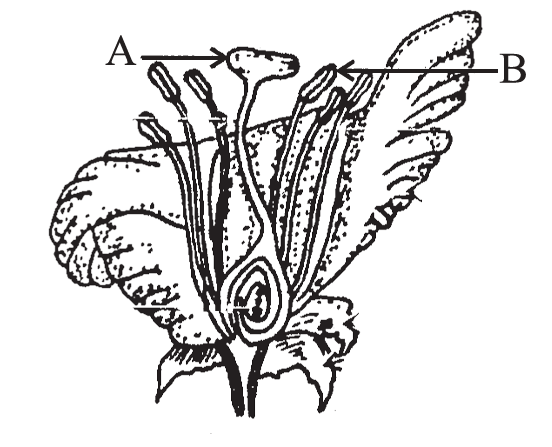
OR
(B) In human female reproductive system state the changes that take place once fertilisation has taken
place. Write the role of placenta in this process. What happens when the egg is not fertilised ?
(A):
<Labels: A = Stigma, B = Anther (or Pollen Grain if pointing to grain). Moves from Anther to Stigma.
 Changes:
1. Pollination: Pollen lands on Stigma.
2. Germination: Pollen tube grows through style.
3. Fertilization: Male gamete fuses with egg in ovule.
4. Post-Fertilization: Zygote \(\rightarrow\) Embryo. Ovule \(\rightarrow\) Seed. Ovary \(\rightarrow\) Fruit. Petals fall off.
(B):
Role of Placenta: Disc-like tissue for exchange of nutrients (glucose, oxygen) and waste between mother and embryo.
If Not Fertilized: Uterine lining (endometrium) breaks down and is released as blood and mucus (Menstruation).
<Labels: A = Stigma, B = Anther (or Pollen Grain if pointing to grain). Moves from Anther to Stigma.
Changes:1. Pollination: Pollen lands on Stigma.
2. Germination: Pollen tube grows through style.
3. Fertilization: Male gamete fuses with egg in ovule.
4. Post-Fertilization: Zygote \(\rightarrow\) Embryo. Ovule \(\rightarrow\) Seed. Ovary \(\rightarrow\) Fruit. Petals fall off.
(B):
Role of Placenta: Disc-like tissue for exchange of nutrients (glucose, oxygen) and waste between mother and embryo.
If Not Fertilized: Uterine lining (endometrium) breaks down and is released as blood and mucus (Menstruation).
1 Mark
Q10. The modes of reproduction in
Spirogyra and Planaria respectively are
Modes:
Spirogyra: Fragmentation.
Planaria: Regeneration.
Order: Fragmentation, Regeneration.
Correct Option: (C)
Spirogyra: Fragmentation.
Planaria: Regeneration.
Order: Fragmentation, Regeneration.
Correct Option: (C)
1 Mark
Q19. Assertion (A): The embryo
gets nutrition from the mother's blood with the help of a special tissue called placenta.
Reason (R): Placenta is a disc which is embedded in the uterine wall.
Reason (R): Placenta is a disc which is embedded in the uterine wall.
Analysis:
Assertion (A): True.
Reason (R): True (Structure description).
Does R explain A? The *structural location* (embedded in uterine wall) facilitates the function (nutrition from blood), but traditionally R explains 'Why'. Why does it get nutrition? Because it provides surface area...
However, without the structural connection described in R, the function in A wouldn't happen.
CBSE logic often treats structural feature as explanation for function if linked.
However, 'It is a disc' doesn't explain 'Why it gets nutrition'. It gets nutrition because it contains *villi* on embryo side.
Most likely answer is (B). (Both true but not explanation).
Let's check standard keys. Often (B). Correct Option: (B)
Assertion (A): True.
Reason (R): True (Structure description).
Does R explain A? The *structural location* (embedded in uterine wall) facilitates the function (nutrition from blood), but traditionally R explains 'Why'. Why does it get nutrition? Because it provides surface area...
However, without the structural connection described in R, the function in A wouldn't happen.
CBSE logic often treats structural feature as explanation for function if linked.
However, 'It is a disc' doesn't explain 'Why it gets nutrition'. It gets nutrition because it contains *villi* on embryo side.
Most likely answer is (B). (Both true but not explanation).
Let's check standard keys. Often (B). Correct Option: (B)
2 Marks
Q23. Give reasons :
(a) The male reproductive organ responsible for formation of germ cells is located outside the abdominal cavity.
(b) The roles of the glands, present along the path of the vas-deferens, are very significant.
(a) The male reproductive organ responsible for formation of germ cells is located outside the abdominal cavity.
(b) The roles of the glands, present along the path of the vas-deferens, are very significant.
(a) Testes are located in the scrotum outside the abdominal cavity to maintain a temperature
2-3�C lower than body temperature, which is necessary for effective sperm production
(spermatogenesis).
(b) Glands (Seminal vesicles, Prostate) secrete fluids that:
1. Provide nutrition to sperms.
2. Provide a fluid medium for easier transport.
3. Activate the sperms.
(b) Glands (Seminal vesicles, Prostate) secrete fluids that:
1. Provide nutrition to sperms.
2. Provide a fluid medium for easier transport.
3. Activate the sperms.
3 Marks
Q30. Differentiate between self-pollination and
cross pollination. Which one of the two is better for the survival of species ? Give reason to justify
your answer.
Differences:
- Self-pollination: Transfer of pollen from anther to stigma of same flower or same plant. No variations.
- Cross-pollination: Transfer to stigma of another flower on different plant. Introduces variations.
Better for Survival: Cross-pollination is better.
Reason: It introduces genetic variations, which enables the species to adapt to changing environmental conditions (Survival of the Fittest). It also prevents inbreeding depression.
- Self-pollination: Transfer of pollen from anther to stigma of same flower or same plant. No variations.
- Cross-pollination: Transfer to stigma of another flower on different plant. Introduces variations.
Better for Survival: Cross-pollination is better.
Reason: It introduces genetic variations, which enables the species to adapt to changing environmental conditions (Survival of the Fittest). It also prevents inbreeding depression.
5 Marks
Q35. (a) Name the method by which Amoeba and
Leishmania reproduce. Write a major difference in the way they divide to produce new individuals.
(b) What is asexual reproduction ? Explain the process of budding in Hydra.
(c) Give two methods used to grow rose and jasmine plants by vegetative propagation.
OR
(a) Write one function each of the parts - (i) petals (ii) anther (iii) style and (iv) ovary of a bisexual flower.
(b) Give one example each of a unisexual flower and a bisexual flower. Mention the changes which a flower undergoes after fertilization.
(b) What is asexual reproduction ? Explain the process of budding in Hydra.
(c) Give two methods used to grow rose and jasmine plants by vegetative propagation.
OR
(a) Write one function each of the parts - (i) petals (ii) anther (iii) style and (iv) ovary of a bisexual flower.
(b) Give one example each of a unisexual flower and a bisexual flower. Mention the changes which a flower undergoes after fertilization.
(a) Binary Fission.
Difference: Amoeba divides in any plane. Leishmania divides in a definite orientation (longitudinal) to its whip-like structure.
(b) Asexual Reproduction: Reproduction involving single parent without gamete fusion.
Budding (Hydra): A small outgrowth (bud) develops due to repeated cell division. It grows, develops mouth/tentacles, and finally detaches to live independently.
(c) Layering, Cutting, Grafting.
(a) Functions: (i) Petals: Attract insects/protections. (ii) Anther: Produces pollen grains. (iii) Style: Path for pollen tube. (iv) Ovary: Contains ovules, becomes fruit.
(b) Examples: Unisexual: Papaya/Watermelon. Bisexual: Hibiscus/Mustard.
Changes: Zygote divides to form Embryo. Ovule becomes Seed. Ovary ripens to form Fruit. Petals/sepals fall off.
Difference: Amoeba divides in any plane. Leishmania divides in a definite orientation (longitudinal) to its whip-like structure.
(b) Asexual Reproduction: Reproduction involving single parent without gamete fusion.
Budding (Hydra): A small outgrowth (bud) develops due to repeated cell division. It grows, develops mouth/tentacles, and finally detaches to live independently.
(c) Layering, Cutting, Grafting.
(a) Functions: (i) Petals: Attract insects/protections. (ii) Anther: Produces pollen grains. (iii) Style: Path for pollen tube. (iv) Ovary: Contains ovules, becomes fruit.
(b) Examples: Unisexual: Papaya/Watermelon. Bisexual: Hibiscus/Mustard.
Changes: Zygote divides to form Embryo. Ovule becomes Seed. Ovary ripens to form Fruit. Petals/sepals fall off.
Board Exam 2024
Content coming soon for 2024...
Board Exam 2023
Content coming soon for 2023...
Board Exam 2022
Content coming soon for 2022...