 ← Back to Practice Arena
Vardaan Learning Institute
vardaanlearning.com | 9508841336
Detailed Solutions: Control and Coordination
Topic 1: Animals � Nervous System and Reflex Action
1.
Ans: A stimulus is any change in the environment (internal or external) of an organism that triggers a physiological or behavioral response.
Examples: (1) Sudden bright light causing pupil constriction, (2) Touching a hot vessel causing rapid hand withdrawal, (3) The scent of tasty food leading to salivation.
Importance: Responding to stimuli allows animals to protect themselves from physical harm (e.g., escaping predators, avoiding heat) and locate essential resources (e.g., food, water, mates), which is critical for survival.
Examples: (1) Sudden bright light causing pupil constriction, (2) Touching a hot vessel causing rapid hand withdrawal, (3) The scent of tasty food leading to salivation.
Importance: Responding to stimuli allows animals to protect themselves from physical harm (e.g., escaping predators, avoiding heat) and locate essential resources (e.g., food, water, mates), which is critical for survival.
2.
Ans: A neuron is the structural and functional unit of the nervous system.
Structure & Function of Parts: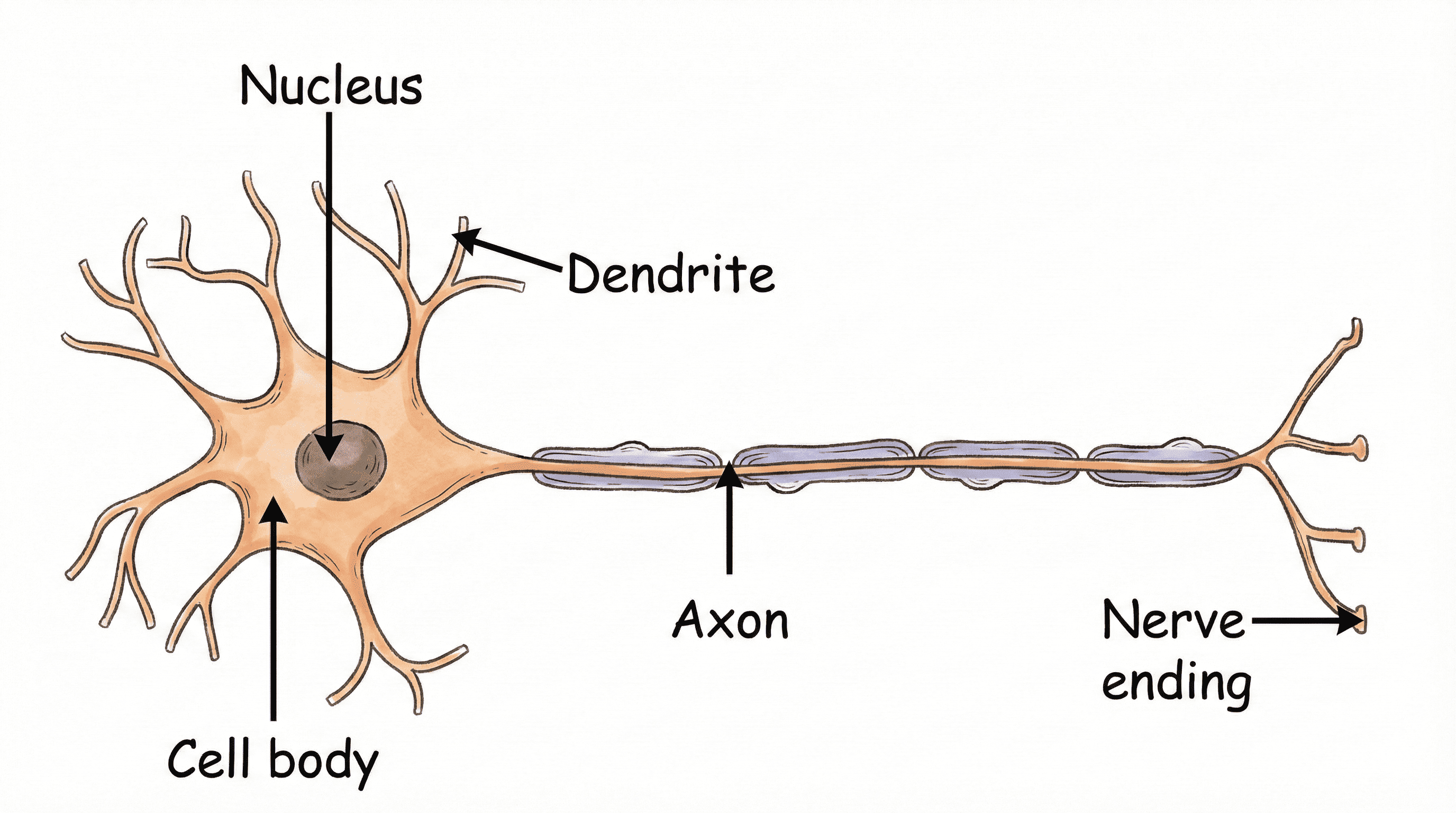
Structure & Function of Parts:
- Dendrites: Hair-like projections that receive chemical signals from adjacent cells and convert them into electrical impulses.
- Cell Body (Cyton): Contains the nucleus and cytoplasm; processes the received signals.
- Axon: A long cylindrical fiber that transmits the electrical impulse away from the cell body towards the nerve ending.
- Nerve Ending: Branched terminal where the electrical signal is converted back into chemical signals (neurotransmitters) for synaptic transfer.
3.
Ans: A synapse is the microscopic gap between the axon terminal of one neuron and the dendrite of the next.
Mechanism of Transmission: When an electrical impulse reaches the nerve endings of the pre-synaptic neuron, it stimulates tiny sacs called synaptic vesicles to release chemicals called neurotransmitters (e.g., acetylcholine) into the synaptic cleft. These chemicals diffuse across the gap and bind to specific receptors on the dendrite of the post-synaptic neuron, initiating a fresh electrical impulse. This conversion ensures controlled, directed communication.
Mechanism of Transmission: When an electrical impulse reaches the nerve endings of the pre-synaptic neuron, it stimulates tiny sacs called synaptic vesicles to release chemicals called neurotransmitters (e.g., acetylcholine) into the synaptic cleft. These chemicals diffuse across the gap and bind to specific receptors on the dendrite of the post-synaptic neuron, initiating a fresh electrical impulse. This conversion ensures controlled, directed communication.
4.
Ans: The differences are:
- Sensory Neurons: Carry electrical impulses from receptors (sense organs) to the central nervous system (brain and spinal cord).
- Motor Neurons: Carry electrical impulses from the central nervous system to effectors (muscles or glands) to produce a response.
- Relay (Association) Neurons: Located entirely within the central nervous system (CNS). They connect sensory and motor neurons, processing and integrating signals.
5.
Ans: Receptors are specialized groups of cells/proteins located in sense organs that detect changes in the environment.
The Five Key Receptors:
The Five Key Receptors:
- Photoreceptors: Located in the eyes; detect light (vision).
- Phonoreceptors (Auditory): Located in the inner ears; detect sound waves and maintain balance (hearing).
- Olfactory Receptors: Located in the nasal passage; detect chemical smells (smell).
- Gustatory Receptors: Located on the tongue (taste buds); detect chemical tastants (taste).
- Thigmoreceptors (Tactile): Located in the skin; detect pressure, touch, heat, cold, and pain.
6.
Ans: A reflex action is an extremely rapid, automatic, and involuntary response of the body to an external stimulus without any conscious thinking by the brain.
Why involuntary & spontaneous: It bypasses conscious brain processing to ensure instantaneous action to prevent tissue damage.
Examples: (1) The knee-jerk reflex when the patellar tendon is tapped, (2) Withdrawing your hand immediately when pricked by a sharp thorn.
Why involuntary & spontaneous: It bypasses conscious brain processing to ensure instantaneous action to prevent tissue damage.
Examples: (1) The knee-jerk reflex when the patellar tendon is tapped, (2) Withdrawing your hand immediately when pricked by a sharp thorn.
7.
Ans: A reflex arc is the neurological pathway that controls a reflex action.
Path of Nerve Impulse during Reflex Action:
Stimulus → Receptor (e.g., skin detects heat) → Sensory Neuron (carries impulse to spinal cord) → Relay Neuron (in spinal cord, processes signal) → Motor Neuron (carries instruction out) → Effector (muscle contracts) → Response (hand pulls away).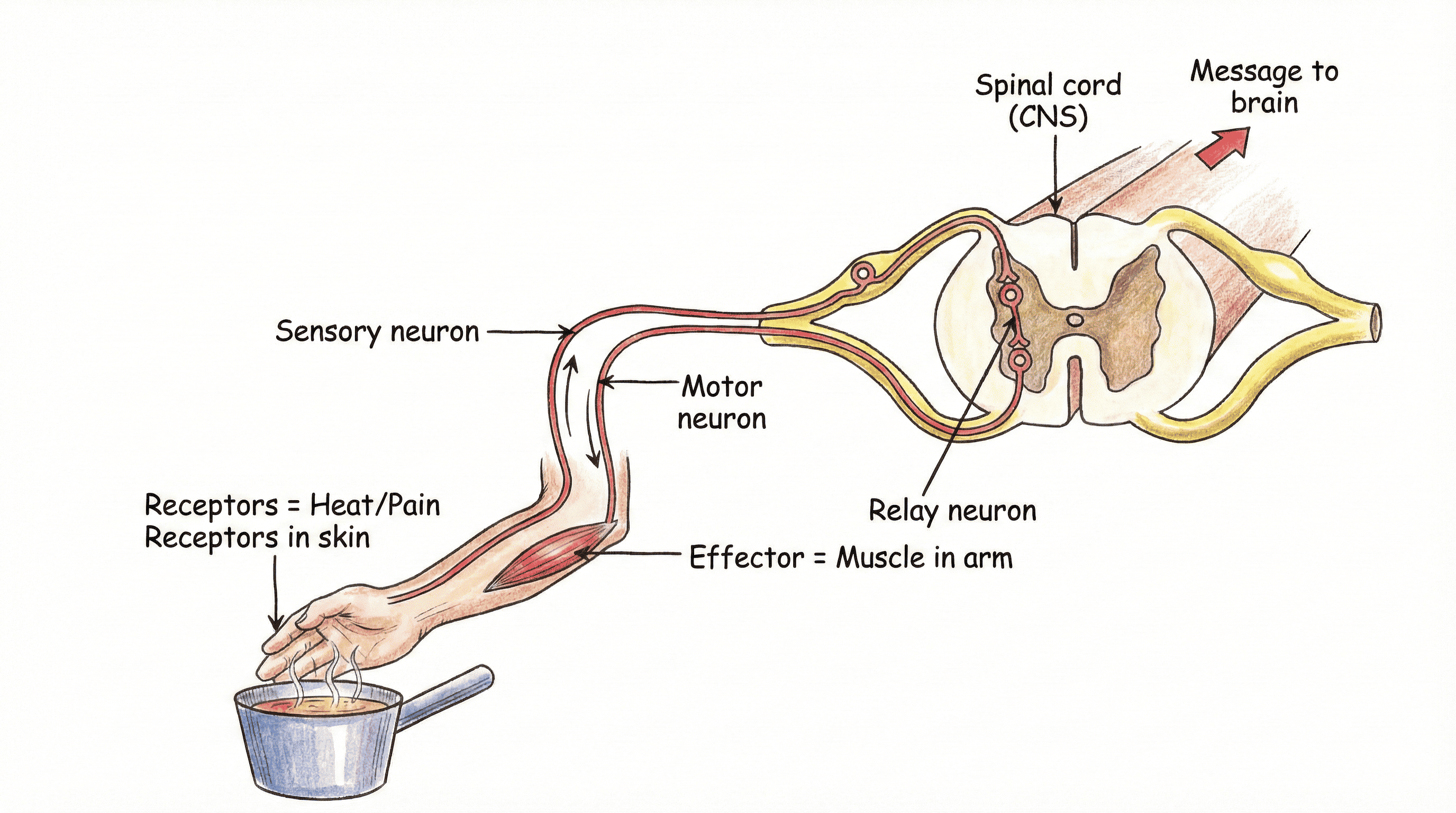
Path of Nerve Impulse during Reflex Action:
Stimulus → Receptor (e.g., skin detects heat) → Sensory Neuron (carries impulse to spinal cord) → Relay Neuron (in spinal cord, processes signal) → Motor Neuron (carries instruction out) → Effector (muscle contracts) → Response (hand pulls away).
8.
Ans: Reflex arcs have evolved because the thinking process of the brain is relatively slow. Conscious thinking involves a network of millions of interconnected neurons that analyze signals, compare them with past memories, and make decisions, which takes valuable seconds. If an animal faced danger (like fire) and waited for the brain to process, its tissues would be destroyed. The reflex arc provides an immediate, survival-critical shortcut.
9.
Ans: The neuromuscular junction (NMJ) is the specialized synapse between a motor neuron terminal and a muscle cell membrane.
Translation into Movement: When an electrical impulse reaches the motor neuron terminal, it releases the neurotransmitter acetylcholine. Acetylcholine binds to receptors on the muscle fiber membrane, creating a local electrical change. This triggers the release of calcium ions ($Ca^{2+}$) within the muscle cell. The calcium ions bind to muscle proteins (actin and myosin), causing them to slide past each other, shortening (contracting) the muscle cell and pulling the bone to create movement.
Translation into Movement: When an electrical impulse reaches the motor neuron terminal, it releases the neurotransmitter acetylcholine. Acetylcholine binds to receptors on the muscle fiber membrane, creating a local electrical change. This triggers the release of calcium ions ($Ca^{2+}$) within the muscle cell. The calcium ions bind to muscle proteins (actin and myosin), causing them to slide past each other, shortening (contracting) the muscle cell and pulling the bone to create movement.
10.
Ans: Nervous tissue causes muscle action through cellular shape changes. Muscle cells contain specialized proteins (actin and myosin) that can actively change their arrangement and shape when stimulated.
When the electrical signal arrives at the neuromuscular junction, it alters the cell's membrane chemistry, causing calcium release. This prompts the proteins to reorganize into a more compact form, shortening the muscle cell. Once the signal stops, the proteins return to their relaxed shape, causing the muscle to elongate.
When the electrical signal arrives at the neuromuscular junction, it alters the cell's membrane chemistry, causing calcium release. This prompts the proteins to reorganize into a more compact form, shortening the muscle cell. Once the signal stops, the proteins return to their relaxed shape, causing the muscle to elongate.
11.
Ans: The three major parts of the human brain are:
- Forebrain (Cerebrum): The main thinking and learning center. It controls voluntary actions, memory, intelligence, emotions, and interprets sensory inputs (vision, hearing, smell).
- Midbrain: Connects the forebrain to the hindbrain. It coordinates auditory and visual reflexes (like turning your head towards a sudden sound).
- Hindbrain: Divided into:
- Cerebellum: Coordinates voluntary muscle movement, precision, and body posture/balance.
- Medulla Oblongata: Controls life-sustaining involuntary activities like respiration, heart rate, blood pressure, and reflexes like swallowing, coughing, and vomiting.
- Pons: Relays signals between different parts of the brain and regulates the breathing cycle.
12.
Ans: The cerebellum (located at the back of the hindbrain) is responsible for coordinating motor control.
It receives sensory signals from the inner ear (balance) and muscles/joints about body position. It then calculates the exact voluntary muscle contractions needed to maintain balance, steady posture, and execute precise physical tasks like walking in a straight line, riding a bicycle, or picking up a needle. Without the cerebellum, motor movement would be jerky and unbalanced.
It receives sensory signals from the inner ear (balance) and muscles/joints about body position. It then calculates the exact voluntary muscle contractions needed to maintain balance, steady posture, and execute precise physical tasks like walking in a straight line, riding a bicycle, or picking up a needle. Without the cerebellum, motor movement would be jerky and unbalanced.
13.
Ans: The medulla oblongata (located in the hindbrain, connecting directly to the spinal cord) regulates crucial involuntary activities.
It is structured as a collection of specialized autonomic nerve nuclei (centres) that directly monitor carbon dioxide levels, blood pressure, and digestion, sending automatic autonomic signals to the heart, lungs, and stomach without conscious control.
It is structured as a collection of specialized autonomic nerve nuclei (centres) that directly monitor carbon dioxide levels, blood pressure, and digestion, sending automatic autonomic signals to the heart, lungs, and stomach without conscious control.
14.
Ans: The central nervous system is protected through three layers:
- Bony Protection: The brain is enclosed inside a strong bony box called the cranium (skull). The spinal cord is enclosed and supported by the bony vertebral column (backbone).
- Fluid Cushion: The brain is surrounded by a fluid-filled balloon. The fluid is cerebrospinal fluid (CSF), which acts as a highly efficient shock absorber, dispersing impact energy.
- Meninges: Three protective connective tissue membranes (dura mater, arachnoid mater, pia mater) cover the neural tissue.
15.
Ans: The differences are:
- Voluntary Action: Actions performed under conscious, deliberate control of the cerebrum. E.g., writing a letter, speaking.
- Involuntary Action: Actions that occur automatically, continuously, and without conscious control, managed by the hindbrain/midbrain. E.g., beating of the heart, peristalsis in the gut.
- Reflex Action: Rapid, automatic, and emergency muscular responses to a specific stimulus, coordinated mainly by the spinal cord. E.g., blinking when a speck of dust flies towards your eye.
Topic 2: Coordination in Plants and Movement
16.
Ans: Although plants lack specialized nervous and muscular systems, they coordinate their responses using chemical messengers called plant hormones (phytohormones).
Plants sense stimuli like light, water, gravity, or touch using cellular receptors. They then synthesize hormones that diffuse to specific target tissues. These hormones trigger responses by altering the rate of cell division, cell elongation, or by changing the water content (turgidity) of cells to cause movement.
Plants sense stimuli like light, water, gravity, or touch using cellular receptors. They then synthesize hormones that diffuse to specific target tissues. These hormones trigger responses by altering the rate of cell division, cell elongation, or by changing the water content (turgidity) of cells to cause movement.
17.
Ans: The differences are:
- Nastic Movements: Non-directional movements where the direction of the plant response is independent of the direction of the stimulus. These are generally fast and caused by changes in turgor pressure. E.g., closing of leaves of Mimosa pudica upon touch.
- Tropic Movements: Directional growth movements where the direction of plant growth is determined by the direction of the stimulus (positive if towards, negative if away). E.g., stems growing towards light (phototropism).
18.
Ans: When touched, the leaves of the "touch-me-not" plant (Mimosa pudica) fold up rapidly.
Mechanism: The touch stimulus triggers an electrical-chemical signal (action potential) that travels rapidly through the leaf cells to the pulvinus (swollen leaf base). This signal stimulates cells on one side of the pulvinus to actively pump out potassium ($K^+$) ions. Water immediately follows the ions out via osmosis, causing these cells to lose turgor pressure and collapse. This rapid loss of turgor causes the petiole to droop and the leaflets to fold shut.
Mechanism: The touch stimulus triggers an electrical-chemical signal (action potential) that travels rapidly through the leaf cells to the pulvinus (swollen leaf base). This signal stimulates cells on one side of the pulvinus to actively pump out potassium ($K^+$) ions. Water immediately follows the ions out via osmosis, causing these cells to lose turgor pressure and collapse. This rapid loss of turgor causes the petiole to droop and the leaflets to fold shut.
19.
Ans: Phototropism is the directional growth of a plant part in response to light.
Experiment: Place a growing potted plant next to a window inside a dark room. After a few days, the shoot tip bends and grows towards the window (positive phototropism).
If you examine the roots, they grow deep into the soil away from the window light source (negative phototropism). This shows that shoots grow towards light to maximize photosynthesis, while roots grow away from light to anchor in the soil.
Experiment: Place a growing potted plant next to a window inside a dark room. After a few days, the shoot tip bends and grows towards the window (positive phototropism).
If you examine the roots, they grow deep into the soil away from the window light source (negative phototropism). This shows that shoots grow towards light to maximize photosynthesis, while roots grow away from light to anchor in the soil.
20.
Ans: Geotropism is the growth movement of plant parts in response to gravity.
Experiment: Place a potted seedling horizontally on a table inside a dark, humid room.
Observation: After 48 hours, the stem curves and grows upward against the pull of gravity (negative geotropism). The root system curves downward in the direction of gravity (positive geotropism). This confirms that gravity acts as a stimulus directing growth.
Experiment: Place a potted seedling horizontally on a table inside a dark, humid room.
Observation: After 48 hours, the stem curves and grows upward against the pull of gravity (negative geotropism). The root system curves downward in the direction of gravity (positive geotropism). This confirms that gravity acts as a stimulus directing growth.
21.
Ans: Chemotropism is the growth of plant parts in response to a chemical stimulus.
Example: The growth of the pollen tube down through the style of a flower towards the ovary/ovule. The ovule secretes sugary chemical substances (peptides/sugars) that attract and guide the growing pollen tube towards it to facilitate double fertilization.
Example: The growth of the pollen tube down through the style of a flower towards the ovary/ovule. The ovule secretes sugary chemical substances (peptides/sugars) that attract and guide the growing pollen tube towards it to facilitate double fertilization.
22.
Ans: Hydrotropism is the growth of plant roots towards a water source.
Experiment:
Experiment:
- Fill a wooden box with dry sawdust and place germinating pea seeds in it.
- Place a porous clay pot filled with water in the center of the box.
- Keep the setup undisturbed for 3-4 days.
- Observation: When examined, the roots of the germinating seeds do not grow straight down. Instead, they curve and grow horizontally towards the porous clay pot containing water, demonstrating positive hydrotropism.
23.
Ans: When a climbing tendril comes into contact with a support (like a fence/stick), the contact stimulus causes the hormone auxin to diffuse away from the side in contact towards the opposite (free) side of the tendril.
Because auxin promotes cell elongation in shoots, the cells on the free outer side grow and elongate much faster than the cells on the side in contact with the support. This unequal growth rate causes the tendril to curve, wrap tightly around the support, and climb upwards.
Because auxin promotes cell elongation in shoots, the cells on the free outer side grow and elongate much faster than the cells on the side in contact with the support. This unequal growth rate causes the tendril to curve, wrap tightly around the support, and climb upwards.
24.
Ans: Plant movements in response to stimuli are slower because they rely on growth changes (cell division and cell elongation) and the slow diffusion of chemical hormones, rather than specialized conduction and muscular systems.
In contrast, animal movements rely on ultra-fast electrical signals along myelinated nerve fibers and active protein-sliding contractions in specialized muscle tissue, enabling sub-second responses.
In contrast, animal movements rely on ultra-fast electrical signals along myelinated nerve fibers and active protein-sliding contractions in specialized muscle tissue, enabling sub-second responses.
25.
Ans: In the absence of synapses and nerve fibers, plant cells communicate information using action-potential-like electrical-chemical waves that propagate through the plasmodesmata (microscopic channels crossing cell walls) and vascular tissue (phloem). This is accompanied by the active transport and diffusion of plant hormones through cells.
Topic 3: Plant Hormones (Phytohormones)
26.
Ans: Phytohormones are naturally occurring, organic chemical substances produced in minute concentrations in one part of the plant body and translocated to other parts to coordinate physiological activities like growth, development, and environmental responses.
Chemical Nature: Simple organic molecules such as indole derivatives (auxins), terpenes (gibberellins), purine derivatives (cytokinins), or carotenoid derivatives (abscisic acid).
Transport: Diffuse locally or are actively transported via xylem and phloem vessels.
Chemical Nature: Simple organic molecules such as indole derivatives (auxins), terpenes (gibberellins), purine derivatives (cytokinins), or carotenoid derivatives (abscisic acid).
Transport: Diffuse locally or are actively transported via xylem and phloem vessels.
27.
Ans: The hormone synthesized at the shoot tips is auxin (Indole-3-acetic acid or IAA).
Mechanism of phototropic bending: When sunlight falls on one side of a plant shoot, auxin molecules diffuse from the lit side to the shaded side of the shoot tip. The high concentration of auxin on the shaded side stimulates the cells there to grow longer (cell elongation) compared to the lit side. This differential growth causes the shoot to bend towards the light source.
Mechanism of phototropic bending: When sunlight falls on one side of a plant shoot, auxin molecules diffuse from the lit side to the shaded side of the shoot tip. The high concentration of auxin on the shaded side stimulates the cells there to grow longer (cell elongation) compared to the lit side. This differential growth causes the shoot to bend towards the light source.
28.
Ans: Gibberellins promote stem elongation and increase internodal length.
They act by stimulating both cell division and cell elongation in the stem cortex, helping dwarf plants grow to normal heights. They also assist in breaking seed dormancy, initiating germination, and increasing fruit size (e.g., in grapes).
They act by stimulating both cell division and cell elongation in the stem cortex, helping dwarf plants grow to normal heights. They also assist in breaking seed dormancy, initiating germination, and increasing fruit size (e.g., in grapes).
29.
Ans: Cytokinins promote active cell division (cytokinesis).
They are synthesized in regions where cell division is extremely rapid, such as actively growing root tips, developing embryos, germinating seeds, and young fruits. They help in opening stomata, delaying leaf senescence (aging), and promoting lateral bud growth.
They are synthesized in regions where cell division is extremely rapid, such as actively growing root tips, developing embryos, germinating seeds, and young fruits. They help in opening stomata, delaying leaf senescence (aging), and promoting lateral bud growth.
30.
Ans: The plant hormone that acts as a growth inhibitor is abscisic acid (ABA).
Physiological Effects:
Physiological Effects:
- Promotes the wilting and shedding (abscission) of leaves and fruits by breaking down chlorophyll.
- Induces seed and bud dormancy to help plants survive harsh winter or drought conditions.
- Triggers rapid stomatal closure during water stress (drought) to conserve water.
31.
Ans: The matched list is:
- Auxin: Promotes cell elongation, shoot tip growth, and phototropic bending.
- Gibberellin: Promotes stem internodal elongation and breaks seed dormancy.
- Cytokinin: Promotes active cell division and delays leaf aging.
- Abscisic Acid: Inhibits growth, closes stomata, and causes leaf wilting.
32.
Ans: Ethylene is unique because it is the only plant hormone that exists in a gaseous state ($C_2H_4$).
Role: It promotes the commercial ripening of fruits by converting starch into sugars and softening cell walls. It also regulates leaf and flower senescence and abscission.
Role: It promotes the commercial ripening of fruits by converting starch into sugars and softening cell walls. It also regulates leaf and flower senescence and abscission.
33.
Ans: Plant growth regulators show cooperative (synergistic) or opposite (antagonistic) actions:
Example (Seed Germination): - Gibberellins promote seed germination by activating amylase enzymes to digest stored starch, breaking seed dormancy. - Abscisic acid (ABA) actively prevents germination, keeping the seed dormant during dry seasons. The balance of these two opposing hormones determines when a seed germinates.
Example (Seed Germination): - Gibberellins promote seed germination by activating amylase enzymes to digest stored starch, breaking seed dormancy. - Abscisic acid (ABA) actively prevents germination, keeping the seed dormant during dry seasons. The balance of these two opposing hormones determines when a seed germinates.
Topic 4: Hormones in Animals � Endocrine System
34.
Ans: The endocrine system consists of ductless glands that secrete hormones directly into the bloodstream to coordinate body functions.
Differences:
Differences:
- Speed: Nervous coordination is ultra-fast (milliseconds); endocrine coordination is slower (seconds to hours).
- Coverage: Nervous signals target specific muscles/glands; endocrine hormones travel through blood, reaching all body cells with matching receptors.
- Duration: Nervous responses are short-lived; endocrine effects last much longer.
35.
Ans: Hormones are organic chemical messengers secreted in tiny quantities by endocrine glands directly into the blood to regulate metabolic activities at target sites.
Characteristics:
Characteristics:
- They do not initiate reactions; they only modify their rates.
- They have low molecular weights and are easily transported.
- They are highly specific to target cell receptors.
36.
Ans: The pituitary gland (located at the base of the brain) is the "master gland" because its secretions control the activity of other endocrine glands.
Hormones & Functions:
Hormones & Functions:
- Growth Hormone (GH): Regulates growth and development of bones and muscles.
- Thyroid Stimulating Hormone (TSH): Stimulates the thyroid gland to produce thyroxine.
- Adrenocorticotropic Hormone (ACTH): Stimulates the adrenal cortex to produce cortisol.
37.
Ans: Thyroxine is secreted by the thyroid gland located in the neck.
Function: It regulates carbohydrate, protein, and fat metabolism, optimizing tissue growth and development.
Role of Iodine: Iodine is a core structural component of the thyroxine molecule.
Deficiency Disease: A lack of dietary iodine prevents thyroxine synthesis, causing the thyroid gland to enlarge, resulting in goitre (swollen neck).
Function: It regulates carbohydrate, protein, and fat metabolism, optimizing tissue growth and development.
Role of Iodine: Iodine is a core structural component of the thyroxine molecule.
Deficiency Disease: A lack of dietary iodine prevents thyroxine synthesis, causing the thyroid gland to enlarge, resulting in goitre (swollen neck).
38.
Ans: Adrenaline is secreted by the adrenal glands (located on top of each kidney) during stress or danger.
Physiological Changes (Fight-or-Flight):
Physiological Changes (Fight-or-Flight):
- Increased Heartbeat: Pumps more oxygen-rich blood to the muscles.
- Rapid Breathing Rate: Increases oxygen intake in the lungs.
- Vasoconstriction: Diversion of blood away from the skin and digestive system towards skeletal muscles.
- Glycogenolysis: Stimulates the liver to convert glycogen to glucose for immediate energy.
39.
Ans: Insulin regulates blood sugar levels.
Gland: Secreted by the beta cells of the Islets of Langerhans in the pancreas.
Function: It promotes the uptake and storage of glucose as glycogen in liver and muscle cells.
Deficiency Condition: Deficiency of insulin causes diabetes mellitus, characterized by high blood sugar levels (hyperglycemia) and glucose in urine.
Gland: Secreted by the beta cells of the Islets of Langerhans in the pancreas.
Function: It promotes the uptake and storage of glucose as glycogen in liver and muscle cells.
Deficiency Condition: Deficiency of insulin causes diabetes mellitus, characterized by high blood sugar levels (hyperglycemia) and glucose in urine.
40.
Ans: The feedback mechanism ensures that hormones are secreted in precise quantities. If hormone levels deviate from the set point, specific receptors detect this and shut down or activate secretion.
Blood Glucose Regulation: - When blood glucose levels rise (e.g., after eating), the beta cells of the pancreas detect this and secrete more insulin. Insulin lowers blood sugar. - Once blood glucose levels fall back to normal, insulin secretion is automatically reduced. This homeostatic loop prevents blood sugar from dropping too low.
Blood Glucose Regulation: - When blood glucose levels rise (e.g., after eating), the beta cells of the pancreas detect this and secrete more insulin. Insulin lowers blood sugar. - Once blood glucose levels fall back to normal, insulin secretion is automatically reduced. This homeostatic loop prevents blood sugar from dropping too low.
Topic 5: Competency-Based Case Studies & Integrated Questions
Case Study 1: The Reflex Action Experiment
41.
Ans:
- Receptor: Thermoreceptors in the skin of the hand. Effector: Biceps muscle of the arm. Coordinator: The Spinal Cord.
- Pathway: Heat stimulus → Skin receptors → Sensory Neuron → Spinal Cord (Relay Neuron) → Motor Neuron → Arm muscle (Biceps contracts) → Hand pulled away.
- If the spinal cord is injured, the reflex arc pathway is broken. The electrical signals will not be coordinated, and the automatic hand-withdrawal reflex will be completely lost, leading to severe burns.
Case Study 2: The Phototropic Bending Project
42.
Ans:
- The plant hormone is auxin, synthesized at the apical meristem of the shoot tips.
- When light comes only from the left, auxin moves away from the light to the shaded (right) side of the stem. The higher auxin concentration on the shaded side causes these cells to elongate faster than the cells on the lit side, forcing the stem to bend towards the light on the left.
- Survival advantage: Bending shoots towards light maximizes leaf surface area exposure to sunlight, increasing the rate of photosynthesis and energy production.
Case Study 3: The Iodine Diet Campaign
43.
Ans:
- Iodine is a building block for thyroxine hormone. The thyroid gland in the neck requires it.
- Thyroxine regulates carbohydrate, protein, and fat metabolism. Without iodine, the thyroid gland cannot synthesize thyroxine. In an attempt to produce more hormone, the gland undergoes compensatory hypertrophy, swelling up to form a goitre.
- Pure iodine is toxic in element form. Iodizing daily table salt ($NaCl$ with traces of potassium iodate) is a safe, cost-effective method to ensure consistent daily micro-nutritional intake.
Case Study 4: The Insulin Injection Mystery
44.
Ans:
- Insulin enables body cells to absorb glucose from the blood and converts excess glucose into glycogen in the liver. It is secreted by beta cells of the pancreas.
- Insulin is a protein hormone. If swallowed as a pill, the stomach's proteolytic enzymes (like pepsin) and pancreatic trypsin would digest it into amino acids, rendering it completely inactive. Therefore, it must be injected directly into the subcutaneous tissue.
- In a healthy person, high blood sugar stimulates pancreatic beta cells to release insulin. As insulin lowers blood sugar, secretion decreases. If sugar drops too low, pancreatic alpha cells release glucagon to raise it, forming a homeostatic loop.
Case Study 5: The Geotropic Potted Plant Experiment
45.
Ans:
- Shoots demonstrate negative geotropism (growing away from gravity). Roots demonstrate positive geotropism (growing towards gravity).
- When horizontal, gravity causes auxin to accumulate on the lower side of both roots and shoots.
- In shoots, high auxin concentration stimulates cell elongation, so the lower side grows faster, curving the shoot upward.
- In roots, high auxin concentration inhibits cell elongation. Thus, the upper side (with lower auxin) grows faster, curving the root downward.
- The dark room eliminates light (phototropism) as a confounding variable, ensuring that the bending response is driven entirely by gravity (geotropism).
Competency Check: The Fight-or-Flight Encounter
46.
Ans:
- The emergency hormone is adrenaline, secreted by the adrenal glands (specifically the adrenal medulla).
- Rationale:
- (a) Rapid Heartbeat: Delivers more oxygen-rich blood to skeletal muscles.
- (b) Quick Breathing: Increases oxygen levels in the blood.
- (c) Pale Skin: Diverts blood flow away from the skin and digestive system to the brain and muscles.
- This coordination increases blood flow, glucose availability, and oxygen delivery to the skeletal muscles, preparing the body for intense physical action (fighting or escaping).
Integrated Puzzle: The Mystery Glands 'A' and 'B'
47.
Ans:
- Gland 'A' is the Adrenal Gland (secretes hormone 'X' = Adrenaline). Gland 'B' is the Thyroid Gland (secretes hormone 'Y' = Thyroxine). Gland 'C' is the Pituitary Gland.
- The pituitary gland 'C' secretes Thyroid Stimulating Hormone (TSH). TSH travels through the bloodstream and binds to receptors on the thyroid gland, regulating thyroxine production. If thyroxine levels drop, TSH secretion increases to restore the balance.
- Under-secretion of Growth Hormone by the pituitary gland during childhood results in severely stunted skeletal growth, a condition called pituitary dwarfism.
48.
Ans: A synapse schematic shows the axon terminal containing synaptic vesicles filled with neurotransmitter molecules, a narrow synaptic cleft ($20\text{ nm}$ wide), and the post-synaptic dendrite membrane with protein receptors.
Role of Calcium Ions: When the action potential reaches the axon terminal, it opens voltage-gated calcium channels. Calcium ions ($Ca^{2+}$) rush into the cell, triggering synaptic vesicles to fuse with the pre-synaptic membrane and release neurotransmitters into the cleft via exocytosis.
Role of Calcium Ions: When the action potential reaches the axon terminal, it opens voltage-gated calcium channels. Calcium ions ($Ca^{2+}$) rush into the cell, triggering synaptic vesicles to fuse with the pre-synaptic membrane and release neurotransmitters into the cleft via exocytosis.
49.
Ans: A nerve is a bundle of axons (nerve fibers) in the Peripheral Nervous System (PNS), held together by protective connective tissue sheets (epineurium). A tract is a bundle of axons located entirely within the Central Nervous System (CNS) (brain or spinal cord).
A peripheral nerve consists of myelinated axons, sensory fibers, motor fibers, blood vessels, and myelin-sheath-producing Schwann cells.
A peripheral nerve consists of myelinated axons, sensory fibers, motor fibers, blood vessels, and myelin-sheath-producing Schwann cells.
50.
Ans: The pupillary light reflex prevents damage to the retina from intense light:
Bright light stimulus → Retinal photoreceptors → Optic Nerve (sensory) → Midbrain (Pretectal area coordinates) → Oculomotor Nerve (motor, parasympathetic fibers) → Ciliary muscle/Circular muscles of iris contract → Pupil constricts.
Bright light stimulus → Retinal photoreceptors → Optic Nerve (sensory) → Midbrain (Pretectal area coordinates) → Oculomotor Nerve (motor, parasympathetic fibers) → Ciliary muscle/Circular muscles of iris contract → Pupil constricts.
51.
Ans: The spinal cord is the primary center because it contains a butterfly-shaped inner grey matter core rich in synapses, relay neurons, and motor neuron cell bodies. This structure allows it to process and route sensory inputs to motor outputs locally, bypassing the brain. The outer white matter contains myelinated tracts that carry signals to and from the brain.
52.
Ans:
- An electrical signal is highly localized, travels rapidly along cell membranes, but cannot pass easily between un-connected cells.
- A chemical signal (hormone) is slower, but can travel through the blood to reach any cell with the right receptors.
Limitations of Electrical Signals: (1) They cannot reach every single cell in the body since not all tissues are directly wired with nerve endings. (2) Once an electrical impulse is generated and transmitted, the nerve cell requires a recovery period to reset its ionic balance before generating a second impulse, preventing continuous stimulation.
Limitations of Electrical Signals: (1) They cannot reach every single cell in the body since not all tissues are directly wired with nerve endings. (2) Once an electrical impulse is generated and transmitted, the nerve cell requires a recovery period to reset its ionic balance before generating a second impulse, preventing continuous stimulation.
53.
Ans: Under water stress (drought), leaves synthesize abscisic acid (ABA). ABA binds to receptors on the guard cell membrane, activating ion channels that pump potassium ($K^+$) and chloride ($Cl^-$) ions out of the guard cells.
This loss of ions reduces the osmotic concentration inside the guard cells, causing water to flow out via osmosis. The guard cells lose turgidity, become flaccid, and collapse, closing the stomatal pore to conserve water.
This loss of ions reduces the osmotic concentration inside the guard cells, causing water to flow out via osmosis. The guard cells lose turgidity, become flaccid, and collapse, closing the stomatal pore to conserve water.
54.
Ans: Photoperiodism is the physiological response of plants to the relative lengths of light (day) and dark (night) periods. Plants detect day length using a light-sensitive pigment called phytochrome.
This pigment coordinates hormone synthesis (like florigen) that travels to the shoot apical meristem, triggering the transition from vegetative growth to flowering.
This pigment coordinates hormone synthesis (like florigen) that travels to the shoot apical meristem, triggering the transition from vegetative growth to flowering.
55.
Ans: The differences are:
- Exocrine Glands: Possess ducts to transport secretions (e.g., salivary, sweat glands). They secrete enzymes or sweat, which are delivered directly to local target organs.
- Endocrine Glands: Ductless glands (e.g., pituitary, thyroid). They secrete hormones directly into the blood, which transports them to distant target cells.
56.
Ans: The hypothalamus (located at the base of the forebrain) acts as the bridge between the nervous and endocrine systems.
It receives sensory inputs from the brain about stress, light, and temperature, and responds by secreting releasing hormones (like TRH, GnRH) or inhibiting hormones. These hormones travel through a portal blood system to the adjacent pituitary gland, regulating the release of pituitary hormones.
It receives sensory inputs from the brain about stress, light, and temperature, and responds by secreting releasing hormones (like TRH, GnRH) or inhibiting hormones. These hormones travel through a portal blood system to the adjacent pituitary gland, regulating the release of pituitary hormones.
57.
Ans: The parathyroid glands are four small glands located on the posterior surface of the thyroid gland in the neck.
Secretion: They secrete parathormone (PTH), which raises calcium ($Ca^{2+}$) levels in the blood by stimulating bone calcium resorption and kidney reabsorption.
Deficiency: Low parathormone levels cause blood calcium to drop, leading to tetany (painful, involuntary muscle spasms).
Secretion: They secrete parathormone (PTH), which raises calcium ($Ca^{2+}$) levels in the blood by stimulating bone calcium resorption and kidney reabsorption.
Deficiency: Low parathormone levels cause blood calcium to drop, leading to tetany (painful, involuntary muscle spasms).
58.
Ans: The ovaries and testes are dual-function organs:
- Cytogenic function: They produce gametes (ova in ovaries; sperm in testes).
- Endocrine function:
- Testes: Leydig cells secrete testosterone, which regulates male secondary sexual characteristics and sperm development.
- Ovaries: Follicles and corpus luteum secrete estrogen and progesterone, which regulate female secondary sexual characteristics and pregnancy.
59.
Ans:
- Gigantism: Caused by the hypersecretion of Growth Hormone (GH) from the pituitary gland during childhood, leading to excessive lengthening of long bones and tall stature.
- Dwarfism: Caused by the hyposecretion of Growth Hormone during childhood, resulting in stunted skeletal development, though mental development remains unaffected.
60.
Ans: Mountainous soils are highly leached by rainfall and snowmelt, washing away natural iodine minerals. Crops grown in this iodine-deficient soil contain almost no iodine.
As a result, populations living in these regions have low dietary iodine intake, leading to high rates of goitre. This is resolved by distributing iodized table salt.
As a result, populations living in these regions have low dietary iodine intake, leading to high rates of goitre. This is resolved by distributing iodized table salt.
61.
Ans: Progesterone prepares and maintains the uterine lining (endometrium) for the implantation of a fertilized egg, and supports pregnancy by preventing uterine contractions.
It is secreted by the corpus luteum, a temporary endocrine structure formed from the ruptured Graafian follicle in the ovary after ovulation.
It is secreted by the corpus luteum, a temporary endocrine structure formed from the ruptured Graafian follicle in the ovary after ovulation.
62.
Ans: Local tissue hormones (like prostaglandins and histamines) are synthesized by almost all cells and act locally on adjacent cells (paracrine action) or the cell that secreted them (autocrine action).
In contrast, classic hormones are synthesized by specialized endocrine glands and must travel through the bloodstream to act on distant target tissues.
In contrast, classic hormones are synthesized by specialized endocrine glands and must travel through the bloodstream to act on distant target tissues.
63.
Ans: Calcitonin is secreted by the parafollicular cells of the thyroid gland. Its primary function is to lower blood calcium levels by promoting calcium deposition in bones and reducing calcium reabsorption in the kidneys.
It acts antagonistically to parathormone (PTH) to maintain calcium homeostasis ($9\text{--}11\text{ mg/dL}$).
It acts antagonistically to parathormone (PTH) to maintain calcium homeostasis ($9\text{--}11\text{ mg/dL}$).
64.
Ans: In severe diabetes, high blood glucose levels exceed the kidney's reabsorption capacity (renal threshold), causing glucose to be excreted in urine (glycosuria).
Because glucose is osmotically active, it pulls water with it into the urine, resulting in frequent urination (polyuria). The loss of body water dehydrates tissues, triggering thirst centers in the brain to prompt frequent drinking (polydipsia).
Because glucose is osmotically active, it pulls water with it into the urine, resulting in frequent urination (polyuria). The loss of body water dehydrates tissues, triggering thirst centers in the brain to prompt frequent drinking (polydipsia).
65.
Ans:
- Non-steroid hormones: Being large and water-soluble, they cannot cross the lipid cell membrane. They bind to outer membrane receptors, activating a membrane protein (like G-protein) that triggers secondary messengers (like cAMP or $Ca^{2+}$) inside the cell to initiate a response.
- Steroid hormones: Being lipid-soluble, they pass through the cell membrane and bind to receptors in the cytoplasm or nucleus. The hormone-receptor complex interacts with DNA to alter gene expression and protein synthesis.