
Board Exam 2025
1 Mark
Q6. Application of Abscisic acid on plants
promotes :
Abscisic acid (ABA) is a growth inhibitor. It promotes senescence and
wilting of leaves.
Correct Option: (B)
Correct Option: (B)
1 Mark
Q8. The part of the hindbrain present
immediately above the medulla is :
The brainstem sequence is Medulla Oblongata -> Pons -> Midbrain.
The Pons is located immediately above the Medulla.
Correct Option: (B)
The Pons is located immediately above the Medulla.
Correct Option: (B)
2 Marks
Q26. (a) Explain how tendrils help a pea
plant
climb up other plants or fences.
OR
(b) List two major limitations of the use of electrical impulses as a means of communication between the cells in most multicellular animals.
OR
(b) List two major limitations of the use of electrical impulses as a means of communication between the cells in most multicellular animals.
(a) Tendrils:
- Tendrils are sensitive to touch (Thigmotropism).
- When a tendril touches a support, the part of the tendril away from the support grows faster than the part in contact.
- This uneven growth causes the tendril to circle around the object and cling to it.
(b) Limitations of Electrical Impulses:
1. They reach only those cells that are connected by nervous tissue (not every cell).
2. Once an impulse is generated and transmitted, the cell takes some time to reset for the next impulse (Refractory period), so continuous transmission is limited.
- Tendrils are sensitive to touch (Thigmotropism).
- When a tendril touches a support, the part of the tendril away from the support grows faster than the part in contact.
- This uneven growth causes the tendril to circle around the object and cling to it.
(b) Limitations of Electrical Impulses:
1. They reach only those cells that are connected by nervous tissue (not every cell).
2. Once an impulse is generated and transmitted, the cell takes some time to reset for the next impulse (Refractory period), so continuous transmission is limited.
1 Mark
Q7. Observe the given figures A and B. When
chhui-mui (sensitive) plant is touched, its leaves fold. This is due to :
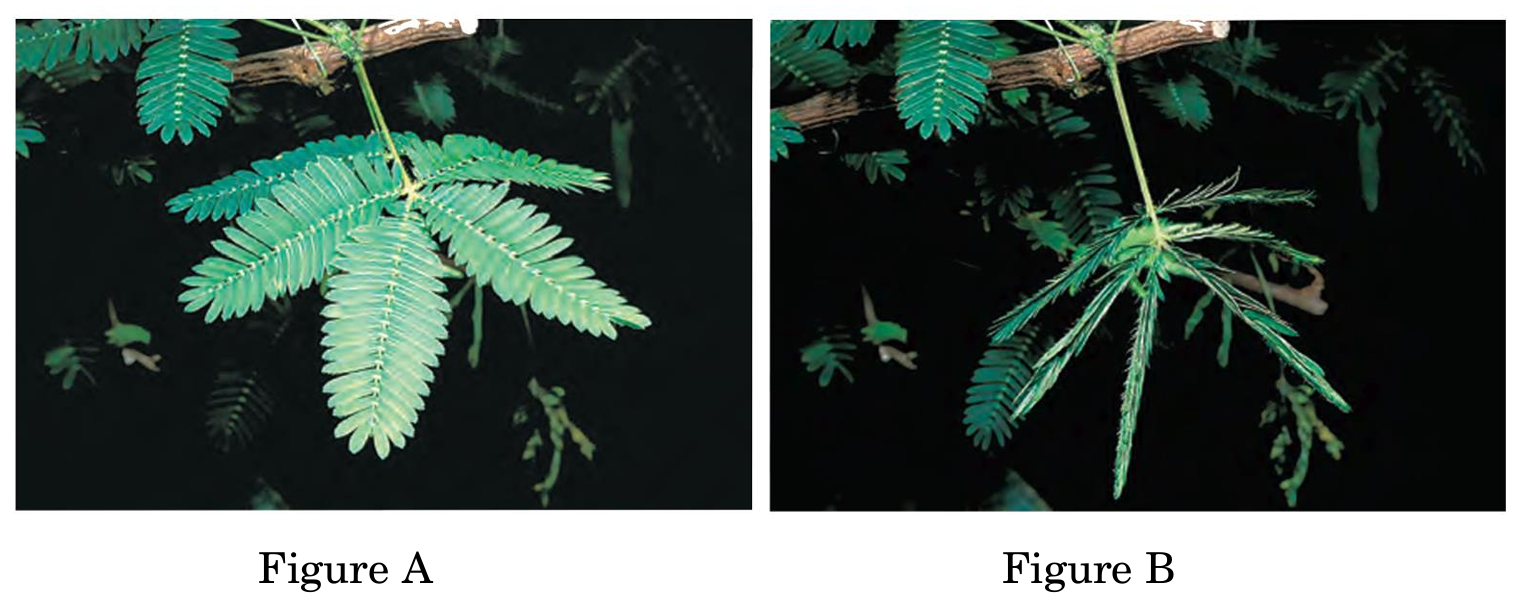
Nastic Movement (Thigmonasty):
The folding of leaves in Mimosa pudica is caused by a sudden loss of turgor pressure (water) in the pulvinus cells at the base of the leaves.
Correct Option: (C)
The folding of leaves in Mimosa pudica is caused by a sudden loss of turgor pressure (water) in the pulvinus cells at the base of the leaves.
Correct Option: (C)
2 Marks
Q23. A person is making a list to purchase few
things from a nearby market. Explain how the fore-brain plays an important role in performing this
activity.
Fore-brain Role:
The fore-brain (specifically the Cerebrum) is the main thinking part of the brain.
- It has regions for thinking, memory, and voluntary actions.
- Making a list involves memory (recalling what is needed), decision making, and motor control (writing the list), all of which are coordinated by the fore-brain.
The fore-brain (specifically the Cerebrum) is the main thinking part of the brain.
- It has regions for thinking, memory, and voluntary actions.
- Making a list involves memory (recalling what is needed), decision making, and motor control (writing the list), all of which are coordinated by the fore-brain.
3 Marks
Q29. (a) Define hormone.
(b) �Hormones should be secreted in precise quantities. We have a feedback mechanism through which this is done.� With the help of an example justify the statement.
(b) �Hormones should be secreted in precise quantities. We have a feedback mechanism through which this is done.� With the help of an example justify the statement.
(a) Hormone:
Hormones are chemical messengers secreted by endocrine glands directly into the blood to act on specific target organs to regulate various body functions.
(b) Feedback Mechanism:
The timing and amount of hormone released are regulated by feedback mechanisms.
Example (Insulin):
- If blood sugar levels rise (e.g., after a meal), they are detected by cells of the pancreas which respond by producing more insulin.
- As blood sugar levels fall, insulin secretion is reduced.
- This ensures precise control of blood sugar.
Hormones are chemical messengers secreted by endocrine glands directly into the blood to act on specific target organs to regulate various body functions.
(b) Feedback Mechanism:
The timing and amount of hormone released are regulated by feedback mechanisms.
Example (Insulin):
- If blood sugar levels rise (e.g., after a meal), they are detected by cells of the pancreas which respond by producing more insulin.
- As blood sugar levels fall, insulin secretion is reduced.
- This ensures precise control of blood sugar.
1 Mark
Q11. The plant hormone whose concentration
stimulates the cells to grow longer on the side of the shoot which is away from light is :
Auxins:
When a growing plant detects light, a hormone called Auxin, synthesized at the shoot tip, helps the cells to grow longer.
When light is coming from one side of the plant, auxin diffuses towards the shady side of the shoot. This concentration of auxin stimulates the cells to grow longer on the side of the shoot which is away from light.
Correct Option: (D)
When a growing plant detects light, a hormone called Auxin, synthesized at the shoot tip, helps the cells to grow longer.
When light is coming from one side of the plant, auxin diffuses towards the shady side of the shoot. This concentration of auxin stimulates the cells to grow longer on the side of the shoot which is away from light.
Correct Option: (D)
3 Marks
Q31. A hormone �X� is secreted in blood when a
person is under scary situation.
(a) Identify the hormone �X� and the gland that secretes it.
(b) Explain its role in dealing with scary or emergency situations.
(a) Identify the hormone �X� and the gland that secretes it.
(b) Explain its role in dealing with scary or emergency situations.
(a) Identity:
Hormone 'X': Adrenaline.
Gland: Adrenal Gland.
(b) Role (Fight or Flight):
1. Increases heart rate to supply more oxygen to muscles.
2. Increases breathing rate.
3. Diverts blood to skeletal muscles by reducing supply to digestive system and skin.
4. Prepares the body to deal with the emergency situation.
Hormone 'X': Adrenaline.
Gland: Adrenal Gland.
(b) Role (Fight or Flight):
1. Increases heart rate to supply more oxygen to muscles.
2. Increases breathing rate.
3. Diverts blood to skeletal muscles by reducing supply to digestive system and skin.
4. Prepares the body to deal with the emergency situation.
1 Mark
Q7. Observe the given figures A and B. When
chhui-mui (sensitive) plant is touched, its leaves fold. This is due to :
Analysis:
- The movement in sensitive plants (Mimosa pudica) is a Seismonastic movement (Nastic movement).
- When touched, the cells at the base of the leaves (pulvinus) lose water and turgor pressure decreases, causing the leaves to fold/droop.
- This is an electrochemical response leading to change in water concentration.
Correct Option: (C)
- The movement in sensitive plants (Mimosa pudica) is a Seismonastic movement (Nastic movement).
- When touched, the cells at the base of the leaves (pulvinus) lose water and turgor pressure decreases, causing the leaves to fold/droop.
- This is an electrochemical response leading to change in water concentration.
Correct Option: (C)
2 Marks
Q23. A person is making a list to purchase few
things from a nearby market. Explain how the fore-brain plays an important role in performing this
activity.
Role of Fore-brain:
- The fore-brain (Cerebrum) is the main thinking part of the brain.
- It has separate areas for receiving sensory impulses (hearing, sight, etc.), association areas (for thinking, memory, interpreting information), and motor areas (for voluntary movements).
- Making a list: Involves thinking, recalling items (Memory), and the voluntary action of writing (controlled by motor areas).
- Thus, the complex process of planning and writing is coordinated by the Fore-brain.
- The fore-brain (Cerebrum) is the main thinking part of the brain.
- It has separate areas for receiving sensory impulses (hearing, sight, etc.), association areas (for thinking, memory, interpreting information), and motor areas (for voluntary movements).
- Making a list: Involves thinking, recalling items (Memory), and the voluntary action of writing (controlled by motor areas).
- Thus, the complex process of planning and writing is coordinated by the Fore-brain.
3 Marks
Q29. (a) Define hormone.
(b) �Hormones should be secreted in precise quantities. We have a feedback mechanism through which this is done.� With the help of an example justify the statement.
(b) �Hormones should be secreted in precise quantities. We have a feedback mechanism through which this is done.� With the help of an example justify the statement.
(a) Hormone:
Hormones are chemical messengers secreted in trace amounts by endocrine glands directly into the blood, which act on specific target organs to regulate physiological processes.
(b) Feedback Mechanism:
The timing and amount of hormone released are regulated by feedback mechanisms to maintain balance (Homeostasis).
Example (Insulin):
- If blood sugar levels rise (e.g., after a meal), they are detected by the cells of the pancreas, which respond by producing more insulin to lower the sugar level.
- As the blood sugar level falls, insulin secretion is reduced automatically.
This ensures that hormones are secreted only when needed and in precise quantities.
Hormones are chemical messengers secreted in trace amounts by endocrine glands directly into the blood, which act on specific target organs to regulate physiological processes.
(b) Feedback Mechanism:
The timing and amount of hormone released are regulated by feedback mechanisms to maintain balance (Homeostasis).
Example (Insulin):
- If blood sugar levels rise (e.g., after a meal), they are detected by the cells of the pancreas, which respond by producing more insulin to lower the sugar level.
- As the blood sugar level falls, insulin secretion is reduced automatically.
This ensures that hormones are secreted only when needed and in precise quantities.
1 Mark
Q7. The growth of the pollen tubes towards ovules
is an example of :
Chemotropism:
It is the movement of a plant part in response to a chemical stimulus.
Example: Growth of pollen tube towards the ovule induced by sugary substances (chemicals) secreted by the stigma/ovule.
(A) Phototropism: Response to light.
(B) Hydrotropism: Response to water.
(C) Geotropism: Response to gravity.
Correct Option: (D)
It is the movement of a plant part in response to a chemical stimulus.
Example: Growth of pollen tube towards the ovule induced by sugary substances (chemicals) secreted by the stigma/ovule.
(A) Phototropism: Response to light.
(B) Hydrotropism: Response to water.
(C) Geotropism: Response to gravity.
Correct Option: (D)
1 Mark
Q9. The plant hormone present in greater
concentration in the areas of rapidly dividing cells is :
Cytokinins:
Cytokinins promote cell division. They are present in greater concentration in areas of rapid cell division, such as in fruits and seeds.
Correct Option: (B)
Cytokinins promote cell division. They are present in greater concentration in areas of rapid cell division, such as in fruits and seeds.
Correct Option: (B)
1 Mark
Q19. Assertion (A): In our
actions of writing or talking, our nervous system communicates with the muscles.
Reason (R): Cranial nerves and spinal nerves form the peripheral nervous system.
Reason (R): Cranial nerves and spinal nerves form the peripheral nervous system.
Analysis:
Assertion (A): True. Voluntary actions like writing/talking involve the CNS sending signals to muscles via nerves.
Reason (R): True. PNS consists of Cranial and Spinal nerves.
Relation: The Reason defines PNS but does not explain how communication happens (electrical impulses, synapses, neuromuscular junctions) or why it happens for writing/talking.
Thus, both are true but R is not the correct explanation of A.
Correct Option: (B)
Assertion (A): True. Voluntary actions like writing/talking involve the CNS sending signals to muscles via nerves.
Reason (R): True. PNS consists of Cranial and Spinal nerves.
Relation: The Reason defines PNS but does not explain how communication happens (electrical impulses, synapses, neuromuscular junctions) or why it happens for writing/talking.
Thus, both are true but R is not the correct explanation of A.
Correct Option: (B)
5 Marks
Q39. A person while climbing up a rocky hill
comes into a panic state and fear. His body starts reacting in a �flight-or-flight� condition to adjust
to the dangerous and stressful situation.
Based on the above facts, answer the questions that follow.
(a) (i) Name the hormone secreted in the blood of the person in this situation.
OR
(a) (ii) Name the source gland of the hormone secreted in this condition.
(b) State any two responses in the body of the person as a result of the secretion of this hormone.
(c) How does the action of the chemical signal in terms of hormones differ from the electrical impulses via nerve cells ?
Based on the above facts, answer the questions that follow.
(a) (i) Name the hormone secreted in the blood of the person in this situation.
OR
(a) (ii) Name the source gland of the hormone secreted in this condition.
(b) State any two responses in the body of the person as a result of the secretion of this hormone.
(c) How does the action of the chemical signal in terms of hormones differ from the electrical impulses via nerve cells ?
(a) (i) Hormone: Adrenaline.
(a) (ii) Source Gland: Adrenal Gland (Adrenal Medulla).
(b) Responses to Adrenaline:
1. Heart beats faster: To supply more oxygen to muscles.
2. Breathing rate increases: Due to contractions of diaphragm and rib muscles.
3. Blood flow to digestive system and skin is reduced (arteries constrict) and diverted to skeletal muscles.
(c) Difference (Hormonal vs Nervous):
- Signal Nature: Hormones are chemical signals (slow, spread via blood). Nerve impulses are electrical (fast, via neurons).
- Reach: Hormones reach all cells of the body (wide-acting). Nerve impulses reach only connected cells (specific).
- Duration: Hormonal effects are long-lasting. Nervous effects are short-lived.
(a) (ii) Source Gland: Adrenal Gland (Adrenal Medulla).
(b) Responses to Adrenaline:
1. Heart beats faster: To supply more oxygen to muscles.
2. Breathing rate increases: Due to contractions of diaphragm and rib muscles.
3. Blood flow to digestive system and skin is reduced (arteries constrict) and diverted to skeletal muscles.
(c) Difference (Hormonal vs Nervous):
- Signal Nature: Hormones are chemical signals (slow, spread via blood). Nerve impulses are electrical (fast, via neurons).
- Reach: Hormones reach all cells of the body (wide-acting). Nerve impulses reach only connected cells (specific).
- Duration: Hormonal effects are long-lasting. Nervous effects are short-lived.
3 Marks
Q33. State two limitations of electrical impulses
in multicellular organisms. Why is chemical communication better than electrical impulses as a means of
communication between cells in multicellular organisms?
Limitations:
1. They reach only those cells connected by nervous tissue (not all cells).
2. Once generated, a cell needs time to reset before generating another impulse (cannot be continuous).
Chemical Communication Advantage:
Hormones (chemical messengers) can diffuse to all cells of the body and allow for steady, persistent changes rather than short pulses.
1. They reach only those cells connected by nervous tissue (not all cells).
2. Once generated, a cell needs time to reset before generating another impulse (cannot be continuous).
Chemical Communication Advantage:
Hormones (chemical messengers) can diffuse to all cells of the body and allow for steady, persistent changes rather than short pulses.
4 Marks
Q39. In life there are certain changes in the
environment called 'stimuli' to which we respond appropriately. Touching a flame suddenly is a dangerous
situation for us. One way is to think consciously about the possibility of burning and then moving the
hand. But our body has been designed in such a way that we save ourself from such situations
immediately.
(i) Name the action by which we protect ourself in the situation mentioned above and define it.
(ii) Write the role of (a) motor and (b) relay neuron.
(iii) (A) What are the two types of nervous system in human body? Name the components of each of them.
OR
(iii) (B) Which part of the human brain is responsible for :
(a) thinking
(b) picking up a pencil
(c) controlling blood pressure
(d) controlling hunger
(i) Name the action by which we protect ourself in the situation mentioned above and define it.
(ii) Write the role of (a) motor and (b) relay neuron.
(iii) (A) What are the two types of nervous system in human body? Name the components of each of them.
OR
(iii) (B) Which part of the human brain is responsible for :
(a) thinking
(b) picking up a pencil
(c) controlling blood pressure
(d) controlling hunger
(i): Reflex Action. It is a sudden, involuntary,
and automatic response to a stimulus.
(ii): (a) Motor Neuron: Carries impulse from spinal cord to effector (muscle). (b) Relay Neuron: Connects sensory and motor neurons within the spinal cord.
(iii) (A):
1. Central Nervous System (CNS): Brain and Spinal Cord.
2. Peripheral Nervous System (PNS): Cranial nerves and Spinal nerves.
(iii) (B):
(a) Thinking: Forebrain (Cerebrum).
(b) Picking pencil: Cerebellum (Hindbrain).
(c) Blood pressure: Medulla (Hindbrain).
(d) Hunger: Forebrain (Hypothalamus/Cerebrum).
(ii): (a) Motor Neuron: Carries impulse from spinal cord to effector (muscle). (b) Relay Neuron: Connects sensory and motor neurons within the spinal cord.
(iii) (A):
1. Central Nervous System (CNS): Brain and Spinal Cord.
2. Peripheral Nervous System (PNS): Cranial nerves and Spinal nerves.
(iii) (B):
(a) Thinking: Forebrain (Cerebrum).
(b) Picking pencil: Cerebellum (Hindbrain).
(c) Blood pressure: Medulla (Hindbrain).
(d) Hunger: Forebrain (Hypothalamus/Cerebrum).
1 Mark
Q9. The plant hormones promoting rapid cell
division in seeds and wilting of leaves respectively are
Hormones:
Cell Division promoter: Cytokinins.
Wilting of leaves (Inhibitor/Stress): Abscisic Acid.
Correct Option: (B)
Cell Division promoter: Cytokinins.
Wilting of leaves (Inhibitor/Stress): Abscisic Acid.
Correct Option: (B)
1 Mark
Q11. 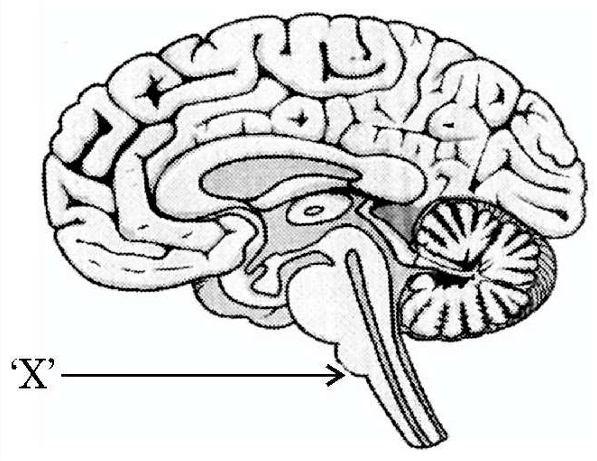
Which among the following is not a neural action controlled by the part of human brain labelled 'X' in the figure above ?
Which among the following is not a neural action controlled by the part of human brain labelled 'X' in the figure above ?
Analysis:
Part X points to the Medulla Oblongata (Hindbrain).
Medulla controls involuntary actions like salivation, vomiting, blood pressure.
Hunger is controlled by the Forebrain (Hypothalamus/Cerebrum).
Question asks which is NOT controlled by X.
Correct Option: (B)
Part X points to the Medulla Oblongata (Hindbrain).
Medulla controls involuntary actions like salivation, vomiting, blood pressure.
Hunger is controlled by the Forebrain (Hypothalamus/Cerebrum).
Question asks which is NOT controlled by X.
Correct Option: (B)
5 Marks
Q35. (A) (a) Analyse the given situations and
interpret the possible reason for each :
(i) Iodine deficiency in diet increases the possibility of a disease of swollen neck in a person.
(ii) Some people in population may have very short heights (dwarfs).
(iii) Thick facial hairs develop in boys at the age of 10-12 years.
(b) Explain two reasons which necessitate the need of chemical communication in multicellular organisms.
OR
(B) (a) Differentiate between voluntary and involuntary action.
(b) Define reflex action. With the help of a flow diagram, show the correct sequence of path of Nerve impulse from place of its origin.
(i) Iodine deficiency in diet increases the possibility of a disease of swollen neck in a person.
(ii) Some people in population may have very short heights (dwarfs).
(iii) Thick facial hairs develop in boys at the age of 10-12 years.
(b) Explain two reasons which necessitate the need of chemical communication in multicellular organisms.
OR
(B) (a) Differentiate between voluntary and involuntary action.
(b) Define reflex action. With the help of a flow diagram, show the correct sequence of path of Nerve impulse from place of its origin.
(A)
(a) (i) Iodine is essential for Thyroxin synthesis by Thyroid gland. Deficiency causes Goitre (swollen neck).
(ii) Deficiency of Growth Hormone (GH) from Pituitary gland in childhood causes Dwarfism.
(iii) Secretion of Testosterone by Testes triggers secondary sexual characters (Puberty).
(b) Need for Chemical Comm:
1. Nerve impulses cannot reach every single cell; chemicals (hormones) can diffuse to all cells.
2. Nerve impulses are transient; chemical effects can be sustained/steady.
OR
(B)
(a) Voluntary: Controlled by will (Forebrain). Involuntary: Not controlled by will (Mid/Hindbrain).
(b) Reflex Action: Sudden, involuntary response to a stimulus.
Flow chart (Relex Arc):
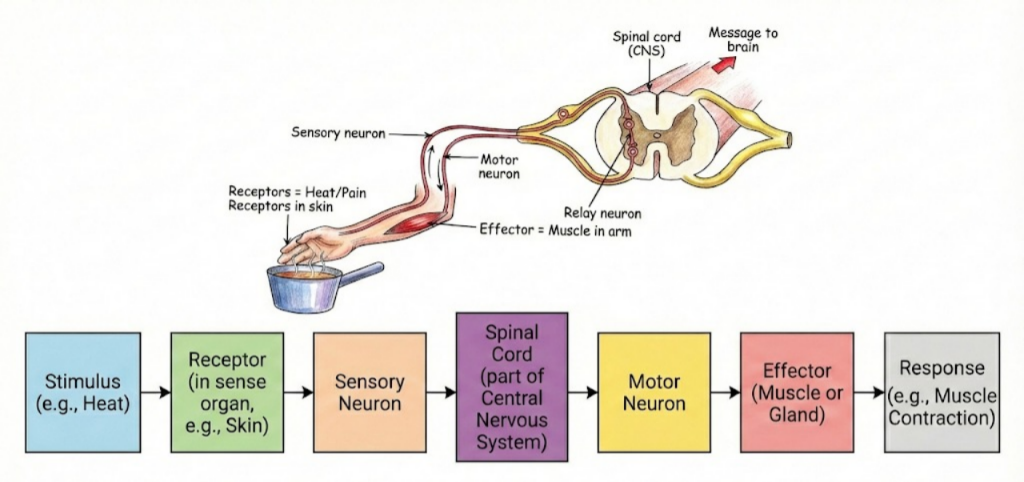
Receptor \(\rightarrow\) Sensory Neuron \(\rightarrow\) Spinal Cord (Relay) \(\rightarrow\) Motor Neuron \(\rightarrow\) Effector (Muscle).
(a) (i) Iodine is essential for Thyroxin synthesis by Thyroid gland. Deficiency causes Goitre (swollen neck).
(ii) Deficiency of Growth Hormone (GH) from Pituitary gland in childhood causes Dwarfism.
(iii) Secretion of Testosterone by Testes triggers secondary sexual characters (Puberty).
(b) Need for Chemical Comm:
1. Nerve impulses cannot reach every single cell; chemicals (hormones) can diffuse to all cells.
2. Nerve impulses are transient; chemical effects can be sustained/steady.
OR
(B)
(a) Voluntary: Controlled by will (Forebrain). Involuntary: Not controlled by will (Mid/Hindbrain).
(b) Reflex Action: Sudden, involuntary response to a stimulus.
Flow chart (Relex Arc):
Receptor \(\rightarrow\) Sensory Neuron \(\rightarrow\) Spinal Cord (Relay) \(\rightarrow\) Motor Neuron \(\rightarrow\) Effector (Muscle).
1 Mark
Q8. Electrical impulse travels in a neuron from
The correct path is: Dendrite (Receives) \(\rightarrow\) Cell body
\(\rightarrow\) Axon \(\rightarrow\) Nerve ending.
Correct Option: (B)
Correct Option: (B)
2 Marks
Q25. (a) How is brain protected in our body ?
(b) A doctor finds in one of his patients that he is not maintaining a proper posture and balance of his body. State the region of brain and also the part of brain which is responsible for it.
(b) A doctor finds in one of his patients that he is not maintaining a proper posture and balance of his body. State the region of brain and also the part of brain which is responsible for it.
(a) Protection: Enclosed in a hard bony box called Cranium
(Search). Inside, it is cushioned by fluid-filled balloon (Cerebrospinal Fluid - CSF) which provides
shock absorption.
(b) Region: Hind Brain.
Part: Cerebellum (Responsible for posture/balance).
(b) Region: Hind Brain.
Part: Cerebellum (Responsible for posture/balance).
4 Marks
Q38. Case Study: The growth
movements of plant parts in which the direction of the stimulus determines the direction of the response
is known as tropic movements or tropism. Plants also have non-directional movements which may not be
growth dependent.
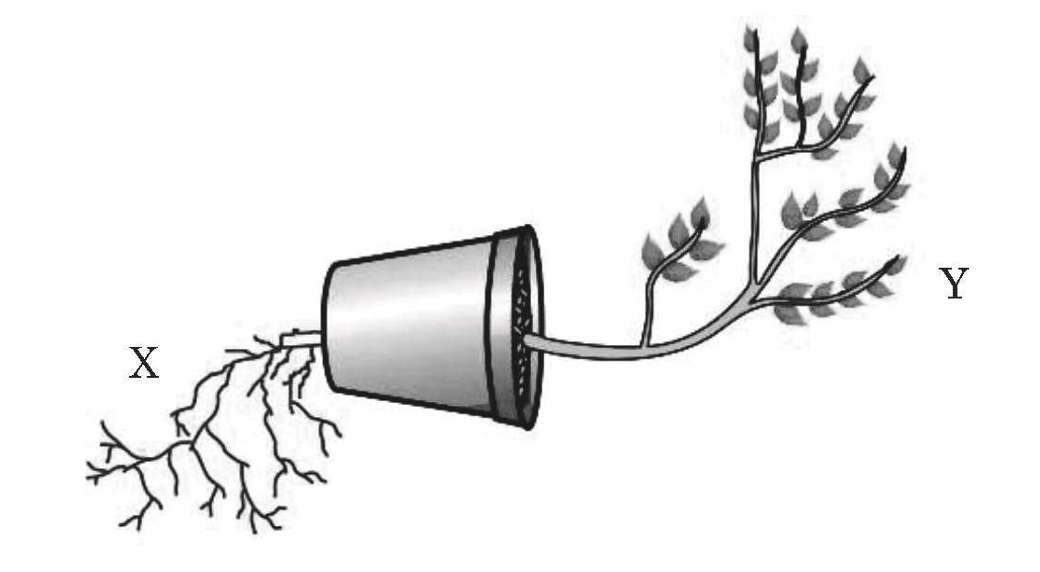
(I) Name the movement which causes 'X' and 'Y' to grow downwards and upwards respectively.
(II) Write the name of a hormone that plays a major role in (i) falling of leaves (ii) rapid cell division.
(III) (a) Leaves of the sensitive plant move very quickly in response to 'touch'. How is this stimulus of touch communicated and explain how the movement takes place.
OR
(III) (b) Name the plant hormone which is synthesized at the shoot tip. How does this hormone helps the plant to bend towards light ?
(I) Name the movement which causes 'X' and 'Y' to grow downwards and upwards respectively.
(II) Write the name of a hormone that plays a major role in (i) falling of leaves (ii) rapid cell division.
(III) (a) Leaves of the sensitive plant move very quickly in response to 'touch'. How is this stimulus of touch communicated and explain how the movement takes place.
OR
(III) (b) Name the plant hormone which is synthesized at the shoot tip. How does this hormone helps the plant to bend towards light ?
(I) Geotropism (Gravisensitivity). X (Root) - Positive Geotropism. Y (Shoot) -
Negative Geotropism.
(II) (i) Falling leaves: Abscisic Acid. (ii) Cell division: Cytokinins.
(III) (a) Communication: Electrochemical signals. Movement: By changing the amount of water (turgor pressure) in the cells (pulvinus). Cells swell or shrink, causing folding.
(III) (b) Hormone: Auxin.
Mechanism: Auxin diffuses to the shady side. More auxin causes cells on shady side to elongate more than the illuminated side, causing bending acting towards light (Phototropism).
(II) (i) Falling leaves: Abscisic Acid. (ii) Cell division: Cytokinins.
(III) (a) Communication: Electrochemical signals. Movement: By changing the amount of water (turgor pressure) in the cells (pulvinus). Cells swell or shrink, causing folding.
(III) (b) Hormone: Auxin.
Mechanism: Auxin diffuses to the shady side. More auxin causes cells on shady side to elongate more than the illuminated side, causing bending acting towards light (Phototropism).
Board Exam 2024
Content coming soon for 2024...
Board Exam 2023
Content coming soon for 2023...
Board Exam 2022
Content coming soon for 2022...