Vardaan Learning Institute
Control and Coordination
1. Animal Nervous System
A. The Neuron (Structural Unit)
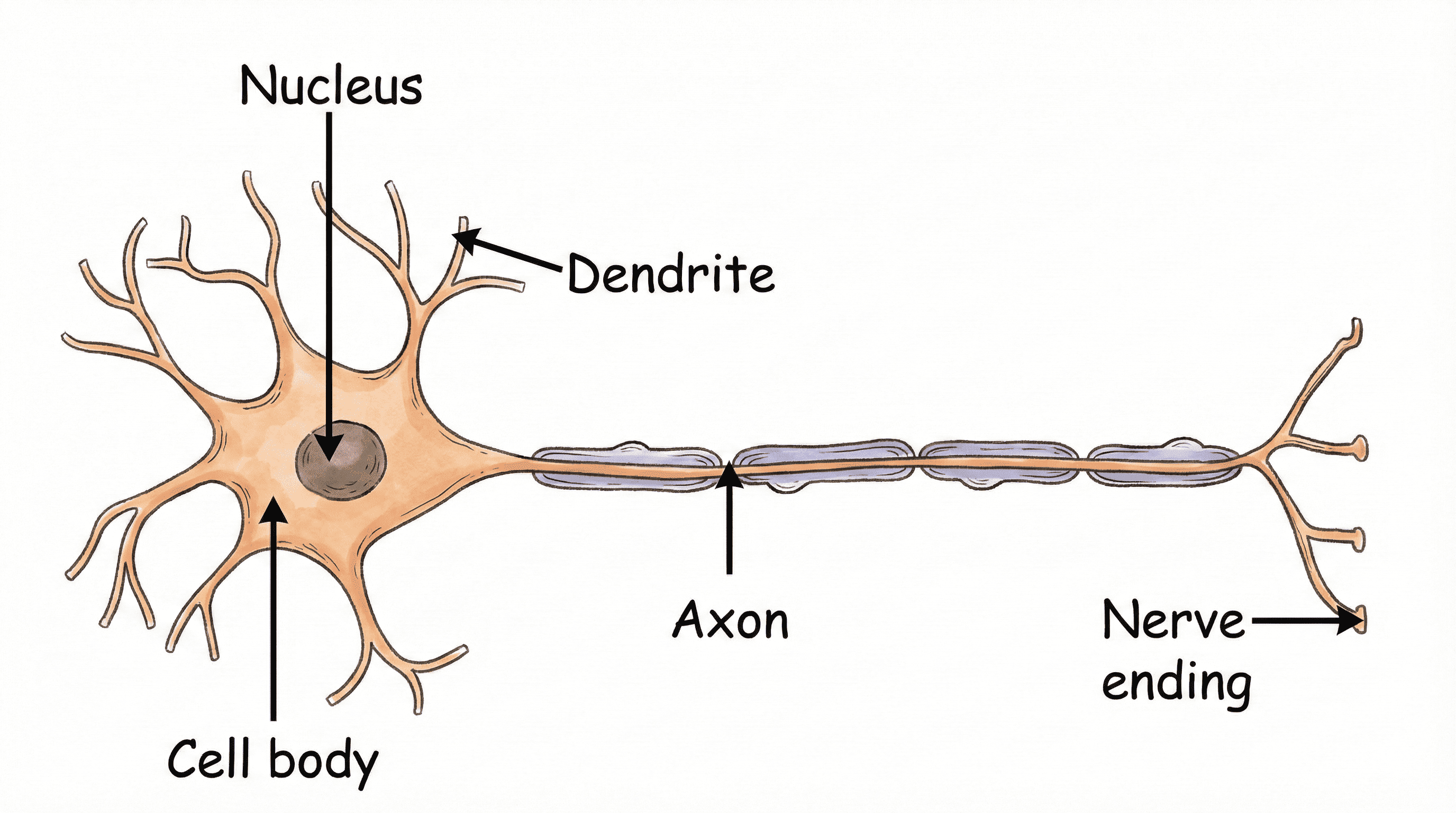
Figure 2.1: Structure of Neuron
Structure & Function:
- Dendrite: Acquires information. (Tips of nerve cells).
- Cell Body (Cyton): Information travels as an Electrical Impulse.
- Axon: Longest fibre. Transmits impulse away from cell body.
- Nerve Ending: Converts Electrical Impulse → Chemical Signal (Neurotransmitter).
The Synapse (Crucial Definition):
It is the microscopic gap between the nerve ending of one neuron and the dendrite of the next.
Mechanism: At the nerve ending, the electrical impulse releases chemicals
(Neurotransmitters like Acetylcholine). These chemicals diffuse across the gap and start a similar
electrical impulse in the dendrite of the next neuron.
Why do we need Chemical Communication (Hormones) if we have Nerves?
Limitations of Electrical Impulses:
1. They reach only those cells connected by nervous tissue.
2. Once an impulse is generated, the cell takes time to reset (cannot continuously create impulses).
Chemical communication (Hormones) overcomes this by reaching every cell and acting
steadily.
B. Reflex Action & Reflex Arc
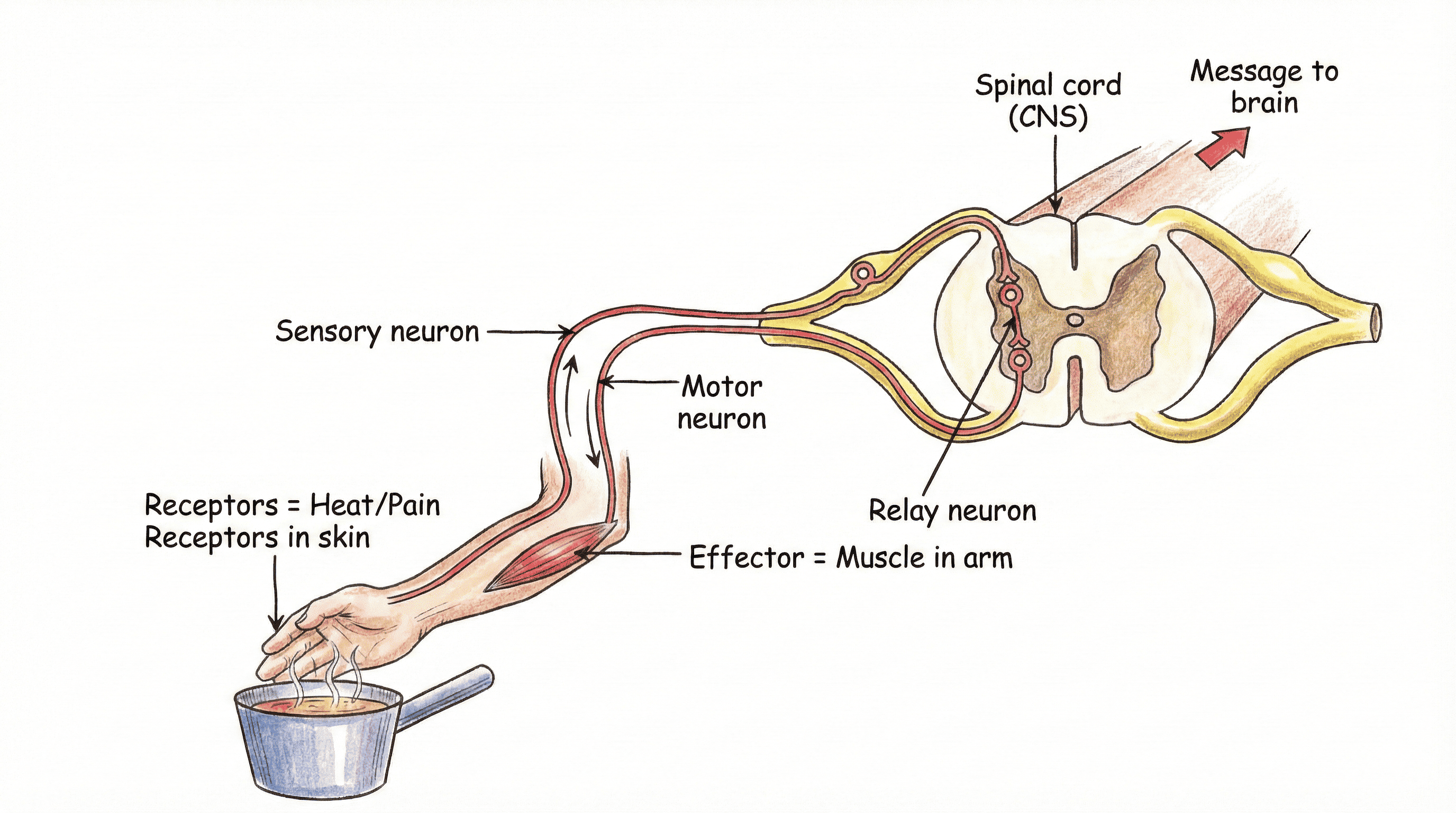
Figure 2.2: Reflex Arc Pathway
Why are Reflex Arcs formed in the Spinal Cord?
Thinking processes in the brain are complex and slow. To save time and prevent tissue damage during
emergencies, nerves connect directly in the spinal cord for a quicker response. (The signal still goes
to
the brain later for memory).
The Pathway (Reflex Arc):
Stimulus (Heat)
→
Receptor (Skin)
→
Sensory Neuron
→
Spinal Cord (Relay Neuron)
→
Motor Neuron
→
Effector (Muscle)
→
Response (Movement)
2. The Human Brain (The Thinking Center)
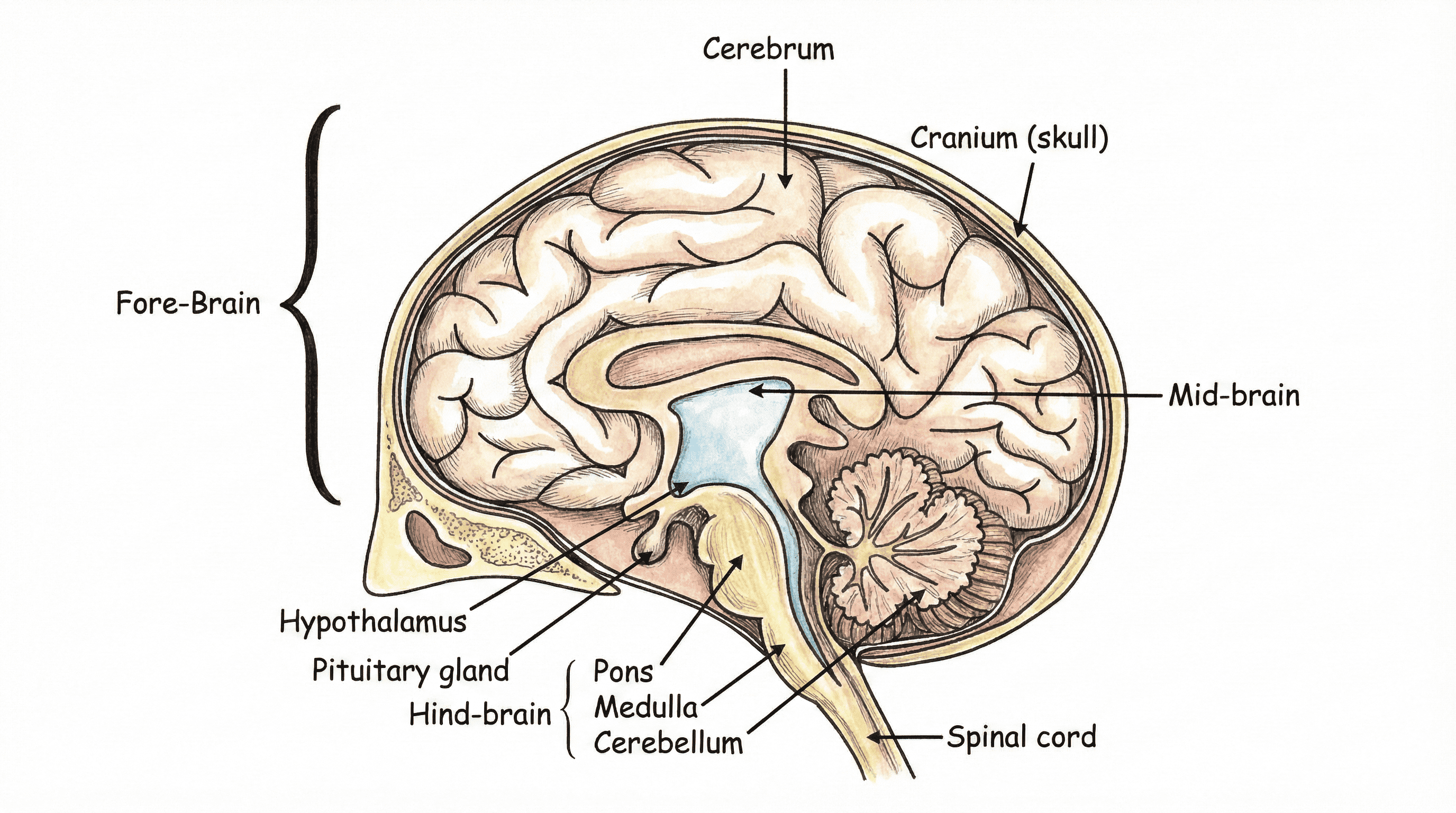
Figure 2.3: Human Brain
| Region |
Part |
Function (Matches PYQ 2025) |
Forebrain
(Main thinking part) |
Cerebrum |
• Voluntary actions.
• Sensory processing (Hearing, Smell, Sight).
• Seat of Intelligence, Memory, Learning.
• Hypothalamus: Satiety Center (Hunger/Thirst).
|
| Midbrain |
- |
Involuntary reflexes of head/neck/eyes. (e.g., Pupil size change). |
| Hindbrain |
Cerebellum |
• Precision of voluntary actions (e.g., Threading a needle).
• Maintains Posture and Balance (e.g., Riding a bike).
(Damage leads to loss of balance, drunk-like walk).
|
| Medulla |
Controls Involuntary life processes: Blood Pressure, Heartbeat, Salivation, Vomiting. |
| Pons |
Regulates Respiration (Rate of breathing). |
C. Protection of the CNS
How are these delicate organs protected?
1. Brain: sits inside a bony box (Cranium/Skull). Inside the box, the brain is
contained in
a fluid-filled balloon (Cerebrospinal Fluid) for shock absorption.
2. Spinal Cord: Protected by the Vertebral Column (Backbone).
3. Coordination in Plants
Plants use Electrical-Chemical means to convey information from cell to cell, but lack
specialized tissue.
A. Types of Movements
| Feature |
Nastic Movements |
Tropic Movements |
| Direction |
Non-directional. |
Directional. |
| Growth |
Growth Independent. |
Growth Dependent. |
| Speed |
Immediate/Fast. |
Slow. |
| Mechanism |
Change in Turgor Pressure. |
Cell division/elongation (Auxin). |
| Example |
Mimosa pudica (Touch-me-not). |
Shoot bending to light (Phototropism). |
B. Mechanism of Phototropism (Auxin Action)
How does a plant bend towards light?
1. Auxin is synthesized at the shoot tip.
2. When light comes from one side, Auxin diffuses towards the shady side of the
shoot.
3. High concentration of Auxin stimulates cells on the shady side to grow longer.
4. As one side grows longer than the other, the plant appears to bend towards light.
C. Various Tropic Movements
| Movement |
Stimulus |
Response (Example) |
| Phototropism |
Light |
Shoot bends towards light (Positive). Root bends away (Negative). |
| Geotropism |
Gravity |
Roots grow down (Positive). Shoots grow up (Negative). |
| Hydrotropism |
Water |
Roots grow towards water (Positive). |
| Chemotropism |
Chemicals |
Growth of Pollen Tube towards Ovule. |
| Thigmotropism |
Touch |
Growth of Tendrils around a support (climbing plants). |
D. Plant Hormones (Phytohormones)
| Hormone |
Function |
| Auxin |
Helps cells to grow longer (Phototropism). |
| Gibberellins |
Helps in the growth of the stem. |
| Cytokinins |
Promotes cell division. Rapid in fruits and seeds. |
| Abscisic Acid |
Inhibits growth. Causes wilting of leaves. |
4. Animal Hormones (Endocrine System)
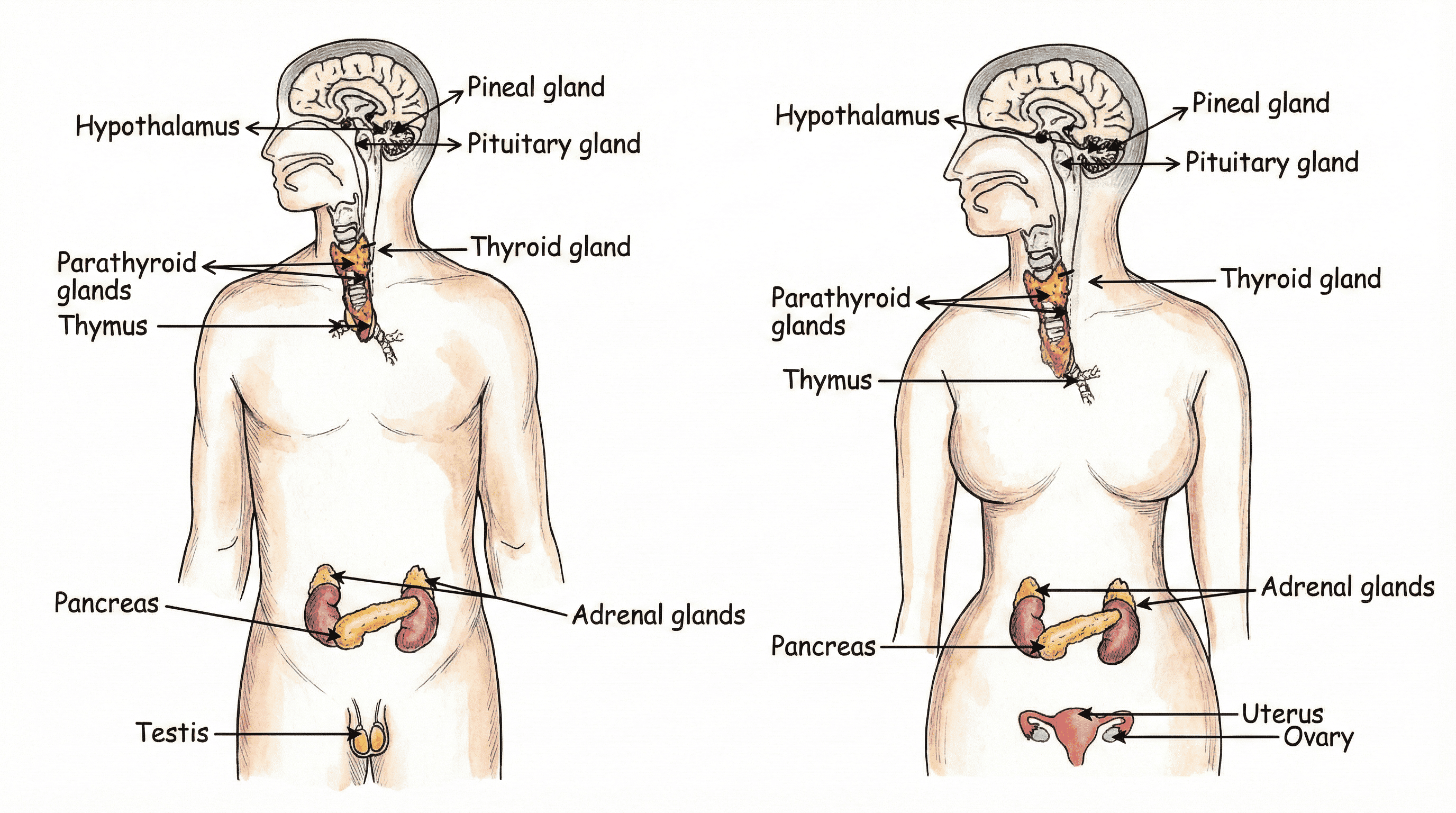
Figure 2.4: Endocrine Glands in Humans
| Gland |
Hormone |
Function/Deficiency Disease |
| Pituitary |
Growth Hormone |
Regulates growth. Deficiency: Dwarfism. Excess: Gigantism. |
| Thyroid |
Thyroxin |
Regulates Metabolism. Deficiency: Goitre. Requires Iodine.
|
| Adrenal |
Adrenaline |
"Fight or Flight": Increases heart rate, breathing, alert. |
| Pancreas |
Insulin |
Lowers blood sugar. Deficiency: Diabetes. |
| Testes |
Testosterone |
Sperm production + Puberty changes. |
| Ovary |
Oestrogen |
Egg production + Puberty changes. |
Feedback Mechanism (Example):
Blood sugar rises → Detected by Pancreas → More Insulin secreted → Sugar falls →
Insulin
secretion reduced.
-
A person is walking in a drunken manner (loss of balance). Which part of the brain is likely
affected? How is this part different from the part that helps you think?
Hint: Balance = Cerebellum (Hindbrain); Thinking = Cerebrum
(Forebrain).
-
Why does a tendril circle around a support? Explain the role of Auxin in this specific case.
Hint: Auxin diffuses to the side AWAY from support, causing it to grow
faster, making the tendril bend/coil.
-
In a Reflex Arc, what happens at the Synapse? Why can't the signal travel backwards?
Hint: Electrical signal converts to Chemical. Receptors for chemicals
are
only on the next dendrite, ensuring one-way flow.
🧪 NCERT EXPERIMENT ZONE (Control &
Coordination)
1. Phototropism (Response to Light):
•
Setup: Conical flask with water, wire mesh covering, germinating bean seeds. Keep in
cardboard box open from one side.
•
Observation: Shoots bend
towards light (Positive Phototropism).
Roots
bend
away (Negative Phototropism).
Figure 2.E1: Phototropism (Response to Light)
2. Geotropism (Response to Gravity):
•
Setup: Potted plant laid horizontally.
•
Observation: Shoot bends
Upwards (Negative Geotropism). Root bends
Downwards (Positive Geotropism).
Figure 2.E2: Geotropism (Response to Gravity)

.png)
.png)
 VARDAAN COMET