 ← Back to Practice Arena
Topic 1 Solutions: Nutrition � Autotrophic and Heterotrophic
1.
Ans: Life processes: The basic molecular and cellular functions performed by living organisms that are absolutely necessary to maintain their existence and sustain life.
Four vital life processes:
- Nutrition: Intake and digestion of food to obtain energy.
- Respiration: Breakdown of digested nutrients at the cellular level to release chemical energy (ATP).
- Transportation: Internal movement of gases, nutrients, and waste materials from one part of the body to another.
- Excretion: Removal of toxic metabolic waste products from the body.
2.
Ans: Differences in modes of nutrition:
- Autotrophic Nutrition: The mode of nutrition in which organisms manufacture their own organic food from simple inorganic raw materials ($\text{CO}_2$ and $\text{H}_2\text{O}$) using light energy (photosynthesis).
Examples: Green plants, Cyanobacteria (blue-green algae). - Heterotrophic Nutrition: The mode of nutrition in which organisms cannot manufacture their own food and must depend on autotrophs or other organic matter for nutrition.
Examples: Humans, Amoeba, Fungi (yeast).
3.
Ans: Balanced chemical equation representing Photosynthesis:
$$6\text{CO}_2(g) + 12\text{H}_2\text{O}(l) \xrightarrow{\text{Chlorophyll \& Sunlight}} \text{C}_6\text{H}_{12}\text{O}_6(aq) + 6\text{O}_2(g) + 6\text{H}_2\text{O}(l)$$
Three major events during Photosynthesis:
- Absorption: Absorption of light energy by chlorophyll pigments in the leaves.
- Conversion & Splitting: Conversion of light energy into chemical energy, and the photolysis (splitting) of water molecules into hydrogen and oxygen: $$2\text{H}_2\text{O} \xrightarrow{\text{Light}} 4\text{H}^+ + 4e^- + \text{O}_2\uparrow$$
- Reduction: Reduction of carbon dioxide gas using hydrogen to form carbohydrates (glucose): $$\text{CO}_2 + 4\text{H}^+ + 4e^- \rightarrow [\text{CH}_2\text{O}]_n + \text{H}_2\text{O}$$
4.
Ans: Stomata: Tiny microscopic pores present on the epidermis of leaves and green stems that facilitate gaseous exchange ($\text{CO}_2$, $\text{O}_2$) and transpiration.
Structure & Regulation by Guard Cells:
Each stomatal pore is surrounded by a pair of kidney-shaped (in dicots) or dumbbell-shaped (in monocots) guard cells.
- Opening of pore: When water flows into the guard cells from surrounding epidermal cells, the guard cells swell, become turgid, and curve outwards. This pulls the inner walls apart, opening the stomatal pore.
- Closing of pore: When water leaves the guard cells, they lose turgidity, become flaccid, and straighten, which closes the stomatal pore to prevent excessive water loss.
5.
Ans: Variegated leaf experiment to show chlorophyll is necessary:
- Take a variegated leaf plant (e.g., Money Plant or Coleus, which has green and white areas) and destarch it by placing it in a dark room for 3 days.
- Keep the plant in bright sunlight for about 6 hours.
- Pluck a leaf and trace the green (chlorophyll-containing) and non-green (white) areas on a sheet of paper.
- Boil the leaf in water for a few minutes to break down cell membranes, then immerse it in a beaker of alcohol heated inside a water bath. The alcohol dissolves the chlorophyll, turning the leaf pale and colourless.
- Rinse the leaf in warm water and add a few drops of dilute iodine solution.
- Observation: Only the green-traced areas turn blue-black (confirming starch presence), while the white areas remain brown/colourless. This proves that photosynthesis and starch synthesis occur only in parts containing chlorophyll.
6.
Ans: Desert plants grow in arid environments where day temperatures are extremely high.
Why they take up CO2 at night: If desert plants open their stomata during the hot day to take in $\text{CO}_2$, they would lose a massive amount of water via transpiration, leading to dehydration and death.
Mechanism: Instead, they open their stomata at night when temperatures are cool, take up $\text{CO}_2$, and convert it into an intermediate four-carbon organic acid (malic acid). During the day, they keep their stomata tightly closed to conserve water. The stored organic acid is then broken down to release $\text{CO}_2$ internally, which is fixed into glucose using the light energy absorbed by chlorophyll during the daytime.
Mechanism: Instead, they open their stomata at night when temperatures are cool, take up $\text{CO}_2$, and convert it into an intermediate four-carbon organic acid (malic acid). During the day, they keep their stomata tightly closed to conserve water. The stored organic acid is then broken down to release $\text{CO}_2$ internally, which is fixed into glucose using the light energy absorbed by chlorophyll during the daytime.
7.
Ans: Amoeba exhibits holozoic nutrition, obtaining food through phagocytosis.
Step-by-step digestion:
.png)
- Ingestion: When Amoeba senses a food particle, it extends temporary finger-like projections of its cell membrane called pseudopodia around the food. The pseudopodia fuse, engulfing the food particle inside a membrane-bound food vacuole.
- Digestion: Lysosomes fuse with the food vacuole, releasing digestive enzymes that break down complex food into simple, soluble molecules.
- Absorption & Assimilation: The digested nutrients diffuse directly into the cytoplasm. The energy is used for growth and maintenance.
- Egestion: The undigested waste residue is moved to the cell membrane and expelled outside the cell by exocytosis.
8.
Ans: Path of a bolus of food in the human digestive tract:
- Mouth (Buccal Cavity): Teeth masticate food, and saliva mixes with it.
Enzyme: Salivary amylase breaks down starch into maltose (sugar): $$\text{Starch} \xrightarrow{\text{Salivary Amylase}} \text{Maltose}$$ - Oesophagus: Food is pushed down by wave-like muscular contractions called peristaltic movements. No digestion occurs here.
- Stomach: Food is churned with gastric juices.
Enzymes/Agents: Pepsin (activated by $\text{HCl}$) digests proteins into peptones. Mucus protects the lining. - Small Intestine (Site of complete digestion): Receives secretions from:
- Liver (Bile): Emulsifies fats and makes the acidic food alkaline.
- Pancreas (Pancreatic juice): Trypsin digests proteins to peptides; Lipase digests emulsified fats to fatty acids/glycerol; Amylase digests starch.
- Intestinal Glands: Peptidases convert peptides to amino acids; Lipase converts fats to fatty acids; Maltase/Lactase converts sugars to glucose.
- Large Intestine: Absorbs excess water and salts from undigested waste.
- Rectum & Anus: Stores solid waste, which is egested through the anus regulated by anal sphincters.
9.
Ans: Explanations for stomach acidity and protection:
Role of HCl in the stomach:
- It creates a highly acidic medium (pH ~ 1.5�2.5) which is absolutely required to activate the inactive protein-digesting enzyme pepsinogen into active pepsin.
- It acts as an antiseptic, killing harmful bacteria and pathogens entering the stomach along with food.
10.
Ans: The small intestine is the primary site for the absorption of digested nutrients, and it is highly adapted for this function.
Adaptations & role of Villi:
- Length: It is exceptionally long (~6 meters), giving ample time for absorption as food passes through.
- Villi: The inner lining of the small intestine has millions of microscopic, finger-like folds called villi. These villi increase the inner surface area of the intestine exponentially.
- Blood supply: Each villus is richly supplied with a dense network of blood capillaries and a central lymphatic vessel called a lacteal. The digested food (glucose, amino acids) is absorbed directly into the blood capillaries, while fatty acids and glycerol are absorbed into the lacteal.
11.
Ans: Bile juice is a green-yellow fluid secreted by the liver and stored in the gallbladder. It does not contain any digestive enzymes, yet it is essential for digestion.
Two major functions of Bile:
- Neutralisation: The acidic food (chyme) entering the small intestine from the stomach is neutralised and made alkaline. This alkaline medium is necessary for pancreatic enzymes (like trypsin and lipase) to act.
- Emulsification of Fats: Fats are present in the intestine as large globules, making it hard for water-soluble lipase enzymes to react. Bile salts bind to these large globules and break them down into millions of tiny droplets. This process is called emulsification, and it increases the surface area for lipase action, speeding up fat digestion.
12.
Ans: Explanations for digestive tract lengths:
- Herbivores (Cows, sheep): Eat grass and leaves containing high levels of cellulose. Cellulose is a complex carbohydrate that is exceptionally tough and takes a very long time to be broken down and digested by symbiotic bacteria in the gut. Therefore, herbivores require a longer small intestine to give ample transit time for complete cellulose fermentation and absorption.
- Carnivores (Tigers, lions): Eat meat. Meat is composed of animal proteins and fats, which are highly digestible and easily broken down by protease and lipase enzymes. Consequently, carnivores have a much shorter small intestine.
Topic 2 Solutions: Respiration � Aerobic and Anaerobic
13.
Ans: Explanations for respiratory terms:
- Respiration: The biochemical process occurring inside living cells where food molecules (glucose) are oxidatively broken down step-by-step to release energy in the form of ATP. It involves chemical reactions.
- Breathing: The purely physical/mechanical process of taking in oxygen-rich air (inhalation) and expelling carbon dioxide-rich air (exhalation) through respiratory organs. No chemical reactions or energy release occur during breathing.
14.
Ans: Flowchart representing the pathways of glucose breakdown:
In all cells, the first step is glycolysis in the cytoplasm, breaking down 6-carbon glucose into 3-carbon pyruvate (yielding 2 ATP):
$$\text{Glucose (6C)} \xrightarrow{\text{In Cytoplasm (Glycolysis)}} \text{Pyruvate (3C)} + \text{Energy}$$
From pyruvate, three pathways exist:
- In Mitochondria (Aerobic Respiration - Presence of } \text{O}_2\text{): $$\text{Pyruvate} \rightarrow 6\text{CO}_2 + 6\text{H}_2\text{O} + 36 \text{ to } 38\text{ ATP}$$
- In Yeast cells (Anaerobic Respiration / Fermentation - Absence of } \text{O}_2\text{): $$\text{Pyruvate} \rightarrow \text{C}_2\text{H}_5\text{OH (Ethanol)} + 2\text{CO}_2 + 2\text{ATP}$$
- In Human Muscle Cells (Anaerobic Respiration - Lack of } \text{O}_2\text{ during vigorous exercise): $$\text{Pyruvate} \rightarrow \text{Lactic acid (3C)} + 2\text{ATP}$$
15.
Ans: Differences between Aerobic and Anaerobic Respiration:
Chemical Equations:
| Property | Aerobic Respiration | Anaerobic Respiration |
|---|---|---|
| Oxygen Requirement | Occurs in the presence of molecular oxygen. | Occurs in the complete absence of oxygen. |
| Location | Starts in cytoplasm, completed in mitochondria. | Occurs entirely in the cytoplasm of the cell. |
| End Products | Carbon dioxide, water, and massive energy. | Ethanol and $\text{CO}_2$ (in yeast) or Lactic acid (in muscles). |
| Energy Yield | Highly efficient: yields 36 to 38 ATP per glucose. | Low efficiency: yields only 2 ATP per glucose. |
Chemical Equations:
- $$\text{C}_6\text{H}_{12}\text{O}_6 + 6\text{O}_2 \rightarrow 6\text{CO}_2 + 6\text{H}_2\text{O} + 38\text{ ATP} \text{ (Aerobic)}$$
- $$\text{C}_6\text{H}_{12}\text{O}_6 \rightarrow 2\text{C}_2\text{H}_5\text{OH} + 2\text{CO}_2 + 2\text{ATP} \text{ (Anaerobic in Yeast)}$$
16.
Ans: Cause of muscle cramps: During rapid running or intense physical exercise, our leg muscles require a massive and immediate supply of energy. The rate of oxygen supplied by breathing is insufficient to meet this sudden demand.
To compensate, muscle cells switch from aerobic respiration to anaerobic respiration. Pyruvate is broken down inside the muscle cytoplasm into lactic acid instead of being oxidized in the mitochondria:
$$\text{Pyruvate} \xrightarrow{\text{Lack of } \text{O}_2} \text{Lactic acid (3-carbon) + Energy (2 ATP)}$$
The rapid accumulation of acidic lactic acid inside the muscle fibers irritates nerve endings and causes localized muscular stiffness, resulting in painful muscle cramps. Hot water baths or massages provide relief by improving blood circulation, which supplies oxygen to oxidize lactic acid back to carbon dioxide and water.
17.
Ans: ATP: Adenosine Triphosphate.
Why called energy currency: In cells, the energy released during cellular respiration is immediately captured to synthesize ATP from ADP and inorganic phosphate ($\text{P}_i$): $$\text{ADP} + \text{P}_i + \text{Energy (from respiration)} \rightarrow \text{ATP}$$ Just like money is used to buy goods, ATP stores chemical energy inside its terminal phosphate bonds and is spent whenever the cell needs to perform work (e.g., protein synthesis, muscle contraction, active transport).
Why called energy currency: In cells, the energy released during cellular respiration is immediately captured to synthesize ATP from ADP and inorganic phosphate ($\text{P}_i$): $$\text{ADP} + \text{P}_i + \text{Energy (from respiration)} \rightarrow \text{ATP}$$ Just like money is used to buy goods, ATP stores chemical energy inside its terminal phosphate bonds and is spent whenever the cell needs to perform work (e.g., protein synthesis, muscle contraction, active transport).
How energy is released: When a cell needs energy, the terminal phosphate bond of ATP is hydrolysed (broken by reacting with water), releasing exactly 30.5 kJ/mol of energy, converting ATP back into ADP:
$$\text{ATP} + \text{H}_2\text{O} \rightarrow \text{ADP} + \text{P}_i + 30.5 \text{ kJ/mol Energy}$$
18.
Ans: Respiration requires a continuous supply of oxygen gas to oxidize glucose.
Why fish breathe faster:
- Terrestrial organisms breathe atmospheric air, where the concentration of oxygen gas is extremely high (~21% by volume).
- Aquatic organisms (like fish) must extract oxygen that is dissolved in water. The amount of dissolved oxygen gas in water is exceptionally low compared to air.
19.
Ans: Structure and safety design of the human respiratory system:
- Nasal Passage: Lined with fine hairs and mucus. These trap dust, dirt particles, and pathogens from incoming air, filtering and warming it.
- Trachea (Windpipe): Lined with C-shaped cartilaginous rings. These rings are rigid and prevent the trachea from collapsing even when there is no air inside, ensuring a continuously open airway.
- Bronchi & Bronchioles: The trachea divides into two bronchi, which enter the lungs and branch into thousands of tiny bronchioles, distributing air uniformly.
- Lungs: Highly elastic organs containing millions of microscopic air sacs (alveoli) where gas exchange occurs.
20.
Ans: Alveoli: Tiny, balloon-like microscopic air sacs that form the terminal ends of bronchioles in the lungs.
Design to maximize gas exchange:
- Thin Walls: Alveolar walls are extremely thin, composed of a single layer of squamous epithelial cells, allowing rapid diffusion of gases.
- Dense Capillary Network: Each alveolus is wrapped in a massive network of blood capillaries, ensuring a continuous flow of blood to absorb oxygen and release carbon dioxide.
- Enormous Surface Area: The lungs contain about 300 to 500 million alveoli. If all these alveoli were unfolded and spread out flat, they would cover an approximate surface area of 80 square meters (roughly the size of a tennis court), facilitating highly efficient gas exchange.
21.
Ans: Role of Hemoglobin: Hemoglobin is a red iron-based respiratory pigment present in red blood cells (RBCs). It has an exceptionally high chemical affinity for oxygen gas. It binds to oxygen in the lungs, forming oxyhemoglobin, and transports it to body tissues:
$$\text{Hb} + 4\text{O}_2 \rightleftharpoons \text{Hb(O}_2)_4$$
Why diffusion alone is insufficient: In large, multicellular organisms like humans, the distance between the lungs and distant body cells (like the toes) is massive. Diffusion is an extremely slow physical process. It is estimated that if oxygen had to travel from our lungs to our toes by diffusion alone, it would take 3 years for a single molecule to arrive. Hemoglobin speeds this transport to less than a minute.
22.
Ans: Breathing movements:
- Inhalation (Breathing In):
- The diaphragm muscles contract, causing the diaphragm to move downward and flatten.
- The intercostal muscles contract, pulling the rib cage upward and outward.
- These movements expand the thoracic cavity volume, lowering the air pressure inside the lungs below atmospheric pressure. Air rushes in from the outside.
- Exhalation (Breathing Out):
- The diaphragm relaxes, moving upward back into its dome-shaped position.
- The rib cage muscles relax, moving the ribs downward and inward.
- This compresses the thoracic cavity, reducing lung volume and raising the air pressure inside the lungs, forcing the air out.
Topic 3 Solutions: Transportation in Human Beings and Plants
23.
Ans: In multicellular organisms, individual cells are not in direct contact with the external environment. Diffusion is too slow to transport nutrients, oxygen, and metabolic wastes across large distances. Hence, a specialized transport system is essential.
Three components of the human circulatory system:
- The Heart: A muscular pumping organ.
- Blood Vessels: Arteries, veins, and capillaries that act as channels.
- Circulating Fluid: Blood and Lymph that act as transport mediums.
24.
Ans: Structure of Human Heart: A muscular, four-chambered organ. The top chambers are the thin-walled Left and Right Atria (auricles); the bottom chambers are the thick-walled Left and Right Ventricles.
Why divided into four chambers:
Warm-blooded organisms like humans have high energy needs to maintain a constant body temperature. This requires a highly efficient supply of oxygen. The division of the heart into four separate chambers completely prevents the mixing of oxygenated blood (coming from the lungs to the left side) with deoxygenated blood (coming from body tissues to the right side). This guarantees that only highly oxygenated blood is sent to the body, maximizing metabolic efficiency.
25.
Ans: Double Circulation: A circulatory mechanism in which blood flows through the heart twice during one complete cardiac cycle of the body.
Two circulation pathways:
.png)
- Pulmonary Circulation: Deoxygenated blood is pumped from the Right Ventricle to the lungs via the pulmonary artery, gets oxygenated, and returns to the Left Atrium via pulmonary veins: $$\text{Right Ventricle} \rightarrow \text{Pulmonary Artery} \rightarrow \text{Lungs} \rightarrow \text{Pulmonary Vein} \rightarrow \text{Left Atrium}$$
- Systemic Circulation: Oxygenated blood is pumped from the Left Ventricle to all body tissues via the Aorta, becomes deoxygenated as cells absorb oxygen, and returns to the Right Atrium via the Vena Cava: $$\text{Left Ventricle} \rightarrow \text{Aorta} \rightarrow \text{Body Tissues} \rightarrow \text{Vena Cava} \rightarrow \text{Right Atrium}$$
26.
Ans: Differences between Arteries and Veins:
| Property | Arteries | Veins |
|---|---|---|
| Wall Thickness | Thick, highly elastic, muscular walls. | Thin, less elastic muscular walls. |
| Valves | Absent (blood flows under high pressure). | Present (prevent backflow of low-pressure blood). |
| Flow Direction | Carry blood away from the heart to organs. | Carry blood towards the heart from organs. |
| Blood Nature | Oxygenated (except pulmonary artery). | Deoxygenated (except pulmonary vein). |
27.
Ans: Blood Capillaries: The thinnest, microscopic blood vessels that branch out from arterioles, forming a dense network throughout body tissues.
Structural Importance:
The walls of capillaries are composed of a single layer of squamous endothelial cells (only one-cell thick), and their diameter is extremely narrow. This minimal thickness slows down the blood flow and allows oxygen, glucose, amino acids, and hormones to easily diffuse out of the blood into the tissue cells, while carbon dioxide and urea diffuse out of the tissue cells into the blood.
28.
Ans: Blood pressure: The lateral force exerted by the blood against the walls of blood vessels as it is pumped by the heart.
Two pressures:
- Systolic Pressure: The maximum pressure in the arteries during the contraction of the ventricles (systole). Normal value is 120 mm Hg.
- Diastolic Pressure: The minimum pressure in the arteries when the ventricles relax (diastole) before the next contraction. Normal value is 80 mm Hg.
29.
Ans: Lymph: A clear, straw-coloured fluid that circulates within the lymphatic system. It is essentially blood plasma without red blood cells and large proteins.
How it is formed: As blood flows under pressure through capillaries, a small amount of water, dissolved salts, and small proteins filter out through the capillary pores into the intercellular spaces between tissue cells, forming tissue fluid. Most of this fluid is reabsorbed, but the remainder drains into tiny lymphatic capillaries, becoming lymph.
Two functions:
Two functions:
- Immune Defense: Contains specialized white blood cells called lymphocytes that fight infections and destroy pathogens.
- Fat Transport: Absorbs and transports digested fats from the small intestine (via lacteals) into the blood circulatory system.
30.
Ans: Evolutionary differences in heart structures:
- Mammals & Birds (4-chambered): They are warm-blooded (homeothermic) and must expend energy to maintain a constant body temperature. This requires a highly efficient, separated double circulation of oxygenated and deoxygenated blood.
- Amphibians & Reptiles (3-chambered): They are cold-blooded (poikilothermic); their body temperature changes with the environment. They have lower energy needs. A 3-chambered heart (2 atria, 1 ventricle) allows some mixing of blood in the single ventricle, which they can tolerate since they do not need to generate body heat.
- Fish (2-chambered): Have simple single circulation. Deoxygenated blood from the single ventricle is pumped directly to the gills for oxygenation and then flows straight to body tissues before returning to the atrium. Their metabolic energy needs are extremely low.
31.
Ans: Water and inorganic minerals are transported upwards from the soil to the leaves through specialized vascular tissue called xylem.
Two mechanisms of upward movement:
- Root Pressure (at night): Active transport of mineral ions from the soil into the root cells creates a high solute concentration inside the root. Water moves into the roots by osmosis, building up hydrostatic pressure (root pressure) that pushes water up the xylem vessels for short distances.
- Transpiration Pull (during day): As water evaporates from the stomatal pores of leaves (transpiration), a powerful suction force is created. Due to cohesive forces between water molecules, this suction pulls the entire column of water in the xylem vessels upwards, acting like a straw, even in exceptionally tall trees.
32.
Ans: Transpiration: The loss of water in the form of water vapour from the aerial parts (leaves, stems) of a plant, primarily through stomata.
Two important roles of Transpiration:
- Absorption & Transport: It creates the powerful transpiration pull necessary to absorb water and dissolved minerals from the soil and transport them to the topmost parts of the plant.
- Temperature Regulation (Cooling): The evaporation of water absorbs heat from the plant tissues, providing a cooling effect that protects the plant from burning under direct, intense sunlight.
33.
Ans: Translocation: The transport of soluble organic products of photosynthesis (sucrose, amino acids) from the leaves (source) to the growing and storage parts (sink - roots, fruits, seeds) of the plant.
How Phloem transport works:
It occurs through sieve tubes with the help of adjacent companion cells in the phloem.
Why energy (ATP) is required: Unlike xylem transport (which is driven by physical transpiration), translocation is an active process. Solutes like sucrose are actively loaded into the phloem sieve tubes using energy from ATP. This active loading creates a high solute concentration, causing water to flow into the phloem from adjacent xylem vessels by osmosis. The resulting high osmotic pressure pushes the organic sap towards areas of lower pressure (the sinks), allowing the plant to distribute food dynamically.
Why energy (ATP) is required: Unlike xylem transport (which is driven by physical transpiration), translocation is an active process. Solutes like sucrose are actively loaded into the phloem sieve tubes using energy from ATP. This active loading creates a high solute concentration, causing water to flow into the phloem from adjacent xylem vessels by osmosis. The resulting high osmotic pressure pushes the organic sap towards areas of lower pressure (the sinks), allowing the plant to distribute food dynamically.
Topic 4 Solutions: Excretion in Humans and Plants
34.
Ans: Excretion: The biological process by which toxic nitrogenous waste products (such as urea, uric acid) and other metabolic wastes are filtered and eliminated from the body of a living organism.
Why essential: During metabolism, cells produce toxic byproducts. If allowed to accumulate, these metabolic wastes change the pH of body fluids, disrupt homeostatic balances, poison cellular machinery, and can lead to organ failure and death.
35.
Ans: Organs of the human excretory system and their functions:
- A pair of Kidneys: Located in the abdomen on either side of the backbone. They filter blood to remove nitrogenous wastes and form urine.
- A pair of Ureters: Long muscular tubes that carry urine from the kidneys to the urinary bladder.
- Urinary Bladder: A muscular, elastic sac that temporarily stores urine under nervous control.
- Urethra: A canal through which urine is expelled outside the body during micturition.
36.
Ans: Nephron: The structural and functional unit of the human kidney, responsible for filtering blood and forming urine. There are about 1 million nephrons in each kidney.
Key structural parts:
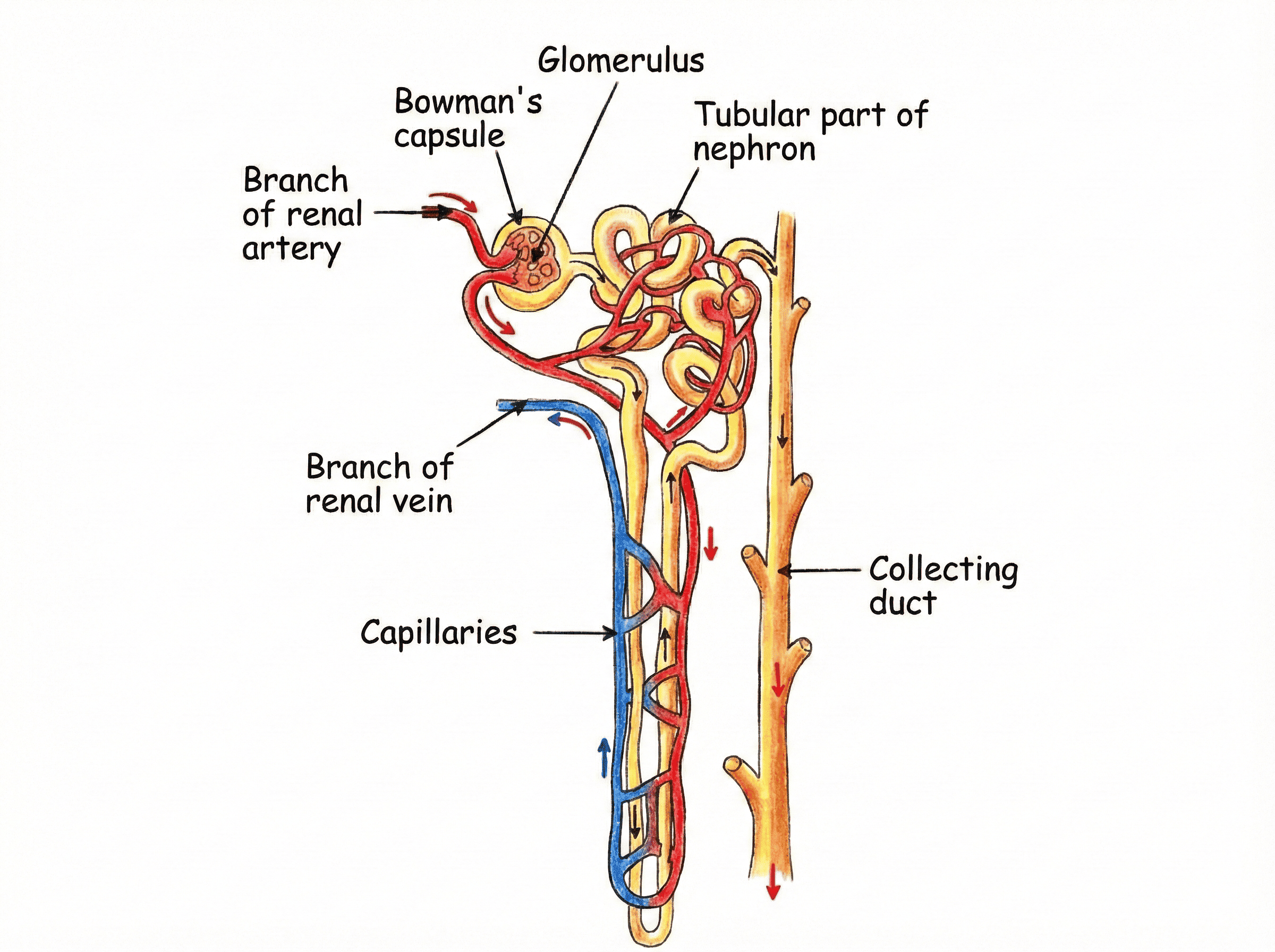
- Bowman's Capsule: A cup-like structure at the beginning of the nephron.
- Glomerulus: A dense network of blood capillaries positioned inside Bowman's capsule.
- Renal Tubule: A long, coiled duct divided into the proximal tubule, Loop of Henle, distal tubule, and collecting duct, where selective reabsorption occurs.
37.
Ans: Urine formation in the human kidney occurs in three distinct stages within the nephron:
- Ultrafiltration (Glomerular Filtration): Blood enters the glomerulus under high pressure through the afferent arteriole. Water, glucose, amino acids, salts, and urea are filtered through the capillary walls into Bowman's capsule, forming the initial filtrate. Large blood cells and proteins cannot pass and remain in the blood.
- Selective Reabsorption: As the filtrate flows down the renal tubule, essential substances needed by the body (all glucose, all amino acids, major salts, and a regulated amount of water) are actively and passively reabsorbed by the tubular cells and returned to the surrounding blood capillaries.
- Tubular Secretion: Excess potassium ions, hydrogen ions, ammonia, and drug residues are actively secreted by the tubular cells from the blood capillaries into the renal tubule, adjusting urine pH. The remaining concentrated fluid is urine.
38.
Ans: Water reabsorption in the nephron tubule is a highly regulated homeostatic process that depends on the body's hydration state.
Two major factors regulating water reabsorption:
- Amount of excess water in the body: If the body is highly hydrated, very little water is reabsorbed, resulting in dilute urine. If dehydrated, maximum water is reabsorbed, resulting in concentrated urine.
- Amount of dissolved waste to be excreted: A higher concentration of dissolved solutes (like urea and salts) requires a corresponding amount of water to remain in the tubule for excretion to prevent solute crystallization.
Hormonal control: Regulated by Antidiuretic Hormone (ADH) secreted by the pituitary gland, which makes the collecting ducts highly permeable to water.
39.
Ans: Hemodialysis (Artificial Kidney): A medical treatment used to filter metabolic wastes from the blood of patients suffering from acute or chronic renal (kidney) failure.
How it works: Blood is drawn from an artery, mixed with an anticoagulant, and pumped through semi-permeable cellophane tubes of a dialyzer. These tubes are immersed in a dialysing fluid that has the same osmotic pressure and solute composition as normal blood plasma, but contains zero nitrogenous waste. Wastes like urea diffuse out of the blood across the cellophane membrane into the dialysing fluid. The cleaned blood is then warmed, mixed with an anti-coagulant reversal agent, and returned to a vein.
Key Difference: A natural kidney has a highly regulated system for selective reabsorption of water and nutrients along the tubule. An artificial kidney has no reabsorption mechanism; it only removes waste via passive diffusion, requiring the dialysing fluid to be precisely pre-balanced.
Key Difference: A natural kidney has a highly regulated system for selective reabsorption of water and nutrients along the tubule. An artificial kidney has no reabsorption mechanism; it only removes waste via passive diffusion, requiring the dialysing fluid to be precisely pre-balanced.
40.
Ans: Plants do not have specialized excretory organs, but they use several highly effective strategies to get rid of their metabolic wastes:
- Gaseous Wastes ($\text{O}_2$ and $\text{CO}_2$): Eliminated by simple diffusion through stomata in leaves and lenticels in stems.
- Transpiration: Excess water is removed as water vapour through stomata.
- Storage in leaves (Senescence): Many solid and liquid wastes are stored inside cellular vacuoles of older leaves. When these leaves turn yellow and fall off, the waste is removed.
- Resins & Gums: Wastes are stored in old, non-functional xylem vessels as sticky resins and gums, which ooze out of bark.
- Soil Secretion: Plants secrete some waste substances directly into the surrounding soil through their roots.
Topic 5 Solutions: Competency-Based Case Studies & Integrated Questions
Case Study 1: The Variegated Leaf Experiment
Money Plant starch test.
41.
Ans: Solutions based on Case Study 1:
- Why green parts turn blue-black: The green parts contain chlorophyll, which absorbs sunlight to perform photosynthesis and synthesize glucose, stored as starch. Iodine reacts with starch to turn blue-black. Non-green (white) parts lack chlorophyll, do not synthesize starch, and do not show a color change. This confirms chlorophyll is necessary for photosynthesis.
- Why boil in alcohol: Boiling in alcohol dissolves the green chlorophyll pigment, making the leaf pale and colourless. This is necessary because the intense green colour of a fresh leaf would mask the dark blue-black iodine-starch colour change.
Why a water bath is used: Alcohol is highly flammable and has a low boiling point. Direct heating over an open flame could cause it to boil over and catch fire. A water bath ensures safe heating. - Balanced equation: $$6\text{CO}_2 + 12\text{H}_2\text{O} \xrightarrow{\text{Chlorophyll \& Sunlight}} \text{C}_6\text{H}_{12}\text{O}_6 + 6\text{O}_2 + 6\text{H}_2\text{O}$$
Case Study 2: The Yeast Fermentation Setup
Fruit juice and yeast anaerobic path.
42.
Ans: Solutions based on Case Study 2:
- Name of process: Anaerobic Respiration or Alcoholic Fermentation. It occurs in the complete absence of oxygen.
- Balanced chemical equation (in Yeast): $$\text{C}_6\text{H}_{12}\text{O}_6(aq) \xrightarrow{\text{In Cytoplasm}} 2\text{C}_2\text{H}_5\text{OH}(aq) \text{ (Ethanol)} + 2\text{CO}_2(g) + 2\text{ATP}$$
- Gas identified & milkiness equation: The gas is carbon dioxide ($\text{CO}_2$). $$\text{Ca(OH)}_2(aq) \text{ (Lime Water)} + \text{CO}_2(g) \rightarrow \text{CaCO}_3(s)\downarrow \text{ (White precipitate)} + \text{H}_2\text{O}(l)$$
Case Study 3: The Blood Pressure Measurement
Ramesh measured BP of 145/95.
43.
Ans: Solutions based on Case Study 3:
- Reading representation:
- 145 mm Hg: Systolic pressure (arterial pressure during ventricular contraction). Normal value is 120 mm Hg.
- 95 mm Hg: Diastolic pressure (arterial pressure during ventricular relaxation). Normal value is 80 mm Hg.
- Medical condition & risks: Ramesh suffers from Hypertension (High Blood Pressure). If left untreated, chronic hypertension forces the heart to work harder, damages arterial walls, and increases the risk of heart attacks, stroke, and kidney failure.
- Why salt raises BP: High sodium intake increases the sodium concentration in the blood. By osmosis, water is drawn out of body cells into the bloodstream to balance the concentration, increasing blood volume. This higher blood volume puts more pressure on the arterial walls, raising blood pressure.
Case Study 4: The Dialysis Patient
Mrs. Sharma hemodialysis process.
44.
Ans: Solutions based on Case Study 4:
- Dialysing fluid composition: It has the same osmotic pressure and exact concentrations of glucose, amino acids, and essential salts as normal, healthy blood plasma. However, it contains zero nitrogenous waste (urea).
- Metabolic waste removed & mechanism: Urea is removed. Since the dialysing fluid has zero urea, urea molecules in Mrs. Sharma's blood move down their concentration gradient, diffusing across the semi-permeable cellophane tube walls into the dialysing fluid by passive diffusion.
- Low urine output & lack of reabsorption: Mrs. Sharma's natural kidneys have failed, meaning glomerular filtration is near zero, resulting in little to no urine production. The artificial kidney does not require a reabsorption mechanism because the dialysing fluid is already balanced with glucose and salts, meaning there is no concentration gradient for these essential molecules to diffuse out of the blood. Only urea diffuses out.
Case Study 5: The Carbon Dioxide Production Test
Seeds and KOH respiration test.
45.
Ans: Solutions based on Case Study 5:
- Role of KOH: Potassium hydroxide (KOH) is placed to absorb all carbon dioxide gas ($\text{CO}_2$) produced by the seeds inside the flask: $$2\text{KOH} + \text{CO}_2 \rightarrow \text{K}_2\text{CO}_3 + \text{H}_2\text{O}$$
- Why water level rose in Flask A: Germinating seeds are actively respiring, absorbing oxygen ($\text{O}_2$) gas and releasing $\text{CO}_2$ gas. The released $\text{CO}_2$ is immediately absorbed by the KOH solution. As a result, the volume of air inside Flask A decreases, creating a partial vacuum. The higher atmospheric pressure outside pushes water up the delivery tube.
- Why Flask B showed no change: Boiled, dry seeds are dead and do not perform respiration. Since there was no oxygen consumption or $\text{CO}_2$ release, the air pressure inside remained unchanged. This experiment proves that respiring tissues produce carbon dioxide gas.
Competency Check: The Transpiration Challenge
Water droplets in Jar A.
46.
Ans: Solutions based on the Transpiration Challenge:
- Biological process: Transpiration. It is the loss of water in the form of water vapour from the stomatal pores of the plant's leaves. The transpired water vapour condenses on the cool glass walls of Jar A to form droplets.
- How it helps water movement: As water evaporates from leaf cells during transpiration, it creates a negative pressure (suction) inside the leaf xylem. Due to cohesive forces between water molecules, this suction pull (transpiration pull) is transmitted down to the roots, pulling water and minerals upwards like a straw.
- Factors increasing rate:
- High Temperature: Increases evaporation rate.
- Low Humidity: Increases the concentration gradient between leaf interior and outside air.
- Wind Speed: Moves water vapour away from the leaf surface, speeding up diffusion.
Integrated Puzzle: The Mystery Organ 'X'
Pump organ pumping blood.
47.
Ans: Solutions based on the Integrated Puzzle:
- Identification:
- Organ 'X' is the Human Heart.
- Fluid 'Y' is Oxygenated Blood; Fluid 'Z' is Deoxygenated Blood.
- Tube 'A' is the Pulmonary Vein; Tube 'B' is the Aorta.
- Tube 'C' is the Vena Cava; Tube 'D' is the Pulmonary Artery.
- Why Left Ventricle has thick walls: The right ventricle only pumps deoxygenated blood a short distance to the lungs (pulmonary circulation). The left ventricle must pump oxygenated blood throughout the entire body (systemic circulation) against high resistance. It requires highly thick, muscular walls to generate the massive pressure needed.
- If valves fail: Valves ensure that blood flows in only one direction. If the valves fail, blood will flow backwards during contractions, causing mixing of blood, lowering blood pressure, and severely reducing oxygen supply to the body.
48.
Ans: Gaseous exchange in leaves during a 24-hour cycle:
- During Daytime: Both photosynthesis and respiration occur. The rate of photosynthesis is much faster than respiration. The $\text{CO}_2$ released during respiration is immediately consumed for photosynthesis. Therefore, there is net absorption of $\text{CO}_2$ and net release of oxygen ($\text{O}_2$) through stomata.
- During Nighttime: No photosynthesis occurs. Only cellular respiration takes place. The plant cells absorb oxygen from the air and release carbon dioxide. Therefore, there is net absorption of $\text{O}_2$ and net release of $\text{CO}_2$.
49.
Ans: Emulsification of fats: The physical breakdown of large fat globules into millions of tiny fat droplets using bile salts.
Why necessary: Lipase is a water-soluble enzyme, whereas fats are hydrophobic and exist as large clumps. Emulsification increases the surface area for lipase action, allowing rapid fat digestion.
Organ & gland responsible: The Liver secretes bile for emulsification, and the Pancreas secretes lipase for fat digestion in the small intestine.
Organ & gland responsible: The Liver secretes bile for emulsification, and the Pancreas secretes lipase for fat digestion in the small intestine.
50.
Ans: Roles of digestive glands/juices:
- Salivary Amylase: Secreted by salivary glands in the mouth. It breaks down complex starch molecules into simple maltose sugar: $$\text{Starch} \xrightarrow{\text{Salivary Amylase}} \text{Maltose}$$
- Gastric Glands:
- Pepsin: Digests proteins into smaller peptides in an acidic medium.
- Mucus: Coats the inner stomach lining, protecting it from corrosion by gastric $\text{HCl}$.
- Pancreas:
- Trypsin: Digests proteins into amino acids in an alkaline medium.
- Lipase: Hydrolyses emulsified fat droplets into fatty acids and glycerol.
51.
Ans: Factors affecting the rate of photosynthesis:
- Light Intensity: As light intensity increases, the rate increases proportionally, but eventually plateaus as other factors (like chlorophyll saturation) become limiting.
- CO2 Concentration: Low $\text{CO}_2$ levels limit the dark reactions, reducing sugar synthesis and lowering the rate of photosynthesis.
- Extreme Temperatures: Photosynthesis is an enzyme-driven process. Extremely high temperatures (above 40°C) denature the enzymes (like RuBisCO) and close stomata to prevent water loss, causing the rate of photosynthesis to drop to zero.
52.
Ans: Glycolysis: The step-by-step anaerobic breakdown of a 6-carbon glucose molecule into two molecules of a 3-carbon compound inside the cell cytoplasm.
Product formed: Pyruvate (or pyruvic acid).
Carbon count: Pyruvate contains exactly 3 carbon atoms ($\text{CH}_3\text{COCOOH}$).
Carbon count: Pyruvate contains exactly 3 carbon atoms ($\text{CH}_3\text{COCOOH}$).
53.
Ans: The respiratory surface of a human lung is composed of the combined surfaces of about 400 million alveoli.
How it helps in rapid diffusion:
The diffusion rate is directly proportional to the surface area (Fick's law of diffusion). The massive surface area (~80 square meters) provided by alveoli ensures that a huge volume of oxygen can diffuse into the blood capillaries simultaneously, while carbon dioxide diffuses out, meeting the high metabolic demands of the human body.
54.
Ans: Circulation differences:
- Single Circulation: Blood flows through the heart only once during one complete circuit of the body (e.g., in fish).
- Double Circulation: Blood flows through the heart twice (pulmonary and systemic) during one complete circuit of the body (e.g., in mammals).
55.
Ans: Plants are stationary organisms and do not need to move to find food or shelter.
Reason for low energy needs:
A large proportion of plant tissues (such as wood, sclerenchyma, and xylem vessels) is composed of dead cells that do not perform active metabolism and require zero energy. Only a small fraction of cells are living. Consequently, plants have very low energy requirements and can survive with a slow transport system driven primarily by simple physical forces (osmosis and transpiration).
56.
Ans: Transpiration pull: Created as water molecules evaporate from the leaf stomata. The continuous loss of water creates a suction force that pulls water up the xylem vessels due to cohesive forces.
Why a "necessary evil":
- Evil: It causes massive water loss (more than 95% of absorbed water evaporates), which can lead to wilting and death during dry droughts.
- Necessary: It is the only way for plants to absorb water and essential minerals from the soil and transport them to tall heights. It also cools the plant.
57.
Ans: Explanations for waste elimination:
- Excretion: The filtering and removal of chemical metabolic wastes (like urea) from body cells/blood.
- Egestion: The elimination of solid, undigested food waste (faeces) from the digestive tract through the anus.
- Aquatic animals (Fish) $\rightarrow$ Ammonia (requires high water to excrete).
- Birds & Reptiles $\rightarrow$ Uric acid (semi-solid paste, conserves water).
- Mammals (Humans) $\rightarrow$ Urea (soluble in water, moderate toxicity).
58.
Ans: The Glomerulus acts as a micro-filter. Blood enters under high hydrostatic pressure because the afferent arteriole is wider than the efferent arteriole, creating pressure.
Filtering function & barriers:
The filtration membrane has extremely tiny pores (fenestrations) that allow water and small solutes to pass into Bowman's capsule. Large blood cells (RBCs, WBCs) and massive plasma proteins (like albumin) are physically too large to pass through these pores and remain in the bloodstream, preventing protein loss.
59.
Ans: Selective reabsorption: The process of reabsorbing essential substances from the initial glomerular filtrate back into the surrounding blood capillaries as the fluid passes along the renal tubule.
Three substances completely reabsorbed:
- Glucose: The primary energy source for cellular respiration.
- Amino acids: The building blocks required for protein synthesis.
- Salts (Sodium/Potassium): Required to maintain blood osmotic balance and pH.
60.
Ans: Plants manage gaseous wastes based on the day-night cycle:
- During Daytime: Photosynthesis is highly active: $$6\text{CO}_2 + 6\text{H}_2\text{O} \rightarrow \text{C}_6\text{H}_{12}\text{O}_6 + 6\text{O}_2$$ The oxygen produced acts as a waste product of photosynthesis and diffuses out of stomata.
- During Nighttime: Only respiration occurs: $$\text{C}_6\text{H}_{12}\text{O}_6 + 6\text{O}_2 \rightarrow 6\text{CO}_2 + 6\text{H}_2\text{O}$$ The carbon dioxide produced acts as a waste product of respiration and diffuses out of stomata.
61.
Ans: Observation: The leaf will not turn blue-black when tested with iodine. It remains brown/colourless.
Why kept in the dark first (Destarching):
Placing the plant in a dark room for 3 days stops photosynthesis completely. During this time, the plant cells consume all their pre-existing stored starch reserves for respiration. This ensures that any starch detected later in the experiment is newly synthesized in sunlight, providing a clean experimental control.
62.
Ans: Why lymph is clear: Lymph originates from blood plasma that filters out through capillary pores. These pores are extremely small. While water, salts, and small proteins pass through easily, red blood cells (RBCs) and large platelets are too large to pass and remain in the capillary blood.
Since it lacks red blood cells and hemoglobin, lymph is a clear, light-yellow fluid.
63.
Ans: Opening and closing of stomata is driven by turgidity changes:
- Opening: Light triggers active transport of potassium ions ($\text{K}^+$) into the guard cells. This raises the solute concentration, drawing water into the guard cells by osmosis. The guard cells swell, curve outwards due to their thick inner walls, and open the pore.
- Closing: In the dark or during water stress, potassium ions pump out of the guard cells. Solute concentration drops, and water moves out of the guard cells by osmosis. The guard cells lose turgor pressure, flatten, and close the stomatal pore.
64.
Ans: At high altitudes, the atmospheric pressure is low, meaning the partial pressure of oxygen is low, making it harder for oxygen to diffuse into the blood.
Body adaptations over a few weeks:
- The kidneys secrete erythropoietin, stimulating the bone marrow to produce more red blood cells (RBCs) to increase oxygen-carrying capacity.
- The breathing rate and heart rate increase to pump blood faster.
- The binding affinity of hemoglobin decreases slightly, allowing it to release oxygen more easily to the tissues.
65.
Ans: Evaluation of uremia treatment options:
- Hemodialysis:
- Efficacy: Highly effective at filtering urea and extending life.
- *Lifestyle Impact:* Severe. Requires visiting a clinic 2-3 times a week for 4 hours, which is exhausting.
- *Risks:* High risk of vascular access infections, blood pressure drops, and cardiovascular strain over time.
- Kidney Transplant:
- *Efficacy:* Excellent. Restores complete renal function, including selective reabsorption and hormone production.
- *Lifestyle Impact:* Returns the patient to a highly normal, active life.
- *Risks:* Major surgical risks, scarce donor availability, and the lifetime requirement of immunosuppressant drugs which increase infection susceptibility.