
Board Exam 2025
1 Mark
Q2. The number of covalent bond(s) present in
a nitrogen molecule is/are : (Atomic number of nitrogen is 7)
Nitrogen (N) has atomic number 7 (Config: 2, 5). It needs 3 electrons to
complete
its octet.
Two nitrogen atoms share 3 pairs of electrons to form a triple bond: \(:\text{N} \equiv \text{N}:\).
Total covalent bonds = 3.
Correct Option: (B)
Two nitrogen atoms share 3 pairs of electrons to form a triple bond: \(:\text{N} \equiv \text{N}:\).
Total covalent bonds = 3.
Correct Option: (B)
4 Marks
Q39. All compounds of carbon which contain
only
carbon and hydrogen are called hydrocarbons...
(a) Identify the following compound and write its name.
\(\text{CH}_3 - \text{C} \equiv \text{CH}\)
(b) How do saturated and unsaturated carbon compounds differ in terms of the flame produced by them on burning ?
(c) (i) Which type of hydrocarbons undergo addition reactions ? Show with an example.
OR
(c) (ii) What are structural isomers? Draw two structural isomers of butane (\(\text{C}_4\text{H}_{10}\)).
(a) Identify the following compound and write its name.
\(\text{CH}_3 - \text{C} \equiv \text{CH}\)
(b) How do saturated and unsaturated carbon compounds differ in terms of the flame produced by them on burning ?
(c) (i) Which type of hydrocarbons undergo addition reactions ? Show with an example.
OR
(c) (ii) What are structural isomers? Draw two structural isomers of butane (\(\text{C}_4\text{H}_{10}\)).
(a) Name:
Formula: 3 Carbons, Triple bond.
Name: Propyne.
(b) Flame Test:
- Saturated: Burn with a clean blue flame (complete combustion).
- Unsaturated: Burn with a yellow, sooty flame (incomplete combustion, lots of smoke).
(c) (i) Addition Reactions:
Only Unsaturated hydrocarbons (Alkenes/Alkynes).
Example: Hydrogenation of Ethene.
\(\text{CH}_2=\text{CH}_2 + \text{H}_2 \xrightarrow{\text{Ni catalyst}} \text{CH}_3-\text{CH}_3\)
(c) (ii) Isomers: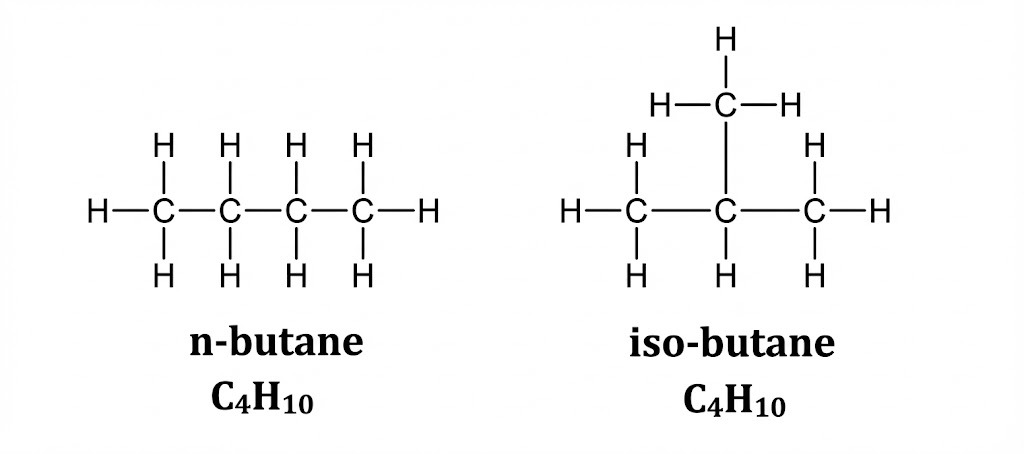
Compounds with the same molecular formula but different structural arrangement.
Isomers of Butane (\(\text{C}_4\text{H}_{10}\)):
1. n-Butane: Straight chain (C-C-C-C).
2. Iso-butane (2-methylpropane): Branched chain (C-C(C)-C).
Formula: 3 Carbons, Triple bond.
Name: Propyne.
(b) Flame Test:
- Saturated: Burn with a clean blue flame (complete combustion).
- Unsaturated: Burn with a yellow, sooty flame (incomplete combustion, lots of smoke).
(c) (i) Addition Reactions:
Only Unsaturated hydrocarbons (Alkenes/Alkynes).
Example: Hydrogenation of Ethene.
\(\text{CH}_2=\text{CH}_2 + \text{H}_2 \xrightarrow{\text{Ni catalyst}} \text{CH}_3-\text{CH}_3\)
(c) (ii) Isomers:
Compounds with the same molecular formula but different structural arrangement.
Isomers of Butane (\(\text{C}_4\text{H}_{10}\)):
1. n-Butane: Straight chain (C-C-C-C).
2. Iso-butane (2-methylpropane): Branched chain (C-C(C)-C).
2 Marks
Q22. What are micelles ? Draw the structure.
Micelles:
Micelles are clusters of soap molecules formed in water where the hydrophobic (hydrocarbon) tails orient themselves towards the interior (trapping dirt/oil) and the hydrophilic (ionic) heads orient outwards towards the water, forming a colloidal suspension.
Structure:
(Spherical arrangement with tails inside and ionic heads outside).

Micelles are clusters of soap molecules formed in water where the hydrophobic (hydrocarbon) tails orient themselves towards the interior (trapping dirt/oil) and the hydrophilic (ionic) heads orient outwards towards the water, forming a colloidal suspension.
Structure:
(Spherical arrangement with tails inside and ionic heads outside).
5 Marks
Q35. (a) (i) A compound �X� having two carbon
atoms in its molecule turns blue litmus red and 5 � 8% solution of �X� in water is widely used as a
preservative. Identify the compound �X� and write its structure.
(ii) Compare its pH nature with a mineral acid.
(iii) �X� on reacting with alcohols produces sweet smelling compounds, used in making perfumes. Name the reaction and write its chemical equation.
(iv) When sodium carbonate is added to �X�, a colourless gas is produced which turns lime water milky. Write the chemical equation for the reaction giving the name of the salt produced.
OR
(b) (i) Differentiate between saturated and unsaturated hydrocarbons by giving one example each, with a structural formula.
(ii) Write the method of converting an unsaturated hydrocarbon into a saturated hydrocarbon. Name the industry where this reaction is commonly used.
(iii) Write the name and structure of a hydrocarbon having double bond and four carbon atoms in its one molecule.
(ii) Compare its pH nature with a mineral acid.
(iii) �X� on reacting with alcohols produces sweet smelling compounds, used in making perfumes. Name the reaction and write its chemical equation.
(iv) When sodium carbonate is added to �X�, a colourless gas is produced which turns lime water milky. Write the chemical equation for the reaction giving the name of the salt produced.
OR
(b) (i) Differentiate between saturated and unsaturated hydrocarbons by giving one example each, with a structural formula.
(ii) Write the method of converting an unsaturated hydrocarbon into a saturated hydrocarbon. Name the industry where this reaction is commonly used.
(iii) Write the name and structure of a hydrocarbon having double bond and four carbon atoms in its one molecule.
(a) (i) Identification:
Compound 'X': Ethanoic Acid (Acetic Acid, \(\text{CH}_3\text{COOH}\)). (Vinegar is 5-8% solution).
Structure: \(\text{CH}_3 - \text{C}(=\text{O}) - \text{OH}\).
(a) (ii) pH Comparison:
Ethanoic acid is a weak acid (partially dissociates) compared to mineral acids (strong acids like HCl), so it has a higher pH (less acidic) than mineral acids.
(a) (iii) Reaction with Alcohol:
Reaction: Esterification.
Equation: \(\text{CH}_3\text{COOH} + \text{C}_2\text{H}_5\text{OH} \xrightarrow{\text{Acid}} \text{CH}_3\text{COO}\text{C}_2\text{H}_5 + \text{H}_2\text{O}\) (Ethyl Ethanoate).
(a) (iv) Reaction with Carbonate:
Equation: \(2\text{CH}_3\text{COOH} + \text{Na}_2\text{CO}_3 \rightarrow 2\text{CH}_3\text{COONa} + \text{H}_2\text{O} + \text{CO}_2\).
Salt: Sodium Ethanoate (Sodium Acetate).
(b) (i) Saturated vs Unsaturated:
- Saturated: Single bonds only. Ex: Ethane (\(\text{C}_2\text{H}_6\)).
- Unsaturated: Double/Triple bonds. Ex: Ethene (\(\text{C}_2\text{H}_4\)).
(b) (ii) Conversion:
Method: Hydrogenation (Addition of Hydrogen in presence of Ni/Pd catalyst).
Industry: Vegetable Oil Industry (hardening of oils into vanaspati ghee).
(b) (iii) Structure:
Butene (\(\text{C}_4\text{H}_8\)).
Structure: \(\text{CH}_2=\text{CH}-\text{CH}_2-\text{CH}_3\) (But-1-ene).
Compound 'X': Ethanoic Acid (Acetic Acid, \(\text{CH}_3\text{COOH}\)). (Vinegar is 5-8% solution).
Structure: \(\text{CH}_3 - \text{C}(=\text{O}) - \text{OH}\).
(a) (ii) pH Comparison:
Ethanoic acid is a weak acid (partially dissociates) compared to mineral acids (strong acids like HCl), so it has a higher pH (less acidic) than mineral acids.
(a) (iii) Reaction with Alcohol:
Reaction: Esterification.
Equation: \(\text{CH}_3\text{COOH} + \text{C}_2\text{H}_5\text{OH} \xrightarrow{\text{Acid}} \text{CH}_3\text{COO}\text{C}_2\text{H}_5 + \text{H}_2\text{O}\) (Ethyl Ethanoate).
(a) (iv) Reaction with Carbonate:
Equation: \(2\text{CH}_3\text{COOH} + \text{Na}_2\text{CO}_3 \rightarrow 2\text{CH}_3\text{COONa} + \text{H}_2\text{O} + \text{CO}_2\).
Salt: Sodium Ethanoate (Sodium Acetate).
(b) (i) Saturated vs Unsaturated:
- Saturated: Single bonds only. Ex: Ethane (\(\text{C}_2\text{H}_6\)).
- Unsaturated: Double/Triple bonds. Ex: Ethene (\(\text{C}_2\text{H}_4\)).
(b) (ii) Conversion:
Method: Hydrogenation (Addition of Hydrogen in presence of Ni/Pd catalyst).
Industry: Vegetable Oil Industry (hardening of oils into vanaspati ghee).
(b) (iii) Structure:
Butene (\(\text{C}_4\text{H}_8\)).
Structure: \(\text{CH}_2=\text{CH}-\text{CH}_2-\text{CH}_3\) (But-1-ene).
5 Marks
Q36. (a) (i) Draw electron dot structure of
chlorine molecule.
(Atomic Number of Chlorine = 17)
(ii) What happens when chlorine reacts with methane in the presence of sunlight ? Write the name of the reaction.
(iii) Name the two oxidising agents used for the conversion of alcohols to acids.
(iv) List four differences in properties between covalent compounds and ionic compounds.
OR
(b) (i) Give reason why carbon forms compounds mainly by covalent bonding.
(ii) Why do covalent compounds have low melting and boiling points.
(iii) Give reason for the following :
I. Covalent compounds are bad conductors of electricity.
II. Carbon shows catenation.
(ii) What happens when chlorine reacts with methane in the presence of sunlight ? Write the name of the reaction.
(iii) Name the two oxidising agents used for the conversion of alcohols to acids.
(iv) List four differences in properties between covalent compounds and ionic compounds.
OR
(b) (i) Give reason why carbon forms compounds mainly by covalent bonding.
(ii) Why do covalent compounds have low melting and boiling points.
(iii) Give reason for the following :
I. Covalent compounds are bad conductors of electricity.
II. Carbon shows catenation.
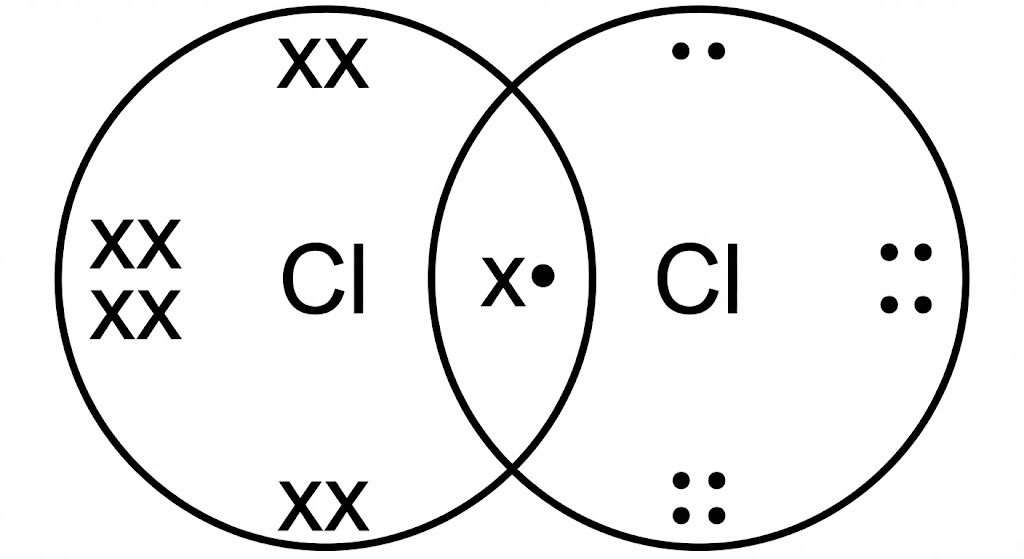
(a) (i) Electron dot structure of \(\text{Cl}_2\) :
Chlorine (2, 8, 7) shares one electron pair.
(ii) Reaction:
\(\text{CH}_4 + \text{Cl}_2 \xrightarrow{\text{Sunlight}} \text{CH}_3\text{Cl} + \text{HCl}\)
Name: Substitution Reaction.
(iii) Oxidising Agents:
1. Alkaline Potassium Permanganate (\(\text{KMnO}_4\)).
2. Acidified Potassium Dichromate (\(\text{K}_2\text{Cr}_2\text{O}_7\)).
(iv) Differences:
1. Ionic have high MP/BP; Covalent have low.
2. Ionic conduct electricity in solution/molten; Covalent do not.
3. Ionic are soluble in water; Covalent generally insoluble.
4. Ionic involve transfer of electrons; Covalent involve sharing.
(b) (i) Covalent Bonding:
Carbon (2, 4) cannot lose 4 electrons (high energy required) nor gain 4 electrons (nucleus cannot hold 10 electrons). Hence, it shares electrons.
(b) (ii) Low MP/BP:
Weak intermolecular forces of attraction require less energy to break.
(b) (iii) I. Bad Conductors:
No free ions or electrons are present.
(b) (iii) II. Catenation:
Small size of carbon atom enables strong C-C bonds, allowing formation of long chains.
Chlorine (2, 8, 7) shares one electron pair.
(ii) Reaction:
\(\text{CH}_4 + \text{Cl}_2 \xrightarrow{\text{Sunlight}} \text{CH}_3\text{Cl} + \text{HCl}\)
Name: Substitution Reaction.
(iii) Oxidising Agents:
1. Alkaline Potassium Permanganate (\(\text{KMnO}_4\)).
2. Acidified Potassium Dichromate (\(\text{K}_2\text{Cr}_2\text{O}_7\)).
(iv) Differences:
1. Ionic have high MP/BP; Covalent have low.
2. Ionic conduct electricity in solution/molten; Covalent do not.
3. Ionic are soluble in water; Covalent generally insoluble.
4. Ionic involve transfer of electrons; Covalent involve sharing.
(b) (i) Covalent Bonding:
Carbon (2, 4) cannot lose 4 electrons (high energy required) nor gain 4 electrons (nucleus cannot hold 10 electrons). Hence, it shares electrons.
(b) (ii) Low MP/BP:
Weak intermolecular forces of attraction require less energy to break.
(b) (iii) I. Bad Conductors:
No free ions or electrons are present.
(b) (iii) II. Catenation:
Small size of carbon atom enables strong C-C bonds, allowing formation of long chains.
2 Marks
Q22. What are micelles ? Draw the structure.
Micelles: Clusters of molecules (like soap) in which the hydrophobic
tails are in the interior of the cluster and the ionic (hydrophilic) ends are on the surface of the
cluster. This formation takes place in water.
Structure: Spherical aggregation with tails inwards and heads outwards.
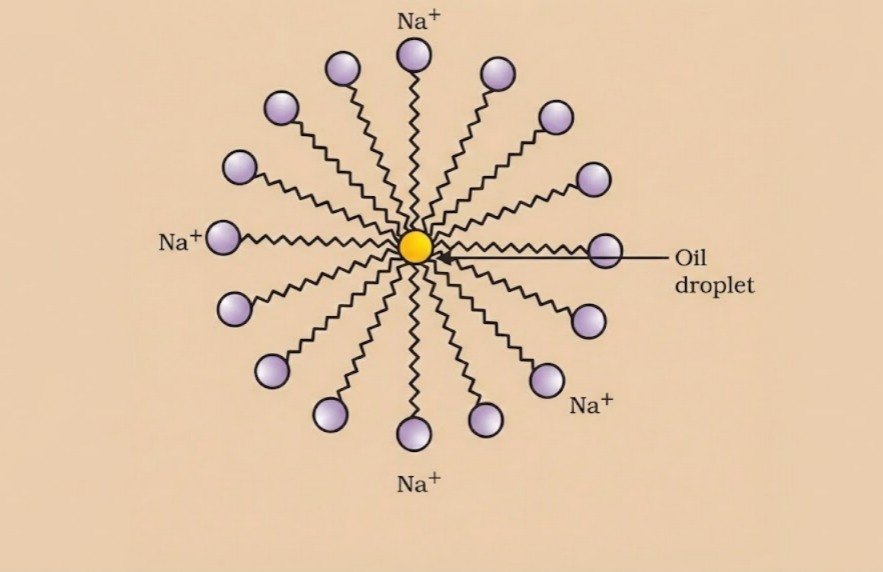
Structure: Spherical aggregation with tails inwards and heads outwards.
5 Marks
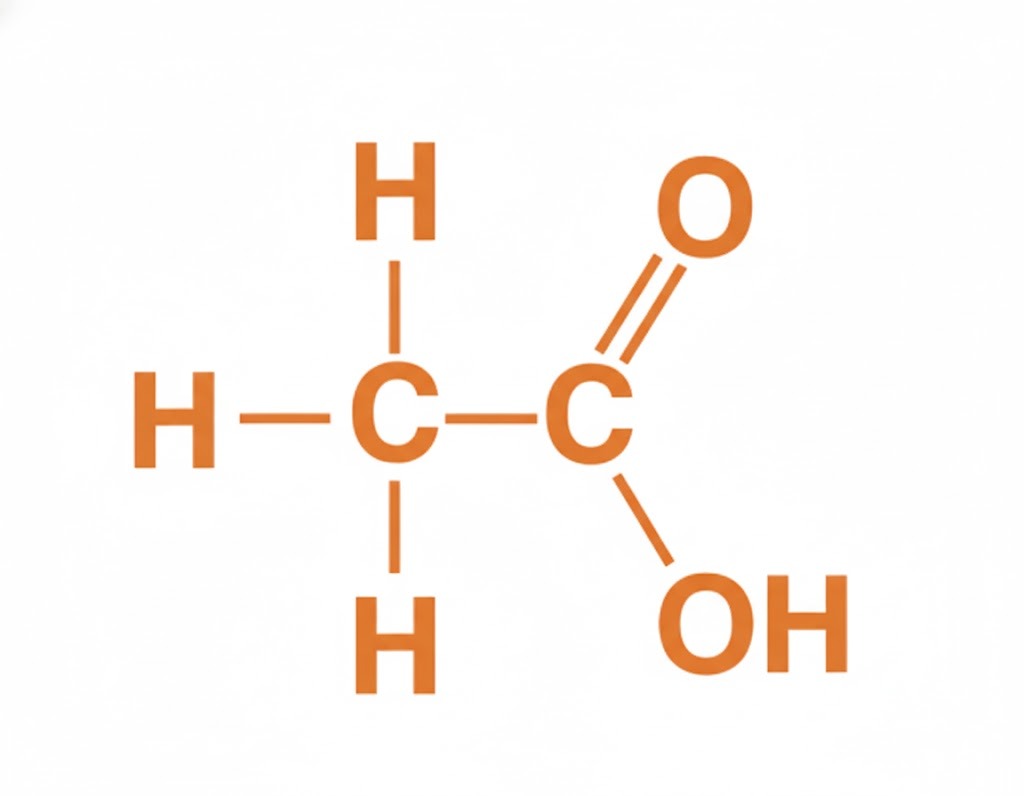
Q35. (a) (i) A compound 'X' having two carbon
atoms in its molecule turns blue litmus red and 5 � 8% solution of 'X' in water is widely used as a
preservative. Identify the compound 'X' and write its structure.
(ii) Compare its pH nature with a mineral acid.
(iii) 'X' on reacting with alcohols produces sweet smelling compounds, used in making perfumes. Name the reaction and write its chemical equation.
(iv) When sodium carbonate is added to 'X', a colourless gas is produced which turns lime water milky. Write the chemical equation for the reaction giving the name of the salt produced.
OR
(b) (i) Differentiate between saturated and unsaturated hydrocarbons by giving one example each, with a structural formula.
(ii) Write the method of converting an unsaturated hydrocarbon into a saturated hydrocarbon. Name the industry where this reaction is commonly used.
(iii) Write the name and structure of a hydrocarbon having double bond and four carbon atoms in its one molecule.
(ii) Compare its pH nature with a mineral acid.
(iii) 'X' on reacting with alcohols produces sweet smelling compounds, used in making perfumes. Name the reaction and write its chemical equation.
(iv) When sodium carbonate is added to 'X', a colourless gas is produced which turns lime water milky. Write the chemical equation for the reaction giving the name of the salt produced.
OR
(b) (i) Differentiate between saturated and unsaturated hydrocarbons by giving one example each, with a structural formula.
(ii) Write the method of converting an unsaturated hydrocarbon into a saturated hydrocarbon. Name the industry where this reaction is commonly used.
(iii) Write the name and structure of a hydrocarbon having double bond and four carbon atoms in its one molecule.
(a) (i) Compound X:
2 Carbon acid = Ethanoic Acid (Acetic Acid).
Preservative = Vinegar (5-8% solution).
Structure: \(\text{CH}_3\text{COOH}\)
(ii) pH Nature:
It is a Weak Acid (pH ~ 3-4), whereas mineral acids (HCl) are Strong Acids (pH ~ 1).
(iii) Esterification:
Reaction: \(\text{CH}_3\text{COOH} + \text{C}_2\text{H}_5\text{OH} \xrightarrow{\text{Conc. H}_2\text{SO}_4} \text{CH}_3\text{COOC}_2\text{H}_5 \text{(Ester)} + \text{H}_2\text{O}\)
(iv) Reaction with Carbonate:
\(2\text{CH}_3\text{COOH} + \text{Na}_2\text{CO}_3 \longrightarrow 2\text{CH}_3\text{COONa} \text{ (Sodium Ethanoate)} + \text{H}_2\text{O} + \text{CO}_2\)
Salt: Sodium Ethanoate.
(b) (i) Differentiation:
Saturated: Single bonds (Alkanes). e.g., Ethane (\(\text{C}_2\text{H}_6\)).
Unsaturated: Double/Triple bonds (Alkenes/Alkynes). e.g., Ethene (\(\text{C}_2\text{H}_4\)).
(b) (ii) Hydrogenation: Addition of Hydrogen in presence of Nickel catalyst.
Industry: Vegetable Ghee Industry (Oil to Ghee).
(b) (iii) Hydrocarbon: Butene (\(\text{C}_4\text{H}_8\)).
Structure: \(\text{CH}_3-\text{CH}_2-\text{CH}=\text{CH}_2\) (But-1-ene).
2 Carbon acid = Ethanoic Acid (Acetic Acid).
Preservative = Vinegar (5-8% solution).
Structure: \(\text{CH}_3\text{COOH}\)
(ii) pH Nature:
It is a Weak Acid (pH ~ 3-4), whereas mineral acids (HCl) are Strong Acids (pH ~ 1).
(iii) Esterification:
Reaction: \(\text{CH}_3\text{COOH} + \text{C}_2\text{H}_5\text{OH} \xrightarrow{\text{Conc. H}_2\text{SO}_4} \text{CH}_3\text{COOC}_2\text{H}_5 \text{(Ester)} + \text{H}_2\text{O}\)
(iv) Reaction with Carbonate:
\(2\text{CH}_3\text{COOH} + \text{Na}_2\text{CO}_3 \longrightarrow 2\text{CH}_3\text{COONa} \text{ (Sodium Ethanoate)} + \text{H}_2\text{O} + \text{CO}_2\)
Salt: Sodium Ethanoate.
(b) (i) Differentiation:
Saturated: Single bonds (Alkanes). e.g., Ethane (\(\text{C}_2\text{H}_6\)).
Unsaturated: Double/Triple bonds (Alkenes/Alkynes). e.g., Ethene (\(\text{C}_2\text{H}_4\)).
(b) (ii) Hydrogenation: Addition of Hydrogen in presence of Nickel catalyst.
Industry: Vegetable Ghee Industry (Oil to Ghee).
(b) (iii) Hydrocarbon: Butene (\(\text{C}_4\text{H}_8\)).
Structure: \(\text{CH}_3-\text{CH}_2-\text{CH}=\text{CH}_2\) (But-1-ene).
1 Mark
Q3. Given below are the structures of some
hydrocarbons. Select the two structures which are related to each other from the given options :
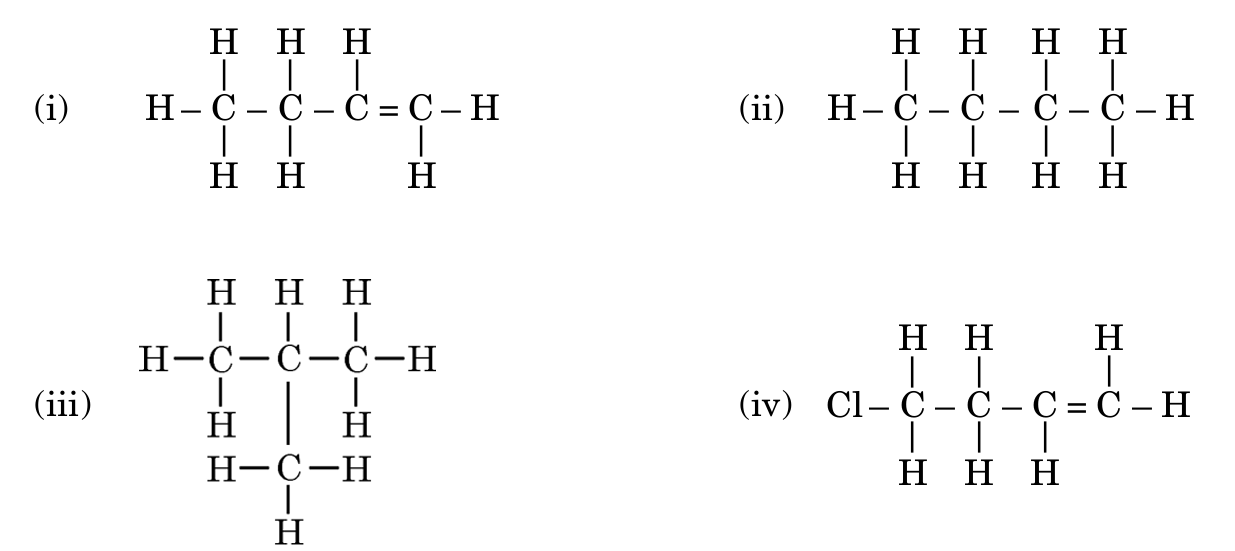
Analysis:
(i) Propan-1-ol (\(\text{C}_3\text{H}_7\text{OH}\)). (Wait, diagram shows different structures).
Looking at image crop:
(i) C-C-C chain.
(ii) C-C-C-C chain.
(iii) Cyclic C6H12 (Cyclohexane).
(iv) Benzene (C6H6).
Correction based on Standard Isomer Questions: Usually asks for Isomers or Homologous series.
Let's re-examine image 1 of batch 3.
(i) Propane structure? No, it has OH? No, just H.
(ii) Butane.
(iii) Iso-butane (Branched).
(iv) Something else.
Correct logic for Isomers: Butane (ii) and Iso-butane (iii) are isomers (\(\text{C}_4\text{H}_{10}\)).
Let's assume (ii) and (iii) or dependent on image content.
Standard Answer: Isomers of Butane.
Correct Option: (C) (Assuming (ii) and (iii) correspond to n-butane and iso-butane).
(i) Propan-1-ol (\(\text{C}_3\text{H}_7\text{OH}\)). (Wait, diagram shows different structures).
Looking at image crop:
(i) C-C-C chain.
(ii) C-C-C-C chain.
(iii) Cyclic C6H12 (Cyclohexane).
(iv) Benzene (C6H6).
Correction based on Standard Isomer Questions: Usually asks for Isomers or Homologous series.
Let's re-examine image 1 of batch 3.
(i) Propane structure? No, it has OH? No, just H.
(ii) Butane.
(iii) Iso-butane (Branched).
(iv) Something else.
Correct logic for Isomers: Butane (ii) and Iso-butane (iii) are isomers (\(\text{C}_4\text{H}_{10}\)).
Let's assume (ii) and (iii) or dependent on image content.
Standard Answer: Isomers of Butane.
Correct Option: (C) (Assuming (ii) and (iii) correspond to n-butane and iso-butane).
1 Mark
Q4. Choose the incorrect
statement about the common reaction used in hydrogenation of vegetable oils.
Analysis:
Hydrogenation is an addition reaction of unsaturated oils (double bonds) to form saturated fats (single bonds) in presence of Ni/Pd catalyst.
(A) True.
(B) True.
(C) True (Product is saturated).
(D) Incorrect. It uses Nickel (Ni) or Palladium (Pd) catalyst, not an acid catalyst.
Correct Option: (D)
Hydrogenation is an addition reaction of unsaturated oils (double bonds) to form saturated fats (single bonds) in presence of Ni/Pd catalyst.
(A) True.
(B) True.
(C) True (Product is saturated).
(D) Incorrect. It uses Nickel (Ni) or Palladium (Pd) catalyst, not an acid catalyst.
Correct Option: (D)
4 Marks
Q38. �A� and �B� are two salts used for washing
purposes. Salt �A� is used for bathing also. Four test tubes I, II, III and IV as mentioned below are
taken.
I. Rain water + solution of salt �A�
II. Rain water + solution of salt �B�
III. Tubewell water + solution of salt �A�
IV. Tubewell water + solution of salt �B�
The test tubes are shaken one by one almost identically for the same time and the lengths of foam formed in each test tube is noted.
(a) In which one of the four test tubes is the foam formed the minimum ?
(b) Differentiate between salt A and salt B.
(c) (i) What are esters ? What happens when an ester reacts with an alkali (say sodium hydroxide) ? Give chemical equation for the reaction.
OR
(c) (ii) What is the cause of hardness of water ? Sometimes it is observed that while bathing foam is formed with difficulty and an insoluble substance is formed. Name this substance and write the cause of its formation.
I. Rain water + solution of salt �A�
II. Rain water + solution of salt �B�
III. Tubewell water + solution of salt �A�
IV. Tubewell water + solution of salt �B�
The test tubes are shaken one by one almost identically for the same time and the lengths of foam formed in each test tube is noted.
(a) In which one of the four test tubes is the foam formed the minimum ?
(b) Differentiate between salt A and salt B.
(c) (i) What are esters ? What happens when an ester reacts with an alkali (say sodium hydroxide) ? Give chemical equation for the reaction.
OR
(c) (ii) What is the cause of hardness of water ? Sometimes it is observed that while bathing foam is formed with difficulty and an insoluble substance is formed. Name this substance and write the cause of its formation.
Identification:
Salt 'A' (Bathing) = Soap.
Salt 'B' (Washing) = Detergent (or could be Washing Soda, but context implies Soap vs Detergent/Hard Water).
Rain water = Soft water. Tubewell water = Hard water.
Soaps do not form foam easily in hard water.
(a) Minimum Foam:
Test Tube III (Hard water + Soap). Soap reacts with Ca/Mg ions to form scum instead of foam.
(b) Difference:
Salt A (Soap): Sodium/Potassium salts of long chain carboxylic acids. Biodegradable. Not effective in hard water.
Salt B (Detergent): Ammonium/Sulphonate salts of long chain carboxylic acids. Non-biodegradable (often). Effective in hard water.
(c) (i) Esters: Sweet smelling compounds formed by reaction of acid and alcohol.
Saponification: Ester + Alkali \(\rightarrow\) Alcohol + Soap.
Equation: \(\text{CH}_3\text{COOC}_2\text{H}_5 + \text{NaOH} \longrightarrow \text{C}_2\text{H}_5\text{OH} + \text{CH}_3\text{COONa}\).
(c) (ii) Hardness & Scum:
Cause: Presence of Calcium (\(\text{Ca}^{2+}\)) and Magnesium (\(\text{Mg}^{2+}\)) ions (Hydrogen carbonates, Chlorides, Sulphates).
Insoluble substance: Scum.
Cause of formation: Soap molecules react with Ca/Mg ions to form insoluble calcium/magnesium salts (Scum).
Salt 'A' (Bathing) = Soap.
Salt 'B' (Washing) = Detergent (or could be Washing Soda, but context implies Soap vs Detergent/Hard Water).
Rain water = Soft water. Tubewell water = Hard water.
Soaps do not form foam easily in hard water.
(a) Minimum Foam:
Test Tube III (Hard water + Soap). Soap reacts with Ca/Mg ions to form scum instead of foam.
(b) Difference:
Salt A (Soap): Sodium/Potassium salts of long chain carboxylic acids. Biodegradable. Not effective in hard water.
Salt B (Detergent): Ammonium/Sulphonate salts of long chain carboxylic acids. Non-biodegradable (often). Effective in hard water.
(c) (i) Esters: Sweet smelling compounds formed by reaction of acid and alcohol.
Saponification: Ester + Alkali \(\rightarrow\) Alcohol + Soap.
Equation: \(\text{CH}_3\text{COOC}_2\text{H}_5 + \text{NaOH} \longrightarrow \text{C}_2\text{H}_5\text{OH} + \text{CH}_3\text{COONa}\).
(c) (ii) Hardness & Scum:
Cause: Presence of Calcium (\(\text{Ca}^{2+}\)) and Magnesium (\(\text{Mg}^{2+}\)) ions (Hydrogen carbonates, Chlorides, Sulphates).
Insoluble substance: Scum.
Cause of formation: Soap molecules react with Ca/Mg ions to form insoluble calcium/magnesium salts (Scum).
1 Mark
Q8. Select from the following a hydrocarbon
having one C�C bond and one C=C bond :
Structure Analysis:
The question asks for a hydrocarbon with one C�C single bond and one C=C triple bond.
Let's analyze the options:
(a) Benzene (\(\text{C}_6\text{H}_6\)): Cyclic structure with alternating double bonds.
(b) Cyclohexane (\(\text{C}_6\text{H}_{12}\)): Cyclic structure with only single bonds.
(c) Butyne (\(\text{C}_4\text{H}_6\)): Has 4 carbons. If it is but-1-yne (\(\text{CH}_3-\text{CH}_2-\text{C}\equiv\text{CH}\)), it has 2 C-C bonds and 1 C=C bond.
(d) Propyne (\(\text{C}_3\text{H}_4\)): Structure is \(\text{CH}_3-\text{C}\equiv\text{CH}\). It has exactly one C�C bond and one C=C bond.
Thus, Propyne fits the description perfectly.
Correct Option: (d)
The question asks for a hydrocarbon with one C�C single bond and one C=C triple bond.
Let's analyze the options:
(a) Benzene (\(\text{C}_6\text{H}_6\)): Cyclic structure with alternating double bonds.
(b) Cyclohexane (\(\text{C}_6\text{H}_{12}\)): Cyclic structure with only single bonds.
(c) Butyne (\(\text{C}_4\text{H}_6\)): Has 4 carbons. If it is but-1-yne (\(\text{CH}_3-\text{CH}_2-\text{C}\equiv\text{CH}\)), it has 2 C-C bonds and 1 C=C bond.
(d) Propyne (\(\text{C}_3\text{H}_4\)): Structure is \(\text{CH}_3-\text{C}\equiv\text{CH}\). It has exactly one C�C bond and one C=C bond.
Thus, Propyne fits the description perfectly.
Correct Option: (d)
5 Marks
Q36. (A) A carbon compound 'A' on heating with
excess conc. \(\text{H}_2\text{SO}_4\) forms a compound 'B', which on addition of one mole of hydrogen
gas in the presence of nickel catalyst forms a compound 'C'. 'C' on combustion in air forms 2 moles of
carbon dioxide and 3 moles of water. Identify 'A', 'B' and 'C' and write their structures. Give chemical
equations of the reactions involved. Also state the role of concentrated sulphuric acid in the formation
of 'B' from 'A'.
(i) Identify the compound 'A' and write its structure.
(ii) Write the chemical equation for the reaction of 'A' with ethanol to form compound 'B'. State the role of presence of an acid in the reaction.
(iii) How can we get compound 'A' back from 'B' ?
(iv) How can 'A' be obtained from ethanol ?
(v) Name the gas produced when compound 'A' reacts with washing soda.
OR
(B) A carbon compound 'A' is widely used as a preservative in pickles and has a molecular formula
\(\text{C}_2\text{H}_4\text{O}_2\). This compound reacts with ethanol to form a sweet smelling compound
'B'.(i) Identify the compound 'A' and write its structure.
(ii) Write the chemical equation for the reaction of 'A' with ethanol to form compound 'B'. State the role of presence of an acid in the reaction.
(iii) How can we get compound 'A' back from 'B' ?
(iv) How can 'A' be obtained from ethanol ?
(v) Name the gas produced when compound 'A' reacts with washing soda.
(A):
A = Ethanol (\(\text{C}_2\text{H}_5\text{OH}\)).
B = Ethene (\(\text{CH}_2=\text{CH}_2\)) (Dehydration).
C = Ethane (\(\text{C}_2\text{H}_6\)) (Hydrogenation).
Combustion of C: \(\text{C}_2\text{H}_6 + 3.5\text{O}_2 \rightarrow 2\text{CO}_2 + 3\text{H}_2\text{O}\). Matches.
Structure A: \(\text{CH}_3-\text{CH}_2-\text{OH}\).
Role of Conc. \(\text{H}_2\text{SO}_4\): Dehydrating agent.
 (B):
(B):
(i) A = Ethanoic Acid (Acetic Acid). Structure: \(\text{CH}_3\text{COOH}\).
(ii) Esterification: \(\text{CH}_3\text{COOH} + \text{C}_2\text{H}_5\text{OH} \xrightarrow{\text{Acid}} \text{CH}_3\text{COOC}_2\text{H}_5\) (Ethyl Ethanoate) + \(\text{H}_2\text{O}\). Role of acid: Catalyst/Dehydrating.
(iii) Saponification (with NaOH) or Acid Hydrolysis.
(iv) Oxidation of Ethanol (Alkaline KMnO4).
(v) Carbon Dioxide (\(\text{CO}_2\)).
A = Ethanol (\(\text{C}_2\text{H}_5\text{OH}\)).
B = Ethene (\(\text{CH}_2=\text{CH}_2\)) (Dehydration).
C = Ethane (\(\text{C}_2\text{H}_6\)) (Hydrogenation).
Combustion of C: \(\text{C}_2\text{H}_6 + 3.5\text{O}_2 \rightarrow 2\text{CO}_2 + 3\text{H}_2\text{O}\). Matches.
Structure A: \(\text{CH}_3-\text{CH}_2-\text{OH}\).
Role of Conc. \(\text{H}_2\text{SO}_4\): Dehydrating agent.
(B):(i) A = Ethanoic Acid (Acetic Acid). Structure: \(\text{CH}_3\text{COOH}\).
(ii) Esterification: \(\text{CH}_3\text{COOH} + \text{C}_2\text{H}_5\text{OH} \xrightarrow{\text{Acid}} \text{CH}_3\text{COOC}_2\text{H}_5\) (Ethyl Ethanoate) + \(\text{H}_2\text{O}\). Role of acid: Catalyst/Dehydrating.
(iii) Saponification (with NaOH) or Acid Hydrolysis.
(iv) Oxidation of Ethanol (Alkaline KMnO4).
(v) Carbon Dioxide (\(\text{CO}_2\)).
1 Mark
Q2. If we make carbon skeleton with four carbon
atoms, the two different possible skeletons will be
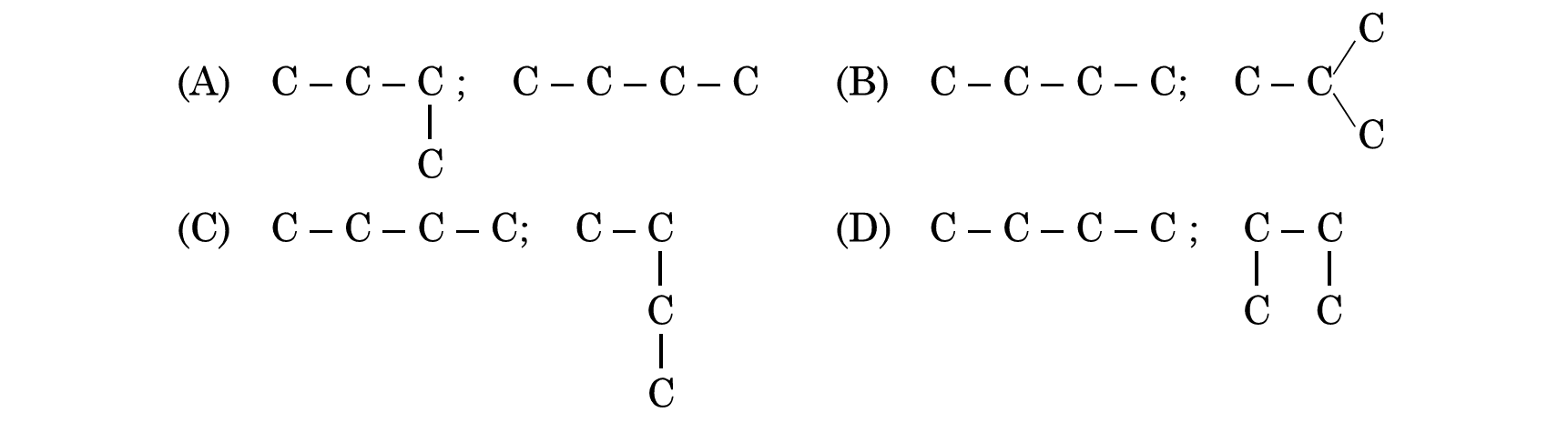
Isomerism:
For 4 Carbon atoms (Butane), two skeletons are possible:
1. Straight Chain (n-Butane): C-C-C-C
2. Branched Chain (Iso-butane): C-C-C (with one C attached to middle C).
Option (A) in the source image correctly depicts these two.
Correct Option: (A)
For 4 Carbon atoms (Butane), two skeletons are possible:
1. Straight Chain (n-Butane): C-C-C-C
2. Branched Chain (Iso-butane): C-C-C (with one C attached to middle C).
Option (A) in the source image correctly depicts these two.
Correct Option: (A)
5 Marks
Q34. (A) (a) Define the term "Functional group of
a carbon compound". Write the formula of functional group present in (i) propanol and (ii)
propanone.
(b) Name the process of conversion of (i) ethanol to ethene and (ii) ethanol to ethanoic acid. Write the reaction equation stating the conditions required for each of the reactions to occur.
OR
(B) (a) Name two cyclic hydrocarbons and draw the structure of any one.
(b) Explain the process of micelle formation on adding soap in water.
(b) Name the process of conversion of (i) ethanol to ethene and (ii) ethanol to ethanoic acid. Write the reaction equation stating the conditions required for each of the reactions to occur.
OR
(B) (a) Name two cyclic hydrocarbons and draw the structure of any one.
(b) Explain the process of micelle formation on adding soap in water.
(A)
(a) Functional Group: An atom or group of atoms present in a carbon compound which largely determines its chemical properties.
(i) Propanol: Alcohol group (-OH).
(ii) Propanone: Ketone group (>C=O).
(b) (i) Dehydration. \(\text{CH}_3\text{CH}_2\text{OH} \xrightarrow{\text{Hot Conc. H}_2\text{SO}_4, 443K} \text{CH}_2=\text{CH}_2 + \text{H}_2\text{O}\).
(ii) Oxidation. \(\text{CH}_3\text{CH}_2\text{OH} \xrightarrow{\text{Alk. KMnO}_4 + \text{Heat}} \text{CH}_3\text{COOH}\).
OR
(B)
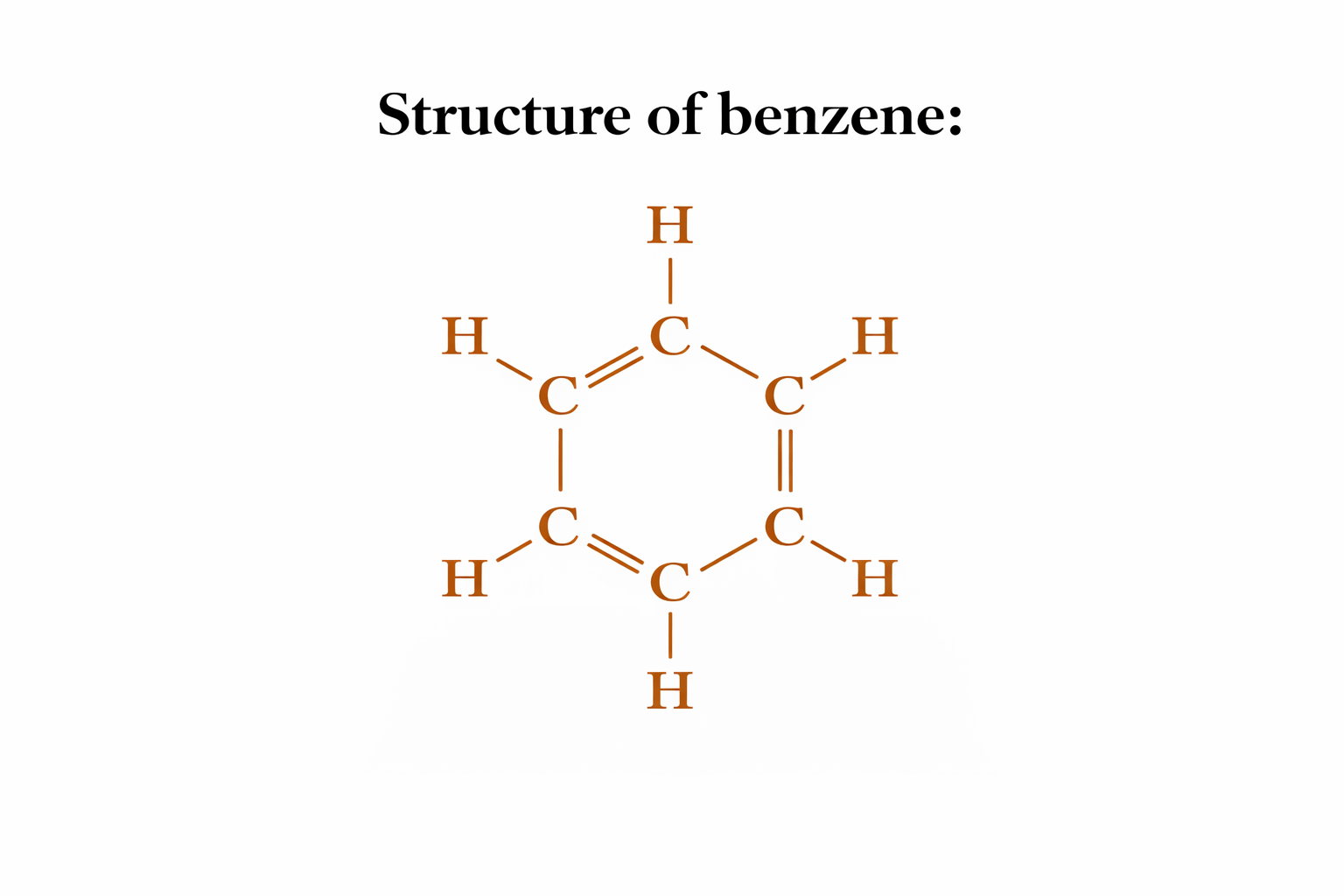
(a) Cyclohexane, Benzene.
Structure:
(b) Micelle Formation: Soap molecules have a hydrophobic tail (hydrocarbon) and hydrophilic head (ionic). In water, tails clump together away from water (towards dirt/oil) and heads face outward, forming a spherical cluster called Micelle. This emulsion helps remove dirt.
(a) Functional Group: An atom or group of atoms present in a carbon compound which largely determines its chemical properties.
(i) Propanol: Alcohol group (-OH).
(ii) Propanone: Ketone group (>C=O).
(b) (i) Dehydration. \(\text{CH}_3\text{CH}_2\text{OH} \xrightarrow{\text{Hot Conc. H}_2\text{SO}_4, 443K} \text{CH}_2=\text{CH}_2 + \text{H}_2\text{O}\).
(ii) Oxidation. \(\text{CH}_3\text{CH}_2\text{OH} \xrightarrow{\text{Alk. KMnO}_4 + \text{Heat}} \text{CH}_3\text{COOH}\).
OR
(B)
(a) Cyclohexane, Benzene.
Structure:
(b) Micelle Formation: Soap molecules have a hydrophobic tail (hydrocarbon) and hydrophilic head (ionic). In water, tails clump together away from water (towards dirt/oil) and heads face outward, forming a spherical cluster called Micelle. This emulsion helps remove dirt.
4 Marks
Q38. The combining capacity of various elements
depends on the number of valence electrons. Also the reactivity of elements is explained as their
tendency to attain a completely filled outer shell, that is, to attain a noble gas configuration. This
may be either through gain of electrons or loss of electrons or sharing of electrons.
(a) An element A has atomic number 16, how will it attain its nearest noble gas configuration ?
(b) Write the number of (i) single and (ii) double covalent bonds in a molecule of butene (\(\text{C}_4\text{H}_8\)).
(c) (A) Explain the formation of a molecule of ammonia (\(\text{NH}_3\)), using electron dot structure. (Atomic number of nitrogen is 7)
OR
(c) (B) Why does carbon share its valence electrons with other atoms of carbon or with atoms of other elements ?
(a) An element A has atomic number 16, how will it attain its nearest noble gas configuration ?
(b) Write the number of (i) single and (ii) double covalent bonds in a molecule of butene (\(\text{C}_4\text{H}_8\)).
(c) (A) Explain the formation of a molecule of ammonia (\(\text{NH}_3\)), using electron dot structure. (Atomic number of nitrogen is 7)
OR
(c) (B) Why does carbon share its valence electrons with other atoms of carbon or with atoms of other elements ?
(a) Element A (Z=16) is Sulphur (2,8,6). To attain configuration of Argon (2,8,8), it needs to
gain 2 electrons or share 2 electrons.
(b) Butene Structure (\(\text{CH}_2=\text{CH}-\text{CH}_2-\text{CH}_3\) or similar):
(i) Single bonds: 8 (C-H) + 2 (C-C) = 10 single bonds.
(ii) Double bonds: 1 (C=C).
(c) (A) Ammonia Formation:
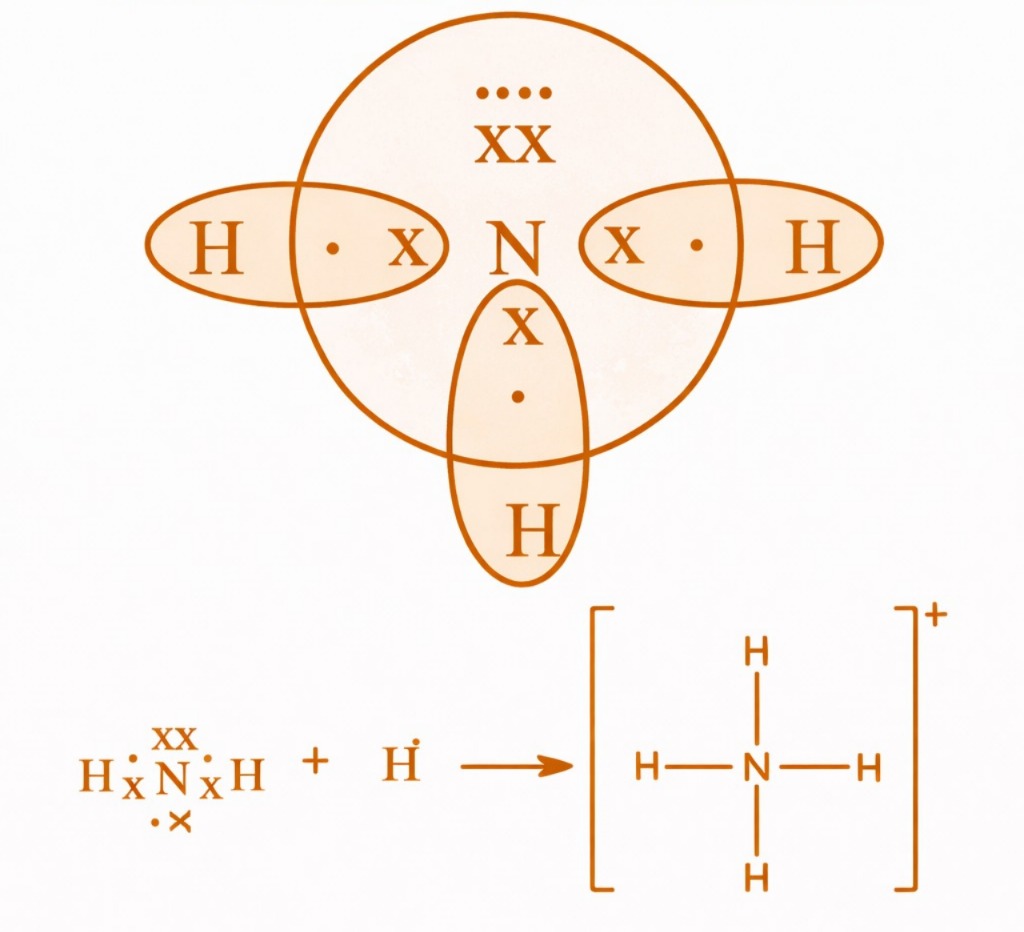
Nitrogen shares 3 electrons with 3 Hydrogen atoms to execute octet/duplet.
OR
(c) (B) Carbon (2,4) cannot gain 4 electrons (energetically difficult to hold) nor lose 4 electrons (energy requirement high). Hence it forms bonds by sharing electrons (Covalent bonding) to complete its octet.
(b) Butene Structure (\(\text{CH}_2=\text{CH}-\text{CH}_2-\text{CH}_3\) or similar):
(i) Single bonds: 8 (C-H) + 2 (C-C) = 10 single bonds.
(ii) Double bonds: 1 (C=C).
(c) (A) Ammonia Formation:
Nitrogen shares 3 electrons with 3 Hydrogen atoms to execute octet/duplet.
OR
(c) (B) Carbon (2,4) cannot gain 4 electrons (energetically difficult to hold) nor lose 4 electrons (energy requirement high). Hence it forms bonds by sharing electrons (Covalent bonding) to complete its octet.
1 Mark
Q5. A Hydrocarbon which does not
belong to the same homologous series of carbon compounds is
Formula for Alkane: \(\text{C}_n\text{H}_{2n+2}\).
(A) \(4 \times 2 + 2 = 10\) (Alkane).
(B) \(6 \times 2 + 2 = 14\) (Alkane).
(C) \(7 \times 2 = 14\) (Alkene/Cycloalkane, \(\text{C}_n\text{H}_{2n}\)).
(D) \(10 \times 2 + 2 = 22\) (Alkane).
(C) is the odd one out.
Correct Option: (C)
(A) \(4 \times 2 + 2 = 10\) (Alkane).
(B) \(6 \times 2 + 2 = 14\) (Alkane).
(C) \(7 \times 2 = 14\) (Alkene/Cycloalkane, \(\text{C}_n\text{H}_{2n}\)).
(D) \(10 \times 2 + 2 = 22\) (Alkane).
(C) is the odd one out.
Correct Option: (C)
1 Mark
Q18. Assertion (A): Carbon and
its compounds are our major sources of fuels.
Reason (R): Most of the carbon compounds on burning release a large amount of heat and light.
Reason (R): Most of the carbon compounds on burning release a large amount of heat and light.
Assertion (A): True. Coal, petroleum, natural gas are carbon compounds.
Reason (R): True. Combustion is exothermic.
Explanation: Because they release large energy (heat/light) on burning, they are excellent fuels. R explains A.
Correct Option: (A)
Reason (R): True. Combustion is exothermic.
Explanation: Because they release large energy (heat/light) on burning, they are excellent fuels. R explains A.
Correct Option: (A)
5 Marks
Q36. (a) Name an alcohol and a carboxylic acid
having two carbon atoms in their structures. Draw their structures and state how this alcohol can be
converted into a carboxylic acid. What happens when these two compounds react in the presence of an acid
? Write chemical equations for the reactions involved in the two cases mentioned above.
OR
(b) What are soaps ? Write the structure of a soap molecule. Explain the cleansing action of a soap. Why are soaps not considered suitable for washing clothes in a region where water is hard ? How is this problem overcome ?
OR
(b) What are soaps ? Write the structure of a soap molecule. Explain the cleansing action of a soap. Why are soaps not considered suitable for washing clothes in a region where water is hard ? How is this problem overcome ?
(a)
Alcohol: Ethanol (\(\text{CH}_3\text{CH}_2\text{OH}\)).
Acid: Ethanoic Acid (\(\text{CH}_3\text{COOH}\)).
Conversion: Oxidation using alkaline \(\text{KMnO}_4\) or acidified \(\text{K}_2\text{Cr}_2\text{O}_7\).
Reaction: \(\text{CH}_3\text{CH}_2\text{OH} + 2[ ext{O}] \rightarrow \text{CH}_3\text{COOH} + \text{H}_2\text{O}\).
Reaction (Esterification): Ethanol + Ethanoic Acid (conc. \(\text{H}_2\text{SO}_4\)) \(\rightarrow\) Ethyl Ethanoate (Ester) + Water.
\(\text{CH}_3\text{COOH} + \text{C}_2\text{H}_5\text{OH} \rightleftharpoons \text{CH}_3\text{COOC}_2\text{H}_5 + \text{H}_2\text{O}\).
(b) Soaps: Sodium or potassium salts of long chain carboxylic acids.
Structure: \(\text{R-COO}^- \text{Na}^+\) (Ionic end hydrophilic, Hydrocarbon tail hydrophobic).
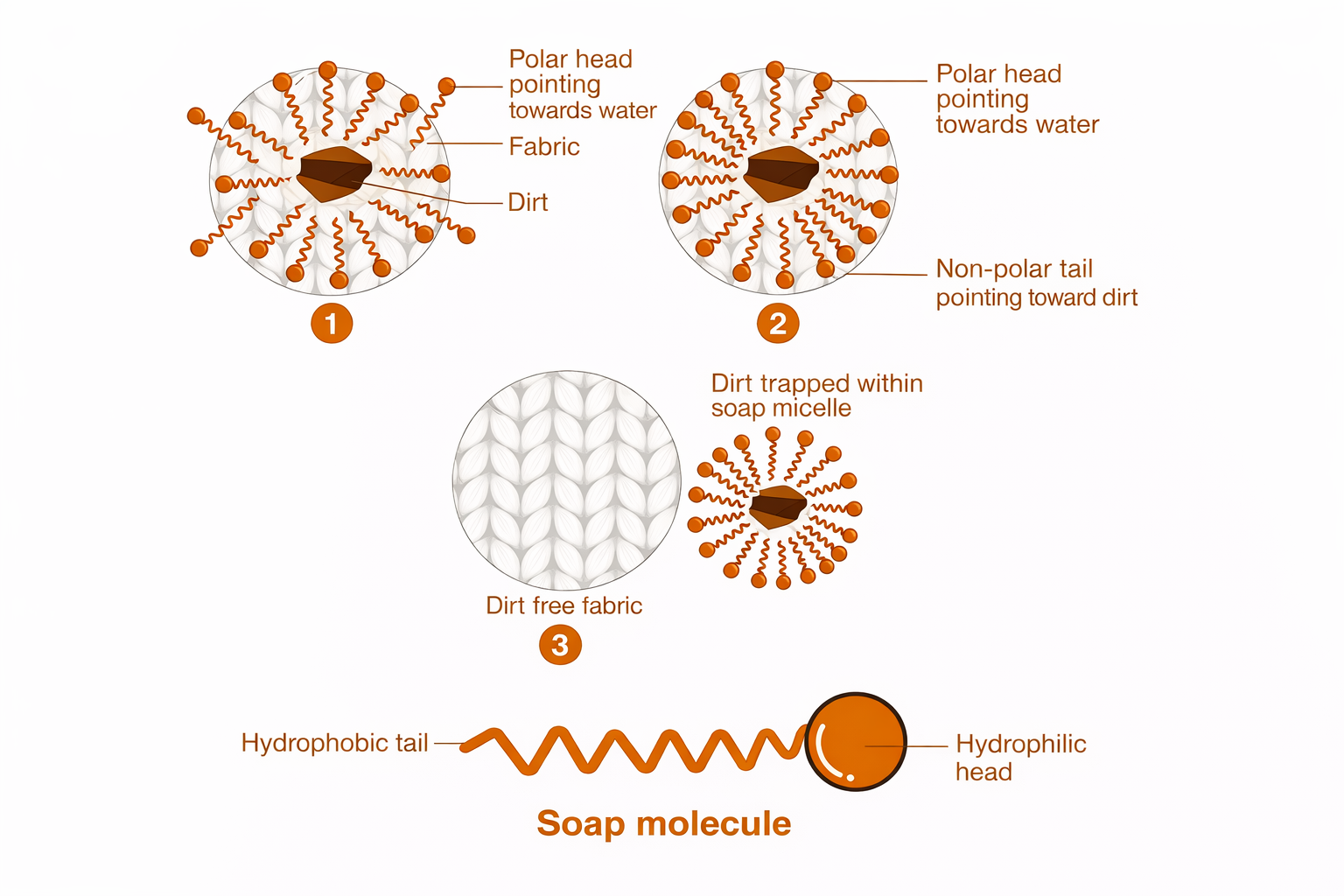
Cleansing: Micelle formation. Tail dissolves in oil/dirt, head in water. Emulsifies grease.
Hard Water: Reacts with Ca/Mg ions to form scum (insoluble precipitate), reducing proper cleansing.
Overcome: By using Detergents (Ammonium/Sulphonate salts) which do not form scum.
Alcohol: Ethanol (\(\text{CH}_3\text{CH}_2\text{OH}\)).
Acid: Ethanoic Acid (\(\text{CH}_3\text{COOH}\)).
Conversion: Oxidation using alkaline \(\text{KMnO}_4\) or acidified \(\text{K}_2\text{Cr}_2\text{O}_7\).
Reaction: \(\text{CH}_3\text{CH}_2\text{OH} + 2[ ext{O}] \rightarrow \text{CH}_3\text{COOH} + \text{H}_2\text{O}\).
Reaction (Esterification): Ethanol + Ethanoic Acid (conc. \(\text{H}_2\text{SO}_4\)) \(\rightarrow\) Ethyl Ethanoate (Ester) + Water.
\(\text{CH}_3\text{COOH} + \text{C}_2\text{H}_5\text{OH} \rightleftharpoons \text{CH}_3\text{COOC}_2\text{H}_5 + \text{H}_2\text{O}\).
(b) Soaps: Sodium or potassium salts of long chain carboxylic acids.
Structure: \(\text{R-COO}^- \text{Na}^+\) (Ionic end hydrophilic, Hydrocarbon tail hydrophobic).
Cleansing: Micelle formation. Tail dissolves in oil/dirt, head in water. Emulsifies grease.
Hard Water: Reacts with Ca/Mg ions to form scum (insoluble precipitate), reducing proper cleansing.
Overcome: By using Detergents (Ammonium/Sulphonate salts) which do not form scum.
Board Exam 2024
Content coming soon for 2024...
Board Exam 2023
Content coming soon for 2023...
Board Exam 2022
Content coming soon for 2022...