
Board Exam 2025
1 Mark
Q3. Consider the reactions of dil.
hydrochloric acid with the following metals : Aluminium, Copper, Iron, Magnesium and Zinc.
The correct observation is :
Reactivity Series: Mg > Al > Zn > Fe > H > Cu.
1. Magnesium is the most reactive among the given metals, so it reacts most vigorously.
2. Copper is below Hydrogen, so it does not react with dilute acids.
Matches Option (C).
Correct Option: (C)
1. Magnesium is the most reactive among the given metals, so it reacts most vigorously.
2. Copper is below Hydrogen, so it does not react with dilute acids.
Matches Option (C).
Correct Option: (C)
1 Mark
Q5. Oxides of aluminium and zinc are :
Metal oxides are generally basic. However, Aluminium oxide
(\(\text{Al}_2\text{O}_3\)) and Zinc oxide (\(\text{ZnO}\)) react with both acids and bases to
produce salt and water.
Such oxides are called Amphoteric Oxides.
Correct Option: (B)
Such oxides are called Amphoteric Oxides.
Correct Option: (B)
2 Marks
Q23. (a) (i) What is an alloy?
(ii) Write the composition of solder and the property which makes it suitable for welding electric wires.
OR
(b) During electrolytic refining of silver :
(i) What are the electrodes � cathode and anode made up of ?
(ii) What is anode mud ? Why is it called so ?
(ii) Write the composition of solder and the property which makes it suitable for welding electric wires.
OR
(b) During electrolytic refining of silver :
(i) What are the electrodes � cathode and anode made up of ?
(ii) What is anode mud ? Why is it called so ?
(a) (i) Alloy: A homogeneous mixture of two or more metals, or a
metal and a non-metal.
(a) (ii) Solder: Lead (Pb) + Tin (Sn).
Property: Low melting point (allows it to melt easily to join wires without damaging them).
(b) (i) Electrodes:
- Anode: Impure Silver block.
- Cathode: Strip of pure Silver.
(b) (ii) Anode Mud: The insoluble impurities (like gold, platinum) that settle down at the bottom of the anode during electrolysis.
Reason: It is called 'anode mud' because it consists of 'mud-like' impurities deposited below the anode.
(a) (ii) Solder: Lead (Pb) + Tin (Sn).
Property: Low melting point (allows it to melt easily to join wires without damaging them).
(b) (i) Electrodes:
- Anode: Impure Silver block.
- Cathode: Strip of pure Silver.
(b) (ii) Anode Mud: The insoluble impurities (like gold, platinum) that settle down at the bottom of the anode during electrolysis.
Reason: It is called 'anode mud' because it consists of 'mud-like' impurities deposited below the anode.
3 Marks
Q27. Using flow chart, show the steps involved in
the method of extraction of a metal of medium reactivity from its ore.
Extraction of Medium Reactivity Metals
1. Concentration of Ore
?
2. Conversion to Oxide:
- Roasting: Sulphide ores heated in excess air (\(2\text{ZnS} + 3\text{O}_2 \rightarrow 2\text{ZnO} + 2\text{SO}_2\))
- Calcination: Carbonate ores heated in limited air (\(\text{ZnCO}_3 \rightarrow \text{ZnO} + \text{CO}_2\))
?
3. Reduction of Oxide to Metal: Using Carbon (Coke) or Displacement (\(\text{ZnO} + \text{C} \rightarrow \text{Zn} + \text{CO}\))
?
4. Purification (Refining)
Image: 2025-31-S-Solution27
(e.g., Zn, Fe, Pb):
1. Concentration of Ore
?
2. Conversion to Oxide:
- Roasting: Sulphide ores heated in excess air (\(2\text{ZnS} + 3\text{O}_2 \rightarrow 2\text{ZnO} + 2\text{SO}_2\))
- Calcination: Carbonate ores heated in limited air (\(\text{ZnCO}_3 \rightarrow \text{ZnO} + \text{CO}_2\))
?
3. Reduction of Oxide to Metal: Using Carbon (Coke) or Displacement (\(\text{ZnO} + \text{C} \rightarrow \text{Zn} + \text{CO}\))
?
4. Purification (Refining)
1 Mark
Q4. Reaction between X and Y forms compound Z. X
loses electrons and Y gains electrons. Which of the following properties is not shown
by Z ?
Since X loses and Y gains electrons, Z is an Ionic Compound.
Ionic compounds have high melting points, conduct electricity in molten state, and are solids.
They do not have low melting points.
Correct Option: (B)
Ionic compounds have high melting points, conduct electricity in molten state, and are solids.
They do not have low melting points.
Correct Option: (B)
1 Mark
Q5. The electronic configuration of three
elements X, Y and Z are :
X � 2, 8
Y � 2, 8, 7
Z � 2, 8, 2
Which of the following is correct ?
X � 2, 8
Y � 2, 8, 7
Z � 2, 8, 2
Which of the following is correct ?
Analysis:
X (2, 8): Noble Gas (Neon).
Y (2, 8, 7): Halogen/Non-metal (Chlorine) - Gains 1 electron.
Z (2, 8, 2): Alkaline Earth Metal (Magnesium) - Loses 2 electrons.
(A) X is a metal - False (Non-metal/Inert gas).
(B) Y is a metal - False (Non-metal).
(C) Z is a non-metal - False (Metal).
(D) Y is non-metal, Z is metal - True.
Correct Option: (D)
X (2, 8): Noble Gas (Neon).
Y (2, 8, 7): Halogen/Non-metal (Chlorine) - Gains 1 electron.
Z (2, 8, 2): Alkaline Earth Metal (Magnesium) - Loses 2 electrons.
(A) X is a metal - False (Non-metal/Inert gas).
(B) Y is a metal - False (Non-metal).
(C) Z is a non-metal - False (Metal).
(D) Y is non-metal, Z is metal - True.
Correct Option: (D)
1 Mark
Q17. Assertion (A): Ductility is
that property of metals which enables copper to be used in making cooking utensils.
Reason (R): Copper is a metal which is ductile as well as malleable.
Reason (R): Copper is a metal which is ductile as well as malleable.
Assertion (A): False. Copper is used for cooking utensils because of
Thermal Conductivity, not ductility.
Reason (R): True. Copper is indeed ductile and malleable.
Correct Option: (D) Assertion (A) is false, but Reason (R) is true.
Reason (R): True. Copper is indeed ductile and malleable.
Correct Option: (D) Assertion (A) is false, but Reason (R) is true.
2 Marks
Q21. (a) In common practice silver is recovered
from silver nitrate solution by the use of copper metal. Name the type of reaction that takes place in
this process and give the chemical equation of the reaction involved.
(b) Name the method used for refining silver.
(b) Name the method used for refining silver.
(a) Reaction Type: Displacement Reaction.
Equation: \(Cu(s) + 2AgNO_3(aq) \longrightarrow Cu(NO_3)_2(aq) + 2Ag(s)\)
(Copper is more reactive than Silver and displaces it).
(b) Refining Method: Electrolytic Refining (Electrolysis).
Equation: \(Cu(s) + 2AgNO_3(aq) \longrightarrow Cu(NO_3)_2(aq) + 2Ag(s)\)
(Copper is more reactive than Silver and displaces it).
(b) Refining Method: Electrolytic Refining (Electrolysis).
1 Mark
Q4. Two metals zinc and tin are dissolved
separately in definite proportions in molten copper (the primary metal) to obtain two different alloys
respectively known as :
Alloy Composition:
Copper + Zinc = Brass.
Copper + Tin = Bronze.
Order: Zinc then Tin \(\rightarrow\) Brass then Bronze.
Correct Option: (C)
Copper + Zinc = Brass.
Copper + Tin = Bronze.
Order: Zinc then Tin \(\rightarrow\) Brass then Bronze.
Correct Option: (C)
1 Mark
Q5. Aluminium powder is used in thermit welding
because :
Thermit Reaction:
\(\text{Fe}_2\text{O}_3(s) + 2\text{Al}(s) \rightarrow 2\text{Fe}(l) + \text{Al}_2\text{O}_3(s) + \text{Heat}\).
The reaction is highly exothermic, producing molten iron which fills the gap.
(B) captures the "molten iron obtained" part correctly.
(A) says reaction with iron (incorrect, it reacts with iron oxide).
Correct Option: (B)
\(\text{Fe}_2\text{O}_3(s) + 2\text{Al}(s) \rightarrow 2\text{Fe}(l) + \text{Al}_2\text{O}_3(s) + \text{Heat}\).
The reaction is highly exothermic, producing molten iron which fills the gap.
(B) captures the "molten iron obtained" part correctly.
(A) says reaction with iron (incorrect, it reacts with iron oxide).
Correct Option: (B)
1 Mark
Q17. Assertion (A): Ductility is
that property of metals which enables copper to be used in making cooking utensils.
Reason (R): Copper is a metal which is ductile as well as malleable.
Reason (R): Copper is a metal which is ductile as well as malleable.
Analysis:
- Assertion: False. Copper is used for cooking utensils because of high thermal conductivity, not ductility (drawing into wires).
- Reason: True. Copper is indeed ductile and malleable.
Correct Option: (D) Assertion (A) is false, but Reason (R) is true.
- Assertion: False. Copper is used for cooking utensils because of high thermal conductivity, not ductility (drawing into wires).
- Reason: True. Copper is indeed ductile and malleable.
Correct Option: (D) Assertion (A) is false, but Reason (R) is true.
3 Marks
Q28. Two substances �A� and �B� are burnt in air
separately. For �A�, ashes are collected and dissolved in water to get solution �X�, while for �B�,
fumes produced are passed through water to get solution �Y�. Both the solutions �X� and �Y� are then
tested with pH paper.
(a) If �X� gives light blue colour and �Y� gives orange colour to the pH paper, then write the nature and range of pH of �X� and �Y�.
(b) Which one of the two � A and B, is a metal ? Justify your answer.
(a) If �X� gives light blue colour and �Y� gives orange colour to the pH paper, then write the nature and range of pH of �X� and �Y�.
(b) Which one of the two � A and B, is a metal ? Justify your answer.
(a) Nature and pH:
- Solution X (Blue): Basic in nature. pH > 7 (Range 8-10).
- Solution Y (Orange): Acidic in nature. pH < 7 (Range 3-5).
(b) Metal Identification:
- Substance 'A' is a Metal.
- Justification: Metal oxides are generally basic. When dissolved in water, they form basic solutions (turning pH paper blue). Non-metal oxides are acidic (turning pH paper orange/red).
- Solution X (Blue): Basic in nature. pH > 7 (Range 8-10).
- Solution Y (Orange): Acidic in nature. pH < 7 (Range 3-5).
(b) Metal Identification:
- Substance 'A' is a Metal.
- Justification: Metal oxides are generally basic. When dissolved in water, they form basic solutions (turning pH paper blue). Non-metal oxides are acidic (turning pH paper orange/red).
1 Mark
Q1. The metals obtained from their molten
chlorides by the process of
electrolytic reduction are :
Highly reactive metals are obtained by electrolytic reduction of their molten
salts.
Both Calcium and Magnesium are highly reactive metals found at the top of the reactivity series.
Correct Option: (B)
Both Calcium and Magnesium are highly reactive metals found at the top of the reactivity series.
Correct Option: (B)
1 Mark
Q2. The formation of magnesium oxide is correctly
shown in option :
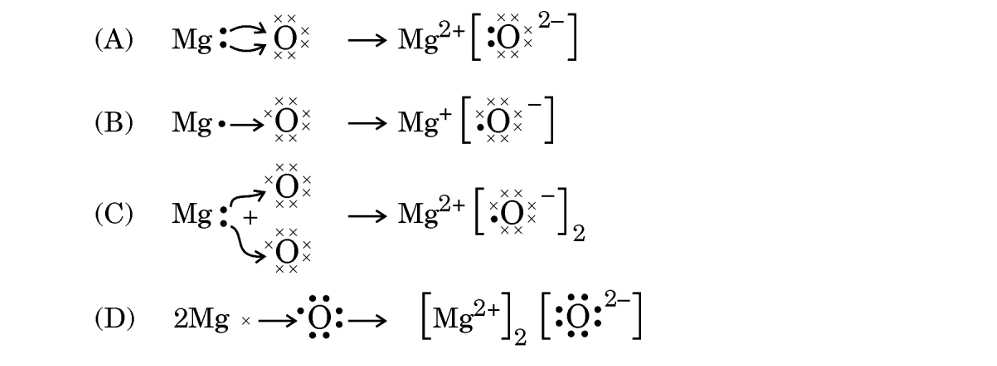
Magnesium (\(\text{Mg}\)) has atomic number 12 (2, 8, 2). It loses 2 electrons to form
\(\text{Mg}^{2+}\).
Oxygen (\(\text{O}\)) has atomic number 8 (2, 6). It gains 2 electrons to form \(\text{O}^{2-}\).
The correct electron dot structure shows the transfer of 2 electrons from Mg to O.
Correct Option: (B)
Oxygen (\(\text{O}\)) has atomic number 8 (2, 6). It gains 2 electrons to form \(\text{O}^{2-}\).
The correct electron dot structure shows the transfer of 2 electrons from Mg to O.
Correct Option: (B)
1 Mark
Q3. Reaction between two elements A and B, forms
a compound C. A loses
electrons and B gains electrons. Which one of the following properties
will not be shown by compound C ?
Since A loses and B gains electrons, Compound C is an Ionic
Compound.
Ionic compounds have strong electrostatic forces of attraction between ions, not weak.
Therefore, statement (C) is incorrect.
Correct Option: (C)
Ionic compounds have strong electrostatic forces of attraction between ions, not weak.
Therefore, statement (C) is incorrect.
Correct Option: (C)
3 Marks
Q32. (a) With the help of an activity, explain
the conditions under which
iron articles get rusted.
OR
(b) (i) Name two metals which react violently with cold water. List any three observations which a student notes when these metals are dropped in a beaker containing water.
(ii) Write a test to identify the gas evolved (if any) during the reaction of these metals with water.
OR
(b) (i) Name two metals which react violently with cold water. List any three observations which a student notes when these metals are dropped in a beaker containing water.
(ii) Write a test to identify the gas evolved (if any) during the reaction of these metals with water.
(a) Activity: Conditions for Rusting
1. Take three test tubes A, B, and C.
2. Tube A: Iron nails + Water + Air (Left open).
3. Tube B: Iron nails + Boiled Water + Oil (Oil layer prevents air contact).
4. Tube C: Iron nails + Anhydrous Calcium Chloride (Absorbs moisture, Dry air).
Observation: Rusting occurs only in Tube A.
Conclusion: Both air (oxygen) and moisture (water) are essential for rusting.
(b) (i) Metals: Sodium (\(\text{Na}\)) and Potassium (\(\text{K}\)).
Observations:
1. The reaction is vigorous and exothermic.
2. The metal floats on water and melts into a silvery ball.
3. The evolved hydrogen gas catches fire immediately.
(b) (ii) Test for Gas:
Bring a burning candle near the gas bubbles. The gas burns with a characteristic pop sound, confirming it is Hydrogen.
1. Take three test tubes A, B, and C.
2. Tube A: Iron nails + Water + Air (Left open).
3. Tube B: Iron nails + Boiled Water + Oil (Oil layer prevents air contact).
4. Tube C: Iron nails + Anhydrous Calcium Chloride (Absorbs moisture, Dry air).
Observation: Rusting occurs only in Tube A.
Conclusion: Both air (oxygen) and moisture (water) are essential for rusting.
(b) (i) Metals: Sodium (\(\text{Na}\)) and Potassium (\(\text{K}\)).
Observations:
1. The reaction is vigorous and exothermic.
2. The metal floats on water and melts into a silvery ball.
3. The evolved hydrogen gas catches fire immediately.
(b) (ii) Test for Gas:
Bring a burning candle near the gas bubbles. The gas burns with a characteristic pop sound, confirming it is Hydrogen.
3 Marks
Q33. (a) �Displacement reactions also play a key
role in extracting metals
in the middle of the reactivity series.� Justify this statement with
two examples.
(b) Why can metals high up in the reactivity series not be obtained by reduction of their oxides by carbon ?
(b) Why can metals high up in the reactivity series not be obtained by reduction of their oxides by carbon ?
(a) Justification:
Moderately reactive metals exist as oxides (after roasting/calcination). These oxides are reduced to metals using displacement reactions with highly reactive metals (like Al, Na, Ca).
Example 1 (Thermite Reaction): Iron(III) oxide is reduced by Aluminium to form molten Iron (used for welding rails).
\(\text{Fe}_2\text{O}_3(s) + 2\text{Al}(s) \longrightarrow 2\text{Fe}(l) + \text{Al}_2\text{O}_3(s) + \text{Heat}\)
Example 2: Manganese dioxide reacting with Aluminium powder.
\(3\text{MnO}_2(s) + 4\text{Al}(s) \longrightarrow 3\text{Mn}(l) + 2\text{Al}_2\text{O}_3(s) + \text{Heat}\)
(b) Reason:
Metals high in the reactivity series (Na, Mg, Al) have more affinity for oxygen than carbon does. Carbon cannot remove oxygen from their oxides to reduce them. Hence, electrolytic reduction is used.
Moderately reactive metals exist as oxides (after roasting/calcination). These oxides are reduced to metals using displacement reactions with highly reactive metals (like Al, Na, Ca).
Example 1 (Thermite Reaction): Iron(III) oxide is reduced by Aluminium to form molten Iron (used for welding rails).
\(\text{Fe}_2\text{O}_3(s) + 2\text{Al}(s) \longrightarrow 2\text{Fe}(l) + \text{Al}_2\text{O}_3(s) + \text{Heat}\)
Example 2: Manganese dioxide reacting with Aluminium powder.
\(3\text{MnO}_2(s) + 4\text{Al}(s) \longrightarrow 3\text{Mn}(l) + 2\text{Al}_2\text{O}_3(s) + \text{Heat}\)
(b) Reason:
Metals high in the reactivity series (Na, Mg, Al) have more affinity for oxygen than carbon does. Carbon cannot remove oxygen from their oxides to reduce them. Hence, electrolytic reduction is used.
1 Mark
Q1. The most common method of extraction of
metals from their oxide ores is :
Reduction with Carbon: Oxides of moderately reactive metals (like Zn,
Fe, Pb, Cu) are reduced to corresponding metals by using Carbon (Coke) as a reducing agent.
Example: \(\text{ZnO} + \text{C} \longrightarrow \text{Zn} + \text{CO}\).
This is the most common method in metallurgy (Smelting).
Correct Option: (A)
Example: \(\text{ZnO} + \text{C} \longrightarrow \text{Zn} + \text{CO}\).
This is the most common method in metallurgy (Smelting).
Correct Option: (A)
1 Mark
Q17. Assertion (A): Brass is
prepared by first melting copper and then dissolving tin into it in a definite proportion.
Reason (R): The primary metal of brass is copper.
Reason (R): The primary metal of brass is copper.
Analysis:
Assertion: Brass is an alloy of Copper and Zinc (Cu + Zn). Bronze is an alloy of Copper and Tin (Cu + Sn). So Assertion says "dissolving tin" which is incorrect for Brass.
Reason: The primary metal of brass is indeed Copper (approx. 70%). So Reason is True.
Since Assertion is False but Reason is True.
Correct Option: (D)
Assertion: Brass is an alloy of Copper and Zinc (Cu + Zn). Bronze is an alloy of Copper and Tin (Cu + Sn). So Assertion says "dissolving tin" which is incorrect for Brass.
Reason: The primary metal of brass is indeed Copper (approx. 70%). So Reason is True.
Since Assertion is False but Reason is True.
Correct Option: (D)
5 Marks
Q34. (a) (i) Consider the following metals :
K, Ca, Al, Cu, Ag, Fe
Select from the above metals, a metal which
I. does not react with oxygen even at high temperature.
II. reacts with oxygen at ordinary temperature and forms a protective oxide layer which prevents the metal from further oxidation.
III. catches fire when kept in the open.
IV. does not burn in oxygen but the hot metal is coated with a black coloured oxide layer.
(ii) What are amphoteric oxides ? With the help of balanced chemical equations show that aluminium oxide is an amphoteric oxide.
(iii) What are alkalis ? Give one example.
OR
(b) (i) With the help of balanced chemical equations state the process of extracting (I) mercury from its ore called cinnabar, and (II) copper from its sulphide ore.
(ii) Silver and copper articles slowly lose their shiny surfaces when exposed to air. Name the compounds formed on (I) silver articles, and (II) copper articles in the form of coating.
K, Ca, Al, Cu, Ag, Fe
Select from the above metals, a metal which
I. does not react with oxygen even at high temperature.
II. reacts with oxygen at ordinary temperature and forms a protective oxide layer which prevents the metal from further oxidation.
III. catches fire when kept in the open.
IV. does not burn in oxygen but the hot metal is coated with a black coloured oxide layer.
(ii) What are amphoteric oxides ? With the help of balanced chemical equations show that aluminium oxide is an amphoteric oxide.
(iii) What are alkalis ? Give one example.
OR
(b) (i) With the help of balanced chemical equations state the process of extracting (I) mercury from its ore called cinnabar, and (II) copper from its sulphide ore.
(ii) Silver and copper articles slowly lose their shiny surfaces when exposed to air. Name the compounds formed on (I) silver articles, and (II) copper articles in the form of coating.
(a) (i) Metal Selection:
I. Silver (Ag) (Noble metal).
II. Aluminium (Al) (Forms \(\text{Al}_2\text{O}_3\)).
III. Potassium (K) (Highly reactive).
IV. Copper (Cu) (Forms black \(\text{CuO}\)).
(a) (ii) Amphoteric Oxides: Metal oxides which react with both acids and bases to produce salt and water.
Aluminum Oxide (\(\text{Al}_2\text{O}_3\)):
With Acid: \(\text{Al}_2\text{O}_3 + 6\text{HCl} \longrightarrow 2\text{AlCl}_3 + 3\text{H}_2\text{O}\)
With Base: \(\text{Al}_2\text{O}_3 + 2\text{NaOH} \longrightarrow 2\text{NaAlO}_2 + \text{H}_2\text{O}\)
(a) (iii) Alkalis: Bases which are soluble in water are called alkalis. Example: Sodium Hydroxide (\(\text{NaOH}\)).
(b) (i) Extraction:
(I) Mercury (Hg) from Cinnabar (\(\text{HgS}\)):
Roasting: \(2\text{HgS} + 3\text{O}_2 \xrightarrow{\Delta} 2\text{HgO} + 2\text{SO}_2\)
Reduction: \(2\text{HgO} \xrightarrow{\Delta} 2\text{Hg} + \text{O}_2\)
(II) Copper (Cu) from Sulphide Ore (\(\text{Cu}_2\text{S}\)):
Roasting: \(2\text{Cu}_2\text{S} + 3\text{O}_2 \xrightarrow{\Delta} 2\text{Cu}_2\text{O} + 2\text{SO}_2\)
Auto-Reduction: \(2\text{Cu}_2\text{O} + \text{Cu}_2\text{S} \xrightarrow{\Delta} 6\text{Cu} + \text{SO}_2\)
(b) (ii) Corrosion Products:
(I) Silver Articles: Silver Sulphide (\(\text{Ag}_2\text{S}\)) - Black.
(II) Copper Articles: Basic Copper Carbonate (\(\text{CuCO}_3 \cdot \text{Cu(OH)}_2\)) - Green.
I. Silver (Ag) (Noble metal).
II. Aluminium (Al) (Forms \(\text{Al}_2\text{O}_3\)).
III. Potassium (K) (Highly reactive).
IV. Copper (Cu) (Forms black \(\text{CuO}\)).
(a) (ii) Amphoteric Oxides: Metal oxides which react with both acids and bases to produce salt and water.
Aluminum Oxide (\(\text{Al}_2\text{O}_3\)):
With Acid: \(\text{Al}_2\text{O}_3 + 6\text{HCl} \longrightarrow 2\text{AlCl}_3 + 3\text{H}_2\text{O}\)
With Base: \(\text{Al}_2\text{O}_3 + 2\text{NaOH} \longrightarrow 2\text{NaAlO}_2 + \text{H}_2\text{O}\)
(a) (iii) Alkalis: Bases which are soluble in water are called alkalis. Example: Sodium Hydroxide (\(\text{NaOH}\)).
(b) (i) Extraction:
(I) Mercury (Hg) from Cinnabar (\(\text{HgS}\)):
Roasting: \(2\text{HgS} + 3\text{O}_2 \xrightarrow{\Delta} 2\text{HgO} + 2\text{SO}_2\)
Reduction: \(2\text{HgO} \xrightarrow{\Delta} 2\text{Hg} + \text{O}_2\)
(II) Copper (Cu) from Sulphide Ore (\(\text{Cu}_2\text{S}\)):
Roasting: \(2\text{Cu}_2\text{S} + 3\text{O}_2 \xrightarrow{\Delta} 2\text{Cu}_2\text{O} + 2\text{SO}_2\)
Auto-Reduction: \(2\text{Cu}_2\text{O} + \text{Cu}_2\text{S} \xrightarrow{\Delta} 6\text{Cu} + \text{SO}_2\)
(b) (ii) Corrosion Products:
(I) Silver Articles: Silver Sulphide (\(\text{Ag}_2\text{S}\)) - Black.
(II) Copper Articles: Basic Copper Carbonate (\(\text{CuCO}_3 \cdot \text{Cu(OH)}_2\)) - Green.
1 Mark
Q3. An element 'M' has 25% of the electrons
filled in the third shell as in the second shell. The element 'M' is :
Electronic Configuration:
2nd Shell (L) capacity: 8 electrons.
3rd Shell (M): 25% of 8 = 2 electrons.
Config: 2, 8, 2.
Total Z = 12. Element is Magnesium (Mg).
Correct Option: (b)
2nd Shell (L) capacity: 8 electrons.
3rd Shell (M): 25% of 8 = 2 electrons.
Config: 2, 8, 2.
Total Z = 12. Element is Magnesium (Mg).
Correct Option: (b)
2 Marks
Q22. (A) Show the formation of calcium chloride
by the transfer of electrons from one element to the other. Atomic Number of calcium and chlorine is 20
and 17 respectively.
OR
(B) "Aluminium oxide is an amphoteric oxide." Justify this statement giving chemical equation for the
reactions involved.
(A):
Ca (20): 2, 8, 8, 2. Loses 2e- \(\rightarrow \text{Ca}^{2+}\).
Cl (17): 2, 8, 7. Gains 1e- \(\rightarrow \text{Cl}^{-}\).
Electron Dot Structure: [Ca] loses 2 electrons, one to each [Cl].
\(\text{Ca} \xrightarrow{-2e^-} \text{Ca}^{2+}\) ; \(2\text{Cl} \xrightarrow{+2e^-} 2\text{Cl}^-\)
Formula: \(\text{CaCl}_2\).
(B):
Amphoteric oxides react with both acids and bases to form salt and water.
1. With Acid: \(\text{Al}_2\text{O}_3 + 6\text{HCl} \rightarrow 2\text{AlCl}_3 + 3\text{H}_2\text{O}\)
2. With Base: \(\text{Al}_2\text{O}_3 + 2\text{NaOH} \rightarrow 2\text{NaAlO}_2 \text{ (Sodium Aluminate)} + \text{H}_2\text{O}\)
Ca (20): 2, 8, 8, 2. Loses 2e- \(\rightarrow \text{Ca}^{2+}\).
Cl (17): 2, 8, 7. Gains 1e- \(\rightarrow \text{Cl}^{-}\).
Electron Dot Structure: [Ca] loses 2 electrons, one to each [Cl].
\(\text{Ca} \xrightarrow{-2e^-} \text{Ca}^{2+}\) ; \(2\text{Cl} \xrightarrow{+2e^-} 2\text{Cl}^-\)
Formula: \(\text{CaCl}_2\).
(B):
Amphoteric oxides react with both acids and bases to form salt and water.
1. With Acid: \(\text{Al}_2\text{O}_3 + 6\text{HCl} \rightarrow 2\text{AlCl}_3 + 3\text{H}_2\text{O}\)
2. With Base: \(\text{Al}_2\text{O}_3 + 2\text{NaOH} \rightarrow 2\text{NaAlO}_2 \text{ (Sodium Aluminate)} + \text{H}_2\text{O}\)
3 Marks
Q28. Name and describe the most widely used
method for refining impure metals ?
Electrolytic Refining:
This is the most widely used method (e.g., for Copper, Zinc, Tin, Silver, Gold).
Process:
1. Anode: A block of impure metal is made the anode.
2. Cathode: A thin strip of pure metal is made the cathode.
3. Electrolyte: A solution of the metal salt (e.g., acidified \(\text{CuSO}_4\) for Cu).
On passing current, pure metal from anode dissolves into electrolyte and deposits on cathode. Soluble impurities go into solution; insoluble impurities settle as 'anode mud'.
This is the most widely used method (e.g., for Copper, Zinc, Tin, Silver, Gold).
Process:
1. Anode: A block of impure metal is made the anode.
2. Cathode: A thin strip of pure metal is made the cathode.
3. Electrolyte: A solution of the metal salt (e.g., acidified \(\text{CuSO}_4\) for Cu).
On passing current, pure metal from anode dissolves into electrolyte and deposits on cathode. Soluble impurities go into solution; insoluble impurities settle as 'anode mud'.
1 Mark
Q1. During electrolytic refining of copper, the
anode, the cathode and the electrolyte used respectively are
Electrolytic Refining:
Anode (Positive): Impure Metal (Dissolves).
Cathode (Negative): Pure Metal strip (Deposition).
Electrolyte: Salt solution of metal (Acidified CuSO4).
Correct Option: (A)
Anode (Positive): Impure Metal (Dissolves).
Cathode (Negative): Pure Metal strip (Deposition).
Electrolyte: Salt solution of metal (Acidified CuSO4).
Correct Option: (A)
1 Mark
Q6. A metal, M, displaces iron from aqueous
solution of ferrous sulphate but fails to do so in case of aqueous solution of aluminium sulphate. The
metal M is
Reactivity Series:
Order: Mg > Al > Zn > Fe > Pb > Cu.
M displaces Fe \(\Rightarrow\) M > Fe.
M does NOT displace Al \(\Rightarrow\) M < Al.
So, Al > M > Fe.
Looking at options:
(A) Mg (> Al, so incorrect).
(B) Cu (< Fe, so incorrect).
(C) Lead (< Fe, so incorrect).
(D) Zinc (Between Al and Fe). Correct.
Correct Option: (D)
Order: Mg > Al > Zn > Fe > Pb > Cu.
M displaces Fe \(\Rightarrow\) M > Fe.
M does NOT displace Al \(\Rightarrow\) M < Al.
So, Al > M > Fe.
Looking at options:
(A) Mg (> Al, so incorrect).
(B) Cu (< Fe, so incorrect).
(C) Lead (< Fe, so incorrect).
(D) Zinc (Between Al and Fe). Correct.
Correct Option: (D)
5 Marks
Q32. (A) Observe the following diagram showing an
experiment to determine the conditions under which a metal 'M' corrodes.
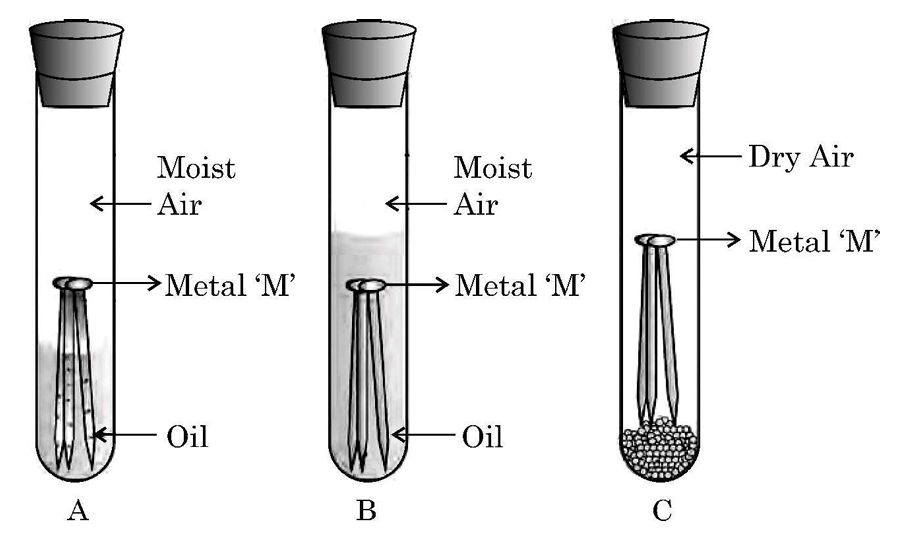
List your observations in each of the cases A, B and C with reason, if the metal 'M' is generally protected against corrosion by the method of galvanisation.
OR
(B) (a) Show the formation of Aluminium Nitride (AlN) by the transfer of electrons. [At. no. of Al = 13; At. no. of N = 7]
(b) "Ionic compounds are solids and are generally brittle and break into pieces when pressure is applied." Give reason to justify the statement.
List your observations in each of the cases A, B and C with reason, if the metal 'M' is generally protected against corrosion by the method of galvanisation.
OR
(B) (a) Show the formation of Aluminium Nitride (AlN) by the transfer of electrons. [At. no. of Al = 13; At. no. of N = 7]
(b) "Ionic compounds are solids and are generally brittle and break into pieces when pressure is applied." Give reason to justify the statement.
(A)
Metal M is likely Iron (Fe) as galvanisation (Zinc coating) is used for it.
Case A (Moist Air): Corrosion (Rusting) occurs. Both Air (O2) and Moisture (H2O) are present.
Case B (Boiled water + Oil): No Corrosion. Boiled water has no dissolved air, oil prevents air contact.
Case C (Dry Air + Desiccant): No Corrosion. No moisture.
(B)
(a) Electron Transfer Diagram:

Al (2,8,3) loses 3e-. N (2,5) gains 3e-.
(b) Brittle Nature: In ionic solids, ions are arranged in layers. When pressure is applied, like charged ions come in front of each other and strong electrostatic repulsion breaks the crystal lattice.
Metal M is likely Iron (Fe) as galvanisation (Zinc coating) is used for it.
Case A (Moist Air): Corrosion (Rusting) occurs. Both Air (O2) and Moisture (H2O) are present.
Case B (Boiled water + Oil): No Corrosion. Boiled water has no dissolved air, oil prevents air contact.
Case C (Dry Air + Desiccant): No Corrosion. No moisture.
(B)
(a) Electron Transfer Diagram:
Al (2,8,3) loses 3e-. N (2,5) gains 3e-.
(b) Brittle Nature: In ionic solids, ions are arranged in layers. When pressure is applied, like charged ions come in front of each other and strong electrostatic repulsion breaks the crystal lattice.
1 Mark
Q3. Which one of the following metals is
protected from corrosion by a layer of its own oxide ?
Aluminium forms a thin, protective layer of aluminium oxide
(\(\text{Al}_2\text{O}_3\)) on exposure to air, which prevents further corrosion (Anodising takes
advantage of this).
Correct Option: (A)
Correct Option: (A)
2 Marks
Q21. Name a metal found in the earth's crust
- in free state and
- in the form of its compound.
(i) Free State: Gold (Au) or Platinum (Pt).
Position: Bottom of the reactivity series (Least reactive).
(ii) Combined State: Aluminium (Al) or Iron (Fe) or Sodium (Na).
Position: Top or Middle of the reactivity series (Highly or Moderately reactive).
Position: Bottom of the reactivity series (Least reactive).
(ii) Combined State: Aluminium (Al) or Iron (Fe) or Sodium (Na).
Position: Top or Middle of the reactivity series (Highly or Moderately reactive).
4 Marks
Q37. Case Study: Many pure
metals like copper, iron and gold are very soft... Instead of pure metals, alloys are used...
(I) How does electrical conductivity and melting point of a metal change when it is converted to its alloy by mixing a small amount of an element in it ?
(II) Name an alloy used for welding two wires together in an electric circuit. Write its major constituents.
(III) (a) What are alloys ? How is 'Brass' (an alloy) prepared ?
OR
(III) (b) What is stainless steel ? How is it prepared ? Write one important property which makes it more useful in making cooking utensils as compared to its primary metal.
(I) How does electrical conductivity and melting point of a metal change when it is converted to its alloy by mixing a small amount of an element in it ?
(II) Name an alloy used for welding two wires together in an electric circuit. Write its major constituents.
(III) (a) What are alloys ? How is 'Brass' (an alloy) prepared ?
OR
(III) (b) What is stainless steel ? How is it prepared ? Write one important property which makes it more useful in making cooking utensils as compared to its primary metal.
(I) Change: Electrical conductivity decreases and melting point
decreases (usually) compared to pure metal.
(II) Solder. Constituents: Lead (Pb) and Tin (Sn).
(III) (a) Alloys: Homogeneous mixture of two or more metals, or a metal and a non-metal. Brass: Prepared by mixing Copper (Cu) and Zinc (Zn).
(III) (b) Stainless Steel: An alloy of Iron, Nickel and Chromium. Prepared by mixing molten iron with C, Ni, Cr. Property: Rust-free (Resistant to corrosion).
(II) Solder. Constituents: Lead (Pb) and Tin (Sn).
(III) (a) Alloys: Homogeneous mixture of two or more metals, or a metal and a non-metal. Brass: Prepared by mixing Copper (Cu) and Zinc (Zn).
(III) (b) Stainless Steel: An alloy of Iron, Nickel and Chromium. Prepared by mixing molten iron with C, Ni, Cr. Property: Rust-free (Resistant to corrosion).
Board Exam 2024
Content coming soon for 2024...
Board Exam 2023
Content coming soon for 2023...
Board Exam 2022
Content coming soon for 2022...