
Elements are classified broadly into Metals and Non-metals based on their physical and chemical properties. Let's examine their fundamental characteristics through key laboratory investigations:
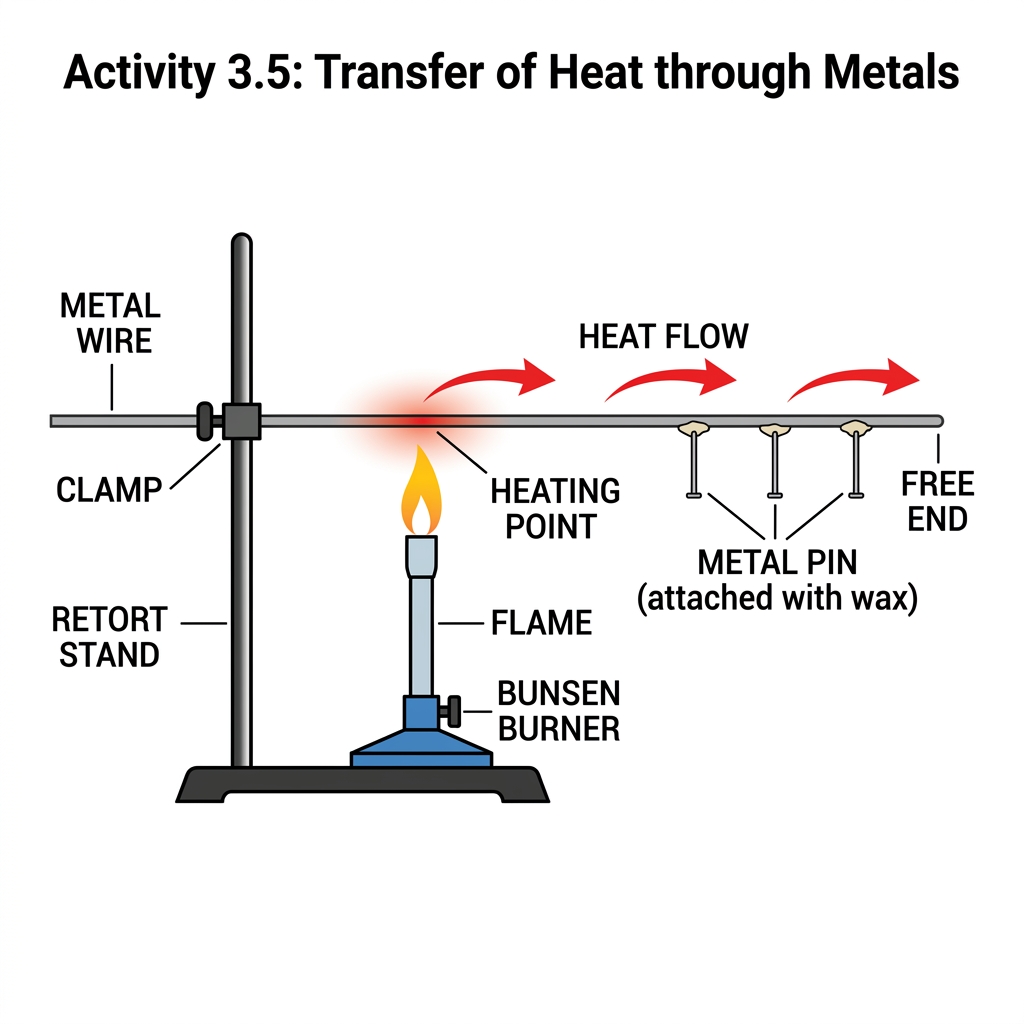
Experiment: Heat one end of a metal wire with a pin attached via wax at the other end.
Observation: The wax melts and the pin falls off, but the metal wire does not melt.
Inference: Metals are good conductors of heat and have high melting points.
Best Conductors: Silver (Ag) and Copper (Cu).
Poor Conductors: Lead (Pb) and Mercury (Hg).
Experiment: Set up a circuit with a gap for testing metal samples.
Observation: The bulb glows when metals like Cu or Al are connected.
Safety Note: Electric wires in homes are coated with PVC (Polyvinylchloride) or a rubber-like material because they are insulators.
Non-Metals: Examples include Carbon, Sulphur, Iodine, and Oxygen. They exist mostly as solids or gases at room temperature (with the sole exception of Bromine, which is liquid).
Nature of Oxides:
• Most non-metals produce acidic oxides when dissolved in water (e.g., $SO_2$).
• Most metals give rise to basic oxides (e.g., $MgO$).
| Property | Exception Detail |
|---|---|
| State | Mercury (Hg) is liquid at room temperature. |
| Melting Point | Gallium (Ga) and Caesium (Cs) melt on your palm (very low melting points). |
| Lustre | Iodine (I2) is a non-metal but it is lustrous with a shining surface. |
| Allotropy (Carbon) | Diamond (hardest natural substance, high MP) & Graphite (good electrical conductor). |
Metals behave differently when they react with air, water, and other substances. Their reactivity is the basis of the Reactivity Series.
Almost all metals combine with oxygen to form Metal Oxides. Most are basic, but some show unique properties.
Example: $2Cu + O_2 \rightarrow 2CuO$ (Black Copper(II) Oxide)
Example: $4Al + 3O_2 \rightarrow 2Al_2O_3$ (Aluminium Oxide)
Key Practical Observation: Iron does not burn on heating, but iron filings burn vigorously when sprinkled in the flame of the burner. Similarly, Copper does not burn, but is coated with a thin layer of black copper(II) oxide.
Oxides which react with both acids and bases to produce salt and water are called Amphoteric Oxides.
Example 1 (Aluminium):
Example 2 (Zinc):
Anodising is a process of forming a thick oxide layer of aluminium. This layer makes it resistant to further corrosion. During the process, clean Al is made the Anode and electrolysed with dilute sulphuric acid. Oxygen gas evolved reacts with Al to form a protective oxide layer.
Note: This layer can be dyed easily to give aluminium articles an attractive finish.
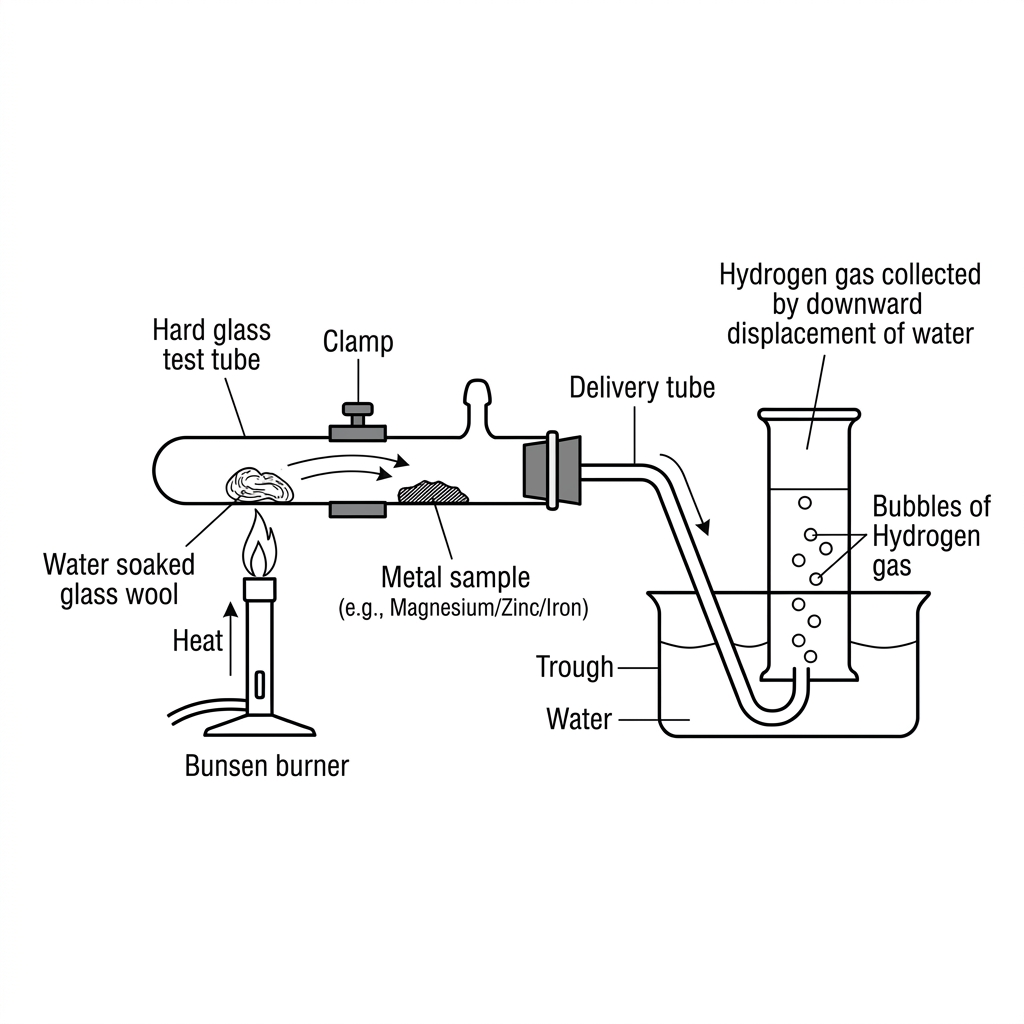
Generally, Metal + Dilute Acid $\rightarrow$ Salt + $H_2$. However, Nitric Acid ($HNO_3$) is different.
Hydrogen gas is NOT evolved when a metal reacts with $HNO_3$ because it is a strong oxidising agent. It oxidises the $H_2$ produced to $H_2O$ and itself gets reduced to nitrogen oxides ($N_2O, NO, NO_2$).
Exceptions: Magnesium ($Mg$) and Manganese ($Mn$) react with very dilute $HNO_3$ to evolve $H_2$ gas.
A freshly prepared mixture of Concentrated HCl and Concentrated $HNO_3$ in the ratio 3:1. It is a highly corrosive, fuming liquid that can dissolve Gold and Platinum, even though neither acid can do so alone.
Why do some metals react vigorously while others remain inert? The answer lies in their position in the Reactivity Series.
Metal A + Salt Solution of B $\rightarrow$ Salt Solution of A + Metal B
If Metal A displaces Metal B from its solution, it is more reactive than B. This is the most reliable way to compare reactivities.
K > Na > Ca > Mg > Al > Zn > Fe > Pb > [H] > Cu > Hg > Ag > Au
(Most Reactive $\rightarrow$ Potassium | Least Reactive $\rightarrow$ Gold)
Elements react with each other to achieve a stable, completely filled valence shell (Noble gas octet configuration).
$$Na\; (2,8,1) \longrightarrow Na^+\; (2,8) + e^-\quad (\text{Sodium cation})$$ $$Cl\; (2,8,7) + e^- \longrightarrow Cl^-\; (2,8,8)\quad (\text{Chloride anion})$$
Crucial Fact: Sodium chloride does NOT exist as discrete single molecules, but as large 3D aggregates of oppositely charged ions held firmly by intense electrostatic attraction forces.
$$Mg\; (2,8,2) \longrightarrow Mg^{2+}\; (2,8) + 2e^-\quad (\text{Magnesium cation})$$ $$2Cl\; (2,8,7) + 2e^- \longrightarrow 2Cl^-\; (2,8,8)\quad (\text{Two Chloride anions})$$
Magnesium loses 2 valence electrons; one electron is transferred to each of the two chlorine atoms to achieve complete noble gas octets.
The earth's crust is the major source of metals. Seawater also contains some soluble salts such as sodium chloride, magnesium chloride, etc.
Why are the ores of many metals oxides?
Oxygen is a very reactive element and is very abundant on the earth. Therefore, many metals react with atmospheric oxygen over time to form stable oxide ores.
Some metals are found in the earth's crust in the free state, while some are found in the form of their compounds:
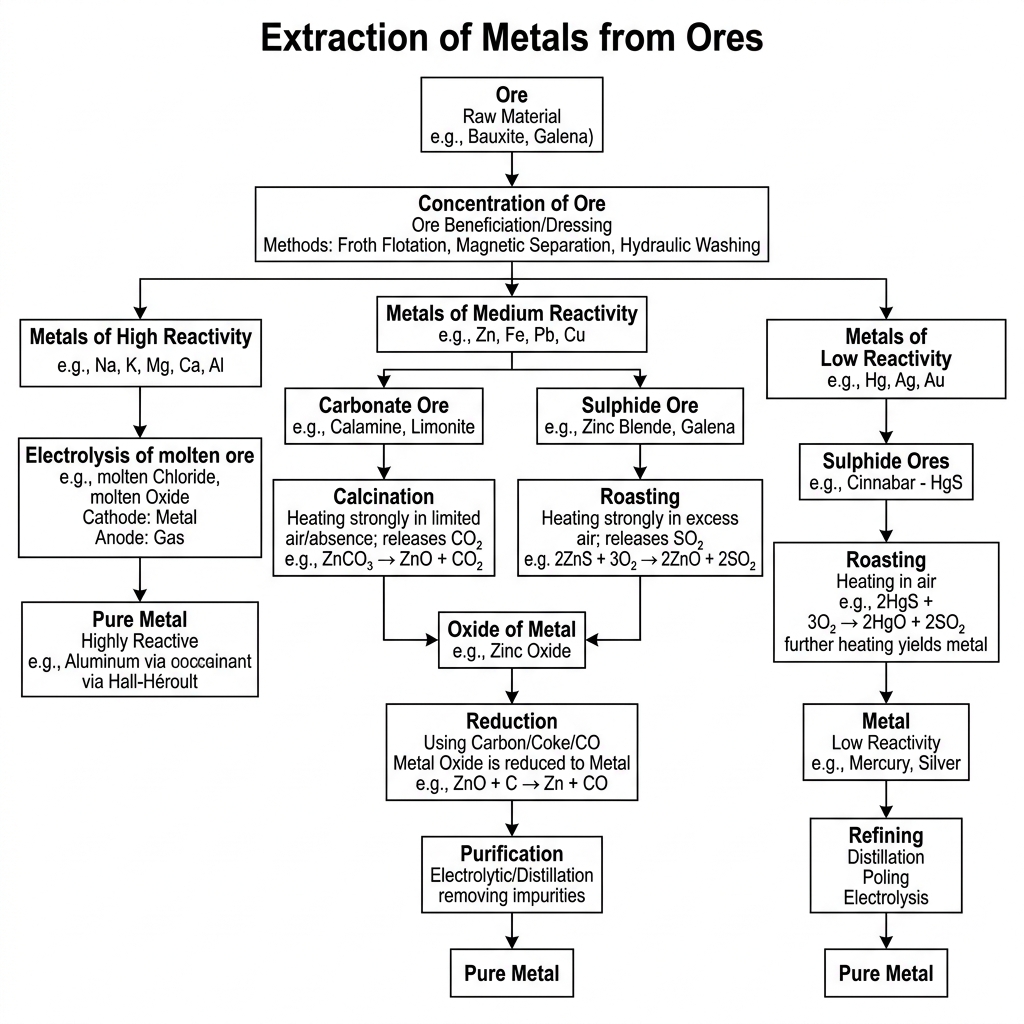
| Reactivity Category | Metals | Nature of Ore | Method of Extraction |
|---|---|---|---|
| Metals of High Reactivity | K, Na, Ca, Mg, Al | Molten Ore (Chlorides/Oxides) | Electrolysis of molten ore (cannot be reduced by carbon). |
| Metals of Medium Reactivity | Zn, Fe, Pb, Cu |
• Carbonate ore • Sulphide ore |
• Calcination (for carbonates) • Roasting (for sulphides) → Oxide of metal → Reduction to metal using Carbon → Purification. |
| Metals of Low Reactivity | Ag, Au (free state) Hg, Cu (sulphides) |
Sulphide ores or Native state | Roasting → Metal → Refining (reduction by heat alone). |
Ores mined from the earth are usually contaminated with large amounts of impurities such as soil, sand, etc., called gangue.
The impurities must be removed from the ore prior to the extraction of the metal. The processes used for removing the gangue from the ore are based on the differences between the physical or chemical properties of the gangue and the ore. Different separation techniques are accordingly employed.
Metals low in the activity series are very unreactive. The oxides of these metals can be reduced to metals by heating alone.
1. Extraction of Mercury from Cinnabar (HgS):
Cinnabar ($HgS$) is an ore of mercury. When it is heated in air, it is first converted into mercuric oxide ($HgO$). Mercuric oxide is then reduced to mercury on further heating:
$$2HgS(s) + 3O_2(g) \overset{\text{Heat}}{\longrightarrow} 2HgO(s) + 2SO_2(g)$$
$$2HgO(s) \overset{\text{Heat}}{\longrightarrow} 2Hg(l) + O_2(g)$$
2. Extraction of Copper from Copper Sulphide (Cu2S):
Similarly, copper which is found as $Cu_2S$ in nature can be obtained from its ore by just heating in air:
$$2Cu_2S + 3O_2(g) \overset{\text{Heat}}{\longrightarrow} 2Cu_2O(s) + 2SO_2(g)$$
$$2Cu_2O + Cu_2S \overset{\text{Heat}}{\longrightarrow} 6Cu(s) + SO_2(g)$$
The metals in the middle of the activity series such as iron, zinc, lead, copper, are moderately reactive. These are usually present as sulphides or carbonates in nature.
Why convert sulphides and carbonates into oxides before reduction?
It is easier to obtain a metal from its oxide, as compared to its sulphides and carbonates. Therefore, prior to reduction, the metal sulphides and carbonates must be converted into metal oxides.
| Process | Roasting | Calcination |
|---|---|---|
| Type of Ore | Used for Sulphide ores (e.g., Zinc blende ZnS). | Used for Carbonate ores (e.g., Calamine ZnCO3). |
| Heating Condition | Heating strongly in the presence of excess air. | Heating strongly in limited air. |
| Reaction Equation |
$$2ZnS(s) + 3O_2(g) \overset{\text{Heat}}{\longrightarrow} 2ZnO(s) + 2SO_2(g)$$
|
$$ZnCO_3(s) \overset{\text{Heat}}{\longrightarrow} ZnO(s) + CO_2(g)$$
|
Reduction of Metal Oxides to Metals:
The metal oxides are then reduced to the corresponding metals by using suitable reducing agents such as carbon. For example, when zinc oxide is heated with carbon, it is reduced to metallic zinc:
$$ZnO(s) + C(s) \rightarrow Zn(s) + CO(g)$$
Note: Obtaining metals from their compounds is also a reduction process.
Displacement Reactions as Reduction:
Besides using carbon (coke) to reduce metal oxides to metals, sometimes displacement reactions can also be used. The highly reactive metals such as sodium, calcium, aluminium, etc., are used as reducing agents because they can displace metals of lower reactivity from their compounds.
For example, when manganese dioxide is heated with aluminium powder, the following reaction takes place:
$$3MnO_2(s) + 4Al(s) \rightarrow 3Mn(l) + 2Al_2O_3(s) + \text{Heat}$$
These displacement reactions are highly exothermic. The amount of heat evolved is so large that the metals are produced in the molten state.
In fact, the reaction of iron(III) oxide ($Fe_2O_3$) with aluminium is used to join railway tracks or cracked machine parts. This reaction is known as the thermit reaction:
$$Fe_2O_3(s) + 2Al(s) \rightarrow 2Fe(l) + Al_2O_3(s) + \text{Heat}$$
Substances Oxidised & Reduced: Aluminium ($Al$) is oxidised (gains oxygen to form $Al_2O_3$), while Iron(III) oxide ($Fe_2O_3$) is reduced (loses oxygen to form $Fe$).
The metals high up in the reactivity series (K, Na, Ca, Mg, Al) are very reactive. They cannot be obtained from their compounds by heating with carbon. For example, carbon cannot reduce the oxides of sodium, magnesium, calcium, aluminium, etc., to the respective metals. This is because these metals have more affinity for oxygen than carbon.
These metals are obtained by electrolytic reduction. For example, sodium, magnesium and calcium are obtained by the electrolysis of their molten chlorides.
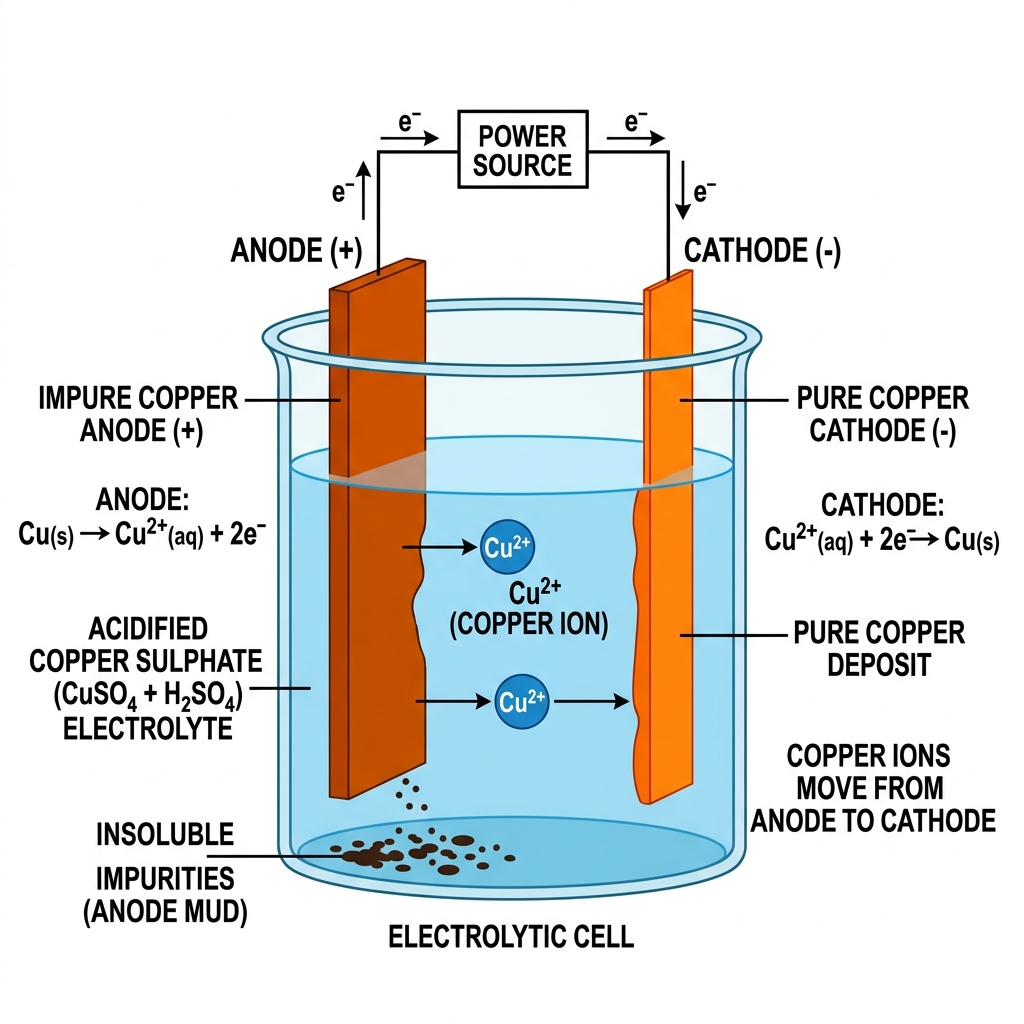
The metals produced by various reduction processes described above are not very pure. They contain impurities, which must be removed to obtain pure metals. The most widely used method for refining impure metals is electrolytic refining (used for copper, zinc, tin, nickel, silver, gold, etc.).
Corrosion is the slow eating away or deterioration of metals by chemical or electrochemical reaction with atmospheric substances (moisture, oxygen, carbon dioxide, hydrogen sulphide).
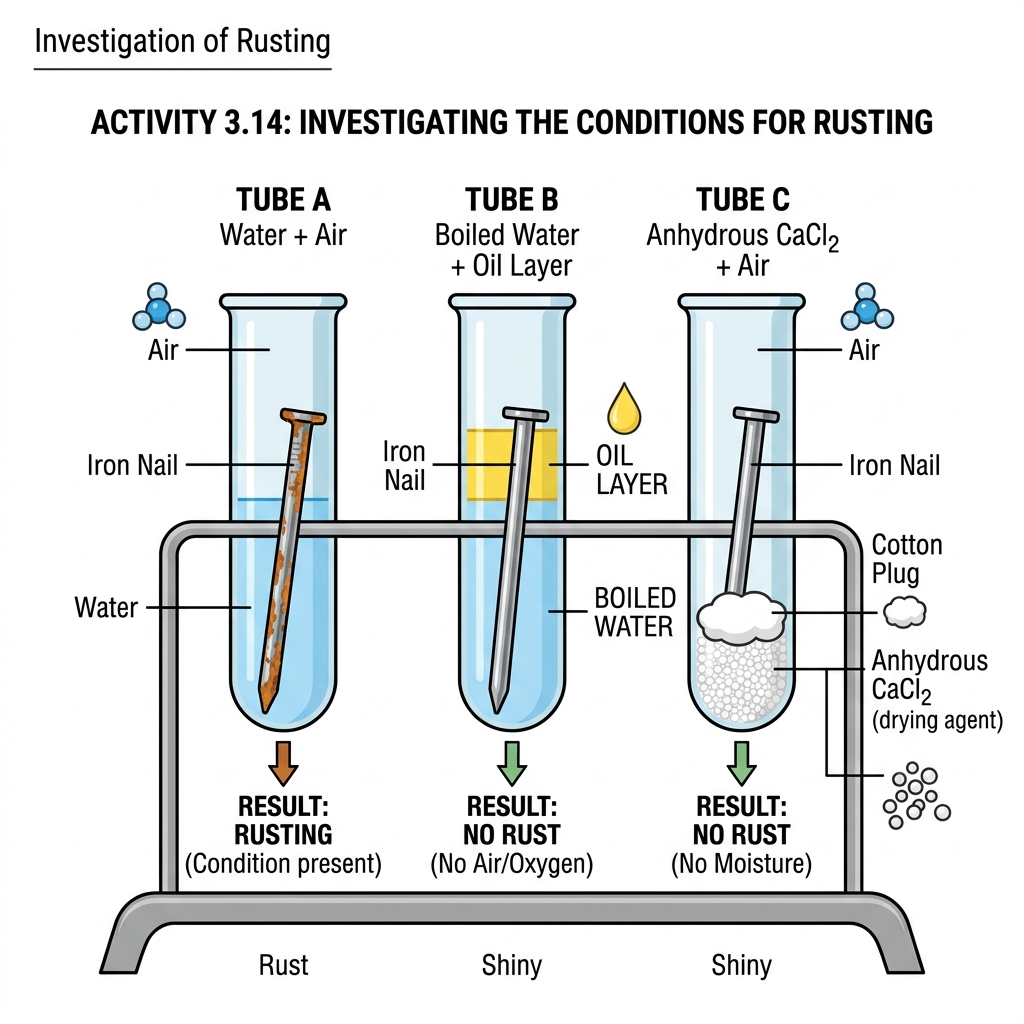
Three Test Tubes Setup:
Rusting of iron can be prevented by painting, oiling, greasing, galvanising, chrome plating, anodising, or by making alloys.
Galvanisation: A method of protecting iron and steel from rusting by coating them with a thin layer of Zinc ($Zn$).
Why is it effective? Zinc is more reactive than iron. Even if the zinc coating is scratched or broken, zinc oxidises preferentially (sacrificial protection), preventing the underlying iron from rusting.
An alloy is a homogeneous mixture of two or more metals, or a metal and a non-metal. It is prepared by melting the primary metal and then dissolving the other elements in definite proportions, followed by cooling to room temperature.
| Alloy | Composition | Key Characteristics & Primary Uses |
|---|---|---|
| Steel | Iron (Fe) + Carbon (0.05% - 1.5%) | Pure iron is very soft and stretches easily when hot; adding small amount of carbon makes it hard and strong. |
| Stainless Steel | Iron (Fe) + Nickel (Ni) + Chromium (Cr) | Hard, highly ductile, and does not rust. Used for surgical instruments and utensils. |
| Brass | Copper (Cu ≈ 80%) + Zinc (Zn ≈ 20%) | Malleable, lustrous golden finish, lower electrical conductivity than pure Cu. Used for musical instruments, decorative items, and fittings. |
| Bronze | Copper (Cu ≈ 90%) + Tin (Sn ≈ 10%) | Tough, resistant to corrosion, poor conductor of electricity. Used for statues, coins, and medals. |
| Solder | Lead (Pb ≈ 50%) + Tin (Sn ≈ 50%) | Low melting point (lower than constituent metals). Used for welding electrical wires together. |
| Amalgam | Mercury (Hg) + Any other metal (e.g., Na or Ag) | Dental amalgam (Ag-Sn-Hg) used for tooth fillings; Sodium amalgam (Na-Hg) used as a reducing agent. |
The famous Iron Pillar near the Qutub Minar in Delhi was built more than 1600 years ago by Indian iron workers. It is 8 metres high and weighs approximately 6 tonnes (6000 kg). Despite centuries of exposure to sun and rain, it has not rusted due to the formation of a protective thin passive layer of magnetic iron oxide ($\mathrm{Fe_3O_4}$) on its surface, standing as testament to ancient India's advanced metallurgical prowess.
Pure gold, known as 24 Carat gold, is very soft and pliable, making it unsuitable for making sturdy jewelry. To improve hardness, it is alloyed with either Silver ($Ag$) or Copper ($Cu$). In India, 22 Carat gold is commonly used, which means 22 parts by mass of pure gold is alloyed with 2 parts of either copper or silver.
 VARDAAN COMET