
Board Exam 2025
3 Marks
Q28. (a) Write the name and chemical formula
of a sodium compound which is sometimes added for faster cooking. How is it produced from sodium
chloride as one of the raw materials? Give chemical equation for the reaction involved.
(b) The compound mentioned in (a) above is also an ingredient of antacids. Why?
(b) The compound mentioned in (a) above is also an ingredient of antacids. Why?
(a) Compound: Baking Soda.
Chemical Name: Sodium Hydrogen Carbonate.
Formula: \(\text{NaHCO}_3\).
Production (Solvay Process): Reaction of cold concentrated NaCl solution (brine) with Ammonia and \(\text{CO}_2\).
\(\text{NaCl} + \text{H}_2\text{O} + \text{CO}_2 + \text{NH}_3 \longrightarrow \text{NH}_4\text{Cl} + \text{NaHCO}_3\)
(b) Antacid Ingredient:
It is a mild non-corrosive base (alkaline). It neutralizes excess acid in the stomach to provide relief from acidity.
Chemical Name: Sodium Hydrogen Carbonate.
Formula: \(\text{NaHCO}_3\).
Production (Solvay Process): Reaction of cold concentrated NaCl solution (brine) with Ammonia and \(\text{CO}_2\).
\(\text{NaCl} + \text{H}_2\text{O} + \text{CO}_2 + \text{NH}_3 \longrightarrow \text{NH}_4\text{Cl} + \text{NaHCO}_3\)
(b) Antacid Ingredient:
It is a mild non-corrosive base (alkaline). It neutralizes excess acid in the stomach to provide relief from acidity.
5 Marks
Q36. (a) (i) Give the relation between
hydrogen ion concentration of an aqueous solution and its pH.
(ii) Concentrated acids should not be diluted by adding water to acid. Why?
(iii) Why do same molar concentrations of hydrochloric acid and acetic acid not produce same amounts of hydrogen ions?
OR
(b) Give reason :
(i) Crystals of washing soda change to white powder on exposure to air.
(ii) Plaster of Paris should be stored in moisture-proof containers.
(iii) Baking soda can be used on bee sting area to get relief.
(iv) Distilled water does not conduct electricity.
(v) Farmers treat the soil of their fields with quick lime.
(ii) Concentrated acids should not be diluted by adding water to acid. Why?
(iii) Why do same molar concentrations of hydrochloric acid and acetic acid not produce same amounts of hydrogen ions?
OR
(b) Give reason :
(i) Crystals of washing soda change to white powder on exposure to air.
(ii) Plaster of Paris should be stored in moisture-proof containers.
(iii) Baking soda can be used on bee sting area to get relief.
(iv) Distilled water does not conduct electricity.
(v) Farmers treat the soil of their fields with quick lime.
(a) (i) Relation: pH is the negative logarithm of \(\text{H}^+\)
concentration. Higher \([\text{H}^+]\), lower pH.
(ii) Dilution Hazard: Simple rule: "Add Acid to Water". Adding water to concentrated acid is highly exothermic. The heat generated may cause the mixture to splash out and cause burns, or break the glass container.
(iii) Strength: HCl is a strong acid (dissociates completely), producing high \([\text{H}^+]\). Acetic acid is a weak acid (dissociates partially), producing low \([\text{H}^+]\).
(b) Reasons:
(i) Efflorescence: Washing Soda (\(\text{Na}_2\text{CO}_3\cdot10\text{H}_2\text{O}\)) loses water of crystallization to become soda ash (\(\text{Na}_2\text{CO}_3\cdot\text{H}_2\text{O}\) / anhydrous).
(ii) Hardening: POP absorbs moisture to form Gypsum, which is a hard solid mass. \(\text{CaSO}_4\cdot\frac{1}{2}\text{H}_2\text{O} + 1\frac{1}{2}\text{H}_2\text{O} \rightarrow \text{CaSO}_4\cdot2\text{H}_2\text{O}\).
(iii) Neutralization: Bee sting contains Methanoic acid. Baking soda is basic and neutralizes the acid pain.
(iv) No Ions: Distilled water is a covalent compound without free ions.
(v) Acidity: Quick lime (CaO) is basic. It is used to neutralize acidic soil.
(ii) Dilution Hazard: Simple rule: "Add Acid to Water". Adding water to concentrated acid is highly exothermic. The heat generated may cause the mixture to splash out and cause burns, or break the glass container.
(iii) Strength: HCl is a strong acid (dissociates completely), producing high \([\text{H}^+]\). Acetic acid is a weak acid (dissociates partially), producing low \([\text{H}^+]\).
(b) Reasons:
(i) Efflorescence: Washing Soda (\(\text{Na}_2\text{CO}_3\cdot10\text{H}_2\text{O}\)) loses water of crystallization to become soda ash (\(\text{Na}_2\text{CO}_3\cdot\text{H}_2\text{O}\) / anhydrous).
(ii) Hardening: POP absorbs moisture to form Gypsum, which is a hard solid mass. \(\text{CaSO}_4\cdot\frac{1}{2}\text{H}_2\text{O} + 1\frac{1}{2}\text{H}_2\text{O} \rightarrow \text{CaSO}_4\cdot2\text{H}_2\text{O}\).
(iii) Neutralization: Bee sting contains Methanoic acid. Baking soda is basic and neutralizes the acid pain.
(iv) No Ions: Distilled water is a covalent compound without free ions.
(v) Acidity: Quick lime (CaO) is basic. It is used to neutralize acidic soil.
1 Mark
Q4. Consider the following reactions :
(i) Dilute hydrochloric acid reacts with sodium hydroxide.
(ii) Magnesium oxide reacts with dilute hydrochloric acid.
(iii) Carbon dioxide reacts with sodium hydroxide.
It is found that in each case :
(i) Dilute hydrochloric acid reacts with sodium hydroxide.
(ii) Magnesium oxide reacts with dilute hydrochloric acid.
(iii) Carbon dioxide reacts with sodium hydroxide.
It is found that in each case :
All these are neutralization reactions:
(i) \(\text{HCl} + \text{NaOH} \longrightarrow \text{NaCl} + \text{H}_2\text{O}\)
(ii) \(\text{MgO} + 2\text{HCl} \longrightarrow \text{MgCl}_2 + \text{H}_2\text{O}\)
(iii) \(\text{CO}_2 + 2\text{NaOH} \longrightarrow \text{Na}_2\text{CO}_3 + \text{H}_2\text{O}\)
In all cases, Salt and Water are produced.
Correct Option: (A)
(i) \(\text{HCl} + \text{NaOH} \longrightarrow \text{NaCl} + \text{H}_2\text{O}\)
(ii) \(\text{MgO} + 2\text{HCl} \longrightarrow \text{MgCl}_2 + \text{H}_2\text{O}\)
(iii) \(\text{CO}_2 + 2\text{NaOH} \longrightarrow \text{Na}_2\text{CO}_3 + \text{H}_2\text{O}\)
In all cases, Salt and Water are produced.
Correct Option: (A)
1 Mark
Q5. Tooth enamel is made up of calcium
hydroxyapatite (a crystalline form of
calcium phosphate). This chemical starts corroding in the mouth when
the pH is :
Tooth decay starts when the pH of the mouth is lower than 5.5.
Among the options, 5 is less than 5.5.
Correct Option: (B)
Among the options, 5 is less than 5.5.
Correct Option: (B)
4 Marks
Q38. Seawater contains many salts dissolved
in it. Common salt is separated
from these salts. Deposits of solid salt are also found in several parts of
the world. These large crystals are often brown due to impurities. This is
called rock salt and is mined like coal. The common salt is an important
raw material for chemicals of daily use.
(a) Write balanced chemical equations to show the products formed during electrolysis of brine.
(b) List two uses of any one product obtained during electrolysis of brine.
(c) (i) A mild non-corrosive basic salt �A�, used for faster cooking, is strongly heated to produce a compound �B�, that is used for removing permanent hardness of water. Identify A and B and also write the equation for the reaction that occurs when A is heated.
OR
(c) (ii) Define water of crystallisation. Give two examples of salts that have water of crystallisation.
(a) Write balanced chemical equations to show the products formed during electrolysis of brine.
(b) List two uses of any one product obtained during electrolysis of brine.
(c) (i) A mild non-corrosive basic salt �A�, used for faster cooking, is strongly heated to produce a compound �B�, that is used for removing permanent hardness of water. Identify A and B and also write the equation for the reaction that occurs when A is heated.
OR
(c) (ii) Define water of crystallisation. Give two examples of salts that have water of crystallisation.
(a) Electrolysis of Brine (Chlor-Alkali Process):
\(2\text{NaCl}(aq) + 2\text{H}_2\text{O}(l) \xrightarrow{\text{electricity}} 2\text{NaOH}(aq) + \text{Cl}_2(g) + \text{H}_2(g)\)
(b) Uses:
Hydrogen (\(\text{H}_2\)): Fuels, margarine, ammonia for fertilizers.
Chlorine (\(\text{Cl}_2\)): Water treatment, PVC, disinfectants, CFCs.
Sodium Hydroxide (\(\text{NaOH}\)): De-greasing metals, soaps and detergents, paper making.
(c) (i):
�A� (Mild basic salt for cooking): Baking Soda (\(\text{NaHCO}_3\), Sodium Hydrogen Carbonate).
�B� (Removes permanent hardness): Sodium Carbonate (\(\text{Na}_2\text{CO}_3\)).
Reaction: \(2\text{NaHCO}_3 \xrightarrow{\text{Heat}} \text{Na}_2\text{CO}_3 + \text{H}_2\text{O} + \text{CO}_2\)
OR
(c) (ii) Water of Crystallisation:
It is the fixed number of water molecules present in one formula unit of a salt.
Examples:
1. Blue Vitriol (Copper Sulphate): \(\text{CuSO}_4 \cdot 5\text{H}_2\text{O}\)
2. Washing Soda: \(\text{Na}_2\text{CO}_3 \cdot 10\text{H}_2\text{O}\)
3. Gypsum: \(\text{CaSO}_4 \cdot 2\text{H}_2\text{O}\)
\(2\text{NaCl}(aq) + 2\text{H}_2\text{O}(l) \xrightarrow{\text{electricity}} 2\text{NaOH}(aq) + \text{Cl}_2(g) + \text{H}_2(g)\)
(b) Uses:
Hydrogen (\(\text{H}_2\)): Fuels, margarine, ammonia for fertilizers.
Chlorine (\(\text{Cl}_2\)): Water treatment, PVC, disinfectants, CFCs.
Sodium Hydroxide (\(\text{NaOH}\)): De-greasing metals, soaps and detergents, paper making.
(c) (i):
�A� (Mild basic salt for cooking): Baking Soda (\(\text{NaHCO}_3\), Sodium Hydrogen Carbonate).
�B� (Removes permanent hardness): Sodium Carbonate (\(\text{Na}_2\text{CO}_3\)).
Reaction: \(2\text{NaHCO}_3 \xrightarrow{\text{Heat}} \text{Na}_2\text{CO}_3 + \text{H}_2\text{O} + \text{CO}_2\)
OR
(c) (ii) Water of Crystallisation:
It is the fixed number of water molecules present in one formula unit of a salt.
Examples:
1. Blue Vitriol (Copper Sulphate): \(\text{CuSO}_4 \cdot 5\text{H}_2\text{O}\)
2. Washing Soda: \(\text{Na}_2\text{CO}_3 \cdot 10\text{H}_2\text{O}\)
3. Gypsum: \(\text{CaSO}_4 \cdot 2\text{H}_2\text{O}\)
4 Marks
Q38. Case Study: Seawater
contains many salts dissolved in it. Common salt is separated from these salts. Deposits of solid salt
are also found in several parts of the world. These large crystals are often brown due to impurities.
This is called rock salt and is mined like coal. The common salt is an important raw material for
chemicals of daily use.
(a) Write balanced chemical equations to show the products formed during electrolysis of brine.
(b) List two uses of any one product obtained during electrolysis of brine.
(c) (i) A mild non-corrosive basic salt �A�, used for faster cooking, is strongly heated to produce a compound �B�, that is used for removing permanent hardness of water. Identify A and B and also write the equation for the reaction that occurs when A is heated.
OR
(c) (ii) Define water of crystallisation. Give two examples of salts that have water of crystallisation.
(a) Write balanced chemical equations to show the products formed during electrolysis of brine.
(b) List two uses of any one product obtained during electrolysis of brine.
(c) (i) A mild non-corrosive basic salt �A�, used for faster cooking, is strongly heated to produce a compound �B�, that is used for removing permanent hardness of water. Identify A and B and also write the equation for the reaction that occurs when A is heated.
OR
(c) (ii) Define water of crystallisation. Give two examples of salts that have water of crystallisation.
(a) Electrolysis of Brine (Chlor-Alkali Process):
\(2\text{NaCl}(aq) + 2\text{H}_2\text{O}(l) \xrightarrow{\text{Electricity}} 2\text{NaOH}(aq) + \text{Cl}_2(g) + \text{H}_2(g)\).
(b) Uses:
- Hydrogen (H2): Fuels, Margarine, Ammonia for fertilizers.
- Chlorine (Cl2): Water treatment, PVC, CFCs, Pesticides.
- Sodium Hydroxide (NaOH): De-greasing metals, Soaps and detergents, Paper making.
(c) (i) Identification:
Salt 'A' (Cooking): Baking Soda (\(\text{NaHCO}_3\)).
Heated to 'B' (Removing Hardness): Sodium Carbonate (\(\text{Na}_2\text{CO}_3\)).
Reaction: \(2\text{NaHCO}_3 \xrightarrow{\Delta} \text{Na}_2\text{CO}_3 + \text{H}_2\text{O} + \text{CO}_2\).
(c) (ii) Water of Crystallisation:
Definition: The fixed number of water molecules present in one formula unit of a salt.
Examples:
1. Copper Sulphate Pentahydrate (\(\text{CuSO}_4 \cdot 5\text{H}_2\text{O}\)) - Blue.
2. Washing Soda (\(\text{Na}_2\text{CO}_3 \cdot 10\text{H}_2\text{O}\)).
3. Gypsum (\(\text{CaSO}_4 \cdot 2\text{H}_2\text{O}\)).
\(2\text{NaCl}(aq) + 2\text{H}_2\text{O}(l) \xrightarrow{\text{Electricity}} 2\text{NaOH}(aq) + \text{Cl}_2(g) + \text{H}_2(g)\).
(b) Uses:
- Hydrogen (H2): Fuels, Margarine, Ammonia for fertilizers.
- Chlorine (Cl2): Water treatment, PVC, CFCs, Pesticides.
- Sodium Hydroxide (NaOH): De-greasing metals, Soaps and detergents, Paper making.
(c) (i) Identification:
Salt 'A' (Cooking): Baking Soda (\(\text{NaHCO}_3\)).
Heated to 'B' (Removing Hardness): Sodium Carbonate (\(\text{Na}_2\text{CO}_3\)).
Reaction: \(2\text{NaHCO}_3 \xrightarrow{\Delta} \text{Na}_2\text{CO}_3 + \text{H}_2\text{O} + \text{CO}_2\).
(c) (ii) Water of Crystallisation:
Definition: The fixed number of water molecules present in one formula unit of a salt.
Examples:
1. Copper Sulphate Pentahydrate (\(\text{CuSO}_4 \cdot 5\text{H}_2\text{O}\)) - Blue.
2. Washing Soda (\(\text{Na}_2\text{CO}_3 \cdot 10\text{H}_2\text{O}\)).
3. Gypsum (\(\text{CaSO}_4 \cdot 2\text{H}_2\text{O}\)).
1 Mark
Q2. The colour of the solution obtained after
30 minutes of placing zinc metal in copper sulphate solution is :
Reaction: \(\text{Zn}(s) + \text{CuSO}_4(aq) [\text{Blue}]
\longrightarrow \text{ZnSO}_4(aq) [\text{Colourless}] + \text{Cu}(s) [\text{Reddish Brown}]\)
Zinc displaces Copper. The blue colour fades and becomes colourless.
Correct Option: (B)
Zinc displaces Copper. The blue colour fades and becomes colourless.
Correct Option: (B)
1 Mark
Q3. The warning sign shown in the given figure
must invariably be
displayed/pasted on the containers which contain hydroxide of :
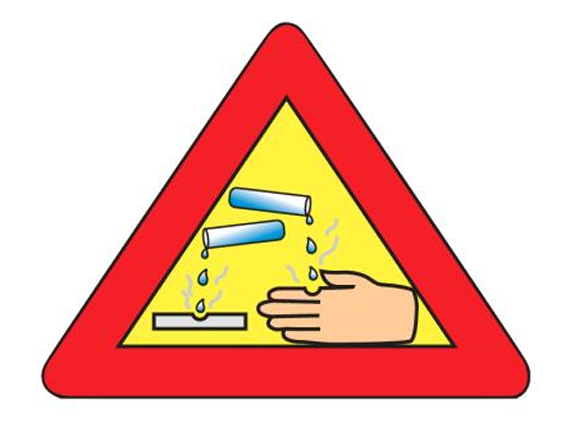
Analysis:
The warning sign shows a Corrosive Substance which can cause severe burns to skin and damage materials.
Among the options, Sodium Hydroxide (Caustic Soda, NaOH) is a strong base and highly corrosive in nature.
Other hydroxides like Aluminium, Calcium (Slaked Lime), and Magnesium (Milk of Magnesia) are relatively milder bases.
Correct Option: (C)
The warning sign shows a Corrosive Substance which can cause severe burns to skin and damage materials.
Among the options, Sodium Hydroxide (Caustic Soda, NaOH) is a strong base and highly corrosive in nature.
Other hydroxides like Aluminium, Calcium (Slaked Lime), and Magnesium (Milk of Magnesia) are relatively milder bases.
Correct Option: (C)
3 Marks
Q28. Two substances 'A' and 'B' are burnt in
air separately. For 'A', ashes are collected and dissolved in water to get solution 'X', while for
'B', fumes produced are passed through water to get solution 'Y'. Both the solutions 'X' and 'Y' are
then tested with pH paper.
(a) If 'X' gives light blue colour and 'Y' gives orange colour to the pH paper, then write the nature and range of pH of 'X' and 'Y'.
(b) Which one of the two � A and B, is a metal ? Justify your answer.
(a) If 'X' gives light blue colour and 'Y' gives orange colour to the pH paper, then write the nature and range of pH of 'X' and 'Y'.
(b) Which one of the two � A and B, is a metal ? Justify your answer.
(a) Nature and pH Range:
Solution 'X' (Light Blue): Basic/Alkaline. pH Range ~ 8-10.
Solution 'Y' (Orange): Acidic. pH Range ~ 3-5.
(b) Metal Identification:
Substance 'A' is a Metal.
Justification: Metal oxides are basic in nature. When 'A' burns (forms oxide) and dissolves in water, it forms a basic solution ('X') which turns pH paper blue. Non-metal oxides (like from 'B') are acidic and turn pH paper orange/red.
Solution 'X' (Light Blue): Basic/Alkaline. pH Range ~ 8-10.
Solution 'Y' (Orange): Acidic. pH Range ~ 3-5.
(b) Metal Identification:
Substance 'A' is a Metal.
Justification: Metal oxides are basic in nature. When 'A' burns (forms oxide) and dissolves in water, it forms a basic solution ('X') which turns pH paper blue. Non-metal oxides (like from 'B') are acidic and turn pH paper orange/red.
4 Marks
Q39. Acid-base indicators can be used to
distinguish between an acid and a base. Universal indicator, a mixture of several indicators, shows
different colours at different concentrations of acids and bases, thereby indicating their pH on the
pH scale of 0 � 14. The pH of a solution is measured by pH paper, which is a paper impregnated with
a universal indicator.
 39.png"
class="question-image" alt="2025-31-2-QuestionNumber39.png" style="max-width: 80%; max-height: 60vh;
object-fit: contain; height: auto; display: block; margin: 10px auto; border-radius: 8px;">
Answer the following questions :
39.png"
class="question-image" alt="2025-31-2-QuestionNumber39.png" style="max-width: 80%; max-height: 60vh;
object-fit: contain; height: auto; display: block; margin: 10px auto; border-radius: 8px;">
Answer the following questions :
(a) Solution P is a strong acid while solution Q is a strong base. On the pH scale, where would you place the solutions P and Q ?
(b) A solution has a pH of 7. Name a compound you would use to (i) increase its pH, and (ii) decrease its pH.
(c) (i) When the pH of a solution is decreased from 4 to 2, what effect does it produce on its hydronium ion concentration ? State the colour change shown by the pH paper.
OR
(c) (ii) A person is feeling pain and irritation in the stomach due to indigestion. What could be the pH of the fluid in the stomach ? Write the common name of the medicines people use for remedy. Give the chemical name of �milk of magnesia� often used for this purpose.
39.png"
class="question-image" alt="2025-31-2-QuestionNumber39.png" style="max-width: 80%; max-height: 60vh;
object-fit: contain; height: auto; display: block; margin: 10px auto; border-radius: 8px;">
Answer the following questions :(a) Solution P is a strong acid while solution Q is a strong base. On the pH scale, where would you place the solutions P and Q ?
(b) A solution has a pH of 7. Name a compound you would use to (i) increase its pH, and (ii) decrease its pH.
(c) (i) When the pH of a solution is decreased from 4 to 2, what effect does it produce on its hydronium ion concentration ? State the colour change shown by the pH paper.
OR
(c) (ii) A person is feeling pain and irritation in the stomach due to indigestion. What could be the pH of the fluid in the stomach ? Write the common name of the medicines people use for remedy. Give the chemical name of �milk of magnesia� often used for this purpose.
(a) pH Scale Placement:
Solution P (Strong Acid): Near 0 - 1.
Solution Q (Strong Base): Near 13 - 14.
(b) Changing pH:
(i) To increase pH (> 7): Add a Base (e.g., Sodium Hydroxide, NaOH or Sodium Carbonate, \(\text{Na}_2\text{CO}_3\)).
(ii) To decrease pH (< 7): Add an Acid (e.g., Hydrochloric Acid, HCl or Acetic Acid, \(\text{CH}_3\text{COOH}\)).
(c) (i) Effect on Hydronium Ions:
Concentration: The hydronium ion concentration \([\text{H}_3\text{O}^+]\) increases (becomes 100 times more concentrated).
Colour Change: pH paper changes from Orange/Yellow (at pH 4) to Red/Dark Red (at pH 2).
OR
(c) (ii) Indigestion:
pH of Stomach Fluid: Acidic, typically range 1 - 3 (due to excess HCl).
Common Name: Antacids.
Chemical Name of Milk of Magnesia: Magnesium Hydroxide (\(\text{Mg(OH)}_2\)).
Solution P (Strong Acid): Near 0 - 1.
Solution Q (Strong Base): Near 13 - 14.
(b) Changing pH:
(i) To increase pH (> 7): Add a Base (e.g., Sodium Hydroxide, NaOH or Sodium Carbonate, \(\text{Na}_2\text{CO}_3\)).
(ii) To decrease pH (< 7): Add an Acid (e.g., Hydrochloric Acid, HCl or Acetic Acid, \(\text{CH}_3\text{COOH}\)).
(c) (i) Effect on Hydronium Ions:
Concentration: The hydronium ion concentration \([\text{H}_3\text{O}^+]\) increases (becomes 100 times more concentrated).
Colour Change: pH paper changes from Orange/Yellow (at pH 4) to Red/Dark Red (at pH 2).
OR
(c) (ii) Indigestion:
pH of Stomach Fluid: Acidic, typically range 1 - 3 (due to excess HCl).
Common Name: Antacids.
Chemical Name of Milk of Magnesia: Magnesium Hydroxide (\(\text{Mg(OH)}_2\)).
1 Mark
Q5. Which of the given option represents a family
of salts ?
Analysis:
Family of Salts: Salts that share a common positive ion (cation) or a common negative ion (anion) are said to belong to the same family.
Checking the options:
(A) Chloride, Sulphate, Sulphate (Different anions). Sodium, Sodium, Calcium (Mixed cations).
(B) \(\text{K}_2\text{SO}_4, \text{Na}_2\text{SO}_4, \text{CaSO}_4\). All these salts contain the Sulphate radical (\(\text{SO}_4^{2-}\)). Thus, they belong to the family of Sulphate salts.
(C) Nitrate, Carbonate, Carbonate (Different anions).
(D) Sulphate, Sulphate, Chloride (Different anions).
Correct Option: (B)
Family of Salts: Salts that share a common positive ion (cation) or a common negative ion (anion) are said to belong to the same family.
Checking the options:
(A) Chloride, Sulphate, Sulphate (Different anions). Sodium, Sodium, Calcium (Mixed cations).
(B) \(\text{K}_2\text{SO}_4, \text{Na}_2\text{SO}_4, \text{CaSO}_4\). All these salts contain the Sulphate radical (\(\text{SO}_4^{2-}\)). Thus, they belong to the family of Sulphate salts.
(C) Nitrate, Carbonate, Carbonate (Different anions).
(D) Sulphate, Sulphate, Chloride (Different anions).
Correct Option: (B)
2 Marks
Q22. A chemical compound �X� is used to bleach
washed clothes in laundry as well as to make drinking water free from germs. Identify �X�. How is this
compound represented ? Write the method of its preparation along with the chemical equation for the
reaction that occurs.
Identification:
Compound 'X' is Bleaching Powder (Calcium Oxychloride).
Representation: \(\text{CaOCl}_2\).
Preparation:
It is produced by the action of chlorine on dry slaked lime [\(\text{Ca(OH)}_2\)].
Equation:
\( \text{Ca(OH)}_2 + \text{Cl}_2 \rightarrow \text{CaOCl}_2 + \text{H}_2\text{O} \)
Compound 'X' is Bleaching Powder (Calcium Oxychloride).
Representation: \(\text{CaOCl}_2\).
Preparation:
It is produced by the action of chlorine on dry slaked lime [\(\text{Ca(OH)}_2\)].
Equation:
\( \text{Ca(OH)}_2 + \text{Cl}_2 \rightarrow \text{CaOCl}_2 + \text{H}_2\text{O} \)
3 Marks
Q28. (a) Common salt is an important raw material
for various chemicals of daily use. State in brief the method of preparation of (i) Sodium hydroxide,
and (ii) Sodium hydrogen carbonate from common salt. Write balanced chemical equations of the reactions
that occur.
OR
(b) Design an experimental set-up to demonstrate that �Alcohol and glucose contain hydrogen but are not categorised as acids�. Also give the reason to justify this fact.
OR
(b) Design an experimental set-up to demonstrate that �Alcohol and glucose contain hydrogen but are not categorised as acids�. Also give the reason to justify this fact.
(a) Preparation from Common Salt:
(i) Sodium Hydroxide (Chlor-alkali process):
Electricity is passed through an aqueous solution of Sodium Chloride (brine). It decomposes to form NaOH, Chlorine, and Hydrogen.
\( 2\text{NaCl}(aq) + 2\text{H}_2\text{O}(l) \xrightarrow{\text{Electricity}} 2\text{NaOH}(aq) + \text{Cl}_2(g) + \text{H}_2(g) \)
(ii) Sodium Hydrogen Carbonate (Solvay Process):
Produced by reacting cold concentrated brine with ammonia and carbon dioxide.
\( \text{NaCl} + \text{H}_2\text{O} + \text{CO}_2 + \text{NH}_3 \rightarrow \text{NH}_4\text{Cl} + \text{NaHCO}_3 \)
(b) OR - Alcohol and Glucose Experiment:
Experiment:
Reason: The bulb does not glow because electric current is carried by ions. Glucose and Alcohol do not dissociate in water to produce ions (specifically \(\text{H}^+\) ions). Since they do not produce hydrogen ions, they are not categorised as acids, even though they contain hydrogen.
(i) Sodium Hydroxide (Chlor-alkali process):
Electricity is passed through an aqueous solution of Sodium Chloride (brine). It decomposes to form NaOH, Chlorine, and Hydrogen.
\( 2\text{NaCl}(aq) + 2\text{H}_2\text{O}(l) \xrightarrow{\text{Electricity}} 2\text{NaOH}(aq) + \text{Cl}_2(g) + \text{H}_2(g) \)
(ii) Sodium Hydrogen Carbonate (Solvay Process):
Produced by reacting cold concentrated brine with ammonia and carbon dioxide.
\( \text{NaCl} + \text{H}_2\text{O} + \text{CO}_2 + \text{NH}_3 \rightarrow \text{NH}_4\text{Cl} + \text{NaHCO}_3 \)
(b) OR - Alcohol and Glucose Experiment:
Experiment:
- Take solutions of glucose and alcohol in a beaker.
- Fix two nails on a cork and place the cork in the beaker.
- Connect the nails to the two terminals of a 6 volt battery through a bulb and a switch.
- Pour the solution and switch on the current.
Reason: The bulb does not glow because electric current is carried by ions. Glucose and Alcohol do not dissociate in water to produce ions (specifically \(\text{H}^+\) ions). Since they do not produce hydrogen ions, they are not categorised as acids, even though they contain hydrogen.
1 Mark
Q7. In order to prepare dry hydrogen chloride gas
in humid atmosphere the gas produced is passed through a guard tube (drying tube) which contains :
Drying Agent: Anhydrous Calcium Chloride (\(\text{CaCl}_2\)) is
used to absorb moisture from HCl gas.
(CaO reacts with HCl, so not used).
Correct Option: (a)
(CaO reacts with HCl, so not used).
Correct Option: (a)
1 Mark
Q19. Assertion (A): Concentrated
nitric acid is diluted by adding water slowly to acid with constant stirring.
Reason (R): Concentrated nitric acid is easily soluble in water.
Reason (R): Concentrated nitric acid is easily soluble in water.
Analysis:
Assertion is False: Water should NEVER be added to concentrated acid. Acid should be added to water slowly.
Reason is True: Acid is soluble in water (highly exothermic).
Correct Option: (d) A is false, R is true.
Assertion is False: Water should NEVER be added to concentrated acid. Acid should be added to water slowly.
Reason is True: Acid is soluble in water (highly exothermic).
Correct Option: (d) A is false, R is true.
1 Mark
Q4. A metal, 'X', on treatment with sodium
hydroxide liberates a gas 'G'. It also liberates the same gas, 'G' on treatment with dilute sulphuric
acid. Based on above information, 'X' and 'G' respectively are
Analysis:
Metal reacting with both Base (NaOH) and Acid (H2SO4) indicates an Amphoteric Metal (matches Zinc).
Gas G: Hydrogen (H2).
Reactions:
1. \(\text{Zn} + 2\text{NaOH} \rightarrow \text{Na}_2\text{ZnO}_2 + \text{H}_2\)
2. \(\text{Zn} + \text{H}_2\text{SO}_4 \rightarrow \text{ZnSO}_4 + \text{H}_2\)
Copper does not react with dilute acids/bases to release H2.
Correct Option: (C)
Metal reacting with both Base (NaOH) and Acid (H2SO4) indicates an Amphoteric Metal (matches Zinc).
Gas G: Hydrogen (H2).
Reactions:
1. \(\text{Zn} + 2\text{NaOH} \rightarrow \text{Na}_2\text{ZnO}_2 + \text{H}_2\)
2. \(\text{Zn} + \text{H}_2\text{SO}_4 \rightarrow \text{ZnSO}_4 + \text{H}_2\)
Copper does not react with dilute acids/bases to release H2.
Correct Option: (C)
1 Mark
Q5. When a mixture of baking soda and tartaric
acid is heated (or mixed in water) a product 'X' is formed, which is responsible for making breads and
cakes soft and spongy. The product 'X' is
Reaction: Baking Powder (NaHCO3 + Tartaric Acid) + H2O
\(\rightarrow\) CO2 (Gas) + H2O + Sodium Salt (Sodium Tartrate).
The gas bubbles 'X' trapped in dough make it rise.
X = Carbon Dioxide (\(\text{CO}_2\)).
Correct Option: (A)
The gas bubbles 'X' trapped in dough make it rise.
X = Carbon Dioxide (\(\text{CO}_2\)).
Correct Option: (A)
3 Marks
Q33. Write chemical formula of washing soda. How
is it obtained from baking soda ? List two uses of washing soda.
Formula: \(\text{Na}_2\text{CO}_3 \cdot 10\text{H}_2\text{O}\) (Sodium Carbonate
Decahydrate).
Preparation: Heating Baking Soda gives Sodium Carbonate (anhydrous), which is then recrystallised with water.
1. \(2\text{NaHCO}_3 \xrightarrow{\text{Heat}} \text{Na}_2\text{CO}_3 + \text{CO}_2 + \text{H}_2\text{O}\)
2. \(\text{Na}_2\text{CO}_3 + 10\text{H}_2\text{O} \rightarrow \text{Na}_2\text{CO}_3 \cdot 10\text{H}_2\text{O}\)
Uses:
1. Softening of hard water.
2. Manufacture of glass, soap, paper.
Preparation: Heating Baking Soda gives Sodium Carbonate (anhydrous), which is then recrystallised with water.
1. \(2\text{NaHCO}_3 \xrightarrow{\text{Heat}} \text{Na}_2\text{CO}_3 + \text{CO}_2 + \text{H}_2\text{O}\)
2. \(\text{Na}_2\text{CO}_3 + 10\text{H}_2\text{O} \rightarrow \text{Na}_2\text{CO}_3 \cdot 10\text{H}_2\text{O}\)
Uses:
1. Softening of hard water.
2. Manufacture of glass, soap, paper.
1 Mark
Q2. You have three aqueous solutions A, B and C
as given below :
A - Potassium nitrate
B - Ammonium chloride
C - Sodium carbonate
The ascending order of the pH of these solutions is :
A - Potassium nitrate
B - Ammonium chloride
C - Sodium carbonate
The ascending order of the pH of these solutions is :
A: Potassium nitrate (neutral salt, Strong Acid + Strong Base) -> pH = 7.
B: Ammonium chloride (acidic salt, SA + WB) -> pH < 7.
C: Sodium carbonate (basic salt, WA + SB) -> pH > 7.
Order: B (Acidic) < A (Neutral) < C (Basic).
Correct Option: (D)
B: Ammonium chloride (acidic salt, SA + WB) -> pH < 7.
C: Sodium carbonate (basic salt, WA + SB) -> pH > 7.
Order: B (Acidic) < A (Neutral) < C (Basic).
Correct Option: (D)
1 Mark
Q6. The water of crystallization is present in
- Bleaching Powder
- Plaster of Paris
- Washing Soda
- Baking Soda
(i) Bleaching powder: \(\text{CaOCl}_2\) (No water).
(ii) PoP: \(\text{CaSO}_4 \cdot \frac{1}{2} \text{H}_2\text{O}\) (Has water).
(iii) Washing Soda: \(\text{Na}_2\text{CO}_3 \cdot 10 \text{H}_2\text{O}\) (Has water).
(iv) Baking Soda: \(\text{NaHCO}_3\) (No water).
Correct Option: (B)
(ii) PoP: \(\text{CaSO}_4 \cdot \frac{1}{2} \text{H}_2\text{O}\) (Has water).
(iii) Washing Soda: \(\text{Na}_2\text{CO}_3 \cdot 10 \text{H}_2\text{O}\) (Has water).
(iv) Baking Soda: \(\text{NaHCO}_3\) (No water).
Correct Option: (B)
1 Mark
Q7. Juice of tamarind turns blue litmus to red.
It is because of the presence of a chemical compound called
Tamarind contains Tartaric acid.
(A) Acetic - Vinegar. (B) Methanoic - Ant sting. (C) Oxalic - Tomato.
Correct Option: (D)
(A) Acetic - Vinegar. (B) Methanoic - Ant sting. (C) Oxalic - Tomato.
Correct Option: (D)
3 Marks
Q28. (a) State the chemical property in each case
on which the following uses of baking soda are based upon :
(b) Write chemical equations to show what happens when an acid reacts with a
- as an anti-acids
- as a constituent in making baking powder
- in soda-acid fire-extinguishers
(b) Write chemical equations to show what happens when an acid reacts with a
- metal
- base and
- carbonate
(a) Uses of Baking Soda (\(\text{NaHCO}_3\)):
(i) Antacid: Being alkaline, it neutralizes excess acid in the stomach.
(ii) Baking Powder: On heating or mixing with water, it releases \(\text{CO}_2\) which makes cake soft/spongy. (Reaction with mild edible acid like tartaric acid).
(iii) Fire Extinguisher: Reacts with acid to produce carbon dioxide (\(\text{CO}_2\)) which cuts off oxygen supply.
(b) Acid Reactions:
(i) Metal: Acid + Metal \(\rightarrow\) Salt + Hydrogen gas.
\(\text{Zn} + \text{H}_2\text{SO}_4 \rightarrow \text{ZnSO}_4 + \text{H}_2\)
Product: Salt (Zinc Sulphate).
(ii) Base: Acid + Base \(\rightarrow\) Salt + Water (Neutralization).
\(\text{HCl} + \text{NaOH} \rightarrow \text{NaCl} + \text{H}_2\text{O}\)
Product: Salt (Sodium Chloride).
(iii) Carbonate: Acid + Carbonate \(\rightarrow\) Salt + Water + Carbon Dioxide.
\(\text{Na}_2\text{CO}_3 + 2\text{HCl} \rightarrow 2\text{NaCl} + \text{H}_2\text{O} + \text{CO}_2\)
Product: Salt (Sodium Chloride).
(i) Antacid: Being alkaline, it neutralizes excess acid in the stomach.
(ii) Baking Powder: On heating or mixing with water, it releases \(\text{CO}_2\) which makes cake soft/spongy. (Reaction with mild edible acid like tartaric acid).
(iii) Fire Extinguisher: Reacts with acid to produce carbon dioxide (\(\text{CO}_2\)) which cuts off oxygen supply.
(b) Acid Reactions:
(i) Metal: Acid + Metal \(\rightarrow\) Salt + Hydrogen gas.
\(\text{Zn} + \text{H}_2\text{SO}_4 \rightarrow \text{ZnSO}_4 + \text{H}_2\)
Product: Salt (Zinc Sulphate).
(ii) Base: Acid + Base \(\rightarrow\) Salt + Water (Neutralization).
\(\text{HCl} + \text{NaOH} \rightarrow \text{NaCl} + \text{H}_2\text{O}\)
Product: Salt (Sodium Chloride).
(iii) Carbonate: Acid + Carbonate \(\rightarrow\) Salt + Water + Carbon Dioxide.
\(\text{Na}_2\text{CO}_3 + 2\text{HCl} \rightarrow 2\text{NaCl} + \text{H}_2\text{O} + \text{CO}_2\)
Product: Salt (Sodium Chloride).
Board Exam 2024
Content coming soon for 2024...
Board Exam 2023
Content coming soon for 2023...
Board Exam 2022
Content coming soon for 2022...