
Board Exam 2025
1 Mark
Q1. Select from the following decomposition
reactions in which the source of energy for decomposition is heat:
- \(\text{CaCO}_3 \longrightarrow \text{CaO} + \text{CO}_2\)
- \(2\text{H}_2\text{O} \longrightarrow 2\text{H}_2 + \text{O}_2\)
- \(2\text{AgBr} \longrightarrow 2\text{Ag} + \text{Br}_2\)
- \(2\text{FeSO}_4 \longrightarrow \text{Fe}_2\text{O}_3 + \text{SO}_2 + \text{SO}_3\)
Reaction Analysis:
(i) \(\text{CaCO}_3 \xrightarrow{\Delta} \text{CaO} + \text{CO}_2\) : Thermal Decomposition (Heat).
(ii) \(2\text{H}_2\text{O} \xrightarrow{\text{Electricity}} 2\text{H}_2 + \text{O}_2\) : Electrolytic Decomposition.
(iii) \(2\text{AgBr} \xrightarrow{\text{Light}} 2\text{Ag} + \text{Br}_2\) : Photolytic Decomposition.
(iv) \(2\text{FeSO}_4 \xrightarrow{\Delta} \text{Fe}_2\text{O}_3 + \text{SO}_2 + \text{SO}_3\) : Thermal Decomposition (Heat).
Thus, (i) and (iv) require heat.
Correct Option: (D)
(i) \(\text{CaCO}_3 \xrightarrow{\Delta} \text{CaO} + \text{CO}_2\) : Thermal Decomposition (Heat).
(ii) \(2\text{H}_2\text{O} \xrightarrow{\text{Electricity}} 2\text{H}_2 + \text{O}_2\) : Electrolytic Decomposition.
(iii) \(2\text{AgBr} \xrightarrow{\text{Light}} 2\text{Ag} + \text{Br}_2\) : Photolytic Decomposition.
(iv) \(2\text{FeSO}_4 \xrightarrow{\Delta} \text{Fe}_2\text{O}_3 + \text{SO}_2 + \text{SO}_3\) : Thermal Decomposition (Heat).
Thus, (i) and (iv) require heat.
Correct Option: (D)
1 Mark
Q4. From the following, select a process in
which combination reaction occurs:
Analysis:
(A) Photography: Decomposition of AgBr.
(B) Burning of Coal: \(\text{C} + \text{O}_2 \longrightarrow \text{CO}_2\). Two reactants bond to form one product. This is a Combination Reaction.
(C) Burning of Methane: \(\text{CH}_4 + 2\text{O}_2 \longrightarrow \text{CO}_2 + 2\text{H}_2\text{O}\). Oxidation/Combustion (Double Displacement type pattern, strictly exotherimic oxidation).
Correct Option: (B)
(A) Photography: Decomposition of AgBr.
(B) Burning of Coal: \(\text{C} + \text{O}_2 \longrightarrow \text{CO}_2\). Two reactants bond to form one product. This is a Combination Reaction.
(C) Burning of Methane: \(\text{CH}_4 + 2\text{O}_2 \longrightarrow \text{CO}_2 + 2\text{H}_2\text{O}\). Oxidation/Combustion (Double Displacement type pattern, strictly exotherimic oxidation).
Correct Option: (B)
1 Mark
Q18. Assertion (A):
Decomposition of vegetable matter into compost is an exothermic reaction.
Reason (R): Decomposition reactions need energy to break down the reactants.
Reason (R): Decomposition reactions need energy to break down the reactants.
Assertion (A): True. Microbial breakdown of organic matter
releases heat.
Reason (R): True. General decomposition (inorganic) is endothermic as bonds break.
Explanation: R does not explain A. A is an exception to the general rule implied by R (which describes endothermic nature). In fact, R contradicts the nature of A if taken as a causal explanation.
Correct Option: (B) Both A and R are true but R is not the correct explanation of A.
Reason (R): True. General decomposition (inorganic) is endothermic as bonds break.
Explanation: R does not explain A. A is an exception to the general rule implied by R (which describes endothermic nature). In fact, R contradicts the nature of A if taken as a causal explanation.
Correct Option: (B) Both A and R are true but R is not the correct explanation of A.
2 Marks
Q22. Translate the following statements into
balanced chemical equations :
(a) Aluminium reacts with copper chloride to form aluminium chloride and copper.
(b) Zinc reacts with sodium hydroxide to give sodium zincate and hydrogen gas.
(a) Aluminium reacts with copper chloride to form aluminium chloride and copper.
(b) Zinc reacts with sodium hydroxide to give sodium zincate and hydrogen gas.
(a) \(2\text{Al}(s) + 3\text{CuCl}_2(aq) \longrightarrow 2\text{AlCl}_3(aq) +
3\text{Cu}(s)\)
(b) \(\text{Zn}(s) + 2\text{NaOH}(aq) \longrightarrow \text{Na}_2\text{ZnO}_2(aq) + \text{H}_2(g)\)
(b) \(\text{Zn}(s) + 2\text{NaOH}(aq) \longrightarrow \text{Na}_2\text{ZnO}_2(aq) + \text{H}_2(g)\)
1 Mark
Q2. The formation of magnesium oxide is correctly
shown in option :
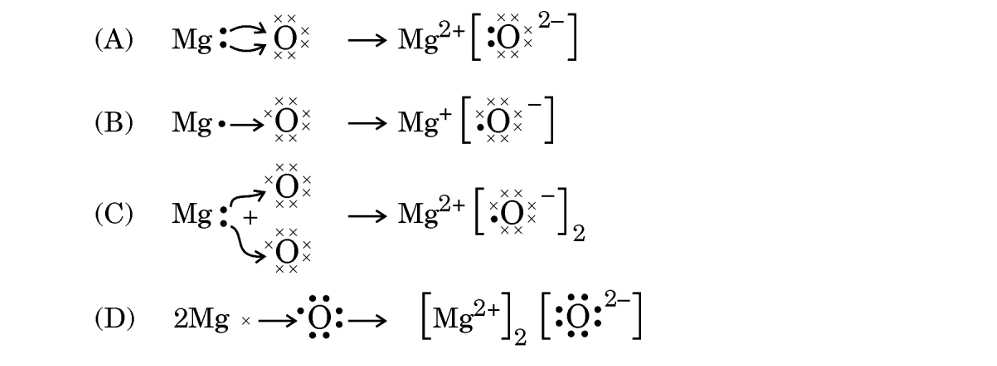
Analysis:
Magnesium (Z=12): 2, 8, 2. Loses 2 electrons to form \(\text{Mg}^{2+}\).
Oxygen (Z=8): 2, 6. Gains 2 electrons to form \(\text{O}^{2-}\).
Electron Transfer: Two electrons from Mg are transferred to O.
Structure: \(\text{Mg}:\xrightarrow{} \text{O} \longrightarrow [\text{Mg}]^{2+} [\text{:O:}]^{2-}\).
Correct Option: (A)
Magnesium (Z=12): 2, 8, 2. Loses 2 electrons to form \(\text{Mg}^{2+}\).
Oxygen (Z=8): 2, 6. Gains 2 electrons to form \(\text{O}^{2-}\).
Electron Transfer: Two electrons from Mg are transferred to O.
Structure: \(\text{Mg}:\xrightarrow{} \text{O} \longrightarrow [\text{Mg}]^{2+} [\text{:O:}]^{2-}\).
Correct Option: (A)
1 Mark
Q6. The products formed when Aluminium and
Magnesium are burnt in the
presence of air respectively are :
Aluminium burns to form aluminium oxide: \(4\text{Al} + 3\text{O}_2 \longrightarrow
2\text{Al}_2\text{O}_3\).
Magnesium burns to form magnesium oxide: \(2\text{Mg} + \text{O}_2 \longrightarrow 2\text{MgO}\).
Correct Option: (B)
Magnesium burns to form magnesium oxide: \(2\text{Mg} + \text{O}_2 \longrightarrow 2\text{MgO}\).
Correct Option: (B)
1 Mark
Q7. Electrolysis of water is a decomposition
reaction. The mass ratio
\((\text{M}_\text{H} : \text{M}_\text{O})\) of hydrogen and oxygen gases liberated at the electrodes
during electrolysis of water is :
Water (\(\text{H}_2\text{O}\)) consists of 2 parts Hydrogen and 1 part Oxygen by
volume, but by mass:
Mass of 2H = \(2 \times 1 = 2\)
Mass of 1O = \(1 \times 16 = 16\)
Ratio \(\text{H} : \text{O} = 2 : 16 = 1 : 8\).
Correct Option: (D)
Mass of 2H = \(2 \times 1 = 2\)
Mass of 1O = \(1 \times 16 = 16\)
Ratio \(\text{H} : \text{O} = 2 : 16 = 1 : 8\).
Correct Option: (D)
1 Mark
Q20. Assertion (A):
Decomposition reactions are generally endothermic reactions.
Reason (R): Decomposition of organic matter into compost is an exothermic process.
Reason (R): Decomposition of organic matter into compost is an exothermic process.
Assertion (A): True. Energy (heat/light/electricity) is required to
break bonds.
Reason (R): True. Microbial decomposition releases heat.
Explanation: R does not explain A. In fact, R is an exception to the statement in A.
Correct Option: (B)
Reason (R): True. Microbial decomposition releases heat.
Explanation: R does not explain A. In fact, R is an exception to the statement in A.
Correct Option: (B)
2 Marks
Q25. A student performs the following experiment
in his school laboratory.
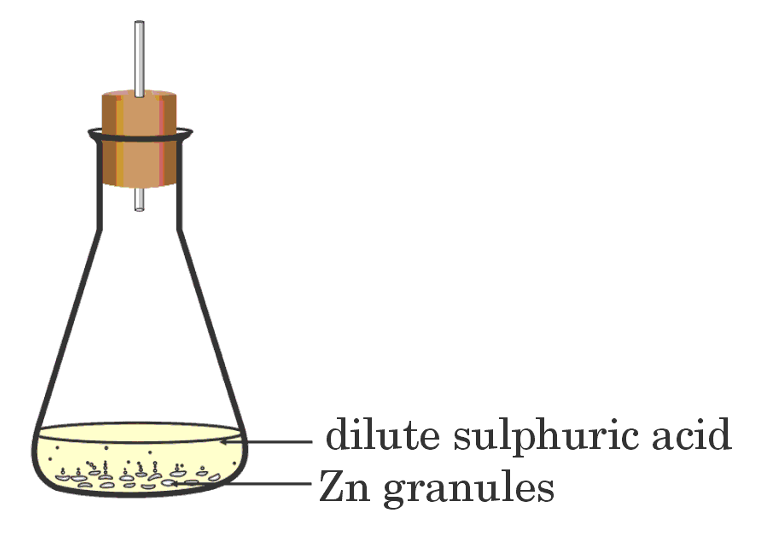 List two observations to justify that in this experiment a chemical change has taken place.
List two observations to justify that in this experiment a chemical change has taken place.
Reaction: \(\text{Zn}(s) + \text{H}_2\text{SO}_4(aq) \longrightarrow
\text{ZnSO}_4(aq) + \text{H}_2(g)\)
Observations:
1. Evolution of gas: Bubbles of Hydrogen gas are observed.
2. Change in Temperature: The conical flask becomes hot (Exothermic reaction).
3. Change of state: Solid Zinc granules gradually disappear/dissolve.
Observations:
1. Evolution of gas: Bubbles of Hydrogen gas are observed.
2. Change in Temperature: The conical flask becomes hot (Exothermic reaction).
3. Change of state: Solid Zinc granules gradually disappear/dissolve.
2 Marks
Q26. Translate the following statements into
chemical equations and then
balance them :
(a) Nitric acid reacts with calcium hydroxide to form calcium nitrate and water.
(b) Sodium chloride reacts with silver nitrate to form silver chloride and sodium nitrate.
(a) Nitric acid reacts with calcium hydroxide to form calcium nitrate and water.
(b) Sodium chloride reacts with silver nitrate to form silver chloride and sodium nitrate.
(a) \(2\text{HNO}_3(aq) + \text{Ca(OH)}_2(aq) \longrightarrow \text{Ca(NO}_3)_2(aq) +
2\text{H}_2\text{O}(l)\)
(b) \(\text{NaCl}(aq) + \text{AgNO}_3(aq) \longrightarrow \text{AgCl}(s) + \text{NaNO}_3(aq)\)
(b) \(\text{NaCl}(aq) + \text{AgNO}_3(aq) \longrightarrow \text{AgCl}(s) + \text{NaNO}_3(aq)\)
1 Mark
Q1. In the electrolysis of water, the mass ratio
of hydrogen and oxygen gases liberated at the electrodes is :
Mass Ratio:
Water (\(\text{H}_2\text{O}\)) by mass:
Mass of H = \(2 \times 1 = 2\) u.
Mass of O = \(1 \times 16 = 16\) u.
Ratio H : O = 2 : 16 = 1 : 8.
Correct Option: (C)
Water (\(\text{H}_2\text{O}\)) by mass:
Mass of H = \(2 \times 1 = 2\) u.
Mass of O = \(1 \times 16 = 16\) u.
Ratio H : O = 2 : 16 = 1 : 8.
Correct Option: (C)
2 Marks
Q21. (a) In common practice silver is recovered
from silver nitrate solution by the use of copper metal. Name the type of reaction that takes place in
this process and give the chemical equation of the reaction involved.
(b) Name the method used for refining silver.
(b) Name the method used for refining silver.
(a) Reaction:
Type: Displacement Reaction (Copper is more reactive than Silver).
Equation: \( \text{Cu}(s) + 2\text{AgNO}_3(aq) \rightarrow \text{Cu}(\text{NO}_3)_2(aq) + 2\text{Ag}(s) \).
(b) Refining Method: Electrolytic Refining.
Type: Displacement Reaction (Copper is more reactive than Silver).
Equation: \( \text{Cu}(s) + 2\text{AgNO}_3(aq) \rightarrow \text{Cu}(\text{NO}_3)_2(aq) + 2\text{Ag}(s) \).
(b) Refining Method: Electrolytic Refining.
3 Marks
Q27. (a) (i) Define the term decomposition
reaction. Write one chemical equation each for decomposition reaction where energy is supplied in the
form of heat, light or electricity.
(ii) Decomposition of vegetable matter into compost is considered an exothermic reaction. Why ?
OR
(b) Why are decomposition reactions called the opposite of combination reactions ? Write one chemical equation each for these two types of reactions mentioning the name of the reactant(s) and the product(s) involved in the reactions.
(ii) Decomposition of vegetable matter into compost is considered an exothermic reaction. Why ?
OR
(b) Why are decomposition reactions called the opposite of combination reactions ? Write one chemical equation each for these two types of reactions mentioning the name of the reactant(s) and the product(s) involved in the reactions.
(a) (i) Decomposition Reaction:
A reaction in which a single reactant breaks down to give simpler products.
Examples:
- Heat (Thermal): \( \text{CaCO}_3(s) \xrightarrow{\Delta} \text{CaO}(s) + \text{CO}_2(g) \)
- Light (Photo): \( 2\text{AgCl}(s) \xrightarrow{\text{Sunlight}} 2\text{Ag}(s) + \text{Cl}_2(g) \)
- Electricity (Electrolytic): \( 2\text{H}_2\text{O}(l) \xrightarrow{\text{Electricity}} 2\text{H}_2(g) + \text{O}_2(g) \)
(a) (ii) Compost:
The decomposition of vegetable matter involves the breakdown of complex organic substances by microbes. This process releases a significant amount of heat energy, hence it is exothermic.
(b) Opposite Nature:
- Decomposition: One reactant breaks into multiple products (AB \(\rightarrow\) A + B).
- Combination: Multiple reactants combine to form one product (A + B \(\rightarrow\) AB).
Equations:
- Decomp: \( 2\text{FeSO}_4(s) \xrightarrow{\Delta} \text{Fe}_2\text{O}_3(s) + \text{SO}_2(g) + \text{SO}_3(g) \) (Ferrous Sulphate \(\rightarrow\) Ferric Oxide + Sulphur Dioxide + Sulphur Trioxide)
- Comb: \( \text{CaO}(s) + \text{H}_2\text{O}(l) \rightarrow \text{Ca}(\text{OH})_2(aq) \) (Quick Lime + Water \(\rightarrow\) Slaked Lime)
A reaction in which a single reactant breaks down to give simpler products.
Examples:
- Heat (Thermal): \( \text{CaCO}_3(s) \xrightarrow{\Delta} \text{CaO}(s) + \text{CO}_2(g) \)
- Light (Photo): \( 2\text{AgCl}(s) \xrightarrow{\text{Sunlight}} 2\text{Ag}(s) + \text{Cl}_2(g) \)
- Electricity (Electrolytic): \( 2\text{H}_2\text{O}(l) \xrightarrow{\text{Electricity}} 2\text{H}_2(g) + \text{O}_2(g) \)
(a) (ii) Compost:
The decomposition of vegetable matter involves the breakdown of complex organic substances by microbes. This process releases a significant amount of heat energy, hence it is exothermic.
(b) Opposite Nature:
- Decomposition: One reactant breaks into multiple products (AB \(\rightarrow\) A + B).
- Combination: Multiple reactants combine to form one product (A + B \(\rightarrow\) AB).
Equations:
- Decomp: \( 2\text{FeSO}_4(s) \xrightarrow{\Delta} \text{Fe}_2\text{O}_3(s) + \text{SO}_2(g) + \text{SO}_3(g) \) (Ferrous Sulphate \(\rightarrow\) Ferric Oxide + Sulphur Dioxide + Sulphur Trioxide)
- Comb: \( \text{CaO}(s) + \text{H}_2\text{O}(l) \rightarrow \text{Ca}(\text{OH})_2(aq) \) (Quick Lime + Water \(\rightarrow\) Slaked Lime)
1 Mark
Q2. Consider the following chemical equation
:
\(p \text{Al} + q \text{H}_2\text{O} \longrightarrow r \text{Al}_2\text{O}_3 + s \text{H}_2\)
To balance this chemical equation, the values of �p�, �q�, �r� and �s� must be respectively :
\(p \text{Al} + q \text{H}_2\text{O} \longrightarrow r \text{Al}_2\text{O}_3 + s \text{H}_2\)
To balance this chemical equation, the values of �p�, �q�, �r� and �s� must be respectively :
Balancing:
Equation: \(\text{Al} + \text{H}_2\text{O} \longrightarrow \text{Al}_2\text{O}_3 + \text{H}_2\)
Aluminium: RHS has 2, so LHS needs 2. (\(p=2\))
Oxygen: RHS has 3, so LHS needs 3. (\(q=3\))
Hydrogen: LHS has \(3 \times 2 = 6\). RHS needs 6, so \(3 \times \text{H}_2\). (\(s=3\))
RHS Al is already balanced with \(r=1\).
Coefficients: \(p=2, q=3, r=1, s=3\).
Order: 2, 3, 1, 3.
Correct Option: (C)
Equation: \(\text{Al} + \text{H}_2\text{O} \longrightarrow \text{Al}_2\text{O}_3 + \text{H}_2\)
Aluminium: RHS has 2, so LHS needs 2. (\(p=2\))
Oxygen: RHS has 3, so LHS needs 3. (\(q=3\))
Hydrogen: LHS has \(3 \times 2 = 6\). RHS needs 6, so \(3 \times \text{H}_2\). (\(s=3\))
RHS Al is already balanced with \(r=1\).
Coefficients: \(p=2, q=3, r=1, s=3\).
Order: 2, 3, 1, 3.
Correct Option: (C)
2 Marks
Q21. (a) List the possible sources of energy
required in decomposition reactions. Illustrate any one with a suitable example.
OR
(b) What is observed when hydrated ferrous sulphate crystals are heated in a dry boiling tube ? Give balanced chemical equation(s) of the reactions(s) that occur(s).
OR
(b) What is observed when hydrated ferrous sulphate crystals are heated in a dry boiling tube ? Give balanced chemical equation(s) of the reactions(s) that occur(s).
(a) Sources of Energy:
Decomposition reactions require energy in the form of Heat, Light, or Electricity.
Example (Heat): Decomposition of Calcium Carbonate.
\( \text{CaCO}_3(s) \xrightarrow{\Delta} \text{CaO}(s) + \text{CO}_2(g) \)
(b) Heating Ferrous Sulphate:
Observation:
1. Green colour of crystals changes to white (loss of water) and then to reddish-brown (Ferric Oxide).
2. Smell of burning sulphur (\(\text{SO}_2, \text{SO}_3\)) is observed.
Equation:
\( 2\text{FeSO}_4(s) \xrightarrow{\Delta} \text{Fe}_2\text{O}_3(s) + \text{SO}_2(g) + \text{SO}_3(g) \)
Decomposition reactions require energy in the form of Heat, Light, or Electricity.
Example (Heat): Decomposition of Calcium Carbonate.
\( \text{CaCO}_3(s) \xrightarrow{\Delta} \text{CaO}(s) + \text{CO}_2(g) \)
(b) Heating Ferrous Sulphate:
Observation:
1. Green colour of crystals changes to white (loss of water) and then to reddish-brown (Ferric Oxide).
2. Smell of burning sulphur (\(\text{SO}_2, \text{SO}_3\)) is observed.
Equation:
\( 2\text{FeSO}_4(s) \xrightarrow{\Delta} \text{Fe}_2\text{O}_3(s) + \text{SO}_2(g) + \text{SO}_3(g) \)
3 Marks
Q27. State the change that is observed when a
China dish containing copper powder is heated over the flame of a burner. Name the phenomenon
responsible for the change and write balanced equation for the chemical reaction that occurs. How is
this reaction different from the reaction that occurs when copper wares kept in open air slowly lose
their shiny brown surface and gain a coat ? Write chemical name of the coating and state its colour.
Heating Copper Powder:
Observation: The brown copper powder becomes coated with a black substance (Copper(II) Oxide).
Phenomenon: Oxidation.
Equation: \( 2\text{Cu} + \text{O}_2 \xrightarrow{\Delta} 2\text{CuO} \)
Difference from Corrosion (Patina):
- Heating: Formation of Black Copper Oxide (\(\text{CuO}\)).
- Open Air (Corrosion): Formation of Green coating due to reaction with \(\text{CO}_2\) and moisture.
Coating Name: Basic Copper Carbonate (\(\text{CuCO}_3 \cdot \text{Cu(OH)}_2\)).
Colour: Green.
Observation: The brown copper powder becomes coated with a black substance (Copper(II) Oxide).
Phenomenon: Oxidation.
Equation: \( 2\text{Cu} + \text{O}_2 \xrightarrow{\Delta} 2\text{CuO} \)
Difference from Corrosion (Patina):
- Heating: Formation of Black Copper Oxide (\(\text{CuO}\)).
- Open Air (Corrosion): Formation of Green coating due to reaction with \(\text{CO}_2\) and moisture.
Coating Name: Basic Copper Carbonate (\(\text{CuCO}_3 \cdot \text{Cu(OH)}_2\)).
Colour: Green.
1 Mark
Q6. In which one of the following situations a
chemical reaction does not occur?
Analysis:
(a), (b), (c) are Chemical Changes (souring, fermentation, rusting).
(d) Melting is a Physical Change (State change).
Correct Option: (d)
(a), (b), (c) are Chemical Changes (souring, fermentation, rusting).
(d) Melting is a Physical Change (State change).
Correct Option: (d)
2 Marks
Q21. Name the compound used in black and white
photography. State whether the reaction that occurs is exothermic or endothermic. Give justification for
your answer.
Compound: Silver Bromide (\(\text{AgBr}\)) or Silver Chloride
(\(\text{AgCl}\)).
Type: Endothermic.
Justification: The decomposition of AgBr/AgCl requires absorption of energy (light) to break down into silver and halogen gas (\(2\text{AgBr} \xrightarrow{\text{Sunlight}} 2\text{Ag} + \text{Br}_2\)).
Type: Endothermic.
Justification: The decomposition of AgBr/AgCl requires absorption of energy (light) to break down into silver and halogen gas (\(2\text{AgBr} \xrightarrow{\text{Sunlight}} 2\text{Ag} + \text{Br}_2\)).
3 Marks
Q30. (A) Why do we balance a chemical equation?
Name and state the law that suggests the balancing of a chemical equation? Balance the following
chemical equation :
\(\text{Zn} + \text{H}_3\text{PO}_4 \rightarrow \text{Zn}_3(\text{PO}_4)_2 + \text{H}_2\)
\(\text{Zn} + \text{H}_3\text{PO}_4 \rightarrow \text{Zn}_3(\text{PO}_4)_2 + \text{H}_2\)
OR
(B) Define a precipitation reaction. Give its example and also express the reaction that occurs in the
form of a balanced chemical equation.
(A):
Why: To satisfy the Law of Conservation of Mass.
Law: Mass can neither be created nor destroyed in a chemical reaction. Total mass of reactants = Total mass of products.
Balanced Equation:
\(3\text{Zn} + 2\text{H}_3\text{PO}_4 \rightarrow \text{Zn}_3(\text{PO}_4)_2 + 3\text{H}_2\)
(B):
Definition: A reaction in which an insoluble substance (precipitate) is formed is called a precipitation reaction.
Example: Reaction between Sodium Sulphate and Barium Chloride.
Equation:
\(\text{Na}_2\text{SO}_4(aq) + \text{BaCl}_2(aq) \rightarrow \text{BaSO}_4(s) (\text{White ppt}) + 2\text{NaCl}(aq)\)
Why: To satisfy the Law of Conservation of Mass.
Law: Mass can neither be created nor destroyed in a chemical reaction. Total mass of reactants = Total mass of products.
Balanced Equation:
\(3\text{Zn} + 2\text{H}_3\text{PO}_4 \rightarrow \text{Zn}_3(\text{PO}_4)_2 + 3\text{H}_2\)
(B):
Definition: A reaction in which an insoluble substance (precipitate) is formed is called a precipitation reaction.
Example: Reaction between Sodium Sulphate and Barium Chloride.
Equation:
\(\text{Na}_2\text{SO}_4(aq) + \text{BaCl}_2(aq) \rightarrow \text{BaSO}_4(s) (\text{White ppt}) + 2\text{NaCl}(aq)\)
4 Marks
Q38. Common salt is a very important chemical
compound for our daily life. It's chemical name is sodium chloride and it is used as a raw material in
the manufacture of caustic soda, washing soda, baking soda etc. It is also used in the preservation of
pickles, butter, meat etc.
(i) Name the acid and the base from which common salt can be obtained.
(ii) State the nature (acidic/basic/neutral) of sodium chloride. Give reason for the justification for your answer.
(iii) (A) What happens when electric current is passed through an aqueous solution of sodium chloride (called brine)? Name the products obtained along with the corresponding places in the electrolytic cell where each of these products is obtained.
OR
(iii) (B) How is washing soda obtained from sodium chloride? Give chemical equation of the reactions involved in the process.
(i) Name the acid and the base from which common salt can be obtained.
(ii) State the nature (acidic/basic/neutral) of sodium chloride. Give reason for the justification for your answer.
(iii) (A) What happens when electric current is passed through an aqueous solution of sodium chloride (called brine)? Name the products obtained along with the corresponding places in the electrolytic cell where each of these products is obtained.
OR
(iii) (B) How is washing soda obtained from sodium chloride? Give chemical equation of the reactions involved in the process.
(i): Acid: Hydrochloric Acid (\(\text{HCl}\)). Base: Sodium
Hydroxide (\(\text{NaOH}\)).
(ii): Neutral. Because it is a salt of a strong acid and a strong base.
(iii) (A): Chlor-Alkali Process:
When electricity is passed through brine, it decomposes to form Sodium Hydroxide.
\(2\text{NaCl}(aq) + 2\text{H}_2\text{O}(l) \rightarrow 2\text{NaOH}(aq) + \text{Cl}_2(g) + \text{H}_2(g)\)
Products:
1. Chlorine gas (\(\text{Cl}_2\)) at Anode.
2. Hydrogen gas (\(\text{H}_2\)) at Cathode.
3. Sodium Hydroxide (\(\text{NaOH}\)) near Cathode.
(iii) (B): Solvay Process / Preparation:
1. \(\text{NaCl} + \text{H}_2\text{O} + \text{CO}_2 + \text{NH}_3 \rightarrow \text{NH}_4\text{Cl} + \text{NaHCO}_3\) (Sodium Hydrogen Carbonate).
2. Heat \(\text{NaHCO}_3\): \(2\text{NaHCO}_3 \xrightarrow{\Delta} \text{Na}_2\text{CO}_3 + \text{H}_2\text{O} + \text{CO}_2\).
3. Recrystallization: \(\text{Na}_2\text{CO}_3 + 10\text{H}_2\text{O} \rightarrow \text{Na}_2\text{CO}_3 \cdot 10\text{H}_2\text{O}\) (Washing Soda).
(ii): Neutral. Because it is a salt of a strong acid and a strong base.
(iii) (A): Chlor-Alkali Process:
When electricity is passed through brine, it decomposes to form Sodium Hydroxide.
\(2\text{NaCl}(aq) + 2\text{H}_2\text{O}(l) \rightarrow 2\text{NaOH}(aq) + \text{Cl}_2(g) + \text{H}_2(g)\)
Products:
1. Chlorine gas (\(\text{Cl}_2\)) at Anode.
2. Hydrogen gas (\(\text{H}_2\)) at Cathode.
3. Sodium Hydroxide (\(\text{NaOH}\)) near Cathode.
(iii) (B): Solvay Process / Preparation:
1. \(\text{NaCl} + \text{H}_2\text{O} + \text{CO}_2 + \text{NH}_3 \rightarrow \text{NH}_4\text{Cl} + \text{NaHCO}_3\) (Sodium Hydrogen Carbonate).
2. Heat \(\text{NaHCO}_3\): \(2\text{NaHCO}_3 \xrightarrow{\Delta} \text{Na}_2\text{CO}_3 + \text{H}_2\text{O} + \text{CO}_2\).
3. Recrystallization: \(\text{Na}_2\text{CO}_3 + 10\text{H}_2\text{O} \rightarrow \text{Na}_2\text{CO}_3 \cdot 10\text{H}_2\text{O}\) (Washing Soda).
1 Mark
Q3. The values of a, b, c and d in the following
balanced chemical equation are respectively :
\( \text{aPb}(\text{NO}_3)_2 \xrightarrow{\text{heat}} \text{PbO} + \text{cNO}_2 + \text{dO}_2 \)
\( \text{aPb}(\text{NO}_3)_2 \xrightarrow{\text{heat}} \text{PbO} + \text{cNO}_2 + \text{dO}_2 \)
Balancing:
\(2\text{Pb}(\text{NO}_3)_2 \rightarrow 2\text{PbO} + 4\text{NO}_2 + \text{O}_2\)
Coefficients: a=2, b=2, c=4, d=1.
Correct Option: (D)
\(2\text{Pb}(\text{NO}_3)_2 \rightarrow 2\text{PbO} + 4\text{NO}_2 + \text{O}_2\)
Coefficients: a=2, b=2, c=4, d=1.
Correct Option: (D)
1 Mark
Q7. The main observations while performing the
experiment of burning magnesium ribbon in air are :
(i) Magnesium ribbon burns with a dazzling white flame.
(ii) A white powder is formed.
(iii) Magnesium ribbon vapourises.
(iv) Aqueous solution of the white powder turns blue litmus to red.
(i) Magnesium ribbon burns with a dazzling white flame.
(ii) A white powder is formed.
(iii) Magnesium ribbon vapourises.
(iv) Aqueous solution of the white powder turns blue litmus to red.
Observations:
(i) Burns with dazzling white flame (True).
(ii) White powder (MgO) is formed (True).
(iii) It does not vapourise (False).
(iv) MgO is basic, turns Red litmus Blue (False).
Correct Option: (C)
(i) Burns with dazzling white flame (True).
(ii) White powder (MgO) is formed (True).
(iii) It does not vapourise (False).
(iv) MgO is basic, turns Red litmus Blue (False).
Correct Option: (C)
1 Mark
Q20. Assertion (A): Silver
chloride turns grey in sunlight.
Reason (R): Decomposition of silver chloride into silver and chlorine takes place by sunlight.
Reason (R): Decomposition of silver chloride into silver and chlorine takes place by sunlight.
Explanation:
AgCl (White) decomposes in sunlight to form Silver (Grey) and Chlorine gas (Photopyrolytic decomposition).
\(2\text{AgCl} \xrightarrow{\text{Sunlight}} 2\text{Ag} + \text{Cl}_2\).
A is True. R is True and explains A.
Correct Option: (A)
AgCl (White) decomposes in sunlight to form Silver (Grey) and Chlorine gas (Photopyrolytic decomposition).
\(2\text{AgCl} \xrightarrow{\text{Sunlight}} 2\text{Ag} + \text{Cl}_2\).
A is True. R is True and explains A.
Correct Option: (A)
2 Marks
Q26. A copper wire on burning in flame, gets
coated with a black substance. Write the chemical equation of the reaction that takes place. How can
this chemical change be reversed ?
Reaction: Oxidation of Copper.
\(2\text{Cu} + \text{O}_2 \xrightarrow{\text{Heat}} 2\text{CuO}\) (Black Copper Oxide).
Reversal: By passing Hydrogen gas over hot copper oxide.
\(\text{CuO} + \text{H}_2 \xrightarrow{\text{Heat}} \text{Cu} + \text{H}_2\text{O}\).
\(2\text{Cu} + \text{O}_2 \xrightarrow{\text{Heat}} 2\text{CuO}\) (Black Copper Oxide).
Reversal: By passing Hydrogen gas over hot copper oxide.
\(\text{CuO} + \text{H}_2 \xrightarrow{\text{Heat}} \text{Cu} + \text{H}_2\text{O}\).
1 Mark
Q1. Example of thermal decomposition reaction are
- \( 2 \text{AgCl} \rightarrow 2 \text{Ag} + \text{Cl}_2 \)
- \( \text{CaCO}_3 \rightarrow \text{CaO} + \text{CO}_2 \)
- \( 2 \text{H}_2\text{O} \rightarrow 2 \text{H}_2 + \text{O}_2 \)
- \( 2 \text{KClO}_3 \rightarrow 2 \text{KCl} + 3 \text{O}_2 \)
(i) Photolytic decomposition (sunlight).
(ii) Thermal decomposition (heat).
(iii) Electrolytic decomposition (electricity).
(iv) Thermal decomposition (heating Potassium Chlorate).
Correct Option: (D)
(ii) Thermal decomposition (heat).
(iii) Electrolytic decomposition (electricity).
(iv) Thermal decomposition (heating Potassium Chlorate).
Correct Option: (D)
1 Mark
Q4. The colour of the solution observed after
about 1 hour of placing iron nails in copper sulphate solution is
Iron displaces Copper from Copper Sulphate solution.
\(\text{Fe}(s) + \text{CuSO}_4(aq) \text{ (Blue)} \rightarrow \text{FeSO}_4(aq) \text{ (Pale Green)} + \text{Cu}(s)\)
Correct Option: (B)
\(\text{Fe}(s) + \text{CuSO}_4(aq) \text{ (Blue)} \rightarrow \text{FeSO}_4(aq) \text{ (Pale Green)} + \text{Cu}(s)\)
Correct Option: (B)
Board Exam 2024
Content coming soon for 2024...
Board Exam 2023
Content coming soon for 2023...
Board Exam 2022
Content coming soon for 2022...