
Board Exam 2025
1 Mark
Q2. There is a square lawn of side 8 m inside
a
circular park of radius 200 m. Mr. Joseph wants to plant a sapling in the park.
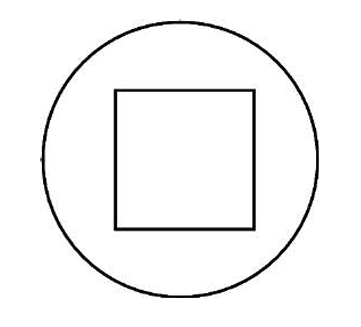 The probability that he can plant it outside the lawn is :
The probability that he can plant it outside the lawn is :
Area of Circle (Park) = \(\pi (20)^2 = 400 \pi\) sq.m. (Wait, text says radius 200m or 20m? Options
suggest 400pi, so radius is 20m).
Lets re-read carefully. Options have \(400\pi\). If radius is 200, area is \(40000\pi\). If radius is 20, area is \(400\pi\). Image says 20 m. Text transcription says 200 m. Options suggest 20m. I will assume 20m.
Area of Square Lawn = \(8 \times 8 = 64\) sq.m.
Area outside lawn = \(400 \pi - 64\).
Probability = \(\frac{\text{Favorable Area}}{\text{Total Area}} = \frac{400 \pi - 64}{400 \pi}\).
Answer: (D)
Lets re-read carefully. Options have \(400\pi\). If radius is 200, area is \(40000\pi\). If radius is 20, area is \(400\pi\). Image says 20 m. Text transcription says 200 m. Options suggest 20m. I will assume 20m.
Area of Square Lawn = \(8 \times 8 = 64\) sq.m.
Area outside lawn = \(400 \pi - 64\).
Probability = \(\frac{\text{Favorable Area}}{\text{Total Area}} = \frac{400 \pi - 64}{400 \pi}\).
Answer: (D)
1 Mark
Q12. Two dice are thrown simultaneously and
the
product of the numbers appearing on the tops is noted. The probability of the product to be less
than 6
is :
Total outcomes = 36.
Favorable outcomes (Product < 6):
(1,1)=1, (1,2)=2, (1,3)=3, (1,4)=4, (1,5)=5 [5 cases]
(2,1)=2, (2,2)=4 [2 cases]
(3,1)=3 [1 case]
(4,1)=4 [1 case]
(5,1)=5 [1 case]
Total favorable = \(5 + 2 + 1 + 1 + 1 = 10\).
Probability = \(\frac{10}{36} = \frac{5}{18}\).
Answer: (C)
Favorable outcomes (Product < 6):
(1,1)=1, (1,2)=2, (1,3)=3, (1,4)=4, (1,5)=5 [5 cases]
(2,1)=2, (2,2)=4 [2 cases]
(3,1)=3 [1 case]
(4,1)=4 [1 case]
(5,1)=5 [1 case]
Total favorable = \(5 + 2 + 1 + 1 + 1 = 10\).
Probability = \(\frac{10}{36} = \frac{5}{18}\).
Answer: (C)
1 Mark
Q15. Cards numbered 10, 11, 12, ..., 30 are
kept
in a box and shuffled thoroughly. Rohit draws a card at random from the box. The probability that
the
number on the card is a multiple of 4 or 5 is :
Total cards = \(30 - 10 + 1 = 21\).
Numbers: 10, 11, ..., 30.
Multiples of 4: 12, 16, 20, 24, 28 (5 numbers).
Multiples of 5: 10, 15, 20, 25, 30 (5 numbers).
Common (Multiple of 20): 20 (1 number).
Total favorable = \(5 + 5 - 1 = 9\).
Probability = \(\frac{9}{21}\).
Answer: (B)
Numbers: 10, 11, ..., 30.
Multiples of 4: 12, 16, 20, 24, 28 (5 numbers).
Multiples of 5: 10, 15, 20, 25, 30 (5 numbers).
Common (Multiple of 20): 20 (1 number).
Total favorable = \(5 + 5 - 1 = 9\).
Probability = \(\frac{9}{21}\).
Answer: (B)
1 Mark
Q18. A card is drawn from a well-shuffled
pack of
52 cards. The probability that the card drawn is a spade or a king is:
Spades = 13. Kings = 4. Common (King of Spades) = 1.
Favorable = \(13 + 4 - 1 = 16\).
Prob = \(16/52 = 4/13\).
Answer: (C)
Favorable = \(13 + 4 - 1 = 16\).
Prob = \(16/52 = 4/13\).
Answer: (C)
1 Mark
Q19.
Assertion (A): The probability of selecting a number at random from the numbers 1
to 20 is 1.
Reason (R): For any event E, if P(E) = 1, then E is called a sure event.
Reason (R): For any event E, if P(E) = 1, then E is called a sure event.
Assertion means the probability of the event "selecting a number from the set 1-20" from the sample
space {1..20} is 1. True.
Reason is definition of Sure event. True and explains A.
Answer: (A)
Reason is definition of Sure event. True and explains A.
Answer: (A)
2 Marks
Q27. Two dice are rolled together. Find the
probability of getting :
(i) a multiple of 2 on one and a multiple of 3 on the other die.
(ii) the product of two numbers on the top of the two dice is a perfect square number.
(i) a multiple of 2 on one and a multiple of 3 on the other die.
(ii) the product of two numbers on the top of the two dice is a perfect square number.
(i) Mult of 2: {2,4,6}. Mult of 3: {3,6}.
Pairs: (2,3), (2,6), (4,3), (4,6), (6,3), (6,6) AND (3,2), (6,2), (3,4), (6,4). Note (6,6) is in both sets. Unique pairs = 11.
Prob = \(11/36\).
(ii) Perfect square products: (1,1), (1,4), (4,1), (2,2), (3,3), (4,4), (5,5), (6,6). Total 8.
Prob = \(8/36 = 2/9\).
Pairs: (2,3), (2,6), (4,3), (4,6), (6,3), (6,6) AND (3,2), (6,2), (3,4), (6,4). Note (6,6) is in both sets. Unique pairs = 11.
Prob = \(11/36\).
(ii) Perfect square products: (1,1), (1,4), (4,1), (2,2), (3,3), (4,4), (5,5), (6,6). Total 8.
Prob = \(8/36 = 2/9\).
1 Mark
Q1. If for any event E, \(P(E) +
P(\overline{E})
= q\), then the value of \(q^2 - 3\) is :
We know \(P(E) + P(\overline{E}) = 1\) (Sum of probabilities of an event and its
complement).
Therefore, \(q = 1\).
Value of \(q^2 - 3 = (1)^2 - 3 = 1 - 3 = -2\).
Answer: (A)
Therefore, \(q = 1\).
Value of \(q^2 - 3 = (1)^2 - 3 = 1 - 3 = -2\).
Answer: (A)
1 Mark
Q8. The probability of drawing an even prime
number out of numbers from 1 to 30 is :
Even prime number is 2. Only one such number exists.
Total numbers = 30.
Probability = \(1/30\).
Answer: (A)
Total numbers = 30.
Probability = \(1/30\).
Answer: (A)
4 Marks
Q38. Case Study � 3

Rahul is a lucky charm for his cricket team. He has a jar of cards with numbers from 10 to 74. Before each match, he draws a card from the jar. If the card bears an even number, the team wins. If the number is even and divisible by 5, they win by a big margin. If the number is an odd number less than 30, they win by a small margin. And if the number is a prime number between 50 and 74, they lose. Answer the following questions if Rahul draws a card today :
(i) What is the probability that Rahul draws a card with an even number? [1 Mark]
(ii) What is the probability that Rahul draws a card with an odd number less than 30? [1 Mark]
(iii) (a) What is the probability that Rahul draws a card with a prime number between 50 and 74? [2 Marks]
Rahul is a lucky charm for his cricket team. He has a jar of cards with numbers from 10 to 74. Before each match, he draws a card from the jar. If the card bears an even number, the team wins. If the number is even and divisible by 5, they win by a big margin. If the number is an odd number less than 30, they win by a small margin. And if the number is a prime number between 50 and 74, they lose. Answer the following questions if Rahul draws a card today :
(i) What is the probability that Rahul draws a card with an even number? [1 Mark]
(ii) What is the probability that Rahul draws a card with an odd number less than 30? [1 Mark]
(iii) (a) What is the probability that Rahul draws a card with a prime number between 50 and 74? [2 Marks]
OR
(iii) (b) What is the probability that Rahul draws a card with an even number divisible by 5? [2
Marks]
Cards numbered 10 to 74. Total cards = \(74 - 10 + 1 = 65\).
(i) Even numbers from 10 to 74: {10, 12, 14, ..., 74}.
Count = \(\frac{74 - 10}{2} + 1 = 33\).
\(P(\text{even}) = \frac{33}{65}\).
(ii) Odd numbers less than 30 (from 10 to 29): {11, 13, 15, 17, 19, 21, 23, 25, 27, 29}.
Count = 10.
\(P(\text{odd} < 30)=\frac{10}{65}=\frac{2}{13}\).
(iii) (a) Prime numbers between 50 and 74: {53, 59, 61, 67, 71, 73}.
Count = 6.
\(P(\text{prime between 50-74}) = \frac{6}{65}\).
(iii) (b) Even numbers divisible by 5 (i.e., divisible by 10): {10, 20, 30, 40, 50, 60, 70}.
Count = 7.
\(P(\text{even and div by 5}) = \frac{7}{65}\).
(i) Even numbers from 10 to 74: {10, 12, 14, ..., 74}.
Count = \(\frac{74 - 10}{2} + 1 = 33\).
\(P(\text{even}) = \frac{33}{65}\).
(ii) Odd numbers less than 30 (from 10 to 29): {11, 13, 15, 17, 19, 21, 23, 25, 27, 29}.
Count = 10.
\(P(\text{odd} < 30)=\frac{10}{65}=\frac{2}{13}\).
(iii) (a) Prime numbers between 50 and 74: {53, 59, 61, 67, 71, 73}.
Count = 6.
\(P(\text{prime between 50-74}) = \frac{6}{65}\).
(iii) (b) Even numbers divisible by 5 (i.e., divisible by 10): {10, 20, 30, 40, 50, 60, 70}.
Count = 7.
\(P(\text{even and div by 5}) = \frac{7}{65}\).
1 Mark
Q6. If in a lottery, there are 10 prizes
and 30
blanks, then the probability of winning a prize is :
Total = \(10 + 30 = 40\).
P(Win) = \(10/40 = 1/4\).
Answer: (A)
P(Win) = \(10/40 = 1/4\).
Answer: (A)
2 Marks
Q23. The probability of guessing the correct
answer of a certain test question is \(\frac{x}{12}\). If the probability of not guessing the
correct answer is \(\frac{5}{6}\), then find the value of x.
\(P(E) + P(\bar{E}) = 1\).
\(\frac{x}{12} + \frac{5}{6} = 1 \Rightarrow \frac{x}{12} = \frac{1}{6} \Rightarrow x = 2\).
\(\frac{x}{12} + \frac{5}{6} = 1 \Rightarrow \frac{x}{12} = \frac{1}{6} \Rightarrow x = 2\).
3 Marks
Q26. All face cards of spades are removed
from a pack of 52 playing cards and the remaining pack is shuffled well. A card is then drawn at
random from the remaining pack. Find the probability of getting :
(a) a face card
(b) an ace or a jack
(a) a face card
(b) an ace or a jack
Removed: K, Q, J of spades (3 cards). Remaining = 49.
(a) Face cards: Total 12. Removed 3. Left 9. Prob = \(9/49\).
(b) Aces: 4 (none removed). Jacks: 4 (1 removed). Total 7. Prob = \(7/49 = 1/7\).
(a) Face cards: Total 12. Removed 3. Left 9. Prob = \(9/49\).
(b) Aces: 4 (none removed). Jacks: 4 (1 removed). Total 7. Prob = \(7/49 = 1/7\).
1 Mark
Q9. Letters A to F are mentioned on six faces of
a die such that each face has a different letter. Two such dice are thrown simultaneously. The
probability that vowels turn up on both the dice is :
Vowels A, E (2). Prob = 2/6 = 1/3. Both = 1/9.
Answer: (c)
Answer: (c)
1 Mark
Q14. The number of red balls in a bag is 10 more
than the number of black balls. If the probability of drawing a red ball at random from this bag is
\(\frac{3}{5}\), then the total number of balls in the bag is :
\(R = x+10, B=x\). \((x+10)/(2x+10) = 3/5 \Rightarrow x=20\). Total
50.
Answer: (a)
Answer: (a)
2 Marks
Q24. Renu and Simran were born in the year 2000
which is a leap year. Find the probability that :
(i) both have same birthday.
(ii) both have different birthdays.
(i) both have same birthday.
(ii) both have different birthdays.
(i) 1/366. (ii) 365/366.
1 Mark
Q9. The probability of getting a composite number
greater than 3 on throwing a die is:
Total outcomes = {1, 2, 3, 4, 5, 6}. Numbers > 3 are {4, 5, 6}.
Composite numbers in this set are {4, 6}. (5 is prime).
Favorable outcomes = 2. Probability = \(2/6 = 1/3\).
Correct Option: (B) \(\frac{1}{3}\)
Composite numbers in this set are {4, 6}. (5 is prime).
Favorable outcomes = 2. Probability = \(2/6 = 1/3\).
Correct Option: (B) \(\frac{1}{3}\)
1 Mark
Q16. A bag contains red coloured, blue coloured
and green coloured balls in the ratio 2 : 3 : 4. A ball is drawn at random from the given bag. The
probability that the ball so drawn being not of blue colour is :
Let balls be \(2x, 3x, 4x\). Total = \(9x\).
Blue = \(3x\). Not blue = \(9x - 3x = 6x\).
Probability = \(6x/9x = 2/3\).
Correct Option: (B) \(\frac{2}{3}\)
Blue = \(3x\). Not blue = \(9x - 3x = 6x\).
Probability = \(6x/9x = 2/3\).
Correct Option: (B) \(\frac{2}{3}\)
2 Marks
Q24. From a pack of 52 cards, all aces and all
kings are removed. A card is drawn at random from the remaining cards. Find the probability that the
card so drawn is (i) a face card (ii) a card of red colour.
Removed: 4 Aces + 4 Kings = 8 cards. Remaining Total = \(52 - 8 =
44\).
(i) Face cards: Originally 12 (4J, 4Q, 4K). Kings removed, so 8 remaining (4J, 4Q).
P(Face) = \(8/44 = 2/11\).
(ii) Red cards: Originally 26. Removed 2 Red Aces + 2 Red Kings = 4.
Remaining Red = \(26 - 4 = 22\).
P(Red) = \(22/44 = 1/2\).
(i) Face cards: Originally 12 (4J, 4Q, 4K). Kings removed, so 8 remaining (4J, 4Q).
P(Face) = \(8/44 = 2/11\).
(ii) Red cards: Originally 26. Removed 2 Red Aces + 2 Red Kings = 4.
Remaining Red = \(26 - 4 = 22\).
P(Red) = \(22/44 = 1/2\).
1 Mark
Q17. Two coins are tossed simultaneously. The
probability of getting atleast one head is
Sample Space: {HH, HT, TH, TT}. Total outcomes = 4.
Favorable outcomes (at least one head): {HH, HT, TH}. Count = 3.
Probability = \(\frac{3}{4}\).
Correct Option: (C)
Favorable outcomes (at least one head): {HH, HT, TH}. Count = 3.
Probability = \(\frac{3}{4}\).
Correct Option: (C)
1 Mark
Q19. In an experiment of throwing a die,
Assertion (A) : Event E1 : getting a number less than 3 and Event E2 : getting a number greater than 3 are complementary events.
Reason (R) : If two events E and F are complementary events, then P(E) + P(F) = 1.
Assertion (A) : Event E1 : getting a number less than 3 and Event E2 : getting a number greater than 3 are complementary events.
Reason (R) : If two events E and F are complementary events, then P(E) + P(F) = 1.
\(E_1\) (Less than 3) = {1, 2}. \(P(E_1) = \frac{2}{6}\).
\(E_2\) (Greater than 3) = {4, 5, 6}. \(P(E_2) = \frac{3}{6}\).
For complementary events, \(E_1 \cup E_2\) must be Sample Space and \(E_1 \cap E_2 = \phi\).
Here, the outcome {3} is missing from both. So they are NOT complementary.
Assertion is False. Reason is True.
Correct Option: (D)
\(E_2\) (Greater than 3) = {4, 5, 6}. \(P(E_2) = \frac{3}{6}\).
For complementary events, \(E_1 \cup E_2\) must be Sample Space and \(E_1 \cap E_2 = \phi\).
Here, the outcome {3} is missing from both. So they are NOT complementary.
Assertion is False. Reason is True.
Correct Option: (D)
2 Marks
Q24. A bag contains balls numbered 2 to 91
such that each ball bears a different number. A ball is drawn at random from the bag. Find the
probability that
i. it bears a 2-digit number
ii. it bears a multiple of 1.
i. it bears a 2-digit number
ii. it bears a multiple of 1.
Total balls = \(91 - 2 + 1 = 90\).
(i) 2-digit number: Numbers from 10 to 91.
Count = \(91 - 10 + 1 = 82\).
Probability = \(\frac{82}{90} = \frac{41}{45}\).
(ii) Multiple of 1: All integers are multiples of 1.
Favorable outcomes = 90.
Probability = \(\frac{90}{90} = 1\).
(i) 2-digit number: Numbers from 10 to 91.
Count = \(91 - 10 + 1 = 82\).
Probability = \(\frac{82}{90} = \frac{41}{45}\).
(ii) Multiple of 1: All integers are multiples of 1.
Favorable outcomes = 90.
Probability = \(\frac{90}{90} = 1\).