
Board Exam 2025
1 Mark
Q10. The numerical value of the area of a
circle
is equal to that of the perimeter of a semicircular disc, both having equal radius. The radius is:
Area of circle = \(\pi r^2\).
Perimeter of semicircular disc = \(\pi r + 2r\) (Arc + Diameter).
\(\pi r^2 = \pi r + 2r \Rightarrow \pi r^2 = r(\pi + 2)\).
\(r = \frac{\pi + 2}{\pi}\).
Answer: (C)
Perimeter of semicircular disc = \(\pi r + 2r\) (Arc + Diameter).
\(\pi r^2 = \pi r + 2r \Rightarrow \pi r^2 = r(\pi + 2)\).
\(r = \frac{\pi + 2}{\pi}\).
Answer: (C)
1 Mark
Q16. A and B are sectors of two different
circles. Radius of sector A is double of that of sector B whereas central angle of sector B is
double
the central angle of sector A. The ratio of the area of sector A to the area of sector B is :
Let \(r_B = r, \theta_B = 2\theta\).
Then \(r_A = 2r, \theta_A = \theta\).
Area A = \(\frac{\theta}{360} \pi (2r)^2 = \frac{\theta}{360} 4\pi r^2\).
Area B = \(\frac{2\theta}{360} \pi r^2 = 2 \frac{\theta}{360} \pi r^2\).
Ratio A:B = \(4 : 2 = 2 : 1\).
Answer: (C)
Then \(r_A = 2r, \theta_A = \theta\).
Area A = \(\frac{\theta}{360} \pi (2r)^2 = \frac{\theta}{360} 4\pi r^2\).
Area B = \(\frac{2\theta}{360} \pi r^2 = 2 \frac{\theta}{360} \pi r^2\).
Ratio A:B = \(4 : 2 = 2 : 1\).
Answer: (C)
3 Marks
Q21. (a)
 The perimeter of a sector of a
circle of radius 15 cm is 80 cm. Find
the area of the sector.
The perimeter of a sector of a
circle of radius 15 cm is 80 cm. Find
the area of the sector.
The perimeter of a sector of a
circle of radius 15 cm is 80 cm. Find
the area of the sector.
OR
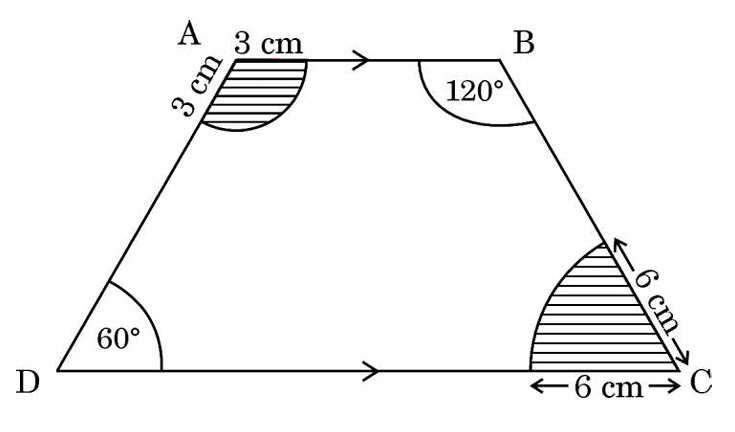
Q21. (b) In the given figure, ABCD is a trapezium with AB || DC.
Find the area of the shaded region. (Keep the answer in terms of π).
(a) Perimeter of Sector = Arc Length + \(2r\).
Given Perimeter = 80 cm, Radius \(r = 15\) cm.
\(L + 2(15) = 80 \Rightarrow L + 30 = 80 \Rightarrow L = 50\) cm.
Area of Sector = \(\frac{1}{2} \times L \times r\)
Area = \(\frac{1}{2} \times 50 \times 15 = 25 \times 15 = 375\) cm\(^2\).
(b)
Properties of Trapezium (AB || DC): Interior angles on the same side of transversal are supplementary.
\(\angle A + \angle D = 180^\circ\) and \(\angle B + \angle C = 180^\circ\).
Given \(\angle D = 60^\circ \Rightarrow \angle A = 180^\circ - 60^\circ = 120^\circ\).
Given \(\angle C\) corresponds to radius 6 cm. If we assume symmetry or specific values from diagram: \(\angle C = 60^\circ, \angle B = 120^\circ\).
Area of Sector (Radius 3 cm, \(\theta=120^\circ\)):
\(= \frac{120}{360} \times \pi (3)^2 = \frac{1}{3} \times 9\pi = 3\pi \text{ cm}^2\).
Area of Sector (Radius 6 cm, \(\theta=60^\circ\)):
\(= \frac{60}{360} \times \pi (6)^2 = \frac{1}{6} \times 36\pi = 6\pi \text{ cm}^2\).
Total Area of Shaded Region = \(3\pi + 6\pi = 9\pi \text{ cm}^2\).
Given Perimeter = 80 cm, Radius \(r = 15\) cm.
\(L + 2(15) = 80 \Rightarrow L + 30 = 80 \Rightarrow L = 50\) cm.
Area of Sector = \(\frac{1}{2} \times L \times r\)
Area = \(\frac{1}{2} \times 50 \times 15 = 25 \times 15 = 375\) cm\(^2\).
(b)
Properties of Trapezium (AB || DC): Interior angles on the same side of transversal are supplementary.
\(\angle A + \angle D = 180^\circ\) and \(\angle B + \angle C = 180^\circ\).
Given \(\angle D = 60^\circ \Rightarrow \angle A = 180^\circ - 60^\circ = 120^\circ\).
Given \(\angle C\) corresponds to radius 6 cm. If we assume symmetry or specific values from diagram: \(\angle C = 60^\circ, \angle B = 120^\circ\).
Area of Sector (Radius 3 cm, \(\theta=120^\circ\)):
\(= \frac{120}{360} \times \pi (3)^2 = \frac{1}{3} \times 9\pi = 3\pi \text{ cm}^2\).
Area of Sector (Radius 6 cm, \(\theta=60^\circ\)):
\(= \frac{60}{360} \times \pi (6)^2 = \frac{1}{6} \times 36\pi = 6\pi \text{ cm}^2\).
Total Area of Shaded Region = \(3\pi + 6\pi = 9\pi \text{ cm}^2\).
1 Mark
Q8. A piece of wire 20 cm long is bent
into
the form of an arc of a circle of radius \(\frac{60}{\pi}\) cm. The angle subtended by the arc
at
the centre of the circle is :
Arc Length \(l = 20\). Radius \(r = 60/\pi\).
\(l = \frac{\theta}{360} 2\pi r \Rightarrow 20 = \frac{\theta}{360} 2\pi (\frac{60}{\pi}) \Rightarrow 20 = \frac{\theta}{360} (120)\).
\(20 = \frac{\theta}{3} \Rightarrow \theta = 60^\circ\).
Answer: (B)
\(l = \frac{\theta}{360} 2\pi r \Rightarrow 20 = \frac{\theta}{360} 2\pi (\frac{60}{\pi}) \Rightarrow 20 = \frac{\theta}{360} (120)\).
\(20 = \frac{\theta}{3} \Rightarrow \theta = 60^\circ\).
Answer: (B)
1 Mark
Q13. If the area of a sector of a circle
is
\(40\pi\) sq units and the angle of the sector is \(72^\circ\), then the radius of the circle
is:
Area = \(\frac{\theta}{360} \pi r^2 = 40\pi\).
\(\frac{72}{360} \pi r^2 = 40\pi \Rightarrow \frac{1}{5} r^2 = 40\).
\(r^2 = 200 \Rightarrow r = \sqrt{200} = 10\sqrt{2}\) units.
Answer: (D)
\(\frac{72}{360} \pi r^2 = 40\pi \Rightarrow \frac{1}{5} r^2 = 40\).
\(r^2 = 200 \Rightarrow r = \sqrt{200} = 10\sqrt{2}\) units.
Answer: (D)
4 Marks
Q38. Case Study - 3
 A brooch is a decorative piece often worn on clothing like jackets, blouses or dresses to add
elegance. Made from precious metals and decorated with gemstones, brooches come in many shapes
and
designs.
A brooch is a decorative piece often worn on clothing like jackets, blouses or dresses to add
elegance. Made from precious metals and decorated with gemstones, brooches come in many shapes
and
designs.
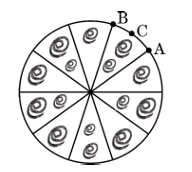
One such brooch is made with silver wire in the form of a circle with diameter 35 mm. The wire is also used in making 5 diameters which divide the circle into 10 equal sectors as shown in the figure.
Based on the above given information, answer the following questions :
(i) Find the central angle of each sector. (1)
(ii) Find the length of the arc ACB. (1)
(iii) (a) Find the area of each sector of the brooch. (2)
A brooch is a decorative piece often worn on clothing like jackets, blouses or dresses to add
elegance. Made from precious metals and decorated with gemstones, brooches come in many shapes
and
designs.
One such brooch is made with silver wire in the form of a circle with diameter 35 mm. The wire is also used in making 5 diameters which divide the circle into 10 equal sectors as shown in the figure.
Based on the above given information, answer the following questions :
(i) Find the central angle of each sector. (1)
(ii) Find the length of the arc ACB. (1)
(iii) (a) Find the area of each sector of the brooch. (2)
OR
(iii) (b) Find the total length of the silver wire used. (2)
(i) Central angle = \(360^\circ / 10 = 36^\circ\).
(ii) Length of arc ACB = \(\frac{36}{360} \times \pi d = 11\) mm.
(iii) (a) Area of sector = \(\frac{36}{360} \times \pi r^2 = 96.25 \text{ mm}^2\).
OR
(iii) (b) Total wire = \(\pi d + 5d = 110 + 175 = 285\) mm.
(ii) Length of arc ACB = \(\frac{36}{360} \times \pi d = 11\) mm.
(iii) (a) Area of sector = \(\frac{36}{360} \times \pi r^2 = 96.25 \text{ mm}^2\).
OR
(iii) (b) Total wire = \(\pi d + 5d = 110 + 175 = 285\) mm.
1 Mark
Q3. An arc of a circle of radius 10 cm
subtends
an angle \(144^\circ\) at the centre. The length of the arc is :
Lengths of arc \(l = \frac{\theta}{360} \times 2\pi r\).
Given \(r = 10, \theta = 144^\circ\).
\(l = \frac{144}{360} \times 2\pi(10)\).
\(\frac{144}{360} = \frac{2}{5}\).
\(l = \frac{2}{5} \times 20\pi = 8\pi\) cm.
Answer: (A)
Given \(r = 10, \theta = 144^\circ\).
\(l = \frac{144}{360} \times 2\pi(10)\).
\(\frac{144}{360} = \frac{2}{5}\).
\(l = \frac{2}{5} \times 20\pi = 8\pi\) cm.
Answer: (A)
2 Marks
Q21. (a)
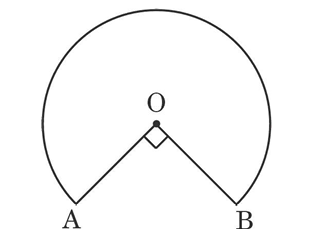 In the given figure, the shape
of the top of a table is that of a sector of a circle with centre O and ∠AOB = 90. If AO =
OB = 42 cm, then find the perimeter of the top of the table.
In the given figure, the shape
of the top of a table is that of a sector of a circle with centre O and ∠AOB = 90. If AO =
OB = 42 cm, then find the perimeter of the top of the table.
In the given figure, the shape
of the top of a table is that of a sector of a circle with centre O and ∠AOB = 90. If AO =
OB = 42 cm, then find the perimeter of the top of the table.
OR
Q21. (b)
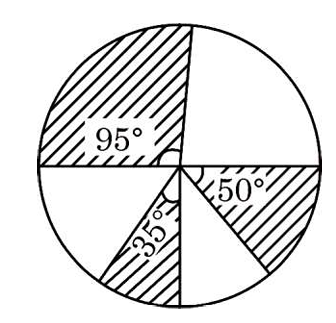 In the given figure, three sectors of a circle of radius 5
cm, making
angles \(\theta = 35^\circ\), \(\theta = 50^\circ\), and \(\theta = 95^\circ\), at the
centre are shaded. Find the area of
the shaded region. [Use \(\pi = \frac{22}{7}\)]
In the given figure, three sectors of a circle of radius 5
cm, making
angles \(\theta = 35^\circ\), \(\theta = 50^\circ\), and \(\theta = 95^\circ\), at the
centre are shaded. Find the area of
the shaded region. [Use \(\pi = \frac{22}{7}\)]
In the given figure, three sectors of a circle of radius 5
cm, making
angles \(\theta = 35^\circ\), \(\theta = 50^\circ\), and \(\theta = 95^\circ\), at the
centre are shaded. Find the area of
the shaded region. [Use \(\pi = \frac{22}{7}\)]
(a)
Given \(AO = OB = 42\) cm (Radius) and \(\angle AOB = 90^\circ\).
Perimeter = Arc Length AB + OA + OB.
Arc Length = \(\frac{90}{360} \times 2\pi r = \frac{1}{4} \times 2 \times \frac{22}{7} \times 42\).
\(= \frac{1}{2} \times 22 \times 6 = 66\) cm.
Perimeter = \(66 + 42 + 42 = 150\) cm.
(b)
We need to find the area of the shaded region which comprises three sectors.
Radius of circle \(r = 5\) cm.
Central angles: \(\theta_1 = 35^\circ, \theta_2 = 50^\circ, \theta_3 = 95^\circ\).
Sum of angles \(\theta_{total} = 35 + 50 + 95 = 180^\circ\) (Semicircle).
Area of shaded region = Area of sector with \(\theta = 180^\circ\).
\(= \frac{180}{360} \times \pi r^2 = \frac{1}{2} \times \frac{22}{7} \times 5^2\).
\(= \frac{1}{2} \times \frac{22}{7} \times 25\)
\(= \frac{11 \times 25}{7} = \frac{275}{7} \approx 39.28\) cm\(^2\).
Given \(AO = OB = 42\) cm (Radius) and \(\angle AOB = 90^\circ\).
Perimeter = Arc Length AB + OA + OB.
Arc Length = \(\frac{90}{360} \times 2\pi r = \frac{1}{4} \times 2 \times \frac{22}{7} \times 42\).
\(= \frac{1}{2} \times 22 \times 6 = 66\) cm.
Perimeter = \(66 + 42 + 42 = 150\) cm.
(b)
We need to find the area of the shaded region which comprises three sectors.
Radius of circle \(r = 5\) cm.
Central angles: \(\theta_1 = 35^\circ, \theta_2 = 50^\circ, \theta_3 = 95^\circ\).
Sum of angles \(\theta_{total} = 35 + 50 + 95 = 180^\circ\) (Semicircle).
Area of shaded region = Area of sector with \(\theta = 180^\circ\).
\(= \frac{180}{360} \times \pi r^2 = \frac{1}{2} \times \frac{22}{7} \times 5^2\).
\(= \frac{1}{2} \times \frac{22}{7} \times 25\)
\(= \frac{11 \times 25}{7} = \frac{275}{7} \approx 39.28\) cm\(^2\).
3 Marks
Q28. The length of the hour hand of a
clock
is 10 cm. Find the area of the minor sector swept by the hour hand of the clock between 5
a.m. to 8
a.m. Also, find the area of the major sector.
Time = 3 hours. Angle swept = \(3 \times 30^\circ = 90^\circ\).
Area Minor = \(\frac{90}{360}\pi (10)^2 = \frac{1}{4} \times 3.14 \times 100 = 78.5\) cm�.
Area Major = Total - Minor = \(314 - 78.5 = 235.5\) cm�.
Area Minor = \(\frac{90}{360}\pi (10)^2 = \frac{1}{4} \times 3.14 \times 100 = 78.5\) cm�.
Area Major = Total - Minor = \(314 - 78.5 = 235.5\) cm�.
1 Mark
Q1. The diameter of a wheel is 63 cm.
The
distance travelled by the wheel in 100 revolutions is :
Circumference \(C = \pi d = \frac{22}{7} \times 63 = 198\) cm.
Distance = \(100 \times 198 = 19800\) cm = 198 m.
Answer: (B)
Distance = \(100 \times 198 = 19800\) cm = 198 m.
Answer: (B)
3 Marks
Q28. A chord of a circle of radius 10
cm
subtends a right angle at the centre. Find the area of the corresponding minor segment.
(\(\pi =
3.14\))
Area Segment = Area Sector - Area Triangle.
Sector = \(\frac{90}{360} \times 3.14 \times 100 = 78.5\).
Triangle = \(\frac{1}{2} \times 10 \times 10 = 50\).
Area = \(78.5 - 50 = 28.5\) cm�.
Sector = \(\frac{90}{360} \times 3.14 \times 100 = 78.5\).
Triangle = \(\frac{1}{2} \times 10 \times 10 = 50\).
Area = \(78.5 - 50 = 28.5\) cm�.
4 Marks
Q37. The Olympic symbol comprising five
interlocking rings represents the union of the five continents of the world and the meeting of athletes
from all over the world at the Olympic games. In order to spread awareness about Olympic games, students
of Class-X took part in various activities organised by the school. One such group of students made 5
circular rings in the school lawn with the help of ropes. Each circular ring required 44 m of
rope.
Also, in the shaded regions as shown in the figure, students made rangoli showcasing various sports and games. It is given that \(\Delta OAB\) is an equilateral triangle and all unshaded regions are congruent.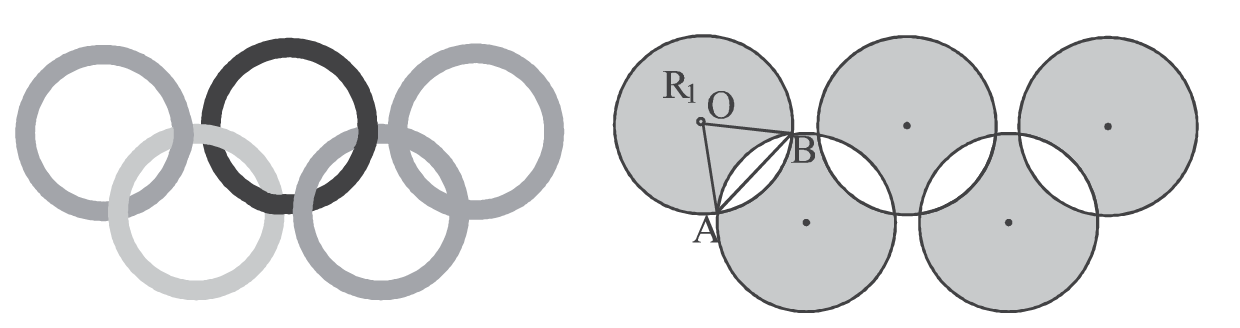 Based on above information, answer the following questions :
(i) Find the radius of each circular ring. (1)
(ii) What is the measure of \(\angle AOB\) ? (1)
(iii) (a) Find the area of shaded region \(R_1\). (2)
Also, in the shaded regions as shown in the figure, students made rangoli showcasing various sports and games. It is given that \(\Delta OAB\) is an equilateral triangle and all unshaded regions are congruent.
Based on above information, answer the following questions :(i) Find the radius of each circular ring. (1)
(ii) What is the measure of \(\angle AOB\) ? (1)
(iii) (a) Find the area of shaded region \(R_1\). (2)
OR
(iii) (b) Find the length of rope around the unshaded regions. (2)
(i) Circumference = 44 m.
Ring 2: 2 overlaps -> \(360-60-60 = 240^\circ\) arc.
Ring 3: 2 overlaps -> \(240^\circ\).
Ring 4: 2 overlaps -> \(240^\circ\).
Ring 5: 1 overlap -> \(300^\circ\).
Total Arc = \(300 + 240 + 240 + 240 + 300 = 1320^\circ\).
Total Length = \(\frac{1320}{360} \times 2\pi r = \frac{11}{3} \times 44\) m? No, \(2\pi r = 44\).
Length = \(\frac{1320}{360} \times 44 = \frac{11}{3} \times 44 = \frac{484}{3} \approx 161.33\) m.
Let's assume this interpretation.
Ring 2: 2 overlaps -> \(360-60-60 = 240^\circ\) arc.
Ring 3: 2 overlaps -> \(240^\circ\).
Ring 4: 2 overlaps -> \(240^\circ\).
Ring 5: 1 overlap -> \(300^\circ\).
Total Arc = \(300 + 240 + 240 + 240 + 300 = 1320^\circ\).
Total Length = \(\frac{1320}{360} \times 2\pi r = \frac{11}{3} \times 44\) m? No, \(2\pi r = 44\).
Length = \(\frac{1320}{360} \times 44 = \frac{11}{3} \times 44 = \frac{484}{3} \approx 161.33\) m.
Let's assume this interpretation.
5 Marks
Q37. A farmer has a circular piece of land of
radius 35 m. He wishes to construct his house in the form of largest possible square within the
land.
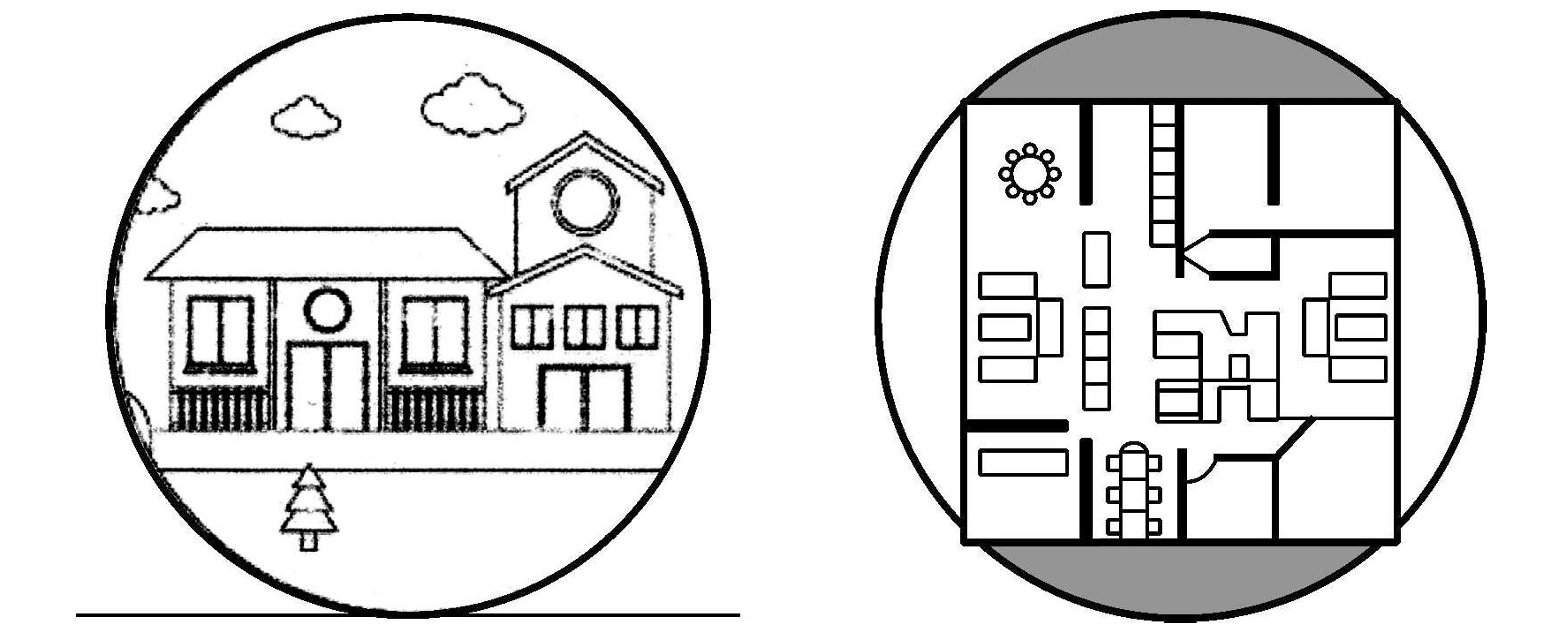 Based on given information, answer the following:
(i) Find the length of wire needed to fence the entire land.
(ii) Find the length of each side of the square land on which house will be constructed.
(iii) (a) The farmer wishes to grow grass on the shaded region around the house. Find the cost of growing the grass at the rate of ?50 per square metre.
Based on given information, answer the following:(i) Find the length of wire needed to fence the entire land.
(ii) Find the length of each side of the square land on which house will be constructed.
(iii) (a) The farmer wishes to grow grass on the shaded region around the house. Find the cost of growing the grass at the rate of ?50 per square metre.
OR
(iii) (b) Find the ratio of area of land on which house is built to remaining area of circular piece
of land.
(i) Circumference \(C = 2\pi r = 2 \times \frac{22}{7} \times 35
= 220\) m.
(ii) Diagonal of square = Diameter = 70 m. Side \(a = 70/\sqrt{2} = 35\sqrt{2}\) m.
(iii)(a) Area of circle = \(\frac{22}{7} \times 35 \times 35 = 3850\) m�.
Area of square = \((35\sqrt{2})^2 = 2450\) m�.
Shaded area = \(3850 - 2450 = 1400\) m�.
Cost = \(1400 \times 50 = \)?70,000.
(iii)(b) Ratio = \(2450 : 1400 = 245 : 140 = 49 : 28 = 7 : 4\).
(ii) Diagonal of square = Diameter = 70 m. Side \(a = 70/\sqrt{2} = 35\sqrt{2}\) m.
(iii)(a) Area of circle = \(\frac{22}{7} \times 35 \times 35 = 3850\) m�.
Area of square = \((35\sqrt{2})^2 = 2450\) m�.
Shaded area = \(3850 - 2450 = 1400\) m�.
Cost = \(1400 \times 50 = \)?70,000.
(iii)(b) Ratio = \(2450 : 1400 = 245 : 140 = 49 : 28 = 7 : 4\).
4 Marks
Q37 (Case Study).
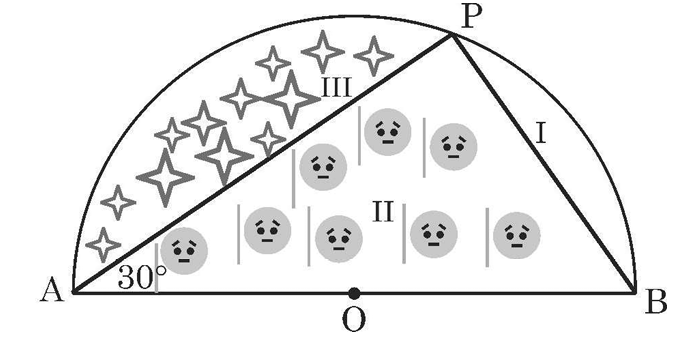 Anurag purchased a
farmhouse which is in the form of a semicircle of diameter 70 m. He divides it into three parts by
taking a point P on the semicircle in such a way that \(\angle PAB = 30�\) as shown in the following
figure, where O is the centre of semicircle.
Anurag purchased a
farmhouse which is in the form of a semicircle of diameter 70 m. He divides it into three parts by
taking a point P on the semicircle in such a way that \(\angle PAB = 30�\) as shown in the following
figure, where O is the centre of semicircle.
In part I, he planted saplings of Mango tree, in part II, he grew tomatoes and in part III, he grew oranges.
Based on given information, answer the following questions.
i. What is the measure of \(\angle POA\)? [1 Mark]
ii. Find the length of wire needed to fence entire piece of land. [1 Mark]
iii. (a) Find the area of region in which saplings of Mango tree are planted. [2 Marks]
Anurag purchased a
farmhouse which is in the form of a semicircle of diameter 70 m. He divides it into three parts by
taking a point P on the semicircle in such a way that \(\angle PAB = 30�\) as shown in the following
figure, where O is the centre of semicircle.In part I, he planted saplings of Mango tree, in part II, he grew tomatoes and in part III, he grew oranges.
Based on given information, answer the following questions.
i. What is the measure of \(\angle POA\)? [1 Mark]
ii. Find the length of wire needed to fence entire piece of land. [1 Mark]
iii. (a) Find the area of region in which saplings of Mango tree are planted. [2 Marks]
OR
(b) Find the length of wire needed to fence the region III. [2 Marks]
Radius \(r = 35\) m.
(i) \(\angle POA\):
In \(\Delta OAP\), \(OA = OP\) (Radii), so \(\angle OPA = \angle OAP = 30�\).
\(\angle POA = 180 - (30 + 30) = 120�\).
(ii) Entire Fence: Perimeter of semicircle.
\(\pi r + 2r = \frac{22}{7}(35) + 70 = 110 + 70 = 180\) m.
(iii) (a) Area of Region I (Segment AP):
Area Sector POA = \(\frac{120}{360} \times \pi r^2 = \frac{1}{3} \times \frac{22}{7} \times 35 \times 35 \approx 1283.33\) m�.
Area \(\Delta POA = \frac{1}{2}r^2 \sin 120� = \frac{1}{2}(35)^2 \times \frac{\sqrt{3}}{2} \approx 530.4\) m�.
Area I = \(1283.33 - 530.4 \approx 752.9\) m�.
(iii) (b) Fence Region III:
\(\angle POB = 180 - 120 = 60�\).
Arc PB = \(\frac{60}{360} \times 2\pi r = \frac{1}{6} \times 220 \approx 36.67\) m.
Since \(\angle POB = 60�\) and \(OP = OB\), \(\Delta POB\) is equilateral, chord \(PB = 35\) m.
Fence = \(36.67 + 35 = 71.67\) m.
(i) \(\angle POA\):
In \(\Delta OAP\), \(OA = OP\) (Radii), so \(\angle OPA = \angle OAP = 30�\).
\(\angle POA = 180 - (30 + 30) = 120�\).
(ii) Entire Fence: Perimeter of semicircle.
\(\pi r + 2r = \frac{22}{7}(35) + 70 = 110 + 70 = 180\) m.
(iii) (a) Area of Region I (Segment AP):
Area Sector POA = \(\frac{120}{360} \times \pi r^2 = \frac{1}{3} \times \frac{22}{7} \times 35 \times 35 \approx 1283.33\) m�.
Area \(\Delta POA = \frac{1}{2}r^2 \sin 120� = \frac{1}{2}(35)^2 \times \frac{\sqrt{3}}{2} \approx 530.4\) m�.
Area I = \(1283.33 - 530.4 \approx 752.9\) m�.
(iii) (b) Fence Region III:
\(\angle POB = 180 - 120 = 60�\).
Arc PB = \(\frac{60}{360} \times 2\pi r = \frac{1}{6} \times 220 \approx 36.67\) m.
Since \(\angle POB = 60�\) and \(OP = OB\), \(\Delta POB\) is equilateral, chord \(PB = 35\) m.
Fence = \(36.67 + 35 = 71.67\) m.