
Board Exam 2025
1 Mark
Q13. In the given figure, PQ and PR are
tangents
to the circle such that \(PQ = 7\) cm and \(\angle RPQ = 60^\circ\). The length of chord QR is:
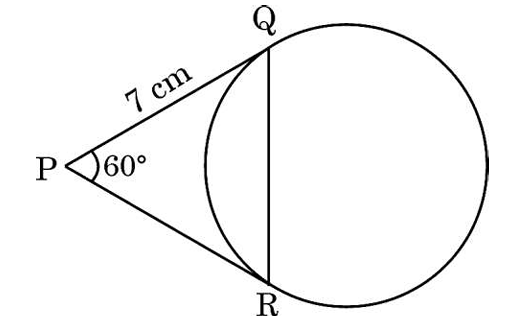
\(PQ = PR = 7\) cm (Tangents from external point).
\(\Delta PQR\) is isosceles with \(\angle P = 60^\circ\).
Base angles \(\angle Q = \angle R = (180 - 60)/2 = 60^\circ\).
Thus \(\Delta PQR\) is equilateral.
\(QR = PQ = 7\) cm.
Answer: (B)
\(\Delta PQR\) is isosceles with \(\angle P = 60^\circ\).
Base angles \(\angle Q = \angle R = (180 - 60)/2 = 60^\circ\).
Thus \(\Delta PQR\) is equilateral.
\(QR = PQ = 7\) cm.
Answer: (B)
1 Mark
Q18. In the given figure, a circle inscribed
in
\(\Delta ABC\), touches AB, BC and CA at X, Z and Y, respectively. If \(AB = 12\) cm, \(AY = 8\) cm
and
\(CY = 6\) cm, then the length of BC is :
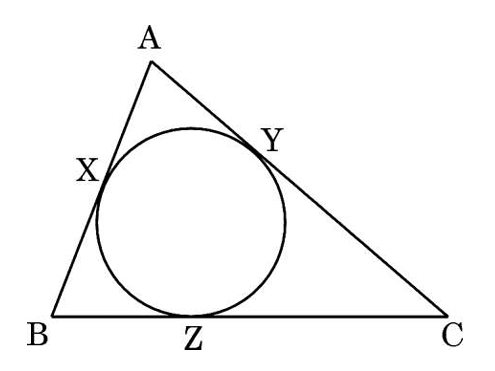
Tangents from a point are equal.
\(AY = AX = 8\).
\(CY = CZ = 6\).
\(AB = 12 \Rightarrow AX + XB = 12 \Rightarrow 8 + XB = 12 \Rightarrow XB = 4\).
\(XB = XZ\)? No, \(XB = BZ\). So \(BZ = 4\).
\(BC = BZ + ZC = 4 + 6 = 10\) cm.
Answer: (C)
\(AY = AX = 8\).
\(CY = CZ = 6\).
\(AB = 12 \Rightarrow AX + XB = 12 \Rightarrow 8 + XB = 12 \Rightarrow XB = 4\).
\(XB = XZ\)? No, \(XB = BZ\). So \(BZ = 4\).
\(BC = BZ + ZC = 4 + 6 = 10\) cm.
Answer: (C)
2 Marks
Q24. In the given figure, TQ and TR are
tangents
to the circle with centre O. Prove that \(\angle QTR = 2\angle OQR\).
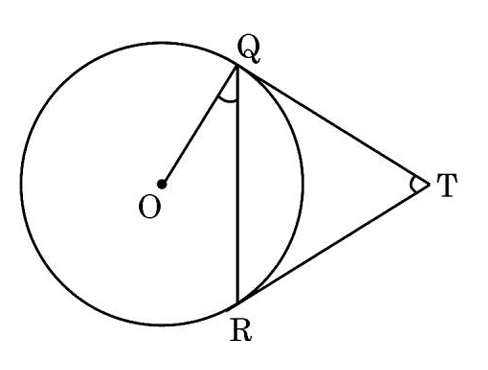
Let \(\angle QTR = x\).
In \(\Delta TQR, TQ = TR\), so \(\angle TQR = \angle TRQ = (180 - x)/2 = 90 - x/2\).
Also, radius \(\perp\) tangent, so \(\angle OQT = 90^\circ\).
\(\angle OQR = \angle OQT - \angle TQR = 90 - (90 - x/2) = x/2\).
So, \(x = 2\angle OQR \Rightarrow \angle QTR = 2\angle OQR\). Proved.
In \(\Delta TQR, TQ = TR\), so \(\angle TQR = \angle TRQ = (180 - x)/2 = 90 - x/2\).
Also, radius \(\perp\) tangent, so \(\angle OQT = 90^\circ\).
\(\angle OQR = \angle OQT - \angle TQR = 90 - (90 - x/2) = x/2\).
So, \(x = 2\angle OQR \Rightarrow \angle QTR = 2\angle OQR\). Proved.
3 Marks
Q26. A quadrilateral circumscribes a circle.
Prove that the opposite sides of the quadrilateral subtend supplementary angles at the centre of the
circle.
Let the quadrilateral ABCD circumscribe the circle with centre O.
Let the points of contact be P, Q, R, S on sides AB, BC, CD, DA respectively.
Join OP, OQ, OR, OS. Also join OA, OB, OC, OD.
In \(\Delta OAP\) and \(\Delta OAS\):
\(AP = AS\) (Tangents from A), \(OP = OS\) (Radii), \(OA = OA\) (Common).
\(\therefore \Delta OAP \cong \Delta OAS\) (SSS). \(\Rightarrow \angle 1 = \angle 8\).
Similarly, \(\angle 2 = \angle 3, \angle 4 = \angle 5, \angle 6 = \angle 7\).
Sum of all angles at O = \(360^\circ\).
\(2(\angle 1 + \angle 2 + \angle 5 + \angle 6) = 360^\circ\) (Grouping angles for opposite sides).
Wait, we want \(\angle AOB + \angle COD\).
\(\angle AOB = \angle 1 + \angle 2\). \(\angle COD = \angle 5 + \angle 6\).
\(2(\angle 2 + \angle 3 + \angle 6 + \angle 7)\) ? No.
Actually: \(\angle 1=\angle 8, \angle 2=\angle 3, \angle 4=\angle 5, \angle 6=\angle 7\).
Sum = \((\angle 1+\angle 8) + (\angle 2+\angle 3) + (\angle 4+\angle 5) + (\angle 6+\angle 7) = 360\).
\(2\angle 1 + 2\angle 2 + 2\angle 5 + 2\angle 6 = 360 \Rightarrow \angle 1 + \angle 2 + \angle 5 + \angle 6 = 180\).
\((\angle 1+\angle 2) + (\angle 5+\angle 6) = 180 \Rightarrow \angle AOB + \angle COD = 180^\circ\).
Similarly \(\angle BOC + \angle DOA = 180^\circ\).
Hence Proved.
Let the points of contact be P, Q, R, S on sides AB, BC, CD, DA respectively.
Join OP, OQ, OR, OS. Also join OA, OB, OC, OD.
In \(\Delta OAP\) and \(\Delta OAS\):
\(AP = AS\) (Tangents from A), \(OP = OS\) (Radii), \(OA = OA\) (Common).
\(\therefore \Delta OAP \cong \Delta OAS\) (SSS). \(\Rightarrow \angle 1 = \angle 8\).
Similarly, \(\angle 2 = \angle 3, \angle 4 = \angle 5, \angle 6 = \angle 7\).
Sum of all angles at O = \(360^\circ\).
\(2(\angle 1 + \angle 2 + \angle 5 + \angle 6) = 360^\circ\) (Grouping angles for opposite sides).
Wait, we want \(\angle AOB + \angle COD\).
\(\angle AOB = \angle 1 + \angle 2\). \(\angle COD = \angle 5 + \angle 6\).
\(2(\angle 2 + \angle 3 + \angle 6 + \angle 7)\) ? No.
Actually: \(\angle 1=\angle 8, \angle 2=\angle 3, \angle 4=\angle 5, \angle 6=\angle 7\).
Sum = \((\angle 1+\angle 8) + (\angle 2+\angle 3) + (\angle 4+\angle 5) + (\angle 6+\angle 7) = 360\).
\(2\angle 1 + 2\angle 2 + 2\angle 5 + 2\angle 6 = 360 \Rightarrow \angle 1 + \angle 2 + \angle 5 + \angle 6 = 180\).
\((\angle 1+\angle 2) + (\angle 5+\angle 6) = 180 \Rightarrow \angle AOB + \angle COD = 180^\circ\).
Similarly \(\angle BOC + \angle DOA = 180^\circ\).
Hence Proved.
1 Mark
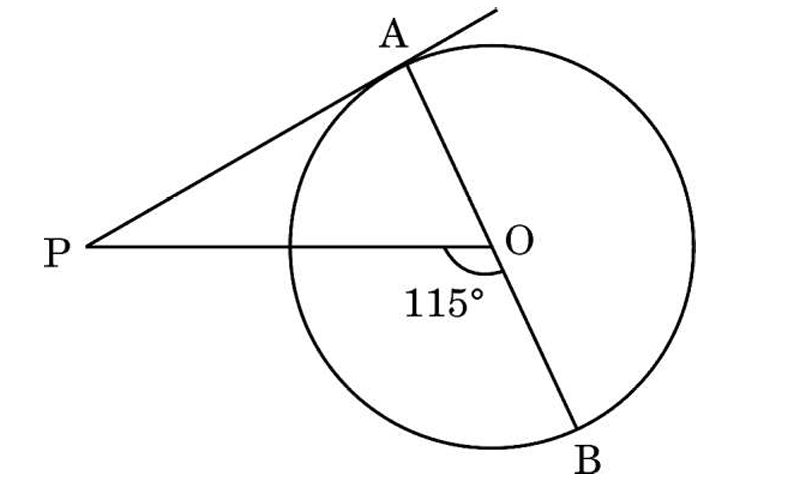
Q7. In the given figure, PA is a tangent from
 an
external point P to a circle with centre O. If \(\angle POB = 115^\circ\) then \(\angle APO\) is
equal
to:
an
external point P to a circle with centre O. If \(\angle POB = 115^\circ\) then \(\angle APO\) is
equal
to:
an
external point P to a circle with centre O. If \(\angle POB = 115^\circ\) then \(\angle APO\) is
equal
to:
Assuming A, O, B are collinear or form linear pair relation with the tangent point A.
\(\angle AOP + \angle POB = 180^\circ\) (Linear pair). \(\angle AOP = 180^\circ - 115^\circ = 65^\circ\).
In \(\Delta PAO\) (Right angled at A), \(\angle APO = 90^\circ - 65^\circ = 25^\circ\).
Answer: (A)
\(\angle AOP + \angle POB = 180^\circ\) (Linear pair). \(\angle AOP = 180^\circ - 115^\circ = 65^\circ\).
In \(\Delta PAO\) (Right angled at A), \(\angle APO = 90^\circ - 65^\circ = 25^\circ\).
Answer: (A)
1 Mark
Q14. The tangents drawn at the extremities of
the
diameter of a circle are always:
Tangents at ends of a diameter are perpendicular to the diameter at endpoints. Since diameter is a
straight line, the perpendiculars are parallel.
Answer: (A)
Answer: (A)
2 Marks
Q23. A person is standing at P outside a
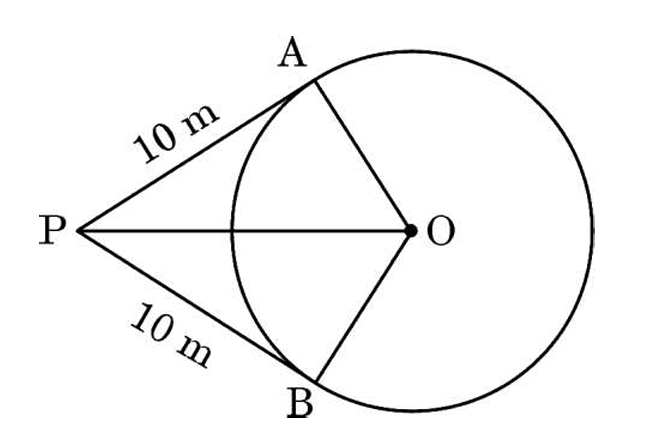 circular ground at a distance of 26 m from the centre of the ground. He found that his distances
from the points A and B on the ground are 10 m (PA and PB are tangents to the circle). Find the
radius of the circular ground.
circular ground at a distance of 26 m from the centre of the ground. He found that his distances
from the points A and B on the ground are 10 m (PA and PB are tangents to the circle). Find the
radius of the circular ground.
circular ground at a distance of 26 m from the centre of the ground. He found that his distances
from the points A and B on the ground are 10 m (PA and PB are tangents to the circle). Find the
radius of the circular ground.
Given: Distance of P from centre, \(OP = 26\) m.
Distance from point A (tangent length), \(PA = 10\) m.
To find: Radius \(r = OA\).
Since tangent is perpendicular to radius at point of contact:
\(\angle OAP = 90^\circ\).
In right-angled \(\Delta OAP\):
\(OP^2 = OA^2 + PA^2\) (Pythagoras Theorem)
\(26^2 = r^2 + 10^2\)
\(676 = r^2 + 100\)
\(r^2 = 676 - 100 = 576\)
\(r = \sqrt{576} = 24\) m.
Radius of circular ground = 24 m.
Distance from point A (tangent length), \(PA = 10\) m.
To find: Radius \(r = OA\).
Since tangent is perpendicular to radius at point of contact:
\(\angle OAP = 90^\circ\).
In right-angled \(\Delta OAP\):
\(OP^2 = OA^2 + PA^2\) (Pythagoras Theorem)
\(26^2 = r^2 + 10^2\)
\(676 = r^2 + 100\)
\(r^2 = 676 - 100 = 576\)
\(r = \sqrt{576} = 24\) m.
Radius of circular ground = 24 m.
3 Marks
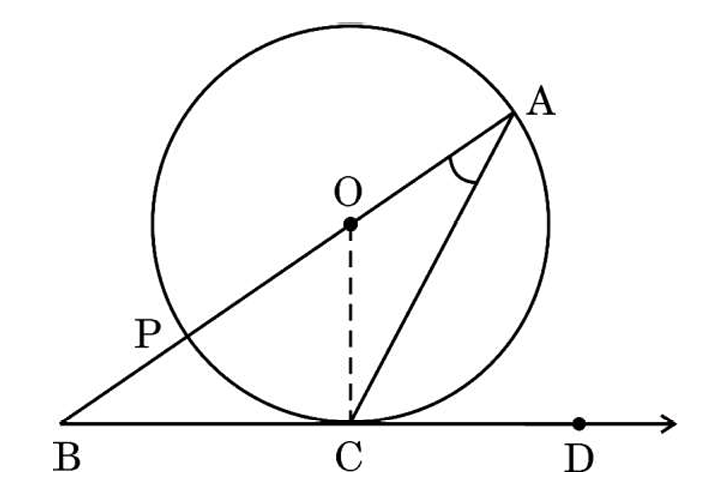
Q30. (a) In the given figure, O is the centre
of the circle and BCD is a tangent to it at C. Prove that \(\angle BAC + \angle ACD = 90^\circ\).
of the circle and BCD is a tangent to it at C. Prove that \(\angle BAC + \angle ACD = 90^\circ\).
OR
Q30. (b)
Prove that opposite sides of a quadrilateral
circumscribing a circle subtend supplementary angles at the centre.
(a) Given BCD is tangent at C. \(OC\) is radius.
We know radius \(\perp\) tangent. \(\therefore \angle OCD = 90^\circ\).
Also in \(\Delta OAC\), \(OA = OC\) (Radii).
\(\therefore \angle OAC = \angle OCA\) (Angles opposite to equal sides).
Let \(\angle OAC = \angle OCA = x\).
In \(\Delta ABC\), exterior angle property? No, simpler:
\(\angle ACD = \angle OCD - \angle OCA = 90^\circ - x\).
We need to prove \(\angle BAC + \angle ACD = 90^\circ\).
Here \(\angle BAC = \angle OAC = x\).
LHS \(= x + (90^\circ - x) = 90^\circ\).
Hence Proved.
(b) let ABCD be the quadrilateral circumscribing the circle with centre O.
Let P, Q, R, S be the points of contact on sides AB, BC, CD, DA respectively.
Join OP, OQ, OR, OS. Join OA, OB, OC, OD.
In \(\Delta OAP\) and \(\Delta OAS\):
1. \(AP = AS\) (Tangents from external point A)
2. \(OP = OS\) (Radii)
3. \(OA = OA\) (Common)
\(\therefore \Delta OAP \cong \Delta OAS\) (SSS Criterion).
\(\Rightarrow \angle AOP = \angle AOS\) (CPCT). Let them be \(\angle 1\) and \(\angle 8\). So \(\angle 1 = \angle 8\).
Similarly, \(\angle 2 = \angle 3\), \(\angle 4 = \angle 5\), \(\angle 6 = \angle 7\).
Sum of angles at centre O = \(360^\circ\).
\(\angle 1 + \angle 2 + \angle 3 + \angle 4 + \angle 5 + \angle 6 + \angle 7 + \angle 8 = 360^\circ\).
Substitute equals: \(2\angle 1 + 2\angle 2 + 2\angle 5 + 2\angle 6 = 360^\circ\).
\(2(\angle 1 + \angle 2) + 2(\angle 5 + \angle 6) = 360^\circ\).
\(\angle AOB + \angle COD = 180^\circ\). (Since \(\angle 1+\angle 2 = \angle AOB\)).
Similarly, \(\angle BOC + \angle DOA = 180^\circ\).
Hence, opposite sides subtend supplementary angles.
We know radius \(\perp\) tangent. \(\therefore \angle OCD = 90^\circ\).
Also in \(\Delta OAC\), \(OA = OC\) (Radii).
\(\therefore \angle OAC = \angle OCA\) (Angles opposite to equal sides).
Let \(\angle OAC = \angle OCA = x\).
In \(\Delta ABC\), exterior angle property? No, simpler:
\(\angle ACD = \angle OCD - \angle OCA = 90^\circ - x\).
We need to prove \(\angle BAC + \angle ACD = 90^\circ\).
Here \(\angle BAC = \angle OAC = x\).
LHS \(= x + (90^\circ - x) = 90^\circ\).
Hence Proved.
(b) let ABCD be the quadrilateral circumscribing the circle with centre O.
Let P, Q, R, S be the points of contact on sides AB, BC, CD, DA respectively.
Join OP, OQ, OR, OS. Join OA, OB, OC, OD.
In \(\Delta OAP\) and \(\Delta OAS\):
1. \(AP = AS\) (Tangents from external point A)
2. \(OP = OS\) (Radii)
3. \(OA = OA\) (Common)
\(\therefore \Delta OAP \cong \Delta OAS\) (SSS Criterion).
\(\Rightarrow \angle AOP = \angle AOS\) (CPCT). Let them be \(\angle 1\) and \(\angle 8\). So \(\angle 1 = \angle 8\).
Similarly, \(\angle 2 = \angle 3\), \(\angle 4 = \angle 5\), \(\angle 6 = \angle 7\).
Sum of angles at centre O = \(360^\circ\).
\(\angle 1 + \angle 2 + \angle 3 + \angle 4 + \angle 5 + \angle 6 + \angle 7 + \angle 8 = 360^\circ\).
Substitute equals: \(2\angle 1 + 2\angle 2 + 2\angle 5 + 2\angle 6 = 360^\circ\).
\(2(\angle 1 + \angle 2) + 2(\angle 5 + \angle 6) = 360^\circ\).
\(\angle AOB + \angle COD = 180^\circ\). (Since \(\angle 1+\angle 2 = \angle AOB\)).
Similarly, \(\angle BOC + \angle DOA = 180^\circ\).
Hence, opposite sides subtend supplementary angles.
1 Mark
Q13.
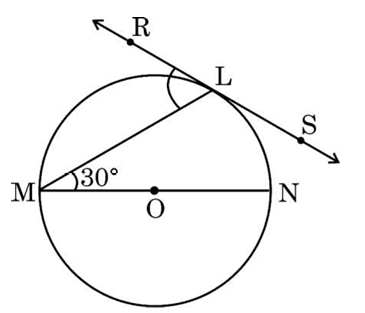 In the given figure, RS is tangent at L,
MN
is diameter. \(\angle NML = 30^\circ\). Find \(\angle RLM\).
In the given figure, RS is tangent at L,
MN
is diameter. \(\angle NML = 30^\circ\). Find \(\angle RLM\).
In the given figure, RS is tangent at L,
MN
is diameter. \(\angle NML = 30^\circ\). Find \(\angle RLM\).
Angle in semicircle \(\angle MLN = 90^\circ\).
In \(\Delta MLN, \angle LNM = 180 - 90 - 30 = 60^\circ\).
By Alternate Segment Theorem, angle between tangent RS and chord LM at L (\(\angle RLM\)) is equal to angle in alternate segment \(\angle LNM\).
So \(\angle RLM = 60^\circ\).
Answer: (B) (Assuming B is 60)
In \(\Delta MLN, \angle LNM = 180 - 90 - 30 = 60^\circ\).
By Alternate Segment Theorem, angle between tangent RS and chord LM at L (\(\angle RLM\)) is equal to angle in alternate segment \(\angle LNM\).
So \(\angle RLM = 60^\circ\).
Answer: (B) (Assuming B is 60)
1 Mark
Q20. Assertion (A): Two
concentric circles are of radii 5 cm and 3 cm. The length of the chord of the larger circle which
touches the smaller circle is 8 cm.
Reason (R): A line drawn through the end point of a radius and perpendicular to it is a tangent to the circle.
Reason (R): A line drawn through the end point of a radius and perpendicular to it is a tangent to the circle.
Check A: In right \(\Delta\) formed by radius (3), half-chord (\(x\)) and
hypotenuse
(5):
\(x^2 = 5^2 - 3^2 = 25 - 9 = 16 \Rightarrow x = 4\).
Chord length = \(2x = 8\) cm. A is True.
Check R: This is a standard theorem. True.
Explanation: The calculation in A relies on the property that the radius is perpendicular to the tangent (chord) at the point of contact, which allows use of Pythagoras theorem. R states this condition. So R is the explanation.
Answer: (A)
\(x^2 = 5^2 - 3^2 = 25 - 9 = 16 \Rightarrow x = 4\).
Chord length = \(2x = 8\) cm. A is True.
Check R: This is a standard theorem. True.
Explanation: The calculation in A relies on the property that the radius is perpendicular to the tangent (chord) at the point of contact, which allows use of Pythagoras theorem. R states this condition. So R is the explanation.
Answer: (A)
2 Marks
Q22. At point A on the diameter AB of a
circle of
radius 10 cm, tangent XAY is drawn. Find length of chord CD parallel to XY at distance 16 cm from A.
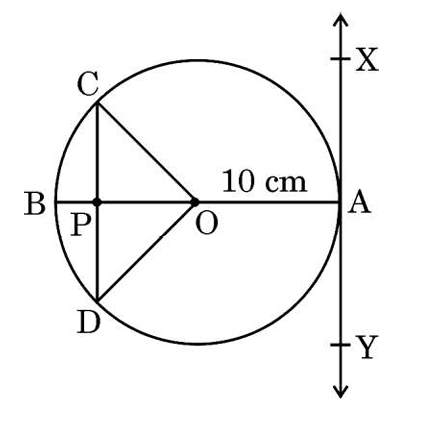
Radius \(r = 10\). Tangent XAY \(\perp\) Diameter AB.
Chord CD || XAY \(\Rightarrow\) CD \(\perp\) Diameter AB.
Distance of chord from A is 16. A is on circle.
Since radius is 10, center O is 10 cm from A.
Distance of chord from center O \(= |16 - 10| = 6\) cm.
Length of chord \(= 2\sqrt{r^2 - d^2} = 2\sqrt{10^2 - 6^2} = 2\sqrt{64} = 16\) cm.
Chord CD || XAY \(\Rightarrow\) CD \(\perp\) Diameter AB.
Distance of chord from A is 16. A is on circle.
Since radius is 10, center O is 10 cm from A.
Distance of chord from center O \(= |16 - 10| = 6\) cm.
Length of chord \(= 2\sqrt{r^2 - d^2} = 2\sqrt{10^2 - 6^2} = 2\sqrt{64} = 16\) cm.
3 Marks
Q29. (a) Prove that the parallelogram
circumscribing a circle is a rhombus.
OR
Q29. (b) Prove that the angle between two
tangents drawn from an external point to a circle is supplementary to the angle subtended by the
line-segment joining the points of contact at the centre.
(a) Let ABCD be parallelogram. Tangents touch at P, Q, R, S.
\(AP = AS, BP = BQ, CR = CQ, DR = DS\).
\(AB + CD\) \( = (AP + PB) + (CR + DR) \) \( = AS + BQ + CQ + DS \) \( = (AS + DS) + (BQ + CQ) \) \( = AD + BC \).
Since \(AB = CD\) and \(AD = BC\) (Parallelogram), \(2AB = 2AD \Rightarrow AB = AD\).
Parallelogram with adjacent sides equal is a rhombus.
(b) Quad OAPB (where P, B are contact points, A external).
\(\angle OPA = 90^\circ, \angle OBA = 90^\circ\).
Sum of angles in quad = 360.
\(\angle AOB + \angle PAB + 90 + 90 = 360 \Rightarrow \angle AOB + \angle PAB = 180^\circ\).
\(AP = AS, BP = BQ, CR = CQ, DR = DS\).
\(AB + CD\) \( = (AP + PB) + (CR + DR) \) \( = AS + BQ + CQ + DS \) \( = (AS + DS) + (BQ + CQ) \) \( = AD + BC \).
Since \(AB = CD\) and \(AD = BC\) (Parallelogram), \(2AB = 2AD \Rightarrow AB = AD\).
Parallelogram with adjacent sides equal is a rhombus.
(b) Quad OAPB (where P, B are contact points, A external).
\(\angle OPA = 90^\circ, \angle OBA = 90^\circ\).
Sum of angles in quad = 360.
\(\angle AOB + \angle PAB + 90 + 90 = 360 \Rightarrow \angle AOB + \angle PAB = 180^\circ\).
1 Mark
Q18. If tangents PA and PB drawn from an
class="question-image">
external point P to the circle with centre O are inclined to each other at an angle of 80� as shown
in the given figure, then the measure of \(\angle\) POA is :
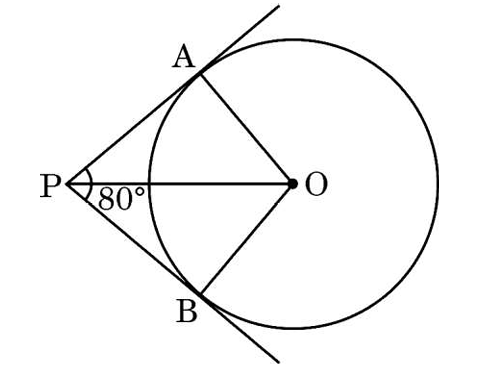
In quadrilateral OAPB:
\(\angle OAP = 90�\) (radius ? tangent)
\(\angle OBP = 90�\) (radius ? tangent)
\(\angle APB = 80�\) (given)
Sum of angles = 360�
\(\angle AOB = 360� - 90� - 90� - 80� = 100�\)
Since OP bisects \(\angle AOB\) (tangents from external point are equal, so triangles OAP ? OBP):
\(\angle POA = \frac{100�}{2} = 50�\).
Answer: (B)
\(\angle OAP = 90�\) (radius ? tangent)
\(\angle OBP = 90�\) (radius ? tangent)
\(\angle APB = 80�\) (given)
Sum of angles = 360�
\(\angle AOB = 360� - 90� - 90� - 80� = 100�\)
Since OP bisects \(\angle AOB\) (tangents from external point are equal, so triangles OAP ? OBP):
\(\angle POA = \frac{100�}{2} = 50�\).
Answer: (B)
1 Mark
Q19. Assertion (A): If two
tangents are drawn to a circle from an external point, then they subtend equal angles at the centre
of the circle.
Reason (R): A parallelogram circumscribing a circle is a rhombus.
Reason (R): A parallelogram circumscribing a circle is a rhombus.
Check A: Since tangents from external point are equal (PA = PB), triangles OPA ?
OPB (RHS). Hence \(\angle AOP = \angle BOP\). True.
Check R: This is a standard theorem � a parallelogram circumscribing a circle has all sides equal (rhombus). True.
Relation: R is about parallelograms and has no connection to explaining A (about tangent angles).
Answer: (B)
Check R: This is a standard theorem � a parallelogram circumscribing a circle has all sides equal (rhombus). True.
Relation: R is about parallelograms and has no connection to explaining A (about tangent angles).
Answer: (B)
2 Marks
Q24. Prove that the tangents drawn at the
ends of a diameter of a circle are parallel.
Let AB be a diameter of circle with centre O.
Let PQ be tangent at A and RS be tangent at B.
Since tangent is perpendicular to radius at point of contact:
\(\angle OAP = 90�\) and \(\angle OBR = 90�\).
Since AB is a straight line (diameter) and these are angles on the same side:
\(\angle PAB = 90�\) and \(\angle RBA = 90�\).
\(\angle PAB + \angle RBA = 180�\) (co-interior angles)
Hence, PQ || RS (lines are parallel if co-interior angles are supplementary).
Hence Proved.
Let PQ be tangent at A and RS be tangent at B.
Since tangent is perpendicular to radius at point of contact:
\(\angle OAP = 90�\) and \(\angle OBR = 90�\).
Since AB is a straight line (diameter) and these are angles on the same side:
\(\angle PAB = 90�\) and \(\angle RBA = 90�\).
\(\angle PAB + \angle RBA = 180�\) (co-interior angles)
Hence, PQ || RS (lines are parallel if co-interior angles are supplementary).
Hence Proved.
3 Marks
Q27. In the given figure, PB is a tangent to
the circle with centre O at B. AB is a chord of the circle of length 24 cm and at a distance of 5 cm
from the centre of the circle. If the length PB of the tangent is 20 cm, find the length of OP.
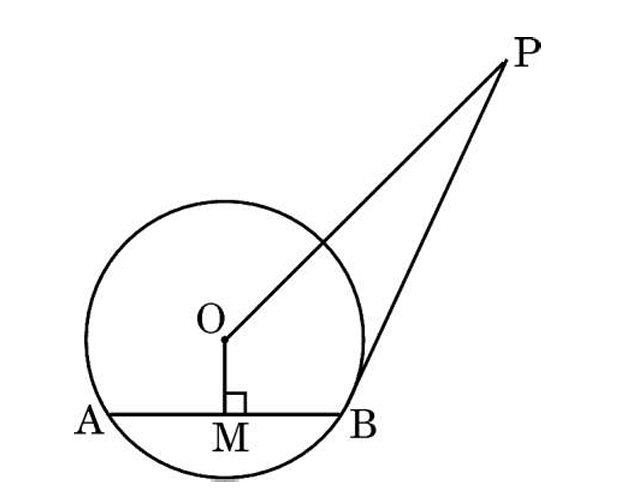
Given: Chord AB = 24 cm, OM = 5 cm (perpendicular from O to AB), PB = 20 cm.
Step 1: Find radius OB.
M is midpoint of AB (perpendicular from centre bisects chord).
AM = MB = 12 cm.
In right triangle OMB:
\(OB^2 = OM^2 + MB^2\) \( = 5^2 + 12^2 \) \( = 25 + 144 = 169 \).
\(OB = 13\) cm (radius).
Step 2: Find OP.
Tangent is perpendicular to radius at point of contact.
So \(\angle OBP = 90�\).
In right triangle OBP:
\(OP^2 = OB^2 + PB^2\) \( = 13^2 + 20^2 \) \( = 169 + 400 = 569 \).
\(OP = \sqrt{569} \approx 23.85\) cm.
Or in exact form: OP = \(\sqrt{569}\) cm � 23.85 cm
Step 1: Find radius OB.
M is midpoint of AB (perpendicular from centre bisects chord).
AM = MB = 12 cm.
In right triangle OMB:
\(OB^2 = OM^2 + MB^2\) \( = 5^2 + 12^2 \) \( = 25 + 144 = 169 \).
\(OB = 13\) cm (radius).
Step 2: Find OP.
Tangent is perpendicular to radius at point of contact.
So \(\angle OBP = 90�\).
In right triangle OBP:
\(OP^2 = OB^2 + PB^2\) \( = 13^2 + 20^2 \) \( = 169 + 400 = 569 \).
\(OP = \sqrt{569} \approx 23.85\) cm.
Or in exact form: OP = \(\sqrt{569}\) cm � 23.85 cm
1 Mark
Q5. In the adjoining figure, AC is diameter
of larger circle with centre O. AB is tangent to smaller circle with centre O. If \(OD = r\), then
BC is equal to :
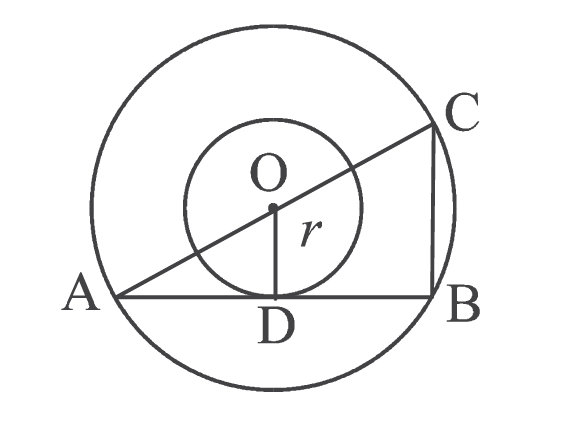
O is midpoint of AC. OD || BC (both perp to AB). By Midpoint theorem, OD = 1/2
BC.
BC = 2r.
Answer: (c)
BC = 2r.
Answer: (c)
1 Mark
Q6. If a parallelogram of side 5 cm
circumscribes
a circle, then its perimeter is :
It must be a rhombus. All sides equal. \(4 \times 5 = 20\).
Answer: (a)
Answer: (a)
1 Mark
Q20. Assertion (A) :
Tangents drawn at the end points of a diameter of a circle are always parallel to each other.
Reason (R) : The lengths of tangents drawn to a circle from a point outside the circle are always equal.
Reason (R) : The lengths of tangents drawn to a circle from a point outside the circle are always equal.
Both true, but R is not correct explanation for A.
Answer: (b)
Answer: (b)
3 Marks
Q29. Rectangle ABCD circumscribes the circle
of
radius 10 cm. Prove that ABCD is a square. Hence, find the perimeter of ABCD.
Given: Rectangle ABCD circumscribes a circle of radius \(r = 10\) cm.
To Prove: ABCD is a square.
Proof: Let ABCD touch the circle at P, Q, R, S.
Since ABCD is a rectangle, \(\angle A = \angle B = \angle C = \angle D = 90^\circ\).
\(OR \perp DC\) and \(OS \perp AD\) (Radius \(\perp\) Tangent).
In quadrilateral ORDS, \(\angle D = 90^\circ, \angle R = 90^\circ, \angle S = 90^\circ\).
Also \(OR = OS = r\) (Radii).
Thus, ORDS is a square. \(\Rightarrow DR = DS = r\).
Similarly, APOS, BQOP, CRQO are squares (or by symmetry tangents from corner of rectangle are equal and form square with radius).
\(AP = AS = r, BP = BQ = r\).
Side \(AB = AP + PB = r + r = 2r\).
Side \(BC = BQ + QC = r + r = 2r\).
Since adjacent sides are equal (\(AB = BC = 20\) cm) in a rectangle, it is a square.
Perimeter: \(4 \times \text{side} = 4 \times 20 = 80\) cm.
To Prove: ABCD is a square.
Proof: Let ABCD touch the circle at P, Q, R, S.
Since ABCD is a rectangle, \(\angle A = \angle B = \angle C = \angle D = 90^\circ\).
\(OR \perp DC\) and \(OS \perp AD\) (Radius \(\perp\) Tangent).
In quadrilateral ORDS, \(\angle D = 90^\circ, \angle R = 90^\circ, \angle S = 90^\circ\).
Also \(OR = OS = r\) (Radii).
Thus, ORDS is a square. \(\Rightarrow DR = DS = r\).
Similarly, APOS, BQOP, CRQO are squares (or by symmetry tangents from corner of rectangle are equal and form square with radius).
\(AP = AS = r, BP = BQ = r\).
Side \(AB = AP + PB = r + r = 2r\).
Side \(BC = BQ + QC = r + r = 2r\).
Since adjacent sides are equal (\(AB = BC = 20\) cm) in a rectangle, it is a square.
Perimeter: \(4 \times \text{side} = 4 \times 20 = 80\) cm.
1 Mark
Q1. Which of the following statements is
false ?
From external point, exactly two tangents can be drawn, not
infinite.
Correct Option: (B)
Correct Option: (B)
1 Mark
Q2. In the adjoining figure, PA and PB are
class="question-image">
tangents to a circle with centre O. The measure of angle APB is :
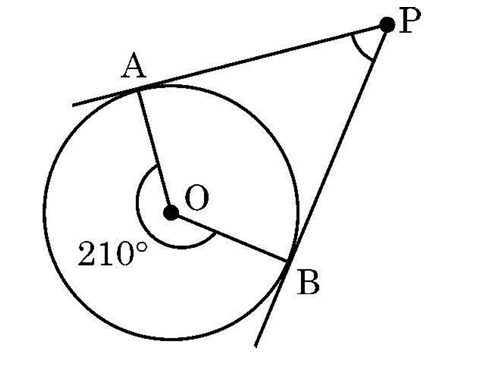
From the figure, reflex \(\angle AOB = 210�\).
So, \(\angle AOB = 360� - 210� = 150�\).
In quadrilateral OAPB:
\(\angle OAP = 90�\) (radius ? tangent).
\(\angle OBP = 90�\) (radius ? tangent).
Sum of angles = 360�.
\(\angle APB = 360� - 90� - 90� - 150� = 30�\).
Answer: (D)
So, \(\angle AOB = 360� - 210� = 150�\).
In quadrilateral OAPB:
\(\angle OAP = 90�\) (radius ? tangent).
\(\angle OBP = 90�\) (radius ? tangent).
Sum of angles = 360�.
\(\angle APB = 360� - 90� - 90� - 150� = 30�\).
Answer: (D)
1 Mark
Q5. In the adjoining figure, the sum of radii
of two concentric circles is 16 cm. The length of chord AB which touches the inner circle at P is 16
cm. The difference of the radii of the given circles is
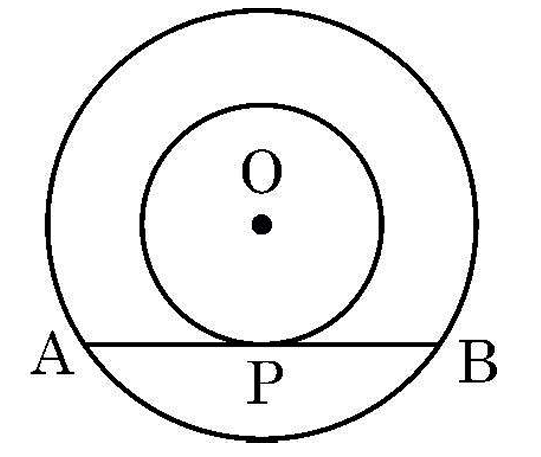
\(AP = 8\), \(R^2 - r^2 = 64\). \((R+r)(R-r) = 64\). \(16(R-r) = 64 \Rightarrow R
- r
= 4\).
Correct Option: (B) 4 cm
Correct Option: (B) 4 cm
3 Marks
Q29. In the adjoining figure, XY and
X\(\prime\)Y\(\prime\) are parallel tangents to a circle with centre O. Another tangent AB touches
the circle at C intersecting XY at A and X\(\prime\)Y\(\prime\) at B. Prove that AB subtends right
angle at the centre of the circle; or \(\angle AOB = 90^\circ\).
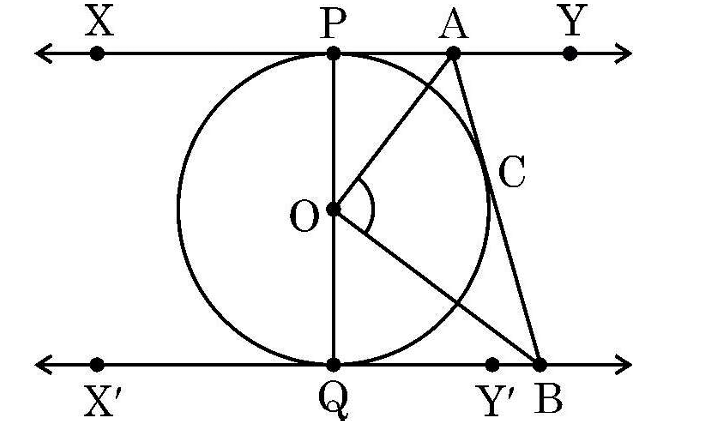
Join OA, OB, OC.
In \(\Delta OPA\) and \(\Delta OCA\):
\(OP = OC\) (Radii), \(OA = OA\) (Common), \(PA = CA\) (Tangents from A).
\(\therefore \Delta OPA \cong \Delta OCA\) (SSS).
\(\Rightarrow \angle POA = \angle COA = x\) (say).
Similarly, \(\Delta OQB \cong \Delta OCB\), so \(\angle QOB = \angle COB = y\) (say).
POQ is a diameter (straight line) because XPY || X'QY' implies contact points P, Q are diametrically opposite.
\(\angle POA + \angle COA + \angle COB + \angle QOB = 180^\circ\).
\(x + x + y + y = 180^\circ\).
\(2(x + y) = 180^\circ \Rightarrow x + y = 90^\circ\).
\(\angle AOB = \angle COA + \angle COB = x + y = 90^\circ\).
Hence Proved.
In \(\Delta OPA\) and \(\Delta OCA\):
\(OP = OC\) (Radii), \(OA = OA\) (Common), \(PA = CA\) (Tangents from A).
\(\therefore \Delta OPA \cong \Delta OCA\) (SSS).
\(\Rightarrow \angle POA = \angle COA = x\) (say).
Similarly, \(\Delta OQB \cong \Delta OCB\), so \(\angle QOB = \angle COB = y\) (say).
POQ is a diameter (straight line) because XPY || X'QY' implies contact points P, Q are diametrically opposite.
\(\angle POA + \angle COA + \angle COB + \angle QOB = 180^\circ\).
\(x + x + y + y = 180^\circ\).
\(2(x + y) = 180^\circ \Rightarrow x + y = 90^\circ\).
\(\angle AOB = \angle COA + \angle COB = x + y = 90^\circ\).
Hence Proved.
1 Mark
Q1. For a circle with centre O and radius 5
cm, which of the following statements is true ?
P : Distance between every pair of parallel tangents is 5 cm.
Q : Distance between every pair of parallel tangents is 10 cm.
R : Distance between every pair of parallel tangents must be between 5 cm and 10 cm.
S : There does not exist a point outside the circle from where length of tangent is 5 cm.
P : Distance between every pair of parallel tangents is 5 cm.
Q : Distance between every pair of parallel tangents is 10 cm.
R : Distance between every pair of parallel tangents must be between 5 cm and 10 cm.
S : There does not exist a point outside the circle from where length of tangent is 5 cm.
Parallel tangents to a circle are always at the ends of a diameter.
Distance between them = Diameter = \(2 \times 5 = 10\) cm.
Correct Option: (B)
Distance between them = Diameter = \(2 \times 5 = 10\) cm.
Correct Option: (B)
1 Mark
Q2. In the adjoining figure, AP and AQ are
tangents to the circle with centre O. If reflex \(\angle POQ = 210�\), the value of \(2x\) is
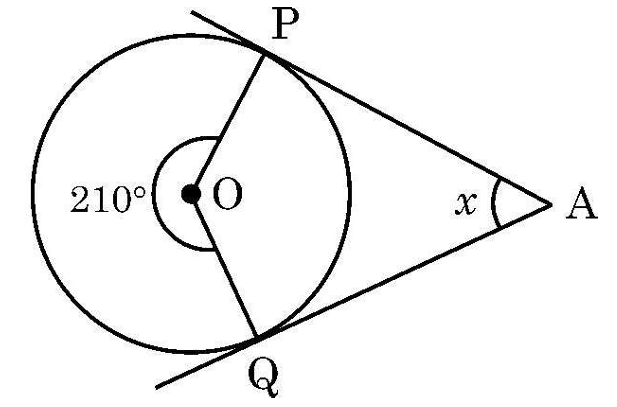
Interior \(\angle POQ = 360� - \text{reflex } \angle POQ = 360� - 210� =
150�\).
In quadrilateral APOQ, angles at P and Q are \(90�\) (Tangents).
\(\angle PAQ + \angle POQ = 180�\).
\(x + 150 = 180 \Rightarrow x = 30�\).
Value of \(2x = 2 \times 30� = 60�\).
Correct Option: (B)
In quadrilateral APOQ, angles at P and Q are \(90�\) (Tangents).
\(\angle PAQ + \angle POQ = 180�\).
\(x + 150 = 180 \Rightarrow x = 30�\).
Value of \(2x = 2 \times 30� = 60�\).
Correct Option: (B)
1 Mark
Q18. In the adjoining figure, PA and PB are
tangents to a circle with centre O such that \(\angle P = 90�\). If \(AB = 3\sqrt{2}\) cm, then the
diameter of the circle is
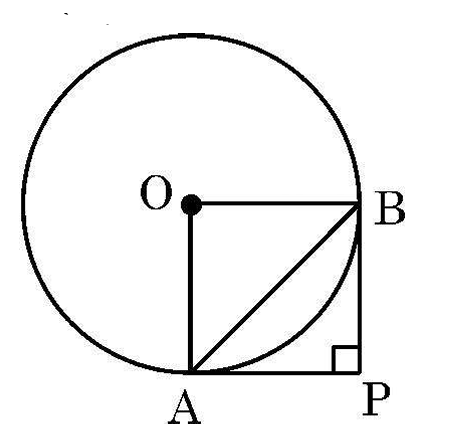
Since \(\angle P = 90�\) and \(\angle A = \angle B = 90�\) (Tangent \(\perp\)
Radius), \(\angle O = 90�\).
Also \(OA = OB\) (Radii). Thus, OAPB is a square.
Side of square = Radius \(r\). Diagonal \(AB = r\sqrt{2}\).
Given \(AB = 3\sqrt{2}\).
\(r\sqrt{2} = 3\sqrt{2} \Rightarrow r = 3\) cm.
Diameter = \(2r = 6\) cm.
Correct Option: (D)
Also \(OA = OB\) (Radii). Thus, OAPB is a square.
Side of square = Radius \(r\). Diagonal \(AB = r\sqrt{2}\).
Given \(AB = 3\sqrt{2}\).
\(r\sqrt{2} = 3\sqrt{2} \Rightarrow r = 3\) cm.
Diameter = \(2r = 6\) cm.
Correct Option: (D)
3 Marks
Q29. In the adjoining figure, TP and TQ are
tangents drawn to a circle with centre O. If \(\angle OPQ = 15�\) and \(\angle PTQ = \theta\), then
find the value of \(\sin 2\theta\).
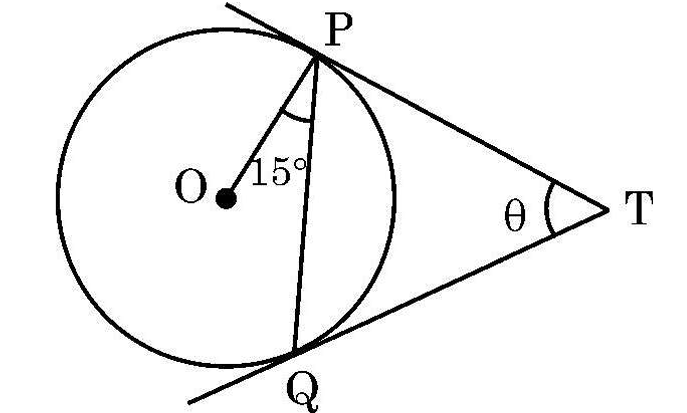
In \(\Delta OPQ\), \(OP = OQ\) (Radii). So \(\angle OQP = \angle OPQ =
15�\).
\(\angle POQ = 180 - (15 + 15) = 150�\).
In quadrilateral TPOQ, angles P and Q are \(90�\).
\(\angle PTQ + \angle POQ = 180�\).
\(\theta + 150 = 180 \Rightarrow \theta = 30�\).
We need \(\sin 2\theta = \sin(2 \times 30�) = \sin 60�\).
\(\sin 60� = \frac{\sqrt{3}}{2}\).
\(\angle POQ = 180 - (15 + 15) = 150�\).
In quadrilateral TPOQ, angles P and Q are \(90�\).
\(\angle PTQ + \angle POQ = 180�\).
\(\theta + 150 = 180 \Rightarrow \theta = 30�\).
We need \(\sin 2\theta = \sin(2 \times 30�) = \sin 60�\).
\(\sin 60� = \frac{\sqrt{3}}{2}\).