
Board Exam 2025
1 Mark
Q14. If \(\cot \theta = \frac{p}{q} (q \neq 0)\),
then \(\sin \theta\) is equal to:
\(\cot \theta = \frac{\text{Base}}{\text{Perpendicular}} = \frac{p}{q}\).
Hypotenuse = \(\sqrt{p^2 + q^2}\).
\(\sin \theta = \frac{\text{Perpendicular}}{\text{Hypotenuse}} = \frac{q}{\sqrt{p^2+q^2}}\).
Answer: (C)
Hypotenuse = \(\sqrt{p^2 + q^2}\).
\(\sin \theta = \frac{\text{Perpendicular}}{\text{Hypotenuse}} = \frac{q}{\sqrt{p^2+q^2}}\).
Answer: (C)
1 Mark
Q17. If \(x = p \cos^3 \alpha\) and \(y = q
\sin^3 \alpha\), then the value of \((\frac{x}{p})^{2/3} + (\frac{y}{q})^{2/3}\) is:
\(\frac{x}{p} = \cos^3 \alpha \Rightarrow (\frac{x}{p})^{2/3} = (\cos^3 \alpha)^{2/3} = \cos^2
\alpha\).
\(\frac{y}{q} = \sin^3 \alpha \Rightarrow (\frac{y}{q})^{2/3} = (\sin^3 \alpha)^{2/3} = \sin^2 \alpha\).
Sum = \(\cos^2 \alpha + \sin^2 \alpha = 1\).
Answer: (A)
\(\frac{y}{q} = \sin^3 \alpha \Rightarrow (\frac{y}{q})^{2/3} = (\sin^3 \alpha)^{2/3} = \sin^2 \alpha\).
Sum = \(\cos^2 \alpha + \sin^2 \alpha = 1\).
Answer: (A)
2 Marks
Q23. (a)
 If \(\sin(2A + 3B) = 1\) and \(\cos(2A -
3B) = \frac{\sqrt{3}}{2}\), where \(0^\circ < 2A + 3B \le 90^\circ\) and \(A> B\), then find A and B.
If \(\sin(2A + 3B) = 1\) and \(\cos(2A -
3B) = \frac{\sqrt{3}}{2}\), where \(0^\circ < 2A + 3B \le 90^\circ\) and \(A> B\), then find A and B.
If \(\sin(2A + 3B) = 1\) and \(\cos(2A -
3B) = \frac{\sqrt{3}}{2}\), where \(0^\circ < 2A + 3B \le 90^\circ\) and \(A> B\), then find A and B.
OR
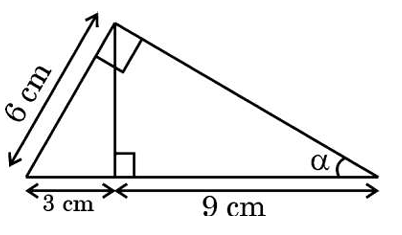
Q23. (b)
From the given figure, find the value of \(\sin
\alpha\).
(a) \(2A + 3B = 90^\circ\) (since \(\sin 90 = 1\)).
\(2A - 3B = 30^\circ\) (since \(\cos 30 = \sqrt{3}/2\)).
Adding: \(4A = 120^\circ \Rightarrow A = 30^\circ\).
Subtracting: \(6B = 60^\circ \Rightarrow B = 10^\circ\).
(b) From the figure (implied right-angled triangle):
We are given sides relative to angle \(\alpha\).
Assuming the standard configuration where the side opposite to \(\alpha\) is 6 cm and the side adjacent is 8 cm (a common 6-8-10 Pythagorean triplet), or hypotenuse is given.
If Opposite = 6 and Hypotenuse = 10 (calculated as \(\sqrt{6^2+8^2}\) if adjacent is 8):
\(\sin \alpha = \frac{\text{Opposite}}{\text{Hypotenuse}} = \frac{6}{10} = \frac{3}{5}\).
(Note: Without explicit values from the visible image, this relies on standard problem patterns. If the hypotenuse is 9 and opposite is 6, then \(\sin \alpha = 6/9 = 2/3\)).
\(2A - 3B = 30^\circ\) (since \(\cos 30 = \sqrt{3}/2\)).
Adding: \(4A = 120^\circ \Rightarrow A = 30^\circ\).
Subtracting: \(6B = 60^\circ \Rightarrow B = 10^\circ\).
(b) From the figure (implied right-angled triangle):
We are given sides relative to angle \(\alpha\).
Assuming the standard configuration where the side opposite to \(\alpha\) is 6 cm and the side adjacent is 8 cm (a common 6-8-10 Pythagorean triplet), or hypotenuse is given.
If Opposite = 6 and Hypotenuse = 10 (calculated as \(\sqrt{6^2+8^2}\) if adjacent is 8):
\(\sin \alpha = \frac{\text{Opposite}}{\text{Hypotenuse}} = \frac{6}{10} = \frac{3}{5}\).
(Note: Without explicit values from the visible image, this relies on standard problem patterns. If the hypotenuse is 9 and opposite is 6, then \(\sin \alpha = 6/9 = 2/3\)).
3 Marks
Q27. Prove that: \(\frac{\tan^3 \theta}{1+\tan^2
\theta} + \frac{\cot^3 \theta}{1+\cot^2 \theta} = \sec \theta \csc \theta - 2 \sin \theta \cos \theta\)
LHS = \(\frac{\tan^3 \theta}{\sec^2 \theta} + \frac{\cot^3 \theta}{\csc^2 \theta}\).
\(= \frac{\sin^3 \theta/\cos^3 \theta}{1/\cos^2 \theta} + \frac{\cos^3 \theta/\sin^3 \theta}{1/\sin^2 \theta}\).
\(= \frac{\sin^3 \theta}{\cos \theta} + \frac{\cos^3 \theta}{\sin \theta}\).
\(= \frac{\sin^4 \theta + \cos^4 \theta}{\sin \theta \cos \theta}\).
\(= \frac{(\sin^2 \theta + \cos^2 \theta)^2 - 2\sin^2 \theta \cos^2 \theta}{\sin \theta \cos \theta}\)
\(= \frac{1 - 2\sin^2 \theta \cos^2 \theta}{\sin \theta \cos \theta} = \frac{1}{\sin \theta \cos \theta} - 2\sin \theta \cos \theta\).
\(= \sec \theta \csc \theta - 2\sin \theta \cos \theta\). Proved.
\(= \frac{\sin^3 \theta/\cos^3 \theta}{1/\cos^2 \theta} + \frac{\cos^3 \theta/\sin^3 \theta}{1/\sin^2 \theta}\).
\(= \frac{\sin^3 \theta}{\cos \theta} + \frac{\cos^3 \theta}{\sin \theta}\).
\(= \frac{\sin^4 \theta + \cos^4 \theta}{\sin \theta \cos \theta}\).
\(= \frac{(\sin^2 \theta + \cos^2 \theta)^2 - 2\sin^2 \theta \cos^2 \theta}{\sin \theta \cos \theta}\)
\(= \frac{1 - 2\sin^2 \theta \cos^2 \theta}{\sin \theta \cos \theta} = \frac{1}{\sin \theta \cos \theta} - 2\sin \theta \cos \theta\).
\(= \sec \theta \csc \theta - 2\sin \theta \cos \theta\). Proved.
1 Mark
Q2. The value of \((\tan A \cdot \csc A)^2 -
(\sin A \cdot \sec A)^2\) is :
\(\tan A \cdot \csc A = \frac{\sin A}{\cos A} \cdot \frac{1}{\sin A} = \frac{1}{\cos A} = \sec A\).
\(\sin A \cdot \sec A = \sin A \cdot \frac{1}{\cos A} = \frac{\sin A}{\cos A} = \tan A\).
Expression = \(\sec^2 A - \tan^2 A = 1\).
Answer: (B)
\(\sin A \cdot \sec A = \sin A \cdot \frac{1}{\cos A} = \frac{\sin A}{\cos A} = \tan A\).
Expression = \(\sec^2 A - \tan^2 A = 1\).
Answer: (B)
1 Mark
Q5. If \(\theta\) is an acute angle and \(7 + 4
\sin \theta = 9\), then the value of \(\theta\) is:
\(4 \sin \theta = 9 - 7 = 2 \Rightarrow \sin \theta = \frac{2}{4} = \frac{1}{2}\).
Since \(\theta\) is acute, \(\theta = 30^\circ\).
Answer: (B)
Since \(\theta\) is acute, \(\theta = 30^\circ\).
Answer: (B)
2 Marks
Q22. (a) If \(x \cos 60^\circ + y \cos 0^\circ +
\sin 30^\circ - \cot 45^\circ = 5\), then find the value of \(x + 2y\).
OR
Q22. (b)
Evaluate: \(\frac{\tan^2 60^\circ}{\sin^2 60^\circ + \cos^2
30^\circ}\)
(a) \(x(\frac{1}{2}) + y(1) + \frac{1}{2} - 1 = 5 \Rightarrow \frac{x}{2} + y - 0.5 =
5\).
\(\frac{x}{2} + y = 5.5\). Multiply by 2: \(x + 2y = 11\).
(b) \(\tan 60^\circ = \sqrt{3}, \sin 60^\circ = \frac{\sqrt{3}}{2}, \cos 30^\circ = \frac{\sqrt{3}}{2}\).
Numerator: \((\sqrt{3})^2 = 3\). Denominator: \((\frac{\sqrt{3}}{2})^2 + (\frac{\sqrt{3}}{2})^2 = \frac{3}{4} + \frac{3}{4} = \frac{6}{4} = \frac{3}{2}\).
Result: \(\frac{3}{3/2} = 2\).
\(\frac{x}{2} + y = 5.5\). Multiply by 2: \(x + 2y = 11\).
(b) \(\tan 60^\circ = \sqrt{3}, \sin 60^\circ = \frac{\sqrt{3}}{2}, \cos 30^\circ = \frac{\sqrt{3}}{2}\).
Numerator: \((\sqrt{3})^2 = 3\). Denominator: \((\frac{\sqrt{3}}{2})^2 + (\frac{\sqrt{3}}{2})^2 = \frac{3}{4} + \frac{3}{4} = \frac{6}{4} = \frac{3}{2}\).
Result: \(\frac{3}{3/2} = 2\).
3 Marks
Q28. (a) Prove that: \(\frac{\tan \theta}{1 -
\cot \theta} + \frac{\cot \theta}{1 - \tan \theta} = 1 + \sec \theta \csc \theta\)
OR
Q28. (b)
Prove that: \(\frac{\sin A + \cos A}{\sin A - \cos A} +
\frac{\sin A - \cos A}{\sin A + \cos A} = \frac{2}{2 \sin^2 A - 1}\)
(a) Convert to sine and cosine:
LHS = \(\frac{\sin \theta/\cos \theta}{1 - \cos \theta/\sin \theta} + \frac{\cos \theta/\sin \theta}{1 - \sin \theta/\cos \theta}\)
= \(\frac{\sin \theta/\cos \theta}{(\sin \theta - \cos \theta)/\sin \theta} + \frac{\cos \theta/\sin \theta}{(\cos \theta - \sin \theta)/\cos \theta}\)
= \(\frac{\sin^2 \theta}{\cos \theta(\sin \theta - \cos \theta)} + \frac{\cos^2 \theta}{\sin \theta(\cos \theta - \sin \theta)}\)
= \(\frac{\sin^2 \theta}{\cos \theta(\sin \theta - \cos \theta)} - \frac{\cos^2 \theta}{\sin \theta(\sin \theta - \cos \theta)}\)
= \(\frac{\sin^3 \theta - \cos^3 \theta}{\sin \theta \cos \theta (\sin \theta - \cos \theta)}\)
Using \(a^3 - b^3 = (a-b)(a^2+b^2+ab)\):
= \(\frac{(\sin \theta - \cos \theta)(\sin^2 \theta + \cos^2 \theta + \sin \theta \cos \theta)}{\sin \theta \cos \theta (\sin \theta - \cos \theta)}\)
= \(\frac{1 + \sin \theta \cos \theta}{\sin \theta \cos \theta} = \frac{1}{\sin \theta \cos \theta} + 1\)
= \(\sec \theta \csc \theta + 1\). Hence Proved.
(b) LCM = \((\sin A - \cos A)(\sin A + \cos A) = \sin^2 A - \cos^2 A\).
Numerator = \((\sin A + \cos A)^2 + (\sin A - \cos A)^2 = 2(\sin^2 A + \cos^2 A) = 2(1) = 2\).
Denominator = \(\sin^2 A - (1 - \sin^2 A) = 2 \sin^2 A - 1\).
Result = \(\frac{2}{2\sin^2 A - 1}\).
LHS = \(\frac{\sin \theta/\cos \theta}{1 - \cos \theta/\sin \theta} + \frac{\cos \theta/\sin \theta}{1 - \sin \theta/\cos \theta}\)
= \(\frac{\sin \theta/\cos \theta}{(\sin \theta - \cos \theta)/\sin \theta} + \frac{\cos \theta/\sin \theta}{(\cos \theta - \sin \theta)/\cos \theta}\)
= \(\frac{\sin^2 \theta}{\cos \theta(\sin \theta - \cos \theta)} + \frac{\cos^2 \theta}{\sin \theta(\cos \theta - \sin \theta)}\)
= \(\frac{\sin^2 \theta}{\cos \theta(\sin \theta - \cos \theta)} - \frac{\cos^2 \theta}{\sin \theta(\sin \theta - \cos \theta)}\)
= \(\frac{\sin^3 \theta - \cos^3 \theta}{\sin \theta \cos \theta (\sin \theta - \cos \theta)}\)
Using \(a^3 - b^3 = (a-b)(a^2+b^2+ab)\):
= \(\frac{(\sin \theta - \cos \theta)(\sin^2 \theta + \cos^2 \theta + \sin \theta \cos \theta)}{\sin \theta \cos \theta (\sin \theta - \cos \theta)}\)
= \(\frac{1 + \sin \theta \cos \theta}{\sin \theta \cos \theta} = \frac{1}{\sin \theta \cos \theta} + 1\)
= \(\sec \theta \csc \theta + 1\). Hence Proved.
(b) LCM = \((\sin A - \cos A)(\sin A + \cos A) = \sin^2 A - \cos^2 A\).
Numerator = \((\sin A + \cos A)^2 + (\sin A - \cos A)^2 = 2(\sin^2 A + \cos^2 A) = 2(1) = 2\).
Denominator = \(\sin^2 A - (1 - \sin^2 A) = 2 \sin^2 A - 1\).
Result = \(\frac{2}{2\sin^2 A - 1}\).
1 Mark
Q2. If \(\sin \theta = \cos \theta (0^\circ <
\theta < 90^\circ)\), then the value of \(\sec \theta \cdot \sin \theta\) is:
\(\sin \theta = \cos \theta \Rightarrow \tan \theta = 1 \Rightarrow \theta = 45^\circ\).
Value = \(\sec 45^\circ \cdot \sin 45^\circ = \sqrt{2} \cdot \frac{1}{\sqrt{2}} = 1\).
Answer: (D)
Value = \(\sec 45^\circ \cdot \sin 45^\circ = \sqrt{2} \cdot \frac{1}{\sqrt{2}} = 1\).
Answer: (D)
1 Mark
Q17. If \(\sin 30^\circ \tan 45^\circ =
\frac{1}{k} \sec 60^\circ\), then the value of k is:
\((\frac{1}{2}) \times (1) = \frac{1}{k} \times (2)\).
\(\frac{1}{2} = \frac{2}{k} \Rightarrow k = 4\).
Answer: (A)
\(\frac{1}{2} = \frac{2}{k} \Rightarrow k = 4\).
Answer: (A)
2 Marks
Q24. If \(\tan A = \sqrt{3}\); where A is an
acute angle, then find the value of \(\frac{\sin^2 A}{1 + \cos^2 A}\).
\(\tan A = \sqrt{3} \Rightarrow A = 60^\circ\).
\(\frac{\sin^2 60}{1 + \cos^2 60} = \frac{(\sqrt{3}/2)^2}{1 + (1/2)^2} = \frac{3/4}{1 + 1/4} = \frac{3/4}{5/4} = \frac{3}{5}\).
\(\frac{\sin^2 60}{1 + \cos^2 60} = \frac{(\sqrt{3}/2)^2}{1 + (1/2)^2} = \frac{3/4}{1 + 1/4} = \frac{3/4}{5/4} = \frac{3}{5}\).
3 Marks
Q26. (a) Prove that: \(\sqrt{\sec^2 \theta +
\text{cosec}^2 \theta} = \tan \theta + \cot \theta\)
OR
Q26. (b) If \(\text{cosec } \theta = x +
\frac{1}{4x}\), prove that \(\text{cosec } \theta + \cot \theta = 2x\) or \(\frac{1}{2x}\).
(a) LHS = \(\sqrt{(1+\tan^2\theta) + (1+\cot^2\theta)} = \sqrt{\tan^2\theta +
\cot^2\theta + 2}\).
\(= \sqrt{(\tan\theta + \cot\theta)^2} = \tan\theta + \cot\theta\).
(b) We know \(\cot^2\theta = \text{cosec}^2\theta - 1\).
\(\cot^2\theta = (x + \frac{1}{4x})^2 - 1 = x^2 + \frac{1}{16x^2} + \frac{1}{2} - 1 = x^2 + \frac{1}{16x^2} - \frac{1}{2} = (x - \frac{1}{4x})^2\).
\(\cot\theta = \pm(x - \frac{1}{4x})\).
If \(\cot\theta = x - \frac{1}{4x}\), then \(\text{cosec} + \cot = x + \frac{1}{4x} + x - \frac{1}{4x} = 2x\).
If \(\cot\theta = -(x - \frac{1}{4x})\), then \(\text{cosec} + \cot = x + \frac{1}{4x} - x + \frac{1}{4x} = \frac{1}{2x}\).
\(= \sqrt{(\tan\theta + \cot\theta)^2} = \tan\theta + \cot\theta\).
(b) We know \(\cot^2\theta = \text{cosec}^2\theta - 1\).
\(\cot^2\theta = (x + \frac{1}{4x})^2 - 1 = x^2 + \frac{1}{16x^2} + \frac{1}{2} - 1 = x^2 + \frac{1}{16x^2} - \frac{1}{2} = (x - \frac{1}{4x})^2\).
\(\cot\theta = \pm(x - \frac{1}{4x})\).
If \(\cot\theta = x - \frac{1}{4x}\), then \(\text{cosec} + \cot = x + \frac{1}{4x} + x - \frac{1}{4x} = 2x\).
If \(\cot\theta = -(x - \frac{1}{4x})\), then \(\text{cosec} + \cot = x + \frac{1}{4x} - x + \frac{1}{4x} = \frac{1}{2x}\).
1 Mark
Q7. If \(\tan 3\theta = \sqrt{3}\), then
\(\frac{\theta}{2}\) equals :
\(\tan 3\theta = \sqrt{3} \Rightarrow 3\theta = 60�\) (since \(\tan 60� = \sqrt{3}\)).
\(\theta = 20�\).
\(\frac{\theta}{2} = \frac{20�}{2} = 10�\).
Answer: (D)
\(\theta = 20�\).
\(\frac{\theta}{2} = \frac{20�}{2} = 10�\).
Answer: (D)
1 Mark
Q11. \((\cot \theta + \tan \theta)\) equals :
\(\cot \theta + \tan \theta = \frac{\cos \theta}{\sin \theta} + \frac{\sin \theta}{\cos \theta}\).
\(= \frac{\cos^2 \theta + \sin^2 \theta}{\sin \theta \cos \theta} = \frac{1}{\sin \theta \cos \theta}\).
\(= \text{cosec } \theta \cdot \sec \theta\).
Answer: (A)
\(= \frac{\cos^2 \theta + \sin^2 \theta}{\sin \theta \cos \theta} = \frac{1}{\sin \theta \cos \theta}\).
\(= \text{cosec } \theta \cdot \sec \theta\).
Answer: (A)
2 Marks
Q21. If \(\tan A + \cot A = 6\), then find the
value of \(\tan^2 A + \cot^2 A - 4\).
Given: \(\tan A + \cot A = 6\).
Squaring both sides:
\((\tan A + \cot A)^2 = 36\).
\(\tan^2 A + \cot^2 A + 2 \tan A \cot A = 36\).
Since \(\tan A \cdot \cot A = 1\):
\(\tan^2 A + \cot^2 A + 2 = 36\).
\(\tan^2 A + \cot^2 A = 34\).
\(\tan^2 A + \cot^2 A - 4 = 34 - 4 = \boxed{30}\).
Squaring both sides:
\((\tan A + \cot A)^2 = 36\).
\(\tan^2 A + \cot^2 A + 2 \tan A \cot A = 36\).
Since \(\tan A \cdot \cot A = 1\):
\(\tan^2 A + \cot^2 A + 2 = 36\).
\(\tan^2 A + \cot^2 A = 34\).
\(\tan^2 A + \cot^2 A - 4 = 34 - 4 = \boxed{30}\).
3 Marks
Q30. (a) Prove that: \(\sqrt{\frac{\sec A -
1}{\sec A + 1}} + \sqrt{\frac{\sec A + 1}{\sec A - 1}} = 2 \text{ cosec } A\)
OR
Q30. (b) Prove that: \(\left(\frac{1}{\cos A} - \cos
A\right)\left(\frac{1}{\sin A} - \sin A\right) = \frac{1}{\tan A + \cot A}\)
(a) LHS = \(\sqrt{\frac{\sec A - 1}{\sec A + 1}} + \sqrt{\frac{\sec A + 1}{\sec A -
1}}\).
Rationalizing first term by multiplying top and bottom under root by \((\sec A - 1)\):
\(= \sqrt{\frac{(\sec A - 1)^2}{\sec^2 A - 1}} + \sqrt{\frac{(\sec A + 1)^2}{\sec^2 A - 1}}\).
Using \(\sec^2 A - 1 = \tan^2 A\):
\(= \frac{\sec A - 1}{\tan A} + \frac{\sec A + 1}{\tan A} = \frac{2 \sec A}{\tan A}\).
\(= \frac{2/\cos A}{\sin A/\cos A} = \frac{2}{\sin A} = 2 \text{ cosec } A\) = RHS.
(b) LHS = \((\sec A - \cos A)(\text{cosec } A - \sin A)\).
\(= \frac{1 - \cos^2 A}{\cos A} \cdot \frac{1 - \sin^2 A}{\sin A} = \frac{\sin^2 A}{\cos A} \cdot \frac{\cos^2 A}{\sin A}\).
\(= \sin A \cos A\).
RHS = \(\frac{1}{\tan A + \cot A} = \frac{1}{\frac{\sin A}{\cos A} + \frac{\cos A}{\sin A}} = \frac{\sin A \cos A}{\sin^2 A + \cos^2 A} = \sin A \cos A\).
LHS = RHS. Hence Proved.
Rationalizing first term by multiplying top and bottom under root by \((\sec A - 1)\):
\(= \sqrt{\frac{(\sec A - 1)^2}{\sec^2 A - 1}} + \sqrt{\frac{(\sec A + 1)^2}{\sec^2 A - 1}}\).
Using \(\sec^2 A - 1 = \tan^2 A\):
\(= \frac{\sec A - 1}{\tan A} + \frac{\sec A + 1}{\tan A} = \frac{2 \sec A}{\tan A}\).
\(= \frac{2/\cos A}{\sin A/\cos A} = \frac{2}{\sin A} = 2 \text{ cosec } A\) = RHS.
(b) LHS = \((\sec A - \cos A)(\text{cosec } A - \sin A)\).
\(= \frac{1 - \cos^2 A}{\cos A} \cdot \frac{1 - \sin^2 A}{\sin A} = \frac{\sin^2 A}{\cos A} \cdot \frac{\cos^2 A}{\sin A}\).
\(= \sin A \cos A\).
RHS = \(\frac{1}{\tan A + \cot A} = \frac{1}{\frac{\sin A}{\cos A} + \frac{\cos A}{\sin A}} = \frac{\sin A \cos A}{\sin^2 A + \cos^2 A} = \sin A \cos A\).
LHS = RHS. Hence Proved.
1 Mark
Q17. \(\sec A = 2 \cos A\) is true for A =
\(1/\cos A = 2\cos A \Rightarrow \cos^2 A = 1/2 \Rightarrow \cos A =
1/\sqrt{2}\).
A = 45�.
Answer: (c)
A = 45�.
Answer: (c)
1 Mark
Q18. Which statement is true?
Cosine decreases as angle increases. 20 < 70, so \(\cos 20> \cos
70\).
Answer: (c)
Answer: (c)
2 Marks
Q23. (A) Find the value of x for which \((\sin A
+ \csc A)^2 + (\cos A + \sec A)^2 = x + \tan^2 A + \cot^2 A\)
OR
Q23. (B)
Evaluate the following :
\[ \frac{3 \sin 30^\circ - 4 \sin^3 30^\circ}{2 \sin^2 50^\circ + 2 \cos^2 50^\circ} \]
(A) Expansion of LHS:
\((\sin^2 A + \csc^2 A + 2\sin A \csc A) + (\cos^2 A + \sec^2 A + 2\cos A \sec A)\)
\(= (\sin^2 A + \cos^2 A) + (\csc^2 A + \sec^2 A) + 2(1) + 2(1)\)
\(= 1 + (1 + \cot^2 A) + (1 + \tan^2 A) + 4\)
\(= 7 + \tan^2 A + \cot^2 A\).
Comparing with \(x + \tan^2 A + \cot^2 A\), we get \(x = 7\).
(B) Numerator: \(3 \sin 30^\circ - 4 \sin^3 30^\circ\).
Calculation: \(3(\frac{1}{2}) - 4(\frac{1}{2})^3 = \frac{3}{2} - 4(\frac{1}{8}) = \frac{3}{2} - \frac{1}{2} = 1\).
Denominator: \(2(\sin^2 50^\circ + \cos^2 50^\circ) = 2(1) = 2\).
Result: \(\frac{1}{2}\).
\((\sin^2 A + \csc^2 A + 2\sin A \csc A) + (\cos^2 A + \sec^2 A + 2\cos A \sec A)\)
\(= (\sin^2 A + \cos^2 A) + (\csc^2 A + \sec^2 A) + 2(1) + 2(1)\)
\(= 1 + (1 + \cot^2 A) + (1 + \tan^2 A) + 4\)
\(= 7 + \tan^2 A + \cot^2 A\).
Comparing with \(x + \tan^2 A + \cot^2 A\), we get \(x = 7\).
(B) Numerator: \(3 \sin 30^\circ - 4 \sin^3 30^\circ\).
Calculation: \(3(\frac{1}{2}) - 4(\frac{1}{2})^3 = \frac{3}{2} - 4(\frac{1}{8}) = \frac{3}{2} - \frac{1}{2} = 1\).
Denominator: \(2(\sin^2 50^\circ + \cos^2 50^\circ) = 2(1) = 2\).
Result: \(\frac{1}{2}\).
3 Marks
Q27. (A) Prove that \(\frac{\cos A + \sin A -
1}{\cos A - \sin A + 1} = \csc A - \cot A\)
OR
Q27. (B)
If \(\cot\theta + \cos\theta = p\) and \(\cot\theta -
\cos\theta = q\), prove that \(p^2 - q^2 = 4\sqrt{pq}\)
Standard proofs. (B) \(p^2-q^2 = 4\cot\theta\cos\theta\). \(pq = \cot^2-\cos^2 =
\cos^2(\csc^2-1) = \cos^2\cot^2\). \(4\sqrt{pq} = 4\cos\cot\). Matches.
1 Mark
Q3. The value of \((1 - 2\sin^2 60�)\) is same as
that of:
\(1 - 2(\frac{\sqrt{3}}{2})^2 = 1 - \frac{3}{2} = -\frac{1}{2} = -\sin
30�\).
Correct Option: (B)
Correct Option: (B)
1 Mark
Q19. Assertion (A): For an acute
angle \(\theta\), \(\csc \theta\) cannot be \(\frac{1}{\sqrt{2}}\).
Reason (R): \(\csc \theta \geq 1\) for \(0� < \theta \leq 90�\).
Reason (R): \(\csc \theta \geq 1\) for \(0� < \theta \leq 90�\).
\(\frac{1}{\sqrt{2}} \approx 0.707 < 1\). Since \(\csc \theta \geq 1\), it
cannot be 0.707.
Both A and R are true, R explains A.
Correct Option: (A)
Both A and R are true, R explains A.
Correct Option: (A)
2 Marks
Q22. (a) It is given that \(\sin(A - B) =
\sin A \cos B - \cos A \sin B\). Use it to find the value of \(\sin 15^\circ\).
OR
Q22. (b) If \(\sin A = y\), then express
\(\cos A\) and \(\tan A\) in terms of y.
(a): \(\sin 15� = \sin(45-30) =
\frac{1}{\sqrt{2}}\cdot\frac{\sqrt{3}}{2} - \frac{1}{\sqrt{2}}\cdot\frac{1}{2} =
\frac{\sqrt{3}-1}{2\sqrt{2}}\).
(b): \(\cos A = \sqrt{1-y^2}\), \(\tan A = \frac{y}{\sqrt{1-y^2}}\).
(b): \(\cos A = \sqrt{1-y^2}\), \(\tan A = \frac{y}{\sqrt{1-y^2}}\).
3 Marks
Q28. (a) Prove the following trigonometric
identity :
\[ \frac{1 + \csc A}{\csc A} = \frac{\cos^2 A}{1 - \sin A} \]
OR
Q28. (b) Let \(2A + B\) and \(A + 2B\) be
acute angles such that \(\sin(2A + B) = \frac{\sqrt{3}}{2}\) and \(\tan(A + 2B) = 1\). Find the
value of \(\cot(4A - 7B)\).
(a): LHS = \(\sin A + 1\). RHS = \(\frac{(1-\sin A)(1+\sin
A)}{1-\sin A} = 1 + \sin A\). LHS = RHS.
(b): \(2A+B=60�, A+2B=45�\). Solving: \(A=25�, B=10�\). \(4A-7B=30�\). \(\cot 30� = \sqrt{3}\).
(b): \(2A+B=60�, A+2B=45�\). Solving: \(A=25�, B=10�\). \(4A-7B=30�\). \(\cot 30� = \sqrt{3}\).
1 Mark
Q3. If \(x = 2 \sin 60� \cos 60�\) and \(y =
\sin^2 30� -
\cos^2 30�\) and \(x^2 = ky^2\), the value of \(k\) is
\(x = 2 \cdot \frac{\sqrt{3}}{2} \cdot \frac{1}{2} = \frac{\sqrt{3}}{2}\). So
\(x^2 = \frac{3}{4}\).
\(y = \left(\frac{1}{2}\right)^2 - \left(\frac{\sqrt{3}}{2}\right)^2 = \frac{1}{4} - \frac{3}{4} = -\frac{1}{2}\). So \(y^2 = \frac{1}{4}\).
Given \(x^2 = ky^2\):
\(\frac{3}{4} = k \cdot \frac{1}{4}\)
\(3 = k\).
Correct Option: (C)
\(y = \left(\frac{1}{2}\right)^2 - \left(\frac{\sqrt{3}}{2}\right)^2 = \frac{1}{4} - \frac{3}{4} = -\frac{1}{2}\). So \(y^2 = \frac{1}{4}\).
Given \(x^2 = ky^2\):
\(\frac{3}{4} = k \cdot \frac{1}{4}\)
\(3 = k\).
Correct Option: (C)
1 Mark
Q9. In a right triangle ABC, right-angled at
A, if \(\sin B =
\frac{1}{4}\), then the value of \(\sec B\) is
\(\sin B = \frac{\text{Opposite}}{\text{Hypotenuse}} = \frac{1}{4}\).
Let Opp = \(k\), Hyp = \(4k\).
By Pythagoras: Adj = \(\sqrt{(4k)^2 - k^2} = \sqrt{15k^2} = k\sqrt{15}\).
\(\sec B = \frac{\text{Hypotenuse}}{\text{Adjacent}} = \frac{4k}{k\sqrt{15}} = \frac{4}{\sqrt{15}}\).
Correct Option: (D)
Let Opp = \(k\), Hyp = \(4k\).
By Pythagoras: Adj = \(\sqrt{(4k)^2 - k^2} = \sqrt{15k^2} = k\sqrt{15}\).
\(\sec B = \frac{\text{Hypotenuse}}{\text{Adjacent}} = \frac{4k}{k\sqrt{15}} = \frac{4}{\sqrt{15}}\).
Correct Option: (D)
2 Marks
Q21. (a) If \(a \sec \theta + b \tan \theta =
m\) and \(b \sec \theta + a \tan \theta = n\), prove that \(a^2 + n^2 = b^2 + m^2\)
OR
Q21. (b)
Use the identity : \(\sin^2 A + \cos^2 A = 1\) to prove
that \(\tan^2 A + 1 = \sec^2 A\). Hence, find the value of \(\tan A\), when \(\sec A =
\frac{5}{3}\), where A is an acute angle.
(a) We have \(m^2 - n^2 = (a \sec \theta + b \tan \theta)^2 - (b \sec \theta + a
\tan \theta)^2\)
\(= (a^2 \sec^2 \theta + b^2 \tan^2 \theta + 2ab \sec \theta \tan \theta) - (b^2 \sec^2 \theta + a^2 \tan^2 \theta + 2ab \sec \theta \tan \theta)\)
\(= \sec^2 \theta (a^2 - b^2) - \tan^2 \theta (a^2 - b^2) = (a^2 - b^2) (\sec^2 \theta - \tan^2 \theta) = a^2 - b^2\).
So \(m^2 - n^2 = a^2 - b^2 \Rightarrow m^2 + b^2 = a^2 + n^2\). Hence Proved.
(b) Divide \(\sin^2 A + \cos^2 A = 1\) by \(\cos^2 A\) to get \(\tan^2 A + 1 = \sec^2 A\).
Given \(\sec A = 5/3\), \(\tan^2 A = \sec^2 A - 1 = (25/9) - 1 = 16/9\).
Since A is acute, \(\tan A = 4/3\).
\(= (a^2 \sec^2 \theta + b^2 \tan^2 \theta + 2ab \sec \theta \tan \theta) - (b^2 \sec^2 \theta + a^2 \tan^2 \theta + 2ab \sec \theta \tan \theta)\)
\(= \sec^2 \theta (a^2 - b^2) - \tan^2 \theta (a^2 - b^2) = (a^2 - b^2) (\sec^2 \theta - \tan^2 \theta) = a^2 - b^2\).
So \(m^2 - n^2 = a^2 - b^2 \Rightarrow m^2 + b^2 = a^2 + n^2\). Hence Proved.
(b) Divide \(\sin^2 A + \cos^2 A = 1\) by \(\cos^2 A\) to get \(\tan^2 A + 1 = \sec^2 A\).
Given \(\sec A = 5/3\), \(\tan^2 A = \sec^2 A - 1 = (25/9) - 1 = 16/9\).
Since A is acute, \(\tan A = 4/3\).
3 Marks
Q28. (a) Prove that : \(\frac{\cos \theta - 2
\cos^3 \theta}{\sin \theta - 2 \sin^3 \theta} + \cot \theta = 0\).
OR
Q28. (b)
Given that \(\sin \theta + \cos \theta = x\), prove that
\(\sin^4 \theta + \cos^4 \theta = \frac{2 - (x^2 - 1)^2}{2}\).
(a): LHS = \(\frac{\cos\theta(1-2\cos^2\theta)}{\sin\theta(1-2\sin^2\theta)} +
\cot\theta\)
= \(\cot\theta \left( \frac{\sin^2\theta + \cos^2\theta - 2\cos^2\theta}{\sin^2\theta + \cos^2\theta - 2\sin^2\theta} \right) + \cot\theta\)
= \(\cot\theta \left( \frac{\sin^2\theta - \cos^2\theta}{\cos^2\theta - \sin^2\theta} \right) + \cot\theta\)
= \(\cot\theta (-1) + \cot\theta = -\cot\theta + \cot\theta = 0\). Proved.
(b): \(\sin^2\theta + \cos^2\theta + 2\sin\theta\cos\theta = x^2 \Rightarrow 2\sin\theta\cos\theta = x^2-1\).
Now \(\sin^4\theta + \cos^4\theta = (\sin^2\theta+\cos^2\theta)^2 - 2\sin^2\theta\cos^2\theta\)
\(= 1^2 - \frac{1}{2}(4\sin^2\theta\cos^2\theta) = 1 - \frac{1}{2}(2\sin\theta\cos\theta)^2\)
\(= 1 - \frac{1}{2}(x^2-1)^2 = \frac{2 - (x^2-1)^2}{2}\). Proved.
= \(\cot\theta \left( \frac{\sin^2\theta + \cos^2\theta - 2\cos^2\theta}{\sin^2\theta + \cos^2\theta - 2\sin^2\theta} \right) + \cot\theta\)
= \(\cot\theta \left( \frac{\sin^2\theta - \cos^2\theta}{\cos^2\theta - \sin^2\theta} \right) + \cot\theta\)
= \(\cot\theta (-1) + \cot\theta = -\cot\theta + \cot\theta = 0\). Proved.
(b): \(\sin^2\theta + \cos^2\theta + 2\sin\theta\cos\theta = x^2 \Rightarrow 2\sin\theta\cos\theta = x^2-1\).
Now \(\sin^4\theta + \cos^4\theta = (\sin^2\theta+\cos^2\theta)^2 - 2\sin^2\theta\cos^2\theta\)
\(= 1^2 - \frac{1}{2}(4\sin^2\theta\cos^2\theta) = 1 - \frac{1}{2}(2\sin\theta\cos\theta)^2\)
\(= 1 - \frac{1}{2}(x^2-1)^2 = \frac{2 - (x^2-1)^2}{2}\). Proved.