
Board Exam 2025
1 Mark
Q4. \(A(-4, 5)\) and \(C(8, 2)\) are the two
opposite vertices of a parallelogram ABCD. Its diagonals intersect each other at \(P(a, b)\). The
relation between 'a' and 'b' is:
P is the midpoint of AC.
\(a = \frac{-4+8}{2} = 2\).
\(b = \frac{5+2}{2} = 3.5\).
Check options with \(a = 2, b = 3.5\).
(A) \(3.5 = 2 - 1.5\) (False)
(B) \(3.5 = 2 + 1.5\) (True)
Answer: (B)
\(a = \frac{-4+8}{2} = 2\).
\(b = \frac{5+2}{2} = 3.5\).
Check options with \(a = 2, b = 3.5\).
(A) \(3.5 = 2 - 1.5\) (False)
(B) \(3.5 = 2 + 1.5\) (True)
Answer: (B)
1 Mark
Q8. A circle with centre \(P(4, 5)\) passes
through the point \(A(0, 9)\). The length of the diagonal of the largest square inside this circle is :
Radius \(r = PA\) \( = \sqrt{(4-0)^2 + (5-9)^2} \) \( = \sqrt{16 + 16} \) \( = \sqrt{32} \) \( =
4\sqrt{2} \).
The diagonal of the largest square inscribed in a circle is the diameter.
Diagonal \(d = 2r = 2(4\sqrt{2}) = 8\sqrt{2}\).
Answer: (B)
The diagonal of the largest square inscribed in a circle is the diameter.
Diagonal \(d = 2r = 2(4\sqrt{2}) = 8\sqrt{2}\).
Answer: (B)
4 Marks
Q37. Case Study - 2
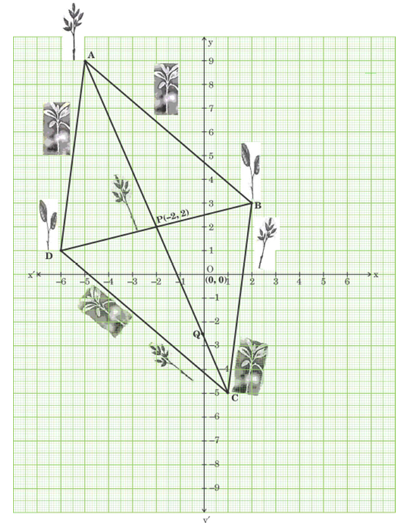
Trees act the natural filters. By planting trees in and around school premises, we create cleaner and healthier air for students and local residents, reducing respiratory problems. A school in Noida has proposed and organised a community drive on tree plantation under the title �Save Earth, Plant Trees�. Students of that school have planted saplings in the field such that it formed a quadrilateral as shown in the figure ABCD. Based on the information given above, answer the following questions :
(i) Find the distance between the two saplings at A and D. [1 Mark]
(ii) (a) One student plants one sapling at the mid-point of AD. Then he moves along a straight line parallel to DB and sows another sapling on AB. What are the coordinates of the positions of these two new saplings? [2 Marks]
(iii) The line segments AC and BD bisect each other at P(-2, 2). Find the coordinates of C. [1 Mark]
Trees act the natural filters. By planting trees in and around school premises, we create cleaner and healthier air for students and local residents, reducing respiratory problems. A school in Noida has proposed and organised a community drive on tree plantation under the title �Save Earth, Plant Trees�. Students of that school have planted saplings in the field such that it formed a quadrilateral as shown in the figure ABCD. Based on the information given above, answer the following questions :
(i) Find the distance between the two saplings at A and D. [1 Mark]
(ii) (a) One student plants one sapling at the mid-point of AD. Then he moves along a straight line parallel to DB and sows another sapling on AB. What are the coordinates of the positions of these two new saplings? [2 Marks]
OR
(ii) (b) A new sapling is kept at a point M on DB such that DM : MB = 3 : 1. Find the coordinates of M.
[2 Marks](iii) The line segments AC and BD bisect each other at P(-2, 2). Find the coordinates of C. [1 Mark]
Coordinates: A(-5, 9), B(2, 4), D(-6, 1).
(i) \(AD\) \( = \sqrt{(-6 - (-5))^2 + (1-9)^2} \) \( = \sqrt{(-1)^2 + (-8)^2} \) \( = \sqrt{65} \) units.
(ii) (a) Sapling 1 at Midpoint of AD: \(M_1 = (\frac{-5-6}{2}, \frac{9+1}{2}) = (-5.5, 5)\).
Sapling 2 on AB parallel to DB: By Midpoint Theorem, it is the midpoint of AB.
\(M_2 = (\frac{-5+2}{2}, \frac{9+4}{2}) = (-1.5, 6.5)\).
Coordinates: \((-5.5, 5)\) and \((-1.5, 6.5)\).
(ii) (b) M divides DB in 3:1. D(-6, 1), B(2, 4).
\(x = \frac{3(2) + 1(-6)}{4} = 0\).
\(y = \frac{3(4) + 1(1)}{4} = \frac{13}{4} = 3.25\).
M(0, 3.25).
(iii) P(-2, 2) is midpoint of AC. A(-5, 9), C(x, y).
\(\frac{-5+x}{2} = -2 \Rightarrow x = 1\).
\(\frac{9+y}{2} = 2 \Rightarrow y = -5\).
C(1, -5).
(i) \(AD\) \( = \sqrt{(-6 - (-5))^2 + (1-9)^2} \) \( = \sqrt{(-1)^2 + (-8)^2} \) \( = \sqrt{65} \) units.
(ii) (a) Sapling 1 at Midpoint of AD: \(M_1 = (\frac{-5-6}{2}, \frac{9+1}{2}) = (-5.5, 5)\).
Sapling 2 on AB parallel to DB: By Midpoint Theorem, it is the midpoint of AB.
\(M_2 = (\frac{-5+2}{2}, \frac{9+4}{2}) = (-1.5, 6.5)\).
Coordinates: \((-5.5, 5)\) and \((-1.5, 6.5)\).
(ii) (b) M divides DB in 3:1. D(-6, 1), B(2, 4).
\(x = \frac{3(2) + 1(-6)}{4} = 0\).
\(y = \frac{3(4) + 1(1)}{4} = \frac{13}{4} = 3.25\).
M(0, 3.25).
(iii) P(-2, 2) is midpoint of AC. A(-5, 9), C(x, y).
\(\frac{-5+x}{2} = -2 \Rightarrow x = 1\).
\(\frac{9+y}{2} = 2 \Rightarrow y = -5\).
C(1, -5).
1 Mark
Q16. The end points of a diameter of circle are
\((2, 4)\) and \((-3, -1)\). The length of radius of the circle is:
Diameter \(d\) \( = \sqrt{(-3 - 2)^2 + (-1 - 4)^2} \) \( = \sqrt{(-5)^2 + (-5)^2} \) \( = \sqrt{25 + 25}
\) \( = \sqrt{50} \) \( =
5\sqrt{2} \).
Radius \(r = \frac{d}{2} = \frac{5\sqrt{2}}{2}\).
Answer: (A)
Radius \(r = \frac{d}{2} = \frac{5\sqrt{2}}{2}\).
Answer: (A)
2 Marks
Q25. Find the length of the median through vertex
B of \(\Delta ABC\) whose vertices are \(A(9, -2)\), \(B(-3, 7)\) and \(C(-1, 10)\).
Median through B bisects AC. Let M be the midpoint of AC.
\(M = \left(\frac{9 + (-1)}{2}, \frac{-2 + 10}{2}\right) = \left(\frac{8}{2}, \frac{8}{2}\right) = (4, 4)\).
Length of Median BM = \(\sqrt{(4 - (-3))^2 + (4 - 7)^2} = \sqrt{(7)^2 + (-3)^2}\).
BM = \(\sqrt{49 + 9} = \sqrt{58}\) units.
\(M = \left(\frac{9 + (-1)}{2}, \frac{-2 + 10}{2}\right) = \left(\frac{8}{2}, \frac{8}{2}\right) = (4, 4)\).
Length of Median BM = \(\sqrt{(4 - (-3))^2 + (4 - 7)^2} = \sqrt{(7)^2 + (-3)^2}\).
BM = \(\sqrt{49 + 9} = \sqrt{58}\) units.
3 Marks
Q31. Find the ratio in which the y-axis divides
the line segment joining the points \((5, -6)\) and \((-1, -4)\). Also find the point of intersection.
Let the ratio be \(k:1\). Let the point of intersection on y-axis be \(P(0, y)\).
Using section formula for x-coordinate:
\(0 = \frac{k(-1) + 1(5)}{k+1} \Rightarrow -k + 5 = 0 \Rightarrow k = 5\).
So, the ratio is 5 : 1.
Now find y-coordinate:
\(y = \frac{5(-4) + 1(-6)}{5+1} = \frac{-20 - 6}{6} = \frac{-26}{6} = \frac{-13}{3}\).
Point of intersection: \(\left(0, \frac{-13}{3}\right)\).
Using section formula for x-coordinate:
\(0 = \frac{k(-1) + 1(5)}{k+1} \Rightarrow -k + 5 = 0 \Rightarrow k = 5\).
So, the ratio is 5 : 1.
Now find y-coordinate:
\(y = \frac{5(-4) + 1(-6)}{5+1} = \frac{-20 - 6}{6} = \frac{-26}{6} = \frac{-13}{3}\).
Point of intersection: \(\left(0, \frac{-13}{3}\right)\).
1 Mark
Q6. The equation of a line parallel to y-axis and
at a distance of 5 units to the right of y-axis is :
Line parallel to y-axis is of the form \(x = k\).
Distance is 5 units to the right (positive x-direction).
Therefore, k = 5.
Equation is \(x = 5\).
Answer: (A)
Distance is 5 units to the right (positive x-direction).
Therefore, k = 5.
Equation is \(x = 5\).
Answer: (A)
1 Mark
Q11. The points \((-5, 0)\), \((5, 0)\) and \((0,
4)\) are the vertices of a triangle which is a/an :
Let \(A = (-5, 0)\), \(B = (5, 0)\), \(C = (0, 4)\).
Length \(AB = \sqrt{(5 - (-5))^2 + (0 - 0)^2} = \sqrt{10^2} = 10\).
Length \(AC\) \( = \sqrt{(0 - (-5))^2 + (4 - 0)^2} \) \( = \sqrt{5^2 + 4^2} \) \( = \sqrt{25 + 16} \) \( = \sqrt{41} \).
Length \(BC\) \( = \sqrt{(0 - 5)^2 + (4 - 0)^2} \) \( = \sqrt{(-5)^2 + 4^2} \) \( = \sqrt{25 + 16} \) \( = \sqrt{41} \).
Since \(AC = BC \neq AB\), the triangle is isosceles.
Answer: (B)
Length \(AB = \sqrt{(5 - (-5))^2 + (0 - 0)^2} = \sqrt{10^2} = 10\).
Length \(AC\) \( = \sqrt{(0 - (-5))^2 + (4 - 0)^2} \) \( = \sqrt{5^2 + 4^2} \) \( = \sqrt{25 + 16} \) \( = \sqrt{41} \).
Length \(BC\) \( = \sqrt{(0 - 5)^2 + (4 - 0)^2} \) \( = \sqrt{(-5)^2 + 4^2} \) \( = \sqrt{25 + 16} \) \( = \sqrt{41} \).
Since \(AC = BC \neq AB\), the triangle is isosceles.
Answer: (B)
1 Mark
Q14. The coordinates of the end points of a
diameter of a circle are \((5, -2)\) and \((5, 2)\). The length of the radius of the circle is :
Diameter length \(d = \sqrt{(5 - 5)^2 + (2 - (-2))^2} = \sqrt{0 + 4^2} = 4\).
Radius \(r = \frac{d}{2} = \frac{4}{2} = 2\).
(Radius is a length, so it must be positive).
Answer: (D)
Radius \(r = \frac{d}{2} = \frac{4}{2} = 2\).
(Radius is a length, so it must be positive).
Answer: (D)
3 Marks
Q30. If the mid-point of the line segment joining
the points \(A(3, 4)\) and \(B(k, 6)\) is \(P(x, y)\) and \(x + y - 10 = 0\), then find the value of k.
Mid-point P(x, y) = \(\left(\frac{3 + k}{2}, \frac{4 + 6}{2}\right) = \left(\frac{3 + k}{2},
5\right)\).
So, \(x = \frac{3 + k}{2}\) and \(y = 5\).
Given relation: \(x + y - 10 = 0\).
Substitute values: \(\frac{3 + k}{2} + 5 - 10 = 0\).
\(\frac{3 + k}{2} - 5 = 0 \Rightarrow \frac{3 + k}{2} = 5\).
\(3 + k = 10 \Rightarrow k = 7\).
So, \(x = \frac{3 + k}{2}\) and \(y = 5\).
Given relation: \(x + y - 10 = 0\).
Substitute values: \(\frac{3 + k}{2} + 5 - 10 = 0\).
\(\frac{3 + k}{2} - 5 = 0 \Rightarrow \frac{3 + k}{2} = 5\).
\(3 + k = 10 \Rightarrow k = 7\).
1 Mark
Q3. The distance of the point (4, 0) from x-axis
is :
The point (4, 0) lies ON the x-axis.
Distance is 0.
Answer: (C)
Distance is 0.
Answer: (C)
1 Mark
Q10. Two of the vertices of \(\Delta PQR\) are
\(P(-1, 5)\) and \(Q(5, 2)\). The coordinates of a point which divides PQ in the ratio 2: 1 are:
Section formula: \(x = \frac{2(5) + 1(-1)}{3} = \frac{9}{3} = 3\).
\(y = \frac{2(2) + 1(5)}{3} = \frac{9}{3} = 3\).
Point is (3, 3).
Answer: (C)
\(y = \frac{2(2) + 1(5)}{3} = \frac{9}{3} = 3\).
Point is (3, 3).
Answer: (C)
5 Marks
Q31. (a) If the mid-point of the line segment
joining the points \(A(3, 4)\) and \(B(k, 6)\) is \(P(x, y)\) and \(x + y - 10 = 0\), find the value of
k.
OR
Q31. (b) Find the coordinates of the points which
divide the line segment joining \(A(-2, 2)\) and \(B(2, 8)\) into four equal parts.
(a) Midpoint \(P = (\frac{3+k}{2}, 5)\).
So \(y = 5\). Substitute in eq: \(x + 5 - 10 = 0 \Rightarrow x = 5\).
\(\frac{3+k}{2} = 5 \Rightarrow 3 + k = 10 \Rightarrow k = 7\).
(b) Points dividing into 4 parts: \(P_1, P_2(mid), P_3\).
Midpoint of AB: \((\frac{-2+2}{2}, \frac{2+8}{2}) = (0, 5)\).
Midpoint of A and (0,5): \((\frac{-2+0}{2}, \frac{2+5}{2}) = (-1, 3.5)\).
Midpoint of (0,5) and B: \((\frac{0+2}{2}, \frac{5+8}{2}) = (1, 6.5)\).
So \(y = 5\). Substitute in eq: \(x + 5 - 10 = 0 \Rightarrow x = 5\).
\(\frac{3+k}{2} = 5 \Rightarrow 3 + k = 10 \Rightarrow k = 7\).
(b) Points dividing into 4 parts: \(P_1, P_2(mid), P_3\).
Midpoint of AB: \((\frac{-2+2}{2}, \frac{2+8}{2}) = (0, 5)\).
Midpoint of A and (0,5): \((\frac{-2+0}{2}, \frac{2+5}{2}) = (-1, 3.5)\).
Midpoint of (0,5) and B: \((\frac{0+2}{2}, \frac{5+8}{2}) = (1, 6.5)\).
1 Mark
Q13. The distance of point \(P(1, -1)\) from
x-axis is :
Distance is \(|y| = |-1| = 1\).
Answer: (a)
Answer: (a)
2 Marks
Q22. Find the coordinates of the point C which
lies on the line AB produced such that \(AC = 2BC\), where coordinates of points A and B are \((-1, 7)\)
and \((4, -3)\) respectively.
C is outside AB. B is midpoint of AC. \(4 = (-1+x)/2 \Rightarrow x=9\). \(-3 = (7+y)/2
\Rightarrow y=-13\).
C = (9, -13)
C = (9, -13)
3 Marks
Q26. \(P(x, y)\), \(Q(-2, -3)\) and \(R(2, 3)\)
are the vertices of a right triangle PQR right angled at P. Find the relationship between \(x\) and
\(y\). Hence, find all possible values of \(x\) for which \(y=2\).
\(PQ^2 + PR^2 = QR^2\). \(QR = 4\).
Result: \(x^2 + (y-3)^2 = 4\).
If \(y=2\): \(x^2 + 1 = 4 \Rightarrow x = \pm \sqrt{3}\).
Result: \(x^2 + (y-3)^2 = 4\).
If \(y=2\): \(x^2 + 1 = 4 \Rightarrow x = \pm \sqrt{3}\).
1 Mark
Q15. In the following figure, P and Q are points
 of trisection of line segment AB. The value of \(\frac{AB}{PB} =\)
of trisection of line segment AB. The value of \(\frac{AB}{PB} =\)
Since P, Q are points of trisection, \(AP = PQ = QB\).
Let each segment be \(k\). Then \(AB = 3k\) and \(PB = PQ + QB = 2k\).
Ratio \(\frac{AB}{PB} = \frac{3k}{2k} = 1.5\).
Correct Option: (B) 1.5
Let each segment be \(k\). Then \(AB = 3k\) and \(PB = PQ + QB = 2k\).
Ratio \(\frac{AB}{PB} = \frac{3k}{2k} = 1.5\).
Correct Option: (B) 1.5
2 Marks
Q21. The coordinates of the end points of the
line segment AB are \(A(-2, -2)\) and \(B(2, -4)\). P is the point on AB such that \(BP =
Given \(BP = \frac{4}{7}AB\). Thus \(AP = \frac{3}{7}AB\).
Ratio \(AP : PB = 3 : 4\), so \(m = 3, n = 4\).
\(x = \frac{3(2) + 4(-2)}{7} = \frac{-2}{7}\), \(y = \frac{3(-4) + 4(-2)}{7} = \frac{-20}{7}\).
\(P\left(-\frac{2}{7}, -\frac{20}{7}\right)\).
Ratio \(AP : PB = 3 : 4\), so \(m = 3, n = 4\).
\(x = \frac{3(2) + 4(-2)}{7} = \frac{-2}{7}\), \(y = \frac{3(-4) + 4(-2)}{7} = \frac{-20}{7}\).
\(P\left(-\frac{2}{7}, -\frac{20}{7}\right)\).
3 Marks
Q27. Find a relation between x and y such
that
point \(P(x, y)\) is equidistant from \(A(3, 5)\) and \(B(7, 1)\). Hence, write coordinates of
points on
x-axis and y-axis equidistant from A and B.
\(PA^2 = PB^2\): \((x-3)^2 + (y-5)^2 = (x-7)^2 + (y-1)^2\).
Simplifying: \(8x - 8y = 16 \Rightarrow x - y = 2\). (Relation)
On x-axis (\(y=0\)): \(x = 2\). Point \((2, 0)\).
On y-axis (\(x=0\)): \(y = -2\). Point \((0, -2)\).
Simplifying: \(8x - 8y = 16 \Rightarrow x - y = 2\). (Relation)
On x-axis (\(y=0\)): \(x = 2\). Point \((2, 0)\).
On y-axis (\(x=0\)): \(y = -2\). Point \((0, -2)\).
1 Mark
Q14. The distance of point \(P(3a, 4a)\) from
y-axis is
The distance of a point \((x, y)\) from the y-axis is the absolute value of its
x-coordinate, \(|x|\).
Here, x-coordinate is \(3a\).
Distance = \(3a\) (assuming \(a > 0\)).
Correct Option: (A)
Here, x-coordinate is \(3a\).
Distance = \(3a\) (assuming \(a > 0\)).
Correct Option: (A)
2 Marks
Q22. Prove that abscissa of a point P which
is equidistant from
\(A(7, 1)\) and \(B(3, 5)\) is 2 more than its ordinate.
Let \(P(x, y)\) be the point.
Given \(PA = PB\) \(\Rightarrow PA^2 = PB^2\)
\((x - 7)^2 + (y - 1)^2\) \( = (x - 3)^2 + (y - 5)^2\)
\(x^2 - 14x + 49 + y^2 - 2y + 1\) \( = x^2 - 6x + 9 + y^2 - 10y + 25\)
\(-14x - 2y + 50\) \( = -6x - 10y + 34\)
\(-14x + 6x - 2y + 10y\) \( = 34 - 50\)
\(-8x + 8y = -16\)
Divide by -8: \(x - y = 2\)
\(x = y + 2\)
This implies Abscissa (x) is 2 more than Ordinate (y). Hence Proved.
Given \(PA = PB\) \(\Rightarrow PA^2 = PB^2\)
\((x - 7)^2 + (y - 1)^2\) \( = (x - 3)^2 + (y - 5)^2\)
\(x^2 - 14x + 49 + y^2 - 2y + 1\) \( = x^2 - 6x + 9 + y^2 - 10y + 25\)
\(-14x - 2y + 50\) \( = -6x - 10y + 34\)
\(-14x + 6x - 2y + 10y\) \( = 34 - 50\)
\(-8x + 8y = -16\)
Divide by -8: \(x - y = 2\)
\(x = y + 2\)
This implies Abscissa (x) is 2 more than Ordinate (y). Hence Proved.
3 Marks
Q27. If points \(A(6, 1)\), \(B(p, 2)\),
\(C(9, 4)\) and \(D(7,
q)\) are vertices of a parallelogram ABCD, find \(p\) and \(q\). Check whether ABCD is a rectangle.
Part 1: Find p and q
Diagonals of a parallelogram bisect each other. So, Midpoint of AC = Midpoint of BD.
Midpoint AC = \(\left(\frac{6+9}{2}, \frac{1+4}{2}\right) = \left(\frac{15}{2}, \frac{5}{2}\right)\)
Midpoint BD = \(\left(\frac{p+7}{2}, \frac{2+q}{2}\right)\)
Equating coordinates:
\(\frac{p+7}{2} = \frac{15}{2} \Rightarrow p + 7 = 15 \Rightarrow p = 8\)
\(\frac{2+q}{2} = \frac{5}{2} \Rightarrow 2 + q = 5 \Rightarrow q = 3\)
Part 2: Check for Rectangle
A parallelogram is a rectangle if its diagonals are equal in length (\(AC = BD\)).
\(AC^2 = (9-6)^2 + (4-1)^2 = 3^2 + 3^2 = 9 + 9 = 18\)
\(BD^2 = (8-7)^2 + (3-2)^2 = 1^2 + 1^2 = 1 + 1 = 2\)
Since \(AC^2 \neq BD^2\), ABCD is not a rectangle.
Diagonals of a parallelogram bisect each other. So, Midpoint of AC = Midpoint of BD.
Midpoint AC = \(\left(\frac{6+9}{2}, \frac{1+4}{2}\right) = \left(\frac{15}{2}, \frac{5}{2}\right)\)
Midpoint BD = \(\left(\frac{p+7}{2}, \frac{2+q}{2}\right)\)
Equating coordinates:
\(\frac{p+7}{2} = \frac{15}{2} \Rightarrow p + 7 = 15 \Rightarrow p = 8\)
\(\frac{2+q}{2} = \frac{5}{2} \Rightarrow 2 + q = 5 \Rightarrow q = 3\)
Part 2: Check for Rectangle
A parallelogram is a rectangle if its diagonals are equal in length (\(AC = BD\)).
\(AC^2 = (9-6)^2 + (4-1)^2 = 3^2 + 3^2 = 9 + 9 = 18\)
\(BD^2 = (8-7)^2 + (3-2)^2 = 1^2 + 1^2 = 1 + 1 = 2\)
Since \(AC^2 \neq BD^2\), ABCD is not a rectangle.
Board Exam 2024
2 Marks
Find the LCM and HCF of 6 and 20 by the prime factorization method.
\( 6 = 2 \times 3 \)
\( 20 = 2^2 \times 5 \)
HCF = \( 2 \) (lowest power of common factors)
LCM = \( 2^2 \times 3 \times 5 = 60 \)
\( 20 = 2^2 \times 5 \)
HCF = \( 2 \) (lowest power of common factors)
LCM = \( 2^2 \times 3 \times 5 = 60 \)
Board Exam 2023
3 Marks
Prove that \( 5 - \sqrt{3} \) is irrational, given that \( \sqrt{3} \) is
irrational.
Assume \( 5 - \sqrt{3} \) is rational, say \( = r \).
Then \( \sqrt{3} = 5 - r \), which is rational (difference of two rationals).
Contradiction: \( \sqrt{3} \) is given to be irrational.
∴ \( 5 - \sqrt{3} \) is irrational. ∎
Then \( \sqrt{3} = 5 - r \), which is rational (difference of two rationals).
Contradiction: \( \sqrt{3} \) is given to be irrational.
∴ \( 5 - \sqrt{3} \) is irrational. ∎
Board Exam 2022
2 Marks
Explain why \( 7 \times 11 \times 13 + 13 \) is a composite number.
\( 7 \times 11 \times 13 + 13 = 13(7 \times 11 + 1) = 13 \times 78 \)
Since it has factors other than 1 and itself, it is composite.
Since it has factors other than 1 and itself, it is composite.