Vardaan Learning Institute
Chapter Practice Sheet: Triangles
Class: 10 (CBSE)
Subject: Mathematics
Max. Marks: 50
SECTION A: OBJECTIVE TYPE QUESTIONS (1 Mark Each)
1. If $\triangle ABC \sim \triangle PQR$, area($\triangle ABC$) = 81 $cm^2$ and area($\triangle PQR$) =
144 $cm^2$. If AB = 9 cm, then PQ is:
[1]
2. In $\triangle ABC$, DE || BC. If AD = 1.5 cm, DB = 3 cm and AE = 1 cm, then EC is:
[1]
3. The lengths of the diagonals of a rhombus are 24 cm and 32 cm. The side of the rhombus is:
[1]
4. Two poles of height 6 m and 11 m stand vertically upright on a plane ground. If the distance between
their feet is 12 m, the distance between their tops is:
[1]
5. A vertical pole of length 6 m casts a shadow 4 m long on the ground and at the same time a tower
casts a shadow 28 m long. The height of the tower is:
[1]
6. Two isosceles triangles have equal angles and their areas are in the ratio 16:25. The ratio of their
corresponding heights is:
[1]
7. If $\triangle ABC \sim \triangle DEF$, BC = 3 cm, EF = 4 cm and area of $\triangle ABC = 54 cm^2$.
Then area of $\triangle DEF$ is:
[1]
8. A ladder 10 m long reaches a window 8 m above the ground. Find the distance of the foot of the ladder
from the base of the wall.
[1]
9. In $\triangle ABC$, if $AB^2 = AC^2 + BC^2$, then the angle opposite to side AB is:
[1]
10. Assertion (A): Two similar triangles are always congruent.
Reason (R): If the areas of two similar triangles are equal, then they are congruent.
[1]
Reason (R): If the areas of two similar triangles are equal, then they are congruent.
SECTION B: SHORT ANSWER TYPE QUESTIONS (2 Marks Each)
11. In $\triangle ABC$, if angles P, Q, R are mid-points of the sides BC, CA and AB respectively. Find
the ratio of the area of $\triangle PQR$ to area of $\triangle ABC$.
[2]
12. In a trapezium ABCD, AB || DC and its diagonals intersect each other at the point O. Show that
$AO/BO
= CO/DO$.
[2]
13. The perimeters of two similar triangles ABC and PQR are 60 cm and 48 cm respectively. If PQ = 8 cm,
find AB.
[2]
14. In the given figure:
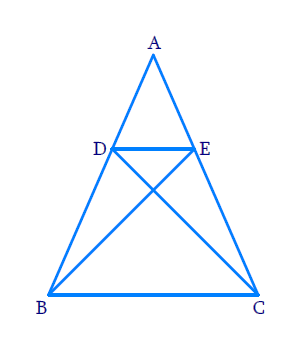 If $\triangle ABE \cong \triangle ACD$, show that $\triangle ADE \sim \triangle
ABC$.
If $\triangle ABE \cong \triangle ACD$, show that $\triangle ADE \sim \triangle
ABC$.
[2]
If $\triangle ABE \cong \triangle ACD$, show that $\triangle ADE \sim \triangle
ABC$.
SECTION C: SHORT ANSWER TYPE II QUESTIONS (3 Marks Each)
15. D is a point on the side BC of a triangle ABC such that $\angle ADC = \angle BAC$. Show that $CA^2 =
CB \cdot CD$.
[3]
16. Sides AB and BC and median AD of a triangle ABC are respectively proportional to sides PQ and QR and
median PM of $\triangle PQR$. Show that $\triangle ABC \sim \triangle PQR$.
[3]
17. Prove that the ratio of the areas of two similar triangles is equal to the square of the ratio of
their corresponding medians.
[3]
18. BL and CM are medians of a triangle ABC right angled at A. Prove that $4(BL^2 + CM^2) = 5 BC^2$.
[3]
19. Through the mid-point M of the side CD of a parallelogram ABCD, the line BM is drawn intersecting AC
in L and AD produced in E. Prove that $EL = 2 BL$.
[3]
20. A vertical stick 12 m long casts a shadow 8 m long on the ground. At the same time a tower casts the
shadow 40 m long on the ground. Find the height of the tower.
[3]
SECTION D: LONG ANSWER TYPE QUESTIONS (5 Marks Each)
21. State and prove the Basic Proportionality Theorem (Thales Theorem).
[5]
22. State and prove the Pythagoras Theorem.
[5]
SECTION E: CASE STUDY (4 Marks)
23. Case Study: Light House
A boy of height 90 cm is walking away from the base of a lamp-post at a speed of 1.2 m/s. If the lamp is 3.6 m above the ground:
(i) Draw a rough sketch of the situation. (1 Mark)
(ii) Find the length of his shadow after 4 seconds. (2 Marks)
(iii) Which similarity criterion is used to solve this problem? (1 Mark)
[4]
A boy of height 90 cm is walking away from the base of a lamp-post at a speed of 1.2 m/s. If the lamp is 3.6 m above the ground:
(i) Draw a rough sketch of the situation. (1 Mark)
(ii) Find the length of his shadow after 4 seconds. (2 Marks)
(iii) Which similarity criterion is used to solve this problem? (1 Mark)