
Board Exam 2025
1 Mark
Q6. In the given figure, PQ || SR. The value
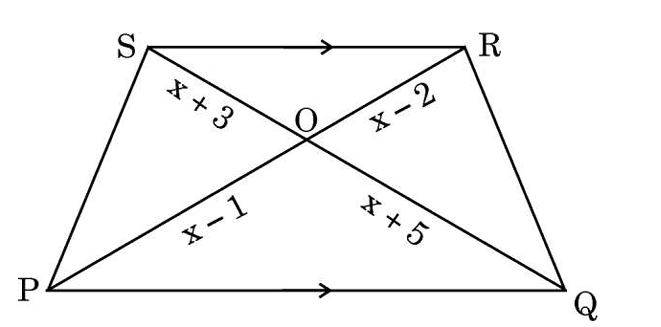 of x is :
of x is :
In trapezium PQRS with diagonals intersecting at O, \(\Delta POQ \sim \Delta SOR\).
\(\frac{PO}{OR} = \frac{QO}{OS} \Rightarrow \frac{x+5}{x-1} = \frac{x+3}{x-2}\).
\((x+5)(x-2) = (x+3)(x-1)\).
\(x^2 + 3x - 10 = x^2 + 2x - 3\).
\(x = 7\).
Answer: (D)
\(\frac{PO}{OR} = \frac{QO}{OS} \Rightarrow \frac{x+5}{x-1} = \frac{x+3}{x-2}\).
\((x+5)(x-2) = (x+3)(x-1)\).
\(x^2 + 3x - 10 = x^2 + 2x - 3\).
\(x = 7\).
Answer: (D)
3 Marks
Q25. In the given figure, Z is a point on the
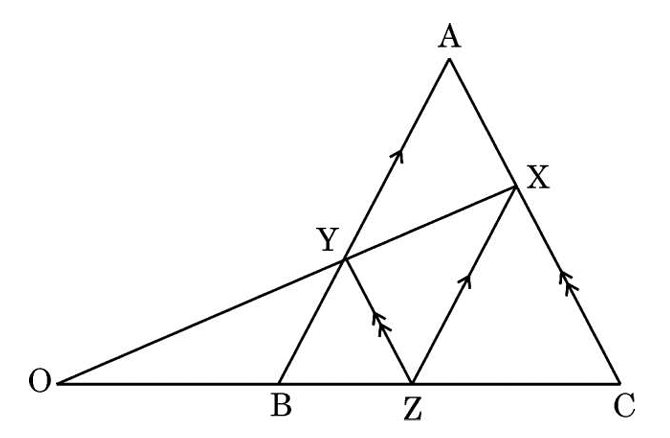 side BC of \(\Delta ABC\) such that \(XZ || AB\) and \(YZ || AC\). If XY and CB produced meet at O,
then prove that \(ZO^2 = OB \times OC\).
side BC of \(\Delta ABC\) such that \(XZ || AB\) and \(YZ || AC\). If XY and CB produced meet at O,
then prove that \(ZO^2 = OB \times OC\).
side BC of \(\Delta ABC\) such that \(XZ || AB\) and \(YZ || AC\). If XY and CB produced meet at O,
then prove that \(ZO^2 = OB \times OC\).
Given: \(XZ \parallel AB\) and \(YZ \parallel AC\). Points \(O, B, C\) are
collinear.
To Prove: \(ZO^2 = OB \times OC\).
Proof:
Consider \(\Delta ABC\). \(XZ \parallel AB\). By BPT:
\(\frac{CX}{XA} = \frac{CZ}{ZB}\) ... (i)
Similarly, \(YZ \parallel AC\). By BPT:
\(\frac{AY}{YB} = \frac{AZ}{ZC}\). Which implies \(\frac{AY}{YB} = \frac{ZC}{BZ}\) ... (ii)
Now consider the transversal line \(O-Y-X\) cutting the sides of \(\Delta ABC\) (extended).
By Menelaus Theorem on \(\Delta ABC\):
\(\frac{OB}{OC} \times \frac{CX}{XA} \times \frac{AY}{YB} = 1\).
Substitute (i) and (ii) into this equation:
\(\frac{OB}{OC} \times \left(\frac{CZ}{ZB}\right) \times \left(\frac{ZC}{BZ}\right) = 1\).
Note that \(\frac{CZ}{ZB} \times \frac{ZC}{BZ} = \left(\frac{CZ}{ZB}\right)^2\).
So, \(\frac{OB}{OC} \times \left(\frac{CZ}{ZB}\right)^2 = 1 \Rightarrow \frac{OC}{OB} = \left(\frac{CZ}{ZB}\right)^2\).
Let's express in terms of lengths from O:
\(\frac{OC}{OB} = \left(\frac{OC-OZ}{OZ-OB}\right)^2\).
Taking square root: \(\sqrt{\frac{OC}{OB}} = \frac{OC-OZ}{OZ-OB}\).
\(\sqrt{OC}(OZ-OB) = \sqrt{OB}(OC-OZ)\).
\(OZ\sqrt{OC} - OB\sqrt{OC} = OC\sqrt{OB} - OZ\sqrt{OB}\).
\(OZ(\sqrt{OC} + \sqrt{OB}) = OC\sqrt{OB} + OB\sqrt{OC}\).
\(OZ(\sqrt{OC} + \sqrt{OB}) = \sqrt{OB \cdot OC}(\sqrt{OC} + \sqrt{OB})\).
Thus, \(OZ = \sqrt{OB \cdot OC} \Rightarrow OZ^2 = OB \times OC\).
Hence Proved.
To Prove: \(ZO^2 = OB \times OC\).
Proof:
Consider \(\Delta ABC\). \(XZ \parallel AB\). By BPT:
\(\frac{CX}{XA} = \frac{CZ}{ZB}\) ... (i)
Similarly, \(YZ \parallel AC\). By BPT:
\(\frac{AY}{YB} = \frac{AZ}{ZC}\). Which implies \(\frac{AY}{YB} = \frac{ZC}{BZ}\) ... (ii)
Now consider the transversal line \(O-Y-X\) cutting the sides of \(\Delta ABC\) (extended).
By Menelaus Theorem on \(\Delta ABC\):
\(\frac{OB}{OC} \times \frac{CX}{XA} \times \frac{AY}{YB} = 1\).
Substitute (i) and (ii) into this equation:
\(\frac{OB}{OC} \times \left(\frac{CZ}{ZB}\right) \times \left(\frac{ZC}{BZ}\right) = 1\).
Note that \(\frac{CZ}{ZB} \times \frac{ZC}{BZ} = \left(\frac{CZ}{ZB}\right)^2\).
So, \(\frac{OB}{OC} \times \left(\frac{CZ}{ZB}\right)^2 = 1 \Rightarrow \frac{OC}{OB} = \left(\frac{CZ}{ZB}\right)^2\).
Let's express in terms of lengths from O:
\(\frac{OC}{OB} = \left(\frac{OC-OZ}{OZ-OB}\right)^2\).
Taking square root: \(\sqrt{\frac{OC}{OB}} = \frac{OC-OZ}{OZ-OB}\).
\(\sqrt{OC}(OZ-OB) = \sqrt{OB}(OC-OZ)\).
\(OZ\sqrt{OC} - OB\sqrt{OC} = OC\sqrt{OB} - OZ\sqrt{OB}\).
\(OZ(\sqrt{OC} + \sqrt{OB}) = OC\sqrt{OB} + OB\sqrt{OC}\).
\(OZ(\sqrt{OC} + \sqrt{OB}) = \sqrt{OB \cdot OC}(\sqrt{OC} + \sqrt{OB})\).
Thus, \(OZ = \sqrt{OB \cdot OC} \Rightarrow OZ^2 = OB \times OC\).
Hence Proved.
5 Marks
Q35. In the figure, MNOP is a trapezium with,
MN || PO and PO = 2 MN. A line segment FE drawn parallel to MN intersects MP at F and NO at E such
that \(\frac{NE}{EO} = \frac{3}{4}\). Diagonal PN intersects FE at X. Prove that 7 FE = 10 MN.
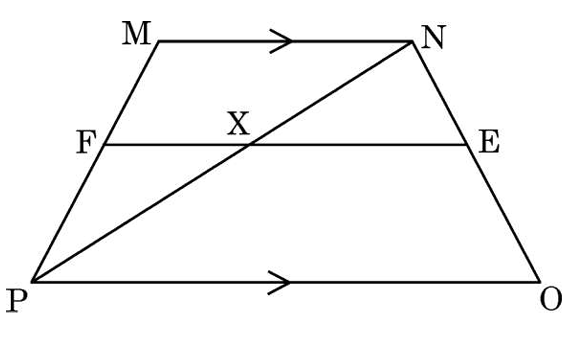
In \(\Delta NPO\), \(XE || PO\). By BPT, \(\frac{NX}{XP} = \frac{NE}{EO} = \frac{3}{4}\).
Also \(\Delta NXE \sim \Delta NPO \Rightarrow \frac{XE}{PO} = \frac{NX}{NP} = \frac{3}{3+4} = \frac{3}{7}\).
So \(XE = \frac{3}{7}PO\). Given \(PO = 2MN\), so \(XE = \frac{3}{7}(2MN) = \frac{6}{7}MN\).
In \(\Delta MN P\), \(FX || MN\). Ratio \(\frac{PF}{PM} = \frac{PX}{PN} = \frac{4}{7}\).
So \(\Delta PFX \sim \Delta PMN \Rightarrow \frac{FX}{MN} = \frac{4}{7} \Rightarrow FX = \frac{4}{7}MN\).
Total Length \(FE = FX + XE = \frac{4}{7}MN + \frac{6}{7}MN = \frac{10}{7}MN\).
\(7 FE = 10 MN\). Hence Proved.
Also \(\Delta NXE \sim \Delta NPO \Rightarrow \frac{XE}{PO} = \frac{NX}{NP} = \frac{3}{3+4} = \frac{3}{7}\).
So \(XE = \frac{3}{7}PO\). Given \(PO = 2MN\), so \(XE = \frac{3}{7}(2MN) = \frac{6}{7}MN\).
In \(\Delta MN P\), \(FX || MN\). Ratio \(\frac{PF}{PM} = \frac{PX}{PN} = \frac{4}{7}\).
So \(\Delta PFX \sim \Delta PMN \Rightarrow \frac{FX}{MN} = \frac{4}{7} \Rightarrow FX = \frac{4}{7}MN\).
Total Length \(FE = FX + XE = \frac{4}{7}MN + \frac{6}{7}MN = \frac{10}{7}MN\).
\(7 FE = 10 MN\). Hence Proved.
1 Mark
Q4. In triangles ABC and DEF, \(\angle B =
\angle
E\), \(\angle F = \angle C\) and \(AB = 3 DE\). Then, the two triangles are:
\(\angle B = \angle E\), \(\angle C = \angle F \Rightarrow \Delta ABC \sim \Delta DEF\) (By AA
similarity).
For congruence, corresponding sides must be equal. Here \(AB = 3 DE \Rightarrow \frac{AB}{DE} = 3 \neq 1\).
So, triangles are similar but not congruent.
Answer: (D)
For congruence, corresponding sides must be equal. Here \(AB = 3 DE \Rightarrow \frac{AB}{DE} = 3 \neq 1\).
So, triangles are similar but not congruent.
Answer: (D)
2 Marks
Q21. (a) If \(\Delta ABC \sim \Delta PQR\) with
\(AB=6\), \(BC=4\), \(AC=8\), \(PR=6\), find \((PQ + QR)\).
OR
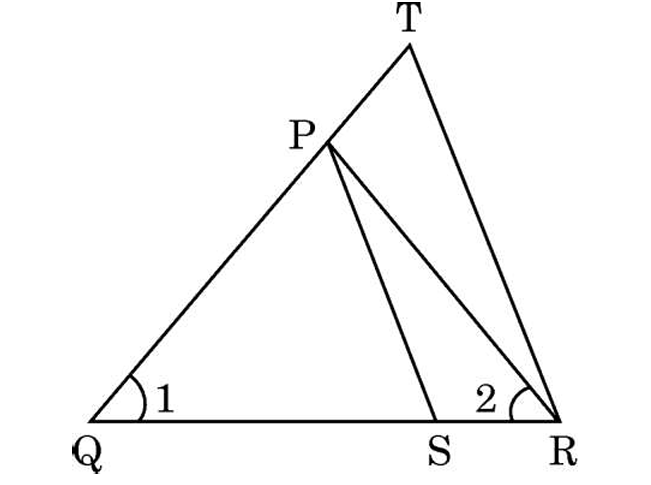
Q21. (b) In the figure, \(\frac{QR}{QS} = \frac{QT}{PR}\) and
\(\angle 1 = \angle 2\). Show that \(\Delta PQS \sim \Delta TQR\).
(a) \(\Delta ABC \sim \Delta PQR \Rightarrow \frac{AB}{PQ} = \frac{BC}{QR} =
\frac{AC}{PR}\).
\(\frac{6}{PQ} = \frac{4}{QR} = \frac{8}{6} = \frac{4}{3}\).
\(PQ = 6 \times \frac{3}{4} = 4.5\).
\(QR = 4 \times \frac{3}{4} = 3\).
\(PQ + QR = 4.5 + 3 = 7.5\).
(b) Given \(\angle 1 = \angle 2 \Rightarrow PQ = PR\) (Isosceles \(\Delta PQR\)).
Substitute \(PR = PQ\) in given ratio: \(\frac{QR}{QS} = \frac{QT}{PQ}\).
In \(\Delta PQS\) and \(\Delta TQR\):
\(\frac{QS}{QR} = \frac{PQ}{QT}\) (Reciprocal of above).
\(\angle Q\) is common.
By SAS similarity, \(\Delta PQS \sim \Delta TQR\).
\(\frac{6}{PQ} = \frac{4}{QR} = \frac{8}{6} = \frac{4}{3}\).
\(PQ = 6 \times \frac{3}{4} = 4.5\).
\(QR = 4 \times \frac{3}{4} = 3\).
\(PQ + QR = 4.5 + 3 = 7.5\).
(b) Given \(\angle 1 = \angle 2 \Rightarrow PQ = PR\) (Isosceles \(\Delta PQR\)).
Substitute \(PR = PQ\) in given ratio: \(\frac{QR}{QS} = \frac{QT}{PQ}\).
In \(\Delta PQS\) and \(\Delta TQR\):
\(\frac{QS}{QR} = \frac{PQ}{QT}\) (Reciprocal of above).
\(\angle Q\) is common.
By SAS similarity, \(\Delta PQS \sim \Delta TQR\).
5 Marks
Q35. (a) The diagonal BD of a parallelogram ABCD
intersects the line segment AE at the point F, where E is any point on the side BC. Prove that \(DF
\times EF = FB \times FA\).
OR
Q35. (b)
In \(\Delta ABC\), if \(AD \perp BC\) and \(AD^2 = BD \times
DC\), then prove that \(\angle BAC = 90^\circ\).
(a) In parallelogram ABCD, \(AD || BC\).
\(\Delta AFD \sim \Delta BFE\) (AA Similarity: Alt Int Angles).
\(\frac{DF}{FB} = \frac{FA}{EF} \Rightarrow DF \times EF = FB \times FA\).
(b) Given \(AD^2 = BD \times DC \Rightarrow \frac{AD}{BD} = \frac{DC}{AD}\).
In \(\Delta ADB\) and \(\Delta CDA\):
\(\angle ADB = \angle CDA = 90^\circ\).
Sides including these angles are proportional.
So \(\Delta ADB \sim \Delta CDA\) (SAS).
Let \(\angle ABD = x \Rightarrow \angle BAD = 90 - x\).
From similarity, \(\angle CAD = \angle ABD = x\).
\(\angle BAC = \angle BAD + \angle CAD = (90 - x) + x = 90^\circ\).
\(\Delta AFD \sim \Delta BFE\) (AA Similarity: Alt Int Angles).
\(\frac{DF}{FB} = \frac{FA}{EF} \Rightarrow DF \times EF = FB \times FA\).
(b) Given \(AD^2 = BD \times DC \Rightarrow \frac{AD}{BD} = \frac{DC}{AD}\).
In \(\Delta ADB\) and \(\Delta CDA\):
\(\angle ADB = \angle CDA = 90^\circ\).
Sides including these angles are proportional.
So \(\Delta ADB \sim \Delta CDA\) (SAS).
Let \(\angle ABD = x \Rightarrow \angle BAD = 90 - x\).
From similarity, \(\angle CAD = \angle ABD = x\).
\(\angle BAC = \angle BAD + \angle CAD = (90 - x) + x = 90^\circ\).
1 Mark
Q9. In the given figure, \(PQ || BC\). If
\(\frac{AP}{PB} = \frac{4}{13}\) and \(AC = 20.4\) cm, then the length of \(AQ\) is :
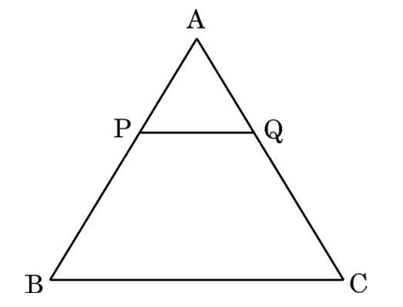
By Basic Proportionality Theorem (Thales Theorem), since \(PQ || BC\):
\(\frac{AP}{PB} = \frac{AQ}{QC}\).
\(\frac{AQ}{QC} = \frac{4}{13} \Rightarrow QC = \frac{13}{4}AQ\).
\(AC = AQ + QC = AQ + \frac{13}{4}AQ = \frac{17}{4}AQ\).
Given \(AC = 20.4\).
\(20.4 = \frac{17}{4}AQ \Rightarrow AQ = \frac{20.4 \times 4}{17} = 1.2 \times 4 = 4.8\) cm.
Answer: (D)
\(\frac{AP}{PB} = \frac{AQ}{QC}\).
\(\frac{AQ}{QC} = \frac{4}{13} \Rightarrow QC = \frac{13}{4}AQ\).
\(AC = AQ + QC = AQ + \frac{13}{4}AQ = \frac{17}{4}AQ\).
Given \(AC = 20.4\).
\(20.4 = \frac{17}{4}AQ \Rightarrow AQ = \frac{20.4 \times 4}{17} = 1.2 \times 4 = 4.8\) cm.
Answer: (D)
1 Mark
Q15. Which of the following statements is
incorrect?
(A) True. Congruent figures have same shape and size, so they are similar.
(B) False. A square has all angles 90�. A rhombus may have any angles. Even with same area, their angles (shape) differ. So not similar.
(C) True. Equilateral triangles always have 60� angles.
(D) True. Similar figures can have different sizes.
Answer: (B)
(B) False. A square has all angles 90�. A rhombus may have any angles. Even with same area, their angles (shape) differ. So not similar.
(C) True. Equilateral triangles always have 60� angles.
(D) True. Similar figures can have different sizes.
Answer: (B)
2 Marks
Q25. (a)
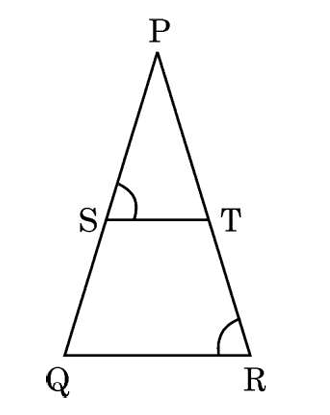 In the given figure, \(\frac{PS}{SQ} =
\frac{PT}{TR}\) and \(\angle PST = \angle PRQ\). Prove that \(\Delta PQR\) is an isosceles triangle.
In the given figure, \(\frac{PS}{SQ} =
\frac{PT}{TR}\) and \(\angle PST = \angle PRQ\). Prove that \(\Delta PQR\) is an isosceles triangle.
In the given figure, \(\frac{PS}{SQ} =
\frac{PT}{TR}\) and \(\angle PST = \angle PRQ\). Prove that \(\Delta PQR\) is an isosceles triangle.
OR
Q25. (b)
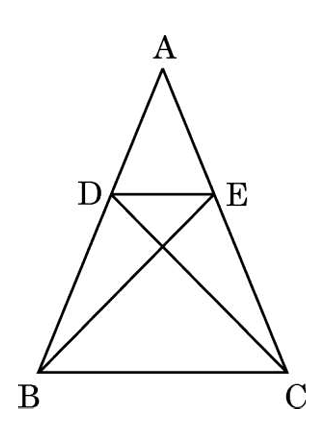
In the given figure, \(\Delta ABE \cong \Delta ACD\). Prove
that \(\Delta ADE \sim \Delta ABC\).
(a)
Given \(\frac{PS}{SQ} = \frac{PT}{TR}\). By Converse of BPT, \(ST || QR\).
Therefore, corresponding angles area equal: \(\angle PST = \angle PQR\).
Given \(\angle PST = \angle PRQ\).
So, \(\angle PQR = \angle PRQ\).
Sides opposite to equal angles are equal: \(PQ = PR\).
Hence, \(\Delta PQR\) is an isosceles triangle.
(b)
Given \(\Delta ABE \cong \Delta ACD\).
By CPCT, \(AB = AC\) and \(AE = AD\).
\(\frac{AB}{AC} = 1\) and \(\frac{AD}{AE} = 1\).
Therefore, \(\frac{AD}{AB} = \frac{AE}{AC}\).
In \(\Delta ADE\) and \(\Delta ABC\):
1. \(\frac{AD}{AB} = \frac{AE}{AC}\) (Proved above)
2. \(\angle A = \angle A\) (Common)
By SAS Similarity Criterion, \(\Delta ADE \sim \Delta ABC\).
Given \(\frac{PS}{SQ} = \frac{PT}{TR}\). By Converse of BPT, \(ST || QR\).
Therefore, corresponding angles area equal: \(\angle PST = \angle PQR\).
Given \(\angle PST = \angle PRQ\).
So, \(\angle PQR = \angle PRQ\).
Sides opposite to equal angles are equal: \(PQ = PR\).
Hence, \(\Delta PQR\) is an isosceles triangle.
(b)
Given \(\Delta ABE \cong \Delta ACD\).
By CPCT, \(AB = AC\) and \(AE = AD\).
\(\frac{AB}{AC} = 1\) and \(\frac{AD}{AE} = 1\).
Therefore, \(\frac{AD}{AB} = \frac{AE}{AC}\).
In \(\Delta ADE\) and \(\Delta ABC\):
1. \(\frac{AD}{AB} = \frac{AE}{AC}\) (Proved above)
2. \(\angle A = \angle A\) (Common)
By SAS Similarity Criterion, \(\Delta ADE \sim \Delta ABC\).
5 Marks
Q32. Prove that a line drawn parallel to one side
of a triangle to intersect the other two sides in distinct points divides the other two sides in the
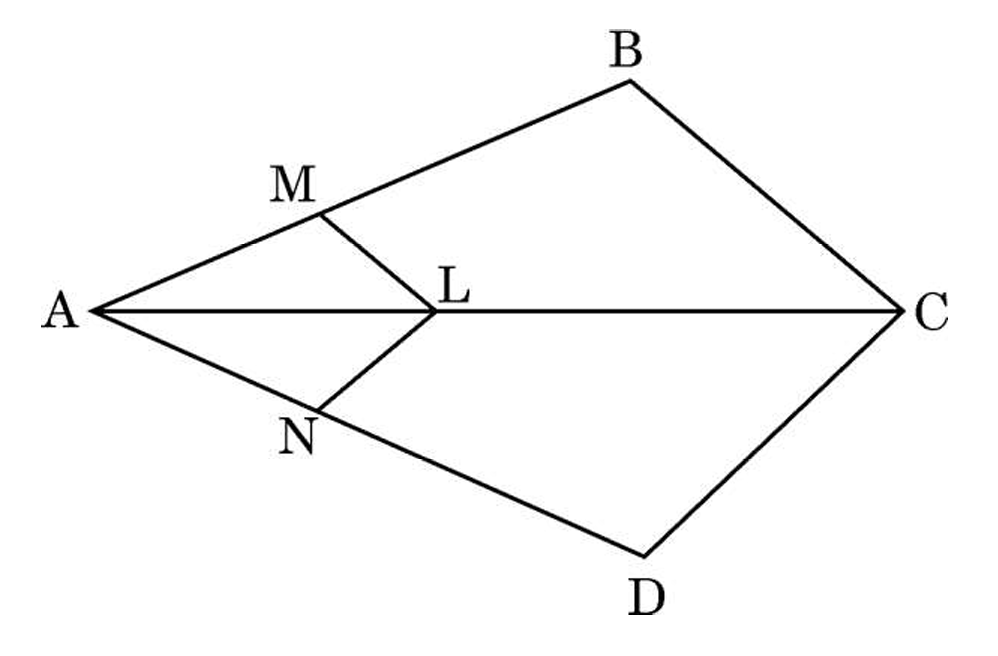
same ratio. Hence, in the figure given below, prove that \(\frac{AM}{MB} = \frac{AN}{ND}\), if \(LM ||
CB\) and \(LN || CD\).
Part 1: Basic Proportionality Theorem (Thales Theorem)
Statement: If a line is drawn parallel to one side of a triangle intersecting the other two sides in distinct points, then the other two sides are divided in the same ratio.
Proof: Given \(\Delta ABC\) and line \(DE \parallel BC\) intersecting \(AB\) at \(D\) and \(AC\) at \(E\).
Draw \(EM \perp AB\) and \(DN \perp AC\). Join \(BE\) and \(CD\).
Area(\(\Delta ADE\)) = \(\frac{1}{2} \times AD \times EM\).
Area(\(\Delta BDE\)) = \(\frac{1}{2} \times DB \times EM\).
Ratio \(\frac{Area(\Delta ADE)}{Area(\Delta BDE)} = \frac{AD}{DB}\). ... (i)
Similarly, \(\frac{Area(\Delta ADE)}{Area(\Delta DEC)} = \frac{AE}{EC}\). ... (ii)
Since \(\Delta BDE\) and \(\Delta DEC\) are on the same base \(DE\) and between same parallel lines \(DE\) and \(BC\), Area(\(\Delta BDE\)) = Area(\(\Delta DEC\)).
Therefore, from (i) and (ii), \(\frac{AD}{DB} = \frac{AE}{EC}\). Proved.
Part 2:
In \(\Delta ABC\), given \(LM || CB\).
By BPT, \(\frac{AM}{MB} = \frac{AL}{LC}\) --- (1)
In \(\Delta ADC\), given \(LN || CD\).
By BPT, \(\frac{AN}{ND} = \frac{AL}{LC}\) --- (2)
From (1) and (2):
\(\frac{AM}{MB} = \frac{AN}{ND}\). Proved.
Statement: If a line is drawn parallel to one side of a triangle intersecting the other two sides in distinct points, then the other two sides are divided in the same ratio.
Proof: Given \(\Delta ABC\) and line \(DE \parallel BC\) intersecting \(AB\) at \(D\) and \(AC\) at \(E\).
Draw \(EM \perp AB\) and \(DN \perp AC\). Join \(BE\) and \(CD\).
Area(\(\Delta ADE\)) = \(\frac{1}{2} \times AD \times EM\).
Area(\(\Delta BDE\)) = \(\frac{1}{2} \times DB \times EM\).
Ratio \(\frac{Area(\Delta ADE)}{Area(\Delta BDE)} = \frac{AD}{DB}\). ... (i)
Similarly, \(\frac{Area(\Delta ADE)}{Area(\Delta DEC)} = \frac{AE}{EC}\). ... (ii)
Since \(\Delta BDE\) and \(\Delta DEC\) are on the same base \(DE\) and between same parallel lines \(DE\) and \(BC\), Area(\(\Delta BDE\)) = Area(\(\Delta DEC\)).
Therefore, from (i) and (ii), \(\frac{AD}{DB} = \frac{AE}{EC}\). Proved.
Part 2:
In \(\Delta ABC\), given \(LM || CB\).
By BPT, \(\frac{AM}{MB} = \frac{AL}{LC}\) --- (1)
In \(\Delta ADC\), given \(LN || CD\).
By BPT, \(\frac{AN}{ND} = \frac{AL}{LC}\) --- (2)
From (1) and (2):
\(\frac{AM}{MB} = \frac{AN}{ND}\). Proved.
1 Mark
Q8. If in two triangles \(\Delta DEF\) and
\(\Delta PQR\), \(\angle D = \angle Q\) and \(\angle R = \angle E\), then which of the following is
not true?
Correspondence: \(D \leftrightarrow Q, E \leftrightarrow R, F \leftrightarrow P\).
\(\Delta DEF \sim \Delta QRP\).
Ratios: \(\frac{DE}{QR} = \frac{EF}{RP} = \frac{DF}{QP}\).
(A) Correct. (B) Correct. (C) Correct.
(D) \(\frac{DE}{PQ}\) compares side DE with PQ (which is QP's partner is DF). Incorrect.
Answer: (D)
\(\Delta DEF \sim \Delta QRP\).
Ratios: \(\frac{DE}{QR} = \frac{EF}{RP} = \frac{DF}{QP}\).
(A) Correct. (B) Correct. (C) Correct.
(D) \(\frac{DE}{PQ}\) compares side DE with PQ (which is QP's partner is DF). Incorrect.
Answer: (D)
1 Mark
Q9. In the given figure, in \(\Delta ABC\),
\(AD \perp BC\) and \(\angle BAC = 90^\circ\). If \(BC = 16\) cm and \(DC = 4\) cm, then the value
of x (AC) is :
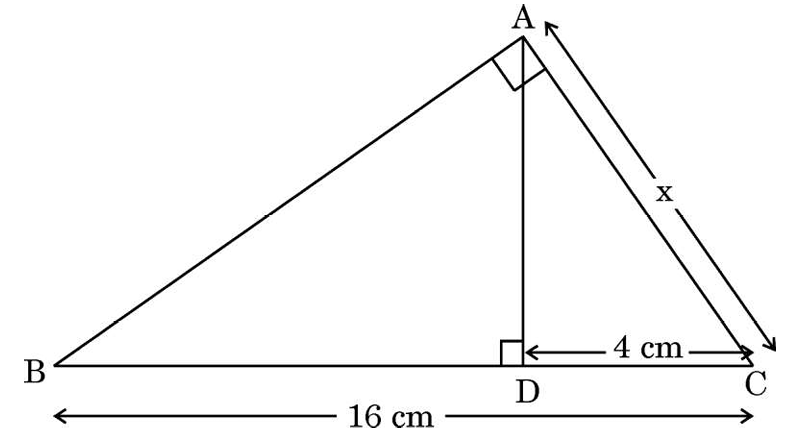
By similarity or Geometric Mean theorem in right triangle: \(AC^2 = CD \times CB\).
\(AC^2 = 4 \times 16 = 64\).
\(AC = 8\) cm.
Answer: (C)
\(AC^2 = 4 \times 16 = 64\).
\(AC = 8\) cm.
Answer: (C)
1 Mark
Q14. The measurements of \(\Delta LMN\) and
\(\Delta ABC\) are shown in the figure given below. The length of side AC is :
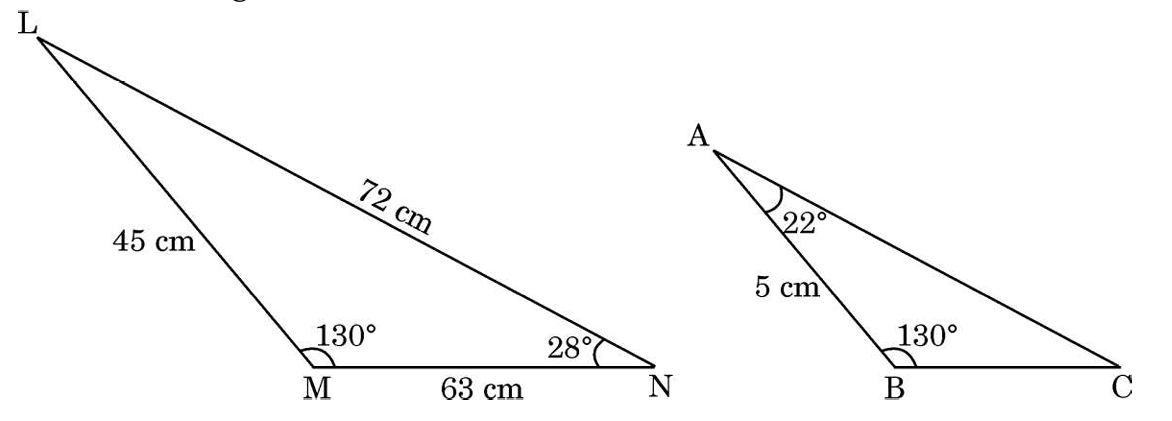
Observations from Figure:
In \(\Delta LMN\), side lengths are \(LM=45\), \(MN=63\), \(LN=72\) (from proportionality). \(\angle M = 130^\circ\).
In \(\Delta ABC\), side \(AB=5\), and \(\angle B = 130^\circ\).
Reasoning:
Comparing \(\Delta LMN\) and \(\Delta ABC\):
Ratios of adjacent sides to \(130^\circ\): \(\frac{LM}{AB} = \frac{45}{5} = 9\).
Assume similarity \(\Delta LMN \sim \Delta ABC\) (as angles match and sides are proportional).
The scale factor is \(k = 9\).
The side opposite to \(130^\circ\) in \(\Delta LMN\) is \(LN = 72\).
The side opposite to \(130^\circ\) in \(\Delta ABC\) is \(AC\).
Therefore, \(\frac{LN}{AC} = 9 \Rightarrow \frac{72}{AC} = 9\).
\(AC = \frac{72}{9} = 8\) cm.
Answer: (C)
In \(\Delta LMN\), side lengths are \(LM=45\), \(MN=63\), \(LN=72\) (from proportionality). \(\angle M = 130^\circ\).
In \(\Delta ABC\), side \(AB=5\), and \(\angle B = 130^\circ\).
Reasoning:
Comparing \(\Delta LMN\) and \(\Delta ABC\):
Ratios of adjacent sides to \(130^\circ\): \(\frac{LM}{AB} = \frac{45}{5} = 9\).
Assume similarity \(\Delta LMN \sim \Delta ABC\) (as angles match and sides are proportional).
The scale factor is \(k = 9\).
The side opposite to \(130^\circ\) in \(\Delta LMN\) is \(LN = 72\).
The side opposite to \(130^\circ\) in \(\Delta ABC\) is \(AC\).
Therefore, \(\frac{LN}{AC} = 9 \Rightarrow \frac{72}{AC} = 9\).
\(AC = \frac{72}{9} = 8\) cm.
Answer: (C)
5 Marks
Q35. (a)
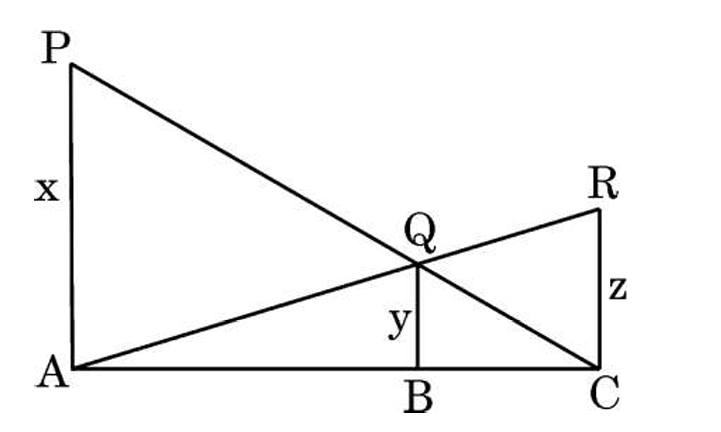 In the given figure, PA, QB and RC
are perpendicular to AC. If \(PA = x, QB = y\) and \(RC = z\), prove that \(\frac{1}{x} +
\frac{1}{z} = \frac{1}{y}\).
In the given figure, PA, QB and RC
are perpendicular to AC. If \(PA = x, QB = y\) and \(RC = z\), prove that \(\frac{1}{x} +
\frac{1}{z} = \frac{1}{y}\).
In the given figure, PA, QB and RC
are perpendicular to AC. If \(PA = x, QB = y\) and \(RC = z\), prove that \(\frac{1}{x} +
\frac{1}{z} = \frac{1}{y}\).
OR
Q35. (b) Sides AB and BC and median AD of
\(\Delta ABC\) are respectively proportional to sides PQ and QR and median PM of \(\Delta PQR\).
Show that \(\Delta ABC \sim \Delta PQR\).
(a) Let \(AB = a, BC = b\).
In \(\Delta PAC, QB || PA \Rightarrow \frac{y}{x} = \frac{b}{a+b}\).
In \(\Delta ACR, QB || RC \Rightarrow \frac{y}{z} = \frac{a}{a+b}\).
Adding: \(\frac{y}{x} + \frac{y}{z} = \frac{a+b}{a+b} = 1\).
Dividing by \(y\): \(\frac{1}{x} + \frac{1}{z} = \frac{1}{y}\).
(b) Standard theorem proof. Proportionality of sides and median implies similarity (SSS similarity for half triangles by doubling median construction, then SAS for whole).
In \(\Delta PAC, QB || PA \Rightarrow \frac{y}{x} = \frac{b}{a+b}\).
In \(\Delta ACR, QB || RC \Rightarrow \frac{y}{z} = \frac{a}{a+b}\).
Adding: \(\frac{y}{x} + \frac{y}{z} = \frac{a+b}{a+b} = 1\).
Dividing by \(y\): \(\frac{1}{x} + \frac{1}{z} = \frac{1}{y}\).
(b) Standard theorem proof. Proportionality of sides and median implies similarity (SSS similarity for half triangles by doubling median construction, then SAS for whole).
1 Mark
Q7. E and F are points on sides AB and AC
respectively of a \(\Delta ABC\) such that \(\frac{AE}{EB} = \frac{AF}{FC} = \frac{1}{2}\). Which of
the following relation is true ?
By BPT, \(EF||BC\). \(\Delta AEF \sim \Delta ABC\).
Ratio \(AE/AB = 1/(1+2) = 1/3\).
So \(EF/BC = 1/3 \Rightarrow BC = 3EF\).
Answer: (d)
Ratio \(AE/AB = 1/(1+2) = 1/3\).
So \(EF/BC = 1/3 \Rightarrow BC = 3EF\).
Answer: (d)
1 Mark
Q16. \(\Delta ABC\) and \(\Delta PQR\) are
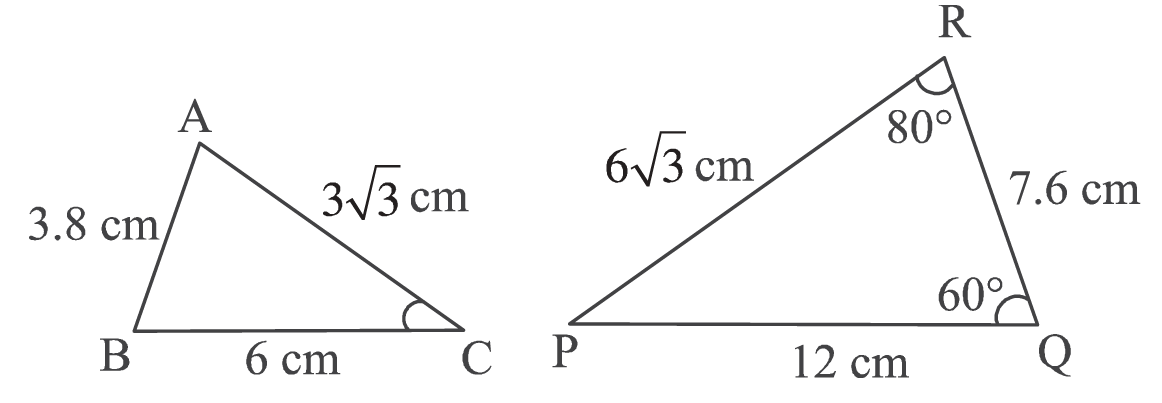 shown in the adjoining figures. The measure of \(\angle C\) is :
shown in the adjoining figures. The measure of \(\angle C\) is :
\(\angle C = 180 - (80+60) = 40�\).
Answer: (d)
Answer: (d)
5 Marks
Q32. (A)
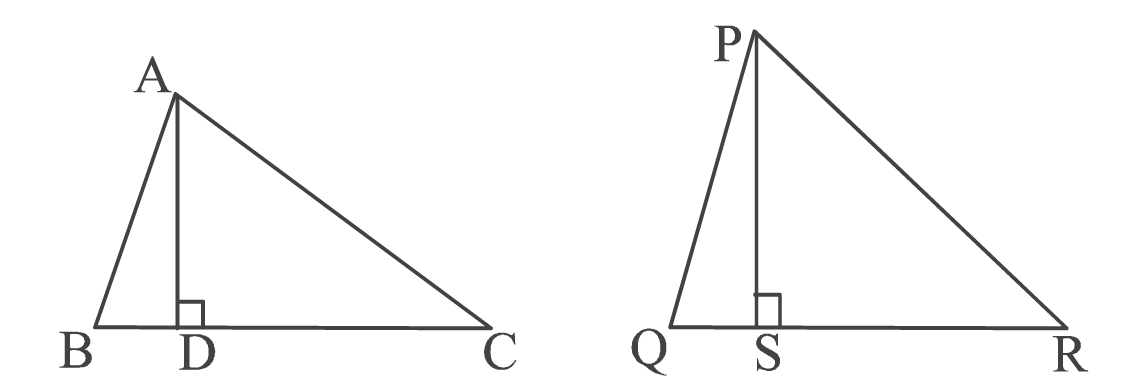 The corresponding sides of \(\Delta
ABC\) and \(\Delta PQR\) are in the ratio 3 : 5. \(AD \perp BC\) and \(PS \perp QR\) as shown in the
following figures :
(i) Prove that \(\Delta ADC \sim \Delta PSR\)
The corresponding sides of \(\Delta
ABC\) and \(\Delta PQR\) are in the ratio 3 : 5. \(AD \perp BC\) and \(PS \perp QR\) as shown in the
following figures :
(i) Prove that \(\Delta ADC \sim \Delta PSR\)
(ii) If \(AD = 4\) cm, find the length of PS.
(iii) Using (ii) find ar \((\Delta ABC)\) : ar \((\Delta PQR)\)
The corresponding sides of \(\Delta
ABC\) and \(\Delta PQR\) are in the ratio 3 : 5. \(AD \perp BC\) and \(PS \perp QR\) as shown in the
following figures :
(i) Prove that \(\Delta ADC \sim \Delta PSR\)(ii) If \(AD = 4\) cm, find the length of PS.
(iii) Using (ii) find ar \((\Delta ABC)\) : ar \((\Delta PQR)\)
OR
Q32. (B)
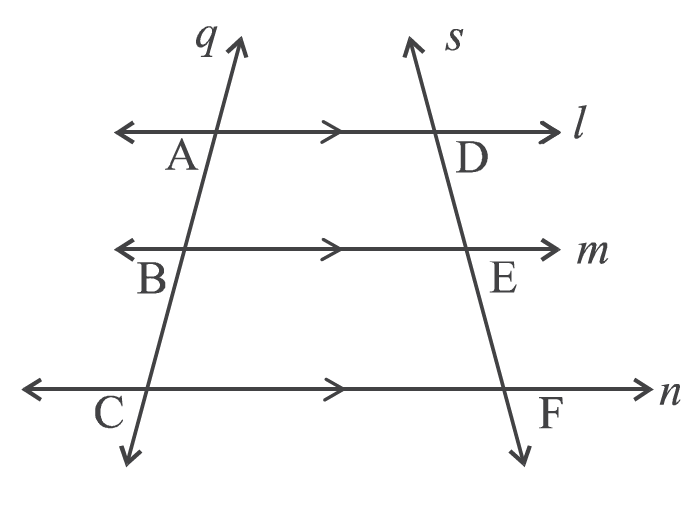 State basic proportionality
theorem.
State basic proportionality
theorem.
Use it to prove the following :
If three parallel lines \(l, m, n\) are intersected by transversals \(q\) and \(s\) as shown in the adjoining figure, then \(\frac{AB}{BC} = \frac{DE}{EF}\).
State basic proportionality
theorem.Use it to prove the following :
If three parallel lines \(l, m, n\) are intersected by transversals \(q\) and \(s\) as shown in the adjoining figure, then \(\frac{AB}{BC} = \frac{DE}{EF}\).
(A):
Given \(\Delta ABC \sim \Delta PQR\) (Implied by ratio of sides).
Ratio of sides = 3 : 5.
(i) Ratio of corresponding altitudes is equal to ratio of sides.
\(\frac{AD}{PS} = \frac{3}{5} \Rightarrow \Delta ADC \sim \Delta PSR\) (Since \(\angle D = \angle S = 90^\circ\) and \(\angle C = \angle R\)).
(ii) \(\frac{AD}{PS} = \frac{3}{5}\). Given \(AD = 4\).
\(\frac{4}{PS} = \frac{3}{5} \Rightarrow PS = \frac{20}{3} \approx 6.67\) cm.
(iii) Ratio of areas = (Ratio of sides)\(^2\) = \((\frac{3}{5})^2 = \frac{9}{25}\).
ar\((\Delta ABC)\) : ar\((\Delta PQR)\) = 9 : 25.
(B): Proof of BPT (Basic Proportionality Theorem):
(See Proof in Q32 30-2 Part 1 above).
Proving Intercept Property:
Join A to F, intersecting line \(m\) at G.
In \(\Delta ACF\), line \(BG \parallel CF\) (given \(m \parallel n\)).
By BPT, \(\frac{AB}{BC} = \frac{AG}{GF}\). ... (i)
In \(\Delta AFD\), line \(GE \parallel AD\) (given \(m \parallel l\)).
By BPT, \(\frac{AG}{GF} = \frac{DE}{EF}\). ... (ii)
From (i) and (ii): \(\frac{AB}{BC} = \frac{DE}{EF}\). Proved.
Given \(\Delta ABC \sim \Delta PQR\) (Implied by ratio of sides).
Ratio of sides = 3 : 5.
(i) Ratio of corresponding altitudes is equal to ratio of sides.
\(\frac{AD}{PS} = \frac{3}{5} \Rightarrow \Delta ADC \sim \Delta PSR\) (Since \(\angle D = \angle S = 90^\circ\) and \(\angle C = \angle R\)).
(ii) \(\frac{AD}{PS} = \frac{3}{5}\). Given \(AD = 4\).
\(\frac{4}{PS} = \frac{3}{5} \Rightarrow PS = \frac{20}{3} \approx 6.67\) cm.
(iii) Ratio of areas = (Ratio of sides)\(^2\) = \((\frac{3}{5})^2 = \frac{9}{25}\).
ar\((\Delta ABC)\) : ar\((\Delta PQR)\) = 9 : 25.
(B): Proof of BPT (Basic Proportionality Theorem):
(See Proof in Q32 30-2 Part 1 above).
Proving Intercept Property:
Join A to F, intersecting line \(m\) at G.
In \(\Delta ACF\), line \(BG \parallel CF\) (given \(m \parallel n\)).
By BPT, \(\frac{AB}{BC} = \frac{AG}{GF}\). ... (i)
In \(\Delta AFD\), line \(GE \parallel AD\) (given \(m \parallel l\)).
By BPT, \(\frac{AG}{GF} = \frac{DE}{EF}\). ... (ii)
From (i) and (ii): \(\frac{AB}{BC} = \frac{DE}{EF}\). Proved.
1 Mark
Q17. Which of the following statements is
false?
Right triangles are only similar if corresponding sides are proportional or acute
angles are equal. An isosceles right triangle is not similar to a scalene right
triangle.
Correct Option: (A)
Correct Option: (A)
1 Mark
Q18. In the adjoining figure, ABCD is a
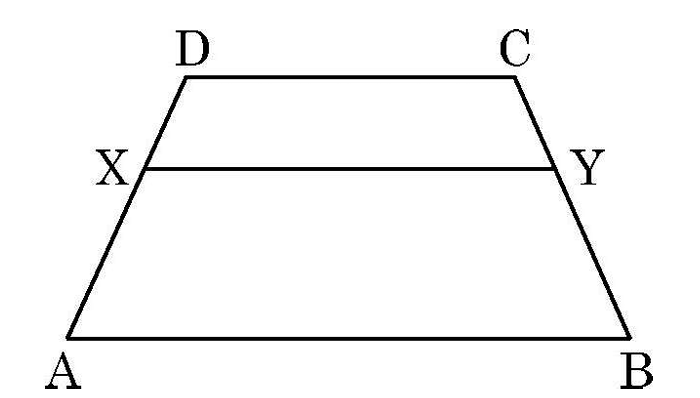 trapezium
in which \(XY \parallel AB \parallel CD\). If \(AX = \frac{2}{3}AD\) then \(CY : YB =\)
trapezium
in which \(XY \parallel AB \parallel CD\). If \(AX = \frac{2}{3}AD\) then \(CY : YB =\)
trapezium
in which \(XY \parallel AB \parallel CD\). If \(AX = \frac{2}{3}AD\) then \(CY : YB =\)
By the property of parallel lines cutting transversals proportionally:
\(\frac{AX}{XD}
= \frac{BY}{YC}\).
Given \(AX = \frac{2}{3}AD \Rightarrow AX = 2k, AD = 3k \Rightarrow XD = k\).
Ratio \(\frac{AX}{XD} = \frac{2}{1}\). So \(\frac{BY}{YC} = \frac{2}{1}\).
The question asks for \(CY : YB\), which is the reciprocal \(1 : 2\).
Correct Option: (D) 1:2
Given \(AX = \frac{2}{3}AD \Rightarrow AX = 2k, AD = 3k \Rightarrow XD = k\).
Ratio \(\frac{AX}{XD} = \frac{2}{1}\). So \(\frac{BY}{YC} = \frac{2}{1}\).
The question asks for \(CY : YB\), which is the reciprocal \(1 : 2\).
Correct Option: (D) 1:2
2 Marks
Q23. In triangles ABC and PQR, AD and PS are
altitudes such that \(\Delta ABD \sim \Delta PQS\) and \(\Delta ACD \sim \Delta PRS\). Prove that
\(\Delta ABC \sim \Delta PQR\).
From \(\Delta ABD \sim \Delta PQS\): \(\frac{AB}{PQ} = \frac{AD}{PS}\) and
\(\angle B
= \angle Q\).
From \(\Delta ACD \sim \Delta PRS\): \(\frac{AC}{PR} = \frac{AD}{PS}\) and \(\angle C = \angle R\).
Combining, \(\frac{AB}{PQ} = \frac{AC}{PR}\).
Also, from \(\angle B = \angle Q\) and \(\angle C = \angle R\), \(\angle A = \angle P\) (Angle sum property).
Thus, \(\Delta ABC \sim \Delta PQR\) by AAA (or SSS using altitude ratios).
From \(\Delta ACD \sim \Delta PRS\): \(\frac{AC}{PR} = \frac{AD}{PS}\) and \(\angle C = \angle R\).
Combining, \(\frac{AB}{PQ} = \frac{AC}{PR}\).
Also, from \(\angle B = \angle Q\) and \(\angle C = \angle R\), \(\angle A = \angle P\) (Angle sum property).
Thus, \(\Delta ABC \sim \Delta PQR\) by AAA (or SSS using altitude ratios).
5 Marks
Q32. State the basic proportionality
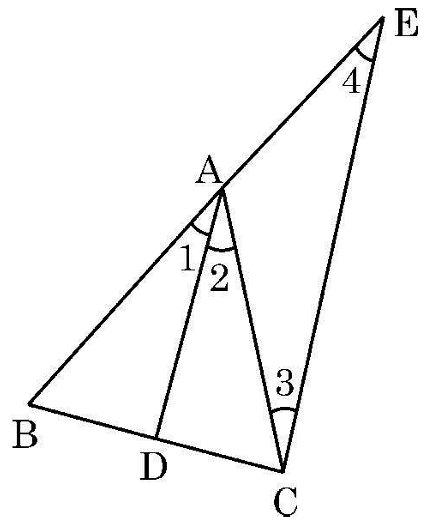 theorem.
Use the theorem to do the following:
In a triangle ABC, AD is the angle bisector of angle A. BA is produced to E such that \(CE \parallel AD\). Prove that \(\frac{BD}{DC} = \frac{BA}{AC}\).
theorem.Use the theorem to do the following:
In a triangle ABC, AD is the angle bisector of angle A. BA is produced to E such that \(CE \parallel AD\). Prove that \(\frac{BD}{DC} = \frac{BA}{AC}\).
Theorem: If a line is drawn parallel to one side of a triangle to
intersect the other two sides in distinct points, the other two sides are divided in the same
ratio.
Proof: Since \(AD \parallel CE\) and AC is transversal, \(\angle DAC = \angle ACE\) (Alternate angles).
Since \(AD \parallel CE\) and BE is transversal, \(\angle BAD = \angle AEC\) (Corresponding angles).
Given AD bisects \(\angle A\), so \(\angle BAD = \angle DAC\).
Therefore, \(\angle ACE = \angle AEC\). In \(\Delta ACE\), sides opposite equal angles are equal, so \(AC = AE\).
In \(\Delta BCE\), since \(AD \parallel CE\), by BPT: \(\frac{BD}{DC} = \frac{BA}{AE}\).
Substituting \(AE = AC\), we get \(\frac{BD}{DC} = \frac{BA}{AC}\).
Proof: Since \(AD \parallel CE\) and AC is transversal, \(\angle DAC = \angle ACE\) (Alternate angles).
Since \(AD \parallel CE\) and BE is transversal, \(\angle BAD = \angle AEC\) (Corresponding angles).
Given AD bisects \(\angle A\), so \(\angle BAD = \angle DAC\).
Therefore, \(\angle ACE = \angle AEC\). In \(\Delta ACE\), sides opposite equal angles are equal, so \(AC = AE\).
In \(\Delta BCE\), since \(AD \parallel CE\), by BPT: \(\frac{BD}{DC} = \frac{BA}{AE}\).
Substituting \(AE = AC\), we get \(\frac{BD}{DC} = \frac{BA}{AC}\).
1 Mark
Q15. In the adjoining figure, \(PQ||XY||BC\),
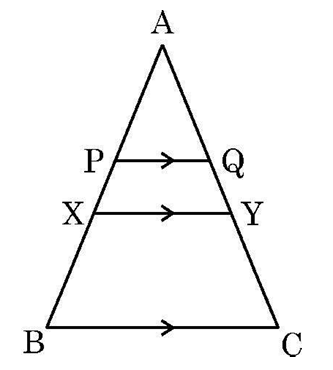 \(AP = 2\) cm, \(PX = 1.5\) cm and \(BX = 4\) cm. If \(QY = 0.75\) cm, then \(AQ + CY =\)
\(AP = 2\) cm, \(PX = 1.5\) cm and \(BX = 4\) cm. If \(QY = 0.75\) cm, then \(AQ + CY =\)
Using BPT (Basic Proportionality Theorem):
In \(\Delta AXY\), \(PQ||XY \Rightarrow \frac{AP}{PX} = \frac{AQ}{QY}\)
\(\frac{2}{1.5} = \frac{AQ}{0.75} \Rightarrow AQ = \frac{2 \times 0.75}{1.5} = 1\) cm.
In \(\Delta ABC\), \(XY||BC \Rightarrow \frac{AX}{XB} = \frac{AY}{YC}\)
\(AX = AP + PX = 2 + 1.5 = 3.5\), \(XB = 4\). \(AY = AQ + QY = 1 + 0.75 = 1.75\).
Using BPT: \(\frac{PX}{XB} = \frac{QY}{YC}\)
\(\frac{1.5}{4} = \frac{0.75}{YC} \Rightarrow YC = \frac{4 \times 0.75}{1.5} = 2\) cm.
Therefore, \(AQ + CY = 1 + 2 = 3\) cm.
Correct Option: (C)
In \(\Delta AXY\), \(PQ||XY \Rightarrow \frac{AP}{PX} = \frac{AQ}{QY}\)
\(\frac{2}{1.5} = \frac{AQ}{0.75} \Rightarrow AQ = \frac{2 \times 0.75}{1.5} = 1\) cm.
In \(\Delta ABC\), \(XY||BC \Rightarrow \frac{AX}{XB} = \frac{AY}{YC}\)
\(AX = AP + PX = 2 + 1.5 = 3.5\), \(XB = 4\). \(AY = AQ + QY = 1 + 0.75 = 1.75\).
Using BPT: \(\frac{PX}{XB} = \frac{QY}{YC}\)
\(\frac{1.5}{4} = \frac{0.75}{YC} \Rightarrow YC = \frac{4 \times 0.75}{1.5} = 2\) cm.
Therefore, \(AQ + CY = 1 + 2 = 3\) cm.
Correct Option: (C)
1 Mark
Q16. Given \(\Delta ABC \sim \Delta PQR\),
\(\angle A = 30�\)
and \(\angle Q = 90�\). The value of \((\angle R + \angle B)\) is
Since \(\Delta ABC \sim \Delta PQR\):
\(\angle A = \angle P = 30�\)
\(\angle B = \angle Q = 90�\)
In \(\Delta PQR\), \(\angle R = 180 - (30 + 90) = 60�\).
Value of \(\angle R + \angle B = 60� + 90� = 150�\).
Correct Option: (C)
\(\angle A = \angle P = 30�\)
\(\angle B = \angle Q = 90�\)
In \(\Delta PQR\), \(\angle R = 180 - (30 + 90) = 60�\).
Value of \(\angle R + \angle B = 60� + 90� = 150�\).
Correct Option: (C)
2 Marks
Q23. In the adjoining figure, \(AP = 1\) cm,
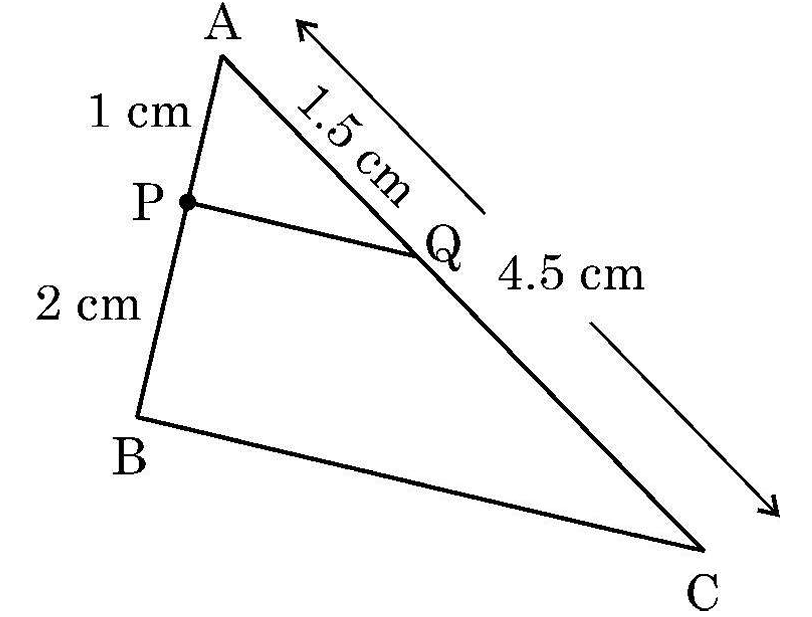 \(BP = 2\) cm, \(AQ = 1.5\) cm and \(AC = 4.5\) cm. Prove that \(\Delta APQ \sim \Delta ABC\). Hence
find the length of \(PQ\), if \(BC = 3.6\) cm.
\(BP = 2\) cm, \(AQ = 1.5\) cm and \(AC = 4.5\) cm. Prove that \(\Delta APQ \sim \Delta ABC\). Hence
find the length of \(PQ\), if \(BC = 3.6\) cm.
\(BP = 2\) cm, \(AQ = 1.5\) cm and \(AC = 4.5\) cm. Prove that \(\Delta APQ \sim \Delta ABC\). Hence
find the length of \(PQ\), if \(BC = 3.6\) cm.
\(AB = AP + BP = 1 + 2 = 3\) cm.
Check ratio of sides:
\(\frac{AP}{AB} = \frac{1}{3}\)
\(\frac{AQ}{AC} = \frac{1.5}{4.5} = \frac{1}{3}\)
In \(\Delta APQ\) and \(\Delta ABC\):
1. \(\frac{AP}{AB} = \frac{AQ}{AC}\) (Proved above)
2. \(\angle A = \angle A\) (Common)
By SAS Similarity Criterion, \(\Delta APQ \sim \Delta ABC\).
Finding PQ:
Since triangles are similar, corresponding sides are proportional:
\(\frac{PQ}{BC} = \frac{AP}{AB}\)
\(\frac{PQ}{3.6} = \frac{1}{3}\)
\(PQ = \frac{3.6}{3} = 1.2\) cm.
Check ratio of sides:
\(\frac{AP}{AB} = \frac{1}{3}\)
\(\frac{AQ}{AC} = \frac{1.5}{4.5} = \frac{1}{3}\)
In \(\Delta APQ\) and \(\Delta ABC\):
1. \(\frac{AP}{AB} = \frac{AQ}{AC}\) (Proved above)
2. \(\angle A = \angle A\) (Common)
By SAS Similarity Criterion, \(\Delta APQ \sim \Delta ABC\).
Finding PQ:
Since triangles are similar, corresponding sides are proportional:
\(\frac{PQ}{BC} = \frac{AP}{AB}\)
\(\frac{PQ}{3.6} = \frac{1}{3}\)
\(PQ = \frac{3.6}{3} = 1.2\) cm.
5 Marks
Q32 (a). If a line drawn parallel to one side
of triangle intersecting the other two sides in distinct points divides the two sides in the same
ratio, then it is parallel to third side. State and prove the converse of the above statement.
OR
Q32 (b)
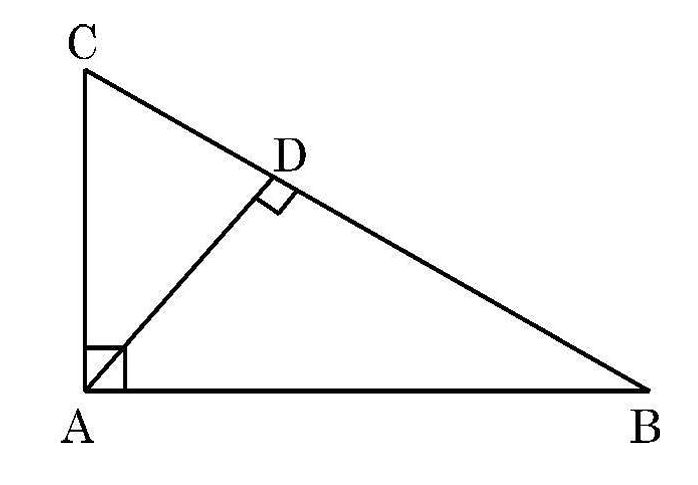 . In the adjoining figure, \(\Delta
CAB\) is a right triangle, right angled at A and \(AD \perp BC\). Prove that \(\Delta ADB \sim
\Delta CDA\). Further, if \(BC = 10\) cm and \(CD = 2\) cm, find the length of \(AD\).
. In the adjoining figure, \(\Delta
CAB\) is a right triangle, right angled at A and \(AD \perp BC\). Prove that \(\Delta ADB \sim
\Delta CDA\). Further, if \(BC = 10\) cm and \(CD = 2\) cm, find the length of \(AD\).
. In the adjoining figure, \(\Delta
CAB\) is a right triangle, right angled at A and \(AD \perp BC\). Prove that \(\Delta ADB \sim
\Delta CDA\). Further, if \(BC = 10\) cm and \(CD = 2\) cm, find the length of \(AD\).
Solution Q32 (a):
Statement: If a line divides any two sides of a triangle in the same ratio, then the line is parallel to the third side.
Given: A triangle ABC and a line \(l\) intersecting AB at D and AC at E, such that \(\frac{AD}{DB} = \frac{AE}{EC}\).
To Prove: \(DE || BC\).
Proof:
Assume \(DE\) is not parallel to \(BC\).
Then, there must be another line passing through D, say \(DF\), such that \(DF || BC\).
By Basic Proportionality Theorem (Thales Theorem), since \(DF || BC\):
\(\frac{AD}{DB} = \frac{AF}{FC}\) --- (i)
But given \(\frac{AD}{DB} = \frac{AE}{EC}\) --- (ii)
From (i) and (ii), \(\frac{AF}{FC} = \frac{AE}{EC}\).
Adding 1 to both sides: \(\frac{AF}{FC} + 1 = \frac{AE}{EC} + 1\)
\(\frac{AF+FC}{FC} = \frac{AE+EC}{EC}\)
\(\frac{AC}{FC} = \frac{AC}{EC}\)
\(\Rightarrow FC = EC\).
This is only possible if points F and E coincide.
Hence, our assumption was wrong, and \(DE || BC\). Proved.
Solution Q32 (b):
To Prove: \(\Delta ADB \sim \Delta CDA\)
Let \(\angle ABD = x\).
In \(\Delta ADB\) (Right angled at D), \(\angle DAB = 90 - x\).
Since \(\angle A = 90�\), \(\angle CAD = 90 - \angle DAB = 90 - (90 - x) = x\).
In \(\Delta ADB\) and \(\Delta CDA\):
1. \(\angle ADB = \angle CDA = 90�\) (Given)
2. \(\angle ABD = \angle CAD = x\) (Proved)
By AA Similarity, \(\Delta ADB \sim \Delta CDA\).
Find AD:
Since \(\Delta ADB \sim \Delta CDA\):
\(\frac{AD}{CD} = \frac{DB}{DA}\)
\(AD^2 = BD \times CD\)
Given \(BC = 10\) and \(CD = 2\), so \(BD = BC - CD = 10 - 2 = 8\) cm.
\(AD^2 = 8 \times 2 = 16\)
\(AD = 4\) cm.
Statement: If a line divides any two sides of a triangle in the same ratio, then the line is parallel to the third side.
Given: A triangle ABC and a line \(l\) intersecting AB at D and AC at E, such that \(\frac{AD}{DB} = \frac{AE}{EC}\).
To Prove: \(DE || BC\).
Proof:
Assume \(DE\) is not parallel to \(BC\).
Then, there must be another line passing through D, say \(DF\), such that \(DF || BC\).
By Basic Proportionality Theorem (Thales Theorem), since \(DF || BC\):
\(\frac{AD}{DB} = \frac{AF}{FC}\) --- (i)
But given \(\frac{AD}{DB} = \frac{AE}{EC}\) --- (ii)
From (i) and (ii), \(\frac{AF}{FC} = \frac{AE}{EC}\).
Adding 1 to both sides: \(\frac{AF}{FC} + 1 = \frac{AE}{EC} + 1\)
\(\frac{AF+FC}{FC} = \frac{AE+EC}{EC}\)
\(\frac{AC}{FC} = \frac{AC}{EC}\)
\(\Rightarrow FC = EC\).
This is only possible if points F and E coincide.
Hence, our assumption was wrong, and \(DE || BC\). Proved.
Solution Q32 (b):
To Prove: \(\Delta ADB \sim \Delta CDA\)
Let \(\angle ABD = x\).
In \(\Delta ADB\) (Right angled at D), \(\angle DAB = 90 - x\).
Since \(\angle A = 90�\), \(\angle CAD = 90 - \angle DAB = 90 - (90 - x) = x\).
In \(\Delta ADB\) and \(\Delta CDA\):
1. \(\angle ADB = \angle CDA = 90�\) (Given)
2. \(\angle ABD = \angle CAD = x\) (Proved)
By AA Similarity, \(\Delta ADB \sim \Delta CDA\).
Find AD:
Since \(\Delta ADB \sim \Delta CDA\):
\(\frac{AD}{CD} = \frac{DB}{DA}\)
\(AD^2 = BD \times CD\)
Given \(BC = 10\) and \(CD = 2\), so \(BD = BC - CD = 10 - 2 = 8\) cm.
\(AD^2 = 8 \times 2 = 16\)
\(AD = 4\) cm.
Board Exam 2024
2 Marks
Find the LCM and HCF of 6 and 20 by the prime factorization method.
\( 6 = 2 \times 3 \)
\( 20 = 2^2 \times 5 \)
HCF = \( 2 \) (lowest power of common factors)
LCM = \( 2^2 \times 3 \times 5 = 60 \)
\( 20 = 2^2 \times 5 \)
HCF = \( 2 \) (lowest power of common factors)
LCM = \( 2^2 \times 3 \times 5 = 60 \)
Board Exam 2023
3 Marks
Prove that \( 5 - \sqrt{3} \) is irrational, given that \( \sqrt{3} \) is
irrational.
Assume \( 5 - \sqrt{3} \) is rational, say \( = r \).
Then \( \sqrt{3} = 5 - r \), which is rational (difference of two rationals).
Contradiction: \( \sqrt{3} \) is given to be irrational.
∴ \( 5 - \sqrt{3} \) is irrational. ∎
Then \( \sqrt{3} = 5 - r \), which is rational (difference of two rationals).
Contradiction: \( \sqrt{3} \) is given to be irrational.
∴ \( 5 - \sqrt{3} \) is irrational. ∎
Board Exam 2022
2 Marks
Explain why \( 7 \times 11 \times 13 + 13 \) is a composite number.
\( 7 \times 11 \times 13 + 13 = 13(7 \times 11 + 1) = 13 \times 78 \)
Since it has factors other than 1 and itself, it is composite.
Since it has factors other than 1 and itself, it is composite.