
Board Exam 2025
1 Mark
Q9. The 6th term of the AP \(\sqrt{27},
\sqrt{75}, \sqrt{147}, ...\) is :
\(\sqrt{27} = 3\sqrt{3}\), \(\sqrt{75} = 5\sqrt{3}\), \(\sqrt{147} = 7\sqrt{3}\).
AP: \(3\sqrt{3}, 5\sqrt{3}, 7\sqrt{3}...\)
\(a = 3\sqrt{3}, d = 2\sqrt{3}\).
\(a_6 = a + 5d = 3\sqrt{3} + 10\sqrt{3} = 13\sqrt{3} = \sqrt{169 \times 3} = \sqrt{507}\).
Answer: (D)
AP: \(3\sqrt{3}, 5\sqrt{3}, 7\sqrt{3}...\)
\(a = 3\sqrt{3}, d = 2\sqrt{3}\).
\(a_6 = a + 5d = 3\sqrt{3} + 10\sqrt{3} = 13\sqrt{3} = \sqrt{169 \times 3} = \sqrt{507}\).
Answer: (D)
1 Mark
Q11. If the 23rd term of an AP exceeds its
16th term by 21, then the common difference is :
\(a_{23} - a_{16} = 21\).
\((a + 22d) - (a + 15d) = 21\).
\(7d = 21 \Rightarrow d = 3\).
Answer: (C)
\((a + 22d) - (a + 15d) = 21\).
\(7d = 21 \Rightarrow d = 3\).
Answer: (C)
4 Marks
Q36. Case Study - 1
In the month of September, villagers of Ankurhut were falling ill... number of Paracetamol sold in different shops were all 3-digit numbers, divisible by 13, taken in order. (i) How many Paracetamols were sold by the 7th pharmacy? [1 Mark]
(ii) What was the difference between the number of Paracetamols sold by the 14th and the 9th pharmacy? [1 Mark]
(iii) (a) How many Paracetamols were sold by the 9th pharmacy from the last? [2 Marks]
In the month of September, villagers of Ankurhut were falling ill... number of Paracetamol sold in different shops were all 3-digit numbers, divisible by 13, taken in order. (i) How many Paracetamols were sold by the 7th pharmacy? [1 Mark]
(ii) What was the difference between the number of Paracetamols sold by the 14th and the 9th pharmacy? [1 Mark]
(iii) (a) How many Paracetamols were sold by the 9th pharmacy from the last? [2 Marks]
OR
(iii) (b) What was the total number of Paracetamols sold in that week (across all pharmacies)? [2
Marks]
Sequence of 3-digit numbers divisible by 13: 104, 117, ... 988.
\(a=104, d=13\). Last term \(l=988\).
Number of terms \(n\): \(988 = 104 + (n-1)13 \Rightarrow 884 = (n-1)13 \Rightarrow n-1 = 68 \Rightarrow n=69\).
(i) \(a_7 = 104 + 6(13) = 104 + 78 = 182\).
(ii) \(a_{14} - a_9 = 5d = 5(13) = 65\).
(iii) (a) 9th form last: \(l - (9-1)d = 988 - 8(13) = 988 - 104 = 884\).
(iii) (b) Total Sales = Sum of AP.
\(S_{69} = \frac{69}{2}(a+l) = \frac{69}{2}(104+988) = \frac{69}{2}(1092) = 69 \times 546 = 37674\).
\(a=104, d=13\). Last term \(l=988\).
Number of terms \(n\): \(988 = 104 + (n-1)13 \Rightarrow 884 = (n-1)13 \Rightarrow n-1 = 68 \Rightarrow n=69\).
(i) \(a_7 = 104 + 6(13) = 104 + 78 = 182\).
(ii) \(a_{14} - a_9 = 5d = 5(13) = 65\).
(iii) (a) 9th form last: \(l - (9-1)d = 988 - 8(13) = 988 - 104 = 884\).
(iii) (b) Total Sales = Sum of AP.
\(S_{69} = \frac{69}{2}(a+l) = \frac{69}{2}(104+988) = \frac{69}{2}(1092) = 69 \times 546 = 37674\).
1 Mark
Q17. The \(11^{th}\) and \(13^{th}\) term of
an
AP are 39 and 45, respectively. What is the common difference of the AP?
\(a_{11} = 39 \Rightarrow a + 10d = 39\) ---(1)
\(a_{13} = 45 \Rightarrow a + 12d = 45\) ---(2)
Subtract (1) from (2): \(2d = 6 \Rightarrow d = 3\).
Answer: (D)
\(a_{13} = 45 \Rightarrow a + 12d = 45\) ---(2)
Subtract (1) from (2): \(2d = 6 \Rightarrow d = 3\).
Answer: (D)
4 Marks
Q37. Case Study - 2 :
 A school is organizing
a
charity run to raise funds for a local hospital. The run is planned as a series of rounds around a
track, with each round being 300 metres. To make the event more challenging and engaging, the
organizers
decide to increase the distance of each subsequent round by 50 metres. For example, the second round
will be 350 metres, the third round will be 400 metres and so on. The total number of rounds planned
is
10.
A school is organizing
a
charity run to raise funds for a local hospital. The run is planned as a series of rounds around a
track, with each round being 300 metres. To make the event more challenging and engaging, the
organizers
decide to increase the distance of each subsequent round by 50 metres. For example, the second round
will be 350 metres, the third round will be 400 metres and so on. The total number of rounds planned
is
10.
Based on the information given above, answer the following questions:
(i) Write the fourth, fifth and sixth term of the Arithmetic Progression so formed. [1 Mark]
(ii) Determine the distance of the \(8^{th}\) round. [1 Mark]
(iii) (a) Find the total distance run after completing all 10 rounds. [2 Marks]
A school is organizing
a
charity run to raise funds for a local hospital. The run is planned as a series of rounds around a
track, with each round being 300 metres. To make the event more challenging and engaging, the
organizers
decide to increase the distance of each subsequent round by 50 metres. For example, the second round
will be 350 metres, the third round will be 400 metres and so on. The total number of rounds planned
is
10.Based on the information given above, answer the following questions:
(i) Write the fourth, fifth and sixth term of the Arithmetic Progression so formed. [1 Mark]
(ii) Determine the distance of the \(8^{th}\) round. [1 Mark]
(iii) (a) Find the total distance run after completing all 10 rounds. [2 Marks]
OR
(iii) (b) If a runner completes only the first 6 rounds, what is the total distance run by the
runner?
[2 Marks]
AP Series: \(300, 350, 400, \dots\)
Here \(a = 300\), \(d = 50\).
(i) Fourth, Fifth, Sixth Terms:
\(a_4 = a + 3d = 300 + 3(50) = 450\) m.
\(a_5 = a + 4d = 300 + 4(50) = 500\) m.
\(a_6 = a + 5d = 300 + 5(50) = 550\) m.
(ii) Distance of 8th round (\(a_8\)):
\(a_8 = a + 7d = 300 + 7(50) = 300 + 350 = 650\) m.
(iii) (a) Total distance after 10 rounds (\(S_{10}\)):
\(S_n = \frac{n}{2}[2a + (n-1)d]\)
\(S_{10} = \frac{10}{2}[2(300) + 9(50)] = 5[600 + 450] = 5(1050) = 5250\) m.
(iii) (b) Total distance after 6 rounds (\(S_6\)):
\(S_6 = \frac{6}{2}[2(300) + 5(50)] = 3[600 + 250] = 3(850) = 2550\) m.
Here \(a = 300\), \(d = 50\).
(i) Fourth, Fifth, Sixth Terms:
\(a_4 = a + 3d = 300 + 3(50) = 450\) m.
\(a_5 = a + 4d = 300 + 4(50) = 500\) m.
\(a_6 = a + 5d = 300 + 5(50) = 550\) m.
(ii) Distance of 8th round (\(a_8\)):
\(a_8 = a + 7d = 300 + 7(50) = 300 + 350 = 650\) m.
(iii) (a) Total distance after 10 rounds (\(S_{10}\)):
\(S_n = \frac{n}{2}[2a + (n-1)d]\)
\(S_{10} = \frac{10}{2}[2(300) + 9(50)] = 5[600 + 450] = 5(1050) = 5250\) m.
(iii) (b) Total distance after 6 rounds (\(S_6\)):
\(S_6 = \frac{6}{2}[2(300) + 5(50)] = 3[600 + 250] = 3(850) = 2550\) m.
1 Mark
Q12. The \(10^{th}\) term of the AP \(5,
\frac{19}{4}, \frac{9}{2}, \frac{17}{4}, \dots\) is :
\(a = 5\).
\(d = \frac{19}{4} - 5 = \frac{19-20}{4} = -\frac{1}{4}\).
\(a_{10} = a + 9d = 5 + 9(-\frac{1}{4}) = \frac{20-9}{4} = \frac{11}{4}\).
Answer: (A)
\(d = \frac{19}{4} - 5 = \frac{19-20}{4} = -\frac{1}{4}\).
\(a_{10} = a + 9d = 5 + 9(-\frac{1}{4}) = \frac{20-9}{4} = \frac{11}{4}\).
Answer: (A)
1 Mark
Q19. Assertion (A): Common
difference of the AP: \(5, 1, -3, -7, \dots\) is 4.
Reason (R): Common difference of the AP: \(a_1, a_2, \dots\) is obtained by \(d = a_n - a_{n-1}\).(D) A is false but R is true
Reason (R): Common difference of the AP: \(a_1, a_2, \dots\) is obtained by \(d = a_n - a_{n-1}\).
For AP: \(5, 1, -3, d = 1 - 5 = -4\).
Assertion says \(d = 4\), which is False.
Reason is True.
Answer: (D)
Assertion says \(d = 4\), which is False.
Reason is True.
Answer: (D)
2 Marks
Q27. Find the sum of all 3-digit natural
numbers
which are divisible by 11.
Smallest 3-digit divisible by 11: 110.
Largest 3-digit divisible by 11: 990.
AP: \(110, 121, \dots, 990\).
\(a_n = a + (n-1)d \Rightarrow 990 = 110 + (n-1)11\).
\(880 = (n-1)11 \Rightarrow 80 = n-1 \Rightarrow n = 81\).
Sum \(S_n = \frac{n}{2}(a+l) = \frac{81}{2}(110 + 990) = \frac{81}{2}(1100) = 81 \times 550 = 44550\).
Largest 3-digit divisible by 11: 990.
AP: \(110, 121, \dots, 990\).
\(a_n = a + (n-1)d \Rightarrow 990 = 110 + (n-1)11\).
\(880 = (n-1)11 \Rightarrow 80 = n-1 \Rightarrow n = 81\).
Sum \(S_n = \frac{n}{2}(a+l) = \frac{81}{2}(110 + 990) = \frac{81}{2}(1100) = 81 \times 550 = 44550\).
5 Marks
Q34 (a). The sum of the third term and the
seventh term of an AP is 6 and their product is 8. Find the sum of the first sixteen terms of the
AP.
OR
Q34 (b). The minimum age of children eligible
to participate in a painting competition is 8 years. It is observed that the age of the youngest boy
was 8 years and the ages of the participants, when seated in order of age, have a common difference
of 4 months. If the sum of the ages of all the participants is 168 years, find the age of the eldest
participant in the painting competition.
(a) \(a_3 + a_7 = 6 \Rightarrow 2a + 8d = 6 \Rightarrow a = 3 - 4d\).
\(a_3 \cdot a_7 = 8 \Rightarrow (a + 2d)(a + 6d) = 8\).
Sub \(a\): \((3 - 4d + 2d)(3 - 4d + 6d) = 8 \Rightarrow (3 - 2d)(3 + 2d) = 8\).
\(9 - 4d^2 = 8 \Rightarrow 4d^2 = 1 \Rightarrow d = \pm 1/2\).
Case 1: \(d = 1/2, a = 1. S_{16} = \frac{16}{2}[2(1) + 15(0.5)] = 8(2 + 7.5) = 76\).
Case 2: \(d = -1/2, a = 5. S_{16} = \frac{16}{2}[2(5) + 15(-0.5)] = 8(10 - 7.5) = 20\).
(b) \(a = 8, d = 4/12 = 1/3\) year. \(S_n = 168\).
\(\frac{n}{2}[16 + (n - 1)\frac{1}{3}] = 168 \Rightarrow n[48 + n - 1] = 1008 \Rightarrow n^2 + 47n - 1008 = 0\).
\((n + 63)(n - 16) = 0 \Rightarrow n = 16\).
Age of eldest (nth term) \(= a + 15d = 8 + 15(1/3) = 13\) years.
\(a_3 \cdot a_7 = 8 \Rightarrow (a + 2d)(a + 6d) = 8\).
Sub \(a\): \((3 - 4d + 2d)(3 - 4d + 6d) = 8 \Rightarrow (3 - 2d)(3 + 2d) = 8\).
\(9 - 4d^2 = 8 \Rightarrow 4d^2 = 1 \Rightarrow d = \pm 1/2\).
Case 1: \(d = 1/2, a = 1. S_{16} = \frac{16}{2}[2(1) + 15(0.5)] = 8(2 + 7.5) = 76\).
Case 2: \(d = -1/2, a = 5. S_{16} = \frac{16}{2}[2(5) + 15(-0.5)] = 8(10 - 7.5) = 20\).
(b) \(a = 8, d = 4/12 = 1/3\) year. \(S_n = 168\).
\(\frac{n}{2}[16 + (n - 1)\frac{1}{3}] = 168 \Rightarrow n[48 + n - 1] = 1008 \Rightarrow n^2 + 47n - 1008 = 0\).
\((n + 63)(n - 16) = 0 \Rightarrow n = 16\).
Age of eldest (nth term) \(= a + 15d = 8 + 15(1/3) = 13\) years.
4 Marks
Q38. Cable cars at hill stations are one of
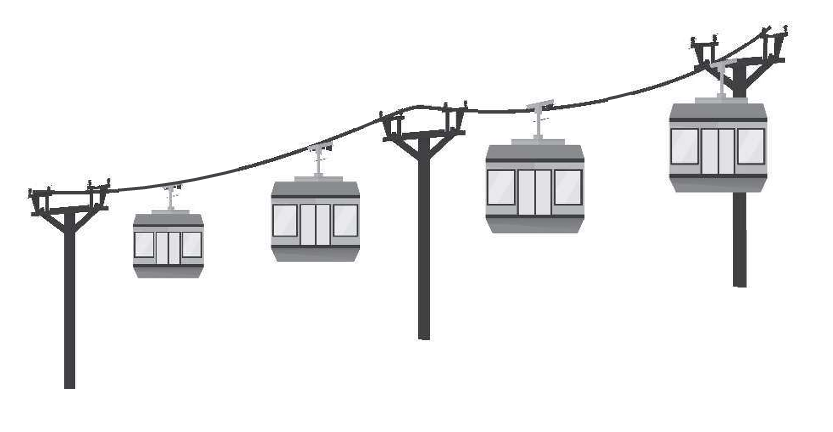 the major tourist attractions. On a hill station, the length of cable car ride from base point to
top most point on the hill is 5000 m. Poles are installed at equal intervals on the way to provide
support to the cables on which car moves.
the major tourist attractions. On a hill station, the length of cable car ride from base point to
top most point on the hill is 5000 m. Poles are installed at equal intervals on the way to provide
support to the cables on which car moves.
The distance of first pole from base point is 200 m and subsequent poles are installed at equal interval of 150 m. Further, the distance of last pole from the top is 300 m. Based on above information, answer the following questions using Arithmetic Progression :
(i) Find the distance of \(10^{th}\) pole from the base.
(ii) Find the distance between \(15^{th}\) pole and \(25^{th}\) pole.
(iii) (a) Find the time taken by cable car to reach \(15^{th}\) pole from the top if it is moving at the speed of 5m/sec and coming from top.
the major tourist attractions. On a hill station, the length of cable car ride from base point to
top most point on the hill is 5000 m. Poles are installed at equal intervals on the way to provide
support to the cables on which car moves.The distance of first pole from base point is 200 m and subsequent poles are installed at equal interval of 150 m. Further, the distance of last pole from the top is 300 m. Based on above information, answer the following questions using Arithmetic Progression :
(i) Find the distance of \(10^{th}\) pole from the base.
(ii) Find the distance between \(15^{th}\) pole and \(25^{th}\) pole.
(iii) (a) Find the time taken by cable car to reach \(15^{th}\) pole from the top if it is moving at the speed of 5m/sec and coming from top.
OR
(iii) (b) Find the total number of poles installed along the entire journey.
(i) \(a_{10} = 200 + 9(150) = 1550\) m.
(ii) \(10d = 1500\) m.
(iii)(b) Last pole pos = \(5000-300=4700\). \(200+(n-1)150=4700 \Rightarrow n=31\).
(iii)(a) 15th from top corresponds to 17th from base. Pos = 2600. Dist from top = 2400. Time = 480s.
(ii) \(10d = 1500\) m.
(iii)(b) Last pole pos = \(5000-300=4700\). \(200+(n-1)150=4700 \Rightarrow n=31\).
(iii)(a) 15th from top corresponds to 17th from base. Pos = 2600. Dist from top = 2400. Time = 480s.
1 Mark
Q20. Assertion (A): For an
A.P.
3, 6, 9, ..., 198, 10th term from the end is 168.
Reason (R): If 'a' and 'l' are the first term and last term of an A.P. with common difference 'd', then nth term from the end of the given A.P. is \(l - (n-1)d\).
Reason (R): If 'a' and 'l' are the first term and last term of an A.P. with common difference 'd', then nth term from the end of the given A.P. is \(l - (n-1)d\).
\(l = 198, d = 3\).
10th term from end = \(198 - (10-1)(3) = 198 - 27 = 171\).
Assertion states 168, which is incorrect. Reason formula is correct.
Correct Option: (D) A is false, but R is true.
10th term from end = \(198 - (10-1)(3) = 198 - 27 = 171\).
Assertion states 168, which is incorrect. Reason formula is correct.
Correct Option: (D) A is false, but R is true.
4 Marks
Q38. In an equilateral triangle of side 10
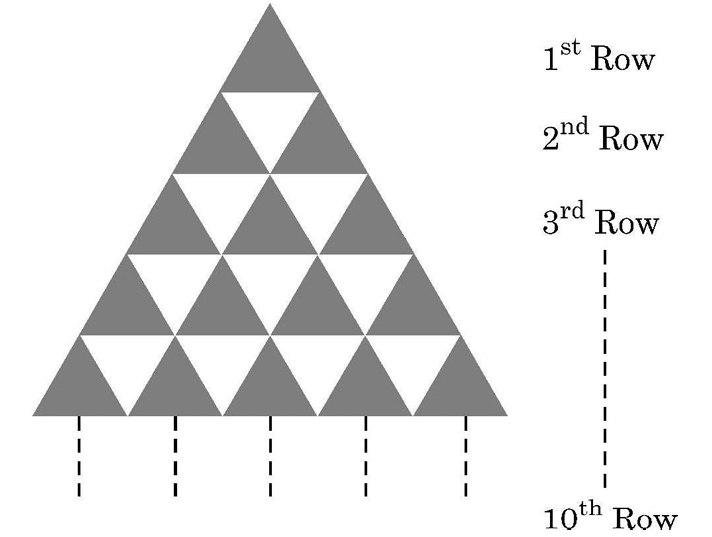 cm,
equilateral triangles of side 1 cm are formed as shown in the figure below, such that there is one
triangle in the first row, three triangles in the second row, five triangles in the third row and so
on.
Based on given information, answer the following questions using Arithmetic Progression.
cm,
equilateral triangles of side 1 cm are formed as shown in the figure below, such that there is one
triangle in the first row, three triangles in the second row, five triangles in the third row and so
on.
Based on given information, answer the following questions using Arithmetic Progression.
(i) How many triangles will be there in bottom most row?
(ii) How many triangles will be there in fourth row from the bottom?
(iii) (a) Find the total number of triangles of side 1 cm each till 8th row.
cm,
equilateral triangles of side 1 cm are formed as shown in the figure below, such that there is one
triangle in the first row, three triangles in the second row, five triangles in the third row and so
on.
Based on given information, answer the following questions using Arithmetic Progression.(i) How many triangles will be there in bottom most row?
(ii) How many triangles will be there in fourth row from the bottom?
(iii) (a) Find the total number of triangles of side 1 cm each till 8th row.
OR
(iii) (b) How many more number of triangles are there from 5th row to 10th row than in first 4 rows?
Show working.
Sequence of triangles: 1, 3, 5... This is an AP with \(a = 1, d = 2\).
Since side is 10cm and small triangles are 1cm, there are 10 rows.
(i) Bottom row is 10th row: \(a_{10} = 1 + (10-1)2 = 1 + 18 = 19\).
(ii) 4th row from bottom means 7th row: (Rows: 10, 9, 8, 7). \(a_7 = 1 + 6(2) = 13\).
(iii)(a) Total triangles in first 8 rows: \(S_n = n^2\) for odd numbers. \(S_8 = 8^2 = 64\).
(iii)(b) Triangles in 5th to 10th row: \(S_{10} - S_4 = 10^2 - 4^2 = 100 - 16 = 84\).
Triangles in first 4 rows = \(S_4 = 16\).
Difference = \(84 - 16 = 68\).
Since side is 10cm and small triangles are 1cm, there are 10 rows.
(i) Bottom row is 10th row: \(a_{10} = 1 + (10-1)2 = 1 + 18 = 19\).
(ii) 4th row from bottom means 7th row: (Rows: 10, 9, 8, 7). \(a_7 = 1 + 6(2) = 13\).
(iii)(a) Total triangles in first 8 rows: \(S_n = n^2\) for odd numbers. \(S_8 = 8^2 = 64\).
(iii)(b) Triangles in 5th to 10th row: \(S_{10} - S_4 = 10^2 - 4^2 = 100 - 16 = 84\).
Triangles in first 4 rows = \(S_4 = 16\).
Difference = \(84 - 16 = 68\).
4 Marks
Q38. In order to organise, Annual Sports Day,
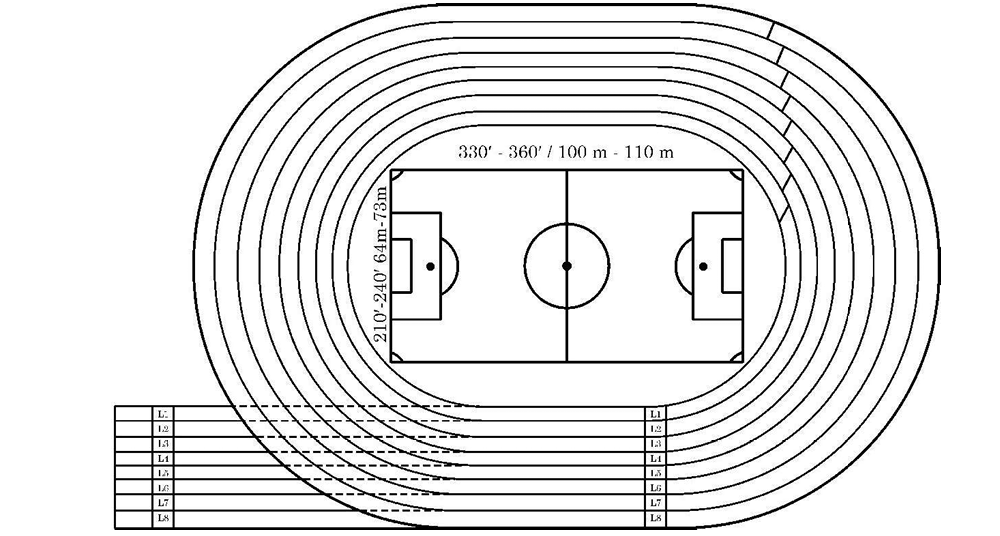 a school prepared an eight lane running track with an integrated football field inside the track
area as shown below :
The length of innermost lane of the track is 400 m and each subsequent lane is 7.6 m longer than the
preceding lane.
a school prepared an eight lane running track with an integrated football field inside the track
area as shown below :
The length of innermost lane of the track is 400 m and each subsequent lane is 7.6 m longer than the
preceding lane.
Based on given information, answer the following questions, using concept of Arithmetic Progression.
(i) What is the length of the \(6^{th}\) lane?
(ii) How long is the \(8^{th}\) lane than that of \(4^{th}\) lane?
(iii) (a) While practicing for a race, a student took one round each in first six lanes. Find the total distance covered by the student.
a school prepared an eight lane running track with an integrated football field inside the track
area as shown below :
The length of innermost lane of the track is 400 m and each subsequent lane is 7.6 m longer than the
preceding lane.Based on given information, answer the following questions, using concept of Arithmetic Progression.
(i) What is the length of the \(6^{th}\) lane?
(ii) How long is the \(8^{th}\) lane than that of \(4^{th}\) lane?
(iii) (a) While practicing for a race, a student took one round each in first six lanes. Find the total distance covered by the student.
OR
(iii) (b) A student took one round each in lane 4 to lane 8. Find the total distance covered by the
student.
\(a = 400\) m (Innermost lane).
\(d = 7.6\) m (Each subsequent lane increase).
(i) Length of 6th lane (\(a_6\)):
\(a_6 = a + 5d = 400 + 5(7.6) = 400 + 38 = 438\) m.
(ii) Difference between 8th and 4th lane:
\(a_8 - a_4 = (a+7d) - (a+3d) = 4d = 4(7.6) = 30.4\) m.
(iii) (a) Total distance in first 6 lanes (\(S_6\)):
\(S_6 = \frac{6}{2}[2a + 5d] = 3[2(400) + 5(7.6)] = 3[800 + 38] = 3(838) = 2514\) m.
(iii) (b) Distance from lane 4 to 8:
Lanes involved: 4, 5, 6, 7, 8 (5 lanes).
Sum = \(S_8 - S_3\).
Alternatively, Sum of AP with first term \(A = a_4\) and \(n=5\).
\(a_4 = 400 + 3(7.6) = 400 + 22.8 = 422.8\) m.
\(Sum = \frac{5}{2}[2(422.8) + 4(7.6)] = \frac{5}{2}[845.6 + 30.4] = \frac{5}{2}[876] = 5(438) = 2190\) m.
\(d = 7.6\) m (Each subsequent lane increase).
(i) Length of 6th lane (\(a_6\)):
\(a_6 = a + 5d = 400 + 5(7.6) = 400 + 38 = 438\) m.
(ii) Difference between 8th and 4th lane:
\(a_8 - a_4 = (a+7d) - (a+3d) = 4d = 4(7.6) = 30.4\) m.
(iii) (a) Total distance in first 6 lanes (\(S_6\)):
\(S_6 = \frac{6}{2}[2a + 5d] = 3[2(400) + 5(7.6)] = 3[800 + 38] = 3(838) = 2514\) m.
(iii) (b) Distance from lane 4 to 8:
Lanes involved: 4, 5, 6, 7, 8 (5 lanes).
Sum = \(S_8 - S_3\).
Alternatively, Sum of AP with first term \(A = a_4\) and \(n=5\).
\(a_4 = 400 + 3(7.6) = 400 + 22.8 = 422.8\) m.
\(Sum = \frac{5}{2}[2(422.8) + 4(7.6)] = \frac{5}{2}[845.6 + 30.4] = \frac{5}{2}[876] = 5(438) = 2190\) m.
Board Exam 2024
2 Marks
Find the LCM and HCF of 6 and 20 by the prime factorization method.
\( 6 = 2 \times 3 \)
\( 20 = 2^2 \times 5 \)
HCF = \( 2 \) (lowest power of common factors)
LCM = \( 2^2 \times 3 \times 5 = 60 \)
\( 20 = 2^2 \times 5 \)
HCF = \( 2 \) (lowest power of common factors)
LCM = \( 2^2 \times 3 \times 5 = 60 \)
Board Exam 2023
3 Marks
Prove that \( 5 - \sqrt{3} \) is irrational, given that \( \sqrt{3} \) is
irrational.
Assume \( 5 - \sqrt{3} \) is rational, say \( = r \).
Then \( \sqrt{3} = 5 - r \), which is rational (difference of two rationals).
Contradiction: \( \sqrt{3} \) is given to be irrational.
? \( 5 - \sqrt{3} \) is irrational. ?
Then \( \sqrt{3} = 5 - r \), which is rational (difference of two rationals).
Contradiction: \( \sqrt{3} \) is given to be irrational.
? \( 5 - \sqrt{3} \) is irrational. ?
Board Exam 2022
2 Marks
Explain why \( 7 \times 11 \times 13 + 13 \) is a composite number.
\( 7 \times 11 \times 13 + 13 = 13(7 \times 11 + 1) = 13 \times 78 \)
Since it has factors other than 1 and itself, it is composite.
Since it has factors other than 1 and itself, it is composite.