
Board Exam 2025
1 Mark
Q3. The pair of linear equations
\(9x - 15y + 19 = 0\) and \(5y - 3x - 9 = 0\)
represents two lines which are :
\(9x - 15y + 19 = 0\) and \(5y - 3x - 9 = 0\)
represents two lines which are :
Eq 1: \(9x - 15y + 19 = 0\).
Eq 2: \(-3x + 5y - 9 = 0\).
Ratios:
\(a_1/a_2 = 9/(-3) = -3\).
\(b_1/b_2 = -15/5 = -3\).
\(c_1/c_2 = 19/(-9) = -19/9\).
Since \(a_1/a_2 = b_1/b_2 \neq c_1/c_2\), lines are parallel.
Answer: (C)
Eq 2: \(-3x + 5y - 9 = 0\).
Ratios:
\(a_1/a_2 = 9/(-3) = -3\).
\(b_1/b_2 = -15/5 = -3\).
\(c_1/c_2 = 19/(-9) = -19/9\).
Since \(a_1/a_2 = b_1/b_2 \neq c_1/c_2\), lines are parallel.
Answer: (C)
3 Marks
Q31 (a). Check graphically whether the pair
of
linear equations \(2x + 3y = 12; 5x - 3y = 9\) is consistent. If so, solve it graphically.
OR
Q31 (b). A 2-digit number is obtained by
either
multiplying the sum of the digits by 7 and then adding 3 or by multiplying the difference of the
digits
by 19 and then subtracting 1. It is given that the digit at ten's place is greater than that of
unit's
place. Find the 2-digit number.
(a) \(2x + 3y = 12\) passes through (0, 4) and (6, 0).
\(5x - 3y = 9\) passes through (0, -3) and (3, 2).
Intersection point: Adding equations: \(7x = 21 \Rightarrow x = 3\).
\(2(3) + 3y = 12 \Rightarrow 3y = 6 \Rightarrow y = 2\).
Point (3, 2). Consistent.
(b) Let number be \(10x + y\) (\(x > y\)).
Case 1: \(10x + y = 7(x + y) + 3 \Rightarrow 10x + y = 7x + 7y + 3 \Rightarrow 3x - 6y = 3 \Rightarrow x - 2y = 1\) ... (i)
Case 2: \(10x + y = 19(x - y) - 1 \Rightarrow 10x + y = 19x - 19y - 1 \Rightarrow 9x - 20y = 1\) ... (ii)
From (i), \(x = 2y + 1\). Substitute in (ii):
\(9(2y + 1) - 20y = 1 \Rightarrow 18y + 9 - 20y = 1 \Rightarrow -2y = -8 \Rightarrow y = 4\).
\(x = 2(4) + 1 = 9\).
Number is 94.
\(5x - 3y = 9\) passes through (0, -3) and (3, 2).
Intersection point: Adding equations: \(7x = 21 \Rightarrow x = 3\).
\(2(3) + 3y = 12 \Rightarrow 3y = 6 \Rightarrow y = 2\).
Point (3, 2). Consistent.
(b) Let number be \(10x + y\) (\(x > y\)).
Case 1: \(10x + y = 7(x + y) + 3 \Rightarrow 10x + y = 7x + 7y + 3 \Rightarrow 3x - 6y = 3 \Rightarrow x - 2y = 1\) ... (i)
Case 2: \(10x + y = 19(x - y) - 1 \Rightarrow 10x + y = 19x - 19y - 1 \Rightarrow 9x - 20y = 1\) ... (ii)
From (i), \(x = 2y + 1\). Substitute in (ii):
\(9(2y + 1) - 20y = 1 \Rightarrow 18y + 9 - 20y = 1 \Rightarrow -2y = -8 \Rightarrow y = 4\).
\(x = 2(4) + 1 = 9\).
Number is 94.
1 Mark
Q12. If \(x = 1\) and \(y = 2\) is a solution
of
the pair of linear equations \(2x - 3y + a = 0\) and \(2x + 3y - b = 0\), then:
Substitute \(x=1, y=2\) in first eq: \(2(1) - 3(2) + a = 0 \Rightarrow 2 - 6 + a = 0 \Rightarrow a =
4\).
Substitute in second eq: \(2(1) + 3(2) - b = 0 \Rightarrow 2 + 6 - b = 0 \Rightarrow b = 8\).
Check options: \(2a = 2(4) = 8 = b\). Matches option (B).
Answer: (B)
Substitute in second eq: \(2(1) + 3(2) - b = 0 \Rightarrow 2 + 6 - b = 0 \Rightarrow b = 8\).
Check options: \(2a = 2(4) = 8 = b\). Matches option (B).
Answer: (B)
3 Marks
Q33. A bag contains some red and blue balls.
Ten
percent of the red balls, when added to twenty percent of the blue balls, give a total of 24. If
three
times the number of red balls exceeds the number of blue balls by 20, find the number of red and
blue
balls.
Let red balls = \(R\) and blue balls = \(B\).
1) \(0.10 R + 0.20 B = 24 \Rightarrow \frac{R}{10} + \frac{B}{5} = 24 \Rightarrow R + 2B = 240\).
2) \(3R - B = 20 \Rightarrow B = 3R - 20\).
Substitute (2) into (1): \(R + 2(3R - 20) = 240\).
\(R + 6R - 40 = 240 \Rightarrow 7R = 280 \Rightarrow R = 40\).
\(B = 3(40) - 20 = 120 - 20 = 100\).
Answer: Red Balls = 40, Blue Balls = 100.
1) \(0.10 R + 0.20 B = 24 \Rightarrow \frac{R}{10} + \frac{B}{5} = 24 \Rightarrow R + 2B = 240\).
2) \(3R - B = 20 \Rightarrow B = 3R - 20\).
Substitute (2) into (1): \(R + 2(3R - 20) = 240\).
\(R + 6R - 40 = 240 \Rightarrow 7R = 280 \Rightarrow R = 40\).
\(B = 3(40) - 20 = 120 - 20 = 100\).
Answer: Red Balls = 40, Blue Balls = 100.
1 Mark
Q10. The line represented by the equation \(x
- y
= 0\) is :
Equation: \(x - y = 0 \Rightarrow y = x\).
For \(x = 0, y = 0\). This point (0, 0) satisfies the equation.
Hence, the line passes through the origin.
Answer: (C)
For \(x = 0, y = 0\). This point (0, 0) satisfies the equation.
Hence, the line passes through the origin.
Answer: (C)
1 Mark
Q20. Assertion (A): The pair
of
linear equations \(px + 3y + 59 = 0\) and \(2x + 6y + 118 = 0\) will have infinitely many solutions
if
\(p = 1\).
Reason (R): If the pair of linear equations \(px + 3y + 19 = 0\) and \(2x + 6y + 157 = 0\) has a unique solution, then \(p \neq 1\).
Reason (R): If the pair of linear equations \(px + 3y + 19 = 0\) and \(2x + 6y + 157 = 0\) has a unique solution, then \(p \neq 1\).
For Assertion:
Condition for infinite solutions: \(\frac{a_1}{a_2} = \frac{b_1}{b_2} = \frac{c_1}{c_2}\).
\(\frac{p}{2} = \frac{3}{6} = \frac{59}{118}\).
\(\frac{p}{2} = \frac{1}{2} = \frac{1}{2}\).
This holds if \(p = 1\). So Assertion is True.
For Reason:
Condition for unique solution: \(\frac{a_1}{a_2} \neq \frac{b_1}{b_2}\).
\(\frac{p}{2} \neq \frac{3}{6} \Rightarrow \frac{p}{2} \neq \frac{1}{2} \Rightarrow p \neq 1\).
So Reason is True.
Since Reason explains a different condition (unique solution) and Assertion is about infinite solutions, R is not the correct explanation for A.
Answer: (B)
Condition for infinite solutions: \(\frac{a_1}{a_2} = \frac{b_1}{b_2} = \frac{c_1}{c_2}\).
\(\frac{p}{2} = \frac{3}{6} = \frac{59}{118}\).
\(\frac{p}{2} = \frac{1}{2} = \frac{1}{2}\).
This holds if \(p = 1\). So Assertion is True.
For Reason:
Condition for unique solution: \(\frac{a_1}{a_2} \neq \frac{b_1}{b_2}\).
\(\frac{p}{2} \neq \frac{3}{6} \Rightarrow \frac{p}{2} \neq \frac{1}{2} \Rightarrow p \neq 1\).
So Reason is True.
Since Reason explains a different condition (unique solution) and Assertion is about infinite solutions, R is not the correct explanation for A.
Answer: (B)
4 Marks
Q37. Case Study � 2
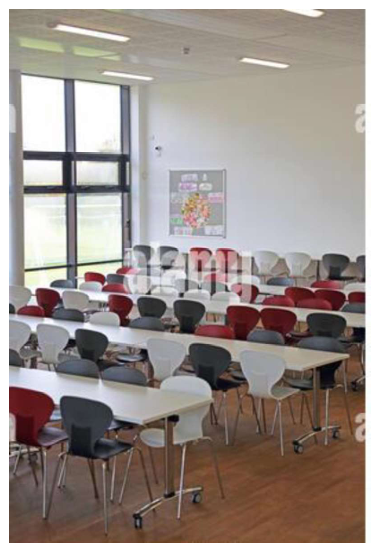
A school is organizing a grand cultural event to show the talent of its students. To accommodate the guests, the school plans to rent chairs and tables from a local supplier. It finds that rent for each chair is ?50 and for each table is ?200. The school spends ?30,000 for renting the chairs and tables. Also, the total number of items (chairs and tables) rented are 300. If the school rents 'x' chairs and 'y' tables, answer the following questions :
(i) Write down the pair of linear equations representing the given information. [1 Mark]
(ii) (a) Find the number of chairs and number of tables rented by the school. [2 Marks]
(iii) What is maximum number of tables that can be rented in ?30,000 if no chairs are rented? [1 Mark]
A school is organizing a grand cultural event to show the talent of its students. To accommodate the guests, the school plans to rent chairs and tables from a local supplier. It finds that rent for each chair is ?50 and for each table is ?200. The school spends ?30,000 for renting the chairs and tables. Also, the total number of items (chairs and tables) rented are 300. If the school rents 'x' chairs and 'y' tables, answer the following questions :
(i) Write down the pair of linear equations representing the given information. [1 Mark]
(ii) (a) Find the number of chairs and number of tables rented by the school. [2 Marks]
OR
(ii) (b) If the school wants to spend a maximum of ?27,000 on 300 items (tables and chairs), then
find the number of chairs and tables it can rent. [2 Marks](iii) What is maximum number of tables that can be rented in ?30,000 if no chairs are rented? [1 Mark]
(i) Equations:
\(x + y = 300\) ... (Total items)
\(50x + 200y = 30000 \Rightarrow x + 4y = 600\) ... (Total cost)
(ii) (a) Subtracting eq (i) from eq (ii):
\(3y = 300 \Rightarrow y = 100\).
\(x = 300 - 100 = 200\).
200 chairs and 100 tables.
(ii) (b) New equations:
\(x + y = 300\), \(50x + 200y = 27000 \Rightarrow x + 4y = 540\).
Subtracting: \(3y = 240 \Rightarrow y = 80\). \(x = 220\).
220 chairs and 80 tables.
(iii) If no chairs: \(200y = 30000 \Rightarrow y = 150\).
Maximum 150 tables.
\(x + y = 300\) ... (Total items)
\(50x + 200y = 30000 \Rightarrow x + 4y = 600\) ... (Total cost)
(ii) (a) Subtracting eq (i) from eq (ii):
\(3y = 300 \Rightarrow y = 100\).
\(x = 300 - 100 = 200\).
200 chairs and 100 tables.
(ii) (b) New equations:
\(x + y = 300\), \(50x + 200y = 27000 \Rightarrow x + 4y = 540\).
Subtracting: \(3y = 240 \Rightarrow y = 80\). \(x = 220\).
220 chairs and 80 tables.
(iii) If no chairs: \(200y = 30000 \Rightarrow y = 150\).
Maximum 150 tables.
1 Mark
Q13. The value of 'k' for which the system of
linear equations \(6x + y = 3k\) and \(36x + 6y = 3\) have infinitely many solutions is:
For infinite solutions: \(\frac{a_1}{a_2} = \frac{b_1}{b_2} =
\frac{c_1}{c_2}\).
\(\frac{6}{36} = \frac{1}{6}\). And \(\frac{3k}{3} = k\).
So \(\frac{1}{6} = k\).
Answer: (B)
\(\frac{6}{36} = \frac{1}{6}\). And \(\frac{3k}{3} = k\).
So \(\frac{1}{6} = k\).
Answer: (B)
1 Mark
Q15. The line represented by \(\frac{x}{4} +
\frac{y}{6} = 1\) intersects x-axis and y-axis respectively at P and Q. The coordinates of the
mid-point of line segment PQ are:
Intercept form \(\frac{x}{a} + \frac{y}{b} = 1\).
x-intercept P is \((4, 0)\). y-intercept Q is \((0, 6)\).
Midpoint \(M = (\frac{4+0}{2}, \frac{0+6}{2}) = (2, 3)\).
Answer: (A)
x-intercept P is \((4, 0)\). y-intercept Q is \((0, 6)\).
Midpoint \(M = (\frac{4+0}{2}, \frac{0+6}{2}) = (2, 3)\).
Answer: (A)
5 Marks
Q33. The students of a class are made to
stand equally in rows. If 3 students are extra in each row, there would be 1 row less. If 3 students
are less in a row, there would be 2 more rows. Find the number of students in the class.
Let number of rows be \(x\) and students per row be \(y\).
Total students \(N = xy\).
Case 1: \((y + 3)(x - 1) = xy \Rightarrow xy - y + 3x - 3 = xy \Rightarrow 3x - y = 3\) ...(i)
Case 2: \((y - 3)(x + 2) = xy \Rightarrow xy + 2y - 3x - 6 = xy \Rightarrow -3x + 2y = 6\) ...(ii)
Adding (i) and (ii): \((3x - y) + (-3x + 2y) = 3 + 6 \Rightarrow y = 9\).
Substitute \(y = 9\) in (i): \(3x - 9 = 3 \Rightarrow 3x = 12 \Rightarrow x = 4\).
Total students \(N = 4 \times 9 = 36\).
Total students \(N = xy\).
Case 1: \((y + 3)(x - 1) = xy \Rightarrow xy - y + 3x - 3 = xy \Rightarrow 3x - y = 3\) ...(i)
Case 2: \((y - 3)(x + 2) = xy \Rightarrow xy + 2y - 3x - 6 = xy \Rightarrow -3x + 2y = 6\) ...(ii)
Adding (i) and (ii): \((3x - y) + (-3x + 2y) = 3 + 6 \Rightarrow y = 9\).
Substitute \(y = 9\) in (i): \(3x - 9 = 3 \Rightarrow 3x = 12 \Rightarrow x = 4\).
Total students \(N = 4 \times 9 = 36\).
1 Mark
Q15. The value of 'p' for which the equations
\(px + 3y = p - 3, 12x + py = p\) has infinitely many solutions is :
Condition: \(a_1/a_2 = b_1/b_2 = c_1/c_2\). \(p/12 = 3/p = (p-3)/p\).
\(p^2 = 36 \Rightarrow p = \pm 6\).
Also \(3/p = (p-3)/p \Rightarrow 3 = p-3 \Rightarrow p = 6\).
Common value is 6.
Answer: (b)
\(p^2 = 36 \Rightarrow p = \pm 6\).
Also \(3/p = (p-3)/p \Rightarrow 3 = p-3 \Rightarrow p = 6\).
Common value is 6.
Answer: (b)
2 Marks
Q25. Solve the following system of equations
algebraically :
\(73x - 37y = 109\)
\(73x - 37y = 109\)
Add equations: \(110x - 110y = 110 \Rightarrow x - y = 1\) (i).
Subtract eq2 from eq1: \(36x + 36y = 108 \Rightarrow x + y = 3\) (ii).
Add (i) & (ii): \(2x = 4 \Rightarrow x = 2\).
Sub in (ii): \(2 + y = 3 \Rightarrow y = 1\).
Solution: \(x=2, y=1\)
Subtract eq2 from eq1: \(36x + 36y = 108 \Rightarrow x + y = 3\) (ii).
Add (i) & (ii): \(2x = 4 \Rightarrow x = 2\).
Sub in (ii): \(2 + y = 3 \Rightarrow y = 1\).
Solution: \(x=2, y=1\)
3 Marks
Q31. The perimeter of a rectangle is 70
cm.
The
length of the rectangle is 5 cm more than twice is breadth. Express the given situation as a
system
of
linear equations in two variables and hence solve it.
\(2(l+b) = 70 \Rightarrow l+b=35\).
\(l = 2b+5\).
Substitute: \((2b+5)+b=35 \Rightarrow 3b=30 \Rightarrow b=10\).
\(l = 2(10)+5 = 25\).
Length = 25 cm, Breadth = 10 cm.
\(l = 2b+5\).
Substitute: \((2b+5)+b=35 \Rightarrow 3b=30 \Rightarrow b=10\).
\(l = 2(10)+5 = 25\).
Length = 25 cm, Breadth = 10 cm.
2 Marks
Q25 (a). The cost of 2 kg apples and 1 kg
grapes on a day was found to be ?320. The cost of 4 kg apples and 2 kg grapes was found to be
?600. If cost of 1 kg of apples and 1 kg of grapes is x and y respectively, represent the given
situation algebraically and check whether the system is consistent or not.
OR
Q25 (b). Solve for x and
y:
\(\sqrt{2}x + \sqrt{3}y = 5\)
\(\sqrt{3}x - \sqrt{8}y = -\sqrt{6}\)
\(\sqrt{2}x + \sqrt{3}y = 5\)
\(\sqrt{3}x - \sqrt{8}y = -\sqrt{6}\)
(a): Equations: \(2x + y = 320\) (i) and \(4x + 2y = 600
\Rightarrow 2x + y = 300\) (ii).
Comparing \(a_1/a_2 = 2/4 = 1/2, b_1/b_2 = 1/2, c_1/c_2 = 320/600 = 8/15\).
Since \(a_1/a_2 = b_1/b_2 \neq c_1/c_2\), lines are parallel.
System is Inconsistent.
(b): Note \(\sqrt{8}y = 2\sqrt{2}y\).
Eq 1: \(\sqrt{2}x + \sqrt{3}y = 5\). Eq 2: \(\sqrt{3}x - 2\sqrt{2}y = -\sqrt{6}\).
Multiply Eq 1 by \(\sqrt{3}\) and Eq 2 by \(\sqrt{2}\):
\(\sqrt{6}x + 3y = 5\sqrt{3}\)
\(\sqrt{6}x - 4y = -2\sqrt{3}\)
Subtracting: \(7y = 7\sqrt{3} \Rightarrow y = \sqrt{3}\).
Substitute in Eq 1: \(\sqrt{2}x + 3 = 5 \Rightarrow \sqrt{2}x = 2 \Rightarrow x = \sqrt{2}\).
Answer: \(x = \sqrt{2}, y = \sqrt{3}\).
Comparing \(a_1/a_2 = 2/4 = 1/2, b_1/b_2 = 1/2, c_1/c_2 = 320/600 = 8/15\).
Since \(a_1/a_2 = b_1/b_2 \neq c_1/c_2\), lines are parallel.
System is Inconsistent.
(b): Note \(\sqrt{8}y = 2\sqrt{2}y\).
Eq 1: \(\sqrt{2}x + \sqrt{3}y = 5\). Eq 2: \(\sqrt{3}x - 2\sqrt{2}y = -\sqrt{6}\).
Multiply Eq 1 by \(\sqrt{3}\) and Eq 2 by \(\sqrt{2}\):
\(\sqrt{6}x + 3y = 5\sqrt{3}\)
\(\sqrt{6}x - 4y = -2\sqrt{3}\)
Subtracting: \(7y = 7\sqrt{3} \Rightarrow y = \sqrt{3}\).
Substitute in Eq 1: \(\sqrt{2}x + 3 = 5 \Rightarrow \sqrt{2}x = 2 \Rightarrow x = \sqrt{2}\).
Answer: \(x = \sqrt{2}, y = \sqrt{3}\).
3 Marks
Q31. Solve the following system of
equations graphically:
\(2x + 3y = 6\)
\(x + y - 1 = 0\)
Also, find the sum of ordinates of the points where given lines meet y-axis.
\(2x + 3y = 6\)
\(x + y - 1 = 0\)
Also, find the sum of ordinates of the points where given lines meet y-axis.
Graphing:
Line 1 (\(2x + 3y = 6\)): Points (3,0), (0,2). Cuts y-axis at (0,2). Ordinate = 2.
Line 2 (\(x + y = 1\)): Points (1,0), (0,1). Cuts y-axis at (0,1). Ordinate = 1.
Intersection point of lines: From \(y = 1 - x\), sub into line 1: \(2x + 3(1-x) = 6 \Rightarrow -x = 3 \Rightarrow x = -3, y = 4\).
Solution is \((-3, 4)\).
Sum of ordinates where they meet y-axis: \(2 + 1 = 3\).
Line 1 (\(2x + 3y = 6\)): Points (3,0), (0,2). Cuts y-axis at (0,2). Ordinate = 2.
Line 2 (\(x + y = 1\)): Points (1,0), (0,1). Cuts y-axis at (0,1). Ordinate = 1.
Intersection point of lines: From \(y = 1 - x\), sub into line 1: \(2x + 3(1-x) = 6 \Rightarrow -x = 3 \Rightarrow x = -3, y = 4\).
Solution is \((-3, 4)\).
Sum of ordinates where they meet y-axis: \(2 + 1 = 3\).
1 Mark
Q8. The system of equations \(y + a = 0\)
and
\(2x = b\) has
\(y = -a\).
\(x = b/2\).
The lines intersect at point \((x, y) = (\frac{b}{2}, -a)\).
Answer: (C)
\(x = b/2\).
The lines intersect at point \((x, y) = (\frac{b}{2}, -a)\).
Answer: (C)
2 Marks
Q25 (a). Solve the following pair of
equations
algebraically :
\(101x + 102y = 304\)
\(102x + 101y = 305\)
\(101x + 102y = 304\)
\(102x + 101y = 305\)
OR
Q25 (b). In a pair of supplementary
angles,
the
greater angle exceeds the smaller by \(50^\circ\). Express the given situation as a system of
linear
equations in two variables and hence obtain the measure of each angle.
(a) Add: \(203(x+y) = 609 \Rightarrow x+y=3\).
Subtract: \(-x+y = -1 \Rightarrow x-y=1\).
Add: \(2x=4 \Rightarrow x=2\). Sub: \(y=1\).
(b) \(x + y = 180\). \(x - y = 50\).
\(2x = 230 \Rightarrow x = 115^\circ\).
\(y = 180 - 115 = 65^\circ\).
Subtract: \(-x+y = -1 \Rightarrow x-y=1\).
Add: \(2x=4 \Rightarrow x=2\). Sub: \(y=1\).
(b) \(x + y = 180\). \(x - y = 50\).
\(2x = 230 \Rightarrow x = 115^\circ\).
\(y = 180 - 115 = 65^\circ\).
3 Marks
Q26. Check whether the given system of
equations
is consistent or not. If consistent, solve graphically.
\(x - 2y = 0\)
\(2x + y = 0\)
\(x - 2y = 0\)
\(2x + y = 0\)
\(a_1/a_2 = 1/2\). \(b_1/b_2 = -2/1\).
\(a_1/a_2 \neq b_1/b_2\). Consistent with unique solution.
\(x - 2y = 0 \Rightarrow x = 2y\) (Passes through origin).
\(2x + y = 0 \Rightarrow y = -2x\) (Passes through origin).
Intersection is \((0, 0)\).
\(a_1/a_2 \neq b_1/b_2\). Consistent with unique solution.
\(x - 2y = 0 \Rightarrow x = 2y\) (Passes through origin).
\(2x + y = 0 \Rightarrow y = -2x\) (Passes through origin).
Intersection is \((0, 0)\).
Board Exam 2024
2 Marks
Find the LCM and HCF of 6 and 20 by the prime factorization method.
\( 6 = 2 \times 3 \)
\( 20 = 2^2 \times 5 \)
HCF = \( 2 \) (lowest power of common factors)
LCM = \( 2^2 \times 3 \times 5 = 60 \)
\( 20 = 2^2 \times 5 \)
HCF = \( 2 \) (lowest power of common factors)
LCM = \( 2^2 \times 3 \times 5 = 60 \)
Board Exam 2023
3 Marks
Prove that \( 5 - \sqrt{3} \) is irrational, given that \( \sqrt{3} \) is
irrational.
Assume \( 5 - \sqrt{3} \) is rational, say \( = r \).
Then \( \sqrt{3} = 5 - r \), which is rational (difference of two rationals).
Contradiction: \( \sqrt{3} \) is given to be irrational.
∴ \( 5 - \sqrt{3} \) is irrational. ∎
Then \( \sqrt{3} = 5 - r \), which is rational (difference of two rationals).
Contradiction: \( \sqrt{3} \) is given to be irrational.
∴ \( 5 - \sqrt{3} \) is irrational. ∎
Board Exam 2022
2 Marks
Explain why \( 7 \times 11 \times 13 + 13 \) is a composite number.
\( 7 \times 11 \times 13 + 13 = 13(7 \times 11 + 1) = 13 \times 78 \)
Since it has factors other than 1 and itself, it is composite.
Since it has factors other than 1 and itself, it is composite.