Vardaan Learning Institute
Class 10 Mathematics • Chapter Notes
🌐 vardaanlearning.com
📞 9508841336
REAL NUMBERS
1. Introduction to Real Numbers
1.1 Number System Classification
Before studying the theorems of Class 10, we must perfectly understand the hierarchy of the number system. Think of the number system as boxes fitting inside larger boxes:
$$\mathbb{N} \subset \mathbb{W} \subset \mathbb{Z} \subset \mathbb{Q} \subset \mathbb{R}$$
- Natural Numbers ($\mathbb{N}$): The counting numbers starting from $1$.
Example: $\{1, 2, 3, 4, \dots\}$
- Whole Numbers ($\mathbb{W}$): Natural numbers plus zero.
Example: $\{0, 1, 2, 3, \dots\}$
- Integers ($\mathbb{Z}$): All positive and negative whole numbers.
Example: $\{\dots, -3, -2, -1, 0, 1, 2, 3, \dots\}$
Rational Numbers ($\mathbb{Q}$): Numbers that can be expressed in the form $\frac{p}{q}$, where $p$ and $q$ are integers and $q \neq 0$.
Key Property: Their decimal expansions are either terminating (like $0.5$) or non-terminating but repeating (like $0.333\dots$).
Examples: $\frac{1}{2}, \frac{-5}{7}, 4 \text{ (since } 4 = \frac{4}{1}), 0, \sqrt{25}$.
Irrational Numbers: Numbers that cannot be expressed in the form $\frac{p}{q}$.
Key Property: Their decimal expansions are strictly non-terminating and non-repeating.
Examples: $\sqrt{2}, \sqrt{3}, \pi, 0.101101110\dots$
What are Real Numbers ($\mathbb{R}$)?
A Real Number is any number that can be plotted on the number line. It is the complete collection of all Rational AND Irrational numbers together. Every real number is either rational OR irrational (it can never be both).
1.2 Operations on Rational and Irrational Numbers
A very common 1-mark question in board exams tests your understanding of what happens when you combine rational and irrational numbers.
Rule 1: Rational and Irrational
The sum, difference, product, or quotient of a non-zero Rational number and an Irrational number is ALWAYS Irrational.
Examples: $2 + \sqrt{3}$, $5\sqrt{2}$, $\frac{\pi}{2}$, $3 - \sqrt{5}$ are all Irrational.
Rule 2: Irrational and Irrational
The sum, difference, product, or quotient of two Irrational numbers CAN BE either Rational or Irrational.
Examples:
- Product gives Rational: $\sqrt{3} \times \sqrt{3} = 3$ (Rational)
- Product gives Irrational: $\sqrt{2} \times \sqrt{3} = \sqrt{6}$ (Irrational)
- Sum gives Rational: $(2 + \sqrt{3}) + (2 - \sqrt{3}) = 4$ (Rational)
1.3 Identifying Rational vs Irrational (Board Hacks)
Examiners love to trick students with numbers that look rational but aren't, or vice-versa.
- The $\pi$ vs $\frac{22}{7}$ Trap:
$\pi$ is Irrational (its decimal never terminates or repeats).
$\frac{22}{7}$ is Rational (it is in the form $p/q$). We only use $\frac{22}{7}$ as an approximate value for $\pi$ in calculations.
- Pattern-Type Decimals:
If you see a pattern like $0.1011011101111\dots$, it is Irrational because the number of 1s keeps increasing. It is non-terminating and non-repeating.
If you see $0.101010\dots$ or $0.\overline{10}$, it is Rational because the exact same block "10" repeats infinitely.
- Hidden Perfect Squares:
Don't just assume every square root is irrational! Simplify first.
$\sqrt{16} = 4$ (Rational).
$\sqrt{\frac{12}{3}} = \sqrt{4} = 2$ (Rational).
2. The Fundamental Theorem of Arithmetic
2.1 Statement of Fundamental Theorem of Arithmetic
Statement: Every composite number can be expressed (factorised) as a product of prime numbers, and this factorisation is unique, apart from the order in which the prime factors occur.
Explanation: This means that if you break down a number into primes, there is only one specific set of prime numbers that multiplies to give that number. For example, $30 = 2 \times 3 \times 5$. Whether you write it as $5 \times 3 \times 2$ or $3 \times 2 \times 5$, the set of primes $\{2, 3, 5\}$ is unique to 30.
Quick Revision: Prime Numbers only have two factors: 1 and themselves (2, 3, 5, 7, 11...).
Composite Numbers have more than two factors (4, 6, 8, 9...). Note: 1 is neither prime nor composite.
Practice Problem (Board Pattern): Explain why $7 \times 11 \times 13 + 13$ is a composite number.
Solution:
We have $7 \times 11 \times 13 + 13$. Let's take $13$ common:
$= 13 \times (7 \times 11 + 1)$
$= 13 \times (77 + 1)$
$= 13 \times 78$
$= 13 \times (13 \times 2 \times 3)$
Since the given expression can be written as a product of prime factors, it has more than two factors. Therefore, it is a composite number.
2.2 Prime Factorisation
You can find prime factors using the Factor Tree Method or the standard Division Method (ladder method).
Examples of Prime Factorisation:
- 140: $140 = 2 \times 70 = 2 \times 2 \times 35 = 2 \times 2 \times 5 \times 7 \implies \mathbf{2^2 \times 5 \times 7}$
- 156: $156 = 2 \times 78 = 2 \times 2 \times 39 = 2 \times 2 \times 3 \times 13 \implies \mathbf{2^2 \times 3 \times 13}$
- 3825: (Ends in 5, divisible by 5)
$3825 = 5 \times 765 = 5 \times 5 \times 153$
$= 5 \times 5 \times 3 \times 51 = 5 \times 5 \times 3 \times 3 \times 17$
$\implies \mathbf{3^2 \times 5^2 \times 17}$
- 5005: (Divisible by larger primes)
$5005 = 5 \times 1001 = 5 \times 7 \times 143$
$= 5 \times 7 \times 11 \times 13 \implies \mathbf{5 \times 7 \times 11 \times 13}$
- 7429: (A tricky one, test larger primes like 17, 19, 23)
$7429 = 17 \times 437 = 17 \times 19 \times 23 \implies \mathbf{17 \times 19 \times 23}$
2.3 HCF and LCM by Prime Factorisation Method
(Direct Board Example to demonstrate the easiest method to find HCF/LCM without missing factors)
Q: Find the HCF and LCM of 540 and 12.
Prime Factorisation:
$540 = 2^2 \times 3^3 \times 5^1$
$12 = 2^2 \times 3^1$
Make Bases Common (Introduce Power Zero):
$540 = 2^2 \times 3^3 \times 5^1$
$12 = 2^2 \times 3^1 \times \mathbf{5^0}$
HCF (Take Smallest Powers):
$HCF = 2^2 \times 3^1 \times 5^0 = 4 \times 3 \times 1 = \mathbf{12}$
LCM (Take Highest Powers):
$LCM = 2^2 \times 3^3 \times 5^1 = 4 \times 27 \times 5 = \mathbf{540}$
Q: Check whether $6^n$ can end with the digit $0$ for any natural number $n$.
Sol: If any number ends with the digit 0, it must be divisible by 10, meaning its prime factors must include both 2 and 5.
Prime factorisation of $6^n = (2 \times 3)^n = 2^n \times 3^n$.
Since the prime factor 5 is missing, by the uniqueness of the Fundamental Theorem of Arithmetic, $6^n$ cannot end with the digit 0.
2.4 Relationship: HCF × LCM = Product of Two Numbers
For any
TWO positive integers $a$ and $b$:
$$\text{HCF}(a, b) \times \text{LCM}(a, b) = a \times b$$
CRITICAL WARNING: This formula works strictly for TWO numbers only. It is FALSE for three numbers. $HCF(p, q, r) \times LCM(p, q, r) \neq p \times q \times r$.
Example 1: Verify the formula for 26 and 91.
We found $HCF = 13$, $LCM = 182$.
LHS: $HCF \times LCM = 13 \times 182 = 2366$.
RHS: $a \times b = 26 \times 91 = 2366$.
LHS = RHS. Verified.
Example 2: Given that $HCF(306, 657) = 9$, find $LCM(306, 657)$.
We know: $LCM \times HCF = a \times b$
$LCM \times 9 = 306 \times 657$
$LCM = \frac{306 \times 657}{9} = 34 \times 657 = \mathbf{22338}$.
Example 3: The LCM of two numbers is 182 and their HCF is 13. If one of the numbers is 26, find the other.
$HCF \times LCM = a \times b \implies 13 \times 182 = 26 \times b \implies b = \frac{13 \times 182}{26} = \frac{182}{2} = \mathbf{91}$.
Example 4: Can two numbers have 16 as their HCF and 380 as their LCM?
Reasoning: A crucial property is that the HCF must always be a perfect factor of the LCM. Let's check if 380 is perfectly divisible by 16.
$380 / 16 = 23.75$ (Not perfectly divisible).
No, they cannot, because HCF must be a factor of LCM.
Example 5: The product of two numbers is 3200 and their LCM is 400. Find their HCF.
$HCF = \frac{\text{Product}}{LCM} = \frac{3200}{400} = \mathbf{8}$.
2.5 HCF and LCM with Algebraic Variables
In board exams, you are often given numbers in the form of algebraic variables rather than actual values. The rules for HCF and LCM remain exactly the same:
- HCF: Take the smallest power of each common variable.
- LCM: Take the highest power of every variable present.
Example 1: Basic Variables
If $p = x^3y^2$ and $q = x^2y^3$, where $x, y$ are prime numbers, find the HCF and LCM of $p$ and $q$.
Solution:
HCF($p, q$): Smallest power of $x$ is $x^2$. Smallest power of $y$ is $y^2$. $\implies \mathbf{HCF = x^2y^2}$
LCM($p, q$): Highest power of $x$ is $x^3$. Highest power of $y$ is $y^3$. $\implies \mathbf{LCM = x^3y^3}$
Example 2: Finding the Missing Power
If $a = x^m y^3$ and $b = x^3 y^2$ are two numbers such that their HCF is $x^2 y^2$. Find the value of $m$.
Solution:
For HCF, we compare powers of $x$. We are given that the $x$-part of the HCF is $x^2$.
Since the power of $x$ in $b$ is $3$, the power of $x$ in $a$ must be $2$ in order for the smallest power (the HCF) to be $2$.
Therefore, $\min(m, 3) = 2 \implies \mathbf{m = 2}$.
Example 3: Three Variables
If $p = a^2b^3c^4$ and $q = ab^4c^2$, find their LCM.
Solution:
Compare highest powers of each variable $a, b,$ and $c$.
Highest power of $a$ is $a^2$. Highest power of $b$ is $b^4$. Highest power of $c$ is $c^4$.
$\implies \mathbf{LCM = a^2b^4c^4}$.
3. Master Class: HCF vs LCM Word Problems
Type A: The LCM Identifier (Future Events / Accumulation)
Keywords: "Meet again", "Ring together", "Minimum distance".
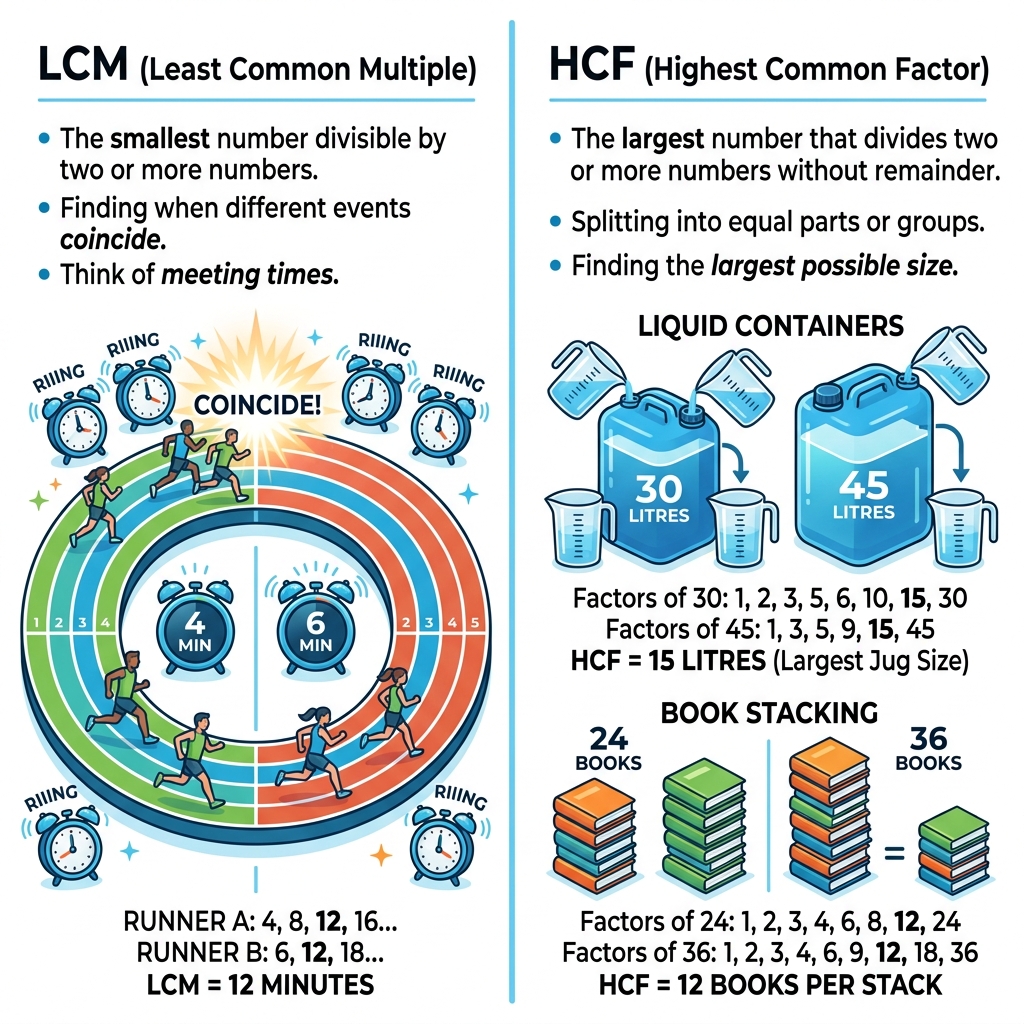
Q: There is a circular path around a sports field. Sonia takes 18 mins to drive one round, while Ravi takes 12 mins. They start at the same point and time. After how many minutes will they meet again at the starting point?
Sol: Find $LCM(18, 12)$.
$18 = 2 \times 3^2$
$12 = 2^2 \times 3$
$LCM = 2^2 \times 3^2 = 4 \times 9 = 36$. They meet again after 36 minutes.
Type B: The HCF Identifier (Splitting / Maximum Capacity)
Keywords: "Maximum capacity", "Largest size", "Equally divide without remainder".
Q: A sweet seller has 420 kaju burfis and 130 badam burfis. She wants to stack them so each stack has the same number and takes up the least area. What is the maximum number of burfis per stack?
Sol: To minimize area, maximize burfis per stack $\implies$ Find $HCF(420, 130)$.
$420 = 2^2 \times 3 \times 5 \times 7$
$130 = 2 \times 5 \times 13$
$HCF = 2 \times 5 = \mathbf{10}$ burfis per stack.
Practice Drill: Word Problems on HCF and LCM
Examiner's Tip: Use LCM when events repeat over time (meeting points, ringing bells) or when you need a number "divisible by" others. Use HCF when dividing items into identical maximum groups.
Word Problem 1: The Sweet Seller
A sweet seller has 420 kaju barfis and 130 badam barfis. She wants to stack them in such a way that each stack has the same number, and they take up the least area of the tray. What is the maximum number of barfis that can be placed in each stack?
Solution: To minimize the area, we need to maximize the number of barfis in each stack. So, we need to find HCF($420, 130$) using prime factorisation.
$420 = 2^2 \times 3 \times 5 \times 7$
$130 = 2 \times 5 \times 13$
$HCF = 2 \times 5 = 10$
The HCF is $10$. Therefore, the sweet seller can make stacks of 10 for both kinds of barfi.
Word Problem 2: Army Contingent
An army contingent of 616 members is to march behind an army band of 32 members in a parade. The two groups are to march in the same number of columns. What is the maximum number of columns in which they can march?
Solution: We must find HCF($616, 32$) using prime factorisation.
$616 = 2^3 \times 7 \times 11$
$32 = 2^5$
$HCF = 2^3 = 8$
The HCF is $8$. Therefore, they can march in a maximum of 8 columns.
Word Problem 3: Remainders Problem
Find the largest number which divides 70 and 125, leaving remainders 5 and 8 respectively.
Solution: Since the number leaves remainders 5 and 8, the numbers that are exactly divisible are:
$70 - 5 = 65$
$125 - 8 = 117$
Now, find HCF($117, 65$) using prime factorisation.
$117 = 3^2 \times 13$
$65 = 5 \times 13$
$HCF = 13$
The largest number is 13.
Word Problem 4: Tiling the Floor
The length and breadth of a room are 8m 25cm and 6m 75cm respectively. Find the length of the longest measuring rod that can measure the dimensions of the room exactly.
Solution: Convert everything to cm.
Length $= 825 \text{ cm}$. Breadth $= 675 \text{ cm}$.
We need the HCF of $825$ and $675$ using prime factorisation.
$825 = 3 \times 5^2 \times 11$
$675 = 3^3 \times 5^2$
$HCF = 3 \times 5^2 = 75$
The HCF is 75. The longest rod is 75 cm long.
Word Problem 5 (Circular Track - LCM): There is a circular path around a sports field. Sonia takes 18 minutes to drive one round, while Ravi takes 12 minutes. Suppose they both start at the same point and at the same time, and go in the same direction. After how many minutes will they meet again at the starting point?
Solution: They will meet again after a time which is a multiple of both 18 and 12. We need the LCM($18, 12$).
$18 = 2 \times 3^2, 12 = 2^2 \times 3$
$LCM = 2^2 \times 3^2 = 4 \times 9 = 36$.
Answer: They will meet again after 36 minutes.
Word Problem 6 (Bells Ringing - LCM): Six bells commence tolling together and toll at intervals of 2, 4, 6, 8, 10 and 12 seconds respectively. In 30 minutes, how many times do they toll together?
Solution: Find LCM of 2, 4, 6, 8, 10, 12.
$LCM = 120 \text{ seconds} = 2 \text{ minutes}$.
So, they toll together every 2 minutes.
In 30 minutes, they will toll $30/2 = 15$ times. BUT we must add 1 because they tolled together at the very start (0th minute).
Answer: $15 + 1 = 16$ times.
Word Problem 7 (Smallest Number + Remainder - LCM): Find the smallest number which when divided by 28 and 32 leaves remainders 8 and 12 respectively.
Solution: Notice the difference between divisors and remainders: $28 - 8 = 20$ and $32 - 12 = 20$. The difference is constant ($20$).
Required number $= LCM(28, 32) - (\text{Constant Difference})$.
$LCM(28, 32): 28 = 2^2 \times 7, 32 = 2^5$. $LCM = 2^5 \times 7 = 32 \times 7 = 224$.
Number $= 224 - 20 = \mathbf{204}$.
Word Problem 8 (Distributing Items - HCF): Three sets of English, Hindi and Mathematics books have to be stacked such that all books are stored topic-wise and the height of each stack is the same. The number of books are 96, 240 and 336. Find the maximum height of the stack (number of books).
Solution: We need equal stacks of maximum size. Find HCF($96, 240, 336$) using prime factorisation.
$96 = 2^5 \times 3$
$240 = 2^4 \times 3 \times 5$
$336 = 2^4 \times 3 \times 7$
$HCF = 2^4 \times 3 = 16 \times 3 = \mathbf{48 \text{ books per stack}}$.
Word Problem 9 (Morning Walk - LCM): Three persons step off together for a morning walk. Their steps measure 80 cm, 85 cm and 90 cm respectively. What is the minimum distance each should walk so that all can cover the same distance in complete steps?
Solution: Minimum distance $= LCM(80, 85, 90)$.
$80 = 2^4 \times 5$
$85 = 5 \times 17$
$90 = 2 \times 3^2 \times 5$
$LCM = 2^4 \times 3^2 \times 5 \times 17 = 16 \times 9 \times 5 \times 17 = 12240 \text{ cm}$.
Answer: 12240 cm (or 122 m 40 cm).
4. Proof of Irrationality (The 3-Marker Guarantee)
Theorem 1.2
Let $p$ be a prime number. If $p$ divides $a^2$, then $p$ divides $a$, where $a$ is a positive integer.
Type 1: Pure Root (The Base Proof)
(Board Tip: Remind students that forgetting to state "$a$ and $b$ are co-prime" will cost marks because the entire contradiction relies on it!)
Q: Prove that $\sqrt{2}$ is irrational.
Sol:
Let us assume $\sqrt{2}$ is rational.
$\sqrt{2} = \frac{a}{b}$ (where $a$ and $b$ are co-prime integers, $b \neq 0$).
$b\sqrt{2} = a$
Squaring both sides: $2b^2 = a^2$ --- (Eq 1)
This means $2$ divides $a^2 \implies \mathbf{2 \text{ divides } a}$ (By Theorem 1.2).
Let $a = 2c$ for some integer $c$.
Substitute in Eq 1: $2b^2 = (2c)^2 \implies 2b^2 = 4c^2 \implies b^2 = 2c^2$.
This means $2$ divides $b^2 \implies \mathbf{2 \text{ divides } b}$.
Since $2$ divides both $a$ and $b$, they are not co-prime. This contradicts our assumption.
Hence, $\sqrt{2}$ is irrational.
Variation: Prove that $\frac{1}{\sqrt{2}}$ is irrational.
Sol:
Let $\frac{1}{\sqrt{2}} = \frac{a}{b}$ (where $a, b$ are co-prime integers, $b \neq 0$).
Reverse the fraction: $\sqrt{2} = \frac{b}{a}$.
Since $a, b$ are integers, $\frac{b}{a}$ is rational. This implies $\sqrt{2}$ is rational, contradicting the fact that $\sqrt{2}$ is irrational.
Hence, $\frac{1}{\sqrt{2}}$ is irrational.
Type 2: Mixed Root (The Shortcut Proof)
(Here, we assume the root part is already proven irrational, and we just isolate it).
Q: Prove that $\frac{\sqrt{2} + 5}{3}$ is irrational.
Sol:
Let $\frac{\sqrt{2} + 5}{3} = \frac{a}{b}$ ($a, b$ are co-prime integers, $b \neq 0$).
Isolate the root:
$\sqrt{2} + 5 = \frac{3a}{b}$
$\sqrt{2} = \frac{3a}{b} - 5 \implies \sqrt{2} = \frac{3a - 5b}{b}$
Since $a, b$ are integers, $\frac{3a - 5b}{b}$ is rational.
This implies $\sqrt{2}$ is rational, which is a contradiction.
Hence, $\frac{\sqrt{2} + 5}{3}$ is irrational.
Type 3: Double Root (The Squaring Method)
Q: Prove that $\sqrt{2} + \sqrt{5}$ is irrational.
Sol:
Let $\sqrt{2} + \sqrt{5} = \frac{a}{b}$ ($a, b$ are co-prime integers, $b \neq 0$).
Shift one root: $\sqrt{5} = \frac{a}{b} - \sqrt{2}$
Square both sides:
$(\sqrt{5})^2 = \left(\frac{a}{b} - \sqrt{2}\right)^2$
$5 = \frac{a^2}{b^2} + 2 - \frac{2a}{b}\sqrt{2}$
Isolate $\sqrt{2}$:
$\frac{2a}{b}\sqrt{2} = \frac{a^2}{b^2} - 3$
$\sqrt{2} = \left(\frac{a^2 - 3b^2}{b^2}\right) \times \frac{b}{2a} \implies \sqrt{2} = \frac{a^2 - 3b^2}{2ab}$
Since $a, b$ are integers, $\frac{a^2 - 3b^2}{2ab}$ is rational, implying $\sqrt{2}$ is rational (Contradiction!).
Hence, $\sqrt{2} + \sqrt{5}$ is irrational.
5. Decimal Expansions of Rational Numbers
5.1 Types of Decimal Expansions
- Terminating: The division ends after finite decimal places. e.g., $\frac{1}{2} = 0.5$, $\frac{7}{8} = 0.875$.
- Non-Terminating Repeating: The division never ends, but a block of digits repeats. e.g., $\frac{1}{3} = 0.333\dots$, $\frac{1}{7} = 0.142857142857\dots$
5.2 Theorem for Terminating Decimals
Let $x = \frac{p}{q}$ be a rational number, such that $p$ and $q$ are co-prime (lowest terms). Then $x$ has a decimal expansion which terminates if and only if the prime factorisation of the denominator $q$ is of the form $2^n \times 5^m$, where $n, m$ are non-negative integers.
Explanation: If the denominator contains ONLY 2s, ONLY 5s, or BOTH 2s and 5s, it terminates. If ANY other prime number (like 3, 7, 11) is present in the denominator, it will be Non-Terminating Repeating.
5.3 Without Actual Division – Determine Nature of Decimal
Problem 1: $\frac{13}{3125}$
Denominator $q = 3125 = 5 \times 5 \times 5 \times 5 \times 5 = 5^5$.
Since $q$ is of the form $2^0 \times 5^5$, the decimal expansion is Terminating.
Problem 2: $\frac{17}{8}$
Denominator $q = 8 = 2^3$. Form is $2^3 \times 5^0$. Terminating.
Problem 3: $\frac{64}{455}$
Denominator $q = 455 = 5 \times 7 \times 13$.
Since $q$ has prime factors 7 and 13 (other than 2 and 5), the expansion is Non-Terminating Repeating.
Problem 4: $\frac{77}{210}$
Common Mistake Check: Simplify fraction FIRST! $\frac{77}{210} = \frac{11}{30}$.
Denominator $q = 30 = 2 \times 3 \times 5$.
Because of the prime factor 3, it is Non-Terminating Repeating.
Problem 5: $\frac{129}{2^2 \times 5^7 \times 7^5}$
Denominator clearly contains $7^5$. It is Non-Terminating Repeating.
5.4 Number of Decimal Places in Terminating Decimals
If $q = 2^n \times 5^m$, the number of decimal places before it terminates is the maximum of $n$ and $m$.
Q: After how many places will $\frac{43}{2^4 \times 5^3}$ terminate?
Max power between 4 and 3 is 4. It terminates after 4 decimal places.