Vardaan Learning Institute
Class 10 History • Chapter Notes
🌐 vardaanlearning.com
📞 9508841336
Team Vardaan ❤️
THE RISE OF NATIONALISM IN EUROPE
In the nineteenth century, Nationalism (a feeling of love or pride for your country) emerged
as a powerful force, changing the political and mental world of Europe. This process led to the emergence of
the nation-state (a group of people with the same culture, language, and history forming an
independent country), replacing multi-national dynastic empires.
Important Dates at a Glance
- 1789: French Revolution begins.
- 1797: Napoleon invades Italy; Napoleonic wars begin.
- 1804: Napoleonic Code introduced.
- 1813: Napoleon loses the battle of Leipzig.
- 1814-1815: Fall of Napoleon; Congress of Vienna Peace Settlement.
- 1821: Greek struggle for independence begins.
- 1830: July Revolution in France.
- 1832: Greece gains independence.
- 1834: Zollverein (customs union) is formed.
- 1846: Uprising in Greater Poland.
- 1848: Revolutions in Europe; Liberals demand nation-states.
- 1859-1870: Unification of Italy.
- 1863: Polish National Revolt.
- 1866-1871: Unification of Germany led by Otto Von Bismarck.
- 1867: Autonomy established in Hungary.
- 1905: Slav nationalism gathers force in the Habsburg and Ottoman Empires.
Fact
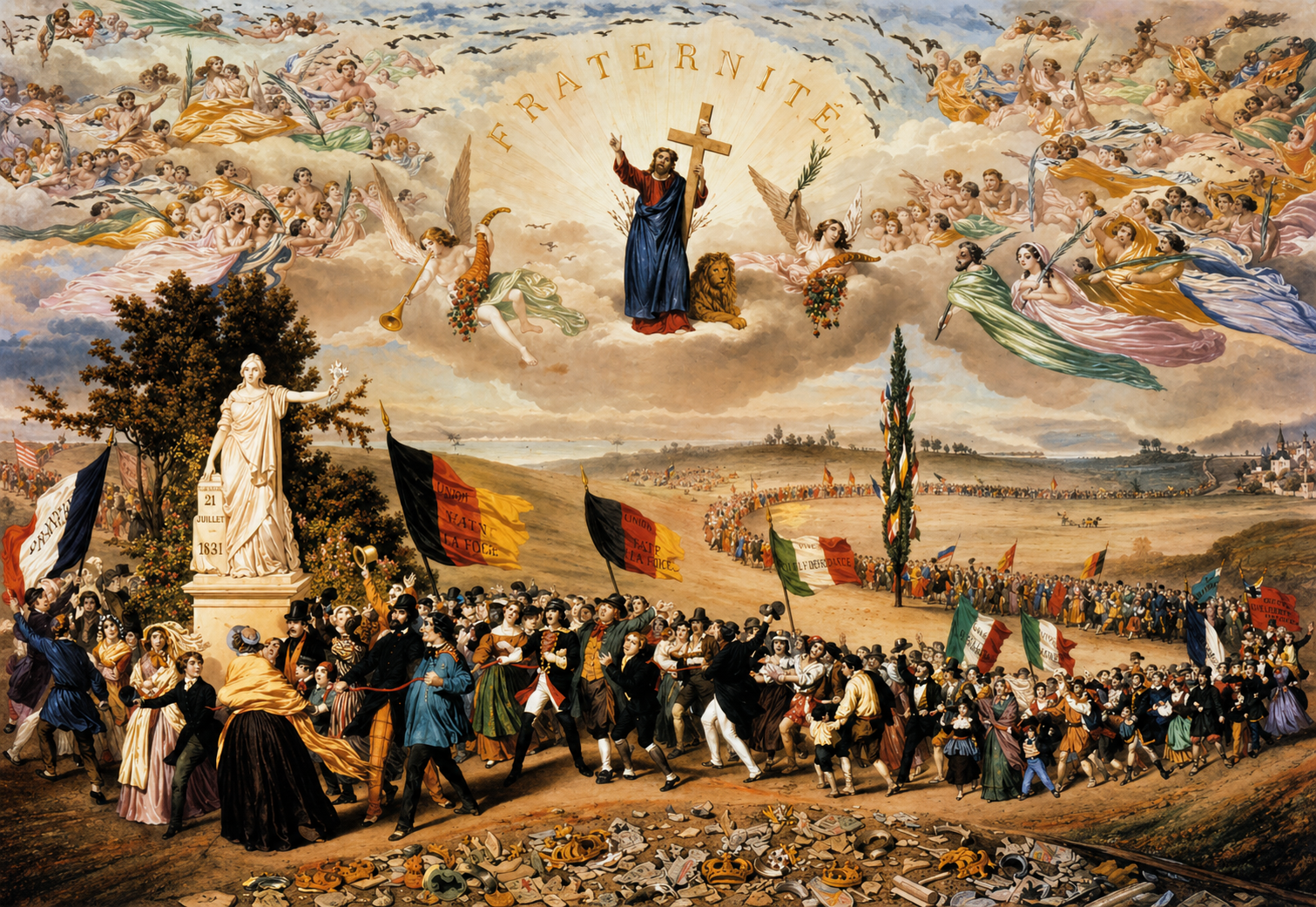
In 1848, French artist
Frédéric Sorrieu prepared a series of 4 prints visualising his dream
of a world made up of
"democratic and social Republics." His utopian vision depicted people
marching towards the statue of Liberty. The Statue holds the
Torch of Enlightenment
(representing Freedom) in one hand and the
Charter of the Rights of Man in another. The
shattered remains on the ground represent the fall of
absolutist institutions.
Concept
Utopian Vision: A vision of a society that is so ideal that it is unlikely to actually
exist.
Absolutist: A government or system of rule that has no restraints on the power exercised
(monarchical rule).
Plebiscite: A direct vote by which all the people of a region are asked to accept or reject
a proposal.
What is a Nation? According to French philosopher Ernst Renan (in his 1882 lecture at the
University of Sorbonne), a nation is not just common language or territory. It is the culmination of a long
past of endeavours, sacrifice, and devotion. It represents a large-scale solidarity and a common will in the
present. He called its existence a "daily plebiscite".
1. The French Revolution and the Idea of the Nation
The first clear expression of nationalism came with the French Revolution in 1789. France
changed from an absolute monarchy to a body of citizens holding sovereignty.
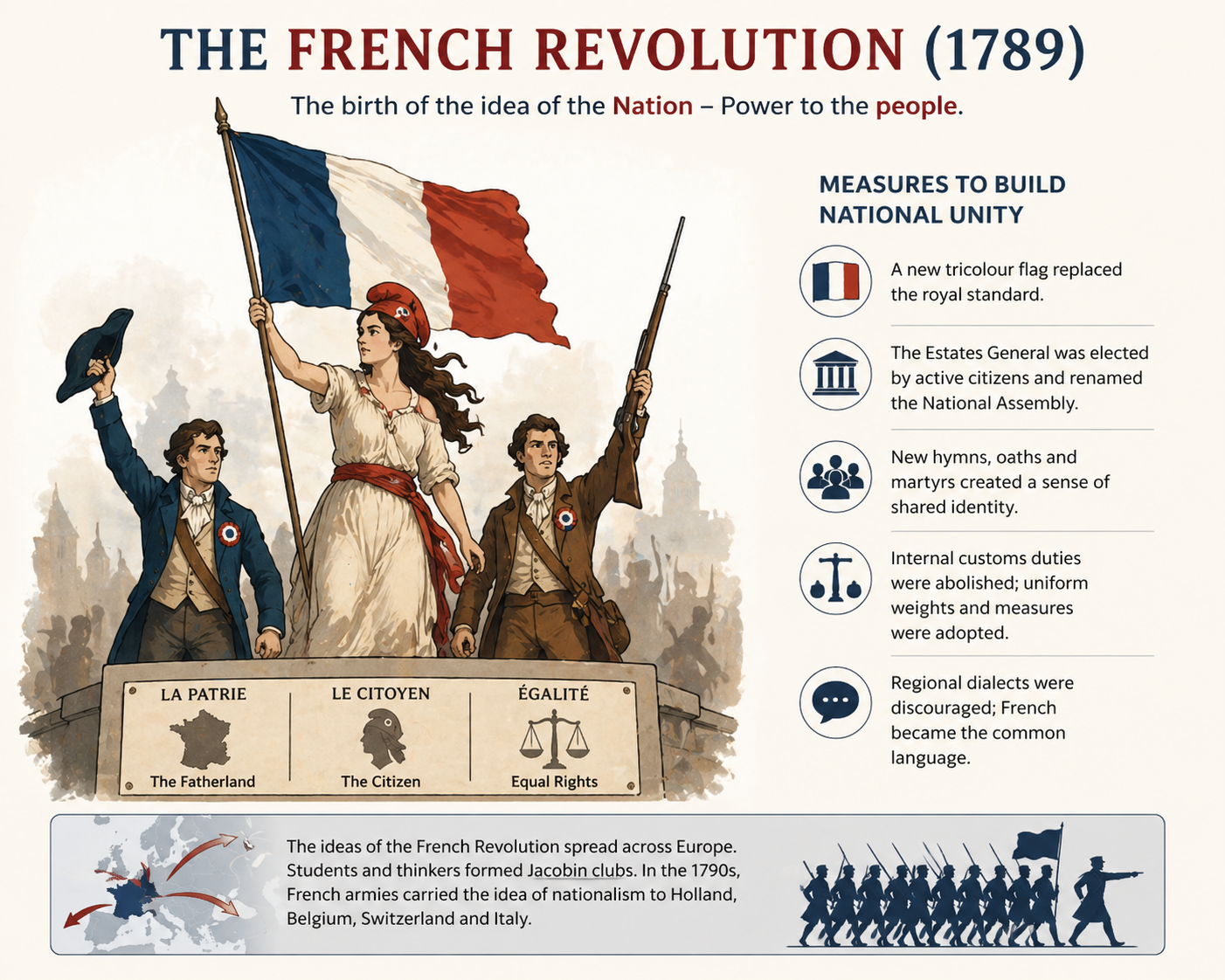
The French Revolution - 1789
Measures introduced to create a sense of collective identity:
- The ideas of la patrie (the fatherland) and le citoyen (the citizen)
emphasised a united community enjoying equal rights.
- A new French flag, the tricolour, replaced the royal standard.
- The Estates General was elected by active citizens and renamed the National Assembly.
- New hymns were composed, oaths taken, and martyrs commemorated.
- Internal customs duties and dues were abolished, and uniform weights and measures were adopted.
- Regional dialects were discouraged, and French became the common language.
When the news of these events reached different European cities, students and educated middle classes began
setting up Jacobin clubs. Their activities and campaigns prepared the way for the French
armies, which moved into Holland, Belgium, Switzerland, and Italy in the 1790s, carrying the idea of
nationalism abroad.
Napoleon's Impact
Napoleon introduced revolutionary principles into the administration to make it more rational and efficient.
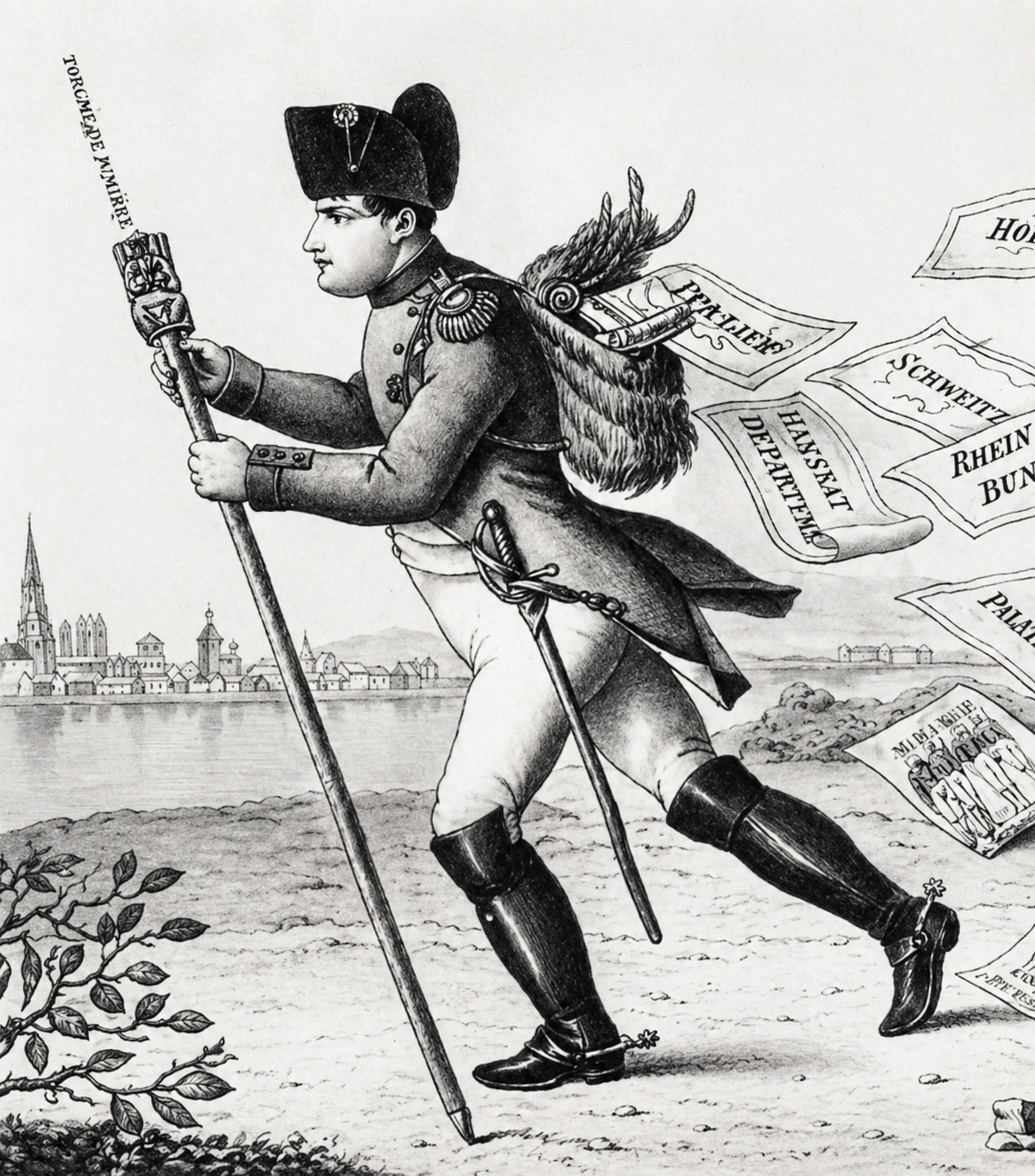
Portrait of Napoleon Bonaparte
Concept
The Civil Code of 1804 (Napoleonic Code): Did away with all privileges based on birth,
established equality before the law, and secured the right to property.
In conquered areas (Holland, Switzerland, Italy, Germany), Napoleon simplified administration, abolished the
feudal system, and freed peasants from serfdom.
Important
Drawbacks of the Napoleonic Code: Despite administrative benefits, enthusiasm soon turned
into hostility because political freedom was missing. The major drawbacks were:
- Increased Taxation: Taxes were raised to fund wars.
- Censorship: Strict control was imposed, and no one could speak against Napoleon.
- Forced Conscription: People were forced to join the French army to conquer the rest
of Europe.
2. The Making of Nationalism in Europe
Mid-18th-century Europe had no nation-states. Empires like the Habsburg Empire (ruling
Austria-Hungary) were a patchwork of diverse regions and peoples.
Fact
The Habsburg Empire's Diversity: It included the Alpine regions (the Tyrol, Austria,
Sudetenland) and Bohemia where the aristocracy was mostly German-speaking. It also included the
Italian-speaking provinces of Lombardy and Venetia. In Hungary, half the population spoke
Magyar, while the rest spoke local dialects. In Galicia, the aristocracy spoke
Polish.
2.1 The Aristocracy and the New Middle Class
- Landed Aristocracy: The socially and politically dominant class. They owned vast
estates, spoke French for diplomacy, and were tied by marriages. However, they were numerically a small
group.
- Peasantry: Formed the bulk of the population. In the West, land was
farmed by tenants and small owners. In Eastern and Central Europe, peasants worked like
servants (serfs) under the aristocracy.
- New Middle Class: Emerged with industrialisation (industrialists, businessmen,
professionals). It was among these educated, liberal middle classes that ideas of national unity gained
popularity.
2.2 What did Liberal Nationalism Stand for?
The term 'liberalism' derives from the Latin root liber, meaning free.
- Political Sphere: Stood for freedom for the individual, equality before the law, and a
government by consent (a constitution and representative parliament). It also stressed the inviolability
of private property. Note: Equality before the law did not mean universal suffrage. Only for a brief
period under the Jacobins did all adult males enjoy suffrage. The Napoleonic Code
reduced women back to the status of a minor.
- Economic Sphere: Stood for the freedom of markets and the abolition of state-imposed
restrictions on the movement of goods and capital.
Important
Zollverein (1834): A customs union formed at the initiative of Prussia and
joined by most German states. It abolished tariff barriers, reduced the number of currencies from over
thirty to two, and created a network of railways that stimulated mobility, facilitating
economic nationalism.
2.3 A New Conservatism after 1815
Following the defeat of Napoleon in 1815, European governments were driven by a spirit of
conservatism. They believed traditional institutions like the monarchy, the Church, and
social hierarchies should be preserved, though they recognised modern armies and bureaucracies could
strengthen autocratic power.
Important
The Treaty of Vienna (1815): Hosted by Austrian Chancellor
Duke
Metternich. Its main goal was to undo changes from the Napoleonic wars and restore the Bourbon
dynasty in France.
Major Territorial Changes:
- France lost the territories it had annexed.
- A series of states were set up on French boundaries to prevent expansion (e.g., the Kingdom of the
Netherlands, including Belgium, was set up in the north, and Genoa was added to Piedmont in the
south).
- Prussia was given important new territories on its western frontiers.
- Austria was given control of northern Italy.
- The German confederation of 39 states was left untouched.
2.4 The Revolutionaries
Fear of repression drove liberal-nationalists underground. Secret societies sprang up to train
revolutionaries and fight for liberty.
Fact
Giuseppe Mazzini: An Italian revolutionary born in Genoa (1805). He became a member of the
Carbonari secret society. As a young man of 24, he was sent into exile in 1831 for attempting a
revolution in Liguria. He later founded two underground societies: Young Italy
in Marseilles and Young Europe in Berne. Metternich described him as "the most dangerous
enemy of our social order."
3. The Age of Revolutions: 1830-1848
Liberalism and nationalism became increasingly associated with revolution in regions like the Italian and
German states, the Ottoman Empire, Ireland, and Poland.
- July Revolution (France, 1830): Bourbon kings were overthrown, and a constitutional
monarchy with Louis Philippe at its head was installed. Metternich remarked: "When
France sneezes, the rest of Europe catches cold." This revolution sparked an uprising in
Brussels, leading to Belgium breaking away from the United Kingdom of the Netherlands.
- Greek War of Independence: Greece struggled against the Ottoman Empire starting in
1821. Supported by West Europeans and Romantics. The English poet Lord Byron organised
funds and went to fight in the war (he died of fever in 1824). The Treaty of Constantinople of
1832 recognised Greece as an independent nation.
3.1 The Romantic Imagination and National Feeling
Romanticism was a cultural movement that focused on emotions, intuition, and mystical
feelings instead of reason and science, aiming to create a sense of a shared collective heritage.
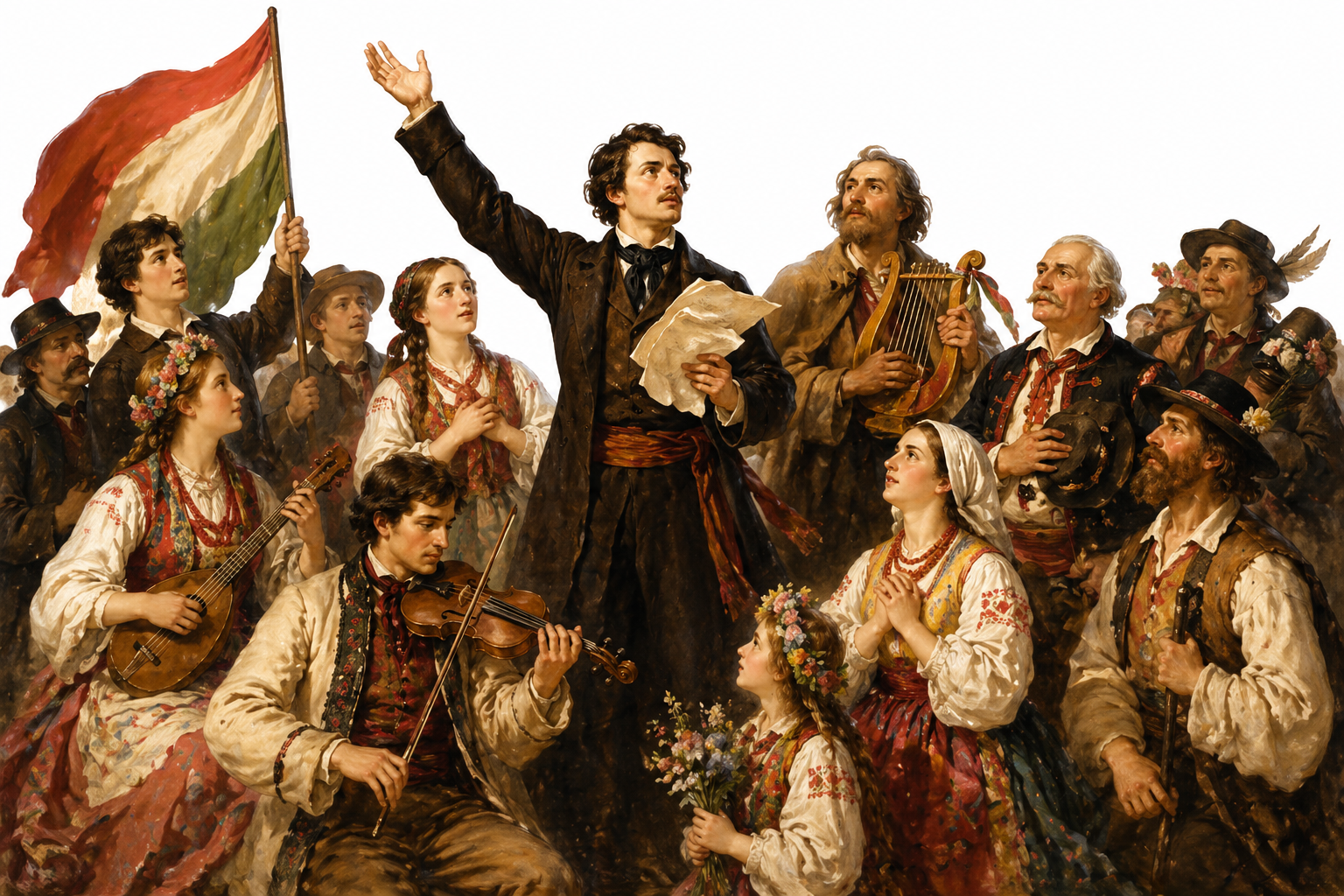
Romantic art and national feeling
Fact
The Grimm Brothers: Jacob and Wilhelm Grimm spent years travelling across German villages
to collect old folktales. They published their first collection in 1812 and saw their project of developing
the German language as a way to oppose French domination and create a pure German national identity.
- German philosopher Johann Gottfried Herder claimed true German culture was discovered
among the common people (das volk) through folk songs and dances.
- Music and Dance: Karol Kurpinski celebrated the Polish national
struggle through his operas and music, turning folk dances like the polonaise and
mazurka into nationalist symbols.
- Language played a key role. After Russian occupation, the Polish language was banned
from schools. However, Polish clerics used language as a weapon of national resistance by preaching
exclusively in Polish.
3.2 Hunger, Hardship and Popular Revolt
The 1830s brought great economic hardship to Europe. The primary causes of this hardship included:
- Europe's population increased rapidly, resulting in not enough jobs.
- People migrated from rural areas to cities, living in overcrowded slums.
- Small producers in towns could not compete with cheap British machine-made goods.
- In regions where the aristocracy still enjoyed power, peasants suffered under feudal
dues and bad harvests, leading to widespread poverty (pauperism).
1848 Paris Revolt: Food shortages and unemployment brought the population of Paris out onto
the roads. Barricades were set up, and King Louis Philippe was forced to flee. A Republic was declared which
granted voting rights to all adult males above 21 and created National Workshops to provide
jobs.
1845 Silesian Weavers' Uprising: Weavers protested against contractors who drastically
reduced their wages. A peaceful protest turned into a riot where houses and storehouses were destroyed. The
army was called in, and 11 weavers were shot dead.
3.3 1848: The Revolution of the Liberals
Parallel to the revolts of the poor, the educated middle classes led their own revolutions. They pushed for
constitutional rule, national unification, and guaranteed freedom of the press and association.
Important
The Frankfurt Parliament (May 18, 1848): 831 elected middle-class representatives gathered
at the Church of St. Paul to draft a constitution for a united Germany led by a monarch
under a parliament. The crown was offered to Friedrich Wilhelm IV of Prussia, who refused it. The parliament
lost popular support by ignoring workers' demands and was eventually dissolved by military force.
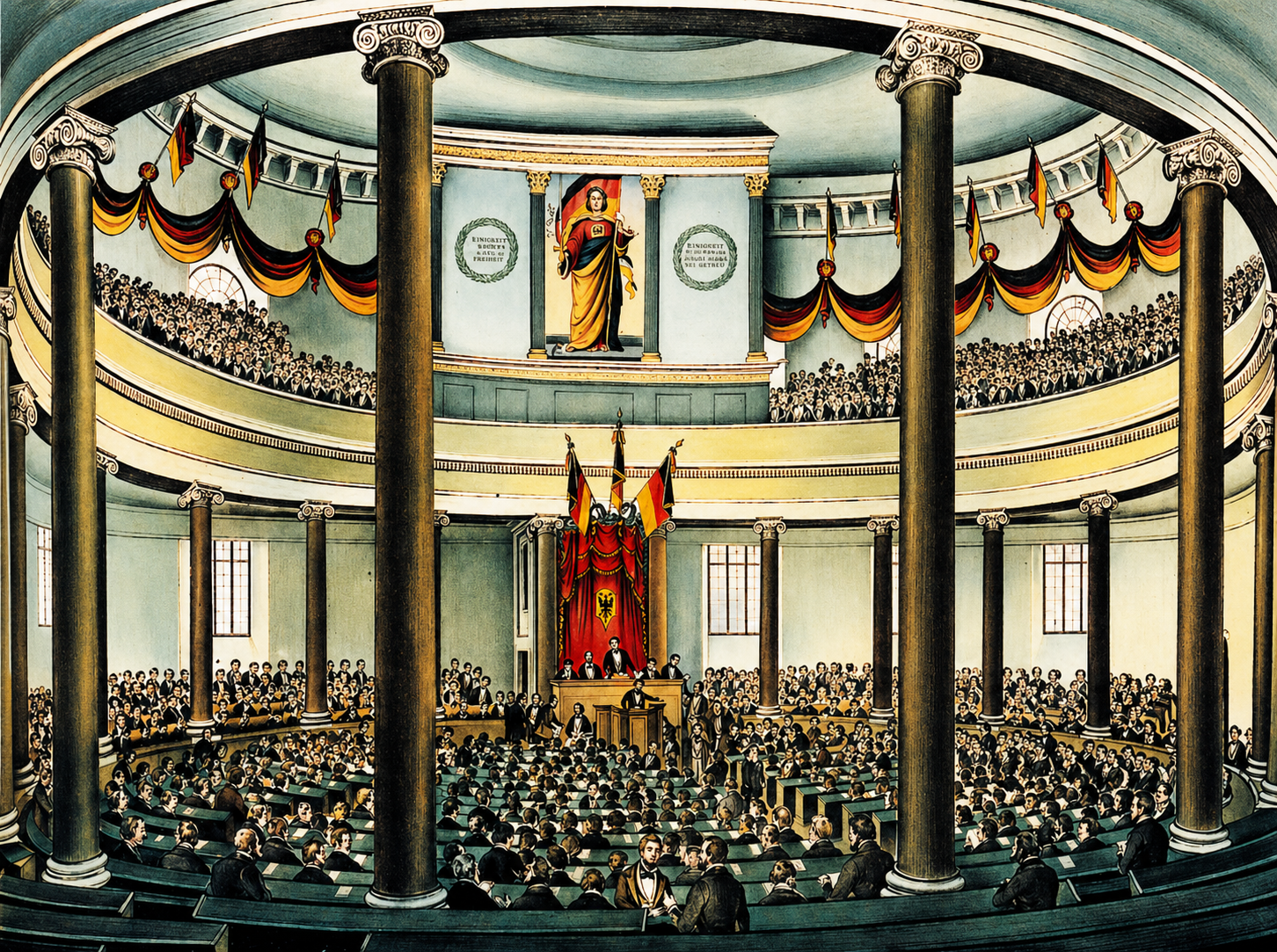
The Frankfurt Parliament - 1848
Role of Women: Women were highly active in these liberal movements. They formed
associations, ran newspapers, and attended political meetings. Despite this, they were completely denied
voting rights. In the Frankfurt Parliament, women were only allowed to watch from the visitors' gallery.
Aftermath of 1848: Although liberal movements were suppressed, conservative monarchs
realized they couldn't fully restore the old order without granting concessions. As a result:
- Serfdom and bonded labour were abolished both in Russia and the Habsburg dominions.
- In 1867, Hungarians gained more autonomy within the Habsburg Empire.
4. The Making of Germany and Italy
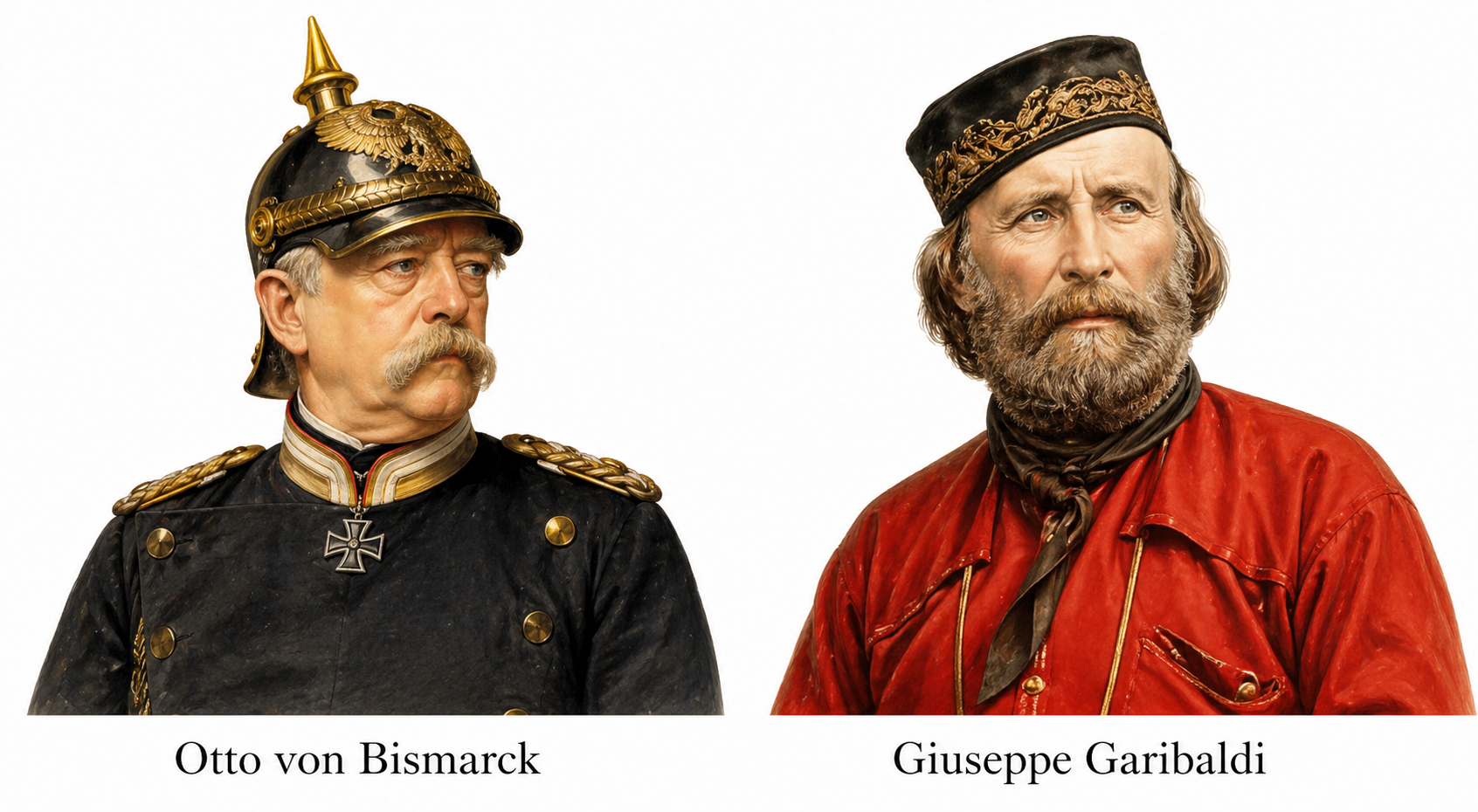
Otto von Bismarck and Giuseppe Garibaldi
4.1 Germany - Can the Army be the Architect of a Nation?
After the failure of the 1848 liberal initiatives, Prussia took leadership of the movement for German
unification. This effort was supported by the large landowners of Prussia, known as the
Junkers.
- Otto von Bismarck: The chief minister of Prussia and the architect of unification. He
carried this out with the help of the Prussian army and bureaucracy, following a firm policy of
"blood and iron."
- He fought three wars over seven years with Denmark (1864),
Austria (1866), and France (1870-71), which ended in Prussian victory
and completed the unification.
- On 18 January 1871, the Prussian king, Kaiser William I, was
proclaimed German Emperor in the Hall of Mirrors at the Palace of Versailles.
- Prussian Dominance: The new German state placed a strong emphasis on modernising
currency, banking, and legal systems, with Prussian measures often serving as a model.
4.2 Italy Unified
Italy had a long history of political fragmentation, divided into seven states. Only
Sardinia-Piedmont was ruled by an Italian princely house (King Victor Emmanuel II). The
north was under Austrian Habsburgs, the centre was ruled by the Pope, and the southern regions were under
the Bourbon kings of Spain.
- Giuseppe Mazzini: Tried to unite Italy in the 1830s. Though his uprisings failed, he
laid the crucial ideological groundwork for a unitary Italian Republic.
- Chief Minister Cavour: Led the movement to unify Italy. A pragmatist rather than a
revolutionary, he engineered a tactful diplomatic alliance with France, defeating Austrian forces in
1859.
- Giuseppe Garibaldi: A nationalist hero who led armed volunteers known as the Red
Shirts. In 1860, he led the famous "Expedition of the Thousand" to South Italy and the
Kingdom of the Two Sicilies, driving out the Spanish rulers with the support of local peasants.
- In 1861, Victor Emmanuel II was proclaimed king of united Italy.
- Forging a "British Identity":
- A new identity was forged as symbols like the British flag (Union Jack), the national anthem
(God Save Our Noble King), and the English language were actively promoted.
- The older nations (Scotland and Ireland) survived only as subordinate partners in this union.
5. Visualising the Nation
Artists in the 18th and 19th centuries personified nations, representing a country as if it were a person,
typically a female figure.
Concept
Allegory: When an abstract idea (like freedom, liberty, or greed) is expressed through a
person or thing. The female form chosen to personify the nation sought to give the abstract idea of the
nation a concrete form.
- Marianne: The female allegory for France. It was a popular Christian
name underlying the idea of a people's nation. Her characteristics were drawn from Liberty and the
Republic (the red cap, tricolour, cockade). Statues were erected in public squares.
- Germania: The allegory of the German nation. She wears a crown of oak
leaves, as the German oak stands for heroism.
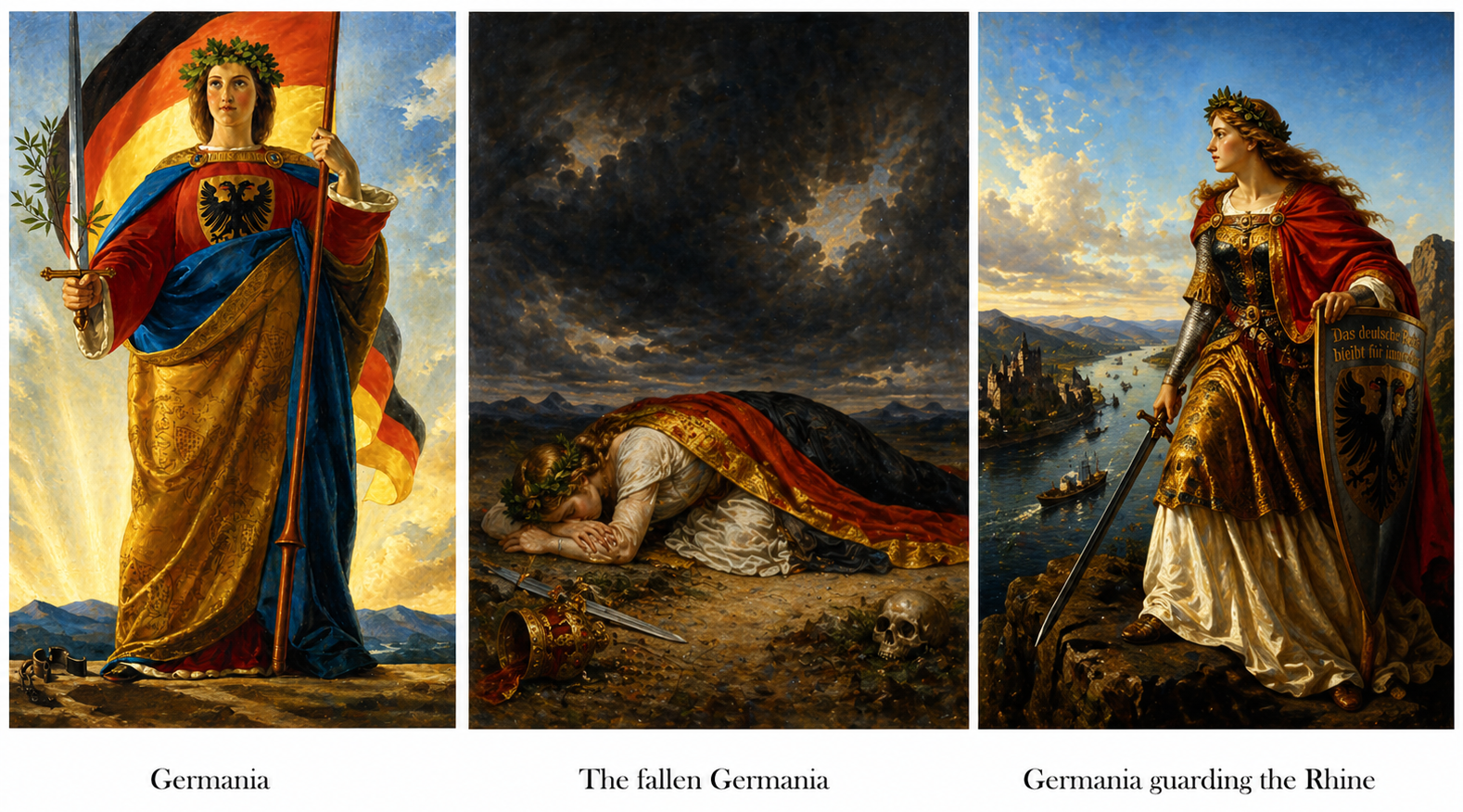
Germania - Allegory of the German Nation
Meanings of Symbols:
- Broken chains: Being freed
- Breastplate with eagle: Symbol of the German empire (strength)
- Sword: Readiness to fight
- Olive branch around the sword: Willingness to make peace
- Rays of the rising sun: Beginning of a new era
6. Nationalism and Imperialism
By the last quarter of the 19th century, nationalism lost its idealistic liberal-democratic sentiment and
became a narrow creed. Major European powers manipulated nationalist aspirations to further their own
imperialist aims.
Important
The Balkans Tension: The most serious source of nationalist tension in Europe after 1871
was the Balkans (comprising modern-day Romania, Bulgaria, Greece, Serbia, etc., whose
inhabitants were broadly known as Slavs). A large part of this region was under the disintegrating
Ottoman Empire.
The Balkans Crisis:
- As the various Slavic nationalities struggled for independence, the Balkan states became fiercely
jealous of each other.
- Each state hoped to gain more territory at the expense of the others.
- The situation was complicated by Big Power Rivalry. Russia, Germany, England, and
Austro-Hungary were eager to extend their trade, colonies, and military control over the area.
- This rivalry led to a series of wars in the region and ultimately triggered the First World War
in 1914.
Nationalism Beyond Europe:
- Simultaneously, countries colonised by European powers began anti-imperial movements.
- These movements were inherently nationalist struggles to form independent nation-states.
- This ultimately made the idea of the "nation-state" a universally accepted natural order.
Important Previous Year Questions (PYQs)
Q & A
Q1. What was the aim of the French Revolution?
Ans: It marked the starting of nationalism in France. The main objective was to build a
collective identity among the French people. Ideas like Le Citoyen and La Patrie promoted
the belief in a united community enjoying equal constitutional rights.
Q & A
Q2. Who was the 'Hero of two Worlds' and what was his role in the unification of Italy?
Ans: Giuseppe Garibaldi was the 'Hero of two Worlds'. He played a crucial
role in the unification of Italy by leading the armed volunteers (Red Shirts) and marching into South Italy
to drive out the Spanish rulers.
Q & A
Q3. Explain the importance of National feeling and Imagination (Romanticism).
Ans:
- Culture (arts, poetry, music, stories) was vital for developing nationalist feelings.
- Glorification of reason and science was openly criticized and replaced by intuitions, sentiments,
and emotions. This movement, known as Romanticism, aimed to create national sentiments.
- Language also played an important role in developing national resistance (e.g., in Poland).
Q & A
Q4. Why did liberal nationalists create secret societies?
Ans: Secret societies were created to train European revolutionaries and spread their
ideas. Their main aim was to oppose monarchical forms established by the Vienna Congress (1815) and to
continue their fight for freedom and liberty.
Q & A
Q5. Why were the Balkan nations in crisis?
Ans: The majority of the Balkans was under the control of the Ottoman Empire. The spread of
romantic nationalism in the area, combined with the deterioration of the Ottoman Empire, made this region
explosive. Balkan states were fiercely jealous of each other, and major European powers were looking to
extend their control over the area, ultimately leading to the First World War.
