

Strictly based on the Rationalised CBSE Syllabus (New NCERT). Covers:
- Conservation of forest and wildlife in India.
- The Indian Wildlife (Protection) Act, 1972.
- Types and distribution of forest and wildlife resources (Reserved, Protected, Unclassed).
- Community and Conservation (Chipko movement, JFM, Sacred Groves).
1. Introduction: Flora and Fauna in India
India is one of the world's richest countries in terms of its vast array of biological diversity. We share this planet with millions of other living beings, starting from micro-organisms and bacteria, lichens to banyan trees, elephants, and blue whales.
- Rich Biodiversity: India has nearly 8% of the total number of species in the world (estimated to be 1.6 million).
- Flora and Fauna: The diverse plants (flora) and animals (fauna) form a complex web of ecological system. They are so well integrated into our daily life that we take them for granted.
- Why preserve them? We depend on this system for our basic needs like the air we breathe, the water we drink, and the soil that produces our food. Forests play a key role in the ecological system as they are the primary producers on which all other living beings depend.
- Threats to Biodiversity: Overexploitation of resources, cutting of trees (deforestation), and hunting have led to a severe decline in India's flora and fauna. Several species (like the Cheetah, pink-headed duck, mountain quail, and forest spotted owlet) have reached the verge of extinction.
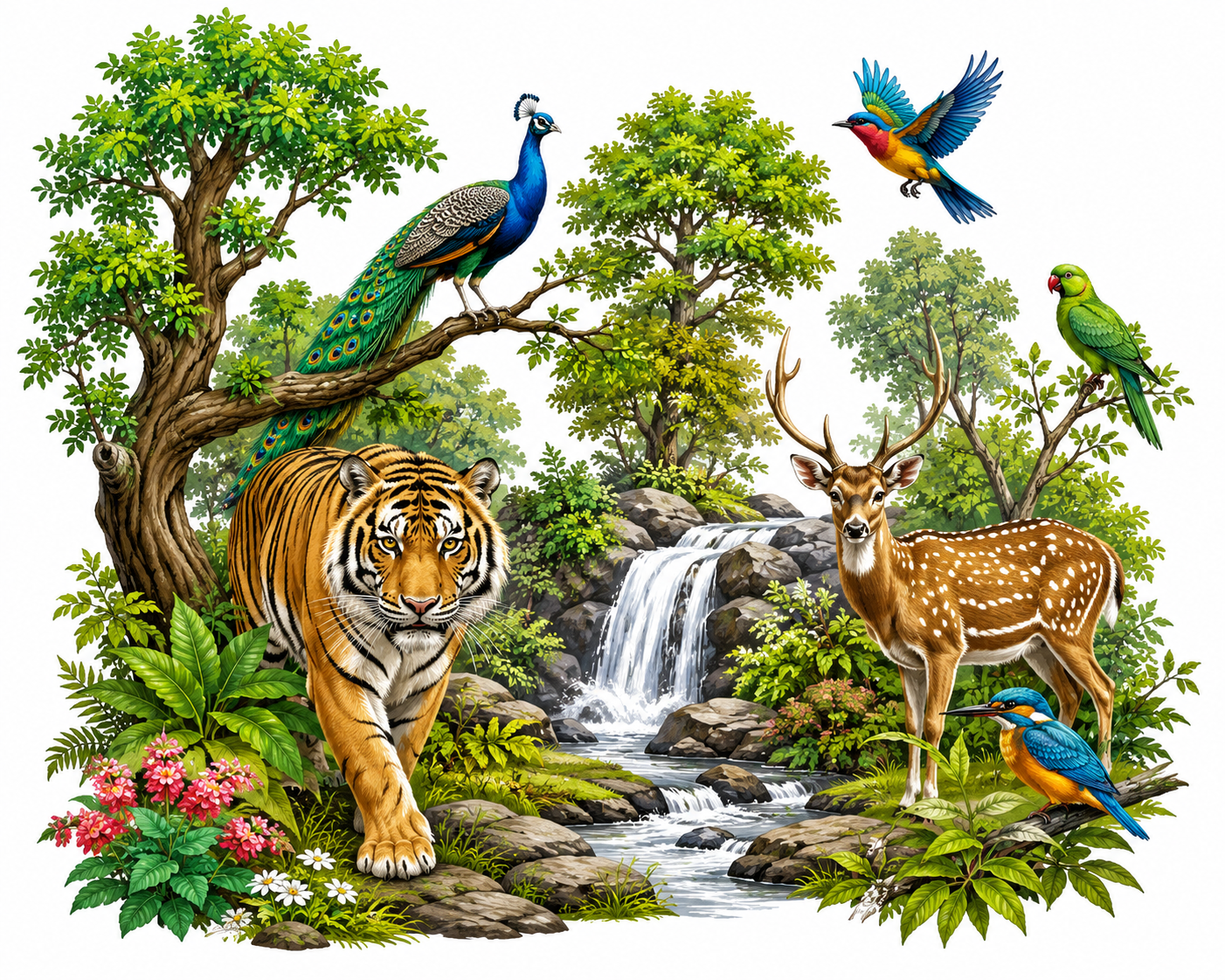
2. Conservation of Forest and Wildlife in India
Conservation preserves the ecological diversity and our life support systems – water, air and soil. It also preserves the genetic diversity of plants and animals for better growth of species and breeding.
The Indian Wildlife (Protection) Act, 1972
In the 1960s and 1970s, conservationists demanded a national wildlife protection programme. The government implemented this act in 1972.
- An all-India list of protected species was published.
- The main focus was to protect the remaining population of certain endangered species by banning hunting, giving legal protection to their habitats, and restricting trade in wildlife.
- Central and many state governments established National Parks and Wildlife Sanctuaries.
- Specific Animal Projects: The central government announced several projects for protecting specific animals, which were gravely threatened, including the tiger, the one-horned rhinoceros, the Kashmir stag or hangul, three types of crocodiles (freshwater crocodile, saltwater crocodile and the Gharial), the Asiatic lion, and others.
- Recent Additions: Recently, the Indian elephant, black buck (chinkara), the great Indian bustard (godawan) and the snow leopard, etc., have been given full or partial legal protection against hunting and trade throughout India.
3. Types and Distribution of Forest and Wildlife Resources
In India, much of its forest and wildlife resources are either owned or managed by the government through the Forest Department or other government departments. They are classified under the following categories:
(i) Reserved Forests
More than half of the total forest land has been declared reserved forests. They are regarded as the most valuable as far as the conservation of forest and wildlife resources are concerned.
(ii) Protected Forests
Almost one-third of the total forest area is protected forest, as declared by the Forest Department. This forest land is protected from any further depletion.
(iii) Unclassed Forests
These are other forests and wastelands belonging to both government and private individuals and communities.
- Permanent Forest Estates: Reserved and protected forests are also referred to as permanent forest estates maintained for the purpose of producing timber and other forest produce, and for protective reasons.
- State-wise Distribution:
- Madhya Pradesh has the largest area under permanent forests, constituting 75% of its total forest area.
- Jammu & Kashmir, Andhra Pradesh, Uttarakhand, Kerala, Tamil Nadu, West Bengal, and Maharashtra have large percentages of reserved forests.
- Bihar, Haryana, Punjab, Himachal Pradesh, Odisha and Rajasthan have a bulk of their forests under protected forests.
- North-eastern states and Gujarat have a very high percentage of their forests as unclassed forests managed by local communities.

1. PROJECT TIGER (1973)
- Launched in 1973 after authorities realised the tiger population had dwindled from an estimated 55,000 to just 1,827.
- Major Threats: Poaching for trade, shrinking habitat, depletion of prey base species, and growing human population. Tiger bones are heavily used in traditional medicines in Asian countries.
- Objective: Not only to save an endangered species but also preserving biotypes of sizeable magnitude.
- Major Tiger Reserves: Corbett National Park (Uttarakhand), Sundarbans (West Bengal), Bandhavgarh (MP), Sariska (Rajasthan), Manas (Assam), and Periyar (Kerala).

2. CHIPKO MOVEMENT
- The famous Chipko Movement in the Himalayas successfully resisted deforestation in several areas.
- It demonstrated that community afforestation with indigenous species can be enormously successful.
- People revived traditional conservation methods and hugged trees to prevent contractors from cutting them.

3. BEEJ BACHAO ANDOLAN & NAVDANYA
- Farmers and citizen's groups like the Beej Bachao Andolan in Tehri and Navdanya have championed agricultural conservation.
- They have shown that adequate levels of diversified crop production without the use of synthetic chemicals are possible and economically viable.
4. SACRED GROVES
- Nature worship is an age-old tribal belief that all creations of nature have to be protected. Such beliefs have preserved several virgin forests in pristine form called Sacred Groves (the forests of God and Goddesses).
- Local people leave these patches untouched and ban any interference.
- Examples of Tree Worship:
- Mundas and Santhal of Chhota Nagpur worship mahua and kadamba trees.
- Tribals of Odisha and Bihar worship tamarind and mango trees during weddings.
- Peepal and Banyan trees are considered sacred across India.
5. LOCAL COMMUNITY INTERVENTIONS
- Sariska Tiger Reserve (Rajasthan): Villagers have fought against mining by citing the Wildlife Protection Act. In many areas, villagers themselves are protecting habitats and explicitly rejecting government involvement.
- Bhairodev Dakav 'Sonchuri' (Alwar, Rajasthan): The inhabitants of five villages declared 1,200 hectares of forest as a sanctuary, declaring their own set of rules and regulations which do not allow hunting, and are protecting the wildlife against outside encroachments.
- Bishnoi Villages (Rajasthan): In villages around Bishnoi communities, herds of blackbuck (chinkara), nilgai and peacocks can be seen as an integral part of the community, and nobody harms them.
6. JOINT FOREST MANAGEMENT (JFM)
- JFM furnishes a good example for involving local communities in the management and restoration of degraded forests.
- The programme has been in formal existence since 1988 when the state of Odisha passed the first resolution for JFM.
- JFM depends on the formation of local (village) institutions that undertake protection activities mostly on degraded forest land managed by the forest department.
- In return, the members of these communities are entitled to intermediary benefits like non-timber forest produces and share in the timber harvested by 'successful protection'.
IMPORTANT POINTS (QUICK REVISION)
- Project Tiger was launched in 1973.
- Chipko Movement is an example of people's participation in forest conservation.
- Bishnoi community protects trees and animals selflessly.
- Sacred Groves are protected due to religious beliefs.
- Joint Forest Management promotes partnership between people and government.
- Local communities play a key role in conserving forests and wildlife.