Vardaan Learning Institute
Detailed Solutions - PYQ 2025
Set - 31-S (Solutions)
SCIENCE
Class - X
Time: 3 Hours
Max. Marks: 80
SECTION A
1.
Answer: (B) (i) and (iv)
Explanation:
Decomposition reactions can be thermal (heat), electrolytic (electricity), or photolytic (light).
(i) \(CaCO_3 \xrightarrow{\Delta} CaO + CO_2\) is a thermal decomposition reaction (Endothermic) requiring heat.
(ii) \(2H_2O \xrightarrow{Electricity} 2H_2 + O_2\) is electrolytic decomposition.
(iii) \(2AgBr \xrightarrow{Sunlight} 2Ag + Br_2\) is photolytic decomposition.
(iv) \(2Pb(NO_3)_2 \xrightarrow{\Delta} 2PbO + 4NO_2 + O_2\) is thermal decomposition.
Thus, reactions (i) and (iv) require heat as the source of energy.
Decomposition reactions can be thermal (heat), electrolytic (electricity), or photolytic (light).
(i) \(CaCO_3 \xrightarrow{\Delta} CaO + CO_2\) is a thermal decomposition reaction (Endothermic) requiring heat.
(ii) \(2H_2O \xrightarrow{Electricity} 2H_2 + O_2\) is electrolytic decomposition.
(iii) \(2AgBr \xrightarrow{Sunlight} 2Ag + Br_2\) is photolytic decomposition.
(iv) \(2Pb(NO_3)_2 \xrightarrow{\Delta} 2PbO + 4NO_2 + O_2\) is thermal decomposition.
Thus, reactions (i) and (iv) require heat as the source of energy.
2.
Answer: (B) 3
Explanation:
A nitrogen molecule (\(N_2\)) is formed by the sharing of three pairs of electrons between two nitrogen atoms. Nitrogen (atomic number 7) has 5 valence electrons. It needs 3 more electrons to complete its octet. Therefore, two nitrogen atoms form a triple covalent bond (\(N \equiv N\)) to achieve stability.
A nitrogen molecule (\(N_2\)) is formed by the sharing of three pairs of electrons between two nitrogen atoms. Nitrogen (atomic number 7) has 5 valence electrons. It needs 3 more electrons to complete its octet. Therefore, two nitrogen atoms form a triple covalent bond (\(N \equiv N\)) to achieve stability.
3.
Answer: (B) Most vigorous reaction with magnesium and no reaction with
iron. (Correction: Iron reactions are VERY slow, but Copper is 'no reaction'). Wait, let's
analyze based on reactivity series.
Let's re-evaluate options based on standard NCERT activity:
Reactivity of metals with dilute HCl decreases in the order: \(Mg > Al > Zn > Fe\).
- Magnesium reacts most vigorously interacting with dilute acids to release hydrogen gas.
- Copper is below Hydrogen in the reactivity series, so it does not react with dilute hydrochloric acid.
- Iron does react, but slowly.
Looking at the options:
(C) "Most vigorous reaction with magnesium and no reaction with copper" matches facts perfectly.
(B) says "no reaction with iron", which is technically incorrect (it reacts slowly), while (C) is factually perfect (Mg is most vigorous among these, Cu is no reaction).
Correct Answer is (C).
Let's re-evaluate options based on standard NCERT activity:
Reactivity of metals with dilute HCl decreases in the order: \(Mg > Al > Zn > Fe\).
- Magnesium reacts most vigorously interacting with dilute acids to release hydrogen gas.
- Copper is below Hydrogen in the reactivity series, so it does not react with dilute hydrochloric acid.
- Iron does react, but slowly.
Looking at the options:
(C) "Most vigorous reaction with magnesium and no reaction with copper" matches facts perfectly.
(B) says "no reaction with iron", which is technically incorrect (it reacts slowly), while (C) is factually perfect (Mg is most vigorous among these, Cu is no reaction).
Correct Answer is (C).
4.
Answer: (B) Burning of carbon (coal)
Explanation:
A combination reaction is one where two or more reactants combine to form a single product.
(A) Black and white photography involves \(2AgBr \rightarrow 2Ag + Br_2\) (Decomposition).
(B) Burning of coal: \(C + O_2 \rightarrow CO_2\). Two reactants (Carbon and Oxygen) form one product (Carbon dioxide). This is a combination reaction.
(C) Burning of methane: \(CH_4 + 2O_2 \rightarrow CO_2 + 2H_2O\) (Combustion/Redox, forms two products).
(D) Refining of copper is an electrolytic process, not a simple chemical combination.
A combination reaction is one where two or more reactants combine to form a single product.
(A) Black and white photography involves \(2AgBr \rightarrow 2Ag + Br_2\) (Decomposition).
(B) Burning of coal: \(C + O_2 \rightarrow CO_2\). Two reactants (Carbon and Oxygen) form one product (Carbon dioxide). This is a combination reaction.
(C) Burning of methane: \(CH_4 + 2O_2 \rightarrow CO_2 + 2H_2O\) (Combustion/Redox, forms two products).
(D) Refining of copper is an electrolytic process, not a simple chemical combination.
5.
Answer: (B) Amphoteric
Explanation:
Metal oxides are generally basic, but Aluminium oxide (\(Al_2O_3\)) and Zinc oxide (\(ZnO\)) are amphoteric oxides. This means they can react with both acids and bases to produce salt and water.
Example: \(Al_2O_3 + 6HCl \rightarrow 2AlCl_3 + 3H_2O\) (Basic nature)
Example: \(Al_2O_3 + 2NaOH \rightarrow 2NaAlO_2 + H_2O\) (Acidic nature)
Metal oxides are generally basic, but Aluminium oxide (\(Al_2O_3\)) and Zinc oxide (\(ZnO\)) are amphoteric oxides. This means they can react with both acids and bases to produce salt and water.
Example: \(Al_2O_3 + 6HCl \rightarrow 2AlCl_3 + 3H_2O\) (Basic nature)
Example: \(Al_2O_3 + 2NaOH \rightarrow 2NaAlO_2 + H_2O\) (Acidic nature)
6.
Answer: (B) Wilting of leaves
Explanation:
Abscisic acid (ABA) is a plant growth inhibitor. Its primary function is to inhibit growth during stress conditions. It is responsible for the closing of stomata to prevent water loss and promotes the wilting and falling of leaves (abscission).
Abscisic acid (ABA) is a plant growth inhibitor. Its primary function is to inhibit growth during stress conditions. It is responsible for the closing of stomata to prevent water loss and promotes the wilting and falling of leaves (abscission).
7.
Answer: (A) (i) and (iii)
Explanation:
- The left side of the heart deals with oxygenated blood. Blood flows from the Left Atrium to the Left Ventricle (Statement i is Correct).
- The right side deals with deoxygenated blood. Blood flows from the Right Atrium to the Right Ventricle (Statement iii is Correct).
- Valves (Tricuspid and Bicuspid/Mitral) ensure this one-way flow and prevent backflow.
- The left side of the heart deals with oxygenated blood. Blood flows from the Left Atrium to the Left Ventricle (Statement i is Correct).
- The right side deals with deoxygenated blood. Blood flows from the Right Atrium to the Right Ventricle (Statement iii is Correct).
- Valves (Tricuspid and Bicuspid/Mitral) ensure this one-way flow and prevent backflow.
8.
Answer: (B) Pons
Explanation:
The hindbrain consists of the cerebellum, pons, and medulla. Anatomically, the Pons lies immediately above the medulla oblongata and below the midbrain. The cerebellum lies dorsally (behind).
The hindbrain consists of the cerebellum, pons, and medulla. Anatomically, the Pons lies immediately above the medulla oblongata and below the midbrain. The cerebellum lies dorsally (behind).
9.
Answer: (B) 50% violet, 50% white
Explanation:
Cross: Parent 1 (Violet, heterozygous) \(Vv\) x Parent 2 (White, recessive) \(vv\).
Gametes from P1: \(V\) and \(v\).
Gametes from P2: \(v\) and \(v\).
F1 Genotypes: \(Vv\) (Violet) and \(vv\) (White).
Ratio: 1 \(Vv\) : 1 \(vv\).
Percentage: 50% Violet and 50% White.
This is a typical test cross.
Cross: Parent 1 (Violet, heterozygous) \(Vv\) x Parent 2 (White, recessive) \(vv\).
Gametes from P1: \(V\) and \(v\).
Gametes from P2: \(v\) and \(v\).
F1 Genotypes: \(Vv\) (Violet) and \(vv\) (White).
Ratio: 1 \(Vv\) : 1 \(vv\).
Percentage: 50% Violet and 50% White.
This is a typical test cross.
10.
Answer: (B) Pollen grains
Explanation:
Meiosis occurs in reproductive cells to form haploid gametes or spores. In the anther of a plant (male reproductive part), microspore mother cells undergo meiosis to produce microspores, which develop into pollen grains. Zygote is a product of fertilization (fusion). Sperms/Eggs are terms usually used for gametes inside; 'Pollen grain' is the specific haploid structure formed after meiosis in anthers.
Meiosis occurs in reproductive cells to form haploid gametes or spores. In the anther of a plant (male reproductive part), microspore mother cells undergo meiosis to produce microspores, which develop into pollen grains. Zygote is a product of fertilization (fusion). Sperms/Eggs are terms usually used for gametes inside; 'Pollen grain' is the specific haploid structure formed after meiosis in anthers.
11.
Answer: (D) Snake
Explanation:
A typical grassland food chain:
1. Grass (Producer - 1st Trophic Level)
2. Grasshopper (Primary Consumer / Herbivore - 2nd Trophic Level)
3. Frog (Secondary Consumer / Carnivore - 3rd Trophic Level)
4. Snake (Tertiary Consumer - 4th Trophic Level)
A typical grassland food chain:
1. Grass (Producer - 1st Trophic Level)
2. Grasshopper (Primary Consumer / Herbivore - 2nd Trophic Level)
3. Frog (Secondary Consumer / Carnivore - 3rd Trophic Level)
4. Snake (Tertiary Consumer - 4th Trophic Level)
12.
Answer: (C) same at all points
Explanation:
Inside a long straight current-carrying solenoid, the magnetic field lines are parallel and straight. This indicates that the magnetic field is uniform. Therefore, the strength of the magnetic field is the same at all points inside the solenoid.
Inside a long straight current-carrying solenoid, the magnetic field lines are parallel and straight. This indicates that the magnetic field is uniform. Therefore, the strength of the magnetic field is the same at all points inside the solenoid.
13.
Answer: (A) Plane mirror
Explanation:
Magnification \(m = +1\) implies two things:
1. The image is virtual and erect (indicated by the '+' sign).
2. The size of the image is equal to the size of the object (indicated by '1').
A plane mirror always forms a virtual, erect image of the same size as the object. Concave mirrors varies. Convex mirrors always form diminished images (\(m < 1\)).
Magnification \(m = +1\) implies two things:
1. The image is virtual and erect (indicated by the '+' sign).
2. The size of the image is equal to the size of the object (indicated by '1').
A plane mirror always forms a virtual, erect image of the same size as the object. Concave mirrors varies. Convex mirrors always form diminished images (\(m < 1\)).
14.
Answer: (A) Temperature
Explanation:
Electrical resistivity (\(\rho\)) is a visible property of the material. It depends on:
1. Nature of the material.
2. Temperature.
It does not depend on the dimensions (Length, Thickness/Area, Shape) of the conductor. Resistance depends on length and area, but resistivity does not.
Electrical resistivity (\(\rho\)) is a visible property of the material. It depends on:
1. Nature of the material.
2. Temperature.
It does not depend on the dimensions (Length, Thickness/Area, Shape) of the conductor. Resistance depends on length and area, but resistivity does not.
15.
Answer: (A) A solar furnace
Explanation:
(A) Solar furnace: Concave mirrors are used to converge parallel sun rays to a single focal point to generate high heat. This is a primary use.
(B) Rear-view mirror: Convex mirrors are used (wider field of view).
(C) Full-size erect image of distant building: Convex mirror is suitable to diminish it to fit; plane mirror requires huge size.
(D) To produce divergent beam: Concave mirrors are converging. (Headlights use them to produce parallel beams from a source at focus).
(A) Solar furnace: Concave mirrors are used to converge parallel sun rays to a single focal point to generate high heat. This is a primary use.
(B) Rear-view mirror: Convex mirrors are used (wider field of view).
(C) Full-size erect image of distant building: Convex mirror is suitable to diminish it to fit; plane mirror requires huge size.
(D) To produce divergent beam: Concave mirrors are converging. (Headlights use them to produce parallel beams from a source at focus).
16.
Answer: (B) chemical energy
Explanation:
Energy flows through an ecosystem in the form of food. According to the 10% law, only 10% of the energy is transferred to the next trophic level, and this energy is stored in the chemical bonds of the biomass (body tissues) of the organism.
Energy flows through an ecosystem in the form of food. According to the 10% law, only 10% of the energy is transferred to the next trophic level, and this energy is stored in the chemical bonds of the biomass (body tissues) of the organism.
17.
Answer: (B) Both Assertion (A) and Reason (R) are true but Reason
(R) is not the correct explanation of Assertion (A).
Explanation:
A: Household circuits use Live, Neutral, and Earth wires. (True).
R: Potential difference is 220V. (True).
Explanation: The existence of 220V is a specification, not the direct reason *why* the system uses two specific wires named 'Live' and 'Neutral' (that relates to completing the circuit path). However, it's a close call. Usually, the reason for "using live and neutral" is to provide a closed path for current with a potential difference. R states the value of that PD. It doesn't fully explain the configuration mechanism.
A: Household circuits use Live, Neutral, and Earth wires. (True).
R: Potential difference is 220V. (True).
Explanation: The existence of 220V is a specification, not the direct reason *why* the system uses two specific wires named 'Live' and 'Neutral' (that relates to completing the circuit path). However, it's a close call. Usually, the reason for "using live and neutral" is to provide a closed path for current with a potential difference. R states the value of that PD. It doesn't fully explain the configuration mechanism.
18.
Answer: (C) Assertion (A) is true but Reason (R) is false.
Explanation:
A: Decomposition of vegetable matter into compost releases heat (metabolic activity of microbes). It is an **exothermic** reaction. (True).
R: Decomposition reactions (in chemistry textbooks, e.g., thermal decomp) usually absorb energy to break bonds (Endothermic). The reason statement makes a general claim about decomposition reactions needing energy, which contradicts the exothermic nature mentioned in A. In the context of compost, the biological decomposition releases energy. But R as a general chemistry statement says "Decomposition needs energy", implying endothermic. Since A is Exothermic, R cannot be the explanation if interpreted as the general chemical rule. Wait, R is actually False in this specific context? No, breaking bonds needs energy, but new bond formation releases it. In compost, net energy is released. The chemical definition "Decomposition reactions are endothermic" is the standard teaching. Compost is the exception listed in NCERT. So A is True. R (General rule) is True for chemical decomp types (CaCO3 etc). But R is NOT the explanation for A. A is exothermic, R implies endothermic. Thus, B or C? Actually, if R is defining standard decomposition, it contradicts A's nature.
Correction: NCERT explicitly states "Decomposition of vegetable matter... is an exothermic reaction". It also defines Decomposition reactions generally as requiring energy (Endothermic). Since these contradict in nature, R (as a general statement) is correct for chemical definition, but it does NOT explain A. It contradicts A.
A: Decomposition of vegetable matter into compost releases heat (metabolic activity of microbes). It is an **exothermic** reaction. (True).
R: Decomposition reactions (in chemistry textbooks, e.g., thermal decomp) usually absorb energy to break bonds (Endothermic). The reason statement makes a general claim about decomposition reactions needing energy, which contradicts the exothermic nature mentioned in A. In the context of compost, the biological decomposition releases energy. But R as a general chemistry statement says "Decomposition needs energy", implying endothermic. Since A is Exothermic, R cannot be the explanation if interpreted as the general chemical rule. Wait, R is actually False in this specific context? No, breaking bonds needs energy, but new bond formation releases it. In compost, net energy is released. The chemical definition "Decomposition reactions are endothermic" is the standard teaching. Compost is the exception listed in NCERT. So A is True. R (General rule) is True for chemical decomp types (CaCO3 etc). But R is NOT the explanation for A. A is exothermic, R implies endothermic. Thus, B or C? Actually, if R is defining standard decomposition, it contradicts A's nature.
Correction: NCERT explicitly states "Decomposition of vegetable matter... is an exothermic reaction". It also defines Decomposition reactions generally as requiring energy (Endothermic). Since these contradict in nature, R (as a general statement) is correct for chemical definition, but it does NOT explain A. It contradicts A.
19.
Answer: (C) Assertion (A) is true but Reason (R) is false.
Explanation:
A: Sky appears blue due to scattering (Rayleigh scattering) of sunlight by atmospheric particles. (True).
R: The wavelength of red light is approximately 1.8 times that of blue light. Scattering is inversely proportional to the 4th power of wavelength. Blue scatters MORE. The reason statement gives a wavelength ratio fact... is it true? \(\lambda_{red} \approx 700nm, \lambda_{blue} \approx 400nm\). \(700/400 = 1.75 \approx 1.8\). So the statement itself is True. Does it explain A? Yes, because \(\lambda_{blue} < \lambda_{red}\), blue scatters more. Wait, let me check the wording. "Blue light wavelength is 1.8 times red" . ERROR. Blue is SHORTER. Red is 1.8 times Blue. The statement says "Blue... is 1.8 times red" . This is FALSE. It implies Blue is longer. A is True, R is False.
A: Sky appears blue due to scattering (Rayleigh scattering) of sunlight by atmospheric particles. (True).
R: The wavelength of red light is approximately 1.8 times that of blue light. Scattering is inversely proportional to the 4th power of wavelength. Blue scatters MORE. The reason statement gives a wavelength ratio fact... is it true? \(\lambda_{red} \approx 700nm, \lambda_{blue} \approx 400nm\). \(700/400 = 1.75 \approx 1.8\). So the statement itself is True. Does it explain A? Yes, because \(\lambda_{blue} < \lambda_{red}\), blue scatters more. Wait, let me check the wording. "Blue light wavelength is 1.8 times red" . ERROR. Blue is SHORTER. Red is 1.8 times Blue. The statement says "Blue... is 1.8 times red" . This is FALSE. It implies Blue is longer. A is True, R is False.
20.
Answer: (B) Both Assertion (A) and Reason (R) are true but
Reason (R) is not the correct explanation of Assertion (A).
Explanation:
A: Transpirational pull is the major driving force for water movement in tall trees during the day. (True).
R: Root pressure is more significant at night when transpiration is low. (True).
Both statements are correct biological facts. However, the fact that root pressure works at night does not explain why transpirational pull works (which is due to evaporation/cohesion-tension). Thus, R is not the correct explanation for A.
A: Transpirational pull is the major driving force for water movement in tall trees during the day. (True).
R: Root pressure is more significant at night when transpiration is low. (True).
Both statements are correct biological facts. However, the fact that root pressure works at night does not explain why transpirational pull works (which is due to evaporation/cohesion-tension). Thus, R is not the correct explanation for A.
SECTION B
21.
Solution:
To draw the ray diagram:
- Draw a triangle ABC representing the glass prism.
- Draw a light ray PQ incident obliquely on face AB. Draw the normal N1 at the point of incidence.
- Mark the Angle of Incidence (\(\angle i\)) between ray PQ and Normal N1.
- The ray bends towards the normal as it enters the glass (refracts). Let this path be QR inside the prism.
- The ray emerges from face AC. Draw Normal N2 at point R. The ray bends away from the normal. Let this be ray RS.
- Extend the incident ray PQ forward and the emergent ray RS backward. The angle between them is the Angle of Deviation (\(\angle D\)).
(Diagram visual: Incident ray enters, bends down, emerges bending further down. Angle D is the external angle formed by the intersection of extended incident and emergent rays).
22.
Solution:
(a) Aluminum reacts with Copper(II) Chloride displacement reaction:
Balanced Equation: \(2Al(s) + 3CuCl_2(aq) \rightarrow 2AlCl_3(aq) + 3Cu(s)\)
(b) Zinc reacts with Sodium Hydroxide (Amphoteric nature of Zn):
Balanced Equation: \(Zn(s) + 2NaOH(aq) \rightarrow Na_2ZnO_2(aq) + H_2(g)\)
(Product is Sodium Zincate).
(a) Aluminum reacts with Copper(II) Chloride displacement reaction:
Balanced Equation: \(2Al(s) + 3CuCl_2(aq) \rightarrow 2AlCl_3(aq) + 3Cu(s)\)
(b) Zinc reacts with Sodium Hydroxide (Amphoteric nature of Zn):
Balanced Equation: \(Zn(s) + 2NaOH(aq) \rightarrow Na_2ZnO_2(aq) + H_2(g)\)
(Product is Sodium Zincate).
23.
Solution:
(a) Alloy: An alloy is a homogeneous mixture of two or more metals, or a metal and a non-metal. It is prepared to enhance properties like strength, resistance to corrosion, etc. (e.g., Brass, Bronze, Steel).
(b) Electrolytic Refining of Silver:
- Cathode: A strip of pure silver (Pure metal is always cathode).
- Anode: A block of impure silver (Impure metal is anode).
- Anode Mud: The insoluble impurities (like gold, platinum) that settle down at the bottom of the anode tank during electrolysis are called anode mud.
(a) Alloy: An alloy is a homogeneous mixture of two or more metals, or a metal and a non-metal. It is prepared to enhance properties like strength, resistance to corrosion, etc. (e.g., Brass, Bronze, Steel).
(b) Electrolytic Refining of Silver:
- Cathode: A strip of pure silver (Pure metal is always cathode).
- Anode: A block of impure silver (Impure metal is anode).
- Anode Mud: The insoluble impurities (like gold, platinum) that settle down at the bottom of the anode tank during electrolysis are called anode mud.
24.
Solution:
Circulation in Fishes (Single Circulation):
1. Fishes have a two-chambered heart (one atrium, one ventricle).
2. The heart pumps deoxygenated blood to the gills.
3. Oxygenation occurs in the gills (gill capillaries take up oxygen from water).
4. The oxygenated blood flows directly from the gills to the rest of the body parts.
5. Deoxygenated blood from the body returns to the atrium of the heart.
Since blood passes through the heart only once in one complete cycle, it is called Single Circulation.
Circulation in Fishes (Single Circulation):
1. Fishes have a two-chambered heart (one atrium, one ventricle).
2. The heart pumps deoxygenated blood to the gills.
3. Oxygenation occurs in the gills (gill capillaries take up oxygen from water).
4. The oxygenated blood flows directly from the gills to the rest of the body parts.
5. Deoxygenated blood from the body returns to the atrium of the heart.
Since blood passes through the heart only once in one complete cycle, it is called Single Circulation.
25.
Solution:
Given:
Concave Mirror.
Object distance, \(u = -18\) cm (Always negative).
Focal length, \(f = -12\) cm (Concave mirror focal length is negative).
To Find: Image position (\(v\)).
Formula: \(\frac{1}{f} = \frac{1}{v} + \frac{1}{u}\)
Calculation:
\(\frac{1}{-12} = \frac{1}{v} + \frac{1}{-18}\)
\(\frac{1}{v} = \frac{1}{-12} + \frac{1}{18}\)
LCM of 12 and 18 is 36.
\(\frac{1}{v} = \frac{-3 + 2}{36}\)
\(\frac{1}{v} = \frac{-1}{36}\)
\(v = -36\) cm.
Result: The image is formed at a distance of 36 cm from the pole, on the same side as the object (Real and Inverted).
Given:
Concave Mirror.
Object distance, \(u = -18\) cm (Always negative).
Focal length, \(f = -12\) cm (Concave mirror focal length is negative).
To Find: Image position (\(v\)).
Formula: \(\frac{1}{f} = \frac{1}{v} + \frac{1}{u}\)
Calculation:
\(\frac{1}{-12} = \frac{1}{v} + \frac{1}{-18}\)
\(\frac{1}{v} = \frac{1}{-12} + \frac{1}{18}\)
LCM of 12 and 18 is 36.
\(\frac{1}{v} = \frac{-3 + 2}{36}\)
\(\frac{1}{v} = \frac{-1}{36}\)
\(v = -36\) cm.
Result: The image is formed at a distance of 36 cm from the pole, on the same side as the object (Real and Inverted).
26.
(a) Solution:
Tendrils are sensitive to touch (thigmotropism). When a tendril comes in contact with a support, the part of the tendril in contact grows slower than the part away from the support (due to auxin distribution). This unequal growth causes the tendril to circle around the object and cling to it, helping the weak-stemmed pea plant to climb up.
OR
(b) Solution:
Limitations of electrical impulses:
1. Reach: They reach only those cells that are connected by nervous tissue; they cannot reach every single cell in the animal body.
2. Speed of Reset: Once an electrical impulse is generated and transmitted, the cell takes some time to reset its mechanism before it can generate and transmit a new impulse. They cannot be generated continuously and instantly.
Tendrils are sensitive to touch (thigmotropism). When a tendril comes in contact with a support, the part of the tendril in contact grows slower than the part away from the support (due to auxin distribution). This unequal growth causes the tendril to circle around the object and cling to it, helping the weak-stemmed pea plant to climb up.
OR
(b) Solution:
Limitations of electrical impulses:
1. Reach: They reach only those cells that are connected by nervous tissue; they cannot reach every single cell in the animal body.
2. Speed of Reset: Once an electrical impulse is generated and transmitted, the cell takes some time to reset its mechanism before it can generate and transmit a new impulse. They cannot be generated continuously and instantly.
SECTION C
27.
Solution:
Extraction of Medium Reactivity Metal (e.g., Zinc) from Carbonate Ore:
Metals in the middle of reactivity series (Zn, Fe, Pb) usually occur as sulphides or carbonates.
Flow Sheet Steps:
1. Concentration of Ore: Removal of gangue.
2. Calcination: The carbonate ore is heated strongly in the absence of limited supply of air to convert it into metal oxide.
Equation: \(ZnCO_3(s) \xrightarrow{\Delta} ZnO(s) + CO_2(g)\)
3. Reduction: The metal oxide is then reduced to metal using a suitable reducing agent like Carbon (Coke).
Equation: \(ZnO(s) + C(s) \rightarrow Zn(s) + CO(g)\)
4. Purification: The metal obtained is refined (e.g., electrolytic refining).
Extraction of Medium Reactivity Metal (e.g., Zinc) from Carbonate Ore:
Metals in the middle of reactivity series (Zn, Fe, Pb) usually occur as sulphides or carbonates.
Flow Sheet Steps:
1. Concentration of Ore: Removal of gangue.
2. Calcination: The carbonate ore is heated strongly in the absence of limited supply of air to convert it into metal oxide.
Equation: \(ZnCO_3(s) \xrightarrow{\Delta} ZnO(s) + CO_2(g)\)
3. Reduction: The metal oxide is then reduced to metal using a suitable reducing agent like Carbon (Coke).
Equation: \(ZnO(s) + C(s) \rightarrow Zn(s) + CO(g)\)
4. Purification: The metal obtained is refined (e.g., electrolytic refining).
28.
Solution:
(a) The compound is Sodium Hydrogen Carbonate (Baking Soda), \(NaHCO_3\).
preparation (Solvay Process component):
It is produced by reacting cold and concentrated sodium chloride solution (brine) with ammonia and carbon dioxide.
\(NaCl + H_2O + CO_2 + NH_3 \rightarrow NH_4Cl + NaHCO_3\)
(b) Use in Antacids:
Sodium hydrogen carbonate is alkaline in nature. Being a mild base, it neutralizes excess acid in the stomach and provides relief from acidity and indigestion.
(a) The compound is Sodium Hydrogen Carbonate (Baking Soda), \(NaHCO_3\).
preparation (Solvay Process component):
It is produced by reacting cold and concentrated sodium chloride solution (brine) with ammonia and carbon dioxide.
\(NaCl + H_2O + CO_2 + NH_3 \rightarrow NH_4Cl + NaHCO_3\)
(b) Use in Antacids:
Sodium hydrogen carbonate is alkaline in nature. Being a mild base, it neutralizes excess acid in the stomach and provides relief from acidity and indigestion.
29.
(a) Solution:
Translocation in Phloem:
- Translocation is the transport of soluble products of photosynthesis (food/sucrose) from leaves (source) to other parts of the plant (sink).
- It is an active process requiring energy (ATP).
- Material like sucrose is transferred into phloem tissue using energy from ATP. This increases the osmotic pressure of the tissue causing water to move into it (from nearby xylem).
- This high pressure moves the material in the phloem to tissues which have less pressure.
- This allows the phloem to move material according to the plant's needs (bidirectional flow).
OR
(b) Solution:
Translocation in Phloem:
- Translocation is the transport of soluble products of photosynthesis (food/sucrose) from leaves (source) to other parts of the plant (sink).
- It is an active process requiring energy (ATP).
- Material like sucrose is transferred into phloem tissue using energy from ATP. This increases the osmotic pressure of the tissue causing water to move into it (from nearby xylem).
- This high pressure moves the material in the phloem to tissues which have less pressure.
- This allows the phloem to move material according to the plant's needs (bidirectional flow).
OR
(b) Solution:
| Feature | Xylem | Phloem |
|---|---|---|
| Direction of Flow | Unidirectional (Root to leaves) | Bidirectional (Source to Sink and vice versa) |
| Forces | Physical forces (Transpiration pull, Root pressure) | Active transport using ATP (Osmotic pressure difference) |
| Substances | Water and Minerals | Food (Sucrose), Amino acids, Hormones |
30.
Solution:
Urine Formation Steps:
1. Glomerular Filtration: Nitrogenous wastes (urea, uric acid), glucose, water, and amino acids are filtered from the blood in the Glomerulus into the Bowman's capsule of the nephron.
2. Tubular Reabsorption: As the filtrate flows along the tubule, useful substances like glucose, amino acids, salts, and a major amount of water are selectively reabsorbed into the blood capillaries surrounding the tubule.
3. Secretion: Additional wastes like excess ions may be secreted into the tubule.
4. Collection: The fluid remaining in the tubule is urine, which contains water and dissolved nitrogenous wastes. It is collected in the collecting duct and moves to the ureter.
Urine Formation Steps:
1. Glomerular Filtration: Nitrogenous wastes (urea, uric acid), glucose, water, and amino acids are filtered from the blood in the Glomerulus into the Bowman's capsule of the nephron.
2. Tubular Reabsorption: As the filtrate flows along the tubule, useful substances like glucose, amino acids, salts, and a major amount of water are selectively reabsorbed into the blood capillaries surrounding the tubule.
3. Secretion: Additional wastes like excess ions may be secreted into the tubule.
4. Collection: The fluid remaining in the tubule is urine, which contains water and dissolved nitrogenous wastes. It is collected in the collecting duct and moves to the ureter.
31.
Solution:
(a) Joule's Law of Heating:
The heat (\(H\)) produced in a resistor is directly proportional to:
- The square of current (\(I^2\))
- The resistance (\(R\))
- The time (\(t\)) for which current flows.
Expression: \(H = I^2 R t\)
(b) Calculation:
Given:
Charge, \(Q = 72000\) C.
Time, \(t = 2\) hours = \(2 \times 3600 = 7200\) s.
Potential Difference, \(V = 220\) V.
We know energy (Heat) \(H = V \times Q\) (Work done in moving charge).
Wait, let's use the simplest relation given variables Q and V.
Work Done (Energy) \(W = V \times Q\).
\(H = 220 \text{ V} \times 72000 \text{ C}\)
\(H = 15,840,000\) Joules.
\(H = 1.584 \times 10^7\) J.
(a) Joule's Law of Heating:
The heat (\(H\)) produced in a resistor is directly proportional to:
- The square of current (\(I^2\))
- The resistance (\(R\))
- The time (\(t\)) for which current flows.
Expression: \(H = I^2 R t\)
(b) Calculation:
Given:
Charge, \(Q = 72000\) C.
Time, \(t = 2\) hours = \(2 \times 3600 = 7200\) s.
Potential Difference, \(V = 220\) V.
We know energy (Heat) \(H = V \times Q\) (Work done in moving charge).
Wait, let's use the simplest relation given variables Q and V.
Work Done (Energy) \(W = V \times Q\).
\(H = 220 \text{ V} \times 72000 \text{ C}\)
\(H = 15,840,000\) Joules.
\(H = 1.584 \times 10^7\) J.
32.
Solution:
(a) Biological Magnification: It is the phenomenon of progressive increase in the concentration of non-biodegradable toxic substances (like DDT, pesticides) at successive trophic levels in a food chain.
(b) Highest Concentration: Human.
Reason: Humans occupy the top trophic level in this food chain. As the chemicals are not metabolized or excreted, they accumulate. The concentration increases with each step (biomagnification), so the top consumer gets the highest load.
(a) Biological Magnification: It is the phenomenon of progressive increase in the concentration of non-biodegradable toxic substances (like DDT, pesticides) at successive trophic levels in a food chain.
(b) Highest Concentration: Human.
Reason: Humans occupy the top trophic level in this food chain. As the chemicals are not metabolized or excreted, they accumulate. The concentration increases with each step (biomagnification), so the top consumer gets the highest load.
33.
Solution:
Experiment (Force on Current Carrying Conductor): An aluminum rod AB is suspended horizontally by wires between the poles of a horseshoe magnet. When current is passed through the rod, it experiences a force and gets displaced. This demonstrates that a magnetic field exerts a force on a current-carrying conductor.
(a) Fleming's Left-Hand Rule: Stretch the thumb, forefinger, and middle finger of your left hand such that they are mutually perpendicular. If the Forefinger points in the direction of the Magnetic Field and the Middle finger points in the direction of the Current, then the Thumb will point in the direction of the Force (Motion) acting on the conductor.
(b) Observations:
- B to A vs A to B: If the direction of current is reversed (e.g., B to A vs A to B), the direction of force (displacement of rod) will also reverse, according to the rule.
- Parallel Alignment: If the rod is aligned parallel to the magnetic field, the angle between current and field is \(0^\circ\). The force \(F = BIl \sin\theta\). Since \(\sin 0^\circ = 0\), the force experienced will be zero. The rod will not move.
Experiment (Force on Current Carrying Conductor): An aluminum rod AB is suspended horizontally by wires between the poles of a horseshoe magnet. When current is passed through the rod, it experiences a force and gets displaced. This demonstrates that a magnetic field exerts a force on a current-carrying conductor.
(a) Fleming's Left-Hand Rule: Stretch the thumb, forefinger, and middle finger of your left hand such that they are mutually perpendicular. If the Forefinger points in the direction of the Magnetic Field and the Middle finger points in the direction of the Current, then the Thumb will point in the direction of the Force (Motion) acting on the conductor.
(b) Observations:
- B to A vs A to B: If the direction of current is reversed (e.g., B to A vs A to B), the direction of force (displacement of rod) will also reverse, according to the rule.
- Parallel Alignment: If the rod is aligned parallel to the magnetic field, the angle between current and field is \(0^\circ\). The force \(F = BIl \sin\theta\). Since \(\sin 0^\circ = 0\), the force experienced will be zero. The rod will not move.
SECTION D
34.
(a) Solution:
Differences:
- Self-Pollination: Transfer of pollen grains from the anther to the stigma of the same flower or genetically similar flower.
- Cross-Pollination: Transfer of pollen grains from the anther of one flower to the stigma of another flower on a different plant of the same species.
Events from Pollination to Fruit:
1. Germination: Pollen grain lands on stigma. If compatible, it germinates producing a pollen tube.
2. Growth: The pollen tube grows through the style towards the ovary, carrying male gametes.
3. Entry: It enters the ovule through the micropyle.
4. Fertilization: One male gamete fuses with the female gamete (egg cell) to form a zygote (Syngamy).
5. Post-Fertilization:
- Zygote divides to form an embryo.
- The ovule develops a tough coat and becomes a seed.
- The ovary grows rapidly and ripens to form a fruit.
OR
(b) Solution:
- Site of Fertilization: Fallopian Tube (Oviduct).
- Nourishment of Fetus:
The embryo gets nutrition from the mother's blood with the help of a special tissue called the placenta.
- It is a disc-like structure embedded in the uterine wall.
- It contains villi on the embryo's side and blood spaces on the mother's side.
- This provides a large surface area for glucose and oxygen to pass from the mother to the embryo.
- Waste substances generated by the embryo are removed by transferring them into the mother's blood through the placenta.
Differences:
- Self-Pollination: Transfer of pollen grains from the anther to the stigma of the same flower or genetically similar flower.
- Cross-Pollination: Transfer of pollen grains from the anther of one flower to the stigma of another flower on a different plant of the same species.
Events from Pollination to Fruit:
1. Germination: Pollen grain lands on stigma. If compatible, it germinates producing a pollen tube.
2. Growth: The pollen tube grows through the style towards the ovary, carrying male gametes.
3. Entry: It enters the ovule through the micropyle.
4. Fertilization: One male gamete fuses with the female gamete (egg cell) to form a zygote (Syngamy).
5. Post-Fertilization:
- Zygote divides to form an embryo.
- The ovule develops a tough coat and becomes a seed.
- The ovary grows rapidly and ripens to form a fruit.
OR
(b) Solution:
- Site of Fertilization: Fallopian Tube (Oviduct).
- Nourishment of Fetus:
The embryo gets nutrition from the mother's blood with the help of a special tissue called the placenta.
- It is a disc-like structure embedded in the uterine wall.
- It contains villi on the embryo's side and blood spaces on the mother's side.
- This provides a large surface area for glucose and oxygen to pass from the mother to the embryo.
- Waste substances generated by the embryo are removed by transferring them into the mother's blood through the placenta.
35.
(a) Solution:
Power of Accommodation: The ability of the eye lens to adjust its focal length to clearly focus on both near and distant objects on the retina is called power of accommodation. This is achieved by the ciliary muscles.
Change in Image Distance:
- In the human eye, the distance between the lens and the retina is fixed (size of the eyeball).
- Therefore, the image distance (v) remains constant regardless of whether we look at near or far objects.
- To focus, the eye changes the focal length (f) of the lens, not the image distance.
OR
(b) Solution:
Defect: The person cannot see beyond 5m clearly. The far point has come closer than infinity. This is Myopia (Near-sightedness).
Diagrams:
1. Defect: Parallel rays from infinity converge in front of the retina.
2. Correction: A Concave lens is placed in front of the eye. It diverges the rays slightly so they act as if coming from the defective far point (5m), allowing the eye lens to focus them on the retina.
Formation of Spectrum by Prism:
- When white light passes through a glass prism, it splits into its seven constituent colors (VIBGYOR).
- This phenomenon is called dispersion.
- Cause: Different colors travel at different speeds in glass. The refractive index is different for each color. Violet bends the most (slowest); Red bends the least (fastest).
- This separation creates a band of colors called a spectrum.
Power of Accommodation: The ability of the eye lens to adjust its focal length to clearly focus on both near and distant objects on the retina is called power of accommodation. This is achieved by the ciliary muscles.
Change in Image Distance:
- In the human eye, the distance between the lens and the retina is fixed (size of the eyeball).
- Therefore, the image distance (v) remains constant regardless of whether we look at near or far objects.
- To focus, the eye changes the focal length (f) of the lens, not the image distance.
OR
(b) Solution:
Defect: The person cannot see beyond 5m clearly. The far point has come closer than infinity. This is Myopia (Near-sightedness).
Diagrams:
1. Defect: Parallel rays from infinity converge in front of the retina.
2. Correction: A Concave lens is placed in front of the eye. It diverges the rays slightly so they act as if coming from the defective far point (5m), allowing the eye lens to focus them on the retina.
Formation of Spectrum by Prism:
- When white light passes through a glass prism, it splits into its seven constituent colors (VIBGYOR).
- This phenomenon is called dispersion.
- Cause: Different colors travel at different speeds in glass. The refractive index is different for each color. Violet bends the most (slowest); Red bends the least (fastest).
- This separation creates a band of colors called a spectrum.
36.
(a) Solution:
- Relation: pH is inversely proportional to the hydrogen ion concentration \([H^+]\). \(pH = -\log[H^+]\). Higher \([H^+]\) means lower pH (Acidic). Lower \([H^+]\) means higher pH.
- Dilution Safety: Diluting a concentrated acid is a highly exothermic process. If water is added to acid, the large amount of heat generated suddenly can cause the mixture to splash out and cause burns, or break the container. Adding acid drop-wise to water with stirring dissipates the heat safely.
- Strength Comparison: HCl is a strong acid (completely dissociates into \(H^+\) ions). Acetic acid (\(CH_3COOH\)) is a weak acid (partially dissociates). So, for the same concentration, HCl is much stronger.
OR
(b) Solution:
(i) Washing Soda (\(Na_2CO_3 \cdot 10H_2O\)): When exposed to air, it loses 9 molecules of water of crystallization (efflorescence) and forms a white powder of sodium carbonate monohydrate (\(Na_2CO_3 \cdot H_2O\)).
Reaction: \(Na_2CO_3 \cdot 10H_2O \rightarrow Na_2CO_3 \cdot H_2O + 9H_2O\).
(ii) Plaster of Paris (\(CaSO_4 \cdot \frac{1}{2}H_2O\)): It is hygroscopic. If exposed to moisture, it absorbs water and hardens to form a solid mass of Gypsum (\(CaSO_4 \cdot 2H_2O\)), becoming useless for moulding. Hence, it must be stored in moisture-proof containers.
- Relation: pH is inversely proportional to the hydrogen ion concentration \([H^+]\). \(pH = -\log[H^+]\). Higher \([H^+]\) means lower pH (Acidic). Lower \([H^+]\) means higher pH.
- Dilution Safety: Diluting a concentrated acid is a highly exothermic process. If water is added to acid, the large amount of heat generated suddenly can cause the mixture to splash out and cause burns, or break the container. Adding acid drop-wise to water with stirring dissipates the heat safely.
- Strength Comparison: HCl is a strong acid (completely dissociates into \(H^+\) ions). Acetic acid (\(CH_3COOH\)) is a weak acid (partially dissociates). So, for the same concentration, HCl is much stronger.
OR
(b) Solution:
(i) Washing Soda (\(Na_2CO_3 \cdot 10H_2O\)): When exposed to air, it loses 9 molecules of water of crystallization (efflorescence) and forms a white powder of sodium carbonate monohydrate (\(Na_2CO_3 \cdot H_2O\)).
Reaction: \(Na_2CO_3 \cdot 10H_2O \rightarrow Na_2CO_3 \cdot H_2O + 9H_2O\).
(ii) Plaster of Paris (\(CaSO_4 \cdot \frac{1}{2}H_2O\)): It is hygroscopic. If exposed to moisture, it absorbs water and hardens to form a solid mass of Gypsum (\(CaSO_4 \cdot 2H_2O\)), becoming useless for moulding. Hence, it must be stored in moisture-proof containers.
SECTION E
37.
Solution:
Sex Determination in Humans:
- It is genetically determined by sex chromosomes.
- Females have two X chromosomes (XX). All eggs contain one X chromosome.
- Males have one X and one Y chromosome (XY). 50% sperms carry X, 50% carry Y.
- If an X-carrying sperm fertilizes an egg \(\rightarrow\) XX (Girl).
- If a Y-carrying sperm fertilizes an egg \(\rightarrow\) XY (Boy).
- Thus, the sex is determined by the sperm of the father.
Exceptions (Temperature):
Yes, in some reptiles like Turtles and some lizards/crocodiles, the temperature at which fertilized eggs are incubated determines the sex of the offspring (e.g., high temp might produce females, low temp males, or vice versa depending on species).
Sex Determination in Humans:
- It is genetically determined by sex chromosomes.
- Females have two X chromosomes (XX). All eggs contain one X chromosome.
- Males have one X and one Y chromosome (XY). 50% sperms carry X, 50% carry Y.
- If an X-carrying sperm fertilizes an egg \(\rightarrow\) XX (Girl).
- If a Y-carrying sperm fertilizes an egg \(\rightarrow\) XY (Boy).
- Thus, the sex is determined by the sperm of the father.
Exceptions (Temperature):
Yes, in some reptiles like Turtles and some lizards/crocodiles, the temperature at which fertilized eggs are incubated determines the sex of the offspring (e.g., high temp might produce females, low temp males, or vice versa depending on species).
38.
Solution:
Analysis of Domestic Circuit (Diagram based):
Assuming a standard parallel circuit configuration as asked in PYQs:
- Appliances (Bulbs, Fans) in domestic circuits are connected in Parallel.
- Advantages:
1. Each appliance gets the same voltage (220V).
2. If one appliance fails (e.g., bulb fuses), the others continue to work.
3. Each appliance can be operated independently with its own switch.
- Keys K1, K2: If K1 controls the fan and K2 the bulb, closing K1 completes the circuit only for the fan. This independent control is possible due to parallel connection.
Analysis of Domestic Circuit (Diagram based):
Assuming a standard parallel circuit configuration as asked in PYQs:
- Appliances (Bulbs, Fans) in domestic circuits are connected in Parallel.
- Advantages:
1. Each appliance gets the same voltage (220V).
2. If one appliance fails (e.g., bulb fuses), the others continue to work.
3. Each appliance can be operated independently with its own switch.
- Keys K1, K2: If K1 controls the fan and K2 the bulb, closing K1 completes the circuit only for the fan. This independent control is possible due to parallel connection.
39.
Solution:
(a) Reaction of Methane with Chlorine:
In the presence of sunlight, a substitution reaction occurs where hydrogen is replaced by chlorine.
Equation: \(CH_4 + Cl_2 \xrightarrow{Sunlight} CH_3Cl + HCl\) (Chloromethane).
Further substitution can produce \(CH_2Cl_2, CHCl_3, CCl_4\).
(b) Flame Difference:
- Saturated Hydrocarbons (Alkanes): Burn with a clean blue flame because complete combustion takes place (high carbon-hydrogen ratio allows easy burning).
- Unsaturated Hydrocarbons (Alkenes/Alkynes): Burn with a yellow, sooty flame due to incomplete combustion (higher carbon percentage requires more oxygen than air usually supplies).
(c) Addition Reactions & Isomers:
- Unsaturated hydrocarbons have double/triple bonds. They are reactive and 'add' atoms (like Hydrogen) to break the multiple bond and become stable saturated compounds. Saturated ones already have single bonds and cannot add atoms without substitution.
- Structural Isomers: Compounds having the same molecular formula but different structural formulas (different arrangement of atoms/carbon chain).
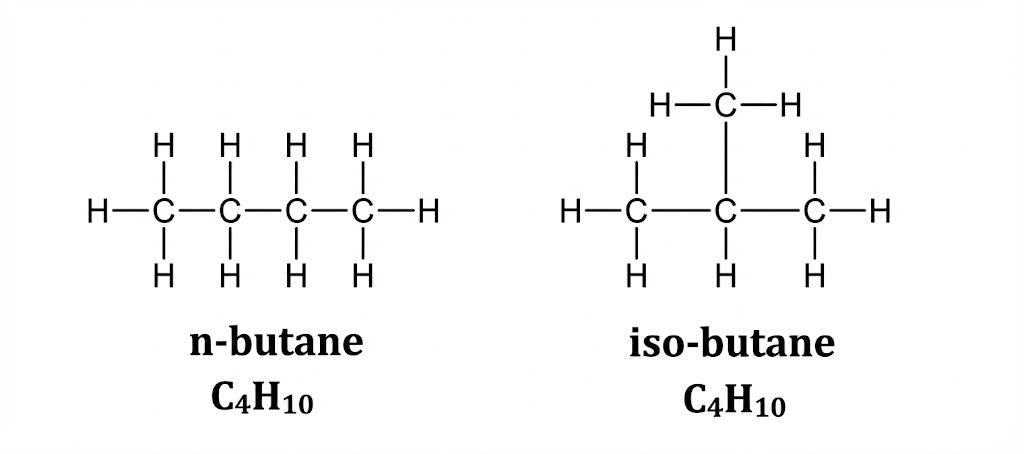
(a) Reaction of Methane with Chlorine:
In the presence of sunlight, a substitution reaction occurs where hydrogen is replaced by chlorine.
Equation: \(CH_4 + Cl_2 \xrightarrow{Sunlight} CH_3Cl + HCl\) (Chloromethane).
Further substitution can produce \(CH_2Cl_2, CHCl_3, CCl_4\).
(b) Flame Difference:
- Saturated Hydrocarbons (Alkanes): Burn with a clean blue flame because complete combustion takes place (high carbon-hydrogen ratio allows easy burning).
- Unsaturated Hydrocarbons (Alkenes/Alkynes): Burn with a yellow, sooty flame due to incomplete combustion (higher carbon percentage requires more oxygen than air usually supplies).
(c) Addition Reactions & Isomers:
- Unsaturated hydrocarbons have double/triple bonds. They are reactive and 'add' atoms (like Hydrogen) to break the multiple bond and become stable saturated compounds. Saturated ones already have single bonds and cannot add atoms without substitution.
- Structural Isomers: Compounds having the same molecular formula but different structural formulas (different arrangement of atoms/carbon chain).