VARDAAN LEARNING INSTITUTE | POWERED BY VARDAAN COMET
Biology Master Notes (2025-26)
Created by Team Vardaan with ❤️
CHAPTER 1: LIFE PROCESSES
Definition: The basic maintenance functions performed by living organisms to sustain
life
are called life processes (Nutrition, Respiration, Transportation, Excretion).
Why is diffusion insufficient? In multicellular organisms (like humans), all cells are NOT in
direct contact with the environment. Simple diffusion cannot meet the oxygen requirement of all cells.
1. Nutrition (The Source of Energy)
A. Types of Heterotrophic Nutrition
| Type |
Definition |
Examples |
| Holozoic |
Organisms take in whole food and digest it inside the body. |
Humans, Animals, Amoeba. |
| Saprophytic |
Organisms feed on dead and decaying matter (break down outside body). |
Fungi (Bread moulds, Yeast, Mushrooms). |
| Parasitic |
Organisms live on/in host and derive nutrition without killing it. |
Cuscuta (Amar-bel), Ticks, Lice, Leeches, Tapeworm. |
B. Nutrition in Amoeba (Holozoic)
Figure 1.0: Nutrition in Amoeba (Phagocytosis)
Steps (Phagocytosis):
- Pseudopodia: Finger-like extensions fuse over the food particle.
- Food Vacuole: Food is trapped inside. Complex substances are broken down into
simpler ones.
- Diffusion: Simple substances diffuse into cytoplasm (Absorption).
- Egestion: Undigested material moves to surface and is thrown out.
C. Autotrophic Nutrition (Plants)
Chemical Equation (Must Memorize):
6CO2 + 12H2O —(Sunlight/Chlorophyll)→ C6H12O6
(Glucose) + 6O2 + 6H2O
Figure 1.1: Stomatal Pore: Open (Turgid) vs Closed (Flaccid)
Detailed Mechanism (3 Steps):
- Absorption: Chlorophyll traps solar energy.
- Conversion & Splitting: Light energy → Chemical energy. Water molecules split
(H2O → H2 + O2). (Note: O2 is a by-product).
- Reduction: CO2 is reduced to Carbohydrates (using Hydrogen).
Desert Plants Exception (CAM Pathway):
Desert plants take up CO2 at night (when stomata are open to save water) and
prepare an intermediate. This is acted upon by energy absorbed by chlorophyll during the
day (when stomata are closed).
B. Nutrition in Humans (Detailed)
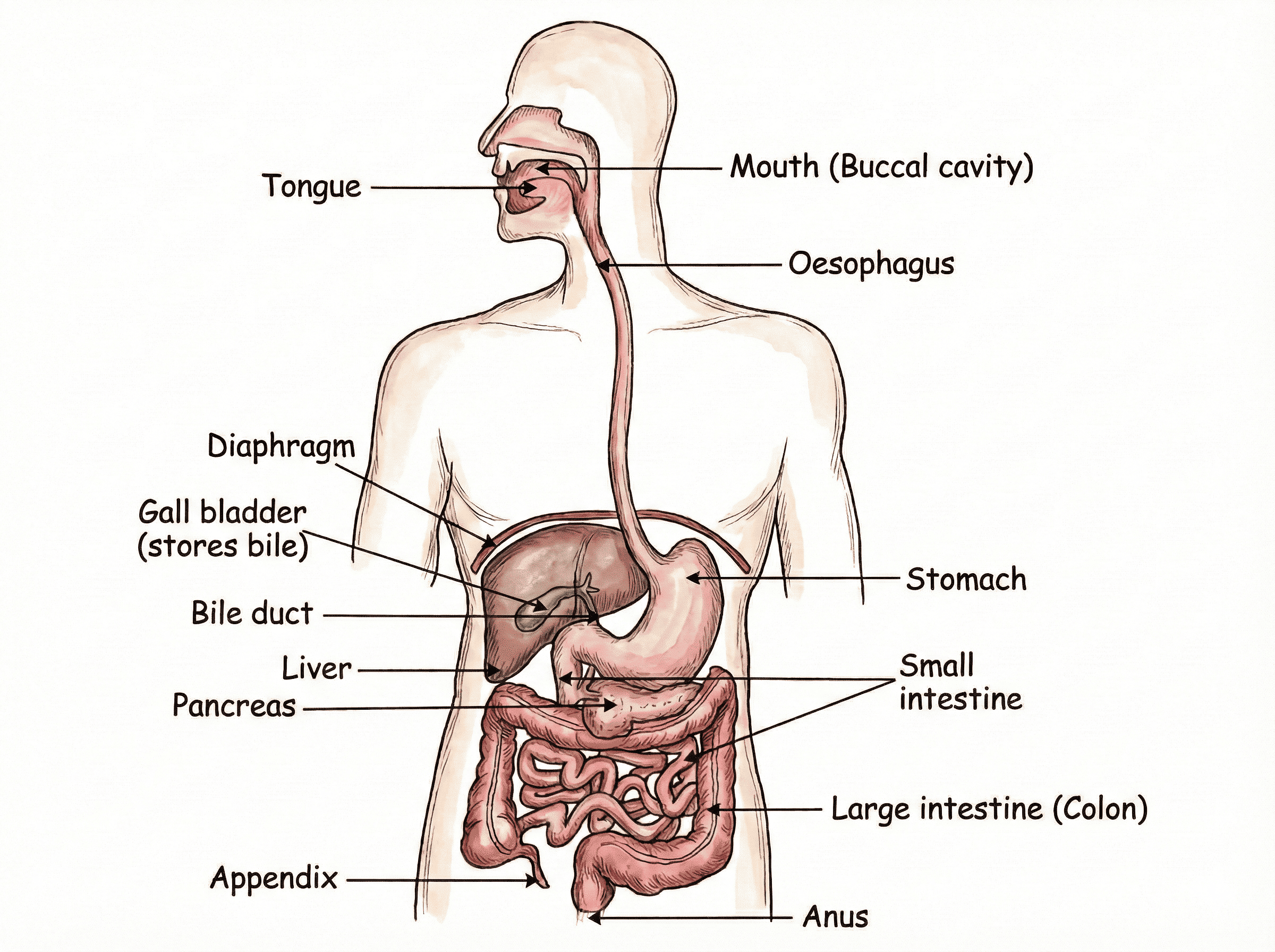
Figure 1.2: Human Digestive System
Alimentary Canal (9 meters long tube):
| Organ |
Secretions |
Action/Function |
| Mouth |
Saliva (Salivary Amylase) |
• Teeth: Chew/Grind.
• Tongue: Tasting/Rolling.
• Amylase: Starch (Complex) → Sugar/Maltose.
|
| Oesophagus |
No Enzymes |
Peristalsis: Rhythmic contraction and relaxation of muscles to push food
down.
|
Stomach
(J-shaped) |
Gastric Glands secrete:
1. HCl
2. Pepsin
3. Mucus |
• HCl: Acidic medium (pH ~1.8) for Pepsin; Kills bacteria.
• Pepsin: Digests Proteins (Partial).
• Mucus: Protects inner lining from acid (prevents ulcers).
|
Small Intestine
(Longest part) |
Receives secretions from Liver & Pancreas |
Site of Complete Digestion.
• Liver (Bile Juice): 1. Makes medium Alkaline. 2.
Emulsification (Large fat globules → Small globules).
• Pancreas (Pancreatic Juice):
- Trypsin: Proteins → Amino Acids.
- Lipase: Emulsified Fats → Fatty Acids + Glycerol.
- Amylase: Remaining Starch → Glucose.
|
Dental Caries (Tooth Decay):
Bacteria acting on sugars produce acids that soften or demineralise the enamel. Mass of
bacterial cells together with food particles stick to the teeth to form Dental Plaque.
Saliva cannot reach the tooth surface to neutralize the acid as plaque covers the teeth.
Absorption in Small Intestine:
Inner lining has millions of finger-like projections called Villi. They increase
surface
area for absorption and are richly supplied with blood vessels to take food to every cell.
Why is the Small Intestine longer in herbivores?
Herbivores eat grass containing cellulose, which takes a long time to digest (needs
symbiotic bacteria). Carnivores eat meat, which is easier to digest, so they have shorter intestines.
2. Respiration (Energy Release)
A. Glucose Breakdown Pathways (The Most Repeated PYQ)
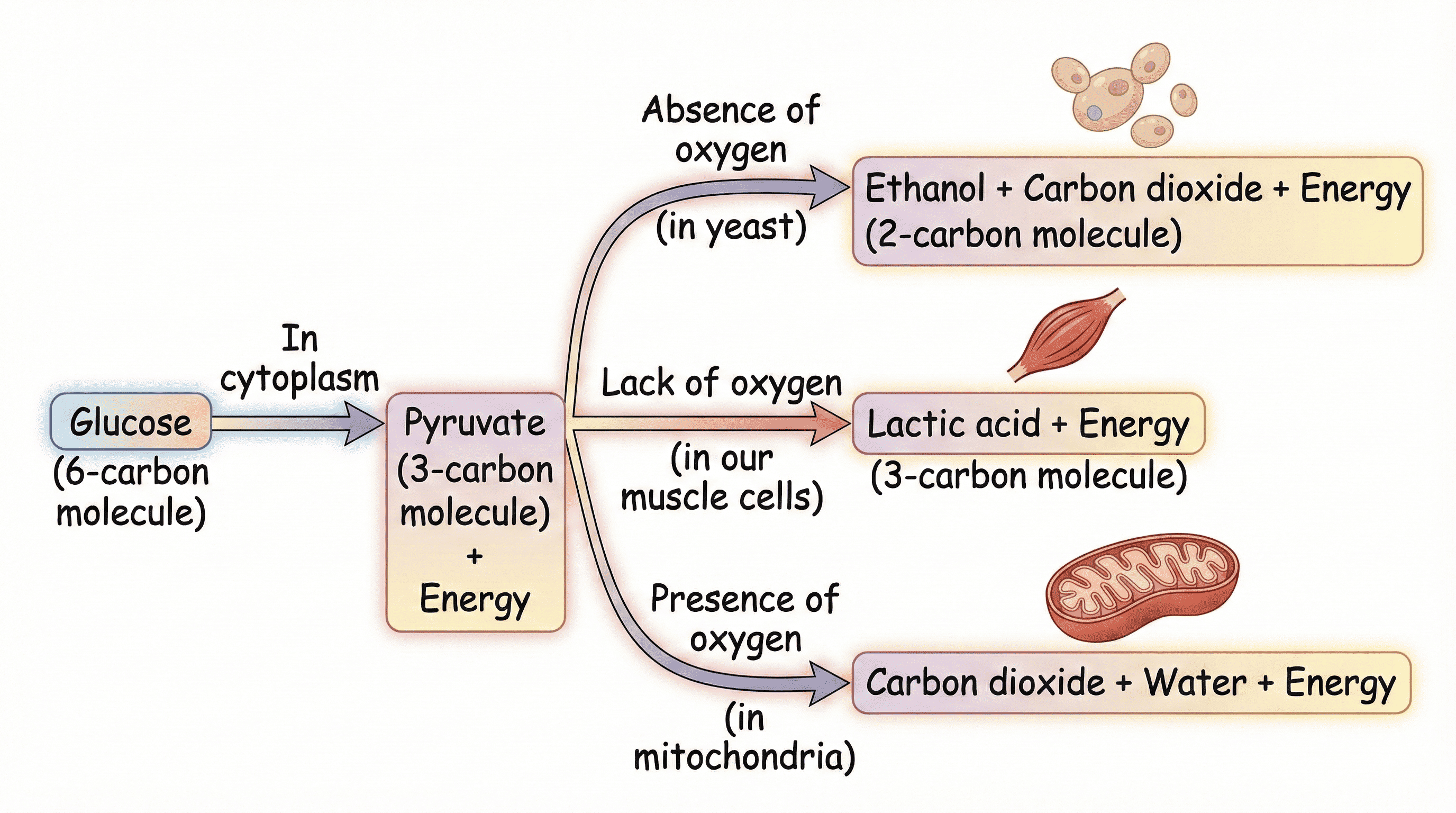
Figure 1.2b: Breakdown of Glucose by Various Pathways
Key Exam Point (Muscle Cramps):
When there is a lack of oxygen in muscle cells (sudden activity), Pyruvate converts to
Lactic
Acid. Accumulation of lactic acid causes muscle cramps.
ATP (Adenosine Triphosphate):
The energy released during respiration is used to make an ATP molecule from ADP and inorganic phosphate.
ATP
is known as the energy currency of the cell.
| Feature |
Aerobic Respiration |
Anaerobic Respiration |
| Presence of Oxygen |
Takes place in the presence of oxygen. |
Takes place in the absence of oxygen. |
| Site |
Mitochondria. |
Cytoplasm. |
| End Products |
CO2 and H2O. |
Alcohol/Lactic Acid and CO2. |
| Energy Released |
More energy. |
Less energy. |
B. Human Respiratory System
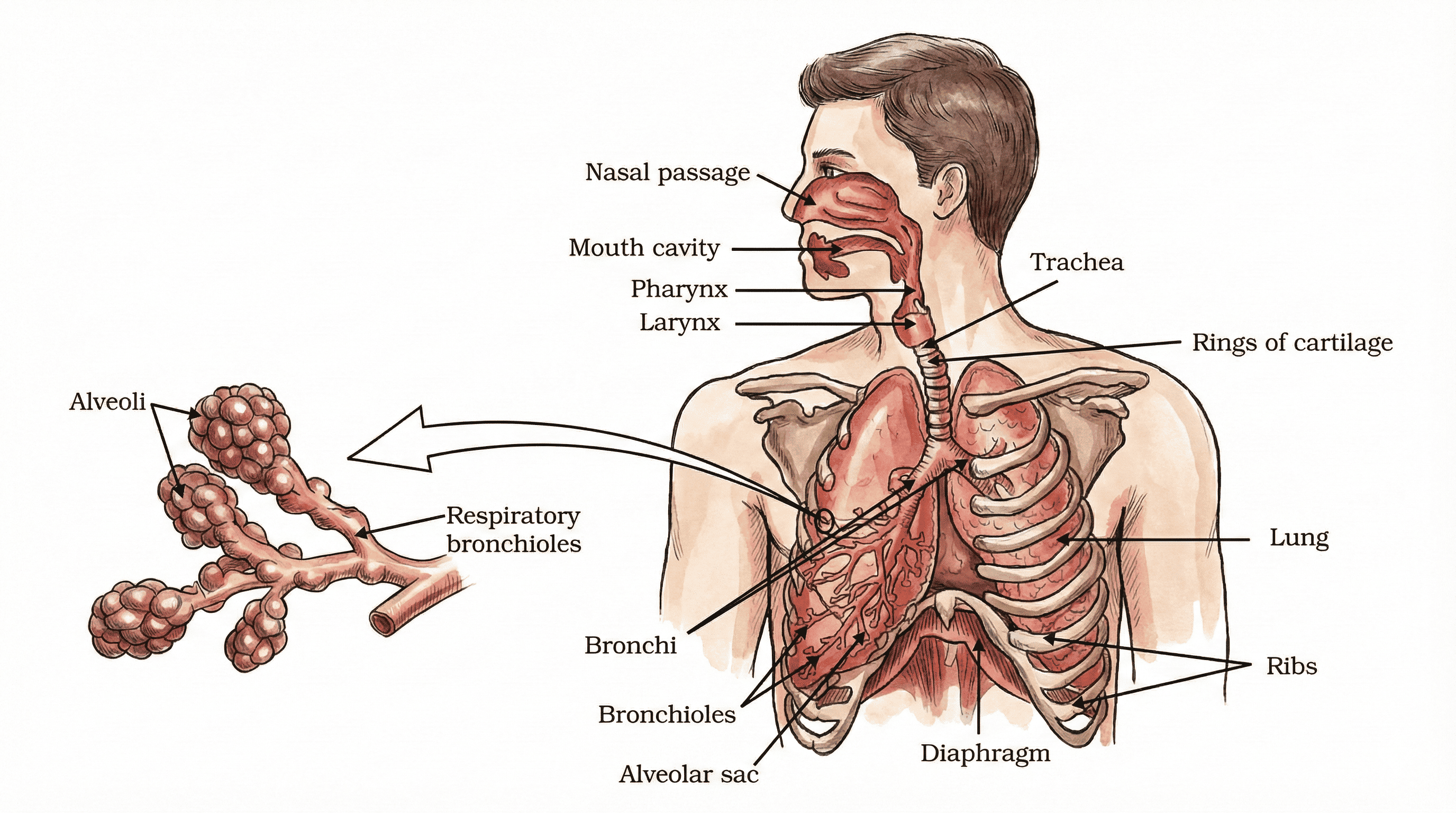
Figure 1.3: Human Respiratory System
- Why Trachea has Cartilaginous Rings? To prevent collapse when there is no air.
- Role of Alveoli: Balloon-like structures where gas exchange occurs. They
provide a
massive surface area (80m²) and are covered in blood capillaries.
Mechanism of Breathing:
1. Inhalation: Ribs lift up, Diaphragm flattens → Chest cavity expands → Air rushes
in.
2. Exhalation: Ribs move down, Diaphragm domes up → Chest cavity contracts → Air pushed
out.
*Exchange of gases takes place in Alveoli via diffusion.
Aquatic vs Terrestrial Organisms (Breathing Rate):
Aquatic animals (like fish) breathe faster than terrestrial animals because the amount
of
dissolved oxygen in water is fairly low compared to the amount of oxygen in the air.
Respiratory Pigment:
In humans, Haemoglobin (present in RBCs) carries oxygen from lungs to tissues. It has a
high affinity for oxygen. (CO2 is more soluble in water and is mostly transported in
dissolved
form).
3. Transportation (Circulation)
A. Human Heart (Double Circulation)
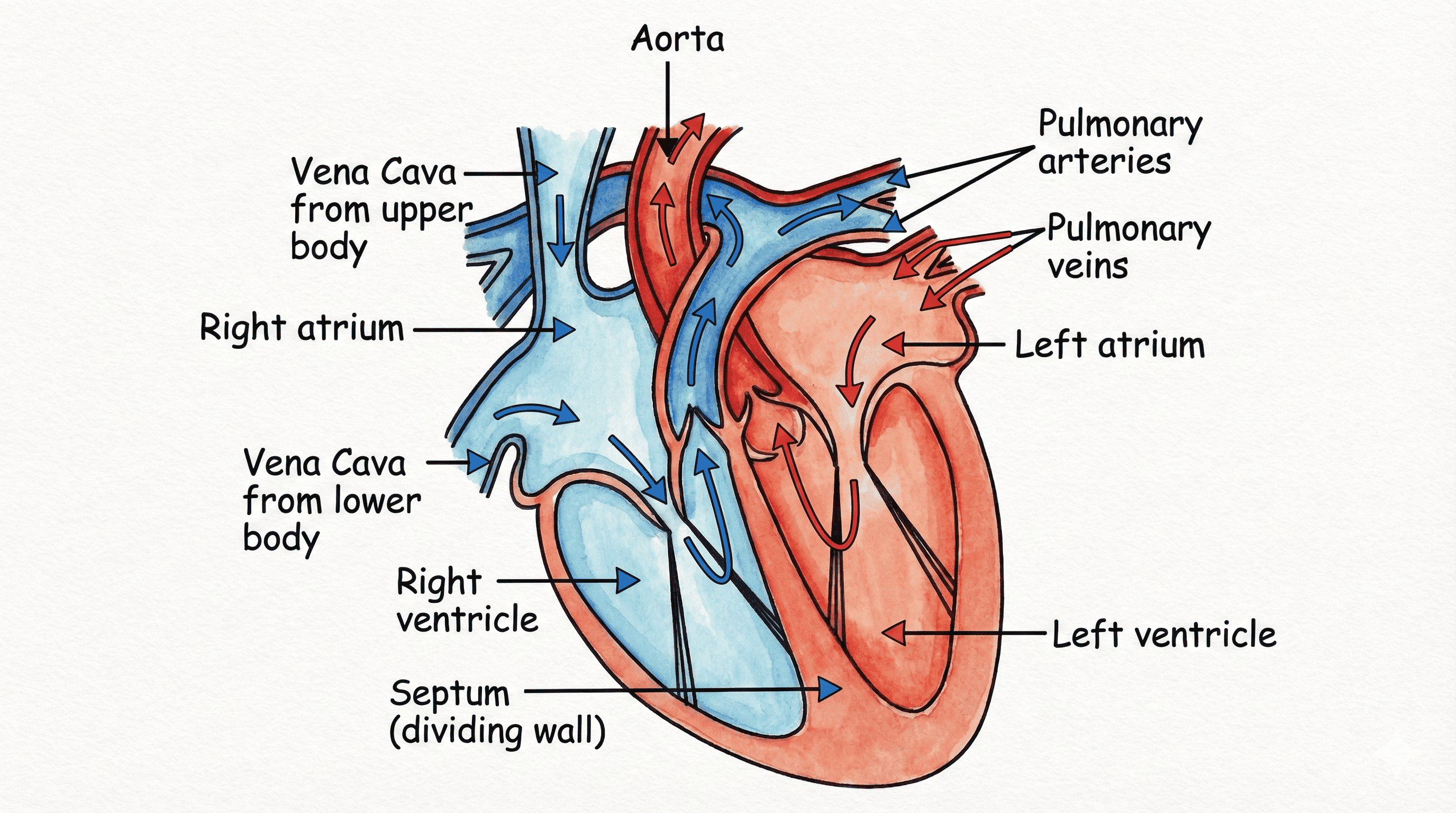
Figure 1.4: Sectional View of Human Heart
Oxygenated and Deoxygenated blood travel in separate circuits.
Step-by-Step Blood Flow:
- Vena Cava brings CO2-rich blood from body to Right
Atrium.
- Right Atrium relaxes (fills) → Contracts → Blood goes to Right Ventricle.
- Right Ventricle pumps blood to Lungs via Pulmonary Artery (for oxygenation).
- Pulmonary Veins bring O2-rich blood from Lungs to Left
Atrium.
- Left Atrium contracts → Blood goes to Left Ventricle.
- Left Ventricle (Thickest wall) pumps blood to body via Aorta.
(Valves ensure unidirectional flow).
Why is separation of Oxygenated and Deoxygenated blood necessary?
Separation allows for a highly efficient supply of oxygen to the body. This is useful for animals that
have
high energy needs, such as birds and mammals, which constantly use energy to maintain
their
body temperature (Warm-blooded/Endothermic).
Why do Ventricles have thicker walls?
Because they have to pump blood to distant organs (Lungs/Whole Body) at high pressure, whereas atria
only
push blood to the next chamber.
Figure 1.4b: Schematic of Double Circulation
Double Circulation Explained:
Blood passes through the heart twice in one complete cycle.
1. Pulmonary Circulation: Blood moves from Heart → Lungs → Heart (Oxygenation).
2. Systemic Circulation: Blood moves from Heart → Body Organs → Heart (Supply O2).
B. Blood Vessels
| Arteries |
Veins |
| Carry blood Away from heart. |
Carry blood Towards heart. |
| Thick, Elastic walls (High pressure). |
Thin walls. |
| No Valves. |
Valves present (prevent backflow). |
C. Other Circulatory Components (Must Know)
- Platelets (Thrombocytes): Maintenance cells. They help in clotting of
blood at the point of injury to prevent loss of blood and pressure.
- Lymph (Tissue Fluid): A fluid similar to blood plasma but colourless
and
contains less protein.
Function:
1. Carries digested and absorbed fat from intestine.
2. Drains excess fluid from extracellular space back into the blood.
C. Transportation in Plants
| Xylem (Water/Minerals) |
Phloem (Food) |
| Vessels & Tracheids (Dead cells). |
Sieve Tubes & Companion Cells (Living). |
| Motion: Unidirectional (Up). |
Motion: Bidirectional. |
| Mechanism: Transpiration Pull (Physical). |
Mechanism: Translocation (Active, uses ATP). |
4. Excretion (Waste Removal)
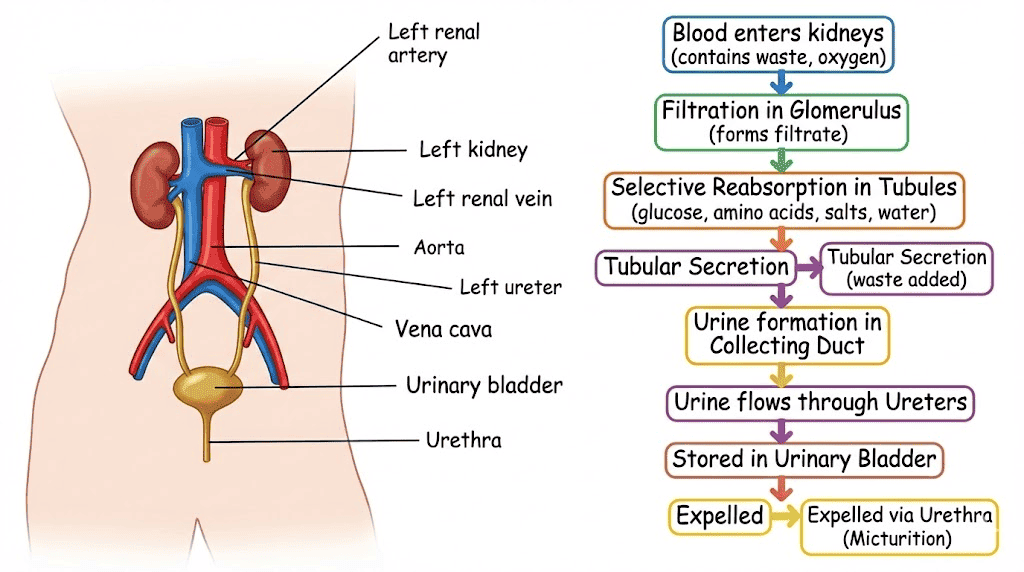
A. Human Excretory System
Figure 1.5a: Human Excretory System
Components of Excretory System:
- 1. Kidneys (Pair): Bean-shaped organs in abdomen. Filter blood to remove
nitrogenous waste (Urea/Uric acid).
- 2. Ureters (Pair): Tubes carrying urine from kidneys to bladder.
- 3. Urinary Bladder: Muscular sac where urine is stored until urge to pass.
- 4. Urethra: Channel through which urine passes out.
How Urine is Formed (Step-by-Step):
Blood enters Kidney -> Filtration in Glomerulus -> Reabsorption in
Tubular
part -> Urine collection in Ureter.
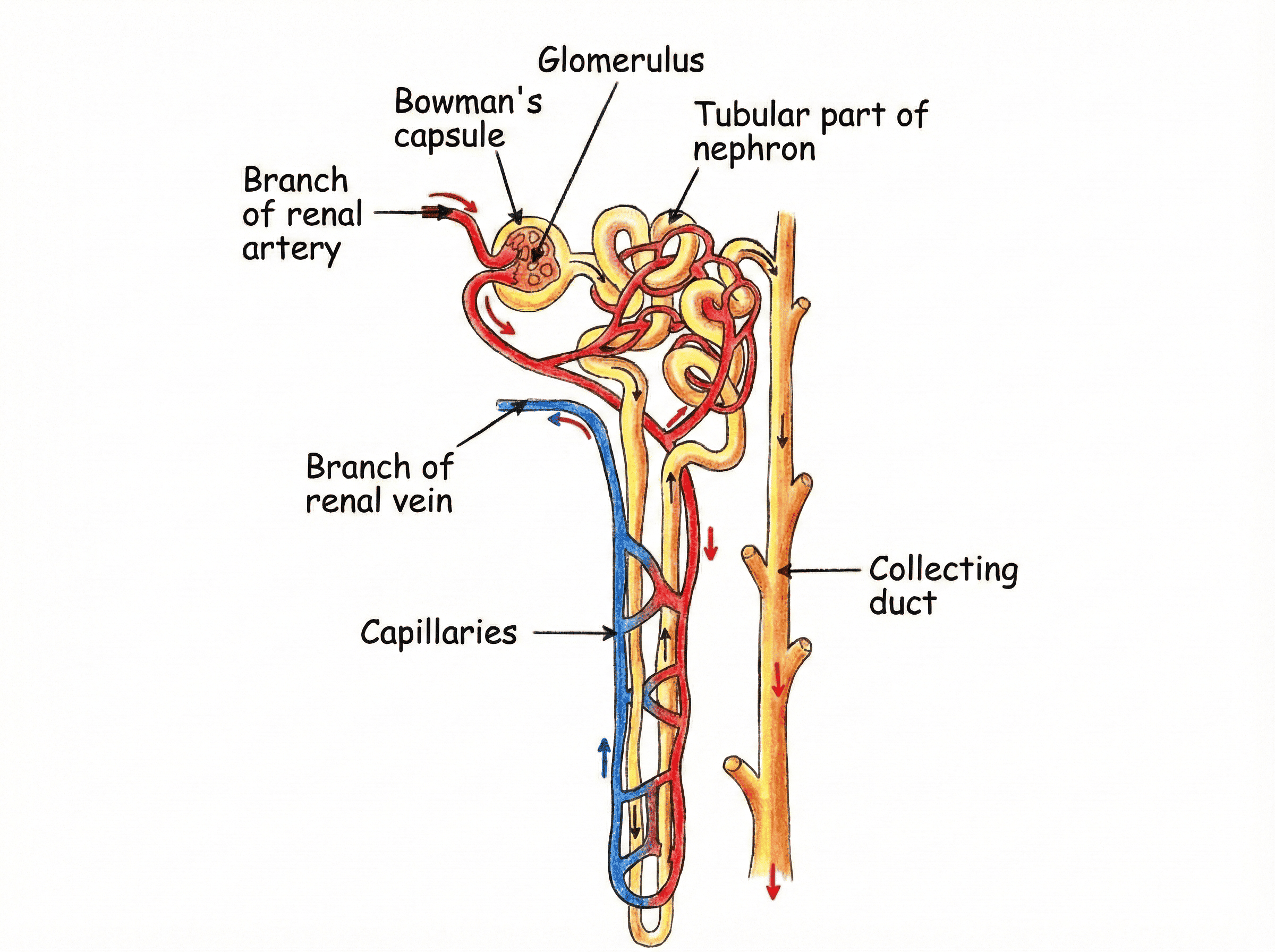
Nephron (Filtration Unit) Structure & Function:
Figure 1.5b: Structure of a Nephron
- Glomerulus & Bowman's Capsule: Filtration under high pressure. Glucose, Amino
acids, Water, Urea filter out.
- Tubular Part (PCT/DCT): Selective Reabsorption. All Glucose,
Amino
acids, and most water are taken back into blood.
- Collecting Duct: Remaining fluid is Urine (Urea + Excess salts + Water).
Hemodialysis (Artificial Kidney):
Blood is pumped into a dialyser (tubes with semi-permeable lining in dialysing fluid). Fluid has same
osmotic pressure as blood but NO nitrogenous waste. Urea diffuses from blood to
fluid.
Difference from Nephron: No Reabsorption occurs in dialysis.
B. Excretion in Plants
How do plants get rid of waste?
1. Oxygen: Released as waste during day (Photosynthesis).
2. Water: Lost via Transpiration.
3. Dead Cells: Stored in leaves that fall off.
4. Resins/Gums: Stored in old Xylem.
5. Into Soil: Some waste is excreted into soil around roots.
-
In the breakdown of glucose, a student confuses the pathway that occurs in Yeast vs Muscle
cells.
Can you clarify the end products for both?
Hint: Yeast produces Ethanol + CO2 (Fermentation); Muscles produce
Lactic
Acid (Cramps).
-
A patient has low blood pressure. Which vessel carries blood back to the heart under low
pressure,
and what structure prevents backflow?
Hint: Veins have thin walls and valves.
-
Plants do not have a heart to pump. How do they move water up to the top of tall trees like
Eucalyptus?
Hint: Think of "Suction" created by evaporation from leaves
(Transpiration
Pull).
🧪 NCERT EXPERIMENT ZONE (Life Processes)
1. Chlorophyll is necessary for Photosynthesis:
•
Plant: Variegated leaf (Money plant/Croton) has green and white parts.
•
Test: Boil in alcohol (remove chlorophyll) → Dip in Iodine.
•
Result: Only green parts turn
Blue-Black (Starch present). White
parts
remain colourless.
Figure 1.E1: Chlorophyll is necessary for Photosynthesis (a) before starch
test
(b)
after starch test
2. CO₂ is necessary for Photosynthesis (Mohl's Half-Leaf):
•
Setup: One plant inside bell jar with
KOH (Potassium Hydroxide).
•
Role of KOH: Absorbs CO₂.
•
Result: Leaf with KOH does NOT turn Blue-Black with Iodine (No Starch formed),
proving
CO₂ is essential.
Figure 1.E2: CO₂ is necessary for Photosynthesis (a) with potassium hydroxide
(b)
without potassium hydroxide
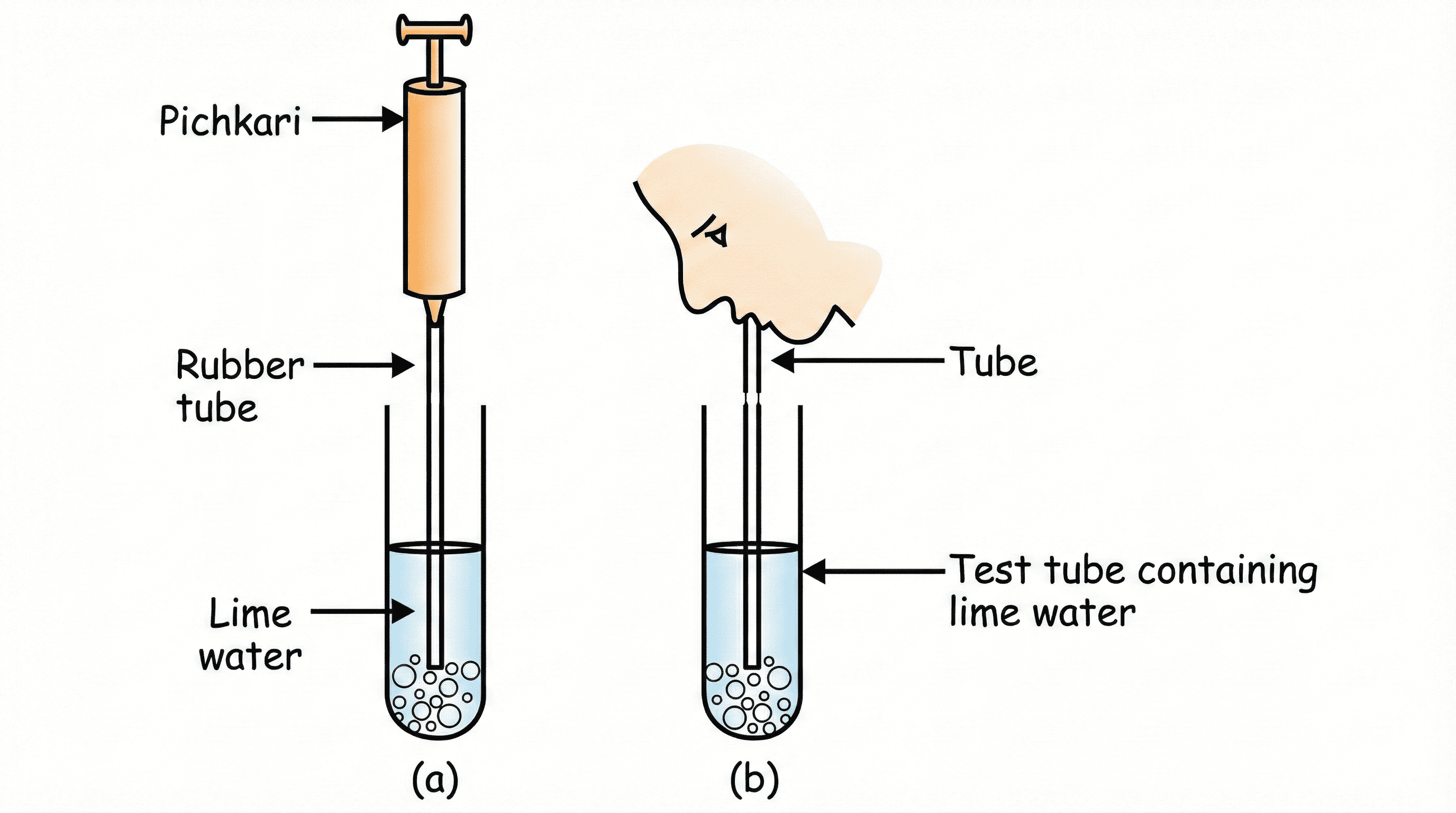
3. CO₂ is released during Respiration:
•
Test: Blow air into Lime Water.
•
Observation: Lime Water turns
Milky.
•
Conclusion: Exhaled air contains Carbon Dioxide.
Figure 1.E3: CO2 is released during Respiration
4. Action of Saliva on Starch:
•
Test Tube A: Starch + Saliva.
Test Tube B: Starch only.
•
Result: After 20 mins, Tube A does NOT turn blue-black (Starch digested by Amylase).
Tube
B turns blue-black.
CHAPTER 2: CONTROL & COORDINATION
1. Animal Nervous System
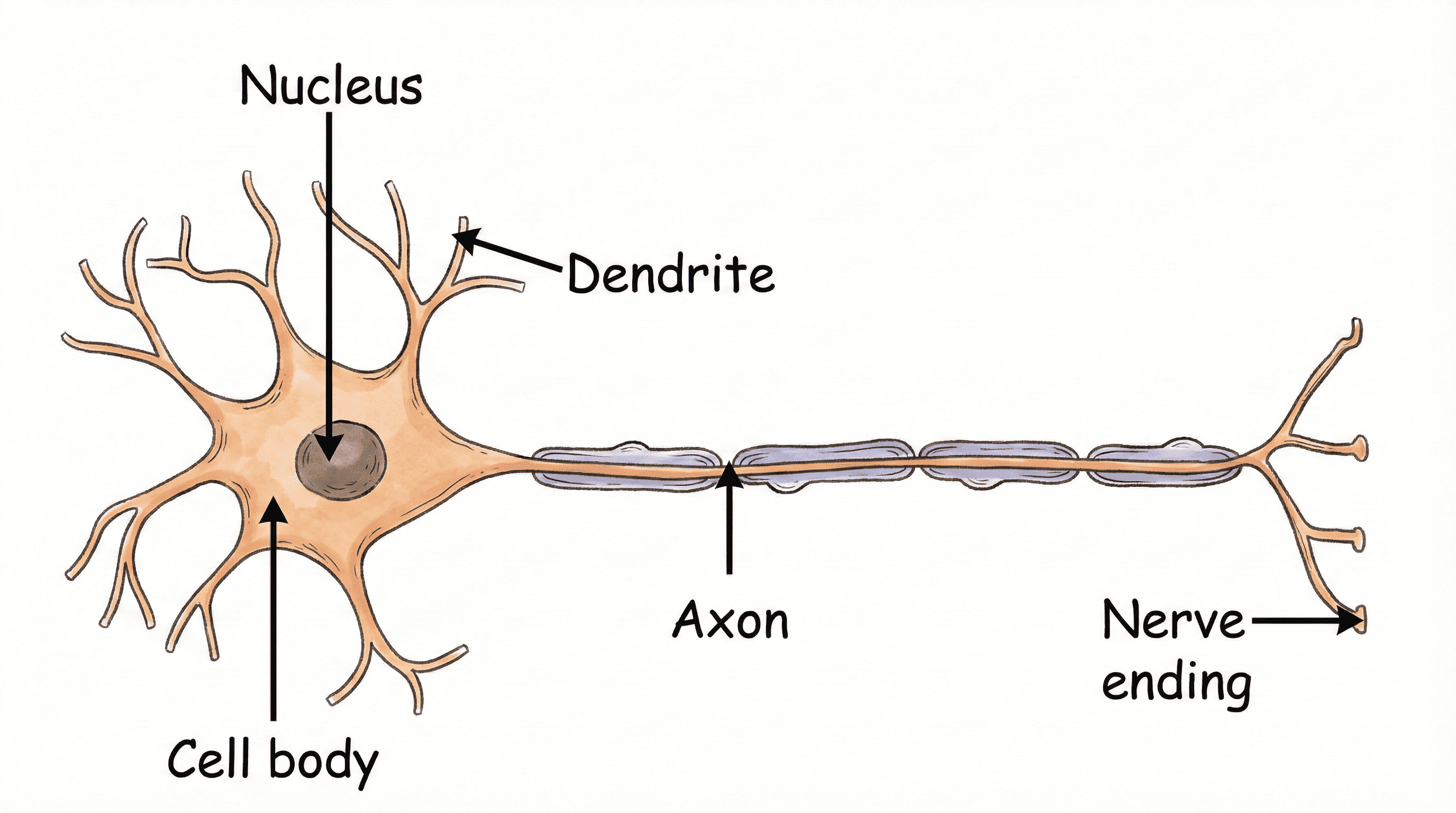
A. The Neuron (Structural Unit)
Figure 2.1: Structure of Neuron
Structure & Function:
- Dendrite: Acquires information. (Tips of nerve cells).
- Cell Body (Cyton): Information travels as an Electrical Impulse.
- Axon: Longest fibre. Transmits impulse away from cell body.
- Nerve Ending: Converts Electrical Impulse → Chemical Signal (Neurotransmitter).
The Synapse (Crucial Definition):
It is the microscopic gap between the nerve ending of one neuron and the dendrite of the next.
Mechanism: At the nerve ending, the electrical impulse releases chemicals
(Neurotransmitters like Acetylcholine). These chemicals diffuse across the gap and start a similar
electrical impulse in the dendrite of the next neuron.
Why do we need Chemical Communication (Hormones) if we have Nerves?
Limitations of Electrical Impulses:
1. They reach only those cells connected by nervous tissue.
2. Once an impulse is generated, the cell takes time to reset (cannot continuously create impulses).
Chemical communication (Hormones) overcomes this by reaching every cell and acting
steadily.
B. Reflex Action & Reflex Arc
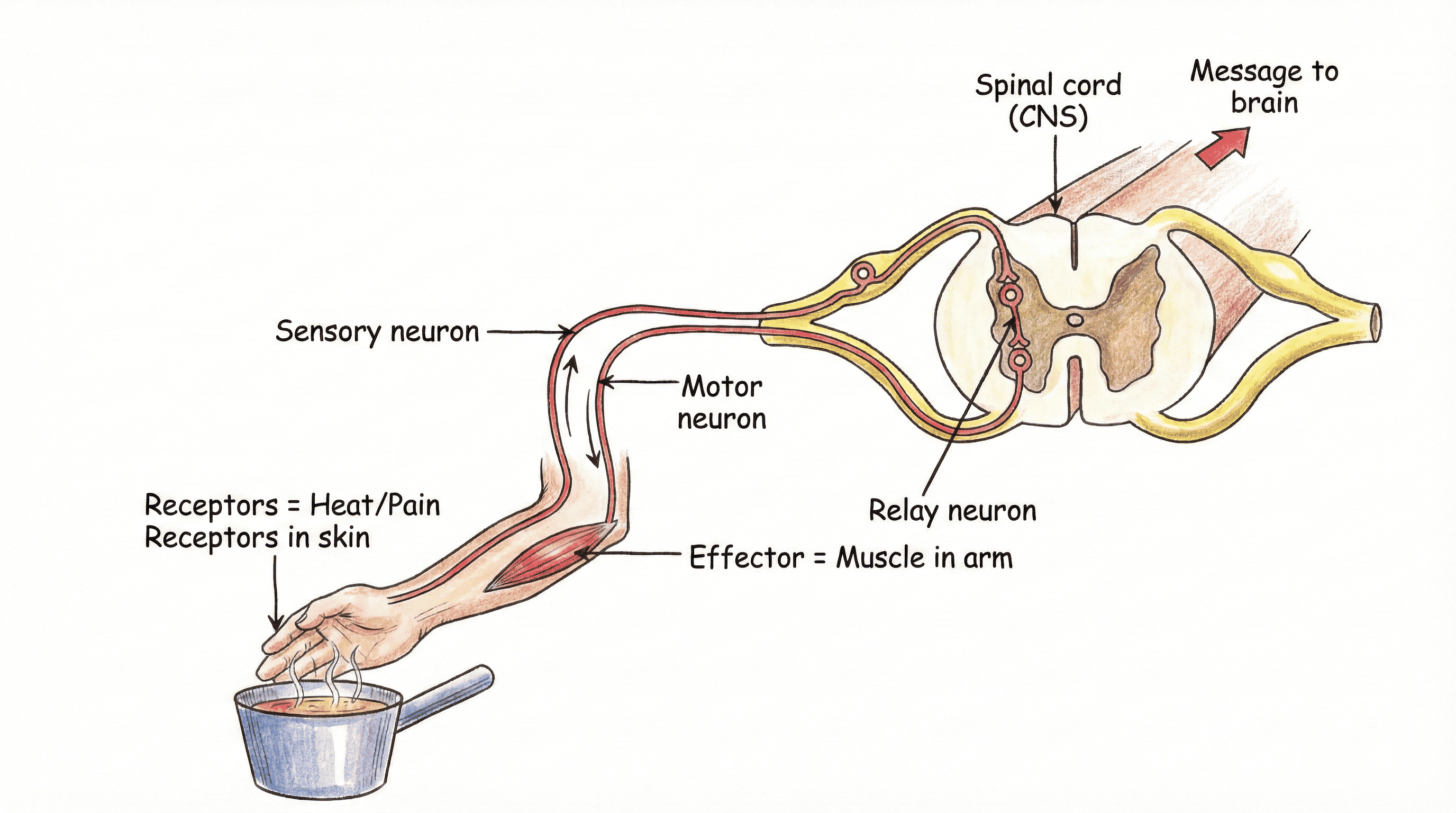
Figure 2.2: Reflex Arc Pathway
Why are Reflex Arcs formed in the Spinal Cord?
Thinking processes in the brain are complex and slow. To save time and prevent tissue damage during
emergencies, nerves connect directly in the spinal cord for a quicker response. (The signal still goes
to
the brain later for memory).
The Pathway (Reflex Arc):
Stimulus (Heat)
→
Receptor (Skin)
→
Sensory Neuron
→
Spinal Cord (Relay Neuron)
→
Motor Neuron
→
Effector (Muscle)
→
Response (Movement)
2. The Human Brain (The Thinking Center)
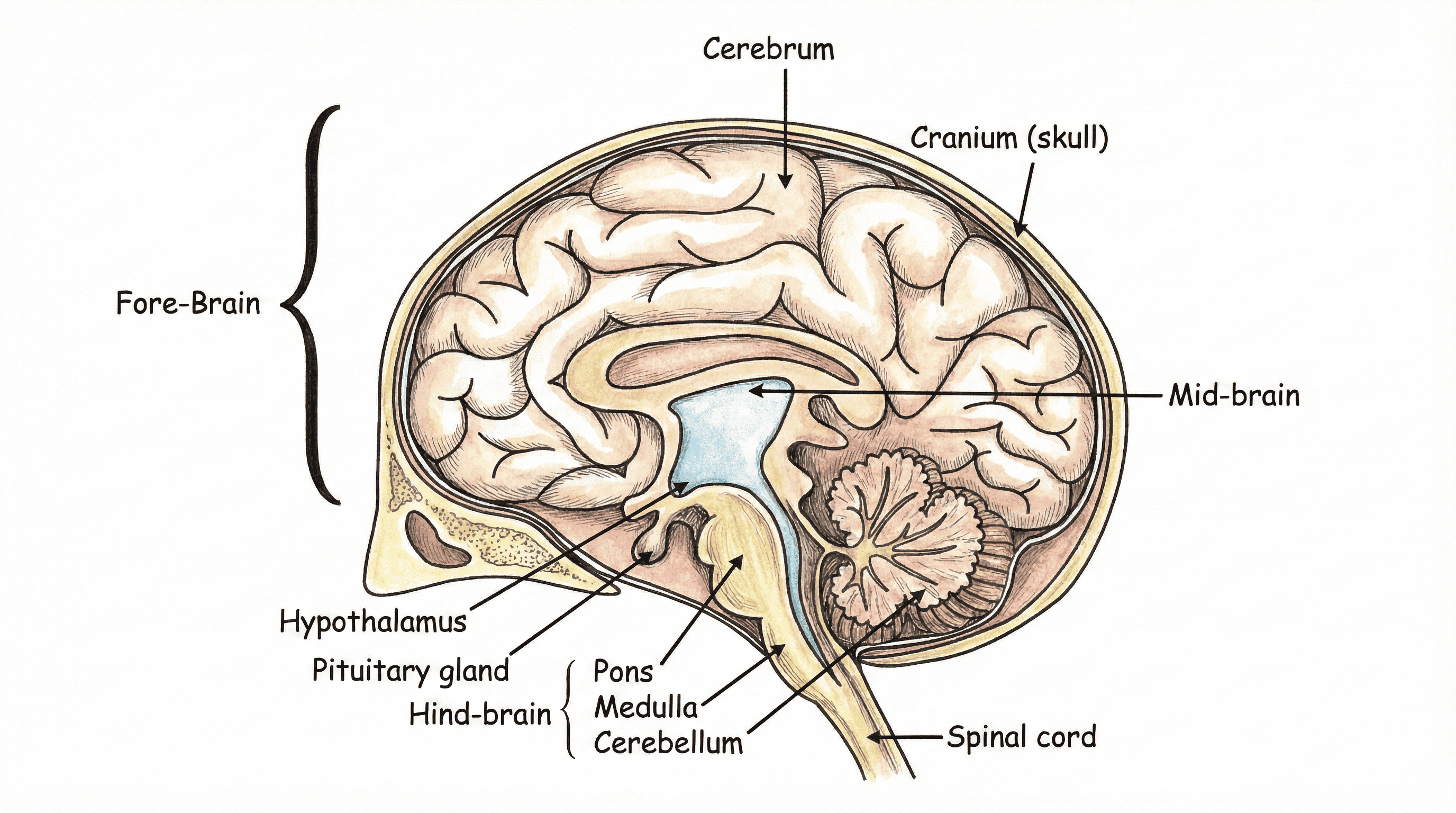
Figure 2.3: Human Brain
| Region |
Part |
Function (Matches PYQ 2025) |
Forebrain
(Main thinking part) |
Cerebrum |
• Voluntary actions.
• Sensory processing (Hearing, Smell, Sight).
• Seat of Intelligence, Memory, Learning.
• Hypothalamus: Satiety Center (Hunger/Thirst).
|
| Midbrain |
- |
Involuntary reflexes of head/neck/eyes. (e.g., Pupil size change). |
| Hindbrain |
Cerebellum |
• Precision of voluntary actions (e.g., Threading a needle).
• Maintains Posture and Balance (e.g., Riding a bike).
(Damage leads to loss of balance, drunk-like walk).
|
| Medulla |
Controls Involuntary life processes: Blood Pressure, Heartbeat, Salivation, Vomiting. |
| Pons |
Regulates Respiration (Rate of breathing). |
C. Protection of the CNS
How are these delicate organs protected?
1. Brain: sits inside a bony box (Cranium/Skull). Inside the box, the brain is
contained in
a fluid-filled balloon (Cerebrospinal Fluid) for shock absorption.
2. Spinal Cord: Protected by the Vertebral Column (Backbone).
3. Coordination in Plants
Plants use Electrical-Chemical means to convey information from cell to cell, but lack
specialized tissue.
A. Types of Movements
| Feature |
Nastic Movements |
Tropic Movements |
| Direction |
Non-directional. |
Directional. |
| Growth |
Growth Independent. |
Growth Dependent. |
| Speed |
Immediate/Fast. |
Slow. |
| Mechanism |
Change in Turgor Pressure. |
Cell division/elongation (Auxin). |
| Example |
Mimosa pudica (Touch-me-not). |
Shoot bending to light (Phototropism). |
B. Mechanism of Phototropism (Auxin Action)
How does a plant bend towards light?
1. Auxin is synthesized at the shoot tip.
2. When light comes from one side, Auxin diffuses towards the shady side of the
shoot.
3. High concentration of Auxin stimulates cells on the shady side to grow longer.
4. As one side grows longer than the other, the plant appears to bend towards light.
C. Various Tropic Movements
| Movement |
Stimulus |
Response (Example) |
| Phototropism |
Light |
Shoot bends towards light (Positive). Root bends away (Negative). |
| Geotropism |
Gravity |
Roots grow down (Positive). Shoots grow up (Negative). |
| Hydrotropism |
Water |
Roots grow towards water (Positive). |
| Chemotropism |
Chemicals |
Growth of Pollen Tube towards Ovule. |
| Thigmotropism |
Touch |
Growth of Tendrils around a support (climbing plants). |
D. Plant Hormones (Phytohormones)
| Hormone |
Function |
| Auxin |
Helps cells to grow longer (Phototropism). |
| Gibberellins |
Helps in the growth of the stem. |
| Cytokinins |
Promotes cell division. Rapid in fruits and seeds. |
| Abscisic Acid |
Inhibits growth. Causes wilting of leaves. |
4. Animal Hormones (Endocrine System)
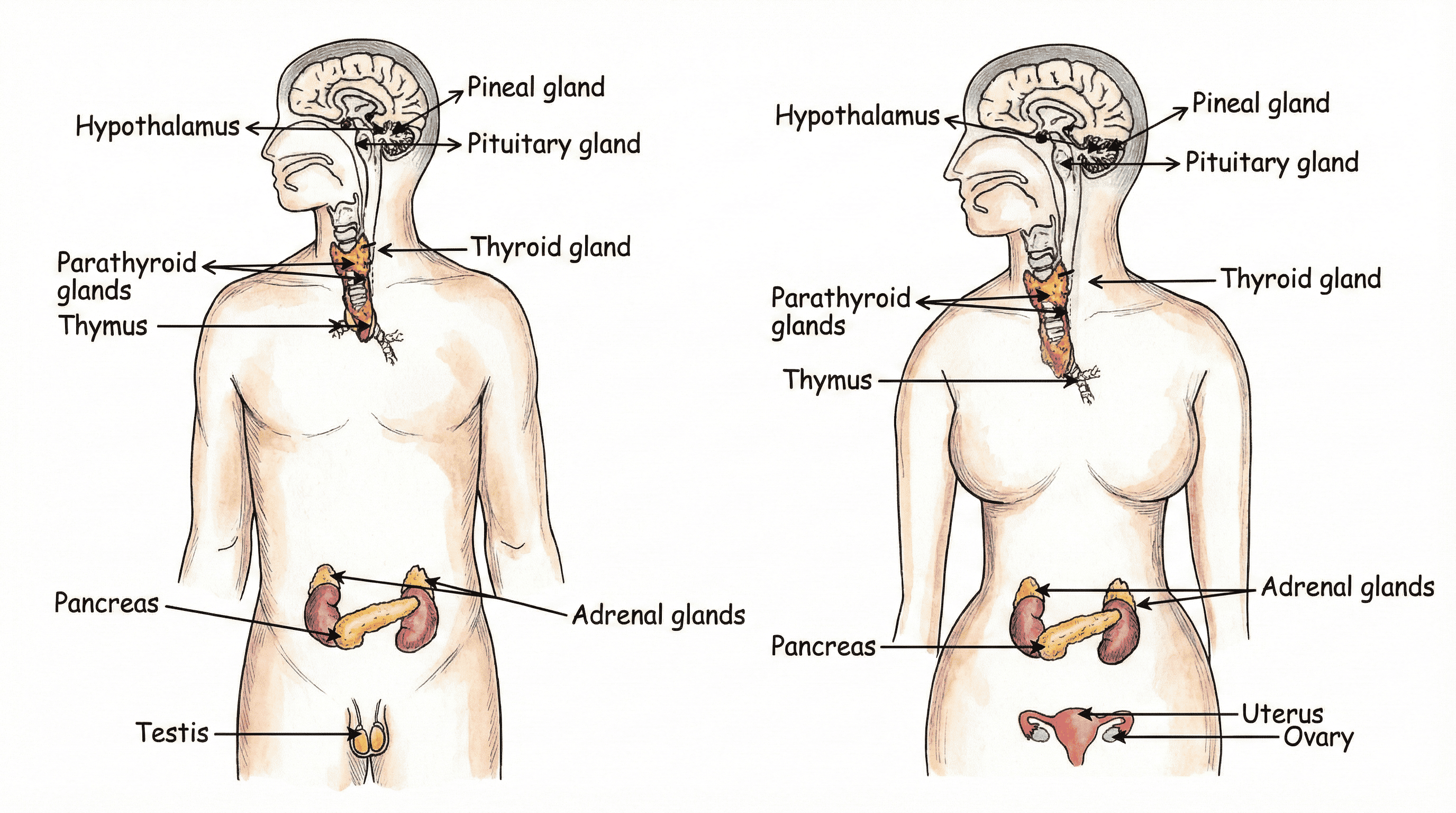
Figure 2.4: Endocrine Glands in Humans
| Gland |
Hormone |
Function/Deficiency Disease |
| Pituitary |
Growth Hormone |
Regulates growth. Deficiency: Dwarfism. Excess: Gigantism. |
| Thyroid |
Thyroxin |
Regulates Metabolism. Deficiency: Goitre. Requires Iodine.
|
| Adrenal |
Adrenaline |
"Fight or Flight": Increases heart rate, breathing, alert. |
| Pancreas |
Insulin |
Lowers blood sugar. Deficiency: Diabetes. |
| Testes |
Testosterone |
Sperm production + Puberty changes. |
| Ovary |
Oestrogen |
Egg production + Puberty changes. |
Feedback Mechanism (Example):
Blood sugar rises → Detected by Pancreas → More Insulin secreted → Sugar falls →
Insulin
secretion reduced.
-
A person is walking in a drunken manner (loss of balance). Which part of the brain is likely
affected? How is this part different from the part that helps you think?
Hint: Balance = Cerebellum (Hindbrain); Thinking = Cerebrum
(Forebrain).
-
Why does a tendril circle around a support? Explain the role of Auxin in this specific case.
Hint: Auxin diffuses to the side AWAY from support, causing it to grow
faster, making the tendril bend/coil.
-
In a Reflex Arc, what happens at the Synapse? Why can't the signal travel backwards?
Hint: Electrical signal converts to Chemical. Receptors for chemicals
are
only on the next dendrite, ensuring one-way flow.
🧪 NCERT EXPERIMENT ZONE (Control &
Coordination)
1. Phototropism (Response to Light):
•
Setup: Conical flask with water, wire mesh covering, germinating bean seeds. Keep in
cardboard box open from one side.
•
Observation: Shoots bend
towards light (Positive Phototropism).
Roots
bend
away (Negative Phototropism).
Figure 2.E1: Phototropism (Response to Light)
2. Geotropism (Response to Gravity):
•
Setup: Potted plant laid horizontally.
•
Observation: Shoot bends
Upwards (Negative Geotropism). Root bends
Downwards (Positive Geotropism).
Figure 2.E2: Geotropism (Response to Gravity)
CHAPTER 3: HOW DO ORGANISMS REPRODUCE?
1. Asexual Reproduction (One Parent)
Production of offspring from a single parent without gametes.
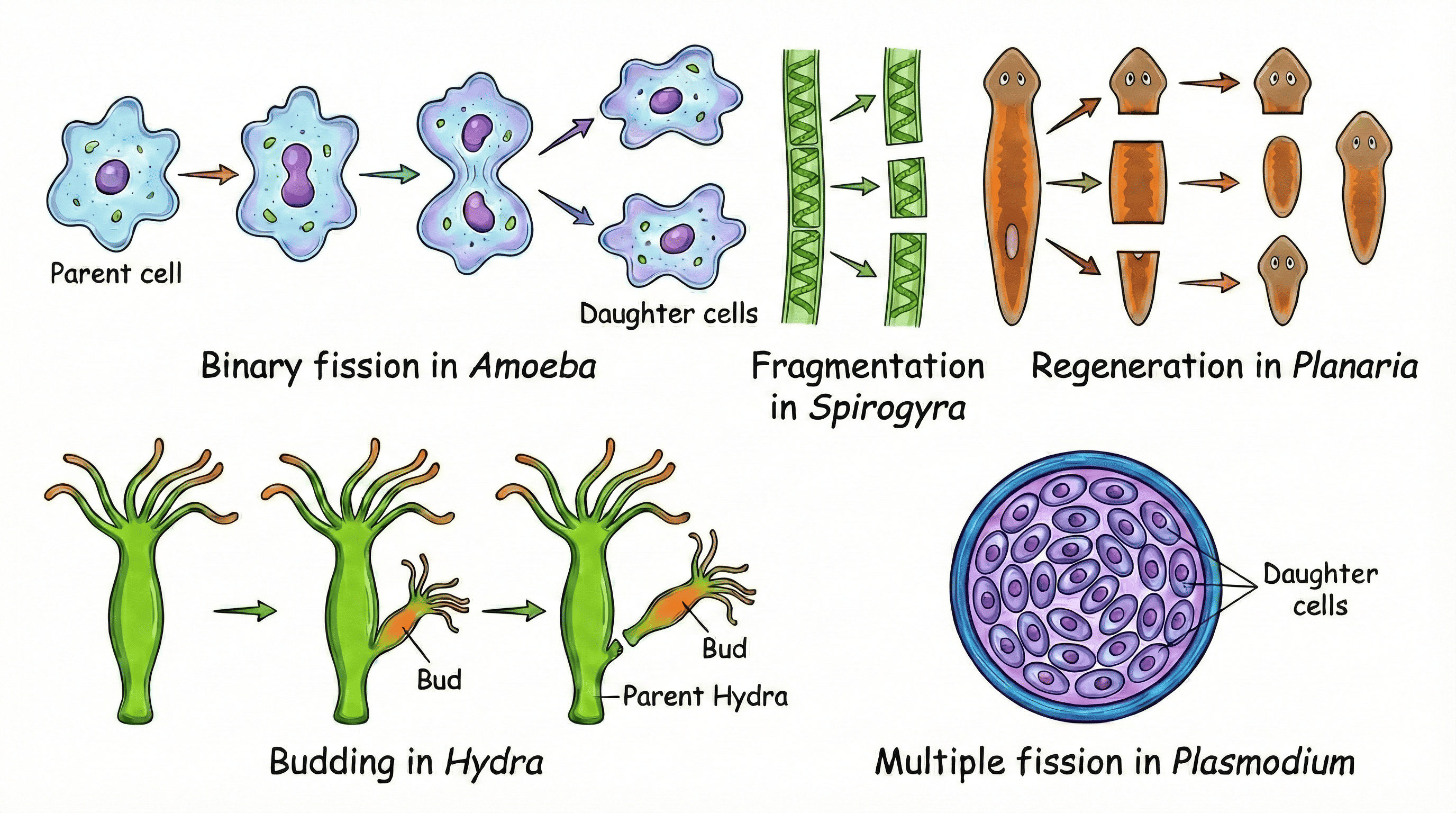
Figure 3.1: Modes of Asexual Reproduction
| Mode |
Definition & Examples |
| Fission |
Cell divides into offspring.
• Binary: Amoeba (any plane), Leishmania (specific
plane).
• Multiple: Plasmodium (Malaria parasite) - one cell divides into
many.
|
| Fragmentation |
Multicellular organism breaks into pieces; each grows into new individual.
Example: Spirogyra (Algae).
|
| Regeneration |
Regrowth of lost parts or whole organism from cut parts via specialized
cells.
Example: Planaria, Hydra.
|
| Budding |
Outgrowth (bud) forms due to repeated cell division at one site.
Example: Hydra (External), Yeast.
|
| Vegetative Propagation |
New plants from root, stem, leaf.
• Leaf: Bryophyllum.
• Artificial: Layering (Jasmine), Grafting (Rose), Tissue Culture.
|
| Spore Formation |
Reproductive parts (Sporangia) burst releasing spores.
Example: Rhizopus (Bread Mould).
|
Why can't complex organisms (Humans/Dogs) reproduce by Regeneration?
Complex organisms are not just a collection of random cells. They have organized tissues and organs. A
piece
of skin cannot grow into a whole human because it lacks the specialized stem cells and organization
required
to form all other organs. Regeneration is meant for repair, not reproduction in higher animals.
Advantages of Vegetative Propagation:
1. Plants that have lost capacity to produce seeds (Banana, Orange, Rose) can reproduce.
2. Genetically identical offspring (clones).
3. Bear flowers and fruits earlier than seed-grown plants.
Tissue Culture: New plants are grown by removing tissue or separating cells from the
growing tip of a plant. The cells are placed in an artificial medium where they divide rapidly to form a
small group of cells or callus. The callus is transferred to another medium containing hormones for
growth
and differentiation.
2. Sexual Reproduction in Flowering Plants
A. Structure of a Flower
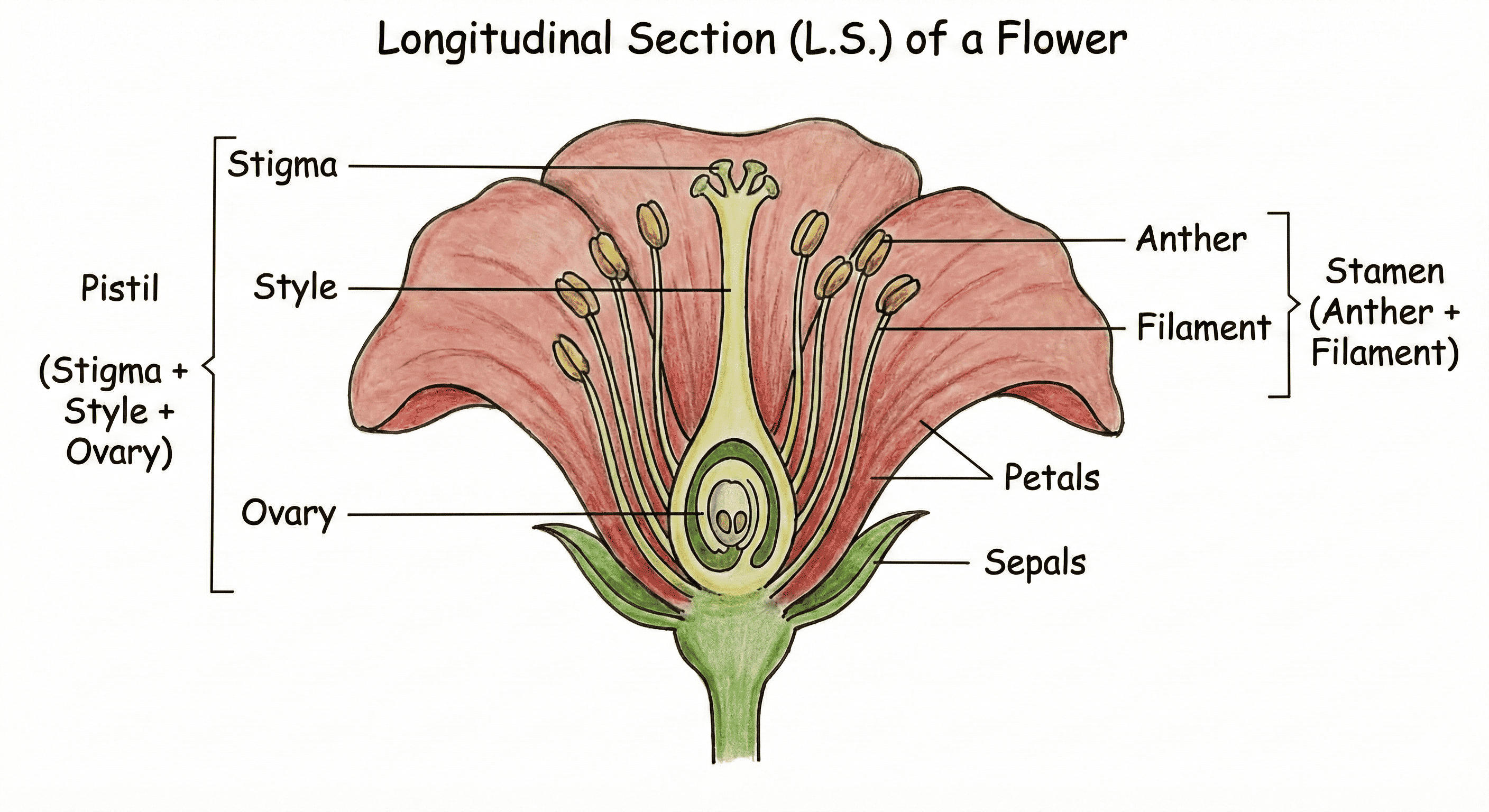
Figure 3.2: L.S. of a Flower
- Stamen (Male): Filament + Anther (Produces Pollen Grains/Yellow powder).
- Pistil/Carpel (Female):
• Stigma: Sticky tip to receive pollen.
• Style: Tube leading down.
• Ovary: Swollen base containing Ovules (Egg).
B. Process of Seed Formation
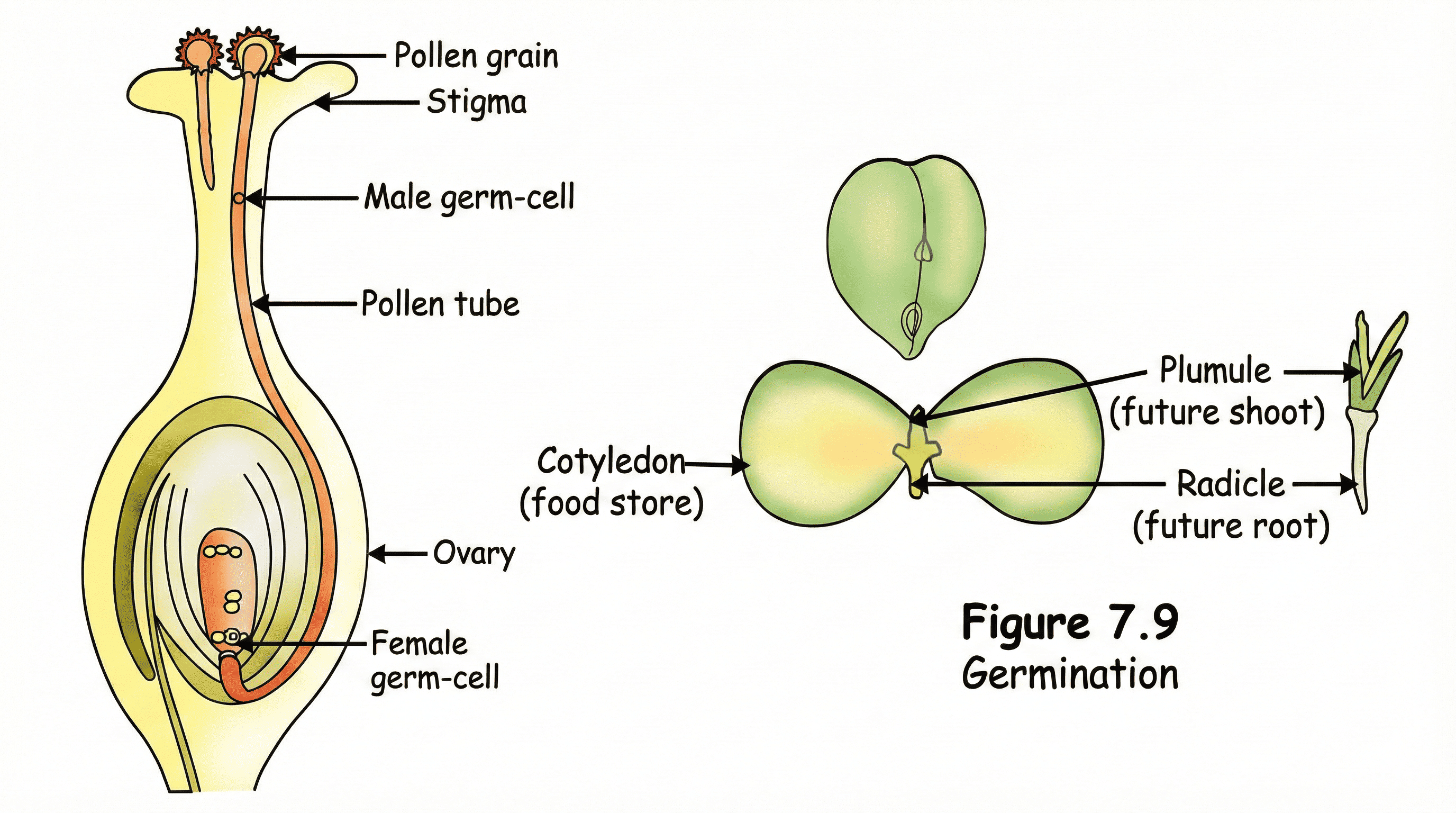
Figure 3.3: Germination of Pollen on Stigma
- Pollination: Transfer of pollen from Anther to Stigma.
• Self: Same flower.
• Cross: Different flower (Agents: Wind, Water, Bees).
- Fertilization: Pollen tube grows through style to ovary. Male germ cell enters
ovule.
• Male gamete (n) + Female gamete (n) → Zygote (2n).
- Post-Fertilization Changes:
• Zygote → divides to form Embryo.
• Ovule → hardens to form Seed.
• Ovary → ripens to form Fruit.
• Petals/Sepals wither and fall off.
Structure of a Seed (Germination):
Comparison of parts:
• Cotyledon: Food Store.
• Plumule: Future Shoot.
• Radicle: Future Root.
Conditions for Germination:
1. Water (Moisture): To soften seed coat and activate enzymes.
2. Air (Oxygen): For respiration.
3. Warmth (Temperature): Optimum temperature for enzymes.
Steps of Germination:
1. Seed absorbs water (swells up).
2. Seed coat bursts.
3. Radicle comes out first (Functions as Root).
4. Plumule comes out next (Functions as Shoot).
Note on Cotyledons:
• Monocots: One Cotyledon (e.g., Maize, Wheat).
• Dicots: Two Cotyledons (e.g., Gram, Pea, Bean). (Gram seeds are used in lab
activities).
3. Human Reproduction
Humans use sexual reproduction. Puberty is the age when reproductive maturity begins.
A. Male Reproductive System
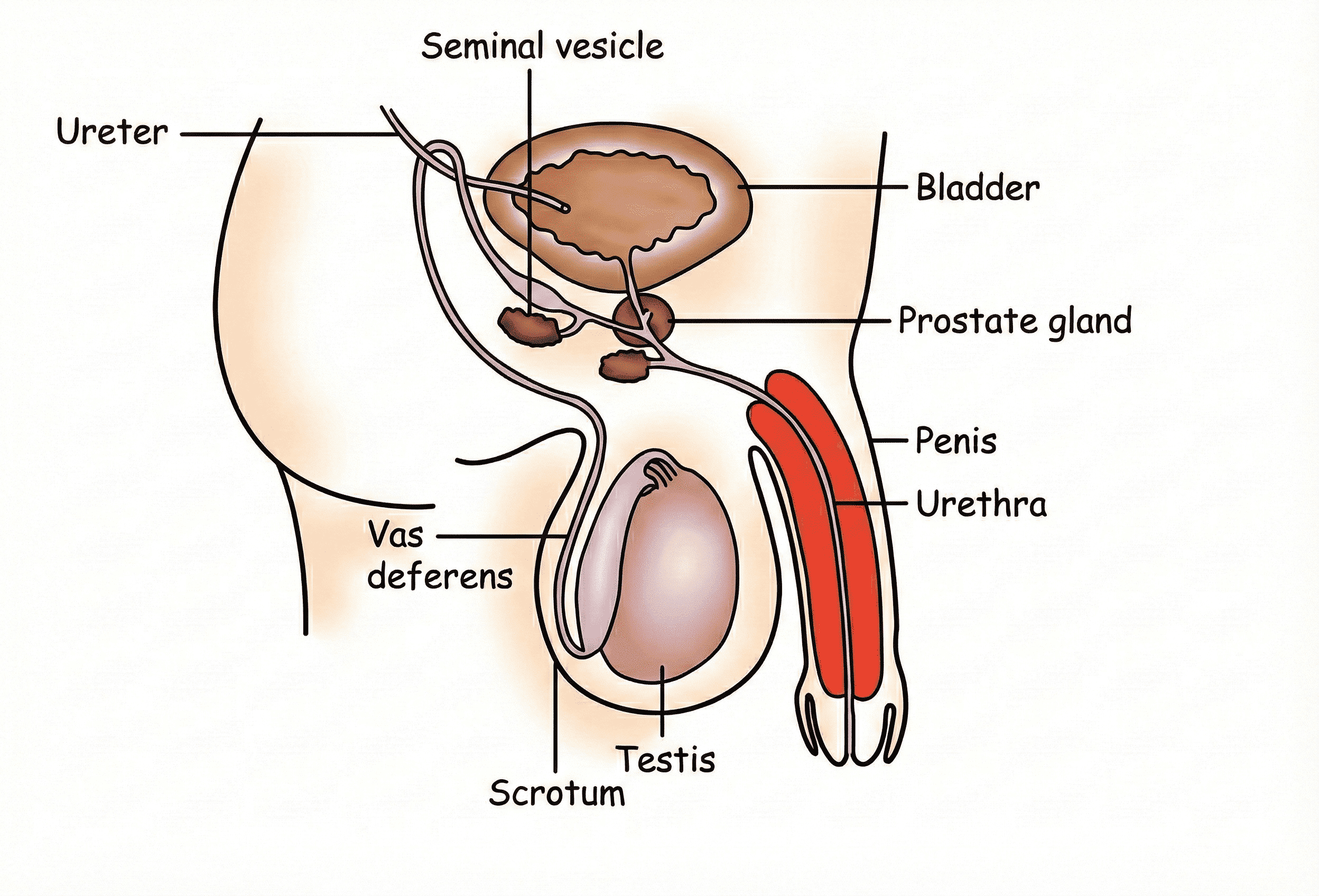
Figure 3.4: Male Reproductive System
| Part |
Function |
| Testes (Pair) |
1. Produce Sperms.
2. Secrete Testosterone (Puberty changes). |
| Scrotum |
Pouch outside body. Keeps testes temp 2-3°C lower than body temp (Required
for
sperm formation). |
| Vas Deferens |
Tube carrying sperm from testes to urethra. |
| Prostate & Seminal Vesicles |
Secrete fluids that:
1. Provide nutrition to sperms.
2. Make
transport
easier (Fluid medium). |
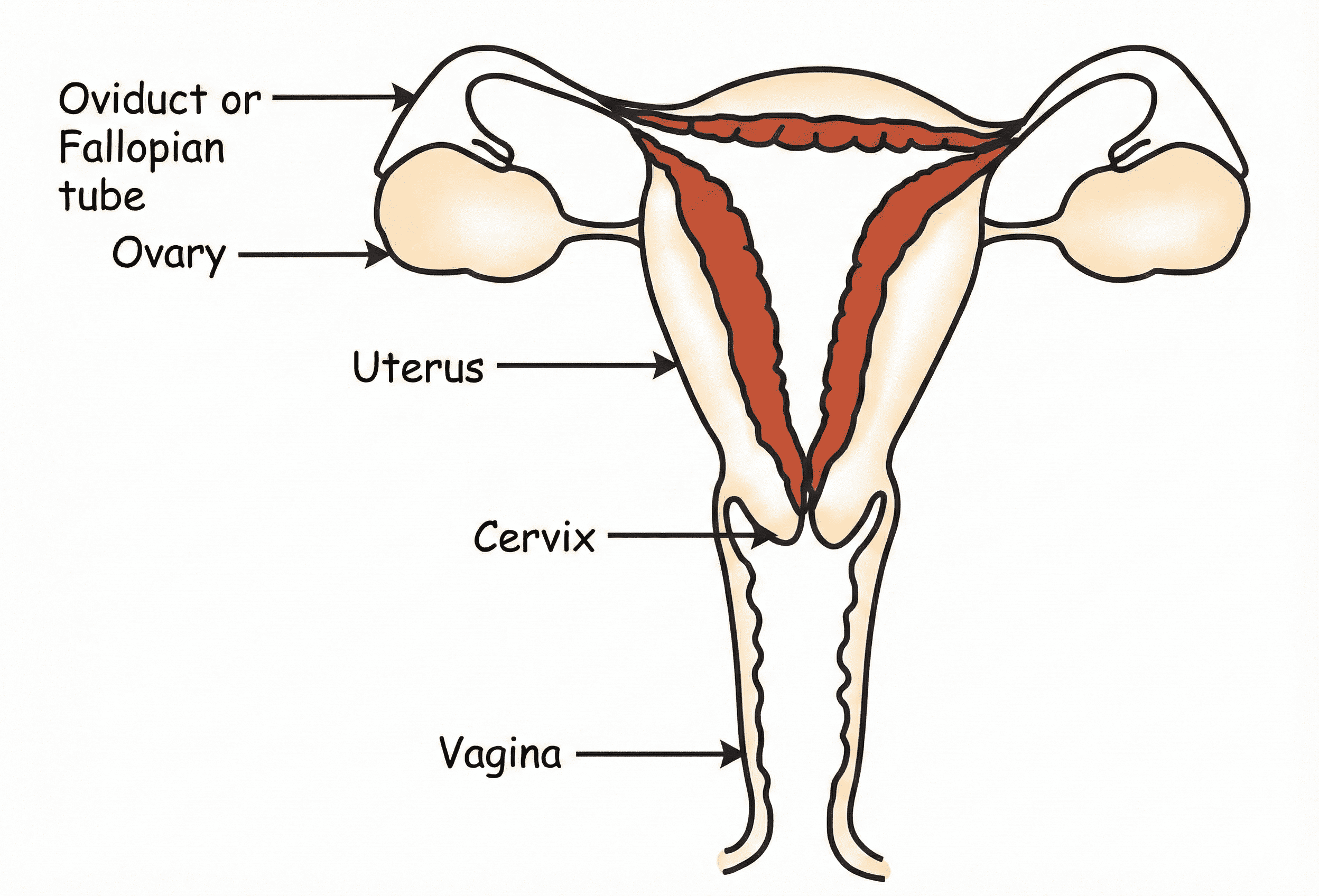
B. Female Reproductive System
Figure 3.5: Female Reproductive System
| Part |
Function |
| Ovary (Pair) |
1. Produce Eggs (Ova).
2. Secrete Oestrogen/Progesterone. |
Oviduct
(Fallopian Tube) |
Site of Fertilization (Sperm meets Egg here). Carries egg to uterus. |
| Uterus (Womb) |
Bag-like structure where baby grows (Implantation). |
C. The Placenta (Very Important PYQ)
Structure: A disc-embedded special tissue in the uterine wall.
• Embryo side: Contains Villi (Finger-like projections).
• Mother side: Blood spaces surrounding villi.
Function: Provides large surface area for:
1. Glucose & Oxygen to pass from Mother → Embryo.
2. Wastes to pass from Embryo → Mother.
D. Menstruation (What if fertilization fails?)
The uterus prepares itself every month with a thick, spongy lining rich in blood to nourish a potential
embryo.
If no fertilization: The lining breaks down and comes out through the vagina as blood
and
mucus. This cycle takes ~28 days.
4. Reproductive Health
A. Sexually Transmitted Diseases (STDs)
- Bacterial: Gonorrhoea, Syphilis.
- Viral: Warts, HIV-AIDS.
B. Contraception (Avoiding Pregnancy)
| Method |
Example |
Pros/Cons |
| Mechanical Barrier |
Condoms, Diaphragm |
Prevents sperm meeting egg. Condoms also prevent STDs. |
| Chemical |
Oral Pills |
Change hormonal balance so egg is not released. Side effects possible. |
| IUCD |
Copper-T |
Placed in uterus. Prevents implantation. |
| Surgical |
Vasectomy (Male)
Tubectomy (Female) |
Blocking Vas Deferens/Fallopian Tube. Permanent. |
-
Why is the use of a condom considered better than oral pills or Copper-T?
Hint: Condoms are the ONLY method that protects against STDs (like
HIV/Syphilis).
-
A flower is pollinated but seeds are not formed. Where did the process likely fail?
Hint: Failure of the Pollen Tube to reach the Ovary or failure of gamete
fusion (Fertilization).
-
If a woman undergoes tubectomy, will menstruation stop? Explain.
Hint: No. Menstruation depends on the Uterus lining and Hormones
(Ovary),
which are still active. Tubectomy only blocks the egg from meeting sperm.
🧪 NCERT EXPERIMENT ZONE (Reproduction)
1. Budding in Yeast:
• Observation under Microscope: Small protuberance (bud) appears on parent cell.
Nucleus
divides. Bud detaches to form new cell.
2. Spore Formation (Rhizopus):
• Observation: Cottony white mass on wet bread slice. Black dots (Sporangia) contain
spores.
• Condition: Moisture and warmth favor fungal growth.
3. Binary Fission in Amoeba:
• Observation: Nucleus elongates → Nucleus divides (Karyokinesis) → Cytoplasm
constricts →
Two daughter cells formed (Cytokinesis).
4. Parts of a Dicot Seed (Gram/Pea):
• Procedure: Soak seeds overnight. Peel off seed coat.
• Observation:
- Cotyledons: Fleshy part (food store).
- Plumule: Future Shoot.
- Radicle: Future Root.
CHAPTER 4: HEREDITY
Why did Mendel choose Garden Peas?
1. Short life cycle (can study many generations).
2. Distinct contrasting characters (Tall/Short, Round/Wrinkled).
3. Self-pollinating (easy to get pure lines) but can be cross-pollinated artificially.
Mendel's 7 Pairs of Contrasting Characters:
| Character |
Dominant Trait |
Recessive Trait |
| Stem Height |
Tall |
Dwarf (Short) |
| Flower Colour |
Violet |
White |
| Flower Position |
Axial |
Terminal |
| Pod Shape |
Inflated (Full) |
Constricted |
| Pod Colour |
Green |
Yellow |
| Seed Shape |
Round |
Wrinkled |
| Seed Colour |
Yellow |
Green |
1. Mendel’s Experiments
A. Terminologies (Must Know)
- Gene: Unit of heredity that controls a trait (segment of DNA).
- Allele: Alternative forms of a gene (e.g., T for Tall, t for Short).
- Genotype: Genetic makeup (TT, Tt, tt).
- Phenotype: Physical appearance (Tall, Short).
- Homozygous: Having two identical alleles for a trait (e.g., TT or tt).
(Pure).
- Heterozygous: Having two different alleles for a trait (e.g., Tt).
(Hybrid).
B. Monohybrid Cross (One Trait: Height)
Parent: Pure Tall (TT) x Pure Short (tt)
Gametes: (T) and (t)
F1 Generation: All Tt (Tall) -> Law of Dominance.
F2 Generation (Selfing Tt x Tt):
| Gametes |
T |
t |
| T |
TT (Tall) |
Tt (Tall) |
| t |
Tt (Tall) |
tt (Short) |
Monohybrid Ratios:
• Phenotypic Ratio: 3 Tall : 1 Short (3:1)
• Genotypic Ratio: 1 TT : 2 Tt : 1 tt (1:2:1)
PYQ Trend (Animals):
In a cross between Black Fur (BB) and White Fur (bb) rabbits, F1 will be Black (Bb). In F2, 25% will be
White (bb). Concept remains the same as plants.
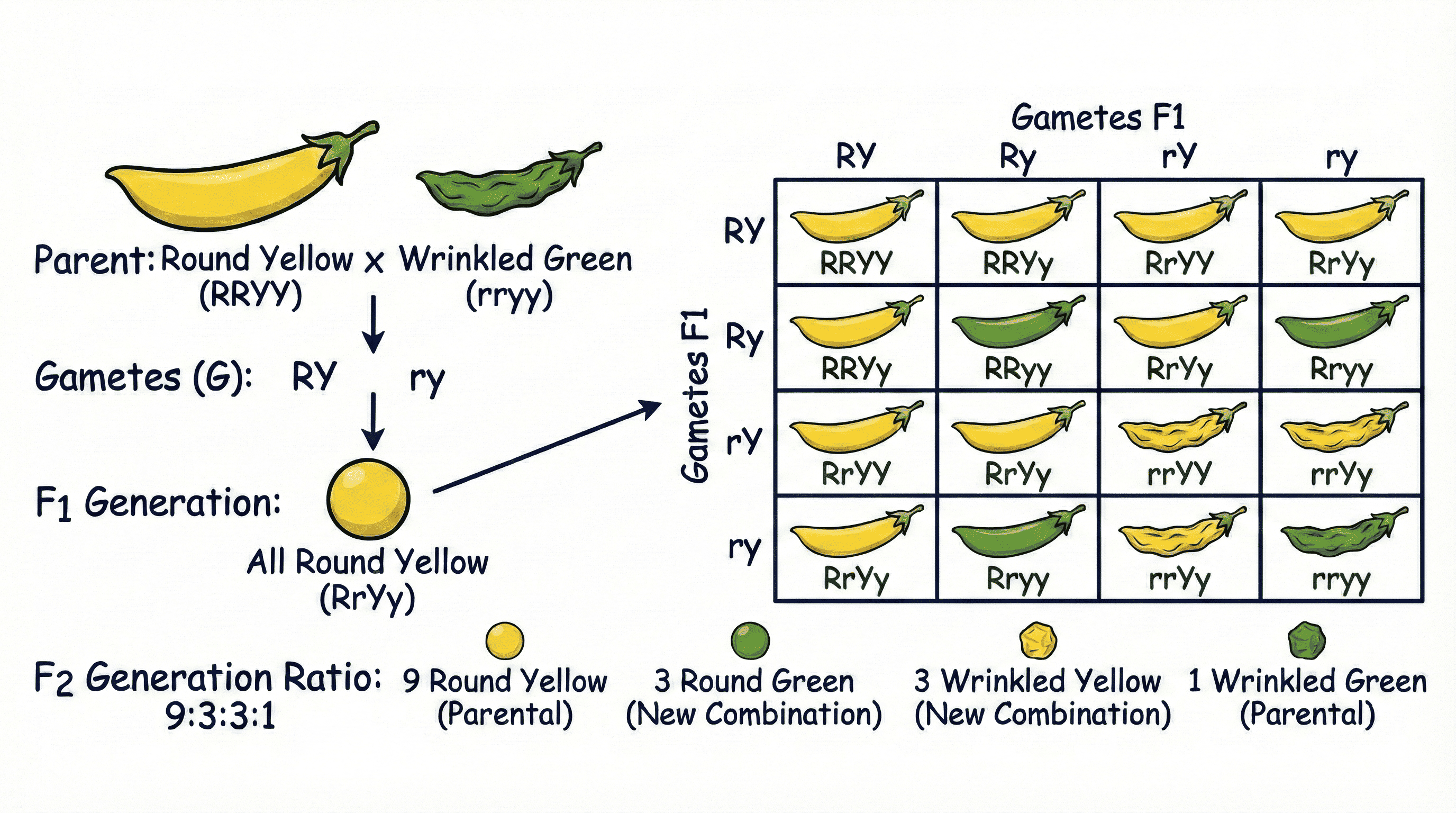
C. Dihybrid Cross (Two Traits: Shape & Colour)
Parent: Round Yellow (RRYY) x Wrinkled Green (rryy)
F1 Generation: All Round Yellow (RrYy).
F2 Generation Ratio: 9:3:3:1
- 9 Round Yellow (Parental)
- 3 Round Green (New Combination)
- 3 Wrinkled Yellow (New Combination)
- 1 Wrinkled Green (Parental)
Conclusion: Law of Independent Assortment (Traits are inherited independently).
D. Mendel's Three Laws of Inheritance (Important Theory)
-
Law of Dominance:
In a cross between two parents with contrasting traits (e.g., TT x tt), only one characteristic
appears in the F1 generation. This expressed trait is called
Dominant (Tall), and the hidden one is Recessive (Dwarf).
-
Law of Segregation (Law of Purity of Gametes):
During gamete formation, the two alleles of a gene separate (segregate) from each other so that
each
gamete receives only one allele. This ensures gametes are pure for a trait.
-
Law of Independent Assortment:
In a Dihybrid cross (two pairs of traits), the inheritance of one pair of characters (e.g.,
Shape)
is independent of the other pair (e.g., Colour). (Example: Round can go with
Green
or Yellow).
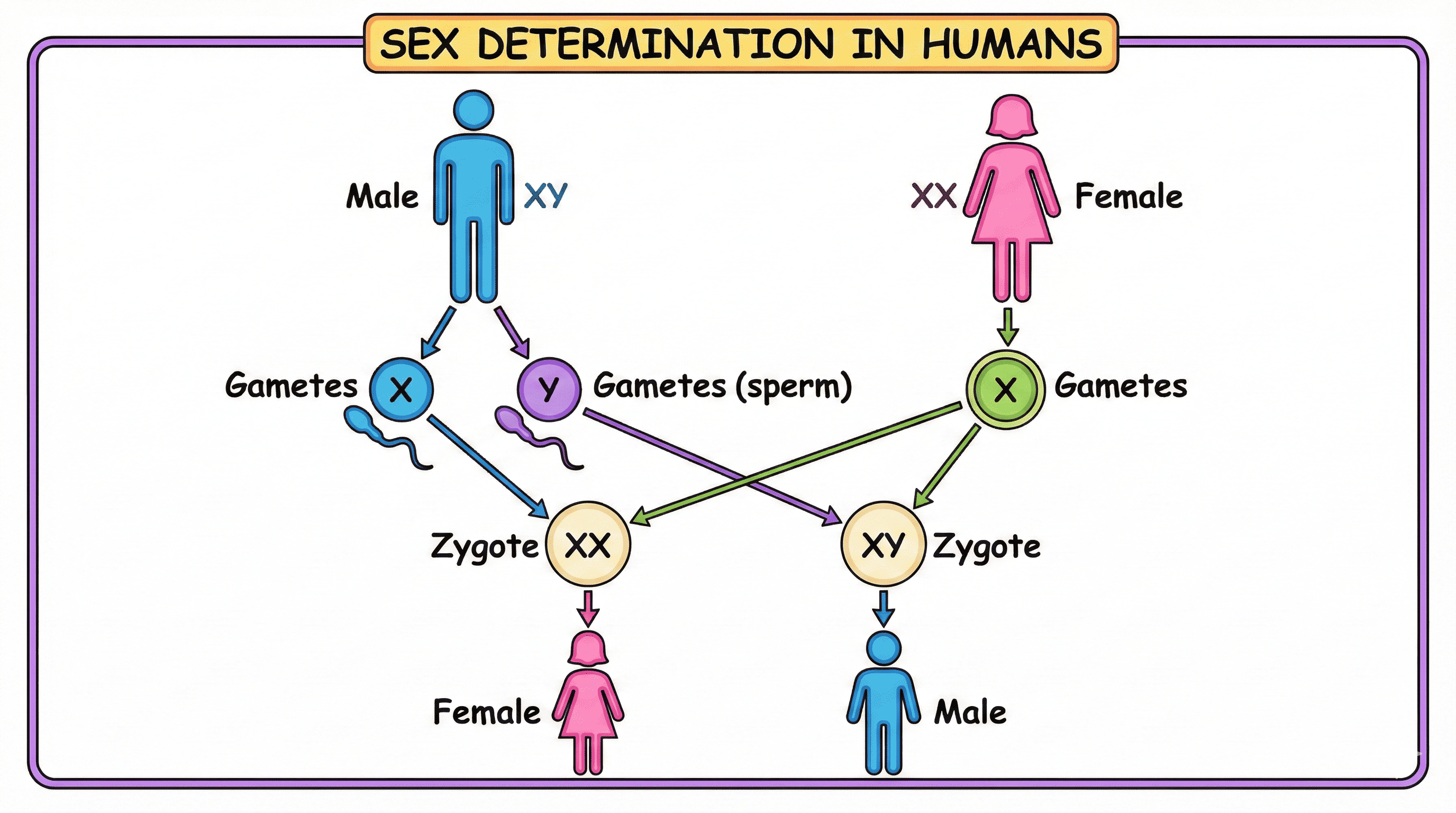
2. Sex Determination in Humans
Figure 4.1: Sex Determination Flowchart
In humans, sex is determined by the sperm (Male Gamete).
- Male: XY chromosomes. Produces two types of sperms (50% X and 50% Y).
- Female: XX chromosomes. Produces only one type of egg (100% X).
| Sperm (Father) |
Egg (Mother) |
Zygote |
Child Sex |
| X |
X |
XX |
Female (Girl) |
| Y |
X |
XY |
Male (Boy) |
Conclusion: There is a 50-50 chance of a boy or a girl. The sex of the child depends
entirely on which sperm (X or Y) fertilizes the egg.
Humans have 23 pairs of chromosomes. 22 pairs are Autosomes. 1 pair is Sex Chromosome.
Mechanism:
• Mother produces eggs only with X chromosome.
• Father produces sperms with X (50%) or Y (50%).
• If Sperm (X) fertilizes Egg (X) → Girl (XX).
• If Sperm (Y) fertilizes Egg (X) → Boy (XY).
Who determines the sex of the child?
The Father. Because the mother provides only X chromosomes, while the father provides
either X or Y, which decides the outcome. It is a matter of chance (50-50 probability).
3. Acquired vs Inherited Traits
| Inherited Traits |
Acquired Traits |
| Passed from parents to offspring. |
Developed during lifetime of individual. |
| Cause change in DNA of Germ cells. |
Involve changes in Somatic (Body) cells only. No DNA change. |
| Examples: Eye colour, Skin colour, Blood group. |
Examples: Muscular body of a wrestler, Learning French, Cut tail of a mouse. |
-
A violet flower (VV) is crossed with a white flower (vv). Why do we not see ANY white flowers in
the
F1 generation?
Hint: Law of Dominance. White (recessive) is hidden by Violet (dominant)
in
F1 (Vv).
-
"A wrestler's son is not born with muscular muscles." Explain scientifically.
Hint: Muscles are an Acquired Trait (change in Somatic cells), which
does
not change the DNA of Germ cells (sperm/egg).
-
In a population of mice, does the environment select the survival of specific traits? (Give an
example).
Hint: Yes. If bushes turn brown, brown mice survive better than green
mice
(Natural Selection).
CHAPTER 5: OUR ENVIRONMENT
1. Ecosystem and its Components
Ecosystem: A self-sustaining system where biotic (living) and abiotic (non-living)
components interact with each other. (e.g., Garden, Forest, Pond).
| Component |
Examples & Role |
| Abiotic |
Temperature, Rainfall, Soil, Air, Light. |
| Biotic |
1. Producers: Green plants/Blue-green algae (Make food).
2. Consumers: Herbivores, Carnivores, Omnivores, Parasites.
3. Decomposers: Bacteria, Fungi (Break down dead matter).
|
What is the role of Decomposers?
They break down complex organic matter (dead plants/animals) into simple inorganic substances that go
into
the soil and are used up once more by the plants. They act as natural cleansing agents
of
the environment.
2. Food Chain & Energy Flow
Food Chain: A series of organisms where one eats another to transfer energy. (Grass →
Deer →
Tiger).
Food Web vs Food Chain:
In nature, food chains are not isolated. One organism may be eaten by many others (e.g., a Frog eaten by
Snake or Bird). This interconnected network is a Food Web. It provides stability to the
ecosystem.
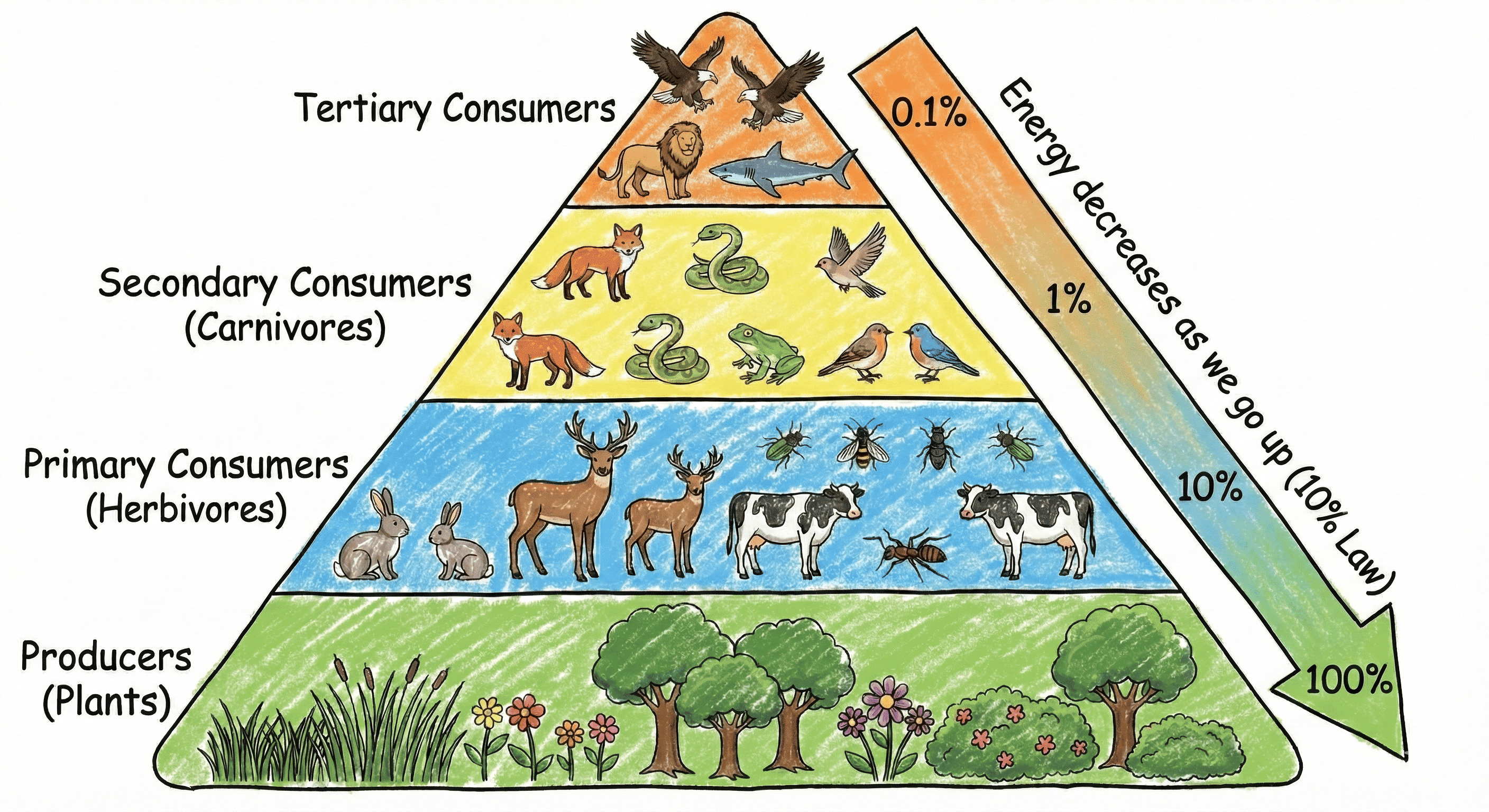
A. The 10% Law (Lindeman)
Statement: Only 10% of energy entering a particular trophic level is
available for transfer to the next higher trophic level. The remaining 90% is lost as
heat/digestion/growth.
*Note: Plants capture only 1% of Solar Energy.
Numerical Example (PYQ):
Sun (100,000 J) → Plant (1% = 1000 J) → Deer (10% = 100 J) → Lion (10% = 10 J).
Conclusion: Food chains generally consist of only 3 or 4 steps because very little energy is
left
for a 5th level.
B. Flow of Energy is Unidirectional
Energy captured by autotrophs does not revert back to the sun. Energy passed to herbivores does not come
back
to autotrophs. It moves progressively through trophic levels.
Figure 5.1: Trophic Levels Pyramid
3. Biological Magnification
Mechanism:
1. Harmful chemicals (Pesticides/DDT) are sprayed on crops.
2. They enter the soil/water bodies.
3. Absorbed by plants (Producers).
4. Passed on to Herbivores and then Carnivores.
5. Since these are non-biodegradable, they accumulate at each level.
Result: Concentration is maximum in Humans (Top level).
4. Ozone Layer Depletion
Ozone (O3): A deadly poison at ground level, but a shield in the
stratosphere. It
protects earth from harmful UV radiation (causes skin cancer, cataracts).
A. Formation of Ozone
- UV splits Oxygen molecule: O2 —(UV)→ O + O
- Free oxygen combines with Oxygen molecule: O + O2 → O3
(Ozone)
B. Depletion Cause
Synthetic chemicals like CFCs (Chlorofluorocarbons) used in Refrigerators and Fire
Extinguishers reach the upper atmosphere and break down Ozone.
UNEP (1987): Forged an agreement to freeze CFC production at 1986 levels (Montreal
Protocol).
5. Managing Garbage
| Biodegradable |
Non-Biodegradable |
| Broken down by biological processes (Bacteria/Enzymes). |
Cannot be broken down biologically. Persist for long. |
| Example: Fruit peels, Paper, Wood, Cotton. |
Example: Plastic, Glass, Metals, DDT. |
Why replaced plastic cups with Kulhads (Clay cups) and then Paper cups?
• Plastic: Non-biodegradable waste.
• Kulhads: Biodegradable, but caused loss of fertile topsoil (to make clay).
• Paper Cups: Biodegradable and can be recycled. Best option.
-
Calculate the energy available to the Tiger if the Plants absorb 20,000 J of energy from the
Sun.
Hint: Don't forget Plants take only 1% from Sun (200 J), then 10% passes
to
Deer (20 J), then 10% to Tiger (2 J).
-
Why do we find maximum chemical accumulation in Humans in a food chain?
Hint: Humans are at the top trophic level. Chemicals are
non-biodegradable
and accumulate at every step (Biomagnification).
-
"Damage to the Ozone layer is a cause for concern." Justify this statement.
Hint: Ozone protects from UV rays. UV rays cause Skin Cancer, Cataracts
in
humans, and damage to crops/ecosystems.
Powered by Vardaan Comet 🚀

.png)
 vs Closed (Flaccid).png)
.png)
 before starch test (b) after starch test.png)
 with potassium hydroxide (b) without potassium hydroxide.png)
.png)
.png)