Vardaan Learning Institute
ONLY PHYSICS TEST 01
Time: 2 Hours
Class: 10 (Science)
Max. Marks: 80
General Instructions: All questions are compulsory. Use of calculators is not permitted.
Draw neat and labeled diagrams wherever necessary.
-
The image formed by a concave mirror is observed to be virtual, erect and larger than the object.
Where should be the position of the object?
- Between principal focus and centre of curvature
- At the centre of curvature
- Beyond the centre of curvature
- Between the pole of the mirror and its principal focus
-
The change in focal length of an eye lens is caused by the action of the:
- Pupil
- Retina
- Ciliary muscles
- Iris
-
A cylindrical conductor of length l and uniform area of cross-section A has
resistance R. Another conductor of length 2l and resistance R of the same
material has area of cross-section:
-
The magnetic field inside a long straight solenoid-carrying current:
- Is zero
- Decreases as we move towards its end
- Increases as we move towards its end
- Is the same at all points
-
Which of the following terms does not represent electrical power in a circuit?
-
The danger signals installed at the top of tall buildings are red in colour. These can be easily
seen from a distance because among all other colours, the red light:
- Is scattered the most by smoke or fog
- Is scattered the least by smoke or fog
- Is absorbed the most by smoke or fog
- Moves fastest in air
-
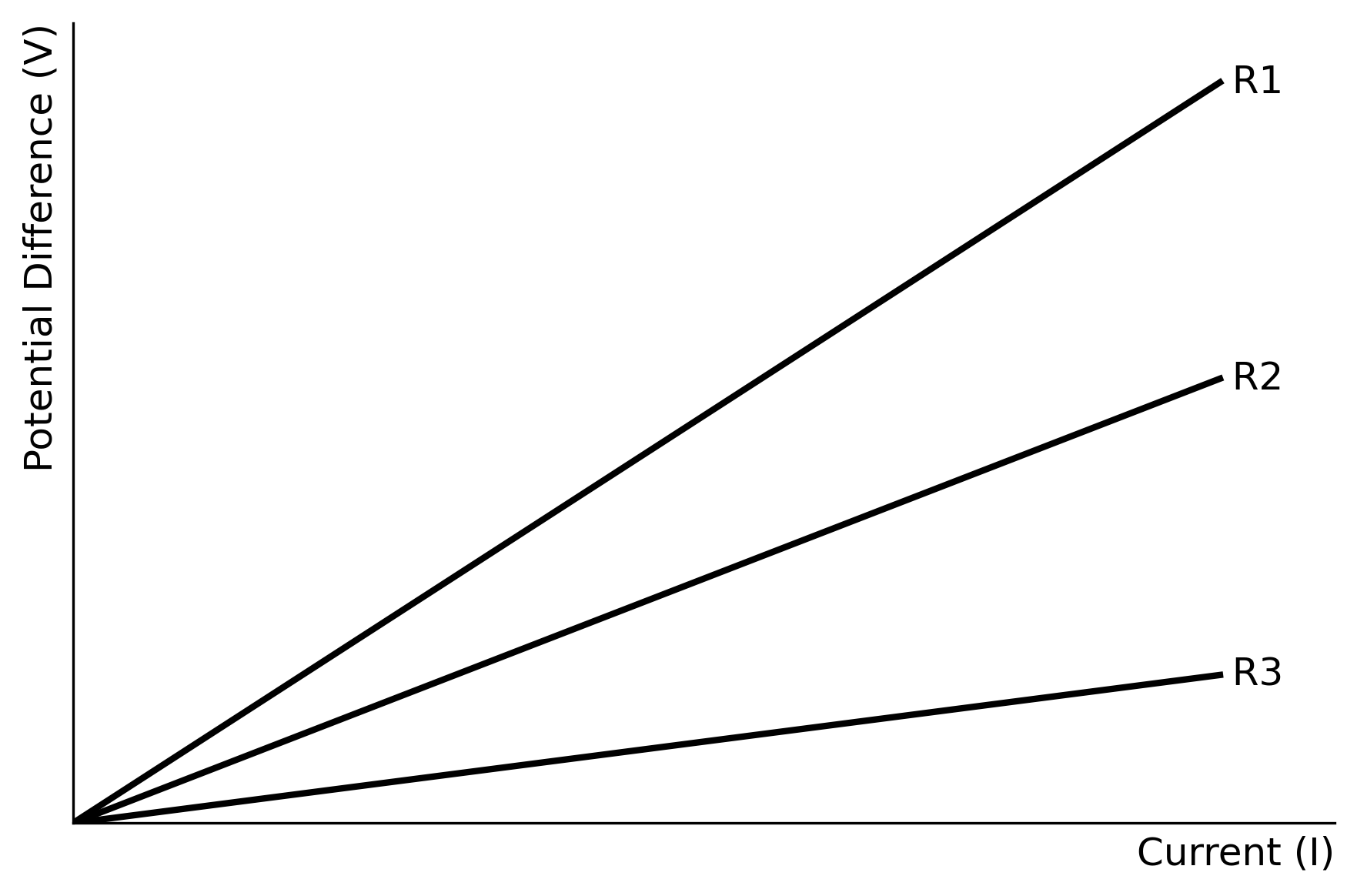
A student carries out an experiment and plots the V-I graph of three samples of nichrome wire with
resistances R1, R2 and R3 respectively. Which
of the following is true?
- R1 = R2 = R3
- R1 > R2 > R3
- R3 > R2 > R1
- R2 > R3 > R1
-
The phenomena of electromagnetic induction is:
- The process of charging a body
- The process of generating magnetic field due to a current
- Producing induced current in a coil due to relative motion
- The process of rotating a coil of an electric motor
-
When light enters from air to glass, the angle of incidence and angle of refraction in the glass
are related as:
- i
< r
- i > r
- i = r
- No relation
-
Commercial unit of electrical energy is kilowatt-hour (kWh). 1 kWh is equal to:
- 3.6 × 10⁵ J
- 3.6 × 10⁶ J
- 36 × 105 J
- 3.6 × 10⁴ J
-
An electric fuse works on the:
- Chemical effect of current
- Magnetic effect of current
- Lighting effect of current
- Heating effect of current
-
At noon the sun appears white as:
- Light is least scattered
- All the colours of the white light are scattered away
- Blue colour is scattered the most
- Red colour is scattered the most
-
For a steady current I flowing through a resistor of resistance R for time t,
the heat produced H is given by:
- H = VIt
- H = I2Rt
- H = V2t/R
- All of these
-
The laws of reflection hold good for:
- Plane mirror only
- Concave mirror only
- Convex mirror only
- All mirrors irrespective of their shape
-
Two resistors of resistance 2Ω and 4Ω when connected to a battery will have:
- Same current flowing through them when connected in parallel
- Same current flowing through them when connected in series
- Same potential difference across them when connected in series
- Different potential difference across them when connected in parallel
-
A full length image of a distant tall building can definitely be seen by using:
- A concave mirror
- A convex mirror
- A plane mirror
- Both concave as well as plane mirror
-
The resistivity does not change if:
- The material is changed
- The temperature is changed
- The shape of the resistor is changed
- Both material and temperature are changed
-
What is the minimum resistance which can be made using five resistors each of 1/5 Ω?
-
In the case of Hypermetropia, the image of a nearby object is formed:
- On the retina
- In front of the retina
- Behind the retina
- At the blind spot
-
The magnetic field lines outside a bar magnet:
- Originate from the South pole and end at its North Pole
- Originate from the North pole and end at its East Pole
- Originate from the North Pole and end at its South Pole
- Originate from the South pole and end at its West Pole
- Define the term "Power of a lens". What is its SI unit? Find the power of a concave lens of focal
length 2 m.
- Why does the sky appear dark instead of blue to an astronaut?
- State two factors on which the resistance of a cylindrical conductor depends.
- Draw a diagram to show the magnetic field lines around a bar magnet.
- An electric bulb is rated 220V and 100W. When it is operated on 110V, what will be the power
consumed?
- An object 5 cm in length is held 25 cm away from a converging lens of focal length 10 cm. Draw the
ray diagram and find the position, size and the nature of the image formed.
- State Joule's law of heating. Name two devices that work on the heating effect of electric
current.
- Explain the formation of a rainbow in the sky with the help of a labeled diagram.
- Two lamps, one rated 100 W at 220 V, and the other 60 W at 220 V, are connected in parallel to
electric mains supply. What current is drawn from the line if the supply voltage is 220 V?
- List the properties of magnetic field lines. Why don't two magnetic field lines intersect each
other?
-
A person cannot see objects distinctly when placed at a distance less than 50 cm.
- Identify the defect of vision.
- Give two reasons for this defect.
- Calculate the power and nature of the lens required to correct the vision, assuming the near
point of the normal eye is 25 cm.
-
(a) Derive the expression for the equivalent resistance of three resistors
R1, R2, and R3 connected in parallel.
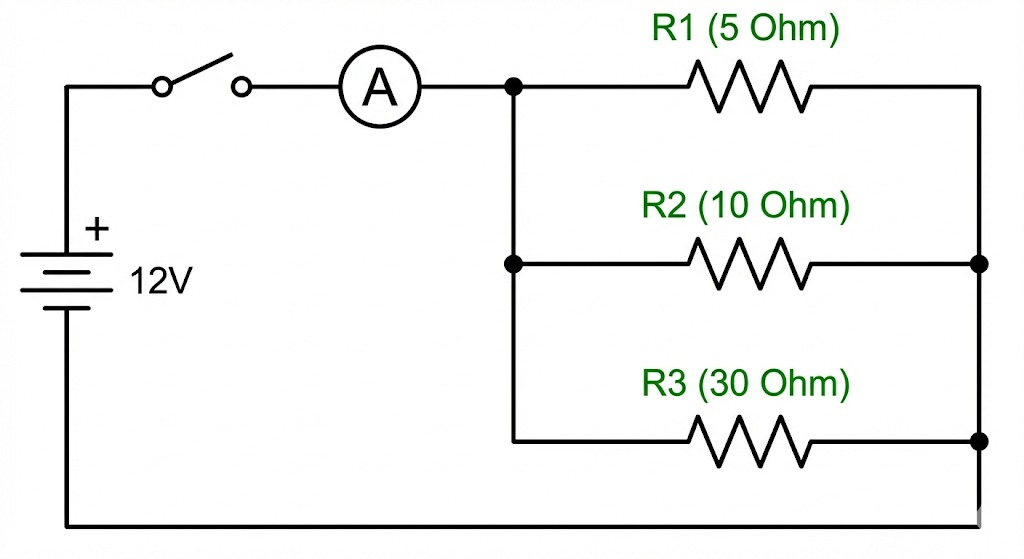
(b) In the circuit diagram given below, suppose the resistors R1,
R2 and R3 have the values 5 Ω, 10 Ω, 30 Ω
respectively, which have been connected to a battery of 12 V. Calculate:
- The current through each resistor.
- The total current in the circuit.
- The total circuit resistance.
-
(a) State the laws of refraction of light.
(b) The refractive index of diamond is 2.42. What is the meaning of this statement?
(c) Draw a ray diagram to show the formation of the image by a concave mirror when an object
is placed between the pole and the focus of the mirror. State the characteristics of the image.
-
(a) What is a solenoid? Draw the pattern of magnetic field lines of a current-carrying
solenoid.
(b) State Fleming's Left-Hand Rule.
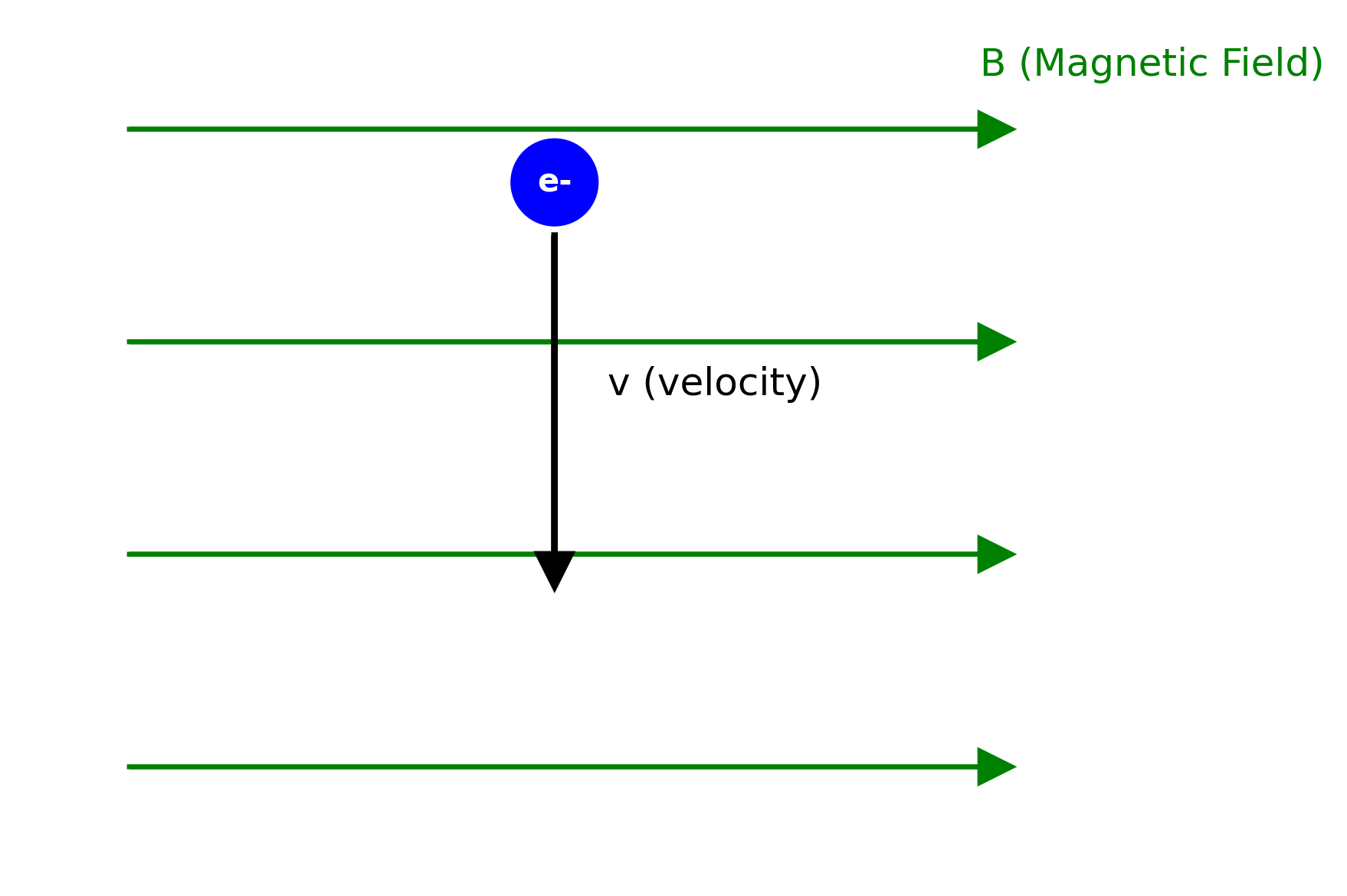
(c) An electron enters a magnetic field at right angles to it, as shown in the figure. The
direction of the force acting on the electron will be? (Upwards/Downwards/Into page/Out of page)
-
(a) What is meant by the 'power of accommodation' of the eye?
(b) A person with a myopic eye cannot see objects beyond 1.2 m distinctly. What should be the
type of the corrective lens used to restore proper vision?
(c) Draw ray diagrams showing: (i) The myopic eye, (ii) Correction for myopia with a lens.
-
Case Study 1: Mirrors in Automobiles
A rearview mirror is a flat or convex mirror in automobiles and other vehicles, designed to allow
the driver to see rearward through the vehicle's rear window. Convex mirrors are preferred because
they give an erect, though diminished, image. Also, they have a wider field of view as they are
curved outwards.
- Why do we prefer a convex mirror as a rear-view mirror in vehicles? [1]
- If the radius of curvature of a rear-view mirror is 3.00 m, find its focal length. [1]
- A bus is located at 5.00 m from this mirror. Find the position, nature and size of the image.
[2]
-
Case Study 2: Domestic Electric Circuits
In our homes, we receive the supply of electric power through a main supply, either supported
through overhead electric poles or by underground cables. One of the wires in this supply, usually
with red insulation cover, is called the live wire. Another wire, with black insulation, is called
the neutral wire. In our country, the potential difference between the two is 220 V.
- What is the function of the earth wire (green insulation)? [1]
- Why are domestic circuits connected in parallel? [1]
- An electric oven of 2 kW power rating is operated in a domestic circuit (220 V) that has a
current rating of 5 A. Explain what result you expect. [2]
-
Case Study 3: Dispersion of Light
A prism is a transparent refracting medium bounded by two plane surfaces inclined to each other at a
certain angle. When a beam of white light is passed through a glass prism, it splits into its
component seven colours. This phenomenon is called dispersion.
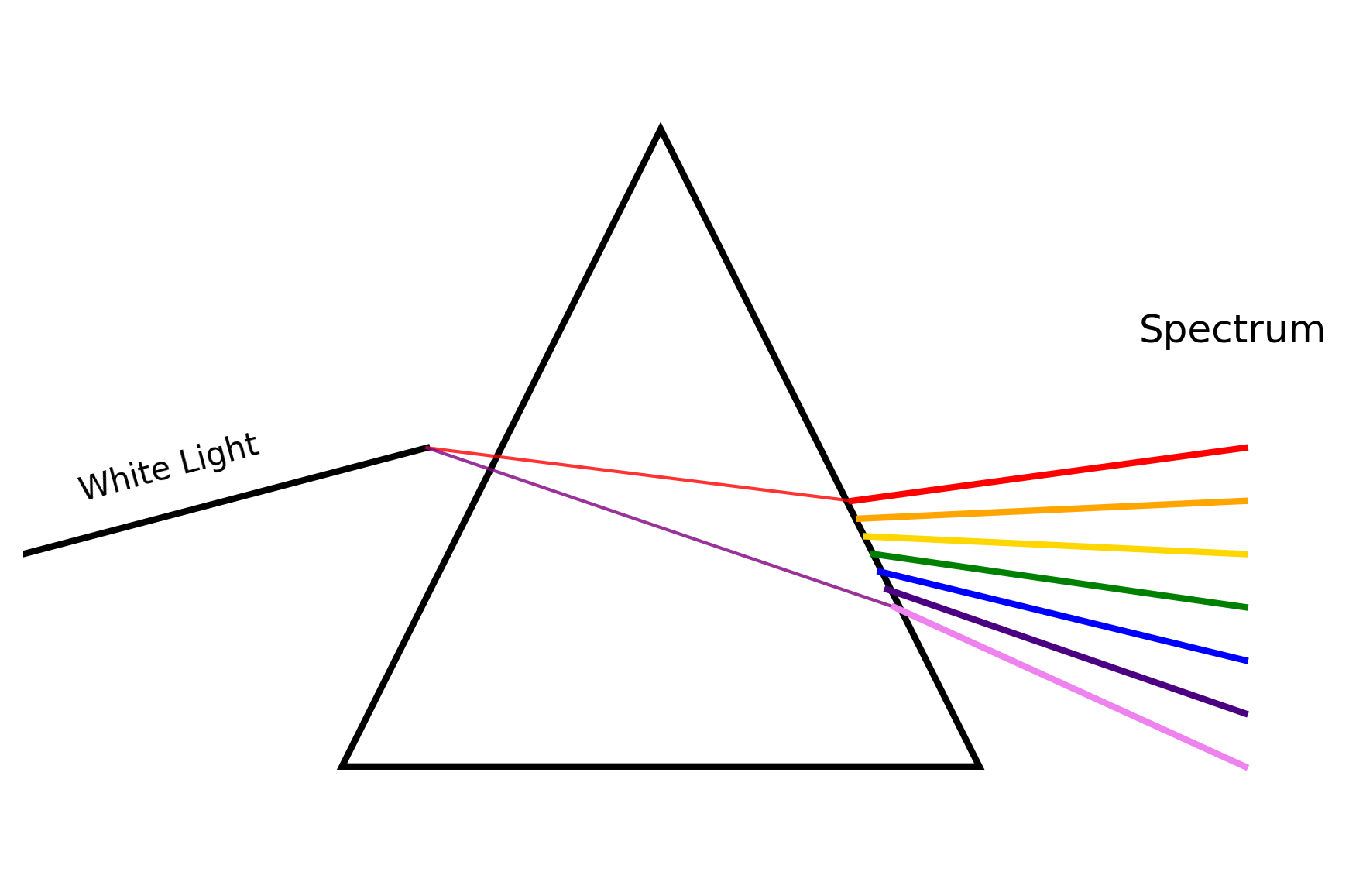
- Which colour of light bends the least? [1]
- Which colour of light bends the most? [1]
- Isaac Newton was the first to use a glass prism to obtain the spectrum of sunlight. Explain
briefly (or draw) how he recombined the spectrum of white light. [2]
