Vardaan Learning Institute
CBSE BIOLOGY MOCK TEST 01
Time: 2 Hours
Class: 10 (Science)
Max. Marks: 80
General Instructions: All questions are compulsory.
Draw neat and labeled diagrams wherever necessary.
-
The kidneys in human beings are a part of the system for:
- Nutrition
- Respiration
- Excretion
- Transportation
-
Which of the following hormones regulates blood sugar levels?
- Thyroxin
- Insulin
- Testosterone
- Adrenaline
-
The gap between two neurons is called a:
- Dendrite
- Synapse
- Axon
- Impulse
-
In a food chain, the third trophic level is always occupied by:
- Carnivores
- Herbivores
- Decomposers
- Producers
-
Which of the following statements about the autotrophs is incorrect?
- They synthesize carbohydrates from carbon dioxide and water.
- They store carbohydrates in the form of starch.
- They convert carbon dioxide and water into carbohydrates in the absence of
sunlight.
- They constitute the first trophic level in food chains.
-
The anther contains:
- Sepals
- Ovules
- Pistil
- Pollen grains
-
The breakdown of pyruvate to give carbon dioxide, water and energy takes place in:
- Cytoplasm
- Mitochondria
- Chloroplast
- Nucleus
-
Which part of the brain controls involuntary actions like blood pressure, salivation, and
vomiting?
- Cerebrum
- Cerebellum
- Medulla
- Pons
-
The xylem in plants is responsible for:
- Transport of water
- Transport of food
- Transport of amino acids
- Transport of oxygen
-
A zygote which has an X-chromosome inherited from the father will develop into a:
- Boy
- Girl
- X-chromosome does not determine the sex of a child
- Either boy or girl
-
The movement of a shoot towards light is:
- Geotropism
- Hydrotropism
- Chemotropism
- Phototropism
-
Accumulation of non-biodegradable pesticides in the food chain in increasing amounts at each
higher trophic level is known as:
- Eutrophication
- Pollution
- Biomagnification
- Accumulation
-
Which of the following is not a natural ecosystem?
- Forest
- Pond
- Crop field
- Lake
-
Exchange of gases in plants takes place through:
- Stomata
- Lenticels
- Cuticle
- All of these
-
Spirogyra reproduces by:
- Budding
- Fragmentation
- Regeneration
- Fission
-
In human females, fertilization takes place in the:
- Uterus
- Ovary
- Vagina
- Fallopian tube
-
If a round, green seeded pea plant (RRyy) is crossed with wrinkled, yellow seeded pea plant
(rrYY), the seeds produced in F1 generation are:
- Round and yellow
- Round and green
- Wrinkled and green
- Wrinkled and yellow
-
Which of the following protects the inner lining of the stomach from the action of hydrochloric
acid?
- Pepsin
- Mucus
- Salivary amylase
- Bile
-
The component of blood which helps in clotting is:
- RBCs
- WBCs
- Platelets
- Plasma
-
Ozone layer is depleted by:
- CFCs
- Carbon monoxide
- Carbon dioxide
- Sulphur dioxide
- What is the role of saliva in the digestion of food? Name the enzyme present in it.
- Why is the use of iodised salt advisable?
- Differentiate between aerobic and anaerobic respiration.
- What are the functions of the testis in humans?
- Give two reasons why we should conserve forests and wildlife.
- Draw a neat diagram of the human excretory system and label the following: (i) Kidney, (ii)
Ureter, (iii) Urinary Bladder.
-
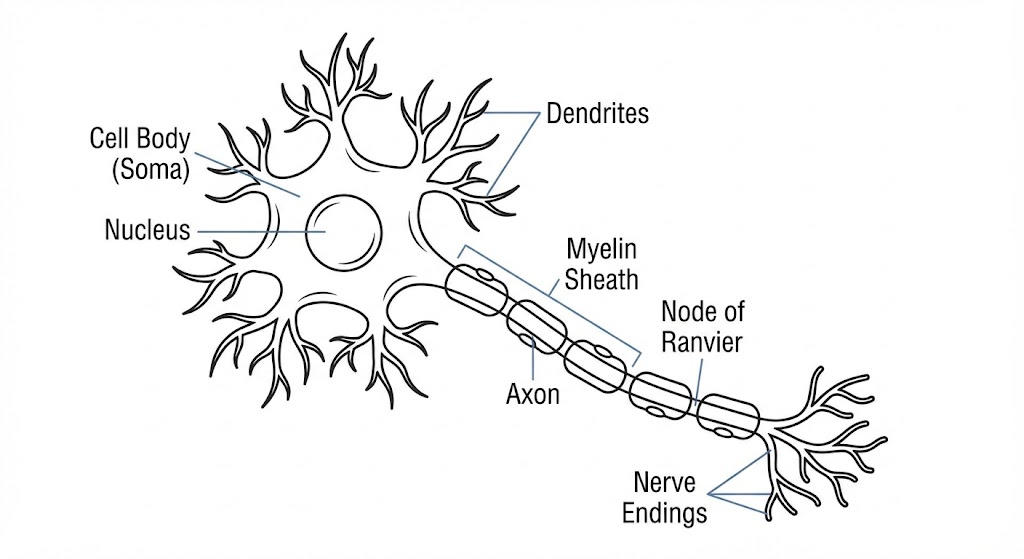 Study the diagram of a neuron. (a) Identify the part where information is acquired. (b) Through
which part does the information travel as an electrical impulse?
Study the diagram of a neuron. (a) Identify the part where information is acquired. (b) Through
which part does the information travel as an electrical impulse?
- Explain the process of double circulation in humans. Why is it necessary?
- What is the placenta? State its function in a human female.
- How is the sex of a child determined in human beings? Explain with a flow chart.
- What are trophic levels? Give an example of a food chain and state the different trophic levels in
it.
-
(a) Draw a diagram of the human alimentary canal and label: Oesophagus, Stomach, Liver,
Pancreas.
(b) Explain the process of digestion of carbohydrates, proteins, and fats in the human body.
-
(a) Draw the structure of a nephron and label Glomerulus, Bowman's capsule, and Collecting
duct.
(b) Describe the mechanism of urine formation in humans.
-
(a) What is pollination? Differentiate between self-pollination and cross-pollination.
(b) Draw a labeled diagram of the longitudinal section of a flower.
(c) Explain the process of fertilization in flowering plants.
-
(a) Define "reflex action".
(b) Trace the sequence of events which occur when a bright light is focused on your eyes.
(c) Draw the path of a reflex arc.
-
(a) Draw a diagram of the human respiratory system and label: Trachea, Bronchi, Lungs,
Diaphragm.
(b) Design an experiment to demonstrate that carbon dioxide is produced during
respiration.
(c) How are alveoli designed to maximize the exchange of gases?
-
Case Study 1: Transport in Plants
Plants have two distinct pathways for the transport of substances. One is the Xylem, which moves
water and minerals obtained from the soil. The other is Phloem, which transports products of
photosynthesis from the leaves to other parts of the plant. The loss of water in the form of vapor
from the aerial parts of the plant is known as transpiration.
- What is the process of transport of soluble products of photosynthesis called? [1]
- Which tissue helps in the upward movement of water and dissolved minerals? [1]
- Explain how transpiration helps in the absorption and upward movement of water and minerals
dissolved in it. [2]
-
Case Study 2: Heredity
Mendel conducted experiments with garden pea plants (Pisum sativum) to understand the
inheritance of traits. He observed that when he crossed a pure tall plant with a pure short plant,
all the offspring in the F1 generation were tall. However, when he self-pollinated the F1 plants,
both tall and short plants appeared in the F2 generation in a specific ratio.
- Why were all plants tall in the F1 generation? [1]
- What happens to the trait of the dwarf plants in the F1 generation? [1]
- State the Law of Dominance and the Law of Segregation based on this observation. [2]
-
Case Study 3: Our Environment
An ecosystem includes all the living organisms (biotic factors) in an area as well as the physical
environment (abiotic factors) with which they interact. There is a flow of energy from one component
to another. The green plants capture about 1% of the energy of sunlight that falls on their leaves
and convert it into food energy.
- What is the 10% law of energy flow? [1]
- Why is the number of trophic levels in a food chain limited? [1]
- Construct a simple food chain of a grassland ecosystem with four trophic levels. [2]
