1. An object 4.0 cm in size is placed at
25.0 cm in front of a concave mirror of focal length 15.0 cm. At what distance from the mirror should a
screen be placed in order to obtain a sharp image? Find the nature and the size of the image.
2. A convex mirror used for rear-view on an
automobile has a radius of curvature of 3.00 m. If a bus is located at 5.00 m from this mirror, find the
position, nature, and size of the image.
3. The magnification produced by a plane
mirror is +1. What does this mean? Compare this with a concave mirror producing a magnification of -1.
4. An object is placed at a distance of 10
cm from a convex mirror of focal length 15 cm. Find the position and nature of the image.
5. A concave mirror produces three times
magnified (enlarged) real image of an object placed at 10 cm in front of it. Where is the image located?
6. An object 2.0 cm high is placed at a
distance of 16 cm from a concave mirror, which produces a real image 3.0 cm high. (i) Find the focal
length of the mirror. (ii) Find the position of the image.
7. Find the focal length of a convex mirror
whose radius of curvature is 32 cm. If an object is placed 20 cm from the pole, calculate the image
distance.
8. When an object is placed at a distance of
60 cm from a convex mirror, the magnification produced is 1/2. Where should the object be placed to get
a magnification of 1/3?
9. A dentist uses a small mirror. If the
dentist holds the mirror 2 cm from the tooth and the mirror has a radius of curvature of 6 cm (concave),
determine the magnification of the image seen.
10. Draw a ray diagram for the formation of
an image by a concave mirror when the object is placed between the center of curvature (C) and the
principal focus (F).
11. Light enters from air to glass having
refractive index 1.50. What is the speed of light in the glass? The speed of light in vacuum is 3 × 10⁸
m/s.
12. The refractive index of diamond is 2.42.
What is the meaning of this statement? Calculate the speed of light in diamond.
13. A ray of light travelling in air enters
obliquely into water. Does the light ray bend towards the normal or away from the normal? Why? Draw a
diagram to support your answer.
14. Light travels from medium A to medium B.
The angle of incidence is 60° and the angle of refraction is 45°. Calculate the refractive index of
medium B with respect to medium A.
15. The refractive index of water is 4/3 and
that of glass is 3/2 with respect to air. What is the refractive index of glass with respect to water?
16. A coin placed at the bottom of a tank
appears to be raised when viewed from above. Explain this phenomenon with a ray diagram.
17. Determine the speed of light in a medium
if the refractive index of the medium is 1.33.
18. A light ray enters a rectangular glass
slab. Draw the path of the ray and define the terms: Angle of Incidence, Angle of Refraction, and Angle
of Emergence. Prove that the emergent ray is parallel to the incident ray.
19. A concave lens has focal length of 15
cm. At what distance should the object from the lens be placed so that it forms an image at 10 cm from
the lens? Also, find the magnification produced by the lens.
20. A 2.0 cm tall object is placed
perpendicular to the principal axis of a convex lens of focal length 10 cm. The distance of the object
from the lens is 15 cm. Find the nature, position, and size of the image.
21. Find the power of a concave lens of
focal length 2 m.
22. A convex lens forms a real and inverted
image of a needle at a distance of 50 cm from it. Where is the needle placed in front of the convex lens
if the image is equal to the size of the object? Also, find the power of the lens.
23. Two thin lenses of power +3.5 D and -2.5
D are placed in contact. Find the power and focal length of the lens combination.
24. An object placed 50 cm from a lens
produces a virtual image at a distance of 10 cm in front of the lens. Identify the nature of the lens
and calculate its focal length.
25. A doctor has prescribed a corrective
lens of power +1.5 D. Find the focal length of the lens. Is the prescribed lens diverging or converging?
26. The image of a candle flame formed by a
lens is obtained on a screen placed on the other side of the lens. If the image is three times the size
of the flame and the distance between lens and image is 80 cm, at what distance should the candle be
placed from the lens? What is the nature of the image?
27. Draw a ray diagram to show the formation
of an image by a convex lens when the object is placed between F1 and 2F1.
28. An object is placed at a distance of 30
cm from a concave lens of focal length 15 cm. Use lens formula to determine the distance of the image
from the lens.
29. A convex lens of focal length 20 cm
produces a real image at a distance of 40 cm. Find the object distance and magnification.
30. A needle placed 45 cm from a lens forms
an image on a screen placed 90 cm on the other side of the lens. Identify the type of lens and its focal
length.
31. One-half of a convex lens is covered
with a black paper. Will this lens produce a complete image of the object? Verify your answer
experimentally. Explain your observations.
32. An object is placed at the focus of a
concave lens. Construct a ray diagram to locate the image.
33. Refractive index of media A, B, C, and D
are: A=1.33, B=1.44, C=1.52, D=1.65. In which of the four media is the speed of light (i) Maximum (ii)
Minimum?
34. If the angle of incidence is 0°
(incident normally), what is the angle of reflection? Draw the diagram.
35. Calculate the distance at which an
object should be placed in front of a convex lens of focal length 10 cm to obtain a virtual image of
double its size.
36. A security mirror used in a big showroom
has a radius of curvature of 5 m. If a customer is standing at a distance of 20 m from the cash counter
(assuming mirror is at the counter), find the position, nature and size of the image formed in the
security mirror.
37. Under what condition does a concave
mirror form a virtual image? Illustrate with a ray diagram.
38. An object is placed 15 cm from a convex
mirror of radius of curvature 60 cm. Find the position of the image and its magnification.
39. A lens has a power of -4.0 D. What is
its focal length and nature? If an object is placed 20 cm from it, where will the image form?
40. A student uses a lens of focal length 5
cm as a simple magnifying glass. What is the nature of the lens? If the object is placed 3 cm from the
lens, calculate the magnification.
Part B: Electricity
41. A current of 0.5 A is drawn by a
filament of an electric bulb for 10 minutes. Find the amount of electric charge that flows through the
circuit.
42. How much work is done in moving a charge
of 2 C across two points having a potential difference of 12 V?
43. Calculate the number of electrons
constituting one coulomb of charge. (Charge on 1 electron = 1.6 × 10⁻¹⁹ C).
44. A 6V battery is connected across a lamp.
The current flowing is 0.25 A. Calculate the resistance of the lamp.
45. A copper wire has a diameter of 0.5 mm
and resistivity of 1.6 × 10⁻⁸ Ω m. What will be the length of this wire to make its resistance 10 Ω? How
much does the resistance change if the diameter is doubled?
46. The potential difference between the
terminals of an electric heater is 60 V when it draws a current of 4 A from the source. What current
will the heater draw if the potential difference is increased to 120 V?
47. A wire of given material having length l
and area of cross-section A has a resistance of 4 Ω. What would be the resistance of another wire of the
same material having length l/2 and area of cross-section 2A?
48. Resistance of a metal wire of length 1 m
is 26 Ω at 20°C. If the diameter of the wire is 0.3 mm, what will be the resistivity of the metal at
that temperature?
49. V-I graph for two wires A and B are
shown in the figure. Which wire has greater resistance? Justify.
50. Three resistors of 5 Ω, 10 Ω and 30 Ω
are connected in parallel with a battery of 6 V. Calculate: (a) the current through each resistor, (b)
the total current in the circuit, and (c) the total circuit resistance.
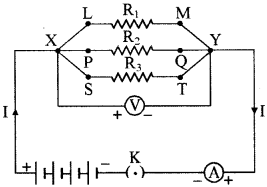
51. In the circuit diagram given below,
suppose the resistors R1, R2 and R3 have the values 5 Ω, 10 Ω, 30 Ω, respectively, which have been
connected to a battery of 12 V. Calculate the current through each resistor and the total current.
52. An electric lamp of 100 Ω, a toaster of
resistance 50 Ω, and a water filter of resistance 500 Ω are connected in parallel to a 220 V source.
What is the resistance of an electric iron connected to the same source that takes as much current as
all three appliances, and what is the current through it?
53. How can three resistors of resistances 2
Ω, 3 Ω, and 6 Ω be connected to give a total resistance of (a) 4 Ω, (b) 1 Ω? Draw diagrams for both.
54. A battery of 9 V is connected in series
with resistors of 0.2 Ω, 0.3 Ω, 0.4 Ω, 0.5 Ω and 12 Ω, respectively. How much current would flow through
the 12 Ω resistor?
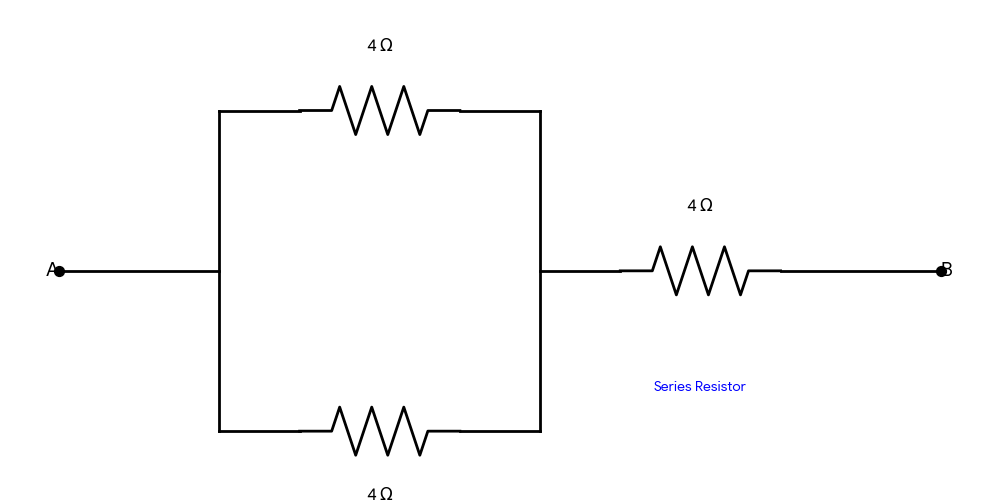
55. Find the equivalent resistance between
points A and B in the following network.
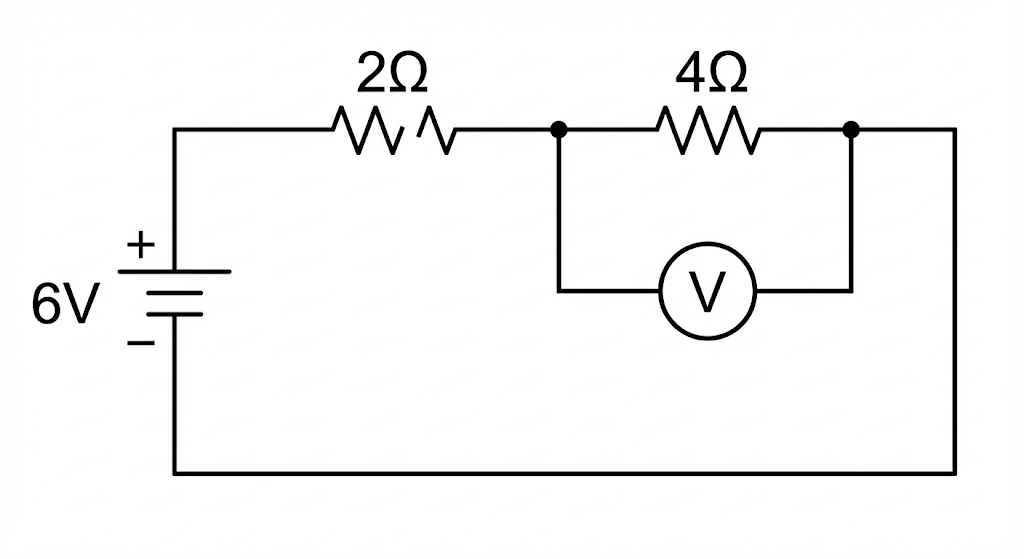
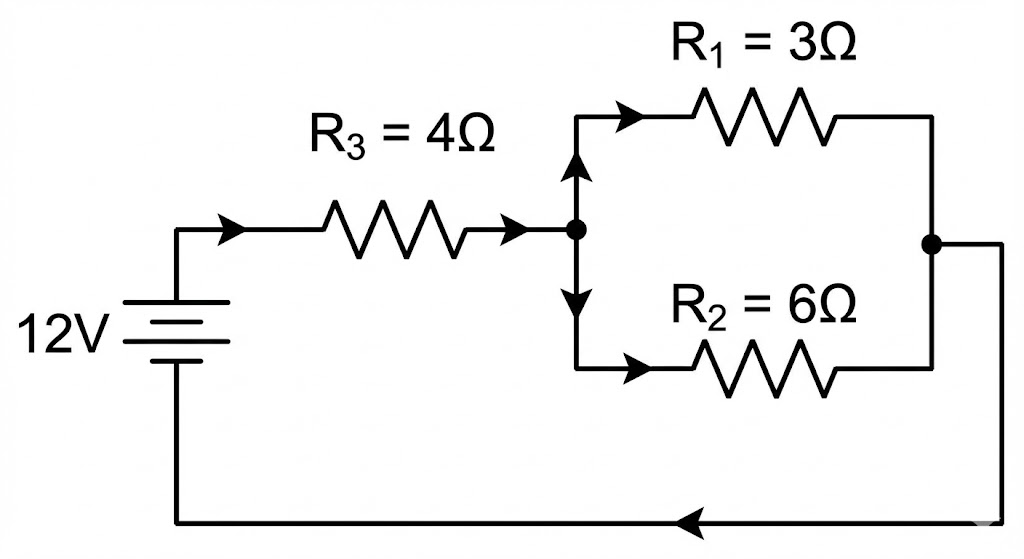
56. Study the following electric circuit and
calculate the potential difference across the 4 Ω resistor.
57. Two lamps, one rated 100 W at 220 V, and
the other 60 W at 220 V, are connected in parallel to electric mains supply. What current is drawn from
the line if the supply voltage is 220 V?
58. An electric iron consumes energy at a
rate of 840 W when heating is at the maximum rate and 360 W when the heating is at the minimum. The
voltage is 220 V. What are the current and the resistance in each case?
59. 100 J of heat is produced each second in
a 4 Ω resistance. Find the potential difference across the resistor.
60. Compute the heat generated while
transferring 96000 coulomb of charge in one hour through a potential difference of 50 V.
61. An electric bulb is connected to a 220 V
generator. The current is 0.50 A. What is the power of the bulb?
62. An electric refrigerator rated 400 W
operates 8 hours/day. What is the cost of the energy to operate it for 30 days at Rs 3.00 per kWh?
63. Several electric bulbs designed to be
used on a 220 V electric supply line, are rated 10 W. How many lamps can be connected in parallel with
each other across the two wires of 220 V line if the maximum allowable current is 5 A?
64. A hot plate of an electric oven
connected to a 220 V line has two resistance coils A and B, each of 24 Ω resistance, which may be used
separately, in series, or in parallel. What are the currents in the three cases?
65. Which uses more energy, a 250 W TV set
in 1 hr, or a 1200 W toaster in 10 minutes?
66. An electric heater of resistance 8 Ω
draws 15 A from the service mains 2 hours. Calculate the rate at which heat is developed in the heater.
67. Two conducting wires of the same
material and of equal lengths and equal diameters are first connected in series and then parallel in a
circuit across the same potential difference. The ratio of heat produced in series and parallel
combinations would be?
68. A fuse wire melts at 5 A. If it is
desired that the fuse wire of same material melt at 10 A, should the new wire have a smaller or larger
radius? Explain mathematically.
69. Calculate the total resistance and total
current in the given circuit.
70. A wire of resistance 20 Ω is bent in the
form of a closed circle. What is the effective resistance between the two points at the ends of any
diameter of the circle?
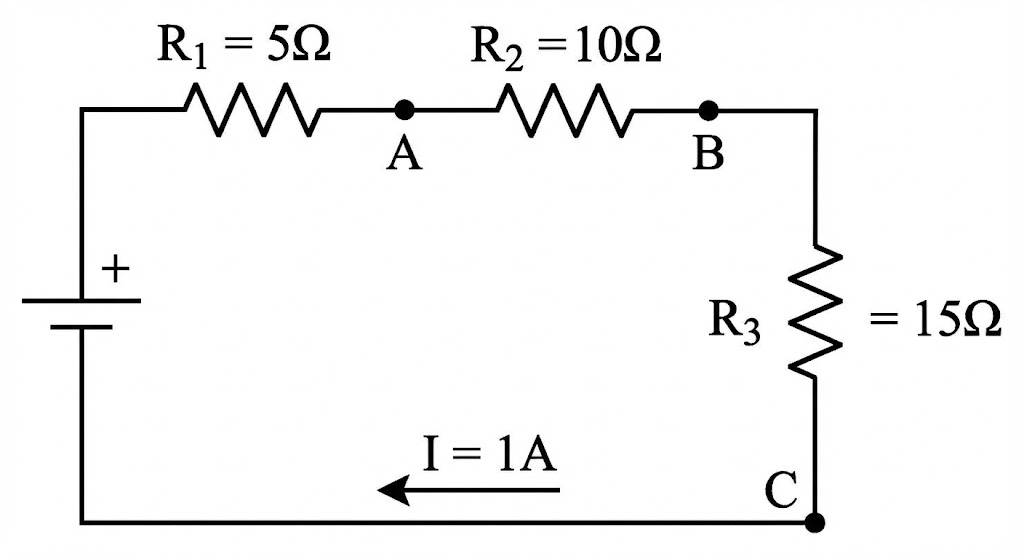
71. Three resistors are connected as shown
in the diagram. Through the resistor 5 Ω, a current of 1 A is flowing. What is the potential difference
across AB and across AC?
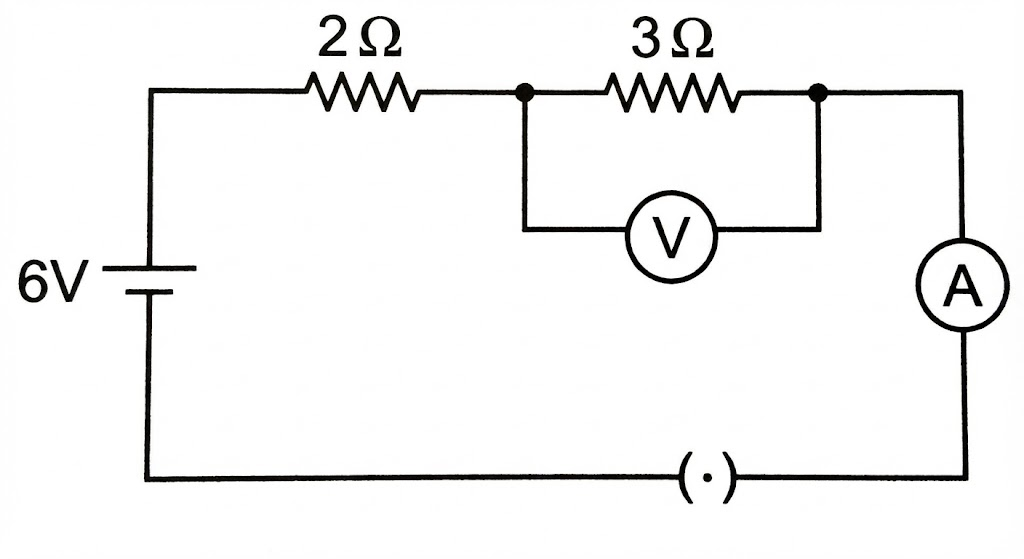
72. Find the reading of the Ammeter and
Voltmeter in the given circuit.
73. A torch bulb is rated 2.5 V and 750 mA.
Calculate: (a) its power, (b) its resistance, and (c) the energy consumed if this bulb is lighted for 4
hours.
74. In a house, two 60W bulbs are lighted
for 4 hours, and three 100W bulbs for 5 hours every day. Calculate the electric energy consumed in 30
days.
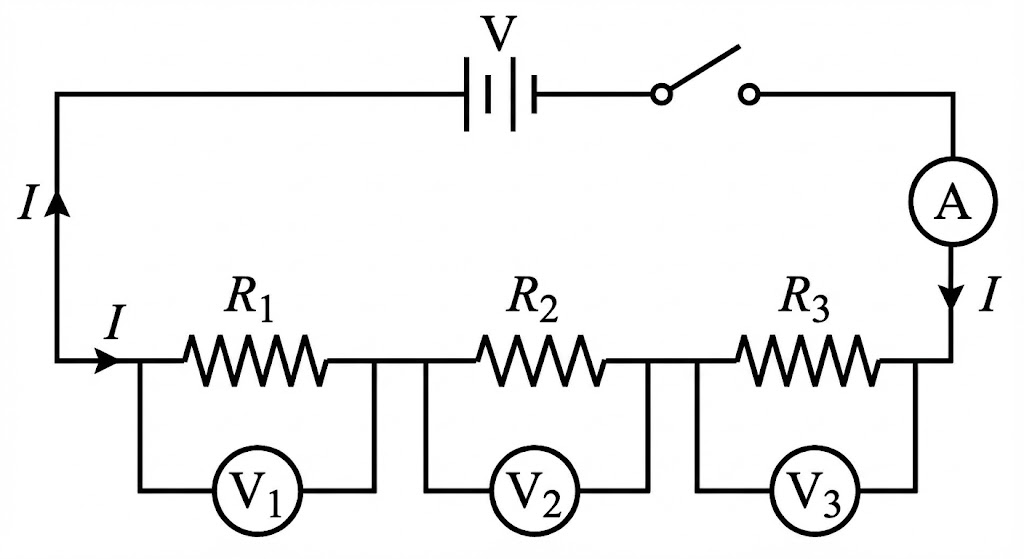
75. Derive the expression for equivalent
resistance of three resistors R1, R2, and R3 connected in series.
76. A cylindrical conductor of length 'l'
and uniform area of cross-section 'A' has resistance 'R'. Another conductor of length '2l' and
resistance 'R' of the same material has area of cross-section 'A''. Find the ratio A'/A.
77. An electric kettle is rated at 230 V,
1000 W. It is used to boil water for 5 minutes. Calculate the heat energy produced.
78. Explain why the filament of an electric
bulb gets hot but the connecting wires do not, even though the same current flows through them. Prove
mathematically using Joule's Law.
79. A piece of wire of resistance R is cut
into five equal parts. These parts are then connected in parallel. If the equivalent resistance of this
combination is R', then find the ratio R/R'.
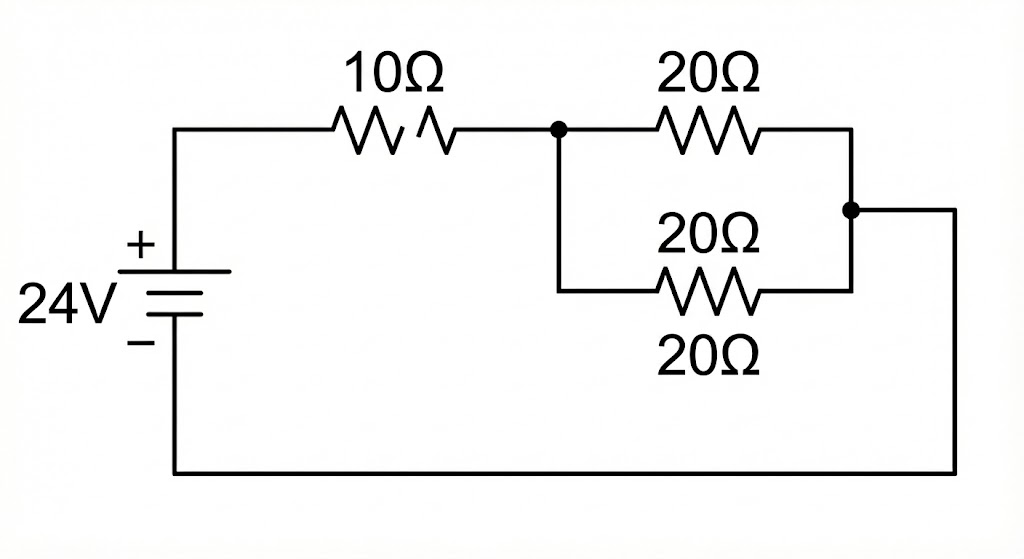
80. In the circuit diagram shown, find: (i)
Total resistance (ii) Current shown by ammeter A.