SECTION A: MULTIPLE CHOICE QUESTIONS (1 Mark Each)
1. Which of the following represents voltage?
(a) Work done / Time
(b) Work done × Charge
(c) Work done × Time / Charge
(d) Work done / Charge
[1]
2. The commercial unit of electrical energy is kilowatt-hour (kWh). 1 kWh is equal to:
(a) $3.6 \times 10^5$ J
(b) $3.6 \times 10^6$ J
(c) $36 \times 10^6$ J
(d) $3.6 \times 10^4$ J
[1]
3. Two resistors of resistance $2\Omega$ and $4\Omega$ when connected to a battery will have:
(a) Same current flowing through them when connected in parallel
(b) Same current flowing through them when connected in series
(c) Same potential difference across them when connected in series
(d) Different potential difference across them when connected in parallel
[1]
4. The heat produced in a wire of resistance 'R' and current 'I' flowing through it for time 't' is
given by:
(a) $H = VIt$
(b) $H = I^2Rt$
(c) $H = V^2t/R$
(d) All of these
[1]
5. An electric fuse works on the:
(a) Chemical effect of current
(b) Magnetic effect of current
(c) Heating effect of current
(d) None of these
[1]
6. If the current flowing through a fixed resistor is halved, the heat produced in it will become:
(a) Double
(b) Half
(c) One-fourth
(d) Four times
[1]
7. Which of the following filaments is suitable for an electric bulb?
(a) Low melting point and high resistivity
(b) High melting point and low resistivity
(c) Low melting point and low resistivity
(d) High melting point and high resistivity
[1]
8. The rate at which electrical energy is consumed or dissipated in an electric circuit is called:
(a) Electric Potential
(b) Electric Current
(c) Electric Power
(d) Electric Resistance
[1]
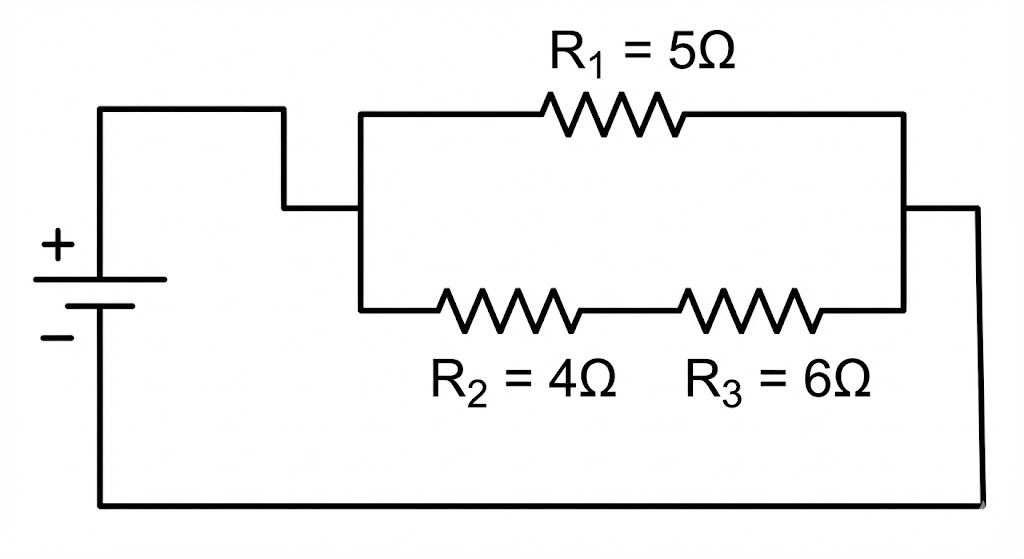
9. In the circuit below, if the heat generated in $5\Omega$ resistor is 10 cal/sec, then heat generated
in $4\Omega$ resistor is:
(a) 1 cal/sec
(b) 2 cal/sec
(c) 3 cal/sec
(d) 4 cal/sec
[1]
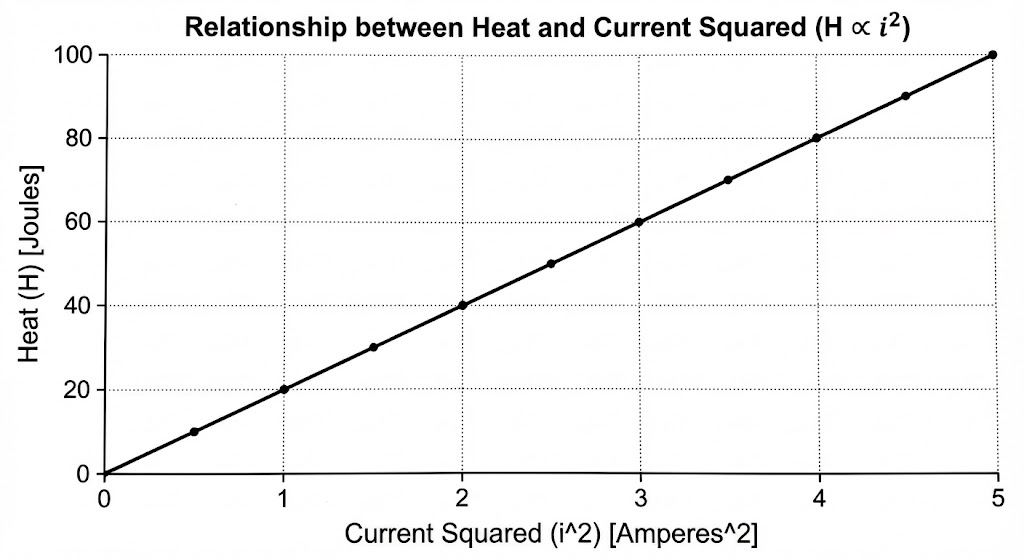
10. Observe the graph showing the variation of Heat (H) produced with the square of Current ($I^2$) for
a constant resistance and time.
The slope of this graph represents:
(a) Resistance × Time ($R \times t$)
(b) Resistance / Time ($R / t$)
(c) Potential Difference ($V$)
(d) Power ($P$)
[1]
SECTION B: ASSERTION-REASON QUESTIONS (1 Mark Each)
Directions: In the following questions, a statement of assertion (A) is followed by a statement of reason
(R). Mark the correct choice as:
(a) Both A and R are true and R is the correct explanation of A.
(b) Both A and R are true but R is NOT the correct explanation of A.
(c) A is true but R is false.
(d) A is false but R is true.
11. Assertion (A): The connecting wires (cords) of an electric heater do not glow while
the heating coil glows. Reason (R): The resistance of connecting wires is negligible compared to that of the
heating element, so negligible heat is produced.
[1]
12. Assertion (A): A fuse wire is always connected in parallel with the mainline. Reason (R): If a current larger than the specified value flows through the circuit, the
fuse wire melts and breaks the circuit.
[1]
13. Assertion (A): 200W bulbs glows brighter than 100W bulb used in parallel. Reason (R): In parallel connection, voltage is same, so power $P = V^2/R$. Higher power
means lower resistance and more brightness.
[1]
SECTION C: VERY SHORT ANSWER QUESTIONS (2 Marks Each)
14. Why are the coils of electric toasters and electric irons made of an alloy rather than a pure metal?
Give two reasons.
[2]
15. An electric bulb is rated 220 V and 100 W. When it is operated on 110 V, calculate the power
consumed.
[2]
16. State Joule’s law of heating. Express it mathematically.
[2]
17. Compute the heat generated while transferring 96000 coulombs of charge in one hour through a
potential difference of 50 V.
[2]
18. Why is tungsten used almost exclusively for filament of electric lamps?
[2]
SECTION D: SHORT ANSWER QUESTIONS (3 Marks Each)
19. Two lamps, one rated 100 W at 220 V, and the other 60 W at 220 V, are connected in parallel to
electric mains supply. What current is drawn from the line if the supply voltage is 220 V?
[3]
20. Which uses more energy, a 250 W TV set in 1 hr, or a 1200 W toaster in 10 minutes? Show
calculations.
[3]
21. An electric heater of resistance $8 \Omega$ draws 15 A from the service mains 2 hours. Calculate the
rate at which heat is developed in the heater.
[3]
22. Explain the function of an electric fuse. What are the essential characteristics of the material
used for making a fuse wire?
[3]
23. Several electric bulbs designed to be used on a 220 V electric supply line, are rated 10 W. How many
lamps can be connected in parallel with each other across the two wires of 220 V line if the maximum
allowable current is 5 A?
[3]
24. A hot plate of an electric oven connected to a 220 V line has two resistance coils A and B, each of
$24 \Omega$ resistance, which may be used separately, in series, or in parallel. What are the currents
in the three cases?
[3]
SECTION E: LONG ANSWER & CASE BASED (5 Mark Each)
25. (a) Define electric power. Express it in terms of potential difference V and
resistance R. (b) An electrical fuse is rated at 2 A. What is meant by this statement? (c) An electric iron of 1 kW is operated at 220 V. Find which of the following fuses
that respectively rated at 1 A, 3 A, and 5 A can be used in it.
[5]
26. A student has two wires of iron and copper of equal length and diameter. He first connects them in a
circuit one by one and then together in series.
(i) Which wire will offer more resistance?
(ii) Which wire will produce more heat when connected one by one across the same battery?
(iii) Which wire will produce more heat when connected in series?
(iv) Justify your answers.
[5]
27. Case Study: Household Consumption
A household uses the following electric appliances:
(i) Refrigerator of rating 400 W for ten hours each day.
(ii) Two electric fans of rating 80 W each for twelve hours each day.
(iii) Six electric tubes of rating 18 W each for six hours each day.
Calculate the electricity bill of the household for the month of June if the cost per unit of electric
energy is ₹ 3.00.
[5]
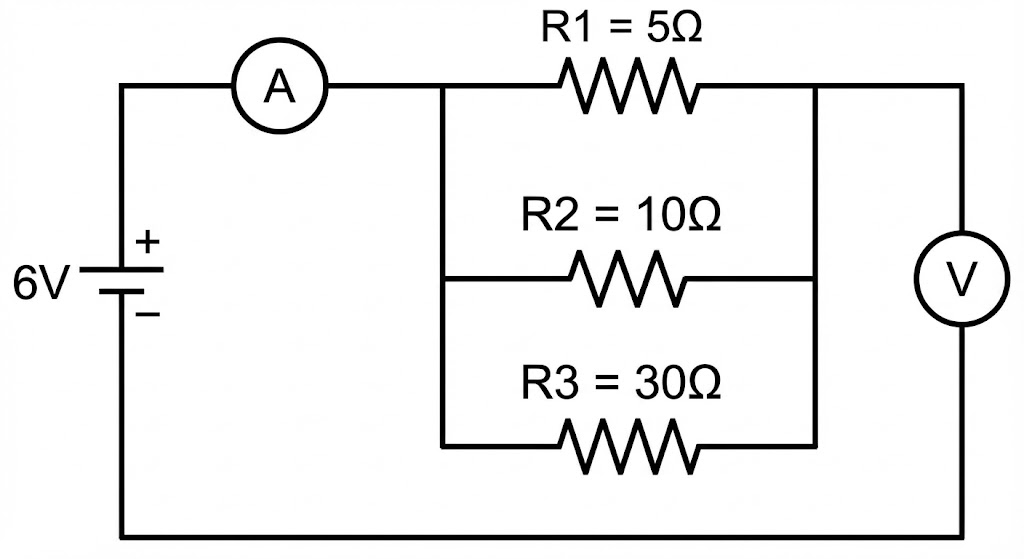
28. Observe the circuit below where three resistors are connected to a 6V battery.
(a) Calculate the current through each resistor.
(b) Calculate the total current in the circuit.
(c) Calculate the total effective resistance of the circuit.
(d) Calculate the heat dissipated in the $5\Omega$ resistor in 10 seconds.
[5]
29. (a) Why transmission of electricity is done at high voltage? (b) Relate S.I. unit of commercial energy with Joules. (c) An electric heater is rated 1500 W. How much energy does it use in 10 hours?
Express in kWh and Joules.
[5]
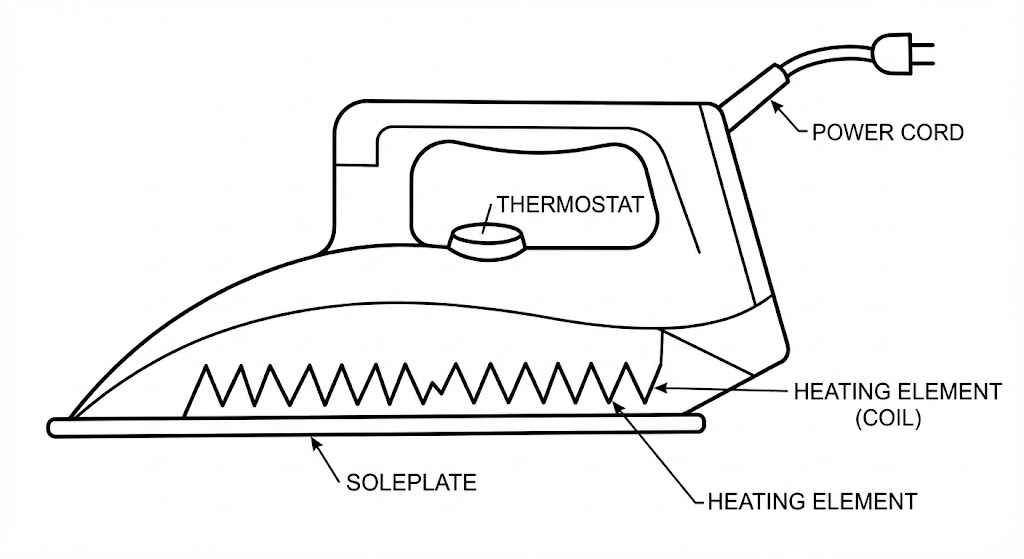
30. Case Study: Heating Effect Applications
The heating effect of electric current is utilised in the working of an electrical heating appliance
such as electric iron, electric kettle, electric toaster, electric oven, electric heater, etc. All these
heating appliances contain a coil of high resistance wire called heating element.
(i) Name the material used for heating elements.
(ii) Determine the heat produced in 10s if the resistance of the element is $100 \Omega$ and current is
2A.
(iii) Explain why the heating element glows red hot but cord does not.
(iv) Suggest one way to increase the heat produced without changing the supply voltage.

 (a) 1 cal/sec
 The slope of this graph represents: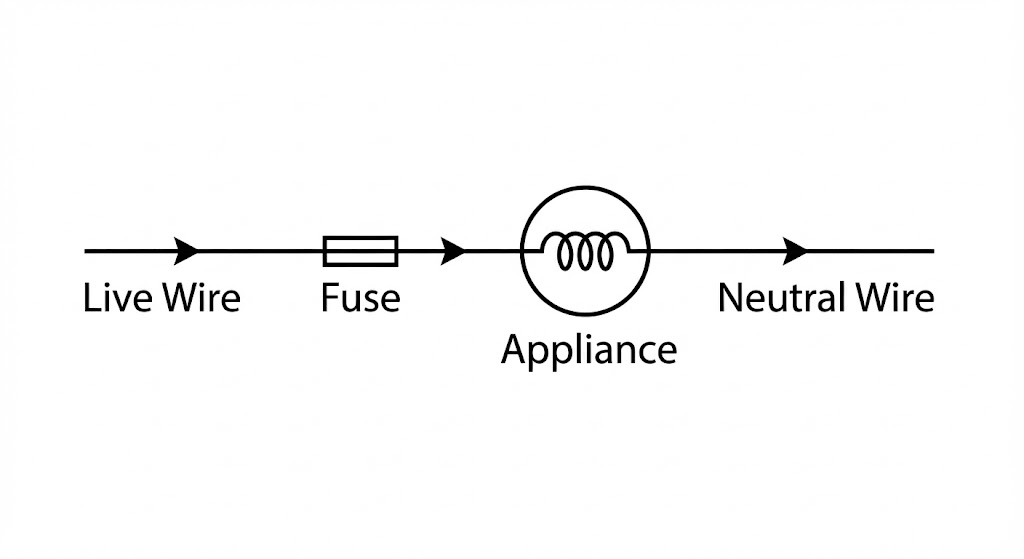
 (a) Calculate the current through each resistor.
 (i) Name the material used for heating elements.