History Revision Notes
- Ch 1: Rise of Nationalism in Europe (Full)
- Ch 2: Nationalism in India (Full + Map Work)
- Ch 3: The Making of a Global World (Only Sub-topics 1 to 1.3 for Board Exam)
- Ch 4: Industrialisation (Excluded from Board, Internal Only)
- Ch 5: Print Culture (Full)
Quick Navigation
Chapter 1: The Rise of Nationalism in Europe
1. The Vision of Nationalism (Frederic Sorrieu)
In 1848, French artist Frederic Sorrieu prepared a series of 4 prints visualising his dream of a world made up of "Democratic and Social Republics."
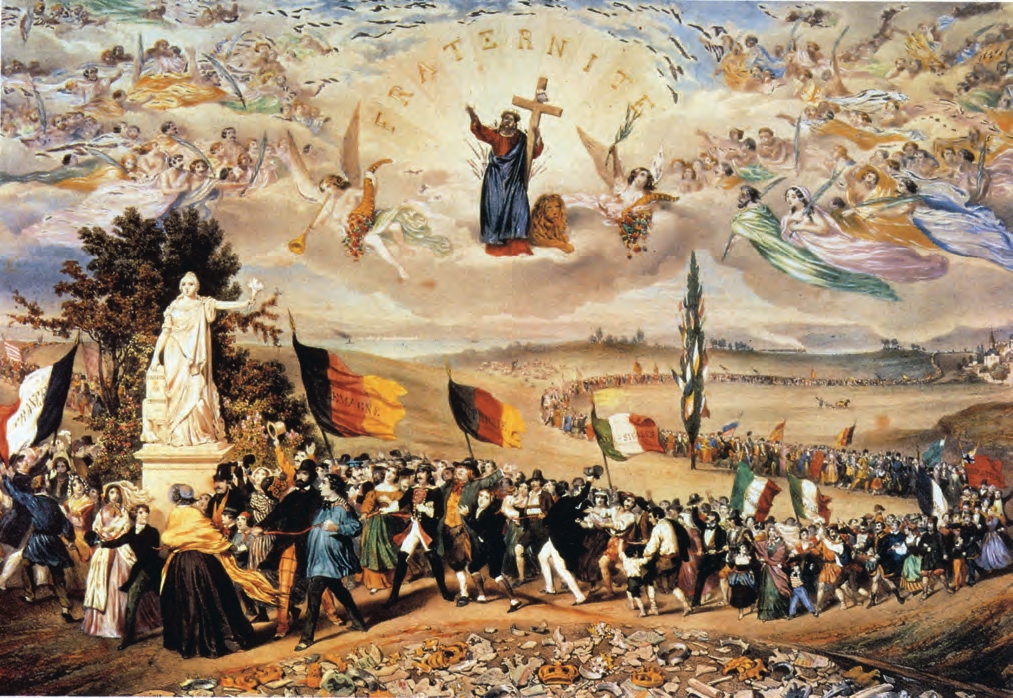
- The Train: Peoples of Europe/America (men & women of all ages/classes) marching in a long train.
- Statue of Liberty: Female figure bearing the Torch of Enlightenment in one hand and the Charter of the Rights of Man in the other.
- Shattered Remains: On the earth lie the shattered symbols of Absolutist institutions (monarchy).
- Utopian Vision: A vision so ideal that it is unlikely to actually exist. Nations are identified by flags and costumes.
- Procession Order: USA and Switzerland lead (already nation-states), followed by France (Tricolour), Germany (Black, Red, Gold flag - expression of liberal hopes), Austria, Lombardy, Poland, England, Ireland, Hungary, Russia.
- Heavenly Gaze: Christ, saints, and angels gaze from above (symbolising fraternity).
Plebiscite: A direct vote by which all people of a region are asked to accept or reject a proposal.
2. The French Revolution (1789)
The first clear expression of nationalism. Transfer of sovereignty from monarchy to a body of French citizens.
- La Patrie (the fatherland) and Le Citoyen (the citizen): United community with equal rights.
- New Flag: Tricolour replaced the Royal Standard.
- Estates General: Elected by active citizens and renamed National Assembly.
- New Hymns & Oaths: Taken in the name of the nation. Martyrs commemorated.
- Centralised Administration: Uniform laws for all citizens.
- Internal Customs: Duties and dues were abolished. Uniform weights and measures adopted.
- Language: Regional dialects discouraged; French became the common language.
3. Napoleon (1799-1815) & The Civil Code
Napoleon destroyed democracy but revolutionised administration.
- Civil Code of 1804 (Napoleonic Code):
- Did away with all privileges based on birth.
- Established equality before the law.
- Secured the right to property.
- Abolished feudal system and serfdom (in Dutch Republic, Switz, Italy, Germany).
- Removed guild restrictions in towns. Improved transport/communication.
- Reaction of People: Initially welcomed as "Harbingers of Liberty" (Brussels, Mainz, Milan). Later turned hostile due to: Increased taxation, Censorship, Forced conscription into French armies.
4. The Making of Nationalism in Europe
Mid-18th Century: No "nation-states". Germany, Italy, Switz were divided kingdoms. Eastern Europe (Habsburg Empire) was a patchwork of diverse people (Magyars, Slavs, etc.).
A. The Aristocracy and New Middle Class
- Landed Aristocracy: Dominant class, owned estates, spoke French, connected by marriage, numerically small.
- Peasantry: Majority of population. West: Tenants/Small owners. East: Serfs.
- New Middle Class: Emerged due to industrialisation (commercial class, professionals). They stood for Liberalism.
B. Liberal Nationalism
- Political: Government by consent, end of autocracy/clerical privileges, constitution, parliament. (Note: Did not necessarily mean Universal Suffrage; women/non-propertied men were excluded).
- Economic: Freedom of markets, abolition of state restrictions on movement of goods/capital.
- Zollverein (1834): A customs union formed at the initiative of
Prussia.
- Abolished tariff barriers.
- Reduced currencies from over 30 to 2.
- Network of railways promoted mobility.
C. A New Conservatism (1815)
After Napoleon's defeat at Waterloo (1815), conservatives (like Metternich) wanted to preserve Monarchy, Church, Hierarchy, Property, Family.
- Bourbon Dynasty restored to power in France.
- France lost territories annexed under Napoleon.
- States set up on boundaries: Kingdom of Netherlands (inc. Belgium) in North; Genoa added to Piedmont in South.
- Prussia: Got new territories on western frontiers (Saxony).
- Austria: Got control of Northern Italy.
- Russia: Given part of Poland.
- German Confederation: The 39 states set up by Napoleon were left untouched.
D. The Revolutionaries (Giuseppe Mazzini)
Secret societies sprang up to fight for liberty. Giuseppe Mazzini (Italian) born in Genoa (1807).
- Member of Carbonari. Exiled in 1831.
- Founded Young Italy (Marseilles) and Young Europe (Berne).
- Believed "God had intended nations to be the natural units of mankind."
- Metternich described him as: "The most dangerous enemy of our social order."
5. The Age of Revolutions (1830–1848)
- July 1830 (France): Bourbon kings overthrown; Louis Philippe installed as constitutional monarch. Metternich remarked: "When France sneezes, the rest of Europe catches cold."
- Belgian Revolution: Belgium broke away from the United Kingdom of the Netherlands.
- Greek War of Independence: Struggle began in 1821. Supported by West Europeans and poets (Lord Byron). Treaty of Constantinople (1832) recognised Greece as an independent nation.
A cultural movement rejecting science/reason, focusing on emotions, intuition, and mystical feelings.
- Johann Gottfried Herder (German): Claimed true German culture was among the common people (das volk) through folk songs, poetry, dances (volkgeist).
- Vernacular Language (Poland): Poland was partitioned by Russia/Prussia/Austria.
National feelings kept alive through music and language.
- Karol Kurpinski: Celebrated national struggle through operas/music (Polonaise, Mazurka).
- Language as Weapon: Polish was used for Church gatherings to resist Russian dominance.
1848: The Revolution of the Liberals
- Frankfurt Parliament: 18 May 1848. 831 elected representatives marched to the Church of St. Paul. Drafted a constitution for a German nation headed by a monarchy subject to parliament.
- Failure: King Friedrich Wilhelm IV of Prussia rejected it and joined other monarchs. The parliament was eroded by lack of support from workers/artisans and troops disbanded it.
- Women: Formed associations, founded newspapers, but were denied suffrage. Stood as observers in the visitor's gallery.
6. Unification of Germany and Italy
- Leadership: Prussia took command.
- Architect: Otto von Bismarck (Prussian CM). Used "Blood and Iron" policy.
- Process: Three wars over 7 years (with Austria, Denmark, France) ended in Prussian victory.
- Result: Jan 1871 - Prussian King William I proclaimed German Emperor at Versailles (Hall of Mirrors).
- Fragmented into 7 states. Only Sardinia-Piedmont ruled by an Italian (King Victor Emmanuel II).
- Giuseppe Mazzini: The soul (Ideology/Young Italy).
- Count Cavour: The brain (Diplomacy). CM of Sardinia-Piedmont. Made a tactful diplomatic alliance with France to defeat Austria (1859).
- Giuseppe Garibaldi: The sword. Led armed volunteers (Red Shirts). Marched to South Italy (1860) to drive out Spanish rulers.
- Result: 1861 - Victor Emmanuel II proclaimed king of United Italy.
The Strange Case of Britain
- No sudden revolution. Long process. Ethnic identities: English, Welsh, Scot, Irish.
- Glorious Revolution (1688): English parliament seized power from monarchy.
- Act of Union (1707): England + Scotland = United Kingdom of Great Britain. Scotland's culture/language suppressed.
- Ireland: Divided (Catholics vs Protestants). English helped Protestants dominate. Wolfe Tone's revolt (1798) failed. Ireland forcibly incorporated in 1801.
- Symbols: British Flag (Union Jack), Anthem (God Save Our Noble King), English language.
7. Visualising the Nation (Allegory)
Allegory of Germania:
In this video representation, Germania is depicted as a strong female figure symbolising the
German nation. She wears a crown of oak leaves, which stands for
heroism. This allegory helped unify the German people emotionally and visually.
- Marianne (France): Red cap, tricolour, cockade. Represents Liberty and Republic. Statues in public squares.
- Germania (Germany): Wears a crown of oak leaves (German oak stands for heroism).
- Symbols: Broken chains (Liberty), Sword (Readiness to fight), Olive branch (Willingness for peace), Rays of rising sun (New era).
8. Nationalism and Imperialism (The Balkans)
- The Balkans: Region of geographical/ethnic variation (modern Romania, Bulgaria, Albania, Greece, etc.). Inhabitants called Slavs.
- Controlled by Ottoman Empire.
- Spread of romantic nationalism + disintegration of Ottoman Empire = Explosive region.
- Rivalry: Big powers (Russia, Germany, England, Austro-Hungary) competed for control over trade/colonies. This led to WWI.
Chapter 2: Nationalism in India
1. Impact of First World War
- Created a new economic and political situation.
- Economic: Huge defence expenditure financed by war loans/taxes. Customs duties raised, Income Tax introduced.
- Prices: Doubled between 1913-1918. Extreme hardship.
- Villages: Forced recruitment of soldiers caused anger.
- 1918-21: Crop failure and Influenza epidemic (12-13 million died).
2. The Idea of Satyagraha
Gandhiji returned to India in Jan 1915 from South Africa.
- 1917 Champaran (Bihar): Against oppressive indigo plantation system.
- 1917 Kheda (Gujarat): For peasants affected by crop failure/plague (demand revenue relaxation).
- 1918 Ahmedabad (Gujarat): For cotton mill workers (demand wage hike).
3. The Rowlatt Act (1919)
- Passed hurriedly by Imperial Legislative Council despite Indian opposition.
- Gave government power to repress political activities and detain prisoners for 2 years without trial.
- Rowlatt Satyagraha: Gandhi started with a Hartal on 6 April 1919.
- Jallianwala Bagh (13 April 1919): Baisakhi fair in Amritsar. General Dyer blocked exits and fired. Goal: "To produce a moral effect" (terror).
- Khilafat Issue: To defend the temporal powers of the Khalifa (Ottoman Emperor). Khilafat Committee formed in Bombay (March 1919) by Muhammad Ali & Shaukat Ali. Gandhi saw this as opportunity to unite Hindus and Muslims.
4. Non-Cooperation Movement (NCM)
- Hind Swaraj (1909): Gandhi wrote that British rule survived only because of Indian cooperation.
- Nagpur Session (Dec 1920): NCM programme adopted.
- Started: January 1921.
- Movement in Towns: Middle class participation. Students left schools, lawyers gave up practice. Foreign cloth boycott (imports halved). Liquor shops picketed. Problem: Khadi was expensive; lack of Indian institutions.
- Rebellion in Countryside (Awadh): Led by Baba Ramchandra (sanyasi/indentured labourer). Against talukdars/landlords demanding high rent & begar. Oudh Kisan Sabha set up by Nehru & Baba Ramchandra (Oct 1920).
- Tribal Peasants (Gudem Hills, Andhra): Militant guerrilla movement led by Alluri Sitaram Raju. He claimed special powers, supported Gandhi but asserted force was necessary. Captured/executed in 1924.
- Swaraj in Plantations (Assam): Workers defied Inland Emigration Act of 1859 (which forbade leaving tea gardens without permission). They headed home but were caught and beaten.
Withdrawal: Feb 1922 after Chauri Chaura incident (police station burnt, 22 policemen died). Gandhi felt people needed training.
5. Towards Civil Disobedience
- Swaraj Party: C.R. Das and Motilal Nehru formed it to argue for return to council politics.
- Simon Commission (1928): Statutory commission under John Simon. No Indian member. Greeted with "Go Back Simon". Lala Lajpat Rai assaulted.
- Lahore Congress (Dec 1929): Under J.L. Nehru. Formalised demand for Purna Swaraj. 26 Jan 1930 declared Independence Day.
- Gandhi sent 11 demands to Viceroy Irwin (31 Jan 1930). Key demand: Abolish Salt Tax (monopoly over essential item).
- The March: Started with 78 volunteers from Sabarmati to Dandi (240 miles). Walked 24 days.
- 6 April 1930: Reached Dandi, boiled sea water, violated salt law. Marked start of Civil Disobedience Movement (CDM).
6. How Participants Saw the Movement (CDM)
- Rich Peasants (Patidars/Jats): Hit by trade depression/falling prices. Fight for Swaraj = Struggle against high revenue. Disappointed when movement called off in 1931 without revenue reduction.
- Poor Peasants: Wanted unpaid rent to landlords remitted. Congress hesitant to support them (fear of upsetting landlords).
- Business Class: Reaction against colonial policies restricting business. Formed FICCI (1927). Led by Purshottamdas Thakurdas, G.D. Birla. Wanted protection against imports and Rupee-Sterling ratio. Saw Swaraj as time when trade would flourish.
- Industrial Workers: Did not participate in large numbers (except Nagpur). Some wore Gandhi caps.
- Women: Large scale participation. Protest marches, salt manufacture, picketing. Moved out of homes.
7. Limits of Civil Disobedience
- Dalits: Congress ignored them for long (fear of Sanatanis). Dr. B.R. Ambedkar organised Depressed Classes Association (1930). Demanded separate electorates.
- Poona Pact (Sept 1932): Gandhi fasted against separate electorates. Pact gave reserved seats to Depressed Classes but voted by general electorate.
- Muslims: Lukewarm response. Alienated after decline of Non-Cooperation/Khilafat. Muhammad Ali Jinnah willing to give up separate electorates if Muslims assured reserved seats in Central Assembly and representation in proportion to population in Bengal/Punjab. M.R. Jayakar (Hindu Mahasabha) opposed compromise.
8. Sense of Collective Belonging
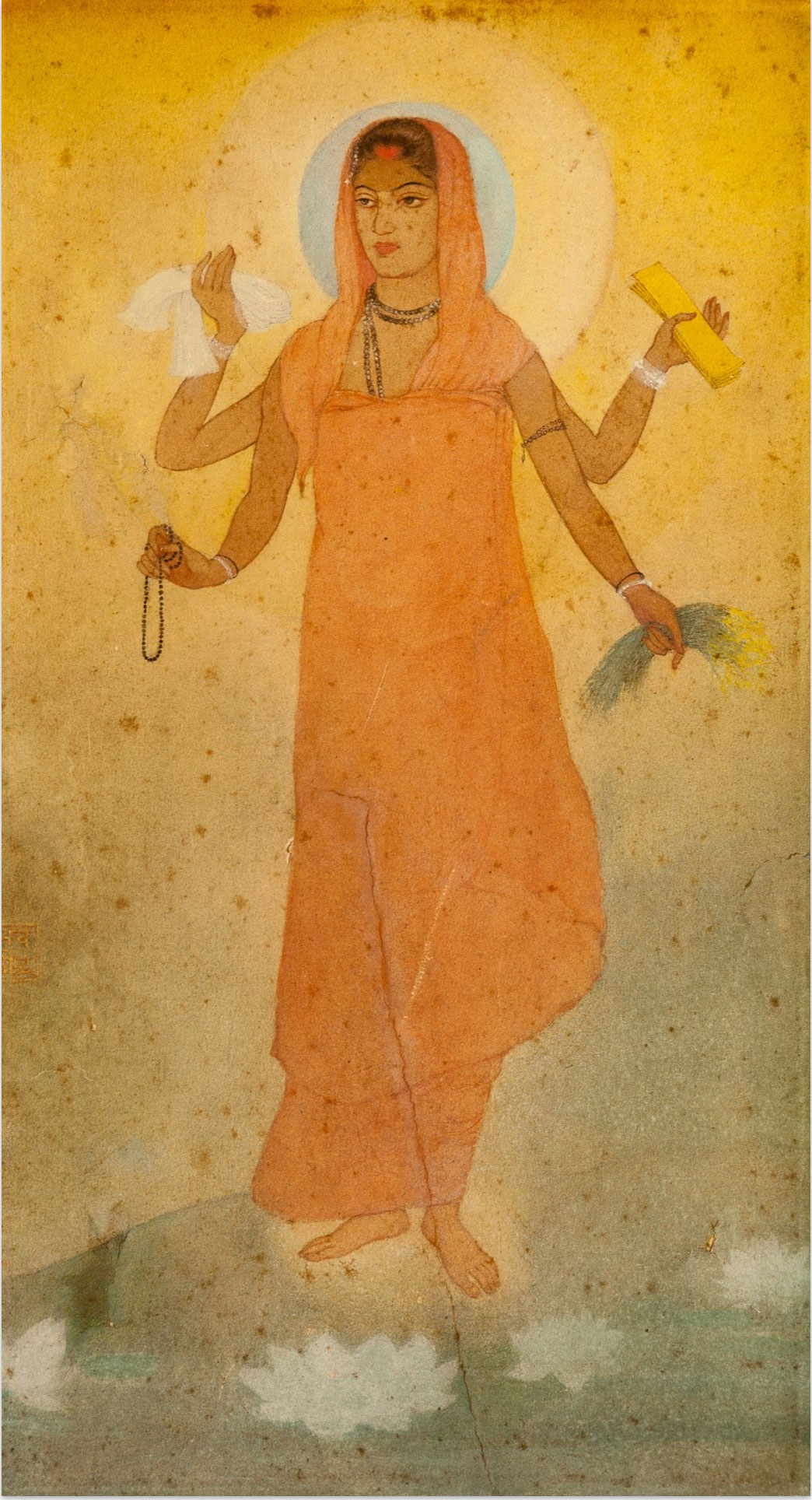
Bharat Mata:
Painted by Abanindranath Tagore, this image portrays Bharat Mata as an ascetic
figure—calm, composed, divine, and spiritual. This visual representation helped create a sense
of collective belonging and devotion to the motherland among Indians.
- Bharat Mata: Image created by Bankim Chandra Chattopadhyay (wrote Vande Mataram). Painted by Abanindranath Tagore (ascetic figure).
- Folklore: Reviving folklore to discover national identity. Rabindranath Tagore (Bengal), Natesa Sastri (Madras - The Folklore of Southern India).
- Flags:
- Swadeshi Flag (1905): Tricolour (Red, Green, Yellow), 8 lotuses (provinces), crescent moon.
- Gandhian Flag (1921): Tricolour (Red, Green, White), Spinning wheel (self-help).
- Reinterpretation of History: Looking at past achievements (math, art, science) to instill pride.
Chapter 3: The Making of a Global World (Sub-topics 1 to 1.3)
1. The Pre-Modern World
Globalisation has a long history of trade, migration, and movement of capital.
- Silk Routes: Connected Asia with Europe/Africa. Chinese silk and pottery, Indian textiles/spices, Gold/Silver from Europe travelled these routes. Buddhism/Christianity/Islam spread via these.
- Food Travels:
- Noodles travelled West from China to become Spaghetti.
- New Crops: Potato, soya, maize, groundnuts, chillies introduced to Europe/Asia after Christopher Columbus discovered the Americas.
- Irish Potato Famine (1840s): Poor peasants dependent on potatoes starved when crop failed.
- Conquest, Disease, and Trade:
- Americas: Abundant crops/minerals transformed trade. Silver from Peru/Mexico financed European trade.
- Biological Warfare: Spanish conquerors used Smallpox germs. Native Americans had no immunity; it killed whole communities, paving way for conquest.
- El Dorado: Fabled city of gold in South America.
Chapter 5: Print Culture & The Modern World
1. The First Printed Books
- China: Developed hand printing (woodblock). Accordion book (folded, stitched). Imperial state sponsored print for civil service exams.
- Japan: Buddhist missionaries introduced print (768-770 AD). Diamond Sutra (868 AD) is the oldest Japanese book. Ukiyo (pictures of the floating world) developed by Kitagawa Utamaro.
2. Print Comes to Europe
- Marco Polo: Brought woodblock knowledge from China to Italy (1295).
- Vellum: Expensive parchment used by aristocrats (considered print 'cheap').
- Johann Gutenberg (Germany): Invented the Printing Press (1430s) adapting olive press technology. First book: The Bible (180 copies in 3 years).
- Print Revolution: Reduced cost, increased speed. Shift from hearing public to reading public.
- Religious Debates: Martin Luther wrote 95 Theses (1517) criticising Roman Catholic Church. Led to Protestant Reformation. Luther said: "Printing is the ultimate gift of God and the greatest one."
- Print & Dissent: Menocchio (miller in Italy) reinterpreted the Bible. Church started Inquisition and Index of Prohibited Books (1558).
- Reading Mania: Almanacs, Ballads, Penny Chapbooks (sold by chapmen in England), Biliotheque Bleue (France - cheap blue books).
3. Print and the French Revolution
Print created conditions for the revolution:
- Popularised ideas of Enlightenment thinkers (Voltaire, Rousseau) - Rule of reason.
- Created culture of dialogue and debate.
- Literature mocked royalty (cartoons/caricatures).
- Louise-Sebastien Mercier: "Tremble, therefore, tyrants of the world!"
4. The Nineteenth Century (Children, Women, Workers)
- Children: Primary education compulsory. Grimm Brothers (Germany) collected folk tales.
- Women: Penny magazines, manuals on behaviour. Women novelists: Jane Austen, Bronte Sisters, George Eliot.
- Workers: Lending libraries. Self-educated workers wrote autobiographies.
- Innovations: Richard M. Hoe (Power-driven cylindrical press - 8000 sheets/hr). Offset press.
5. India and the World of Print
- Manuscripts: Sanskrit, Persian, Arabic. Expensive/Fragile. Continued till late 19th century.
- First Press: Portuguese in Goa.
- Bengal Gazette (1780): Edited by James Augustus Hickey. "Commercial paper open to all, influenced by none". Published gossip about Company officials.
- Reform Debates:
- Rammohun Roy: Sambad Kaumudi (1821).
- Hindu Orthodoxy: Samachar Chandrika.
- Persian: Jam-i-Jahan Nama.
- Deoband Seminary (1867): Published thousands of Fatwas for Muslims.
- Ramcharitmanas: Printed in Calcutta (1810). Naval Kishore Press (Lucknow).
- Novels: Reflected Indian lives. Visual culture by Raja Ravi Varma.
- Rashsundari Debi: Wrote Amar Jiban (1876) - first autobiography in Bengali (learnt secretly).
- Tarabai Shinde: Wrote Stripurushtulna (comparison of men and women).
- Begum Rokeya Sakhawat Hossein: Educationist, condemned men for withholding education.
- Print & Poor: Cheap books at crossroads. Jyotiba Phule wrote Gulamgiri (1871) linking caste to American slavery. B.R. Ambedkar and Periyar wrote on caste.
6. Print and Censorship
- Vernacular Press Act (1878): Modelled on Irish Press Laws. Gave government rights to censor reports in vernacular newspapers.
- Bal Gangadhar Tilak: Wrote in Kesari (Marathi). Imprisoned in 1908 leading to protests.
IMPORTANT MAP WORK (5 Marks)
1. Indian National Congress Sessions:
- Calcutta (Sep 1920): Gandhi convinced leaders to start NCM.
- Nagpur (Dec 1920): NCM programme adopted.
- Madras (1927): Decision to boycott Simon Commission.
2. Important Centres of Indian National Movement:
- Champaran (Bihar): Indigo Planters Movement.
- Kheda (Gujarat): Peasant Satyagraha.
- Ahmedabad (Gujarat): Cotton Mill Workers Satyagraha.
- Amritsar (Punjab): Jallianwala Bagh Incident.
- Dandi (Gujarat): Civil Disobedience Movement (Salt March).