Vardaan Learning Institute
Mock Board Paper Solutions 2025-26
Set - 4 (Solutions)
MATHEMATICS (STANDARD)
Class - X
Time: 3 Hours
Max. Marks: 80
SECTION A (Solutions)
1.
(b) 15/4
For parallel lines: \(\frac{a_1}{a_2} = \frac{b_1}{b_2} \neq \frac{c_1}{c_2}\). \(\frac{3}{2} = \frac{2k}{5} \Rightarrow 4k = 15 \Rightarrow k = 15/4\).
For parallel lines: \(\frac{a_1}{a_2} = \frac{b_1}{b_2} \neq \frac{c_1}{c_2}\). \(\frac{3}{2} = \frac{2k}{5} \Rightarrow 4k = 15 \Rightarrow k = 15/4\).
2.
(d) 18
Smallest prime = 2. Smallest odd composite = 9. LCM(2, 9) = 18.
Smallest prime = 2. Smallest odd composite = 9. LCM(2, 9) = 18.
3.
(b) 2/3
Sum \(\alpha+\beta = -(-2)/p = 2/p\). Product \(\alpha\beta = 3p/p = 3\).
\(2/p = 3 \Rightarrow p = 2/3\).
Sum \(\alpha+\beta = -(-2)/p = 2/p\). Product \(\alpha\beta = 3p/p = 3\).
\(2/p = 3 \Rightarrow p = 2/3\).
4.
(a) \(b^2/a\)
For equal roots \(D=0\). \((2b)^2 - 4ac = 0 \Rightarrow 4b^2 - 4ac = 0 \Rightarrow 4b^2 = 4ac \Rightarrow c = b^2/a\).
For equal roots \(D=0\). \((2b)^2 - 4ac = 0 \Rightarrow 4b^2 - 4ac = 0 \Rightarrow 4b^2 = 4ac \Rightarrow c = b^2/a\).
5.
(d) 28
\(a_n = a + (n-1)d \Rightarrow 4 = a + 6(-4) \Rightarrow 4 = a - 24 \Rightarrow a = 28\).
\(a_n = a + (n-1)d \Rightarrow 4 = a + 6(-4) \Rightarrow 4 = a - 24 \Rightarrow a = 28\).
6.
(b) \(DE = 12 \text{ cm}, \angle F = 100^\circ\)
\(\frac{AB}{DF} = \frac{AC}{DE} \Rightarrow \frac{5}{7.5} = \frac{8}{DE} \Rightarrow DE = 12\).
\(\angle B = 180 - (30+50) = 100^\circ\). Since \(\Delta ABC \sim \Delta DFE\), \(\angle F = \angle B = 100^\circ\).
\(\frac{AB}{DF} = \frac{AC}{DE} \Rightarrow \frac{5}{7.5} = \frac{8}{DE} \Rightarrow DE = 12\).
\(\angle B = 180 - (30+50) = 100^\circ\). Since \(\Delta ABC \sim \Delta DFE\), \(\angle F = \angle B = 100^\circ\).
7.
(d) IV quadrant
\(x = \frac{1(3)+2(7)}{3} = \frac{17}{3}\). \(y = \frac{1(4)+2(-6)}{3} = \frac{-8}{3}\). (+, -) is IV quadrant.
\(x = \frac{1(3)+2(7)}{3} = \frac{17}{3}\). \(y = \frac{1(4)+2(-6)}{3} = \frac{-8}{3}\). (+, -) is IV quadrant.
8.
(c) 1/2
\(\tan \theta = 3/4\). Divide num and den by \(\cos \theta\). \(\frac{4\tan-1}{4\tan+1} = \frac{4(3/4)-1}{4(3/4)+1} = \frac{3-1}{3+1} = \frac{2}{4} = 1/2\).
\(\tan \theta = 3/4\). Divide num and den by \(\cos \theta\). \(\frac{4\tan-1}{4\tan+1} = \frac{4(3/4)-1}{4(3/4)+1} = \frac{3-1}{3+1} = \frac{2}{4} = 1/2\).
9.
(d) \(55^\circ\)
Opposite sides of a quadrilateral circumscribing a circle subtend supplementary angles at the centre. \(\angle AOB + \angle COD = 180^\circ \Rightarrow 125 + \angle COD = 180 \Rightarrow \angle COD = 55^\circ\).
Opposite sides of a quadrilateral circumscribing a circle subtend supplementary angles at the centre. \(\angle AOB + \angle COD = 180^\circ \Rightarrow 125 + \angle COD = 180 \Rightarrow \angle COD = 55^\circ\).
10.
(b) 8 units
\(\pi r^2 = 2(2\pi r) \Rightarrow \pi r^2 = 4\pi r \Rightarrow r = 4\). Diameter = 8.
\(\pi r^2 = 2(2\pi r) \Rightarrow \pi r^2 = 4\pi r \Rightarrow r = 4\). Diameter = 8.
11.
(a) \(60^\circ\)
\(\tan \theta = \frac{6}{2\sqrt{3}} = \frac{3}{\sqrt{3}} = \sqrt{3} \Rightarrow \theta = 60^\circ\).
\(\tan \theta = \frac{6}{2\sqrt{3}} = \frac{3}{\sqrt{3}} = \sqrt{3} \Rightarrow \theta = 60^\circ\).
12.
(c) \(147\pi \text{ cm}^2\)
TSA Hemisphere = \(3\pi r^2 = 3\pi (7)^2 = 3\pi(49) = 147\pi\).
TSA Hemisphere = \(3\pi r^2 = 3\pi (7)^2 = 3\pi(49) = 147\pi\).
13.
(c) 30-40
Class intervals: 0-10 (3), 10-20 (9), 20-30 (15), 30-40 (30), 40-50 (18). Max freq is 30. Modal class 30-40.
Class intervals: 0-10 (3), 10-20 (9), 20-30 (15), 30-40 (30), 40-50 (18). Max freq is 30. Modal class 30-40.
14.
(a) 5/12
Sum < 7: (1,1)..(1,5), (2,1)..(2,4), (3,1)..(3,3), (4,1)..(4,2), (5,1). Total 15 outcomes. \(15/36 = 5/12\).
Sum < 7: (1,1)..(1,5), (2,1)..(2,4), (3,1)..(3,3), (4,1)..(4,2), (5,1). Total 15 outcomes. \(15/36 = 5/12\).
15.
(d) 29
Mean of first n natural numbers = \((n+1)/2\). \(15 = (n+1)/2 \Rightarrow 30 = n+1 \Rightarrow n = 29\).
Mean of first n natural numbers = \((n+1)/2\). \(15 = (n+1)/2 \Rightarrow 30 = n+1 \Rightarrow n = 29\).
16.
(a) 6
\(2(x+10) = 2x + (3x+2) \Rightarrow 2x+20 = 5x+2 \Rightarrow 3x = 18 \Rightarrow x=6\).
\(2(x+10) = 2x + (3x+2) \Rightarrow 2x+20 = 5x+2 \Rightarrow 3x = 18 \Rightarrow x=6\).
17.
(b) 12
Sides: \(\sqrt{(0-0)^2+(4-0)^2}=4\), \(\sqrt{(3-0)^2+(0-0)^2}=3\), Hypotenuse \(\sqrt{3^2+4^2}=5\). Perimeter \(3+4+5=12\).
Sides: \(\sqrt{(0-0)^2+(4-0)^2}=4\), \(\sqrt{(3-0)^2+(0-0)^2}=3\), Hypotenuse \(\sqrt{3^2+4^2}=5\). Perimeter \(3+4+5=12\).
18.
(d) \(\cos A\)
\((\frac{1}{\cos} + \frac{\sin}{\cos})(1-\sin) = \frac{1+\sin}{\cos}(1-\sin) = \frac{1-\sin^2}{\cos} = \frac{\cos^2}{\cos} = \cos A\).
\((\frac{1}{\cos} + \frac{\sin}{\cos})(1-\sin) = \frac{1+\sin}{\cos}(1-\sin) = \frac{1-\sin^2}{\cos} = \frac{\cos^2}{\cos} = \cos A\).
19.
(b) Both A and R are true but R is not the correct explanation of A
R explains properties of tangent, but A (equality of lengths) is proved using RHS congruence which R does not explicitly state.
R explains properties of tangent, but A (equality of lengths) is proved using RHS congruence which R does not explicitly state.
20.
(d) A is false but R is true
\(LCM = 3072/18 = 170.66\), not an integer. LCM must be a multiple of HCF. 169 is not div by 18.
\(LCM = 3072/18 = 170.66\), not an integer. LCM must be a multiple of HCF. 169 is not div by 18.
SECTION B (Solutions)
21.
For a number \(6^n\) to end with digit 0, its prime factorization must contain at least one pair of 2 and 5.
\(6^n = (2 \times 3)^n = 2^n \times 3^n\).
The prime factors of \(6^n\) are 2 and 3. Since 5 is not a factor, \(6^n\) can never end with digit 0.
\(6^n = (2 \times 3)^n = 2^n \times 3^n\).
The prime factors of \(6^n\) are 2 and 3. Since 5 is not a factor, \(6^n\) can never end with digit 0.
22.
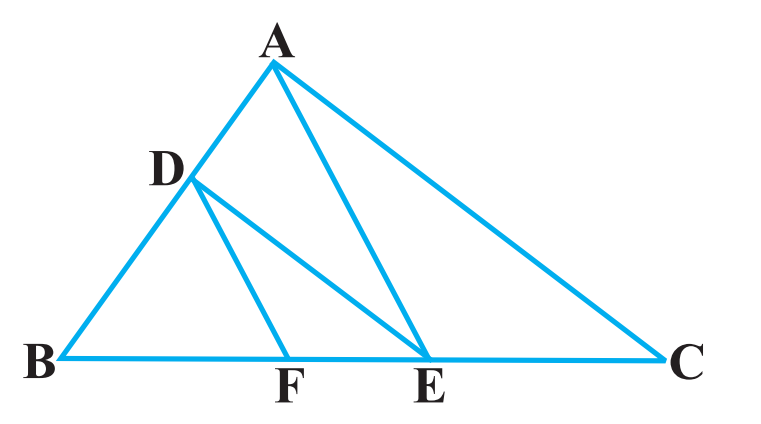
In \(\Delta ABC\), \(DE \parallel AC\), so \(\frac{BD}{DA} = \frac{BE}{EC}\) (BPT) ... (i)
In \(\Delta ABE\), \(DF \parallel AE\), so \(\frac{BD}{DA} = \frac{BF}{FE}\) (BPT) ... (ii)
From (i) and (ii), \(\frac{BF}{FE} = \frac{BE}{EC}\). Hence Proved.
23.
\(\tan(A+B) = \sqrt{3} \Rightarrow A+B = 60^\circ\).
\(\tan(A-B) = 1/\sqrt{3} \Rightarrow A-B = 30^\circ\).
Adding: \(2A = 90^\circ \Rightarrow A = 45^\circ\).
Subtracting: \(2B = 30^\circ \Rightarrow B = 15^\circ\).
\(\tan(A-B) = 1/\sqrt{3} \Rightarrow A-B = 30^\circ\).
Adding: \(2A = 90^\circ \Rightarrow A = 45^\circ\).
Subtracting: \(2B = 30^\circ \Rightarrow B = 15^\circ\).
OR
\(\frac{2(1/\sqrt{3})}{1-(1/\sqrt{3})^2} = \frac{2/\sqrt{3}}{1-1/3} = \frac{2/\sqrt{3}}{2/3} = \frac{3}{\sqrt{3}} = \sqrt{3}\).24.
\(d=42 \Rightarrow r=21\). \(\theta = 60^\circ\).
Length of Arc = \(\frac{\theta}{360} \times 2\pi r = \frac{60}{360} \times 2 \times \frac{22}{7} \times 21 = \frac{1}{6} \times 44 \times 3 = 22\) cm.
Length of Arc = \(\frac{\theta}{360} \times 2\pi r = \frac{60}{360} \times 2 \times \frac{22}{7} \times 21 = \frac{1}{6} \times 44 \times 3 = 22\) cm.
25.
Chord of larger circle is tangent to smaller circle. Radius (3) is perpendicular to chord.
Half chord length \(x = \sqrt{5^2 - 3^2} = \sqrt{25-9} = 4\).
Total length = \(2 \times 4 = 8\) cm.
Half chord length \(x = \sqrt{5^2 - 3^2} = \sqrt{25-9} = 4\).
Total length = \(2 \times 4 = 8\) cm.
SECTION C (Solutions)
26.
Let \(\sqrt{3} = p/q\) (p, q co-prime). \(3 = p^2/q^2 \Rightarrow p^2 = 3q^2\). \(p\) is div by 3. Let \(p=3k\).
\(9k^2 = 3q^2 \Rightarrow q^2 = 3k^2\). \(q\) is div by 3. Common factor 3 contradicts co-prime. \(\sqrt{3}\) irrational.
RHS is rational, LHS is irrational. Contradiction.
\(9k^2 = 3q^2 \Rightarrow q^2 = 3k^2\). \(q\) is div by 3. Common factor 3 contradicts co-prime. \(\sqrt{3}\) irrational.
OR
Let \(2+5\sqrt{3}\) be rational \(r\). \(5\sqrt{3} = r-2 \Rightarrow \sqrt{3} = \frac{r-2}{5}\).RHS is rational, LHS is irrational. Contradiction.
27.
\(f(x) = x^2 - 4x + 3\). \(\alpha+\beta = 4, \alpha\beta = 3\).
\(\alpha^4\beta^3 + \alpha^3\beta^4 = \alpha^3\beta^3(\alpha+\beta) = (\alpha\beta)^3(\alpha+\beta)\).
\(= (3)^3(4) = 27 \times 4 = 108\).
\(\alpha^4\beta^3 + \alpha^3\beta^4 = \alpha^3\beta^3(\alpha+\beta) = (\alpha\beta)^3(\alpha+\beta)\).
\(= (3)^3(4) = 27 \times 4 = 108\).
28.
Let fixed charge \(x\) and per day charge \(y\).
\(x + 20y = 1000\) ... (i)
\(x + 26y = 1180\) ... (ii)
(ii) - (i): \(6y = 180 \Rightarrow y = 30\).
\(x + 20(30) = 1000 \Rightarrow x + 600 = 1000 \Rightarrow x = 400\).
Fixed: Rs 400, Per day: Rs 30.
\(x + 20y = 1000\) ... (i)
\(x + 26y = 1180\) ... (ii)
(ii) - (i): \(6y = 180 \Rightarrow y = 30\).
\(x + 20(30) = 1000 \Rightarrow x + 600 = 1000 \Rightarrow x = 400\).
Fixed: Rs 400, Per day: Rs 30.
29.
Divide num and den by \(\sin A\):
\(\frac{\cot A - 1 + \text{cosec } A}{\cot A + 1 - \text{cosec } A} = \frac{(\cot A + \text{cosec } A) - 1}{1 - \text{cosec } A + \cot A}\).
Replace \(1\) with \(\text{cosec}^2 A - \cot^2 A\).
\(= \frac{(\cot + \text{cosec}) - (\text{cosec} - \cot)(\text{cosec} + \cot)}{\cot + 1 - \text{cosec}}\).
\(= \frac{(\cot + \text{cosec})(1 - (\text{cosec} - \cot))}{\cot + 1 - \text{cosec}} = \text{cosec } A + \cot A\).
\(\frac{\cot A - 1 + \text{cosec } A}{\cot A + 1 - \text{cosec } A} = \frac{(\cot A + \text{cosec } A) - 1}{1 - \text{cosec } A + \cot A}\).
Replace \(1\) with \(\text{cosec}^2 A - \cot^2 A\).
\(= \frac{(\cot + \text{cosec}) - (\text{cosec} - \cot)(\text{cosec} + \cot)}{\cot + 1 - \text{cosec}}\).
\(= \frac{(\cot + \text{cosec})(1 - (\text{cosec} - \cot))}{\cot + 1 - \text{cosec}} = \text{cosec } A + \cot A\).
30.
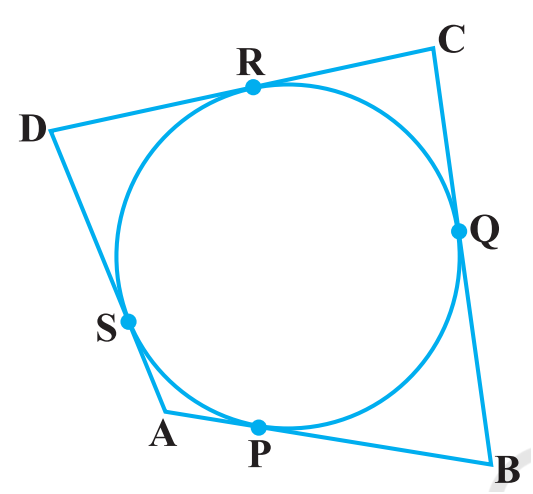
Tangents from external point are equal.
\(AP=AS, BP=BQ, CR=CQ, DR=DS\).
Adding: \((AP+BP) + (CR+DR) = (AS+DS) + (BQ+CQ)\).
\(AB + CD = AD + BC\).
31.
Max freq = 12. Modal class 60-80.
\(l=60, f_1=12, f_0=10, f_2=6, h=20\).
Mode \(= l + \frac{f_1-f_0}{2f_1-f_0-f_2} \times h = 60 + \frac{12-10}{24-10-6} \times 20\).
\(= 60 + \frac{2}{8} \times 20 = 60 + 5 = 65\).
\(l=60, f_1=12, f_0=10, f_2=6, h=20\).
Mode \(= l + \frac{f_1-f_0}{2f_1-f_0-f_2} \times h = 60 + \frac{12-10}{24-10-6} \times 20\).
\(= 60 + \frac{2}{8} \times 20 = 60 + 5 = 65\).
SECTION D (Solutions)
32.
Let usual speed \(x\). Time \(480/x\).
\(\frac{480}{x-8} - \frac{480}{x} = 3\).
\(480[\frac{x-(x-8)}{x(x-8)}] = 3 \Rightarrow 160(8) = x^2 - 8x\).
\(x^2 - 8x - 1280 = 0\). \((x-40)(x+32) = 0 \Rightarrow x = 40\) km/h.
Vol in 1 hr = \(\pi r^2 h = \frac{22}{7}(0.07)^2(15000) = 231 \text{ m}^3\).
Req Vol in pond = \(50 \times 44 \times 0.21 = 462 \text{ m}^3\).
Time = \(462/231 = 2\) hours.
\(\frac{480}{x-8} - \frac{480}{x} = 3\).
\(480[\frac{x-(x-8)}{x(x-8)}] = 3 \Rightarrow 160(8) = x^2 - 8x\).
\(x^2 - 8x - 1280 = 0\). \((x-40)(x+32) = 0 \Rightarrow x = 40\) km/h.
OR
Pipe radius \(r=7\) cm = 0.07 m. Speed \(15\) km/h = 15000 m/h.Vol in 1 hr = \(\pi r^2 h = \frac{22}{7}(0.07)^2(15000) = 231 \text{ m}^3\).
Req Vol in pond = \(50 \times 44 \times 0.21 = 462 \text{ m}^3\).
Time = \(462/231 = 2\) hours.
33.
Thales Theorem: Line parallel to one side divides other two in same ratio.
Given \(AD/DB = 3/5\). By BPT, \(AE/EC = 3/5\).
Let \(AE = 3x, EC = 5x\). \(AC = 8x = 4.8 \Rightarrow x = 0.6\).
\(AE = 3(0.6) = 1.8\) cm.
Given \(AD/DB = 3/5\). By BPT, \(AE/EC = 3/5\).
Let \(AE = 3x, EC = 5x\). \(AC = 8x = 4.8 \Rightarrow x = 0.6\).
\(AE = 3(0.6) = 1.8\) cm.
34.
Let height of multi-storey be \(H\). Distance \(x\). Small building height 8m.
\(\tan 45^\circ = H/x \Rightarrow H=x\).
\(\tan 30^\circ = (H-8)/x \Rightarrow 1/\sqrt{3} = (H-8)/H\).
\(H = \sqrt{3}H - 8\sqrt{3} \Rightarrow H(\sqrt{3}-1) = 8\sqrt{3}\).
\(H = \frac{8\sqrt{3}}{\sqrt{3}-1} = 4\sqrt{3}(\sqrt{3}+1) = 4(3+\sqrt{3})\) m.
\(\tan 45^\circ = H/x \Rightarrow H=x\).
\(\tan 30^\circ = (H-8)/x \Rightarrow 1/\sqrt{3} = (H-8)/H\).
\(H = \sqrt{3}H - 8\sqrt{3} \Rightarrow H(\sqrt{3}-1) = 8\sqrt{3}\).
\(H = \frac{8\sqrt{3}}{\sqrt{3}-1} = 4\sqrt{3}(\sqrt{3}+1) = 4(3+\sqrt{3})\) m.
35.
\(N=100\). \(76+x+y=100 \Rightarrow x+y=24\).
Median 525 (Class 500-600). \(l=500, f=20, cf=36+x, h=100\).
\(525 = 500 + \frac{50-(36+x)}{20} \times 100 \Rightarrow 25 = (14-x)5\).
\(5 = 14-x \Rightarrow x=9\). \(y = 24-9 = 15\).
Median 525 (Class 500-600). \(l=500, f=20, cf=36+x, h=100\).
\(525 = 500 + \frac{50-(36+x)}{20} \times 100 \Rightarrow 25 = (14-x)5\).
\(5 = 14-x \Rightarrow x=9\). \(y = 24-9 = 15\).
SECTION E (Solutions)
Case Study - 1 Solution
1. \(x^2 - 2x - 8 = x^2 - 4x + 2x - 8 = (x-4)(x+2)\). Zeroes: 4, -2.
2. \(f(x) = (x-2)^2 + 4 = x^2 - 4x + 8\). \(D = 16 - 32 < 0\). No real zeroes (0 zeroes).
3. \(k(x^2 - (sum)x + prod) = k(x^2 - 0x - 9) = x^2 - 9\).
OR
\(x^2 - 5x + 6\). \(\alpha+\beta=5, \alpha\beta=6\).
Value = \(5 - 2(6) = 5 - 12 = -7\).
1. \(x^2 - 2x - 8 = x^2 - 4x + 2x - 8 = (x-4)(x+2)\). Zeroes: 4, -2.
2. \(f(x) = (x-2)^2 + 4 = x^2 - 4x + 8\). \(D = 16 - 32 < 0\). No real zeroes (0 zeroes).
3. \(k(x^2 - (sum)x + prod) = k(x^2 - 0x - 9) = x^2 - 9\).
OR
\(x^2 - 5x + 6\). \(\alpha+\beta=5, \alpha\beta=6\).
Value = \(5 - 2(6) = 5 - 12 = -7\).
Case Study - 2 Solution
1. P(4, 6), Q(3, 2). Midpoint \((\frac{4+3}{2}, \frac{6+2}{2}) = (3.5, 4)\).
2. Q(3, 2), R(6, 5). \(QR = \sqrt{(6-3)^2 + (5-2)^2} = \sqrt{9+9} = \sqrt{18} = 3\sqrt{2}\).
3. Centroid \((\frac{4+3+6}{3}, \frac{6+2+5}{3}) = (13/3, 13/3)\).
OR
\(PQ = \sqrt{1^2+4^2} = \sqrt{17}\). \(QR = \sqrt{18}\). \(PR = \sqrt{2^2+(-1)^2} = \sqrt{5}\).
No two sides equal. Not isosceles.
1. P(4, 6), Q(3, 2). Midpoint \((\frac{4+3}{2}, \frac{6+2}{2}) = (3.5, 4)\).
2. Q(3, 2), R(6, 5). \(QR = \sqrt{(6-3)^2 + (5-2)^2} = \sqrt{9+9} = \sqrt{18} = 3\sqrt{2}\).
3. Centroid \((\frac{4+3+6}{3}, \frac{6+2+5}{3}) = (13/3, 13/3)\).
OR
\(PQ = \sqrt{1^2+4^2} = \sqrt{17}\). \(QR = \sqrt{18}\). \(PR = \sqrt{2^2+(-1)^2} = \sqrt{5}\).
No two sides equal. Not isosceles.
Case Study - 3 Solution
1. Cyl \(r=6, h=15\). Vol = \(\pi r^2 h = \pi(36)(15) = 540\pi\).
2. Cone \(r=3, h=12\). Vol = \(\frac{1}{3}\pi r^2 h = \frac{1}{3}\pi (9)(12) = 36\pi\).
3. Hemi Vol = \(\frac{2}{3}\pi r^3 = \frac{2}{3}\pi (27) = 18\pi\). Total = \(36\pi + 18\pi = 54\pi\).
OR
Number = \(540\pi / 54\pi = 10\) ice creams.
1. Cyl \(r=6, h=15\). Vol = \(\pi r^2 h = \pi(36)(15) = 540\pi\).
2. Cone \(r=3, h=12\). Vol = \(\frac{1}{3}\pi r^2 h = \frac{1}{3}\pi (9)(12) = 36\pi\).
3. Hemi Vol = \(\frac{2}{3}\pi r^3 = \frac{2}{3}\pi (27) = 18\pi\). Total = \(36\pi + 18\pi = 54\pi\).
OR
Number = \(540\pi / 54\pi = 10\) ice creams.