Vardaan Learning Institute
Mock Board Paper 2025-26
Set - 4
MATHEMATICS (STANDARD)
Class - X
Time: 3 Hours
Max. Marks: 80
General Instructions:
- This Question Paper has 5 Sections A, B, C, D and E.
- Section A has 20 MCQs carrying 1 mark each.
- Section B has 5 questions carrying 2 marks each.
- Section C has 6 questions carrying 3 marks each.
- Section D has 4 questions carrying 5 marks each.
- Section E has 3 case based integrated units of assessment (04 marks each) with sub-parts.
- All Questions are compulsory. However, an internal choice has been provided.
- Draw neat figures wherever required. Take \(\pi = 22/7\) wherever required if not stated.
SECTION A
(Section A consists of 20 questions of 1 mark each)
(Section A consists of 20 questions of 1 mark each)
1.
If the lines \(3x + 2ky - 2 = 0\) and \(2x + 5y + 1 = 0\) are parallel, then the value of \(k\) is:
1
2.
The LCM of the smallest prime number and the smallest odd composite number is:
1
3.
If \(\alpha\) and \(\beta\) are the zeroes of a polynomial \(f(x) = px^2 - 2x + 3p\) and \(\alpha + \beta = \alpha\beta\), then p is:
1
4.
The value of \(c\) for which the equation \(ax^2 + 2bx + c = 0\) has equal roots is:
1
5.
In an AP, if \(d = -4, n = 7, a_n = 4\), then \(a\) is:
1
6.
It is given that \(\Delta ABC \sim \Delta DFE\), \(\angle A = 30^\circ\), \(\angle C = 50^\circ\), \(AB = 5\) cm, \(AC = 8\) cm and \(DF = 7.5\) cm. Then, the following is true:
1
7.
The point which divides the line segment joining the points (7, -6) and (3, 4) in ratio 1:2 internally lies in the:
1
8.
If \(4 \tan \theta = 3\), then \((\frac{4\sin \theta - \cos \theta}{4\sin \theta + \cos \theta})\) is equal to:
1
9.
In the given figure, if \(\angle AOB = 125^\circ\), then \(\angle COD\) is equal to:
1
10.
If the area of a circle is numerically equal to twice its circumference, then the diameter of the circle is:
1
11.
A pole 6m high casts a shadow \(2\sqrt{3}\) m long on the ground, then the Sun's elevation is:
1
12.
The total surface area of a solid hemisphere of radius 7 cm is:
1
13.
For the following distribution:
The modal class is:
| Marks | Below 10 | Below 20 | Below 30 | Below 40 | Below 50 |
| Students | 3 | 12 | 27 | 57 | 75 |
1
14.
Two dice are thrown together. The probability that the sum of the two numbers is less than 7 is:
1
15.
If the mean of the first \(n\) natural numbers is \(15\), then \(n\) is:
1
16.
The value of \(x\) for which \(2x, x+10\) and \(3x+2\) are the three consecutive terms of an AP is:
1
17.
The perimeter of a triangle with vertices (0, 4), (0, 0) and (3, 0) is:
1
18.
\((\sec A + \tan A)(1 - \sin A)\) is equal to:
1
19.
Assertion (A): The two tangents drawn to a circle from an external point are equal.
Reason (R): The tangent at any point of a circle is perpendicular to the radius through the point of contact.
Reason (R): The tangent at any point of a circle is perpendicular to the radius through the point of contact.
1
20.
Assertion (A): The HCF of two numbers is 18 and their product is 3072. Then their LCM is 169.
Reason (R): If a and b are two positive integers, then HCF \(\times\) LCM \( = a \times b\).
Reason (R): If a and b are two positive integers, then HCF \(\times\) LCM \( = a \times b\).
1
SECTION B
(Section B consists of 5 questions of 2 marks each)
(Section B consists of 5 questions of 2 marks each)
21.
Show that \(6^n\) cannot end with the digit 0 for any natural number \(n\).
2
22.
In the given figure, \(DE \parallel AC\) and \(DF \parallel AE\). Prove that \(\frac{BF}{FE} = \frac{BE}{EC}\).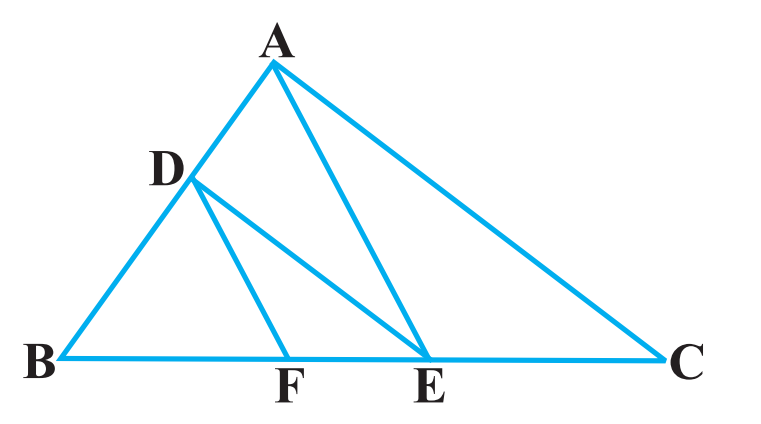
2
23.
If \(\tan(A+B) = \sqrt{3}\) and \(\tan(A-B) = \frac{1}{\sqrt{3}}\); \(0 < A+B \le 90^\circ; A > B\), find A and B.
OR
Evaluate: \(\frac{2 \tan 30^\circ}{1 - \tan^2 30^\circ}\).2
24.
Find the length of the arc of a circle of diameter 42 cm which subtends an angle of \(60^\circ\) at the centre.
2
25.
Two concentric circles are of radii 5 cm and 3 cm. Find the length of the chord of the larger circle which touches the smaller circle.
2
SECTION C
(Section C consists of 6 questions of 3 marks each)
(Section C consists of 6 questions of 3 marks each)
26.
Prove that \(\sqrt{3}\) is an irrational number.
OR
Given that \(\sqrt{3}\) is irrational, prove that \(2 + 5\sqrt{3}\) is an irrational number.3
27.
If \(\alpha\) and \(\beta\) are the zeroes of the quadratic polynomial \(f(x) = x^2 - 4x + 3\), find the value of \(\alpha^4\beta^3 + \alpha^3\beta^4\).
3
28.
A part of monthly hostel charges is fixed and the remaining depends on the number of days one has taken food in the mess. When a student A takes food for 20 days she has to pay Rs 1000 as hostel charges whereas a student B, who takes food for 26 days, pays Rs 1180 as hostel charges. Find the fixed charges and the cost of food per day.
3
29.
Prove that: \(\frac{\cos A - \sin A + 1}{\cos A + \sin A - 1} = \text{cosec } A + \cot A\).
3
30.
Prove that the lengths of tangents drawn from an external point to a circle are equal. Using this, prove that if a quadrilateral ABCD circumscribes a circle, then \(AB + CD = AD + BC\).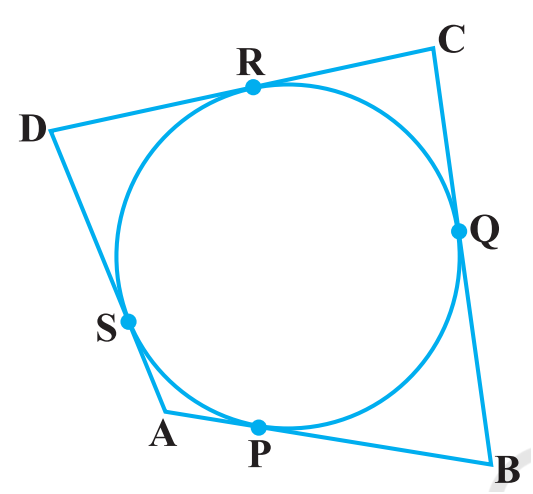
3
31.
Find the mode of the following distribution:
| Class | 0-20 | 20-40 | 40-60 | 60-80 | 80-100 | 100-120 | 120-140 |
| Frequency | 6 | 8 | 10 | 12 | 6 | 5 | 3 |
3
SECTION D
(Section D consists of 4 questions of 5 marks each)
(Section D consists of 4 questions of 5 marks each)
32.
A train travels a distance of 480 km at a uniform speed. If the speed had been 8 km/h less, then it would have taken 3 hours more to cover the same distance. Find the speed of the train.
OR
Water is flowing at the rate of 15 km/h through a pipe of diameter 14 cm into a cuboidal pond which is 50 m long and 44 m wide. In what time will the level of water in pond rise by 21 cm?5
33.
State and prove Basic Proportionality Theorem (Thales Theorem). Using this theorem, solve: In \(\Delta ABC\), if line \(DE \parallel BC\) intersects AB at D and AC at E, such that \(AD/DB = 3/5\) and \(AC = 4.8\) cm, find AE.
5
34.
The angles of depression of the top and the bottom of an 8 m tall building from the top of a multi-storeyed building are \(30^\circ\) and \(45^\circ\), respectively. Find the height of the multi-storeyed building and the distance between the two buildings.
5
35.
The median of the following data is 525. Find the values of x and y, if the total frequency is 100.
| Class Interval | 0-100 | 100-200 | 200-300 | 300-400 | 400-500 | 500-600 | 600-700 | 700-800 | 800-900 | 900-1000 |
| Frequency | 2 | 5 | x | 12 | 17 | 20 | y | 9 | 7 | 4 |
5
SECTION E
(Case Study Based Questions. Each carries 4 marks)
(Case Study Based Questions. Each carries 4 marks)
36.
Case Study - 1 (Polynomials - Parabolic Path)
A highway underpass is parabolic in shape. The path of a projectile or a ball thrown in the air also follows a parabolic path. A parabola is the graph that results from \(p(x) = ax^2 + bx + c\).
1. If the highway overpass is represented by \(x^2 - 2x - 8\), then find its zeroes. (1)
2. Find the number of zeroes of the polynomial \(f(x) = (x-2)^2 + 4\). (1)
3. If the sum of zeroes is 0 and product is -9, find the quadratic polynomial. (2)
OR
If \(\alpha\) and \(\beta\) are zeroes of \(x^2 - 5x + 6\), find the value of \(\alpha + \beta - 2\alpha\beta\). (2)
A highway underpass is parabolic in shape. The path of a projectile or a ball thrown in the air also follows a parabolic path. A parabola is the graph that results from \(p(x) = ax^2 + bx + c\).
1. If the highway overpass is represented by \(x^2 - 2x - 8\), then find its zeroes. (1)
2. Find the number of zeroes of the polynomial \(f(x) = (x-2)^2 + 4\). (1)
3. If the sum of zeroes is 0 and product is -9, find the quadratic polynomial. (2)
OR
If \(\alpha\) and \(\beta\) are zeroes of \(x^2 - 5x + 6\), find the value of \(\alpha + \beta - 2\alpha\beta\). (2)
4
37.
Case Study - 2 (Coordinate Geometry - Seating Arrangement)
The Class X students of a secondary school in Krishinagar have been allotted a rectangular plot of land for their gardening activity. Sapling of Gulmohar are planted on the boundary at a distance of 1m from each other. There is a triangular grassy lawn in the plot as shown in the fig. The students are to sow seeds of flowering plants on the remaining area of the plot.
Considering A as origin, coordinates of vertices of the triangle are P(4, 6), Q(3, 2), and R(6, 5).
1. Find the coordinates of the midpoint of PQ. (1)
2. Find the distance QR. (1)
3. Find the coordinates of the centroid of \(\Delta PQR\). (2)
OR
Check if \(\Delta PQR\) is an isosceles triangle. (2)
The Class X students of a secondary school in Krishinagar have been allotted a rectangular plot of land for their gardening activity. Sapling of Gulmohar are planted on the boundary at a distance of 1m from each other. There is a triangular grassy lawn in the plot as shown in the fig. The students are to sow seeds of flowering plants on the remaining area of the plot.
Considering A as origin, coordinates of vertices of the triangle are P(4, 6), Q(3, 2), and R(6, 5).
1. Find the coordinates of the midpoint of PQ. (1)
2. Find the distance QR. (1)
3. Find the coordinates of the centroid of \(\Delta PQR\). (2)
OR
Check if \(\Delta PQR\) is an isosceles triangle. (2)
4
38.
Case Study - 3 (Surface Areas - Ice Cream Cone)
A shantytown seller sells ice creams in a container which is in the shape of a frustum of a cone (not in syllabus, replaced by cylinder). Let's assume the ice cream container is cylindrical with height 15cm and diameter 12cm. The ice cream is filled into cones of height 12cm and diameter 6cm, having a hemispherical shape on the top.
1. Find the volume of the cylindrical container. (1)
2. Find the volume of one ice cream cone (conical part only). (1)
3. Find the total volume of one ice cream (cone + hemisphere). (2)
OR
How many such ice creams can be filled from the full cylindrical container? (2)
A shantytown seller sells ice creams in a container which is in the shape of a frustum of a cone (not in syllabus, replaced by cylinder). Let's assume the ice cream container is cylindrical with height 15cm and diameter 12cm. The ice cream is filled into cones of height 12cm and diameter 6cm, having a hemispherical shape on the top.
1. Find the volume of the cylindrical container. (1)
2. Find the volume of one ice cream cone (conical part only). (1)
3. Find the total volume of one ice cream (cone + hemisphere). (2)
OR
How many such ice creams can be filled from the full cylindrical container? (2)
4
*** END OF PAPER ***