Vardaan Learning Institute
Mock Board Paper 2025-26
Set - 2
MATHEMATICS (STANDARD)
Class - X
Time: 3 Hours
Max. Marks: 80
General Instructions:
- This Question Paper has 5 Sections A, B, C, D and E.
- Section A has 20 MCQs carrying 1 mark each.
- Section B has 5 questions carrying 2 marks each.
- Section C has 6 questions carrying 3 marks each.
- Section D has 4 questions carrying 5 marks each.
- Section E has 3 case based integrated units of assessment (04 marks each) with sub-parts.
- All Questions are compulsory. However, an internal choice has been provided.
- Draw neat figures wherever required. Take \(\pi = 22/7\) wherever required if not stated.
SECTION A
(Section A consists of 20 questions of 1 mark each)
(Section A consists of 20 questions of 1 mark each)
1.
If the product of two positive integers is 504 and their HCF is 6, then their LCM
is:
1
2.
If one zero of the quadratic polynomial \(x^2 + 3x + k\) is 2, then the value of k
is:
1
3.
The pair of equations \(x = a\) and \(y = b\) graphically represents lines which
are:
1
4.
The nature of roots of the quadratic equation \(2x^2 - \sqrt{5}x + 1 = 0\) is:
1
5.
The 10th term of the AP: 5, 8, 11, 14, ... is:
1
6.
If \(\Delta ABC \sim \Delta PQR\), area(\(\Delta ABC\)) = 81 \(cm^2\), area(\(\Delta
PQR\)) = 144 \(cm^2\) and QR = 6 cm, then length of BC is:
1
7.
The distance of the point P(2, 3) from the x-axis is:
1
8.
If \(\cos A = 4/5\), then the value of \(\tan A\) is:
1
9.
The value of \(\sin^2 60^\circ + 2\tan 45^\circ - \cos^2 30^\circ\) is:
1
10.
The angle between two tangents drawn from an external point to a circle is
\(110^\circ\). The angle subtended by the line segment joining the points of contact at the centre
is:
1
11.
If the circumference of a circle and the perimeter of a square are equal, then:
1
12.
Volumes of two spheres are in the ratio 64:27. The ratio of their surface areas
is:
1
13.
The mean and mode of a frequency distribution are 28 and 16 respectively. The
median is:
1
14.
If an event cannot occur, then its probability is:
1
15.
A card is drawn from a well shuffled deck of 52 cards. The probability that the
card will not be an ace is:
1
16.
If the mid-point of the line segment joining the points P(6, b-2) and Q(-2, 4)
is (2, -3), find the value of b.
1
17.
The decimal expansion of the rational number \(\frac{33}{2^2 \times 5}\) will
terminate after:
1
18.
A ladder 15 m long just reaches the top of a vertical wall. If the ladder makes
an angle of \(60^\circ\) with the wall, then the height of the wall is:
1
19.
Assertion (A): The number \(3^n\) cannot end with the digit 0
for any natural number n.
Reason (R): Prime factorisation of 3 has only the factor 3.
Reason (R): Prime factorisation of 3 has only the factor 3.
1
20.
Assertion (A): The point (0, 4) lies on the
y-axis.
Reason (R): The x-coordinate of a point on the y-axis is zero.
Reason (R): The x-coordinate of a point on the y-axis is zero.
1
SECTION B
(Section B consists of 5 questions of 2 marks each)
(Section B consists of 5 questions of 2 marks each)
21.
Find the value of k for which the system of equations has infinitely many
solutions:
\(2x + 3y = 7\)
\((k-1)x + (k+2)y = 3k\)
\(2x + 3y = 7\)
\((k-1)x + (k+2)y = 3k\)
2
22.
In the given figure, if \(DE \parallel AC\) and \(DF \parallel AE\), prove that
\(\frac{BF}{FE} = \frac{BE}{EC}\).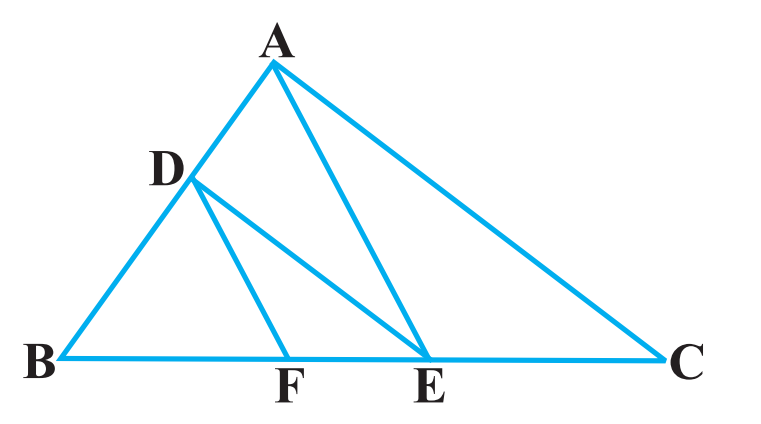
2
23.
Evaluate: \(\frac{\sin 30^\circ + \tan 45^\circ - \text{cosec } 60^\circ}{\sec
30^\circ + \cos 60^\circ + \cot 45^\circ}\)
OR
If \(4 \tan \theta =
3\), evaluate \((\frac{4\sin \theta - \cos \theta + 1}{4\sin \theta + \cos \theta - 1})\)2
24.
Two concentric circles are of radii 5 cm and 3 cm. Find the length of the chord
of the larger circle which touches the smaller circle.
2
25.
A bag contains 5 red balls and some blue balls. If the probability of drawing a
blue ball is double that of a red ball, determine the number of blue balls in the bag.
2
SECTION C
(Section C consists of 6 questions of 3 marks each)
(Section C consists of 6 questions of 3 marks each)
26.
Prove that \(5 - \sqrt{3}\) is an irrational number, given that \(\sqrt{3}\) is
irrational.
OR
Find the HCF and LCM of 404 and 96 and verify that
HCF \(\times\) LCM = Product of the two numbers.3
27.
Find the zeroes of the quadratic polynomial \(6x^2 - 3 - 7x\) and verify the
relationship between the zeroes and the coefficients.
3
28.
A fraction becomes 1/3 when 1 is subtracted from the numerator and it becomes
1/4 when 8 is added to its denominator. Find the fraction.
3
29.
Prove the identity: \(\frac{\tan \theta}{1 - \cot \theta} + \frac{\cot \theta}{1
- \tan \theta} = 1 + \sec \theta \text{ cosec } \theta\)
3
30.
Prove that the lengths of tangents drawn from an external point to a circle are
equal.
3
31.
The distribution below gives the weights of 30 students of a class. Find the
median weight of the students.
| Weight (in kg) | 40-45 | 45-50 | 50-55 | 55-60 | 60-65 | 65-70 | 70-75 |
| No. of students | 2 | 3 | 8 | 6 | 6 | 3 | 2 |
3
SECTION D
(Section D consists of 4 questions of 5 marks each)
(Section D consists of 4 questions of 5 marks each)
32.
A straight highway leads to the foot of a tower. A man standing at the top of
the tower observes a car at an angle of depression of \(30^\circ\), which is approaching the
foot of the tower with a uniform speed. Six seconds later, the angle of depression of the car is
found to be \(60^\circ\). Find the time taken by the car to reach the foot of the tower from
this point.
5
33.
A train travels 360 km at a uniform speed. If the speed had been 5 km/h more, it
would have taken 1 hour less for the same journey. Find the speed of the train.
OR
Solve for x: \(\frac{1}{a+b+x} = \frac{1}{a} + \frac{1}{b} +
\frac{1}{x}\), \(a, b, x \neq 0\).5
34.
A medicine capsule is in the shape of a cylinder with two hemispheres stuck to
each of its ends. The length of the entire capsule is 14 mm and the diameter of the capsule is 5
mm. Find its surface area.
OR
A wooden article was made by scooping
out a hemisphere from each end of a solid cylinder. If the height of the cylinder is 10 cm, and
its base is of radius 3.5 cm, find the total surface area of the article.5
35.
If the median of the distribution given below is 28.5, find the values of x and
y.
| Class Interval | 0-10 | 10-20 | 20-30 | 30-40 | 40-50 | 50-60 | Total |
| Frequency | 5 | x | 20 | 15 | y | 5 | 60 |
5
SECTION E
(Case Study Based Questions. Each carries 4 marks)
(Case Study Based Questions. Each carries 4 marks)
36.
Case Study - 1 (Arithmetic Progression)
Your friend Veer wants to participate in a 200m race. He can currently run that distance in 51 seconds and with each day of practice it takes him 2 seconds less. He wants to do in 31 seconds.
Based on this, answer the following:
1. Which of the following terms are in AP for the given situation? (1)
2. What is the minimum number of days he needs to practice till his goal is achieved? (2)
3. If nth term of an AP is given by \(a_n = 2n + 3\) then find the common difference of an AP. (1)
Your friend Veer wants to participate in a 200m race. He can currently run that distance in 51 seconds and with each day of practice it takes him 2 seconds less. He wants to do in 31 seconds.
Based on this, answer the following:
1. Which of the following terms are in AP for the given situation? (1)
2. What is the minimum number of days he needs to practice till his goal is achieved? (2)
3. If nth term of an AP is given by \(a_n = 2n + 3\) then find the common difference of an AP. (1)
4
37.
Case Study - 2 (Coordinate Geometry)
In a classroom, 4 friends are seated at the points A, B, C and D as shown in a grid. Champa and Chameli walk into the class and after observing for a few minutes Champa asks Chameli, "Don't you think ABCD is a square?" Chameli disagrees.
Coordinates: A(3, 4), B(6, 7), C(9, 4), D(6, 1).
1. Find the distance between points A and B. (1)
2. Find the distance between points A and C. (1)
3. Check if ABCD is a square. Justify. (2)
OR
Find the coordinates of the point which divides the line segment joining A and C in the ratio 1:1. (2)
In a classroom, 4 friends are seated at the points A, B, C and D as shown in a grid. Champa and Chameli walk into the class and after observing for a few minutes Champa asks Chameli, "Don't you think ABCD is a square?" Chameli disagrees.
Coordinates: A(3, 4), B(6, 7), C(9, 4), D(6, 1).
1. Find the distance between points A and B. (1)
2. Find the distance between points A and C. (1)
3. Check if ABCD is a square. Justify. (2)
OR
Find the coordinates of the point which divides the line segment joining A and C in the ratio 1:1. (2)
4
38.
Case Study - 3 (Applications of Trigonometry)
A group of students of class X visited India Gate on an education trip. The teacher and students had interest in history as well. The teacher narrated that India Gate, official name Delhi Memorial, originally called All-India War Memorial, monumental sandstone arch in New Delhi, dedicated to the troops of British India who died in wars fought between 1914 and 1919. The teacher also said that India Gate, which is located at the eastern end of the Rajpath (formerly called the Kingsway), is about 138 feet (42 metres) in height.
1. What is the angle of elevation if they are standing at a distance of 42m away from the monument? (1)
2. They want to see the tower at an angle of \(60^\circ\). So, they want to know the distance where they should stand and hence find the distance. (1)
3. If the altitude of the Sun is at \(60^\circ\), then the height of the vertical tower that will cast a shadow of length 20m is? (2)
OR
The ratio of the length of a rod and its shadow is \(1:\sqrt{3}\). The angle of elevation of the sun is? (2)
A group of students of class X visited India Gate on an education trip. The teacher and students had interest in history as well. The teacher narrated that India Gate, official name Delhi Memorial, originally called All-India War Memorial, monumental sandstone arch in New Delhi, dedicated to the troops of British India who died in wars fought between 1914 and 1919. The teacher also said that India Gate, which is located at the eastern end of the Rajpath (formerly called the Kingsway), is about 138 feet (42 metres) in height.
1. What is the angle of elevation if they are standing at a distance of 42m away from the monument? (1)
2. They want to see the tower at an angle of \(60^\circ\). So, they want to know the distance where they should stand and hence find the distance. (1)
3. If the altitude of the Sun is at \(60^\circ\), then the height of the vertical tower that will cast a shadow of length 20m is? (2)
OR
The ratio of the length of a rod and its shadow is \(1:\sqrt{3}\). The angle of elevation of the sun is? (2)
4
*** END OF PAPER ***