Vardaan Learning Institute
Class 10 Civics • Chapter Notes
🌐 vardaanlearning.com
📞 9508841336
Team Vardaan ❤️
POWER SHARING
In a democracy, all power does not rest with any one organ of the government. An intelligent sharing of power among the legislature, executive, and judiciary is very important to the design of a modern democracy. To understand this, we look at the contrasting stories of two democracies: Belgium and Sri Lanka.
Concept
Ethnic: A social division based on shared culture. People belonging to the same ethnic group believe in their common descent because of similarities of physical type or of culture or both. They need not always have the same religion or nationality.
1. The Story of Belgium
Belgium is a small country in Europe, smaller in area than the state of Haryana. It shares its borders with France, the Netherlands, Germany, and Luxembourg.
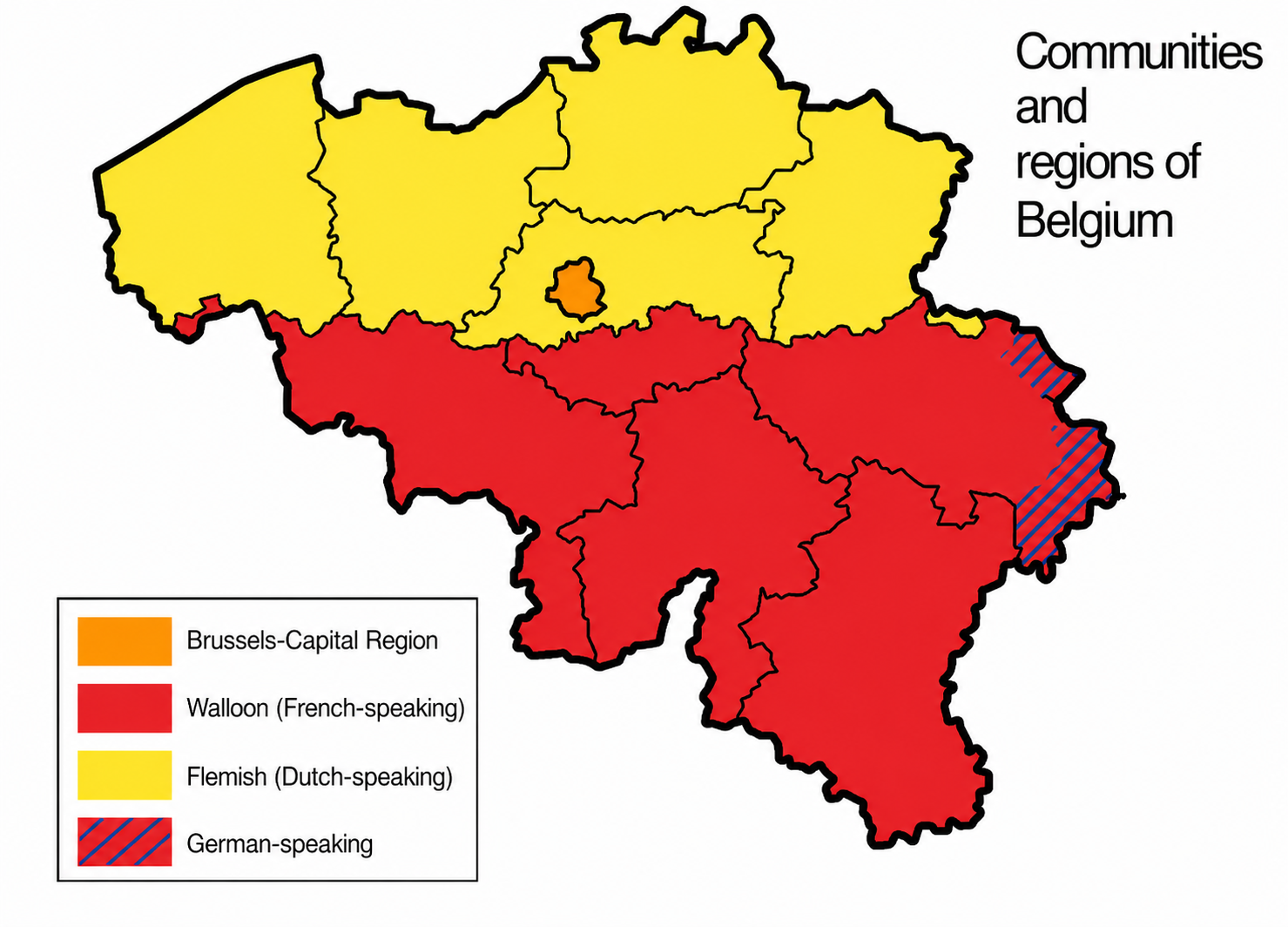
Ethnic Composition of Belgium
- 59% of the total population lives in the Flemish region and speaks Dutch.
- 40% of the people live in the Wallonia region and speak French.
- The remaining 1% of the Belgians speak German.
The Conflict in Brussels (The Capital)
The ethnic composition of the capital city, Brussels, was the exact opposite of the country:
- 80% of the people spoke French (Majority in capital, Minority in country).
- 20% of the people spoke Dutch (Minority in capital, Majority in country).
Reasons for Tension (1950s and 1960s): The minority French-speaking community was relatively rich and powerful. This was resented by the Dutch-speaking community who got the benefit of economic development and education much later. This led to tension between the two communities, which was most acute in Brussels.
2. Accommodation in Belgium (The Belgian Model)
The Belgian leaders took a different path to prevent civil strife. Between 1970 and 1993, they amended their constitution four times so as to work out an arrangement that would enable everyone to live together within the same country.
Fact
Key Elements of the Belgian Model:
- Equal Ministers: The Constitution prescribes that the number of Dutch and French-speaking ministers shall be equal in the central government. No single community can make decisions unilaterally.
- More Power to States: Many powers of the central government have been given to state governments of the two regions. The state governments are not subordinate to the Central Government.
- Separate Government in Brussels: Brussels has a separate government in which both the communities have equal representation. The French accepted equal representation here because the Dutch accepted equal representation at the centre.
- Community Government: A third kind of government elected by people belonging to one language community (Dutch, French, and German-speaking) no matter where they live. It has power regarding cultural, educational, and language-related issues.
Result: This complex arrangement worked well to avoid civic strife and a possible division of the country on linguistic lines. When many countries of Europe came together to form the European Union, Brussels was chosen as its headquarters.
3. The Story of Sri Lanka
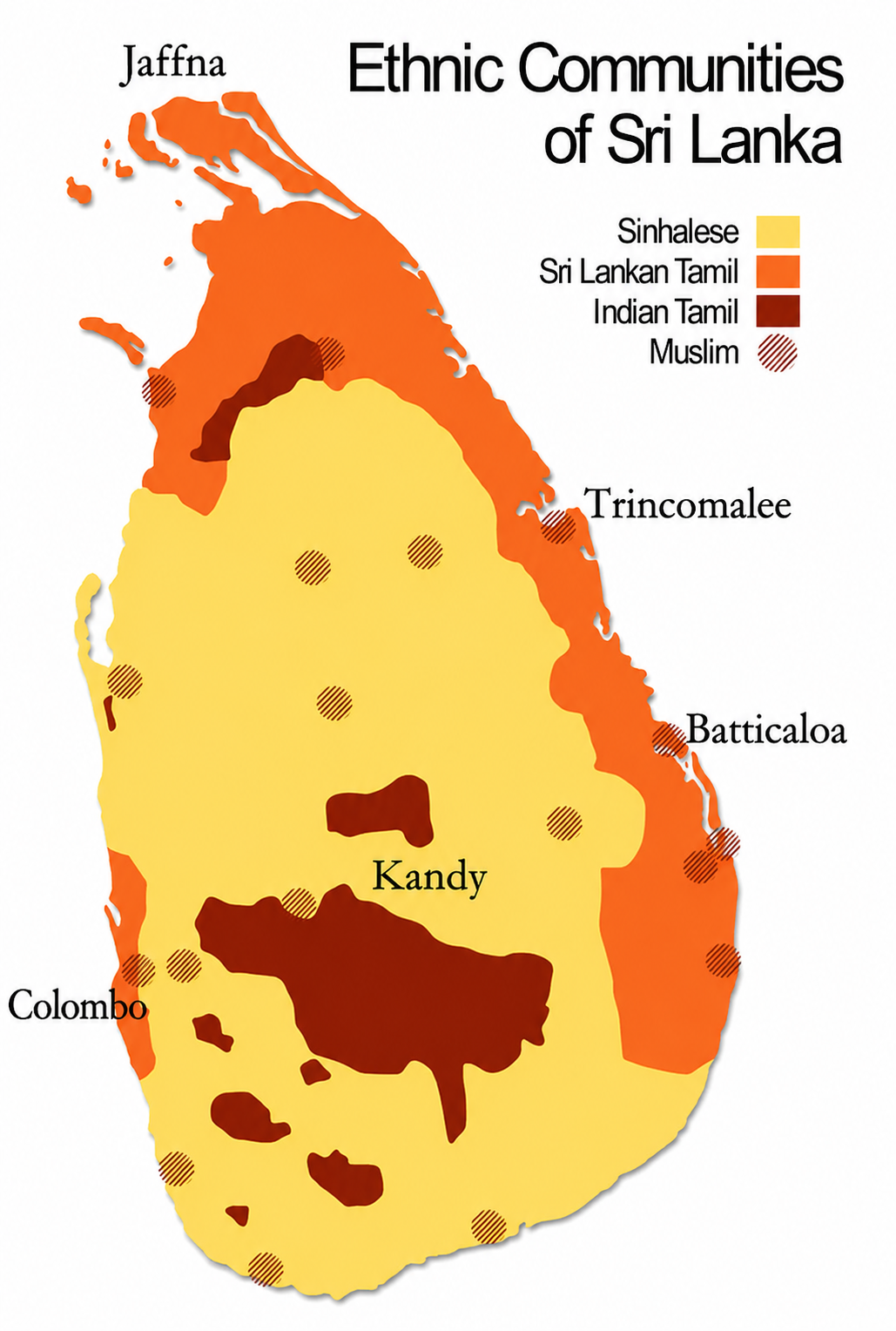
Sri Lanka is an island nation, just a few kilometres off the southern coast of Tamil Nadu. Like other nations in the South Asia region, it has a diverse population (about 2 crores).
Ethnic Composition of Sri Lanka
- Sinhala speakers: 74% (Mostly Buddhists).
- Tamil speakers: 18% (Mostly Hindus or Muslims). Tamils are divided into two sub-groups:
- Sri Lankan Tamils (13%): Tamil natives of the country, concentrated in the north and east.
- Indian Tamils (5%): Forefathers came from India as plantation workers during the colonial period.
- Christians: 7% (They are both Sinhala and Tamil).
4. Majoritarianism in Sri Lanka
Sri Lanka emerged as an independent country in 1948. The leaders of the Sinhala community sought to secure dominance over government by virtue of their majority.
Important
Majoritarianism: A belief that the majority community should be able to rule a country in whichever way it wants, by disregarding the wishes and needs of the minority.
Steps Taken to Establish Sinhala Supremacy:
- In 1956, an Act was passed to recognise Sinhala as the only official language, completely disregarding Tamil.
- The governments followed preferential policies that favoured Sinhala applicants for university positions and government jobs.
- A new constitution stipulated that the state shall protect and foster Buddhism.
Impact of these Policies:
These measures gradually increased the feeling of alienation among the Sri Lankan Tamils. They felt that none of the major political parties led by the Buddhist Sinhala leaders were sensitive to their language and culture. They felt that the constitution denied them equal political rights.
The Response of Tamils: The Sri Lankan Tamils launched parties and struggles for the recognition of Tamil as an official language, for regional autonomy, and equality of opportunity in securing education and jobs. By the 1980s, several political organisations were formed demanding an independent Tamil Eelam (state) in northern and eastern parts of Sri Lanka.
Result: The distrust turned into widespread conflict and soon turned into a Civil War. Thousands of people from both communities were killed, and many were forced to leave the country as refugees.
5. Why is Power Sharing Desirable?
There are two broad sets of reasons why power sharing is good for a democracy:
- Prudential Reasons (Based on careful calculation of gains and losses):
- It helps to reduce the possibility of conflict between social groups.
- Since social conflict often leads to violence and political instability, power sharing is a good way to ensure the stability of political order.
- Imposing the will of the majority community over others may look like an attractive option in the short run, but in the long run it undermines the unity of the nation (e.g., Sri Lanka).
- Moral Reasons (Based on purely moral considerations):
- Power sharing is the very spirit of democracy.
- A democratic rule involves sharing power with those affected by its exercise, and who have to live with its effects.
- People have a right to be consulted on how they are to be governed. A legitimate government is one where citizens acquire a stake in the system.
6. Forms of Power Sharing
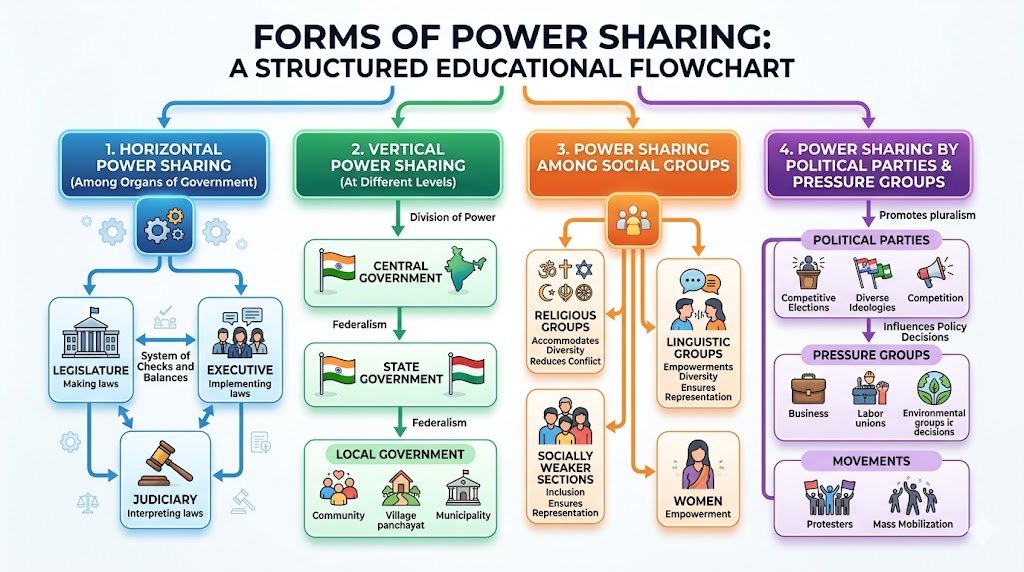
In modern democracies, power sharing arrangements can take many forms:
I. Horizontal Distribution of Power
- Power is shared among different organs of government, such as the legislature, executive, and judiciary.
- It is called horizontal distribution because it allows different organs of government placed at the same level to exercise different powers.
- Such a separation ensures that none of the organs can exercise unlimited power. Each organ checks the others. This results in a balance of power, known as a system of checks and balances.
II. Vertical Distribution of Power (Federal Government)
- Power can be shared among governments at different levels – a general government for the entire country and governments at the provincial or regional level.
- In India, we refer to it as the Central or Union Government, and the governments at the provincial level as State Governments.
- The constitution clearly lays down the powers of different levels of government (e.g., Union List, State List).
- Power is further shared to lower levels like municipality and panchayats.
III. Power Sharing among Social Groups
- Power may also be shared among different social groups such as the religious and linguistic groups.
- The 'Community Government' in Belgium is a good example of this arrangement.
- In some countries, there are legal and constitutional arrangements where socially weaker sections and women are represented in the legislatures and administration. For example, the system of 'reserved constituencies' in assemblies and the parliament of India.
IV. Power Sharing among Political Parties, Pressure Groups, and Movements
- In a democracy, the citizens must have freedom to choose among various contenders for power. This competition ensures that power does not remain in one hand.
- Power is shared among different political parties that represent different ideologies and social groups.
- Sometimes this kind of sharing can be direct, when two or more parties form an alliance to contest elections. If elected, they form a coalition government and thus share power.
- Pressure groups and movements (like those of traders, businessmen, industrialists, farmers, and industrial workers) also have a share in governmental power, either through participation in governmental committees or bringing influence on the decision-making process.
Important Previous Year Questions (PYQs)
Q & A
Q1. Compare the different ways in which the Belgians and the Sri Lankans dealt with the problem of cultural diversity.
Ans: The Belgian leaders recognised the existence of regional differences and cultural diversities. They amended their constitution four times to accommodate the French and Dutch speaking populations equally, establishing a Community Government and preventing civil war. In contrast, Sri Lankan leaders followed the path of Majoritarianism, passing the 1956 Act to establish Sinhala supremacy, completely alienating the Tamils. This refusal to share power led to a devastating Civil War.
Q & A
Q2. What is majoritarianism? How did it lead to conflict in Sri Lanka?
Ans: Majoritarianism is the belief that the majority community should be able to rule a country by disregarding the wishes and needs of the minority. In Sri Lanka, the Sinhala majority passed the 1956 Act making Sinhala the only official language, favoured Sinhalas in jobs/universities, and fostered Buddhism. This alienated the Sri Lankan Tamils, who demanded regional autonomy and a separate state (Tamil Eelam), eventually triggering a Civil War.
Q & A
Q3. Explain the Prudential and Moral reasons for power sharing.
Ans:
- Prudential reasons stress that power sharing brings better outcomes. It reduces the possibility of conflict between social groups and ensures the stability of political order.
- Moral reasons emphasize the intrinsic worth of power sharing. It is the very spirit of democracy; citizens have a right to be consulted on how they are governed, creating a legitimate government.
Q & A
Q4. Differentiate between horizontal and vertical power sharing in modern democracies.
Ans: Horizontal power sharing distributes power among different organs of the government (Legislature, Executive, Judiciary) at the same level. It establishes a system of 'checks and balances'. Vertical power sharing distributes power among governments at different levels (Central, State, Local). It involves higher and lower levels of government and is known as federal division of power.
Q & A
Q5. Write a short note on the 'Community Government' in Belgium.
Ans: In Belgium, apart from the Central and the State Government, there is a third kind of government called the 'Community Government'. It is elected by people belonging to one language community—Dutch, French, and German-speaking—no matter where they live. This government has the power to make decisions regarding cultural, educational, and language-related issues.
