
What happens if the mangoes your parents bought last week are now half the price? Why are vegetables expensive in the morning but cheaper in the evening? Why does a flight seat cost ₹3,000 one day and ₹9,000 the next? These real-world situations are all driven by the interaction among buyers and sellers. Prices are determined by two powerful forces constantly at work: Demand and Supply.
As the mango season approaches, prices are high, so people buy smaller quantities. When prices fall, people buy more. Demand is the quantity of a product that people are willing and able to buy at a particular price, depending on their needs, preferences, season, trend, and income. Demand is not just the desire to buy something; it is willingness complemented by the purchasing power to buy it.
The Law of Demand highlights the inverse relationship between the price of a product and its quantity demanded, keeping other factors constant:
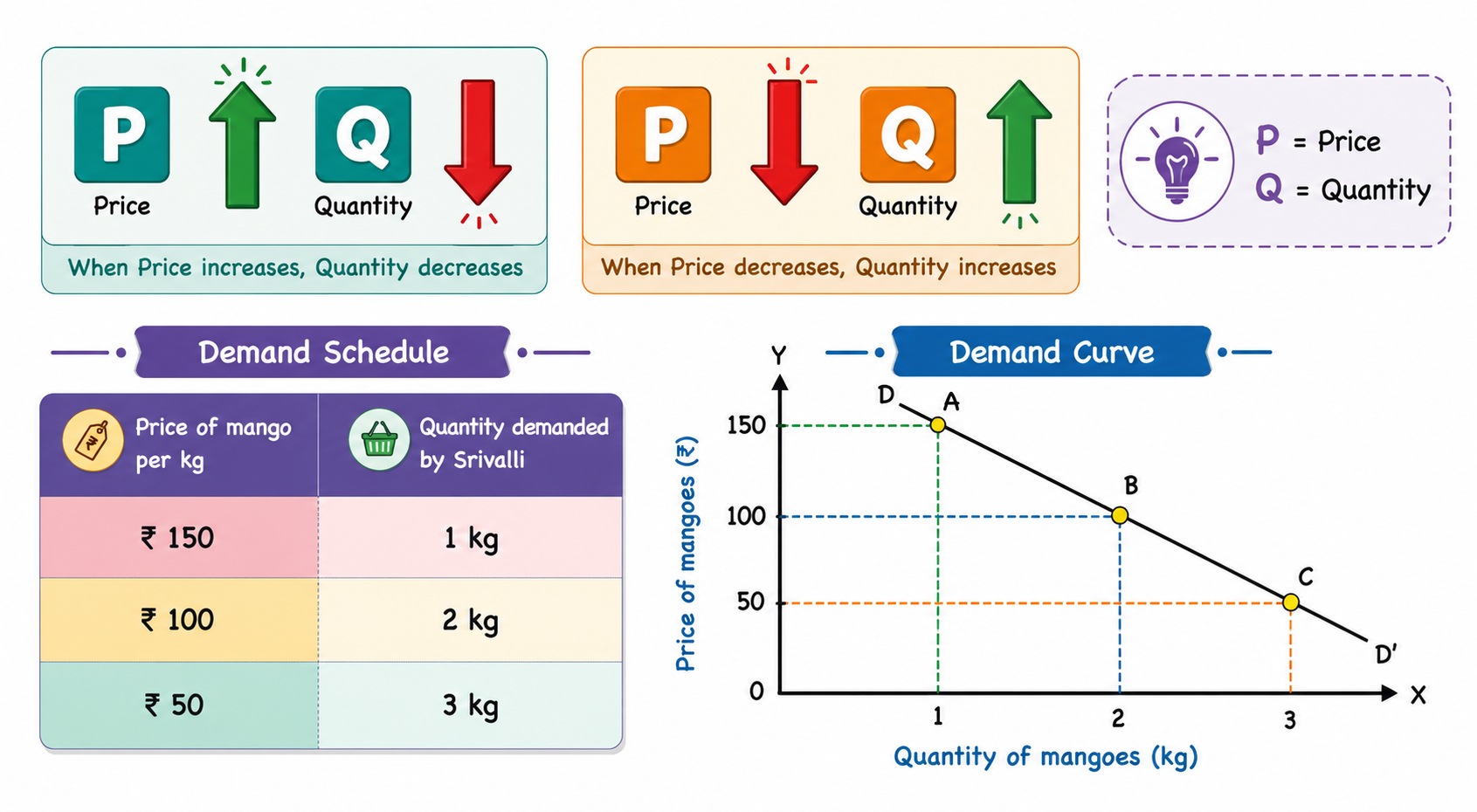
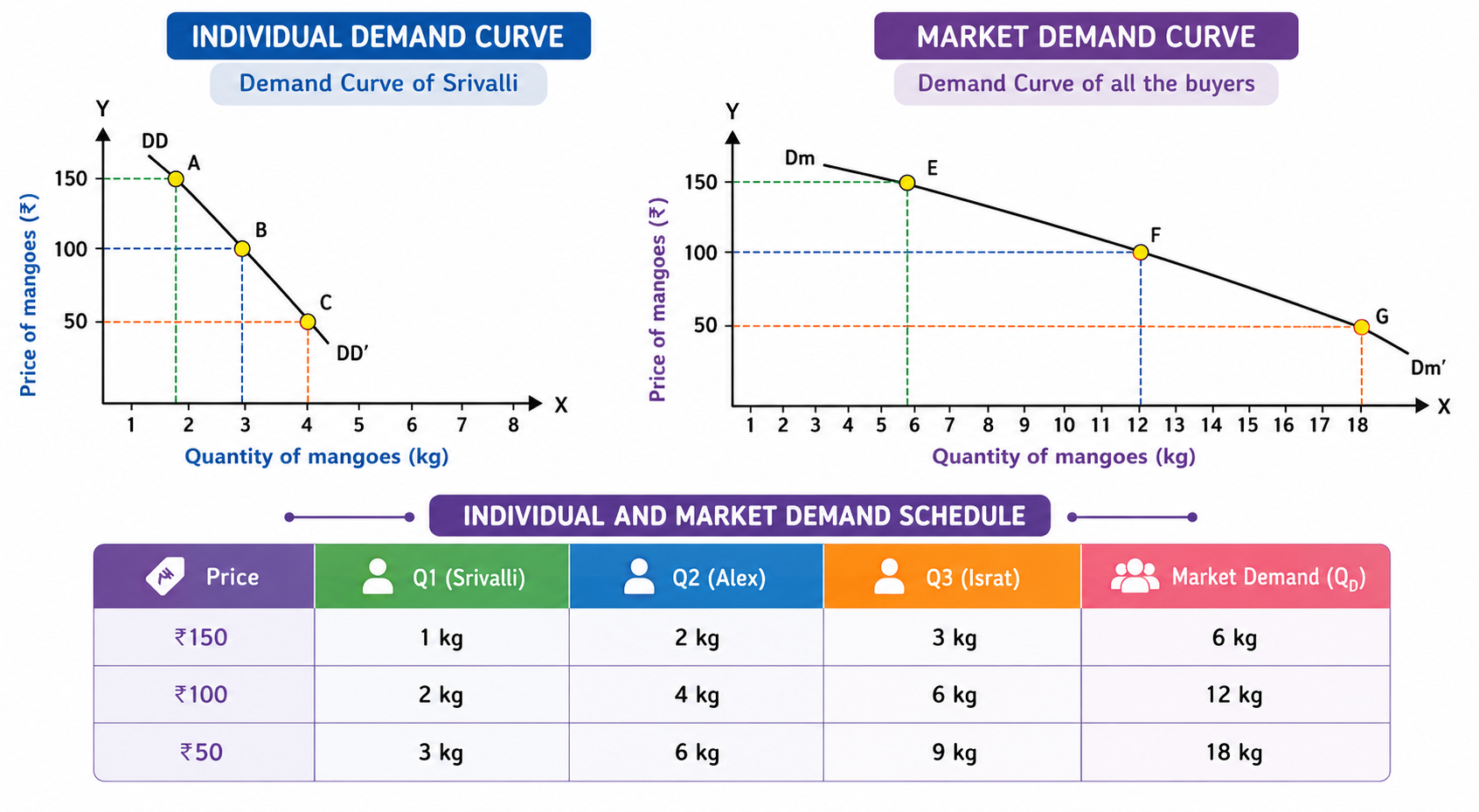
While the price of the good itself is a major factor, several other determinants influence how much people want to buy, even if the price of the original good remains unchanged:
When household income rises, consumers can afford to buy more goods or choose higher-quality products. A rise in income generally increases the quantity demanded for most goods.
Consumer preferences, influenced by trends, culture, and demographics, dictate demand. For example, a country with a high population of children will have increased demand for toys and sports shoes, while a population with more elderly people will demand more orthopaedic shoes or medicines.
Demand fluctuates based on weather, festivals, and cultural habits (e.g., high demand for sweaters in winter, sweets during Diwali, or books at the start of an academic session).
If consumers expect the price of a good to fall in the near future (like a festival sale), they will postpone their purchase, decreasing present demand. Conversely, if they expect prices to rise soon, they will buy immediately, increasing present demand.
The first mango you eat tastes delicious. The second is good, but by the third or fourth, you barely want any more. This is the principle of diminishing marginal utility. As the utility (usefulness/satisfaction) derived from a successive quantity of a product falls, the willingness to pay for it also decreases. This is a key reason why demand falls at higher quantities.
From the seller's perspective, we look at supply.
Supply is the quantity of a product that sellers are willing and able to offer at a particular price in the market.
The Law of Supply states that there is a direct relationship between the price of a product and its quantity supplied, assuming other factors remain constant:
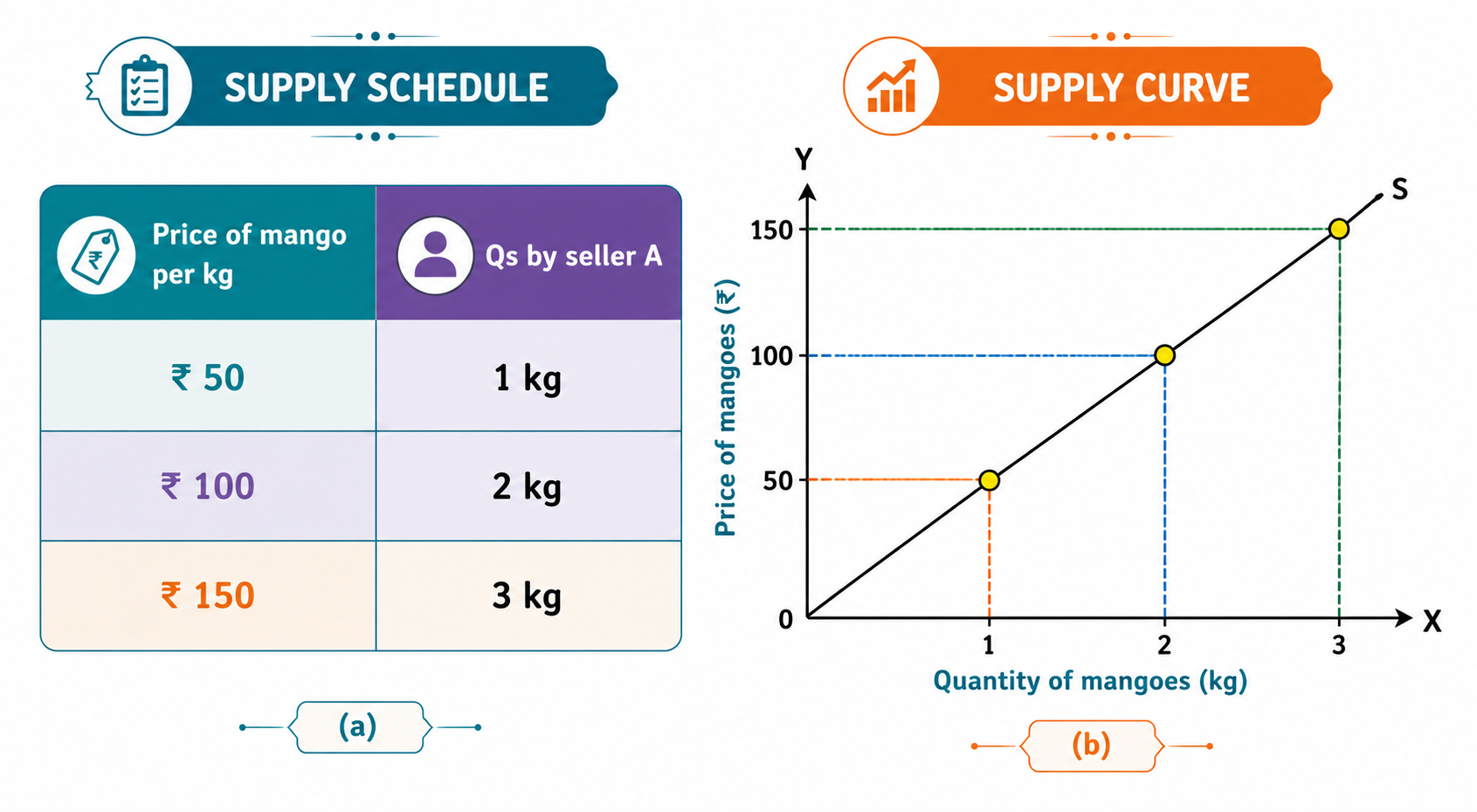
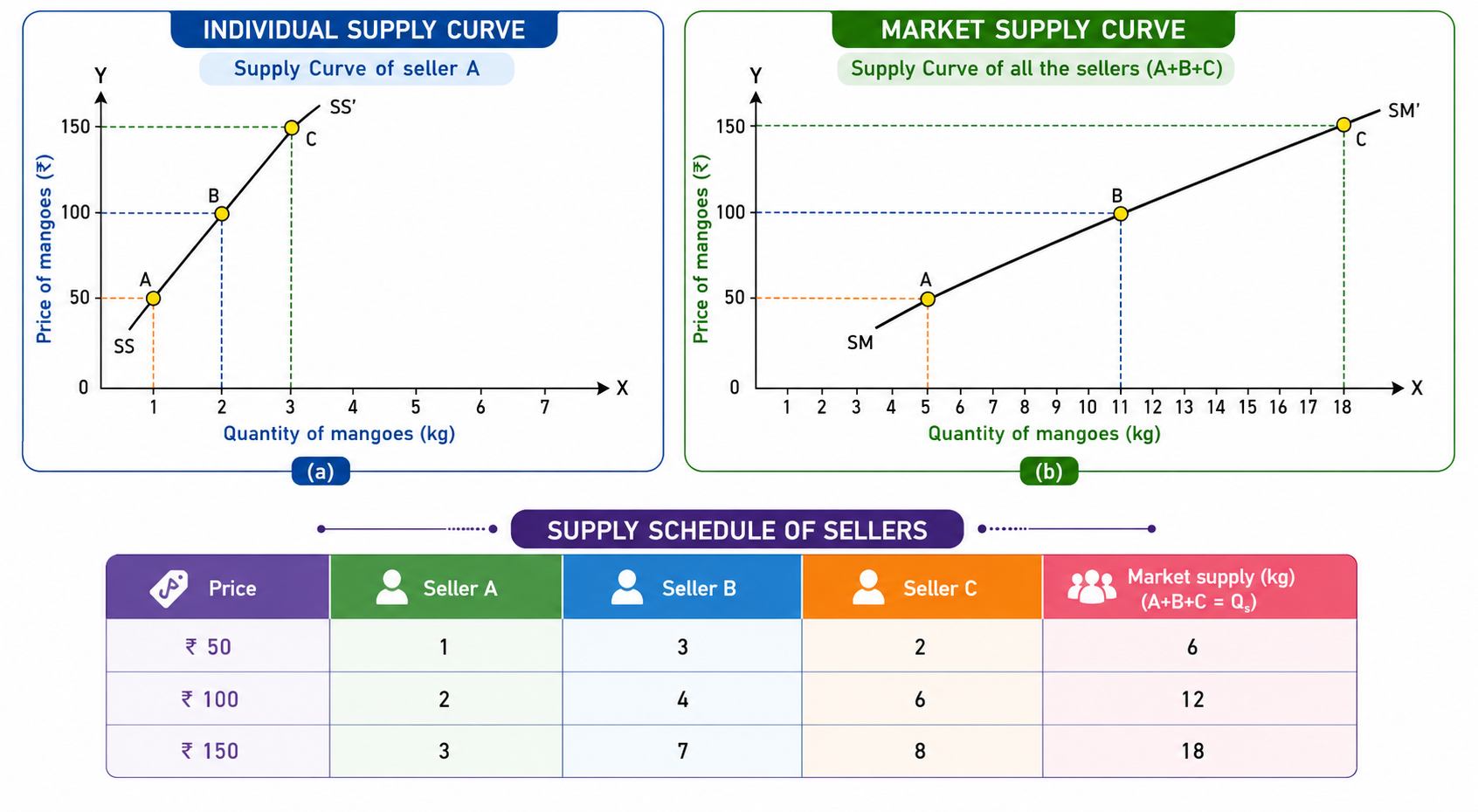
Factors other than the price of the good that affect its supply include:
Suppliers allocate resources based on profitability. If a farmer can grow wheat or chickpeas, and the price of chickpeas rises significantly in the market while wheat stays low, the farmer will shift resources to grow more chickpeas. The supply of wheat will drop.
If new firms enter the market, competition increases, and the overall market supply of the product increases. If sellers leave, supply decreases.
Improvements in technology reduce the cost of production and increase efficiency. For example, adopting cold storage facilities or drip irrigation allows producers to supply more goods at the same cost. Better tech → increased supply.
If producers expect a boom in demand soon, they will produce more. Alternatively, if a potato wholesaler expects prices to rise during a peak season, they might hold back (hoard) current supply to sell it later at a higher price, thus reducing current supply.
.png)
Prices in a free market are determined by the interaction between demand and supply. A market involves a constant negotiation between what buyers are willing to pay and what sellers are willing to accept.
Market Equilibrium is the specific point where the Quantity Supplied exactly equals the Quantity Demanded. At this equilibrium price, there is neither a shortage nor a surplus. The market is 'cleared'.
For example, if at ₹100, buyers demand 12 kg of mangoes and sellers supply exactly 12 kg, then ₹100 is the equilibrium price. At ₹40, demand might be 38 kg but supply only 6 kg (severe shortage). At ₹150, demand might be 8 kg but supply 43 kg (severe surplus). Thus, prices tend to naturally adjust toward the stable equilibrium.
In economic theory, equilibrium is a neat intersection point. However, in the real world, markets are highly dynamic. Factors like new technology, changes in wages, weather events, political crises, or pandemics constantly shift both the demand and supply curves.
Therefore, 'equilibrium' is never fully stable. The market is always in a continuous process of adjusting to a new equilibrium. For example, during the COVID-19 pandemic, demand for face masks skyrocketed suddenly, causing prices to rise. Over time, suppliers ramped up production (supply increased), and as the pandemic eased (demand fell), prices eventually reduced and adjusted to a new reality.
Hotels do not charge the same tariff (price) for rooms all the time. Prices change dynamically based on demand and varying conditions. For example, a hotel room in Goa might cost ₹1,500 on an off-season weekday, ₹8,000 on a tourist season weekend, and ₹25,000 on New Year's Eve (peak demand). If a group tour cancels, the hotel may slash prices by 40% overnight to fill empty rooms. This perfectly illustrates prices changing rapidly with shifts in demand and supply.
While markets are excellent at allocating goods based on willingness and ability to pay, they do not always work fairly. If essential goods like life-saving medicines become prohibitively expensive, they become inaccessible to the poor. Thus, the government must intervene to ensure fairness, equity, and the welfare of vulnerable groups.
The government intervenes to protect consumers and workers from exploitation:
Public goods are services provided by the government for the benefit of all citizens, such as national defence, roads, bridges, public parks, streetlighting, and sanitation/drainage systems.
Why doesn't the private sector provide them? Because public goods do not generate direct profit. Also, they suffer from the "free-rider problem". Suppose your neighborhood needs a park costing ₹5,000 per family. Many families might refuse to pay, thinking, "If others pay, the park will be built anyway, and I can use it without paying." Because of this thinking, not enough money is collected, and the park is never built. Thus, the government must use tax money to provide these essential services to ensure social welfare and equal access.
While necessary, excessive government regulation can be inefficient and have adverse side effects on the economy:
Understanding how economic systems work provides the tools to think critically, use resources wisely, and make informed decisions. Markets are not machines with fixed equilibria; they are dynamic systems that constantly adapt, evolve, and respond to changing conditions. The next time you see a price change, you can decode reality by asking: Is supply changing? Is demand shifting? Is government intervention helping or hurting?
 VARDAAN COMET