Vardaan Learning Institute
Building Blocks in Economics: The Problem of Choice
The Big Questions
- What does economics deal with?
- What are the key questions in economics?
- How do different economic systems address these questions?
1. The Problem of Choice
At the heart of economics lies a fundamental reality: human wants are unlimited, but the resources to satisfy them are limited. This creates the problem of choice. Every day, individuals, enterprises, and governments face situations where they must prioritize their spending and resource allocation.
For example, if you have limited pocket money, you must decide whether to spend it on snacks today or save it for a pair of shoes later. Similarly, a government with a limited budget must choose between building a new hospital, upgrading the military, or constructing highways. Because we cannot have everything, we must make choices.
Understanding Needs vs. Wants
- Needs: These are the basic, non-negotiable requirements for human survival. They include essentials such as food, water, clothing, and shelter. Needs are generally universal and limited.
- Wants: These are desires for goods and services that make life more comfortable, enjoyable, or luxurious, but are not essential for survival. Examples include a high-end smartphone, a luxury car, or a vacation abroad.
Key Characteristics of Wants:
- They are unlimited; as soon as one want is satisfied, another arises (e.g., wanting a motorcycle after getting a bicycle).
- They are subjective and vary from person to person based on age, culture, and income.
- They are recurring; the desire for food or entertainment keeps coming back.
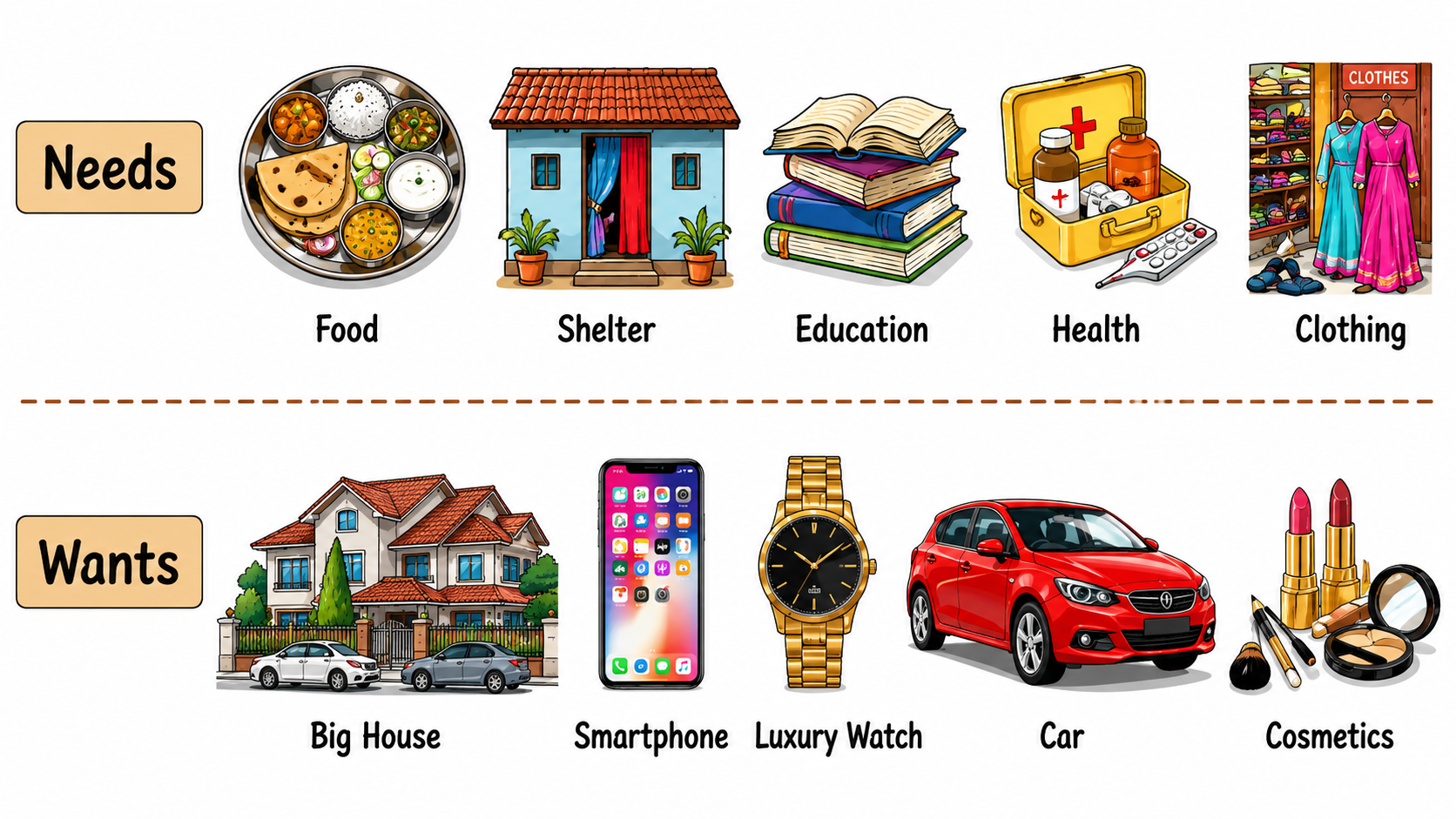
Figure 8.1: Difference between Needs vs Wants
2. Choices, Limited Resources, and Scarcity
To produce goods and services that satisfy our wants, we require resources. These resources are often categorized as the Factors of Production: Land, Labour, Capital, and Technology/Entrepreneurship. However, the defining characteristic of these resources is that they are scarce (limited in quantity) and have alternative uses.
For instance, a piece of land can be used to build a factory, construct a school, or grow crops. Steel can be used to manufacture medical equipment, aircraft, or refrigerators. Because resources have alternative uses, allocating them to one purpose means taking them away from another.
Core Concept
Opportunity Cost
Every choice involves a sacrifice. Opportunity cost is defined as the value of the next best alternative that is given up when a choice is made. It is the cost of what you sacrificed.
Examples:
- If a farmer uses a plot of land to grow wheat instead of barley, the barley that could have been grown (and the profit it would have yielded) is the opportunity cost of growing wheat.
- If you spend two hours playing video games instead of studying for a test, the opportunity cost is the better grade you could have achieved.
- If a government spends ₹1000 Crores on a space mission, the opportunity cost might be the 50 new schools that could have been built with that same money.
Production Possibility Curve (PPC)
The Production Possibility Curve (PPC), also known as the Production Possibility Frontier (PPF), is a graphical representation showing all the possible combinations of two goods that an economy can produce, assuming all resources are fully and efficiently utilized, and technology remains constant.
Key Takeaways from the PPC:
- Trade-off: The downward slope of the curve illustrates opportunity cost. To produce more of Good A, you must produce less of Good B.
- Efficiency: Any point on the curve represents maximum productive efficiency (no resources are wasted).
- Inefficiency: Any point inside the curve indicates that resources are underutilized or wasted (e.g., high unemployment).
- Unattainable: Any point outside the curve cannot be reached with the current level of resources and technology. It represents economic growth that requires better technology or more resources to achieve.
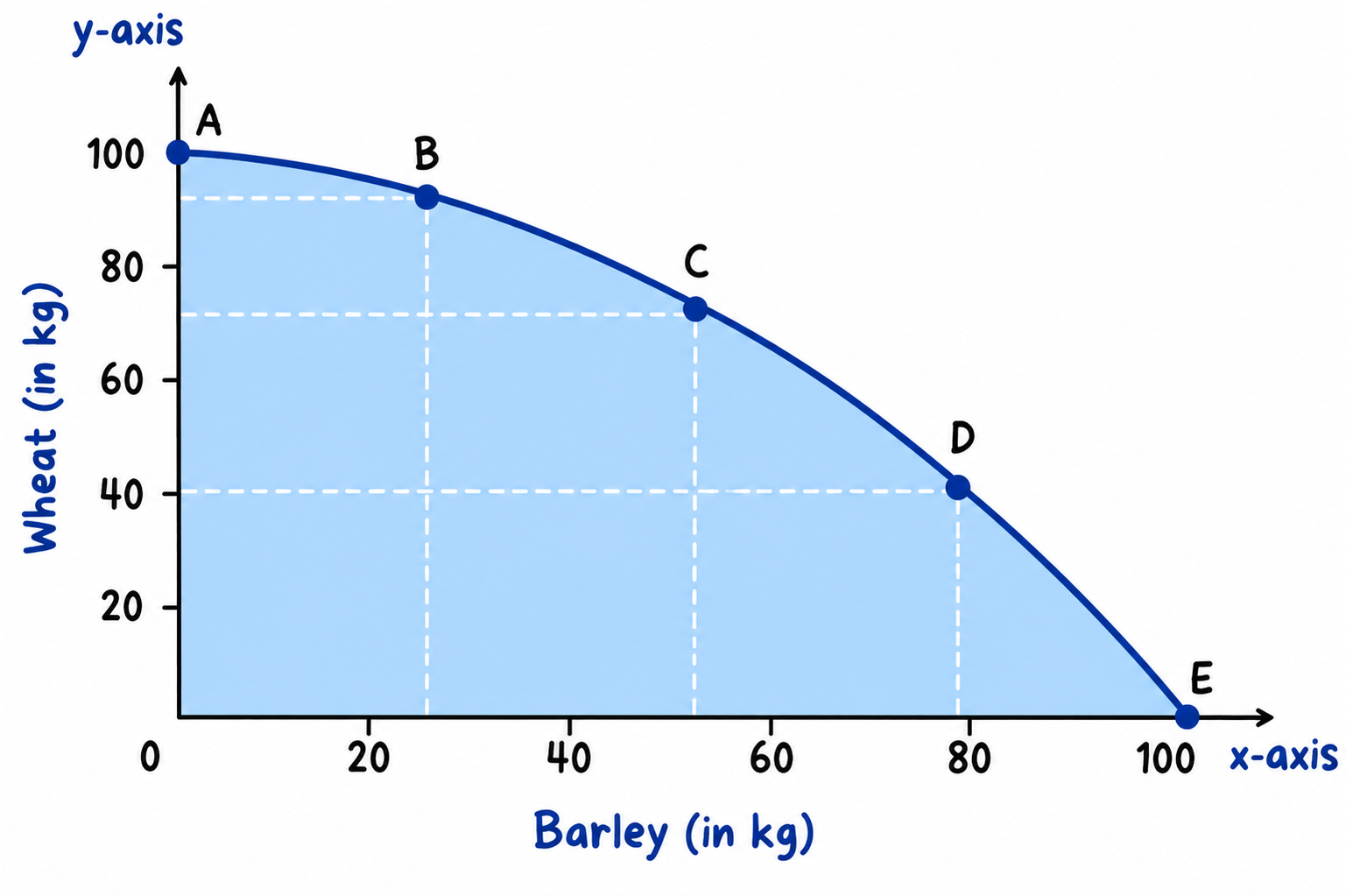
Figure 8.3: Production Possibility Curve graph and table
3. What does Economics Deal with?
The word Economics is derived from the ancient Greek word oikonomia, which translates roughly to 'household management' (oikos meaning household, and nemein meaning management). Today, it scales far beyond the household.
Economics is the study of how society manages its scarce resources to satisfy unlimited human wants. It examines how individuals, businesses, governments, and nations make choices about allocating resources.
- Economic Entities: The players in an economy. This includes consumers (who decide what to buy), producers (who decide what to make), governments (who regulate and provide public goods), and financial institutions (like banks that manage money flows).
- The Scope: Economics explains complex interactions: how wages are determined, how wealth is distributed, what causes inflation, why prices fluctuate in markets, and how international trade policies affect local industries.
Modern economics relies heavily on data, statistics, and systematic surveys. Economists analyze this data to understand past behaviours, predict future trends, and formulate policies that minimize risks and maximize societal welfare.
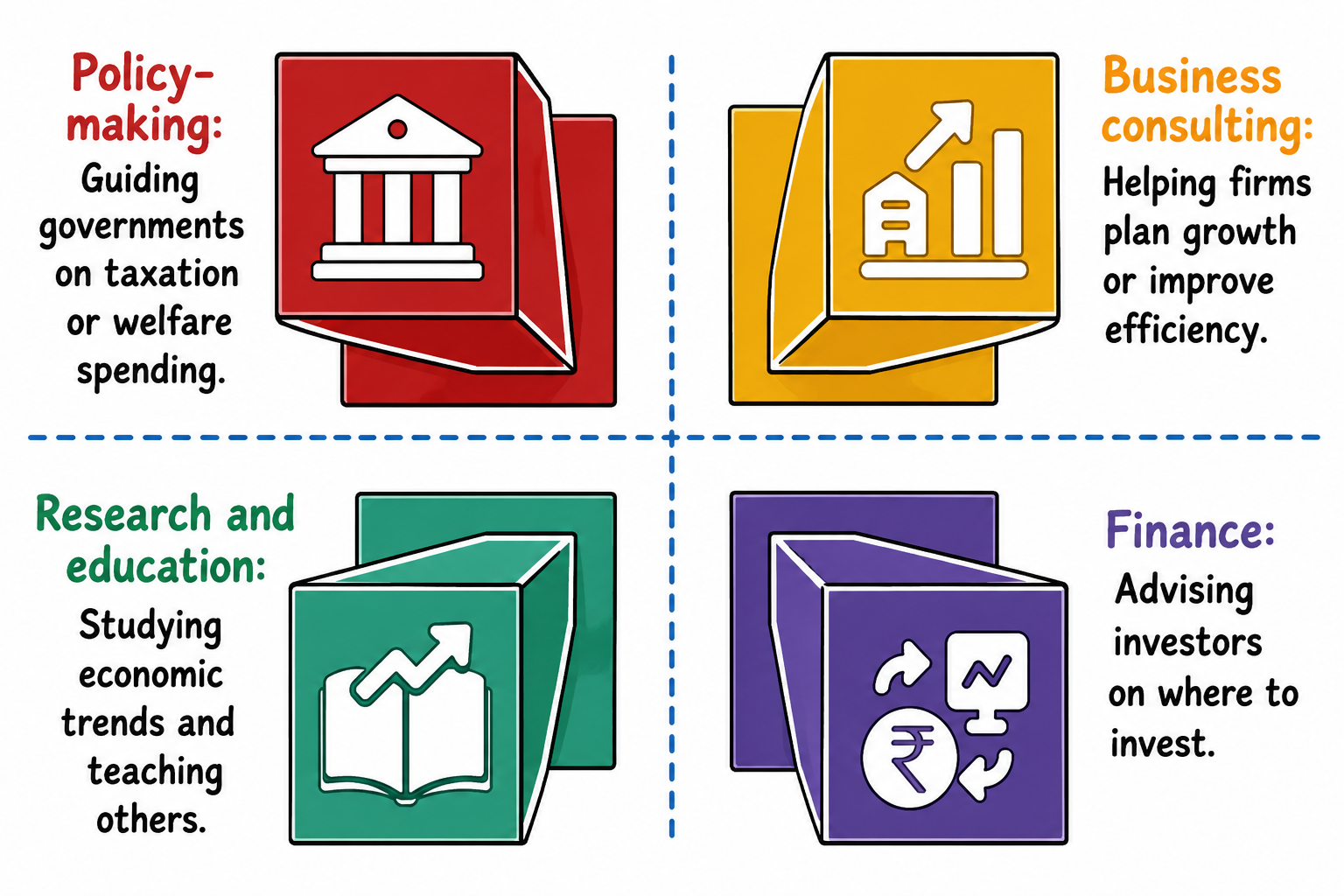
Figure 8.4: Scope of work of Economists
Did you know?
Economic Survey of India
The Economic Survey is a highly anticipated annual document prepared by the Ministry of Finance under the guidance of the Chief Economic Advisor. It is presented in Parliament right before the Union Budget. It meticulously reviews the country's economic performance over the past year, analyzes sectors like agriculture and industry, discusses challenges like inflation and employment, and acts as a strategic blueprint for upcoming economic policies.
4. The Three Central Questions of an Economy
The core problem of scarcity means that no society can produce everything its people want. Therefore, every economic system must answer three fundamental, central questions regarding resource allocation:
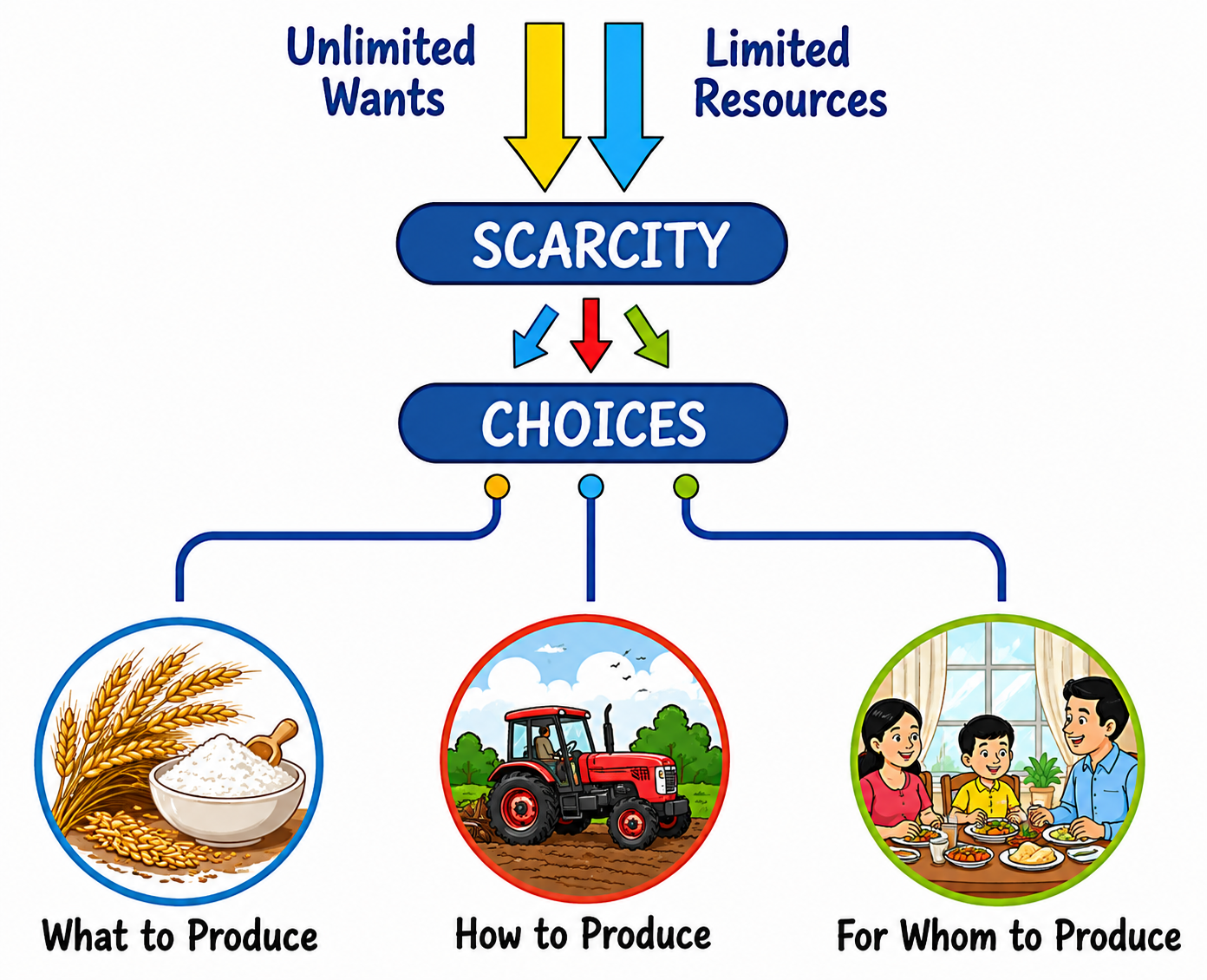
Figure 8.5: Diagram illustrating Scarcity Choices What How For Whom
I. What to Produce and in What Quantities?
Because resources are limited, producing more of one good means producing less of another. A society must decide the exact mix of goods and services it will produce.
- Should a nation dedicate its factories to producing consumer goods (clothes, TVs, cars) to improve immediate living standards, or capital goods (machinery, factory equipment) to boost future production?
- Should farmers in a dry region grow highly profitable but water-intensive crops like sugarcane, or should they focus on drought-resistant millets that save water and preserve soil health? This choice highlights the trade-off between short-term economic gain and long-term environmental sustainability.
II. How to Produce?
Once society decides what to produce, it must decide how to produce it. This refers to the choice of production methods and technologies.
- Labour-Intensive Technique: This method uses a higher proportion of human labour compared to machinery. It is highly beneficial for generating employment in populous countries like India. It is often used in agriculture, textiles, and handicrafts.
- Capital-Intensive Technique: This method uses a higher proportion of advanced machinery, robotics, and technology compared to human labour. It is highly efficient, faster, and suitable for mass production (e.g., automobile assembly, oil refining), but it requires massive investment and creates fewer direct jobs.
The choice between these two depends on the relative cost and availability of labour versus capital in the country, as well as the desired scale of production.
.png)
Figure 8.6: Illustration of Factors of Production (Land, Labour, Capital, Tech)
III. For Whom to Produce?
This question delves into the distribution of the final goods and services. Who gets to consume what is produced? This largely depends on the purchasing power (income) of individuals in the society.
Producers must identify their target demographic based on income levels, tastes, and lifestyle needs. For example, the shoe industry addresses different segments:
- Students: Require durable, affordable school shoes.
- Professionals: Require formal, comfortable office wear (often leather).
- Athletes: Require highly specialized, flexible, and supportive sports shoes.
The answer to this question also dictates the materials used and the pricing strategy of the producer.
5. Economic Systems
An economic system is a complex network of institutions, laws, and mechanisms that a society uses to answer the three central questions of what, how, and for whom to produce. Broadly, there are three types of economic systems in the world:
A. Planned Economy (Command Economy)
In a planned economy, a central authority (the government) makes all major economic decisions. The forces of market demand and supply play almost no role.
- Ownership: The government owns and controls the vast majority of resources, land, factories, banks, and transport networks. Private property is virtually non-existent.
- Motive: The primary goal is social welfare and equality, rather than private profit.
- Disadvantages: Because enterprises only have to meet government quotas and face no competition, there is very little motivation to innovate, improve product quality, or operate efficiently. This often leads to shortages of consumer goods.
- Examples: The former Soviet Union, North Korea, and Cuba (historically).
B. Market Economy (Capitalist Economy)
In a pure market economy, the three central questions are answered entirely by the free forces of market demand and supply. The government's role is minimal, acting mainly as a referee to maintain law and order, enforce contracts, and protect property rights.
- Ownership: Resources and enterprises are privately owned by individuals and corporations.
- Motive: The driving force is profit maximization. Producers make what consumers are willing to buy.
- Advantages: Intense competition forces producers to innovate, keep prices low, and constantly improve the quality of their goods. It is a highly efficient system.
- Disadvantages: It can lead to severe income inequality. Also, public goods that aren't profitable (like street lighting or defense) will not be produced by the private sector.
- Examples: The United States of America, Japan, and Hong Kong lean heavily toward this model.
C. Mixed Economy
Recognizing the flaws in both extreme systems, a mixed economy combines the best features of both the market and planned economies. Both the private sector and the public (government) sector coexist and play vital roles.
- Dual Roles: Private enterprises operate in the market to generate wealth and drive innovation. Simultaneously, the government regulates these private entities to prevent monopolies and protect consumers.
- Public Sector: The government runs essential services, provides infrastructure (roads, railways), and ensures the provision of public goods (education, healthcare, defense).
- Examples: Almost all modern economies today are mixed. India, China, Germany, and Sweden are prominent examples.
The Indian Context
India is a classic example of a mixed economy. In the decades following Independence (1947), India followed a heavily state-led approach. The government controlled heavy industries, banking, and transport, while the private sector was tightly regulated by licenses and permits (the "License Raj").
However, facing severe economic difficulties, India introduced massive Economic Reforms in 1991 (LPG: Liberalisation, Privatisation, Globalisation). These reforms slashed excessive regulations, opened doors for private and foreign investments, and shifted India toward a more dynamic, market-oriented system, while the government continues to spearhead welfare programmes.
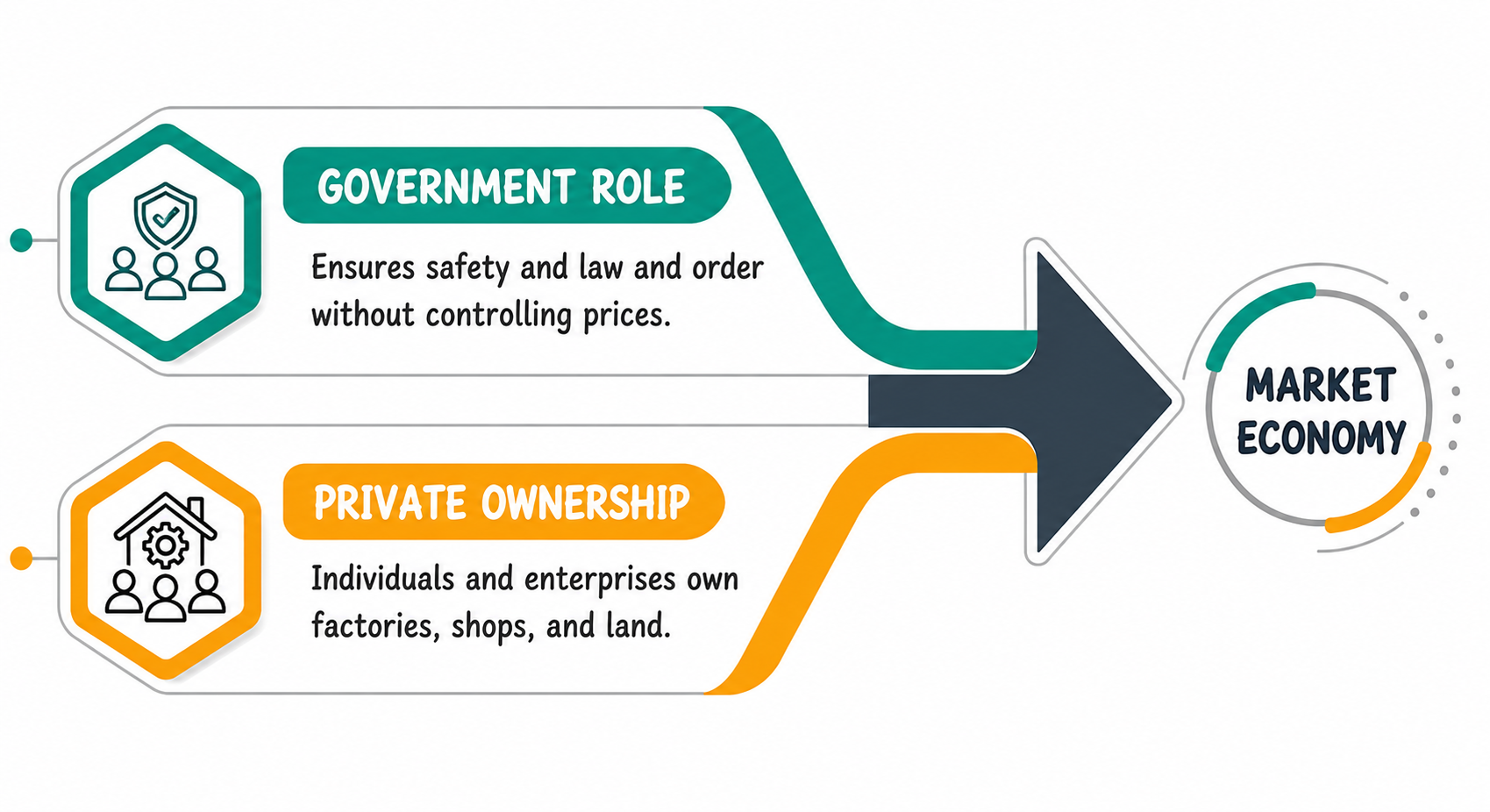
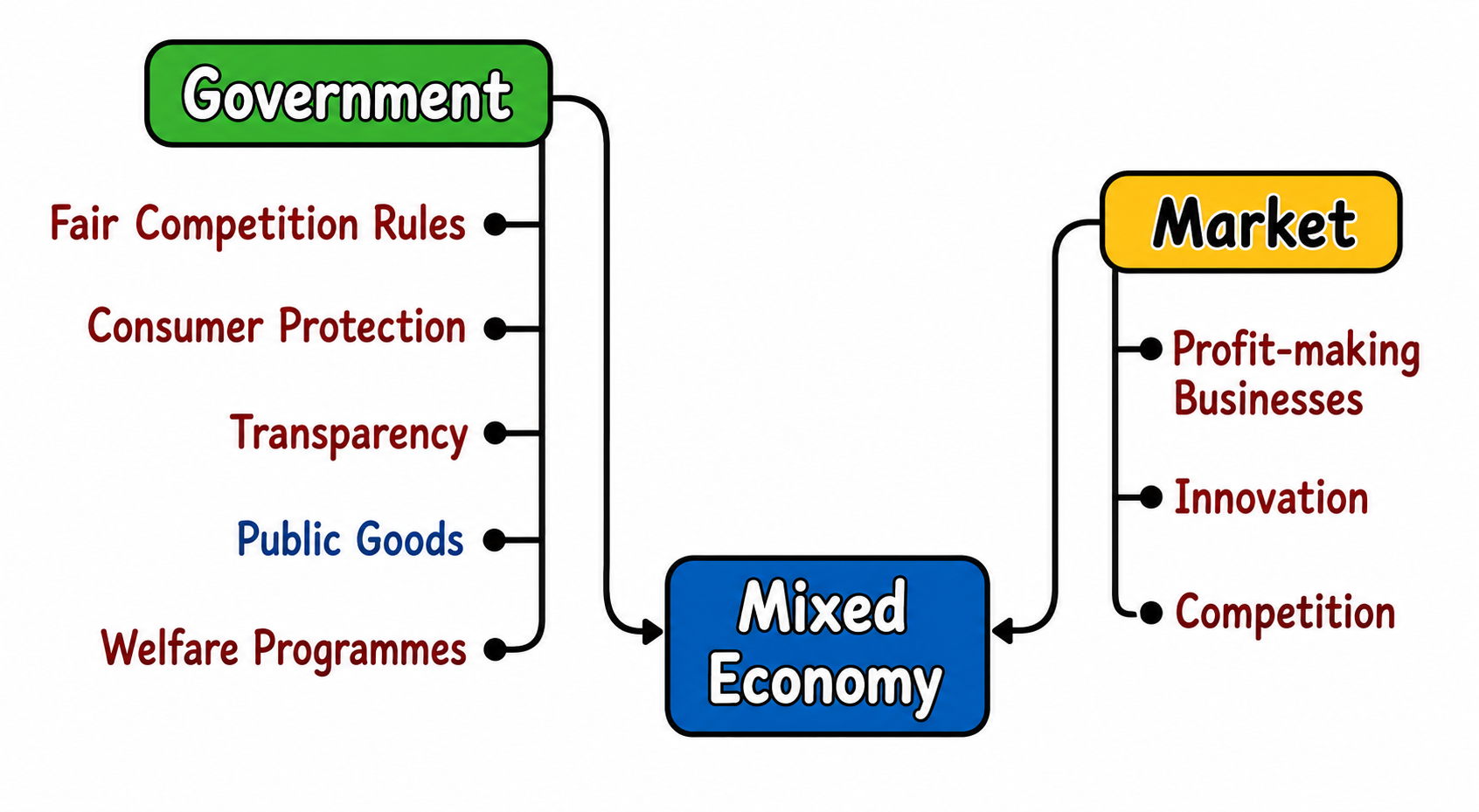
Figure 8.7 & 8.8: Role of Government and Private Ownership in Market and Mixed Economies
Conclusion
This chapter has shown that economics is essentially about making choices in a world of scarce resources and unlimited wants. Individuals, enterprises, and governments must constantly decide how to best use available resources, keeping in mind the opportunity cost of each decision. These choices are reflected in the three key economic questions—what to produce, how to produce, and for whom to produce. Different economic systems provide different ways of answering these questions, but most modern economies combine elements of both market and planned economic systems. Understanding these ideas helps us appreciate how everyday decisions, public policies, and economic systems together shape the production, distribution, and use of resources in an economy.
Before we move on...
- Economics deals with how individuals and societies make choices to use limited resources to satisfy unlimited wants. Every choice involves an opportunity cost—giving up one option for another.
- Every economy faces three central questions—what to produce, how to produce, and for whom to produce—to decide how best to use scarce resources.
- Different systems answer these questions differently: market economies rely on private decisions and demand and supply whereas, planned economies depend on government control, and mixed economies combine both.

 VARDAAN COMET