
Democracy is a form of government in which the source of power and authority lies with the citizens, who elect their representatives through free and fair elections. It is founded on the principles of freedom, equality, justice, rights, and duties.
India is the world's largest democracy. With a population of over 140 crore and a voter base of over 96.8 crore (in 2024), Bharat represents the largest participatory democracy in the world.
A constitution plays a crucial role in safeguarding democratic rights. The Constitution of India was adopted on 26 November 1949 and came into force on 26 January 1950. It guarantees and protects Fundamental Rights and ensures no citizen is discriminated against.
The democratic ethos in India did not emerge suddenly; it evolved through a long historical process.
In the Vedic period, assemblies like the Sabha, Samiti, and Vidhata involved collective decision-making. From the earliest times, republican states (ganas or sanghas) showed that kings were not independent rulers but worked in consultation with assemblies.
Foreign invasions and British colonial rule disrupted these structures, but the long struggle for independence revived and strengthened democratic ideas among the people.
Before independence, the Constituent Assembly was formed in 1946 to draft a constitution. It took 2 years, 11 months, and 18 days to draft the world's longest written Constitution under the chairmanship of Dr. B.R. Ambedkar.
A thriving democracy rests on certain non-negotiable principles upheld in India through the Constitution:
The ultimate source of power lies with the people. The state derives its authority from them. A government is elected through free and fair elections via a secret ballot. Every citizen aged 18 and above has the right to vote, known as Universal Adult Franchise.
It ensures equality before the law (every individual is treated equally by law irrespective of status) and equal protection of the law. No one is above the law. Disputes are resolved through procedures established by law. No citizen can be punished without due process.
These rights are enforceable in courts and are indivisible and inalienable. There are six Fundamental Rights:
The Right to Education (Article 21A) was added in 2009, ensuring free and compulsory education for children aged 6 to 14.
Power is separated among three organs to maintain checks and balances:
Democratic governments are accountable to citizens through elections and public debates. Transparency is ensured by tools like the Right to Information (RTI) Act, 2005.
Parliamentary procedures such as Question Hour (the first hour of a session where members ask questions) hold the government accountable.
Several political parties contest elections, representing diverse socio-cultural and regional interests. The party (or coalition) securing more than 50% of seats forms the government; others form the opposition. They function under the Representation of the People Act, 1951.
The government must ensure equitable resource distribution. Article 46 states the State shall promote the educational and economic interests of weaker sections, particularly Scheduled Castes and Scheduled Tribes.
| Process | Institutions | Democratic Values |
|---|---|---|
| Legislative Process | Legislature (Parliament, State legislature, Local bodies) | Representation, Deliberation, Dissent |
| Electoral Process | Election Commission of India | Participation, Equality |
| Judicial Process | Courts | Rule of law, Equality, Justice |
| Participatory Processes | Media, Civil Society (voluntary groups, NGOs) | Debate and discussion, freedom of expression |
| Accountability Mechanisms | CAG, CIC, Lokpal, CVC | Transparency |
| Decentralisation | Rural and Urban local bodies | People's participation at grassroots level |
| Checks and Balances | Division of powers between centre and states | Devolution of power |
The media keeps people informed, raises public issues, and safeguards people's voices. It is often referred to as the "fourth pillar of democracy".
1. Direct Democracy: Citizens directly participate in most decision-making processes. (e.g., Switzerland)
2. Representative Democracy (Indirect Democracy): People elect their representatives to govern. The government is accountable to the people. (e.g., India)
| Country | Type of Democracy | System of Government | Key Features |
|---|---|---|---|
| India | Representative (Parliamentary) | Executive power lies with council of ministers headed by PM. President is Head of State. | Multi-party, written constitution, Federalism. |
| Canada | Representative (Parliamentary) | Executive power lies with PM. Governor-General appointed by UK Crown is Head of State. | Federalism, multi-party system. |
| United Kingdom | Representative (Parliamentary with Constitutional Monarchy) | Executive power lies with PM. Monarch is Head of State. | Unwritten constitution, Sovereignty. |
| Switzerland | Direct Democracy | Executive power lies with the Federal Council. | Written constitution with multiple parties. |
| USA | Representative (Presidential) | Executive power lies with the President (also Head of State). | Written constitution, two major parties. |
India is the world's largest democracy, representing an unparalleled exercise in public participation. Its democracy is considered "living" due to its scale, diversity, and citizens' active engagement.
India operates through a three-tier system: Union, State, and Local governments (Panchayats and Municipalities). The Constitution also provides for Autonomous District Councils (ADCs) in specific north-eastern regions and the PESA Act (1996) for tribal areas to protect local customs.
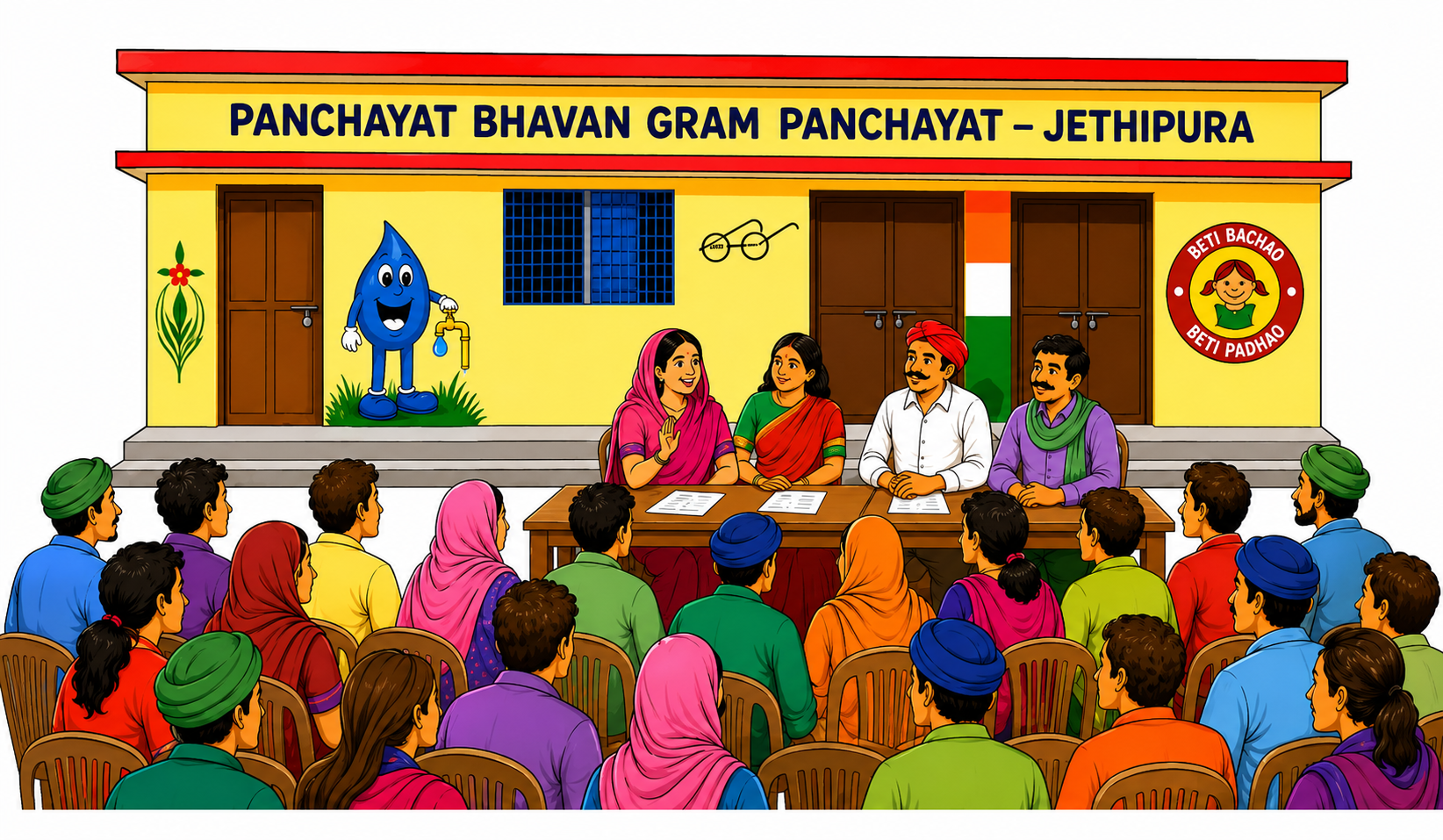
In countries like Britain (1928) and the USA (1920), women had to protest for decades to secure voting rights. In contrast, when India's Constitution came into force in 1950, Universal Adult Franchise was immediately extended to all citizens—men and women alike—without prolonged legal battles.
To further empower women, Article 243(d) guarantees not less than one-third reservation for women in Panchayats and Municipalities. As of 2023, many states have increased this to 50% reservation for women in local bodies.
Enacted through democratic processes, consultations, and pressure from civil society and journalists. It empowers citizens to seek information from government departments, strengthening accountability and legislation (laws made by the government to maintain order).
Democracy requires constant care and active participation. India faces several challenges:
A major challenge was recorded when a National Emergency was imposed in June 1975 due to internal disturbance. Fundamental Rights were suspended, press censored, and leaders arrested. Mass movements led by Jayaprakash Narayan (Lok Nayak) mobilised students and citizens. When the Emergency was lifted in 1977, the defeat of the ruling government demonstrated the immense resilience and strength of Indian democracy.
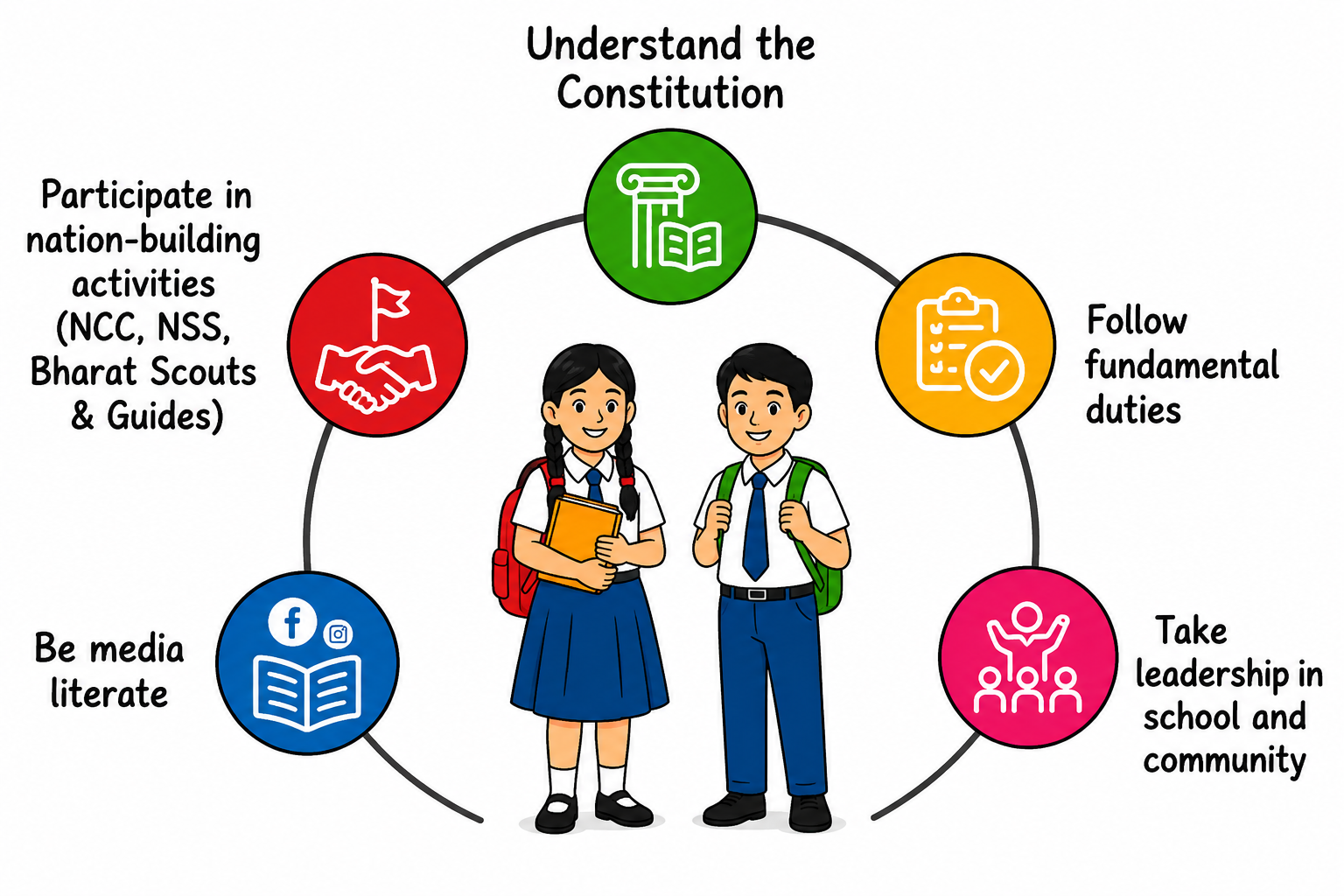
Being well-informed is a vital responsibility. Programmes like the National Service Scheme (NSS) and National Cadet Corps (NCC) instill civic responsibility. This includes respecting others' rights, using social media responsibly, and abiding by laws.
 VARDAAN COMET