
To understand historical developments, we must first define two foundational concepts:
This chapter traces how kin-based social organisations (jana, kula) developed into more complex territorial units like janapadas, mahajanapadas, and eventually vast empires (like the Mauryas and Guptas in the north, and Cholas in the south).
The Vedas constitute the earliest known corpus of Indian literature. The exact date of the Rig Veda is debated among historians (estimates range from the 5th millennium BCE to the 2nd millennium BCE). It was composed in the northwestern part of the subcontinent (the Sapta-Sindhu region), where the Sindhu-Sarasvati civilisation flourished.
| Veda | Description |
|---|---|
| Rig Veda | The earliest Veda, consisting of 1,028 hymns (suktas). Contains praises of deities and universal thoughts (creation, birth, death). |
| Yajur Veda | Elaborates the performative aspects of yajnas (sacrifices) and explains the hymns in prose. |
| Sama Veda | Comprises hymns drawn from the Rig Veda arranged for musical recitation. Forms the foundation of Indian music (seven svaras). |
| Atharva Veda | Contains hymns intended to ward off evil and others related to the treatment of physical and mental ailments. |
Each text of the Veda is further divided into four distinct parts:
Early Vedic society was organised into janas or clans. These were groups of people bound together by kinship ties. For instance, the Rig Veda mentions the panchajana ('five peoples'): Yadu, Turvasha, Puru, Anu, and Druhyu.
The term 'Bharata jana' referred to the people ruled by the family of the Bharatas (giving rise to the name 'Bharata' for India).
The raja (king) functioned primarily as a clan chief who led the group in warfare and ensured their protection. The power of the raja was checked and guided by institutionalised assemblies ensuring people's participation.
| Assembly | Function and Composition |
|---|---|
| Sabha | A smaller body composed of select elites that primarily served a judicial function. |
| Samiti | A larger assembly representing the broader population, focused on policy decisions and political affairs. |
| Vidhata | A popular gathering attended by members of the community (janas), functioning as a forum for discussions on warfare and other matters. |
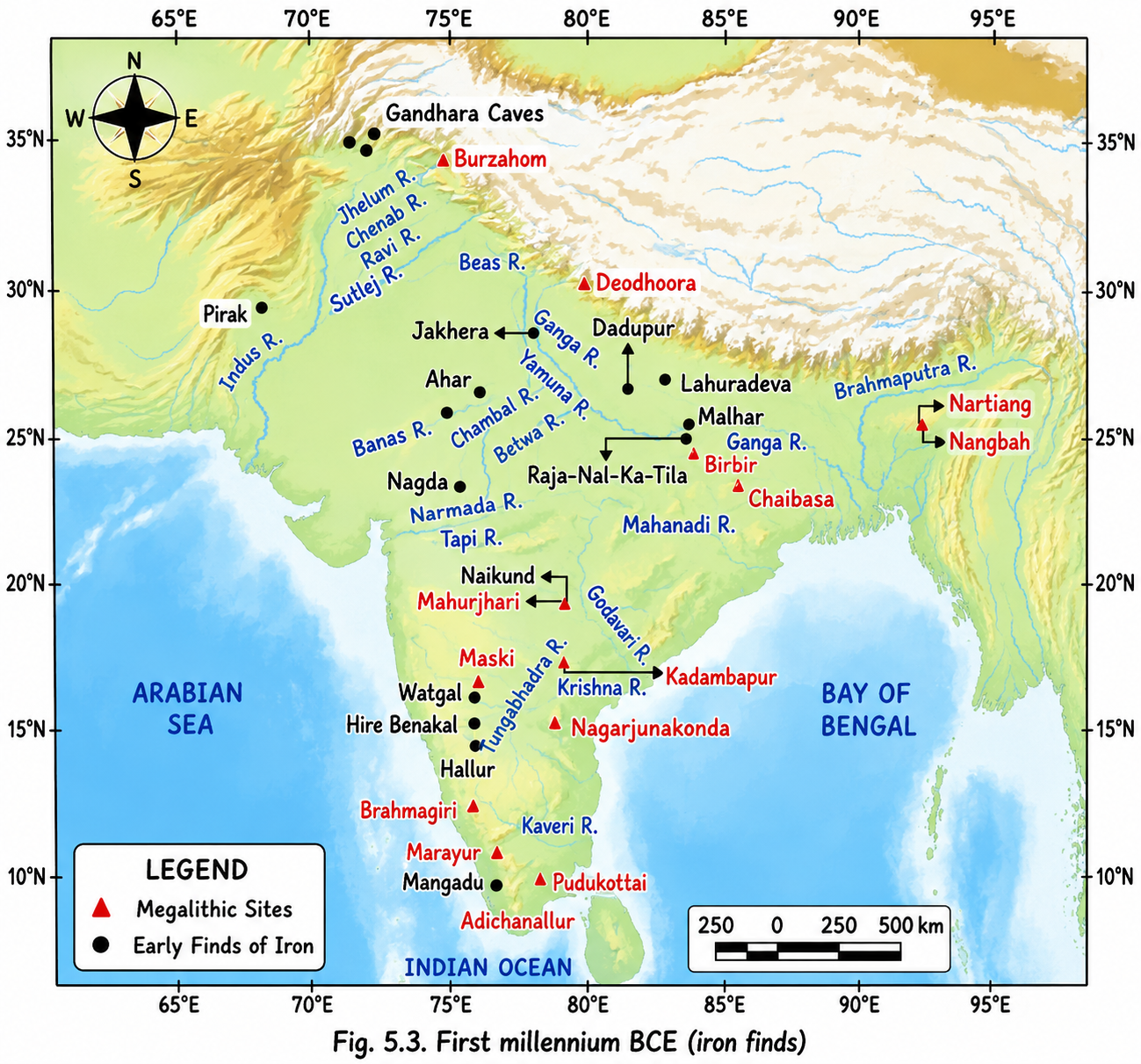
Over time, the center of Vedic culture shifted from the northwestern regions to the fertile Ganga plains. This period (first millennium BCE) saw the emergence of a richer material culture, marked by:
As society expanded territorially, the kin-based janas evolved into janapadas (literally meaning "where a people (jana) first set its feet"). This marked a massive shift from kinship-based identity to territorial identity between 1000 BCE and 600 BCE.
Control over land, agriculture, and trade routes became increasingly important. This consolidation led to the rise of larger, more complex political formations known as mahajanapadas between 600 BCE and 300 CE.
Historical sources identify sixteen mahajanapadas (e.g., Kuru, Panchala, Kosala, Vatsa). Among these, Magadha (located in present-day Bihar) emerged as the most powerful due to its strategic location, highly fertile plains, and strong rulers, ultimately paving the way for the mighty Mauryan Empire.
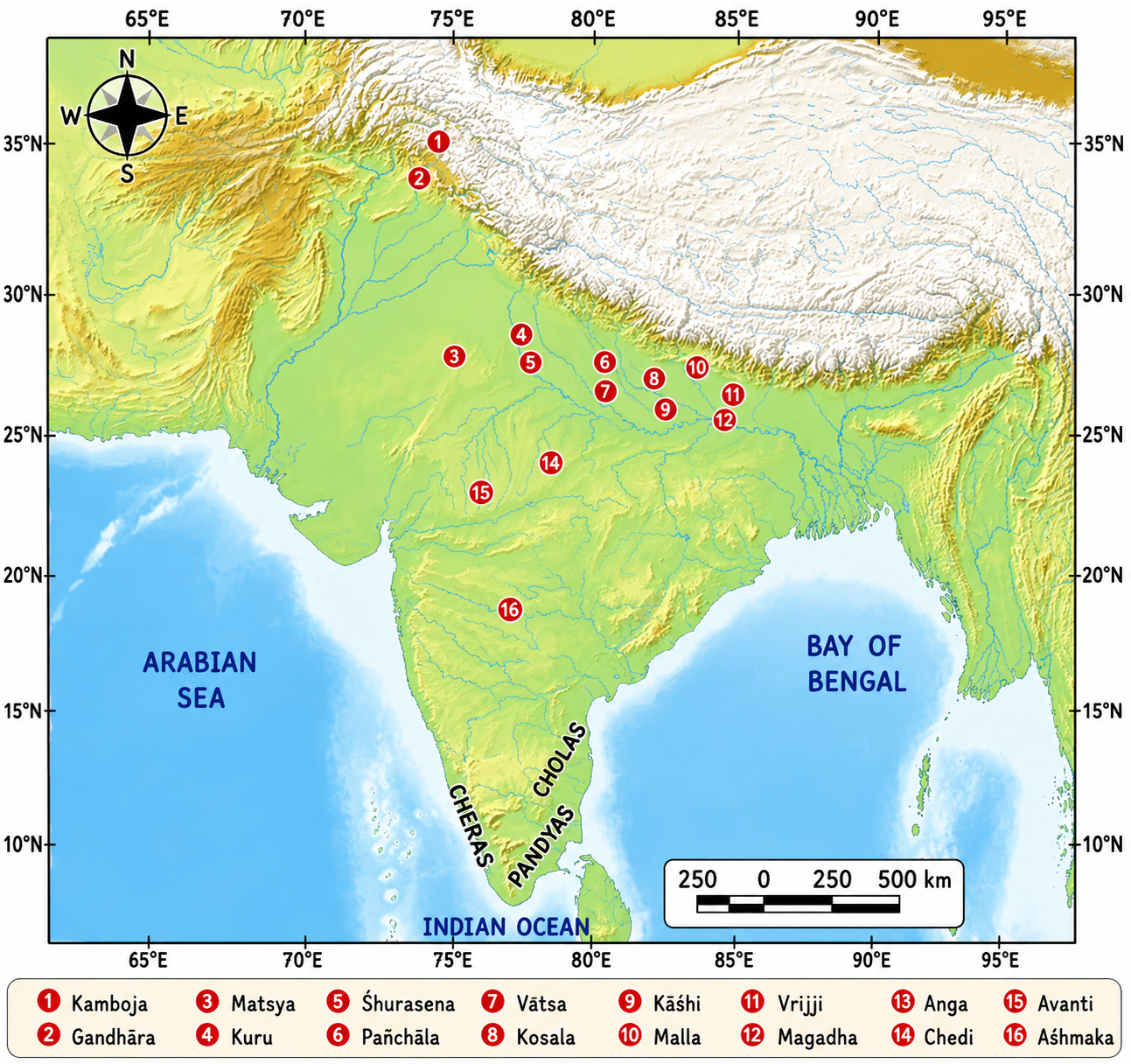
While northern India saw the rise of different forms of political organisation (monarchies and republics), southern India also developed powerful states. In the Deccan, the Mauryan Empire was succeeded by the Satavahana Empire (lasting from 2nd century BCE to 3rd century CE).
Further south in peninsular India, early Tamil kingdoms flourished in fertile rice-growing regions. These polities are also mentioned in Ashokan inscriptions:
Much of what we know about these early Tamil kingdoms comes from Sangam literature, the earliest Tamil literary tradition (composed between 300 BCE and 300 CE). The Chera, Chola, and Pandya rulers were known as the three crowned kings or "Vendar of Tamilakam".
From the 6th century BCE onwards, rulers adopted titles like raja, maharaja, or samrat. Early Indian texts provide deep insights into the ideals of kingship:
Geopolitical awareness extended beyond a king's local boundaries to the whole Indian subcontinent. This pan-Indian awareness was expressed through terms like Jambudvipa, Bharatavarsha, Ashvamedha, and chakravarti kshetra (domain of a universal paramount ruler).
For example, Ashoka's edicts mention Jambudvipa, and a Chera king (Nedunjeral Adan) won the rank of adhiraja, claiming conquests up to the Himalayas. Later, Chola ruler Rajendra I adopted the title Gangaikonda to commemorate his conquests in the north.
The state was regarded as an organic whole composed of seven constituents, according to Kautilya's Saptanga:
The king did not rule alone but through a mantri-parishad (council of ministers), an advisory body of elder statesmen that included the treasurer, chief tax collector, chief legal advisor, and commander-in-chief.
Empires were divided into administrative units to govern effectively:
Villages remained the lowest but most self-reliant administrative units. The Pallavas and Chalukyas made tax-free land grants to villages (known as Brahmadeya or agraharams for Brahmin settlements). Village assemblies had small committees called variyams that managed irrigation, gardens, and temples independently of royal administration.
.png)
The Uttaramerur inscription of Parantaka I (10th century) details the functioning of Chola village assemblies. It describes the Kudavolai or 'ballot pot' system for village elections. Candidates' names were written on palm leaves and put in a pot. A child would randomly draw leaves to select representatives for specialised committees (variyams), ensuring fairness.
Ethics formed the basis of law and state governance in ancient India. Key concepts include:
Early Vedic texts do not indicate a fixed social status strictly based on birth. The four-fold varna system (brahmanas, kshatriyas, vaishyas, shudras) was originally a functional division based on values and occupation, not rigid birthrights. For example, a Rig Veda verse notes: "I am a poet; my father is a physician, my mother is a grinder of corn."
Gradually, a distinct structure called jati emerged due to intermarriage, territorial differences, and communities becoming endogamous (marrying strictly within their own social group). While there were only four varnas, the number of jatis grew indefinitely as new occupations developed.
Despite these categories, there was considerable social and occupational mobility. Many rulers came from diverse backgrounds (e.g., Mauryas, Guptas, Satavahanas). An inscription from Mandsaur (473 CE) mentions a guild of silk weavers who migrated from Gujarat to Madhya Pradesh and became proficient in archery and astrology as well.
The kula (family) formed the smallest basic unit of society. The concept of gotra referred to a patrilineal lineage traced to a common ancestor (a Vedic sage), which played a crucial role in regulating marriage practices.
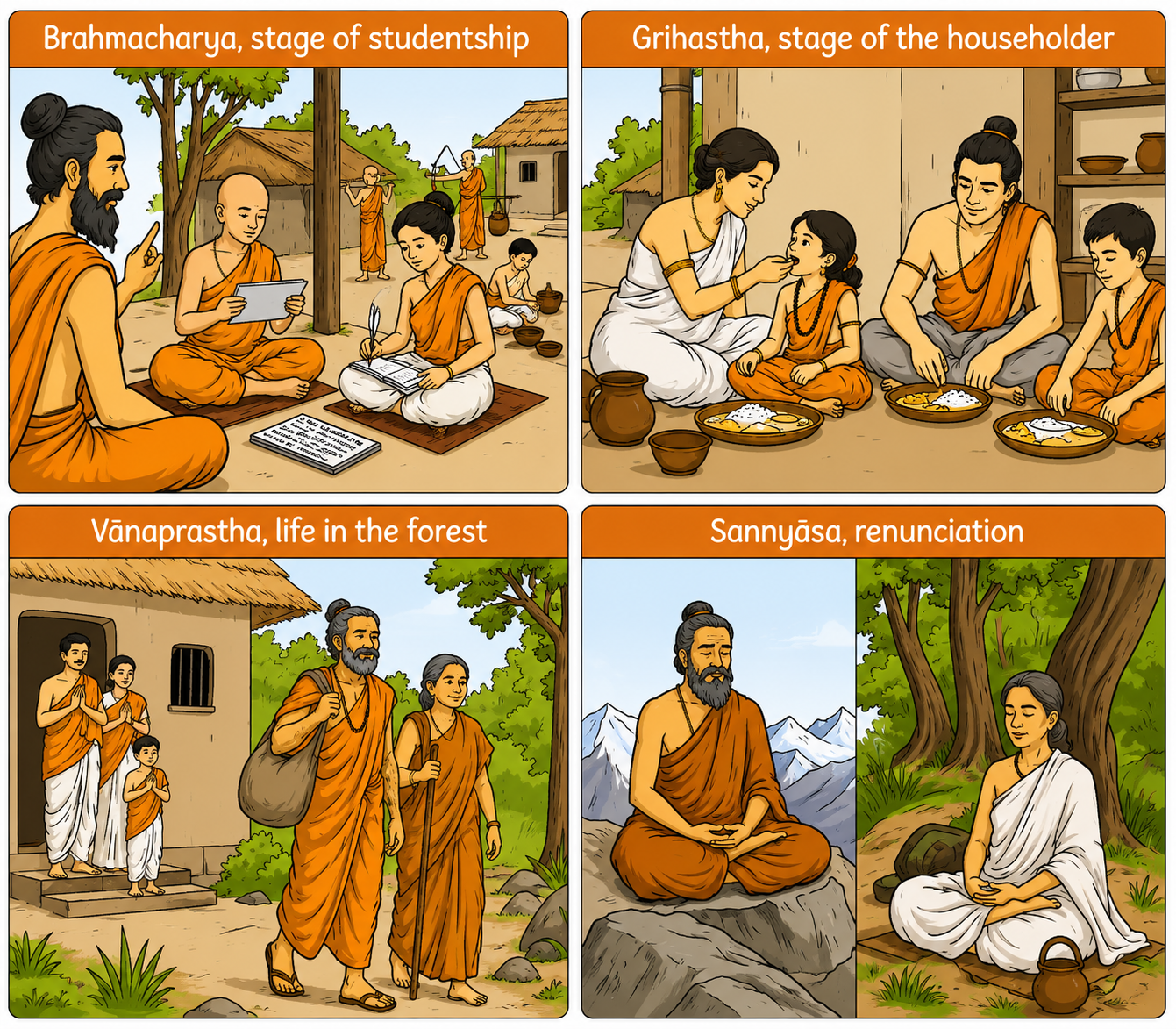
Life was ideally divided into four stages (ashramas), accompanied by sixteen rites of passage (shodasha samskaras):
The four goals of life (purusharthas) were: dharma (righteousness), artha (material well-being), kama (desires), and moksha (liberation).
During the Vedic period, women held high, respectful positions. They participated in scholarly learning, attended the sabha, and performed rituals. The Rig Veda features hymns composed by notable women sages like Apala, Vishvavara, Ghosha, and Lopamudra.
Though their status fluctuated over time, historical records from the Gupta-Vakataka period (like Queen Prabhavati Gupta) and the Chola period (Sembiyan Mahadevi) show women playing vital roles in governance, land grants, and temple patronage. Sangam literature also celebrates influential poetesses.
In early India, education was an integral part of life serving a holistic purpose. It cultivated inner values like truth, patience, humility, and control of senses. The guru-shishya parampara (teacher-student relationship) was highly sacred. Students lived with their teacher (guru or acharya) in a gurukula, receiving practical education across subjects like Vedas, grammar, logic, philosophy, medicine, and astronomy, alongside arts, crafts, and archery.
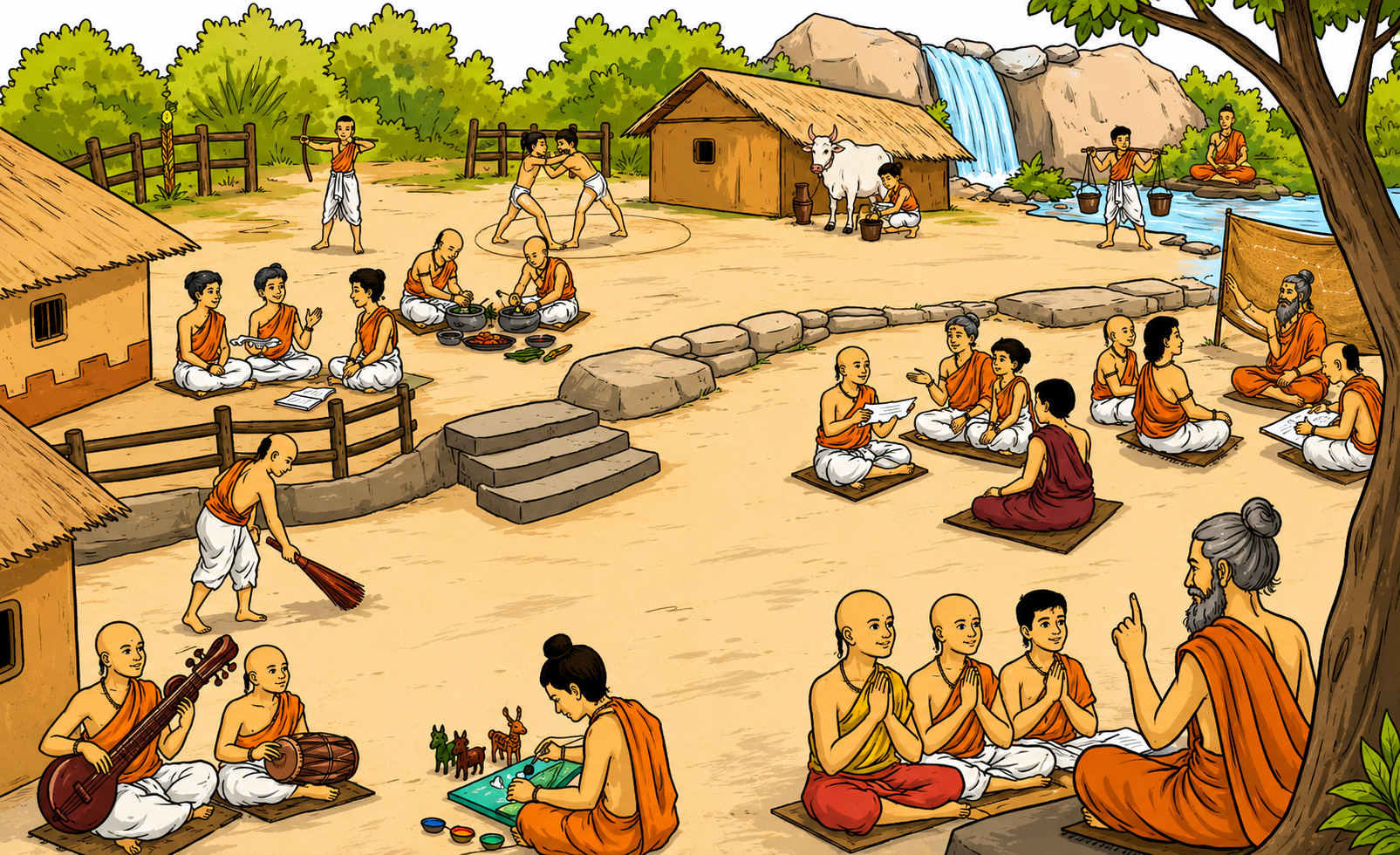
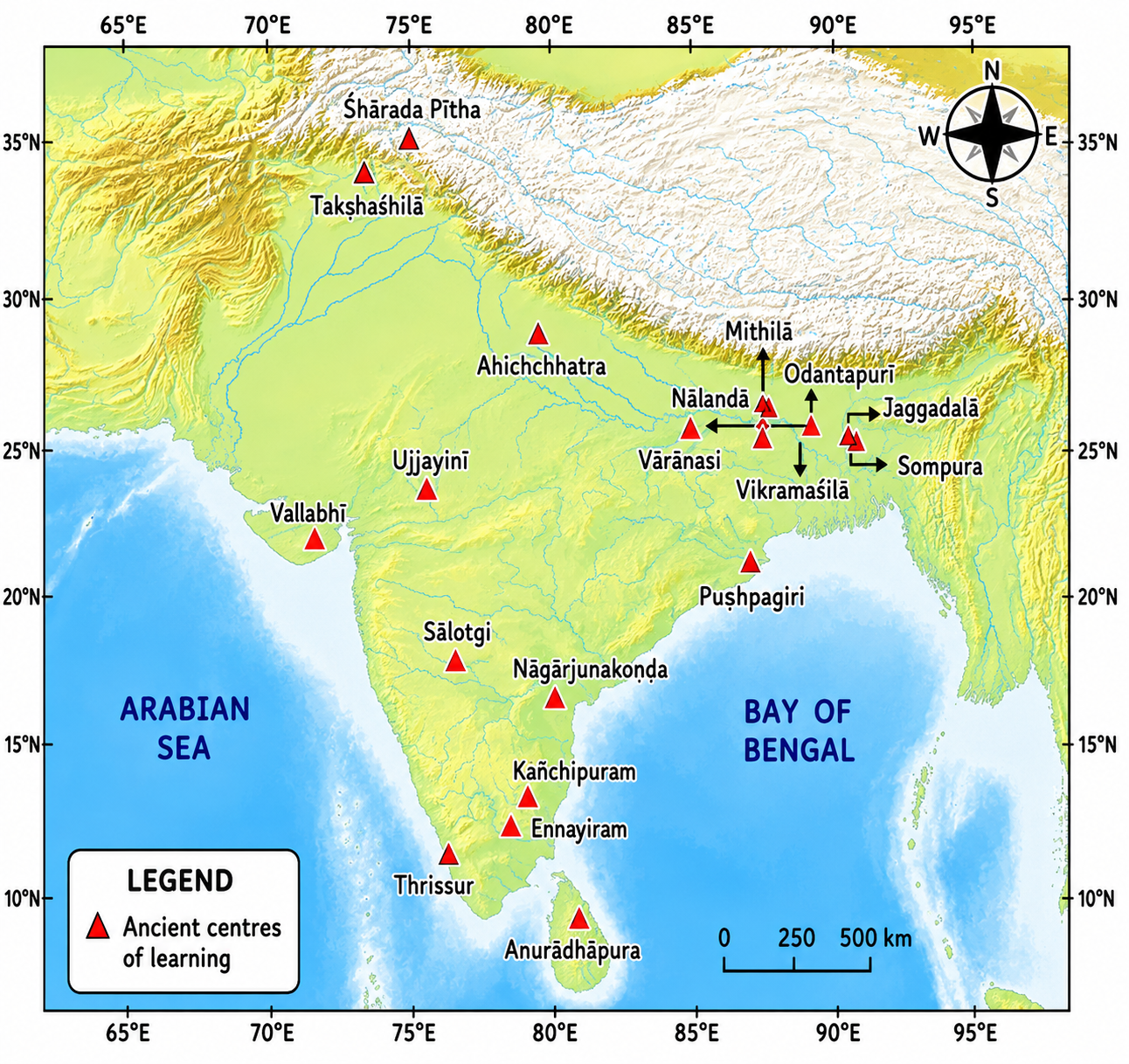
Over time, institutions of higher learning (early universities) emerged, attracting students from across India and beyond. Prominent ancient centres of learning included Takshashila, Nalanda, Vallabhi, and Kanchipuram.
The Mauryan state developed an elaborate system to regulate economic activities. Agriculture remained the backbone of the economy. The basic tax on land for revenue assessment was generally fixed at one-sixth of the produce. A wide variety of crops were cultivated, including rice, wheat, pulses, cotton, and sugarcane.
Irrigation was critical. The Junagadh inscription records that Pushyagupta, a Mauryan governor, constructed a dam on Sudarshana Lake. In the south, the Cholas were master builders of irrigation systems, most notably the Grand Anicut (Kallanai) built by Karikala Chola, which remains in use even today.
The emergence of well-structured states provided infrastructure for trade to flourish. Magadha, for instance, traded textiles, gems, pearls, and salt. The state ensured the safety of trade routes and prevented adulteration of goods.
Two major overland routes developed:
Indian ports (like Muziris, Kaveripattinam, Arikamedu) facilitated robust maritime trade across the Indian Ocean and the Persian Gulf. By the early Common Era, India's trade with Rome had expanded significantly.
The early Indian economy was strongly supported by collective organisations known as guilds (shrenis). These were associations of people engaged in the same profession, craft, or occupation (like weavers or merchants).
Guilds were highly influential. They regulated the quality of goods and fixed prices. Remarkably, they also functioned as Financial Institutions (banks). The Nashik cave inscription records that monetary donations were deposited with professional guilds, which paid a fixed rate of interest used to maintain Buddhist monasteries.
 VARDAAN COMET