
The history of humanity goes back much further than the various kingdoms, empires, and even the Sindhu-Sarasvati civilisation. The period before the development of writing is understood mainly through archaeological evidence, as written languages emerged at different times in different parts of the world.
One of the earliest known writing systems is associated with the Sindhu-Sarasvati Civilisation (or Indus Valley Civilisation / Harappan Civilisation). Writings found on seals and pottery indicate the use of a pictographic script. However, since it has not yet been deciphered, it is still referred to as the Sindhu lipi.
Other early writing systems include the cuneiform script of the Sumerians in Mesopotamia and the hieroglyphic script of ancient Egypt, both flourishing around the same time. These have been deciphered, marking the beginning of the historical period roughly 5000 years ago.
The invention of writing is a major dividing line in human history. A comparison helps us understand its impact:
| Parameter | Before Writing | After Writing |
|---|---|---|
| Human History | More than 99% of human history (from about 3 million years ago to 5000 years ago). | Less than 1% of human history (the last 5000 years, including present). |
| Main Source for Reconstruction | Tools, implements, and other material objects (artefacts) made by humans. | Both material remains and written documents reconstruct people's lives. |
| Lives of the People | Difficult to understand their complex thoughts and ideas. | Literature provides information about names, events, and socio-political life. |
| Measurement of Time | Dating of events and cultures is only approximate. | Dating becomes relatively accurate due to mentioned specific dates (coronations, wars, etc.). |

Studying early human history helps us understand the long process of biological and cultural evolution in relation to changes in climate and the environment.
Over time, human life changed from hunting and gathering to agriculture and food production, leading to the creation of surplus food and material goods. This laid the foundation for civilisation.
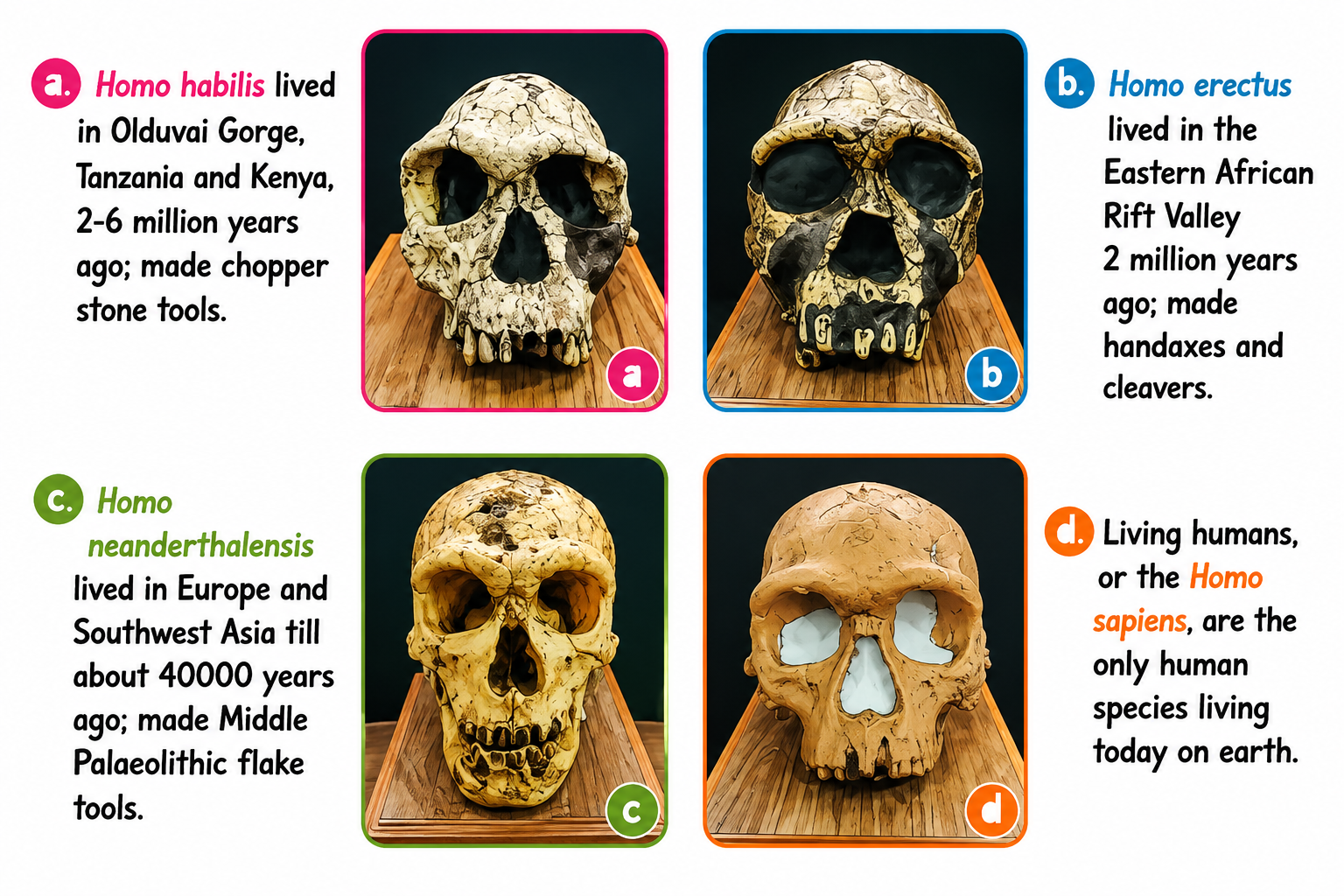
Our earliest ancestors evolved in Africa around 2 million years ago. Homo erectus was the first hominin to exit Africa, with stone tools like handaxes and cleavers found in parts of Asia and Europe, indicating their dispersion. Later, Homo sapiens (modern humans) evolved in Africa around 300,000 years ago and subsequently spread all over the earth.
The earliest human settlements constitute what we today call the 'Old World' (Africa, Asia, and Europe). Different human ancestors co-existed at times. Around 3.3 million years ago, the earliest stone tools were made, marking the beginning of 'human behaviour' distinct from animals.
Humans were known as hominins or tool makers. Tools functioned as extra-corporal limbs, extending physical capabilities. Over time, discarded tools got buried and turned into fossils, which are key sources of evidence.
Fossil: The preserved remains, traces, or impressions of plants, animals, or humans from the distant past. They form when remains get buried under layers of earth and slowly turn into stone over thousands or millions of years.
Key human ancestors identified through archaeological findings include:
Early human history is divided based on technological progress, development of tools, beginning of agriculture, and settlement patterns.
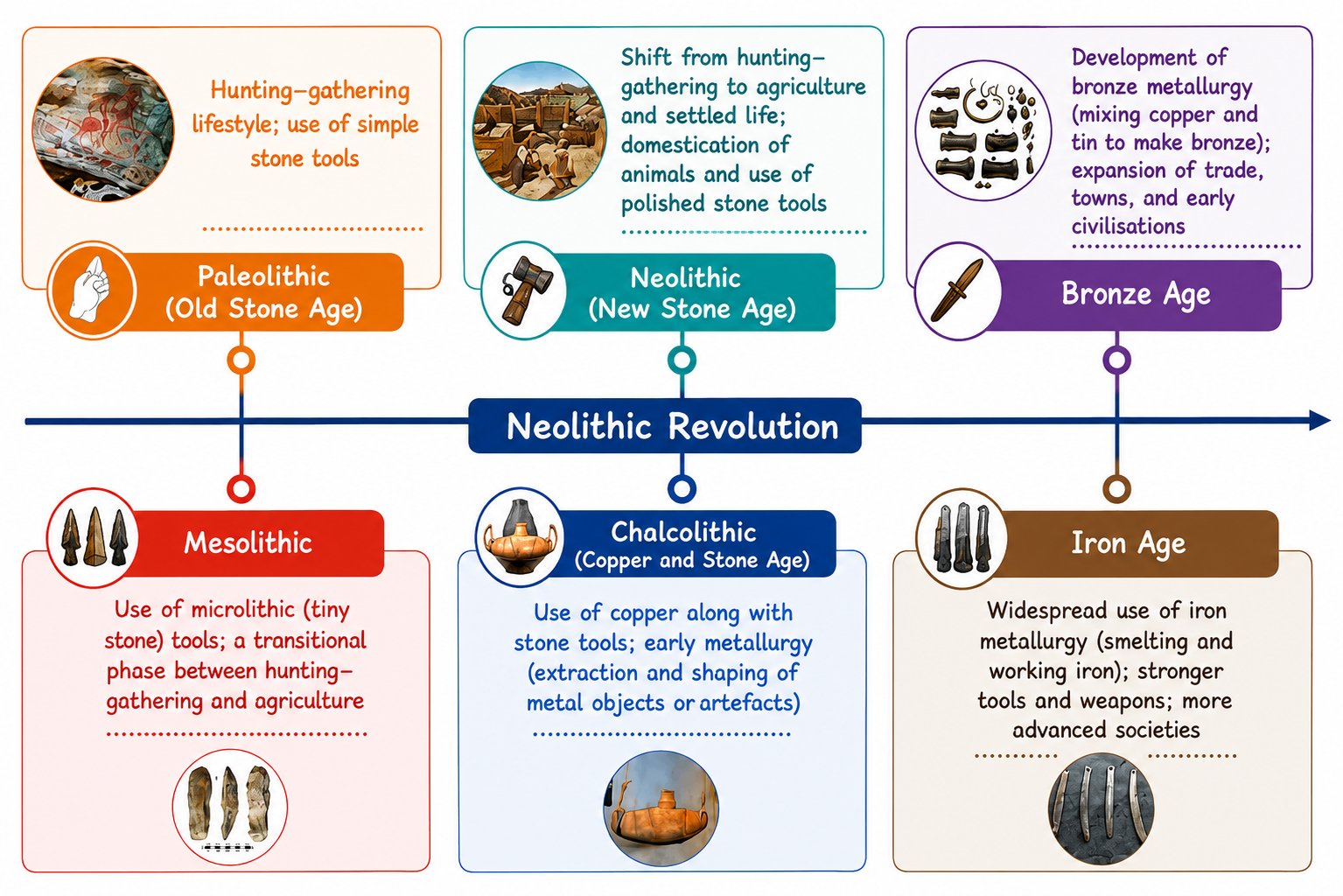
The word palaeo means 'old' and lithic means 'stone'. Characterized by a hunting-gathering lifestyle and the use of simple stone tools. In the Indian subcontinent, the oldest settlements date back to about 2 million years ago (e.g., Attirampakkam in Tamil Nadu is dated to 1.5-1.7 million years ago, Isampur in Karnataka to 1.2 million years ago).
Tools like handaxes, cleavers, scrapers, and choppers made of quartzite and limestone were used to chop meat, dig tubers, scrape animal skin, and extract bone marrow.
Progress was reflected in smaller, more efficient stone tools (scrapers, borers, points). Humans eventually invented the bow and arrow, parallel-sided blade tools, and microblades. They hunted small game, developed symbolic communication, decorated caves with paintings, and produced beads of stone, bone, and shell.
Around 12,000 years ago, Earth's climate became warmer. Ice sheets melted, and forests and grasslands expanded. This created a wider variety of resources (small animals, fish, wild grains), leading to the first-ever population explosion in human history.
People used microlithic tools (tiny stone tools) often fixed in handles of bone or wood to form saws and sickles. Aquatic food and fishing became mainstays of their subsistence. Art flourished, with rock shelters frequently occupied.
Example: The World Heritage Site of Bhimbetka in Madhya Pradesh contains hundreds of painted rock shelters showcasing Mesolithic and earlier human occupation and cave art.
As hunter-gatherers gained familiarity with seasons and different types of food resources, there was a gradual transition to a food-producing way of life, known as the Neolithic revolution.
The hallmark of this revolution was the domestication of select animals and plants, bringing them under human control, and the development of new breeds through cultivation and husbandry. Neolithic farmers made tools for food production and processing, developed earthenware pottery of various shapes, utilised raw materials, and established the first village settlements, laying the foundations for the urban revolution.
There was regional variation in the initiation of agricultural ways of life in the Indian subcontinent. In the northwest, the site of Mehrgarh on the Bolan River (in present-day Pakistan) is the oldest Neolithic site and agricultural village, dating back to about 7000 BCE. They built handmade sun-dried brick houses and granaries, buried their dead in graves with ornaments (lapis lazuli, carnelian), cultivated wheat and barley, and raised sheep, goats, and the Indian cattle (zebu humped bull).
They were also the first to make copper objects, entering the metal age and becoming known as Chalcolithic people by about 4000 BCE. By 2500 BCE, most of the Indian subcontinent was occupied by Neolithic agricultural communities.
The Neolithic way of life from the foothills of Baluchistan spread into the middle and upper Indus valley. Some of these settlements mastered the extraction of copper from its ores around 4000 BCE, becoming the earliest Chalcolithic sites and marking the beginning of the Bronze Age.
Introduction of copper tools in the fertile plains of the Indus and Ghaggar-Sarasvati basins enhanced productivity. This led to prosperity and large-scale production of diverse regional pottery.
Some sites like Bhirrana and Kunal (pre-Harappan phase between 7000 and 5500 BCE) evolved over time and became standard features of the Sindhu-Sarasvati civilisation by about 2500 BCE. This continuous stage is described as Early Harappan.
Features include continuity in pottery traditions, semi-precious stone beads, shell bangles, terracotta objects, copper working, perimeter walls, use of seals, and the beginnings of Harappan writings/script.
The Early Harappans ploughed fields (as seen at Kalibangan) showing horizontal and vertical furrows, indicating double crop cultivation (like the seasonal Rabi and Kharif cultivation practiced even today).
The Harappans had their own standard systems of weight and measurement, reflecting efficient interregional trade practices. They followed a binary multiple system (1, 2, 4, 8, 16...) for weighing smaller units and multiples of ten for larger denominations using cubical stone weights.
Four early world civilisations emerged in fertile river plains:
Due to geographical proximity, the Mesopotamian and Harappan civilisations had strong contacts and trade. The Egyptian and Chinese civilisations had little tangible evidence of direct contact with the Sindhu-Sarasvati civilisation.
Mesopotamia (Greek for "land in between") was drained by the Euphrates and Tigris rivers. It is known as the 'fertile crescent' due to its high agricultural potential. Over time, large cities became 'city-states'.
The Sumerians: Earliest to evolve into a city-based civilisation at Ur (southern Iraq). They were the first to build dams/canals for irrigation, use mud bricks/burnt bricks for construction, and invented the wheeled cart and sailboat. They built massive step-pyramid temples called ziggurats.
Cuneiform Script: Sumerians were the first to start writing around 3300 BCE. Their writing system is known as cuneiform (from Latin 'cuneus' meaning wedge), written by pressing a wedge-shaped stylus into soft clay tablets.
Other Mesopotamian Empires:
Emerged along the river Nile, which flooded every summer leaving behind rich mud called 'kemet' (the black land). Egyptian history is reconstructed from papyrus (old paper records made from plant strips). Their script was deciphered in 1822 using the famous Rosetta Stone.
Pharaohs and Pyramids: Powerful rulers were called 'Pharaohs'. Because Egyptians believed that a spiritual double (ka) lived on after death, they preserved bodies through mummification and buried Pharaohs in massive structures called Pyramids.
Society and Calendar: They had a 365-day calendar based on the Dog Star (Sirius). Women in Egypt enjoyed more rights than their Greek or Roman counterparts, often owning property and running businesses (e.g., Queen Cleopatra).
Flourished along the Huang He (Yellow River) and the Yangtze. Early dynasties included the Shang dynasty (1600-1046 BCE) and Zhou dynasty (1046-256 BCE) during the Bronze Age. The Qin dynasty (221-206 BCE) is credited with unifying the country, and the name 'China' comes from the Ch'in (Qin) dynasty.
Sources and Culture: Information comes from 'oracles'—symbols carved on animal bones and tortoise shells. The Chinese script is logographic (characters represent words, not sounds). They were masters of jade carving and bronze metallurgy.
Key Innovations:
 VARDAAN COMET