Created by Team Vardaan with ♥|Powered byVARDAAN COMET
NCERT Solutions: Sound Waves
Class 9 Science Chapter 10 - Official Textbook Solutions
Part 1: In-Text "Pause & Ponder" Questions & Solutions
Pause & Ponder 1 & 2
1. Explore various ways of producing sound.
2. Make a list of different types of musical instruments and identify their vibrating parts which produce sound.
✅ Detailed Solution
1. Ways of Producing Sound: Sound is produced by vibrating objects. Common methods include:
Blowing air columns into hollow pipes (e.g., flute, trumpet).
Striking stretched membranes (e.g., tabla, drum).
Striking metal or wooden plates/bars (e.g., tuning fork, xylophone, cymbals/taal).
Vibrating vocal cords by forcing air from lungs through larynx.
2. Table of Musical Instruments & Vibrating Parts:
Category
Instrument Name
Vibrating Part Producing Sound
Stringed Instruments
Sitar, Guitar, Violin, Veena
Stretched strings
Wind Instruments
Flute (Bansuri), Shehnai, Harmonium
Air column inside hollow tube / Air reeds
Percussion (Membrane)
Tabla, Mridangam, Dholak
Stretched drum membrane (skin with syaahi patch)
Solid Percussion
Cymbals (Manjira/Taal), Jal Tarang
Metal plates / Water filled ceramic bowls
Pause & Ponder 3
Assertion (A): We cannot hear the sound of a bell ringing in a closed jar after most of the air is pumped out.
Reason (R): Sound requires a medium to travel.
Choose the correct statement:
(i) Both A and R are true, but R is not the correct explanation of A.
(ii) Both A and R are true, and R is the correct explanation of A.
(iii) A is true, but R is false.
(iv) A is false, but R is true.
(i) Both A and R are true, but R is not the correct explanation of A.
✔ (ii) Both A and R are true, and R is the correct explanation of A.
(iii) A is true, but R is false.
(iv) A is false, but R is true.
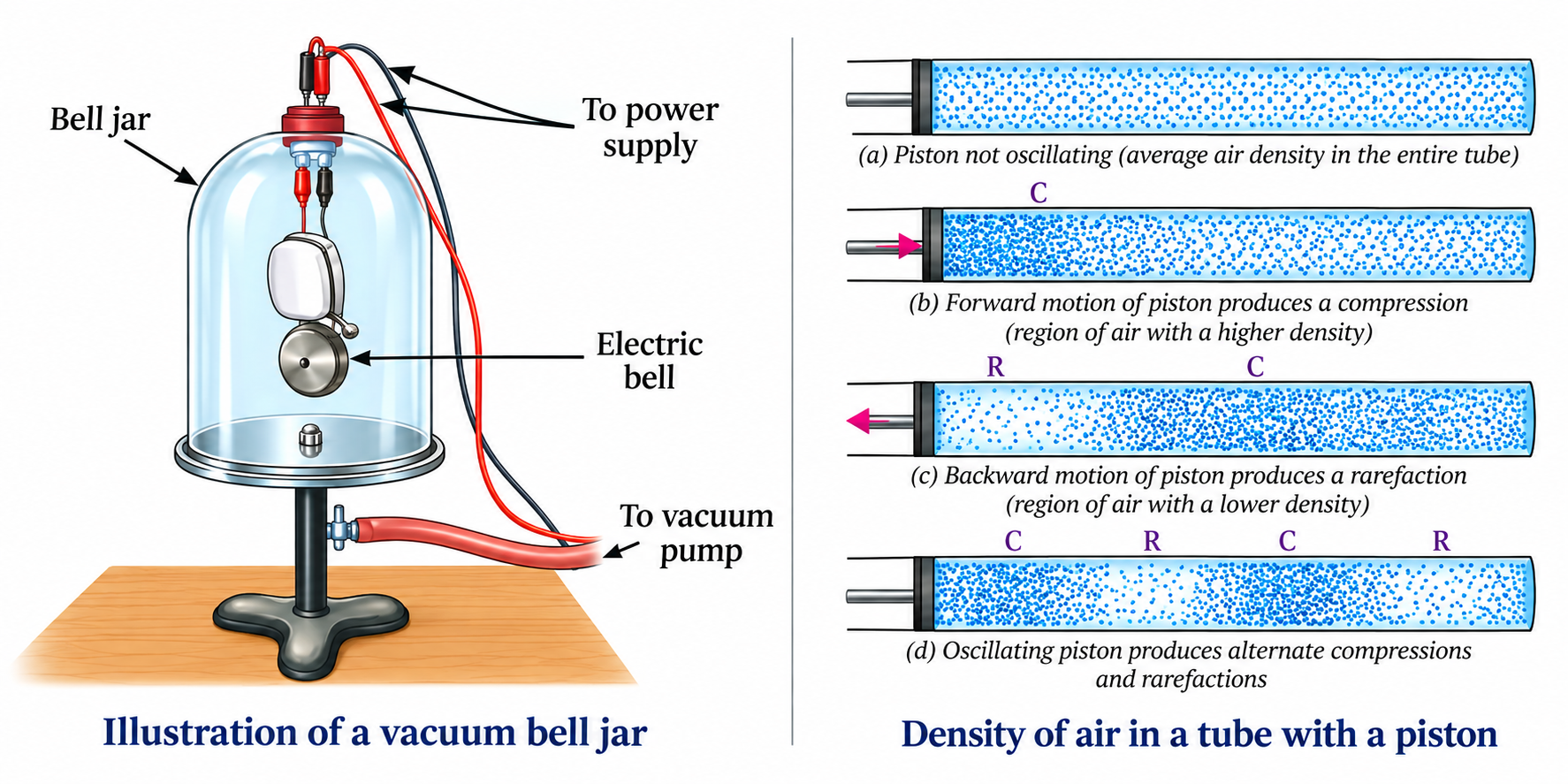
Reference Diagram: Vacuum Bell Jar Experiment (Fig 10.7)
✅ Detailed Solution
Sound is a mechanical wave that propagates by creating density/pressure disturbances in medium particles. In the bell jar experiment, as air is evacuated, there are fewer medium particles to transmit vibrations. In a near vacuum, sound cannot propagate at all. Hence, Reason (R) correctly explains Assertion (A).
Correct Option: (ii) Both A and R are true, and R is the correct explanation of A.
Pause & Ponder 4
Assertion (A): Compressions and rarefactions move through the medium.
Reason (R): Individual particles of the medium continuously move forward with the wave.
Choose the correct statement:
(i) Both A and R are true, but R is not the correct explanation of A.
(ii) Both A and R are true, and R is the correct explanation of A.
(iii) A is true, but R is false.
(iv) A is false, but R is true.
(i) Both A and R are true, but R is not the correct explanation of A.
(ii) Both A and R are true, and R is the correct explanation of A.
✔ (iii) A is true, but R is false.
(iv) A is false, but R is true.
✅ Detailed Solution
Explanation: Assertion (A) is TRUE because compressions (high density) and rarefactions (low density) propagate forward as a disturbance. However, Reason (R) is FALSE because individual medium particles do NOT move continuously forward; they only oscillate back and forth about their fixed mean positions.
Correct Option: (iii) A is true, but R is false.
Pause & Ponder 5
When sound travels from a tuning fork to your ear, which of the following actually reaches your ear?
(i) Air particles near the tuning fork
(ii) Energy carried by sound waves
(iii) The tuning fork material
(iv) A continuous stream of compressed air
(i) Air particles near the tuning fork
✔ (ii) Energy carried by sound waves
(iii) The tuning fork material
(iv) A continuous stream of compressed air
✅ Detailed Solution
In wave propagation, it is the energy of the disturbance that travels through particle-to-particle collisions. The air particles themselves near the tuning fork stay in their local vicinity and oscillate back and forth.
Correct Option: (ii) Energy carried by sound waves
Pause & Ponder 8 & 9
8. If the frequency of a sound wave produced by an oscillating piston of a long tube filled with air is 20 Hz, then how many oscillations does the piston complete per minute?
9. For the sound wave represented by the graph shown in Fig. 10.19 (where distance between consecutive peaks is 3.0 cm), what is half of its wavelength?
✅ Detailed Solution
Solution to Q8:
Frequency $\nu = 20\text{ Hz} = 20\text{ oscillations/second}$.
Number of oscillations in 1 minute ($60\text{ seconds}$) $= 20 \times 60 = \mathbf{1200\text{ oscillations/min}}$.
Solution to Q9:
From graph Fig. 10.19, the full wavelength $\lambda$ (distance from 0 to peak to next peak) $= 3.0\text{ cm}$.
Part 2: Chapter-End Exercise Solutions (Revise, Reflect, Refine)
Question 1
Which observation best supports the idea that sound is a mechanical wave?
(i) Sound shows reflection
(ii) Sound needs a medium to propagate
(iii) Sound has frequency
(iv) Sound carries energy
(i) Sound shows reflection
✔ (ii) Sound needs a medium to propagate
(iii) Sound has frequency
(iv) Sound carries energy
✅ Detailed Solution
A mechanical wave is defined as a wave that propagates through the vibration of material particles and strictly requires a physical medium (solid, liquid, or gas) to travel. Electromagnetic waves (like light) also show reflection, carry energy, and have frequency without needing a medium. Therefore, the requirement of a material medium is the definitive proof that sound is a mechanical wave.
Correct Option: (ii) Sound needs a medium to propagate
Question 2
For a sound wave propagating in a medium, increasing its frequency will increase its:
(i) wavelength
(ii) speed
(iii) number of compressions per second
(iv) time period
(i) wavelength
(ii) speed
✔ (iii) number of compressions per second
(iv) time period
✅ Detailed Solution
Frequency ($\nu$) is defined as the number of complete oscillations (compressions and rarefactions passing a fixed point) per unit time (second). Increasing frequency means more compressions pass per second.
Note: Speed $v$ depends only on the medium. Since $v = \lambda \nu$, increasing frequency decreases wavelength $\lambda$ and decreases time period $T = 1/\nu$.
Correct Option: (iii) number of compressions per second
Question 3
If 20 compressions pass a point in 4 seconds, the frequency is:
(i) 80 Hz
(ii) 5 Hz
(iii) 10 Hz
(iv) 0.2 Hz
(i) 80 Hz
✔ (ii) 5 Hz
(iii) 10 Hz
(iv) 0.2 Hz
✅ Detailed Solution
Given: Number of compressions $N = 20$, Time $t = 4\text{ seconds}$.
In a room, the reflected sound reaches the ear 0.05 s after its production. Will it produce an echo or reverberation? Justify your answer.
✅ Detailed Solution
Answer: It will produce reverberation.
Justification:
The human brain retains the sensation of any sound for approximately $0.1\text{ seconds}$ (known as persistence of hearing).
To hear a distinct, separate echo, the reflected sound must arrive at the ear at least $0.1\text{ s}$ after the original sound.
Here, the reflected sound arrives in $0.05\text{ s}$, which is less than $0.1\text{ s}$ ($0.05\text{ s} < 0.1\text{ s}$).
Therefore, the original sound and reflected sound overlap in the ear, resulting in a prolonged persistence of sound known as reverberation rather than a distinct echo.
Question 5
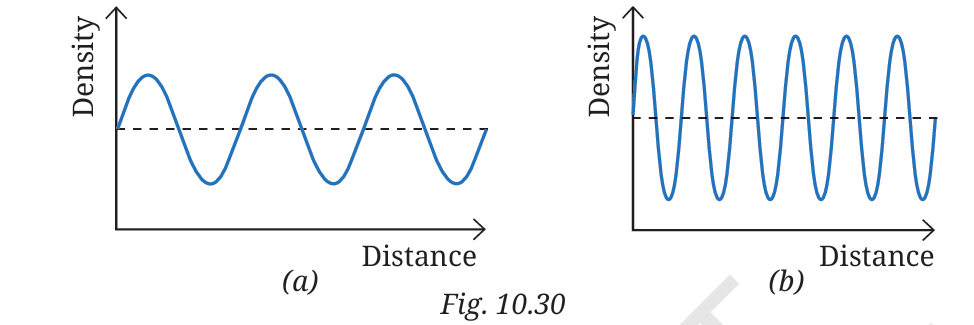
Graphs representing two sound waves are given in Fig. 10.30. If the scales on the X and Y axes of the two graphs are the same, which of the two sound waves has (i) greater wavelength, and (ii) smaller amplitude?
Figure 10.30: Sound wave graphs (a) and (b)
✅ Detailed Solution
Comparing graph (a) and graph (b) given in Fig. 10.30 on identical X and Y axes scales:
(i) Greater Wavelength ($\lambda$):
Wavelength is the horizontal distance between two consecutive crests or troughs along the X-axis.
In Graph (a), the crests are spread farther apart (fewer wave cycles per unit distance), meaning it has a larger crest-to-crest distance.
Hence, Graph (a) has the greater wavelength.
(ii) Smaller Amplitude ($A$):
Amplitude is the vertical height of a crest above the average baseline along the Y-axis.
In Graph (a), the height of the wave peaks is visually smaller than the tall peaks in Graph (b).
Hence, Graph (a) has the smaller amplitude.
(i) Graph (a) has greater wavelength | (ii) Graph (a) has smaller amplitude
Question 6
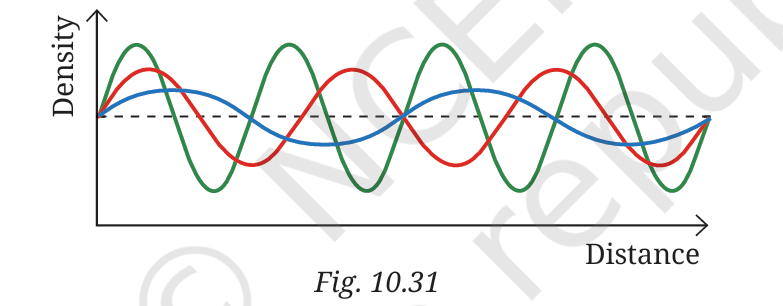
The sound waves emitted by three sources A, B and C are represented in Fig. 10.31. If the frequency of A is maximum and C is minimum, identify the corresponding curves, and mark A, B and C on them.
Figure 10.31: Sound waves from three sources
✅ Detailed Solution
Frequency corresponds to the number of wave cycles per unit distance on the graph:
Green Curve: Shows the highest number of oscillations/cycles within the given distance $\implies$ Maximum Frequency $\implies$ Source A.
Red Curve: Shows intermediate number of oscillations $\implies$ Medium Frequency $\implies$ Source B.
Blue Curve: Shows the least number of oscillations (widest wavelength) within the given distance $\implies$ Minimum Frequency $\implies$ Source C.
Green Curve = Source A (Max Frequency) | Red Curve = Source B | Blue Curve = Source C (Min Frequency)
Question 7
Draw a graph to represent a sound wave for which the density amplitude is 3 units and wavelength is 4 cm.
X-axis (Distance in cm): Wavelength $\lambda = 4\text{ cm}$. One full cycle starts at $0\text{ cm}$, crest at $1\text{ cm}$, baseline crossing at $2\text{ cm}$, trough at $3\text{ cm}$, and completes at $4\text{ cm}$. The second cycle completes at $8\text{ cm}$.
Figure 7: Density vs Distance graph with Amplitude = 3 units and Wavelength λ = 4 cm
Question 8
In a movie, while showing the explosion of a spacecraft in space, a flash of light is shown along with sound at the same time. What are the errors in this depiction?
✅ Detailed Solution
There are two major scientific errors in this movie depiction:
Sound cannot travel in outer space (Vacuum): Outer space is a near vacuum with no material medium (air). Sound is a mechanical wave that requires a material medium to propagate. Therefore, an explosion in space produces no sound that can be heard by an external observer.
Speed difference between Light and Sound: Light travels at an extremely high speed ($c = 3 \times 10^8\text{ m/s}$), whereas sound in air travels much slower ($\approx 340\text{ m/s}$). Even if air were present, the flash of light would be seen almost instantly, while the sound would arrive much later—never at the exact same time.
Question 9
A source produces a sound wave of wavelength 3.44 m. If the wave travels with a speed of 344 m s⁻¹ find its time period.
✅ Detailed Solution
Given:
Wavelength ($\lambda$) $= 3.44\text{ m}$
Speed of wave ($v$) $= 344\text{ m s}^{-1}$
Step 1: Calculate Frequency ($\nu$)
$$ v = \lambda \times \nu \implies \nu = \frac{v}{\lambda} = \frac{344\text{ m s}^{-1}}{3.44\text{ m}} = 100\text{ Hz} $$
A ship searching for a sunken ship sent a sonar signal and detected an echo after 5 s. If ultrasonic wave travels at 1525 m s⁻¹ in seawater, approximately how far down in the ocean is the wreckage of the sunken ship located?
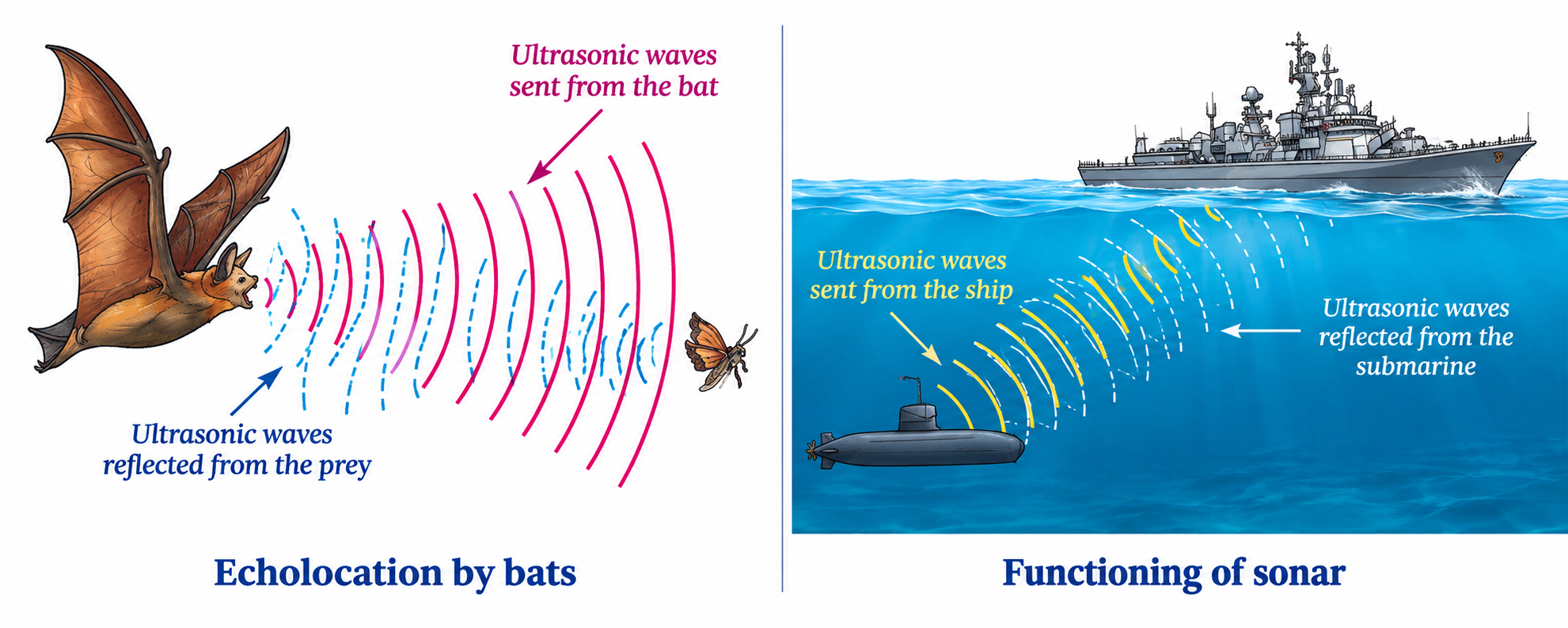
Reference Diagram: SONAR Echo Ranging System (Fig 10.28)
✅ Detailed Solution
Given:
Total round-trip echo time ($t$) $= 5\text{ s}$
Speed of ultrasound in seawater ($v$) $= 1525\text{ m s}^{-1}$
Formula:
In echo-ranging, the ultrasound signal travels down to the wreckage and reflects back to the ship, covering a total distance of $2d$.
$$ 2d = v \times t \implies d = \frac{v \times t}{2} $$
Calculation:
$$ d = \frac{1525\text{ m s}^{-1} \times 5\text{ s}}{2} = \frac{7625}{2} = \mathbf{3812.5\text{ metres}} $$
Depth of Wreckage = 3812.5 m (or 3.8125 km)
Question 11
A vehicle is fitted with an ultrasonic distance sensor as part of parking assistance system which provides echolocation, while the driver is reversing the vehicle. It emits ultrasonic wave (about 40 kHz) which is reflected by the obstacle. When the warning beep starts sounding at a distance of 1.2 m from the obstacle, how much time is taken by ultrasonic wave to travel to the obstacle and come back? Assume the speed of ultrasonic wave in air to be 345 m s⁻¹.
✅ Detailed Solution
Given:
Distance to obstacle ($d$) $= 1.2\text{ m}$
Speed of ultrasonic wave in air ($v$) $= 345\text{ m s}^{-1}$
Calculation:
Total round-trip distance traveled by ultrasonic wave to obstacle and back $= 2d = 2 \times 1.2\text{ m} = 2.4\text{ m}$.
$$ t = \frac{\text{Total Distance}}{\text{Speed}} = \frac{2d}{v} = \frac{2.4\text{ m}}{345\text{ m s}^{-1}} \approx \mathbf{0.006956\text{ seconds}} $$
The speed of sound in air is about 331 m s⁻¹ at 0 °C and nearly 344 m s⁻¹ at 22 °C. Roughly how much extra time will the sound of thunder take to travel a distance of 1720 m, if the air temperature changes from 22 °C to 0 °C? Assume that all other conditions remain unchanged.
✅ Detailed Solution
Given:
Distance ($d$) $= 1720\text{ m}$
Speed at $22^{\circ}\text{C}$ ($v_1$) $= 344\text{ m s}^{-1}$
Speed at $0^{\circ}\text{C}$ ($v_2$) $= 331\text{ m s}^{-1}$
Step 1: Time taken at $22^{\circ}\text{C}$ ($t_1$)
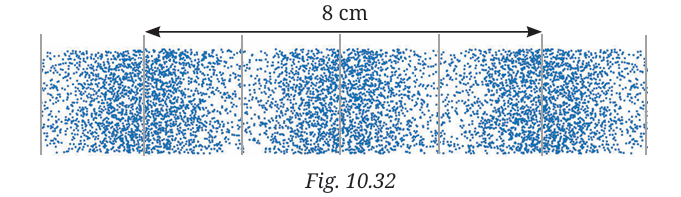
The variation of density of medium for a sound wave propagating with a speed of 340 m s⁻¹ is shown in Fig. 10.32. Calculate the wavelength and frequency of the sound wave.
Figure 10.32: Density variation of sound wave spanning 8 cm for 2 complete waves
✅ Detailed Solution
Given:
Speed of wave ($v$) $= 340\text{ m s}^{-1}$
From Fig. 10.32: The bracket length of $8\text{ cm}$ spans 2 complete compressions/wavelengths ($2\lambda$).
Wavelength (λ) = 0.04 m (4 cm) | Frequency (ν) = 8500 Hz (8.5 kHz)
Question 14
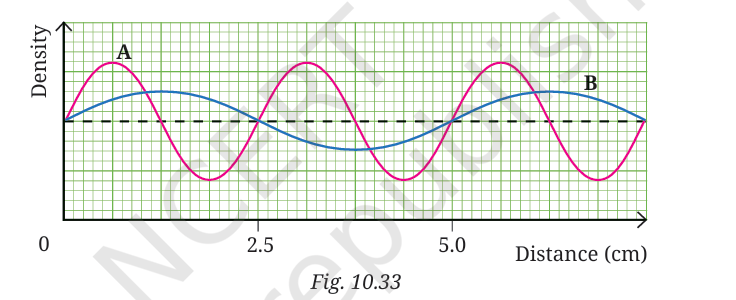
The graphical representation of two sound waves A and B propagating at the same speed of 345 m s⁻¹ is shown in Fig. 10.33. What is the wavelength of each of them? Also, calculate their frequencies.
Figure 10.33: Graphical representation of sound waves A and B
✅ Detailed Solution
Given: Speed of both waves $v = 345\text{ m s}^{-1}$.
Analysis for Wave A (Pink Curve):
From graph Fig. 10.33, one complete wave cycle of A spans from $0$ to $2.5\text{ cm}$.
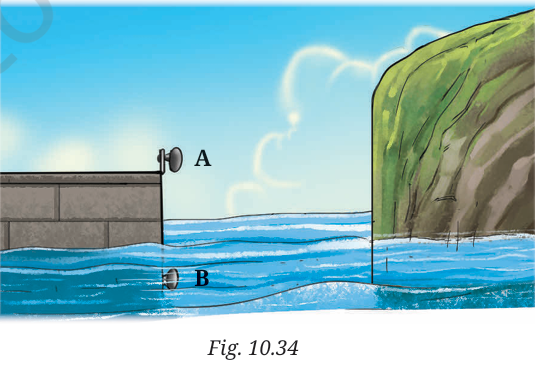
Two identical sound sources are placed at A and B—one in air and one submerged in water (Fig. 10.34). Both produce sounds at the same time, which travel horizontally to the vertical side of the cliff and come back. If the time taken by the sound to return to A is 4.5 times than that of B, what is the ratio between the speeds of sound in air and water?
Figure 10.34: Sound sources A (in air) and B (in water) facing a vertical cliff
✅ Detailed Solution
Given:
Distance to cliff $d$ is identical for both sources A and B.
Round-trip distance $= 2d$.
Time taken in air ($t_A$) is $4.5$ times time taken in water ($t_B$): $t_A = 4.5 \times t_B$.