
Sound is a form of energy which produces a sensation of hearing in our ears. Just like light and heat, sound is an energy form, but unlike them, it requires physical movement or vibration of particles to be produced.
Activity 10.2 (NCERT): Striking a tuning fork prong against a soft rubber pad makes it vibrate and emit a sound. If a vibrating prong touches the surface of water in a glass, ripples and splashes are immediately produced, visually proving that the prongs are vibrating rapidly to generate sound.
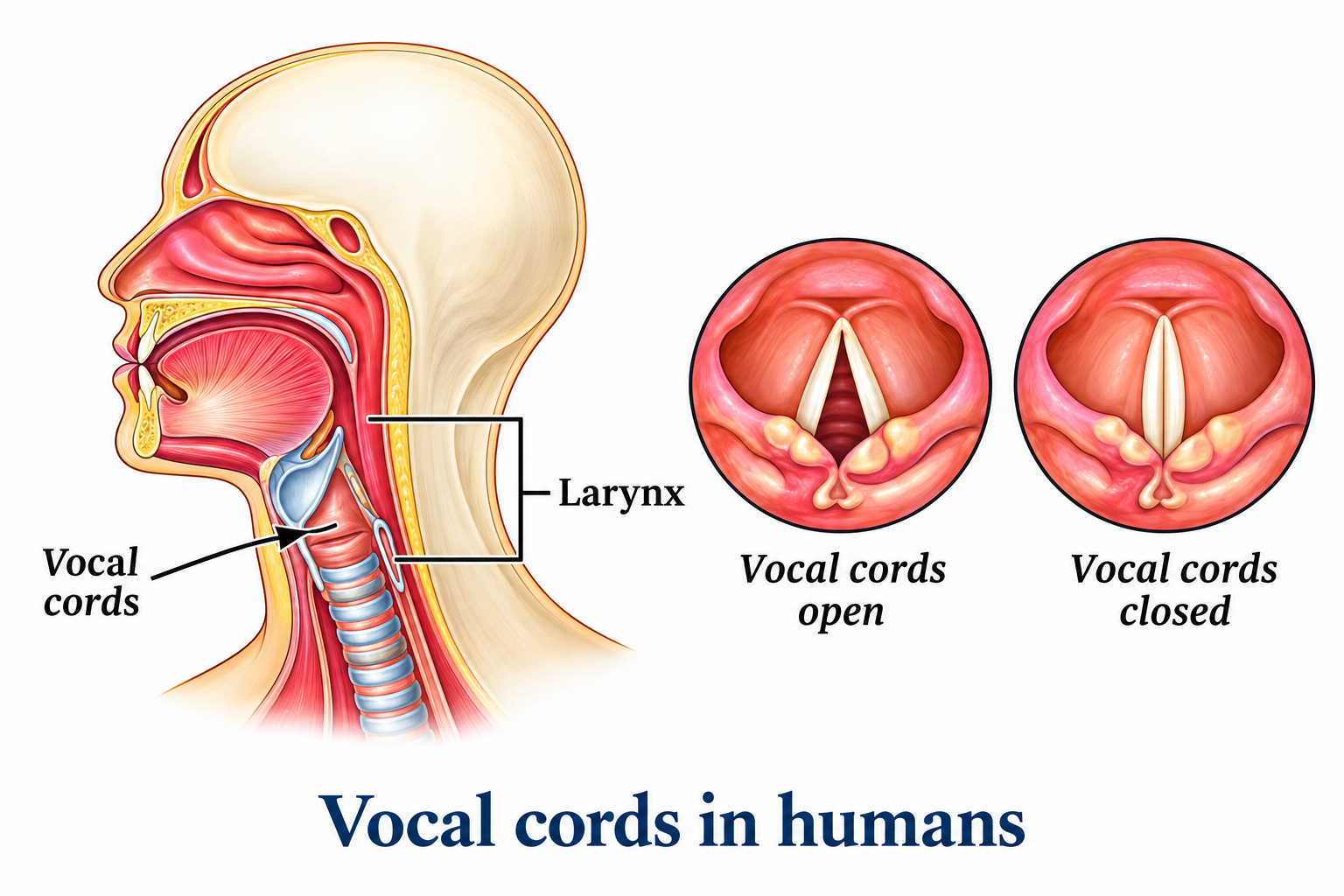
In Kongthong village near Shillong (Meghalaya), known as the Whistling Village, every person has a unique tune name composed by their mother at birth. This tradition is called Jingrwai Iawbei, where people call out to each other across hills using musical whistling tones.
The matter or substance through which sound is transmitted is called a medium. It can be a solid, liquid, or gas.
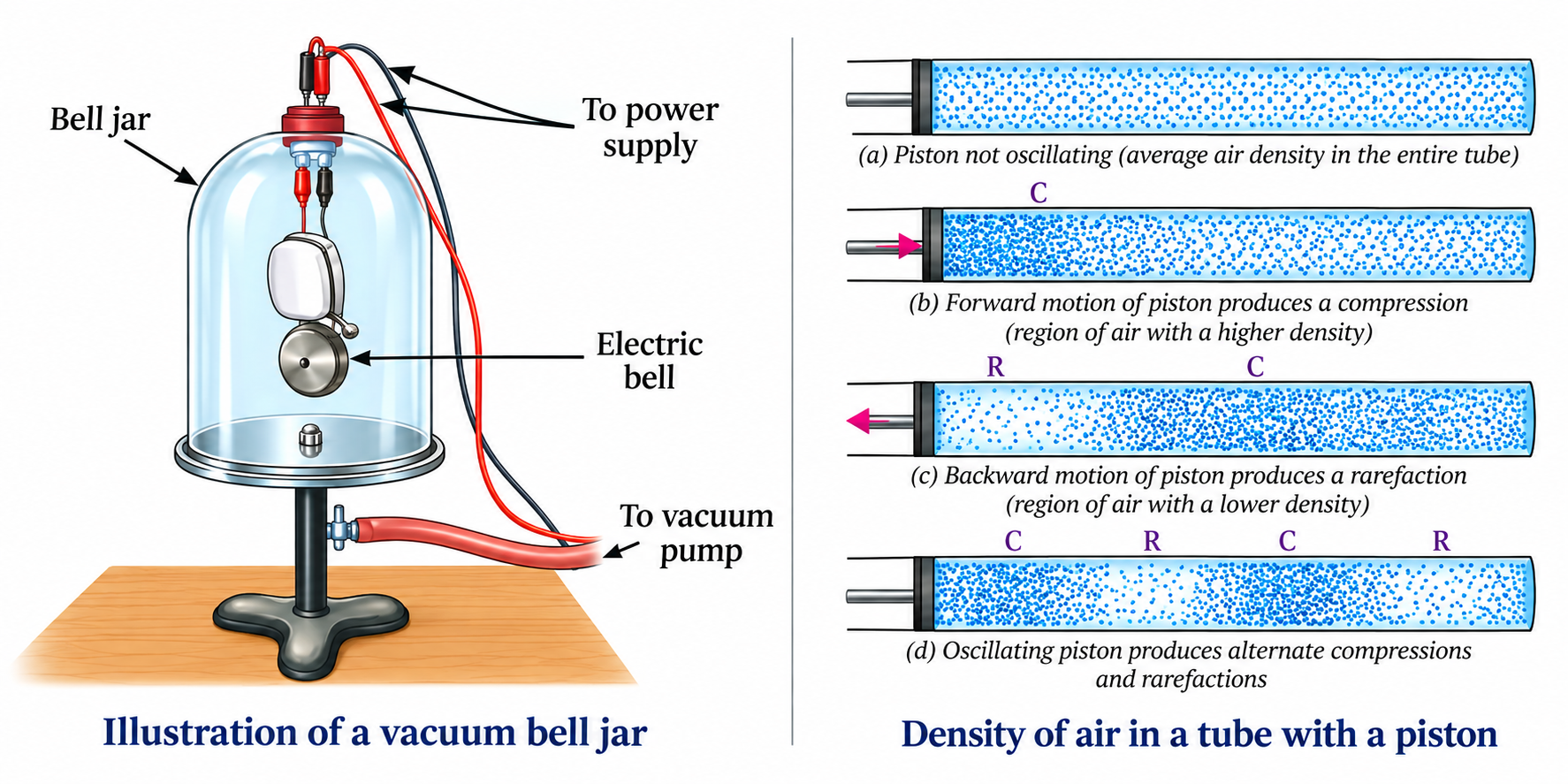
When an object vibrates, it displaces adjacent particles of the medium. Important: The particles themselves do not travel all the way from the source to the ear. Each particle vibrates back and forth around its mean position, transferring energy to neighbouring particles. It is the disturbance (wave) that propagates through the medium.
As the source vibrates continuously back and forth, a series of alternating compressions and rarefactions moves outward through the medium, forming a sound wave.
Sound is a mechanical wave and requires a material medium (air, water, steel) for propagation. In outer space (a vacuum), sound waves cannot propagate. Astronauts on spacewalks rely on radio signals inside their helmets to communicate.
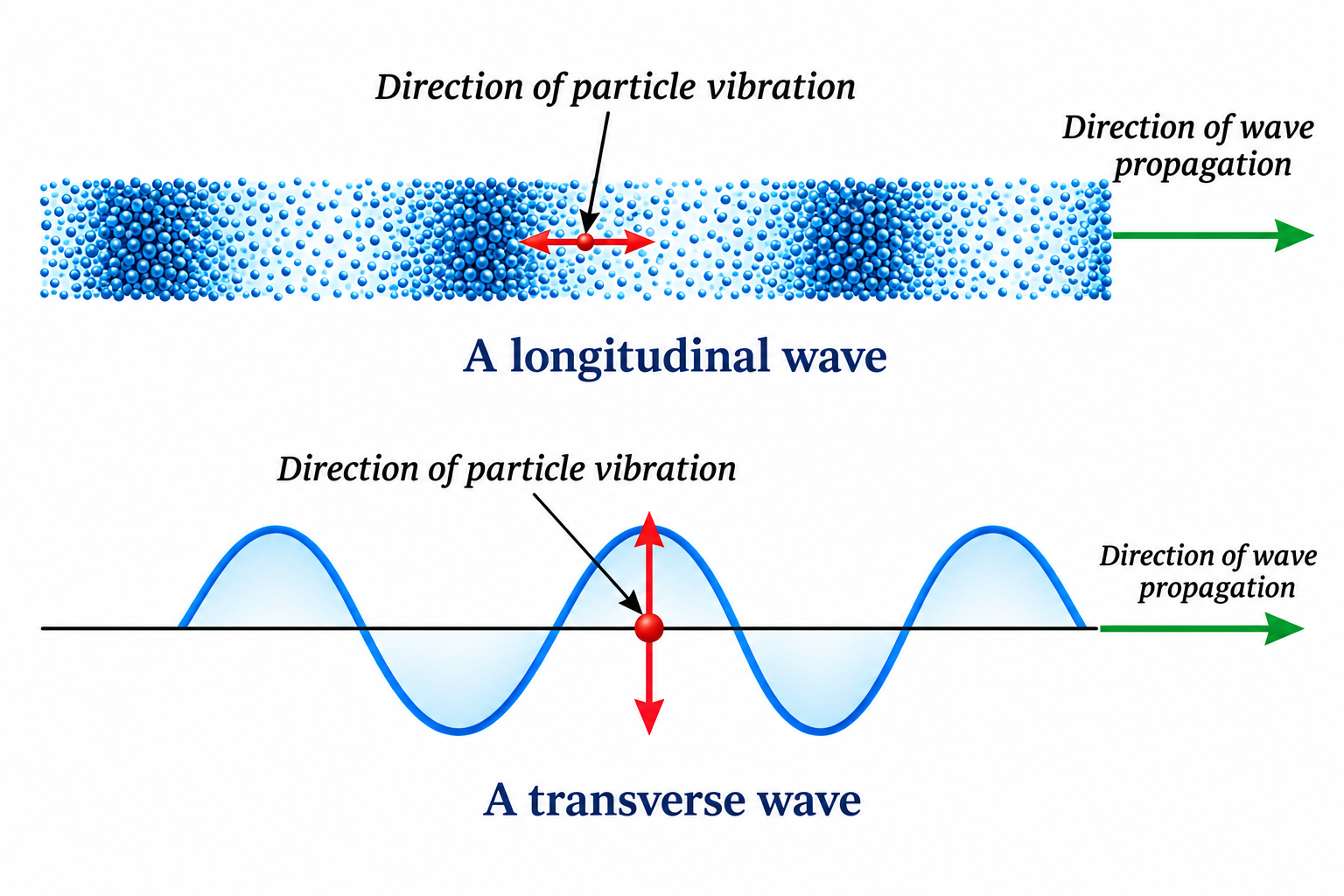
Waves are classified based on the relative direction of particle displacement with respect to the wave's propagation direction:
| Parameter | Longitudinal Waves (e.g., Sound in Air) | Transverse Waves (e.g., Light, String Waves) |
|---|---|---|
| Particle Oscillation | Particles oscillate parallel ($\leftrightarrow$) to the direction of wave propagation. | Particles oscillate perpendicular ($\updownarrow$) to the direction of wave propagation. |
| Structure | Consists of alternating Compressions (C) and Rarefactions (R). | Consists of alternating Crests (peaks) and Troughs (valleys). |
| Medium Requirement | Mechanical wave; strictly requires a physical medium. | Can be mechanical (water/string waves) or non-mechanical (light/electromagnetic waves). |
Earthquakes generate both longitudinal and transverse seismic waves through the Earth. Seismographs detect primary longitudinal waves (P-waves) first because they travel faster through terrestrial rock layers than secondary transverse waves (S-waves).
Sound carries energy transferred from the vibrating source. In Activity 10.6 (NCERT), when grains of salt or semolina are sprinkled over a stretched rubber membrane on a bowl and a loud sound is produced nearby, the grains dance up and down. This demonstrates that sound waves transfer kinetic energy through medium particles.
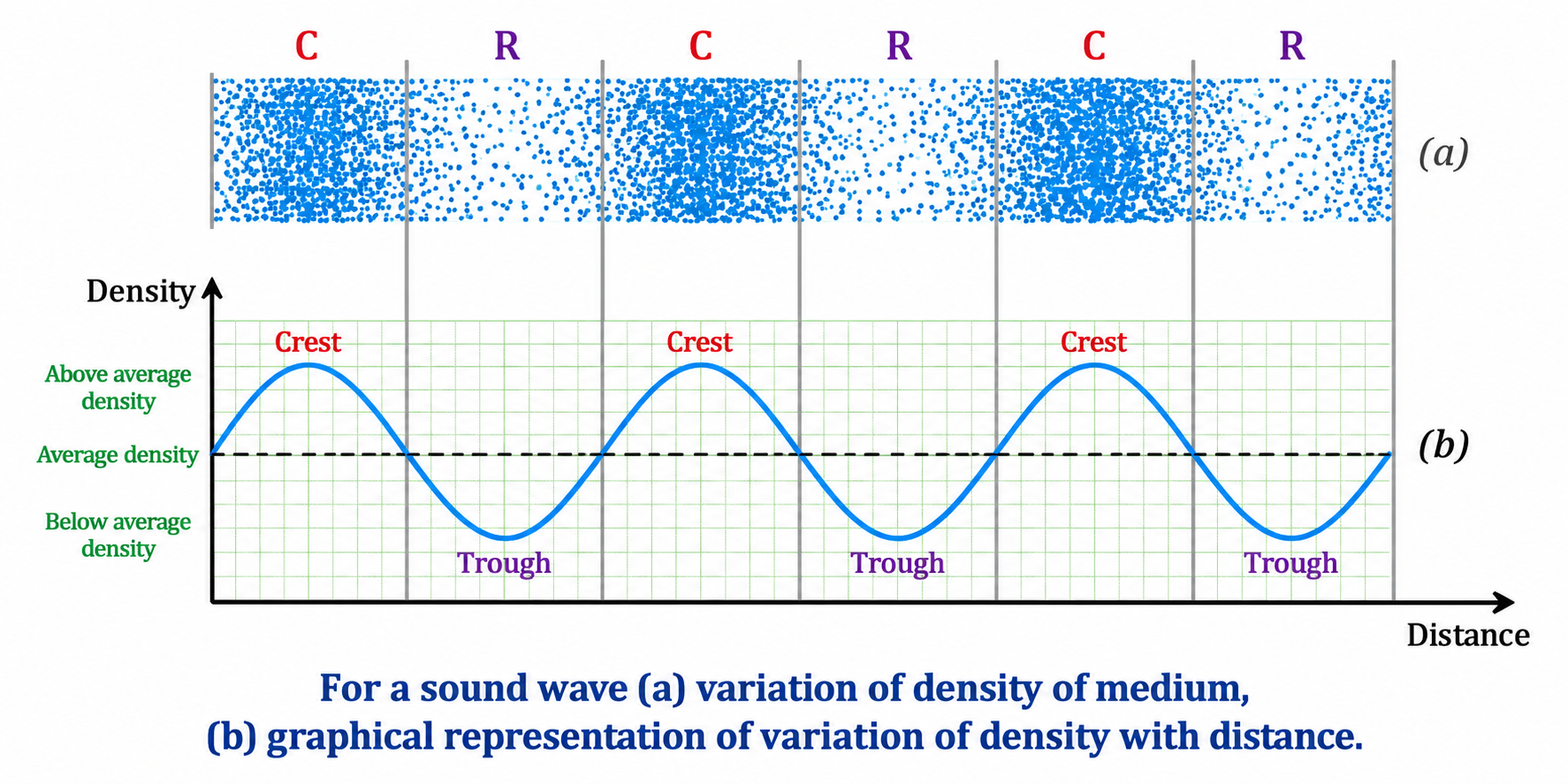
As a sound wave propagates, the density (or pressure) of the medium varies periodically with distance from the source. A sine wave graph models these density variations:
Every sound wave is defined by five key physical characteristics:
The distance between two consecutive compressions (C) or two consecutive rarefactions (R) (or two consecutive crests / troughs) is called the wavelength.
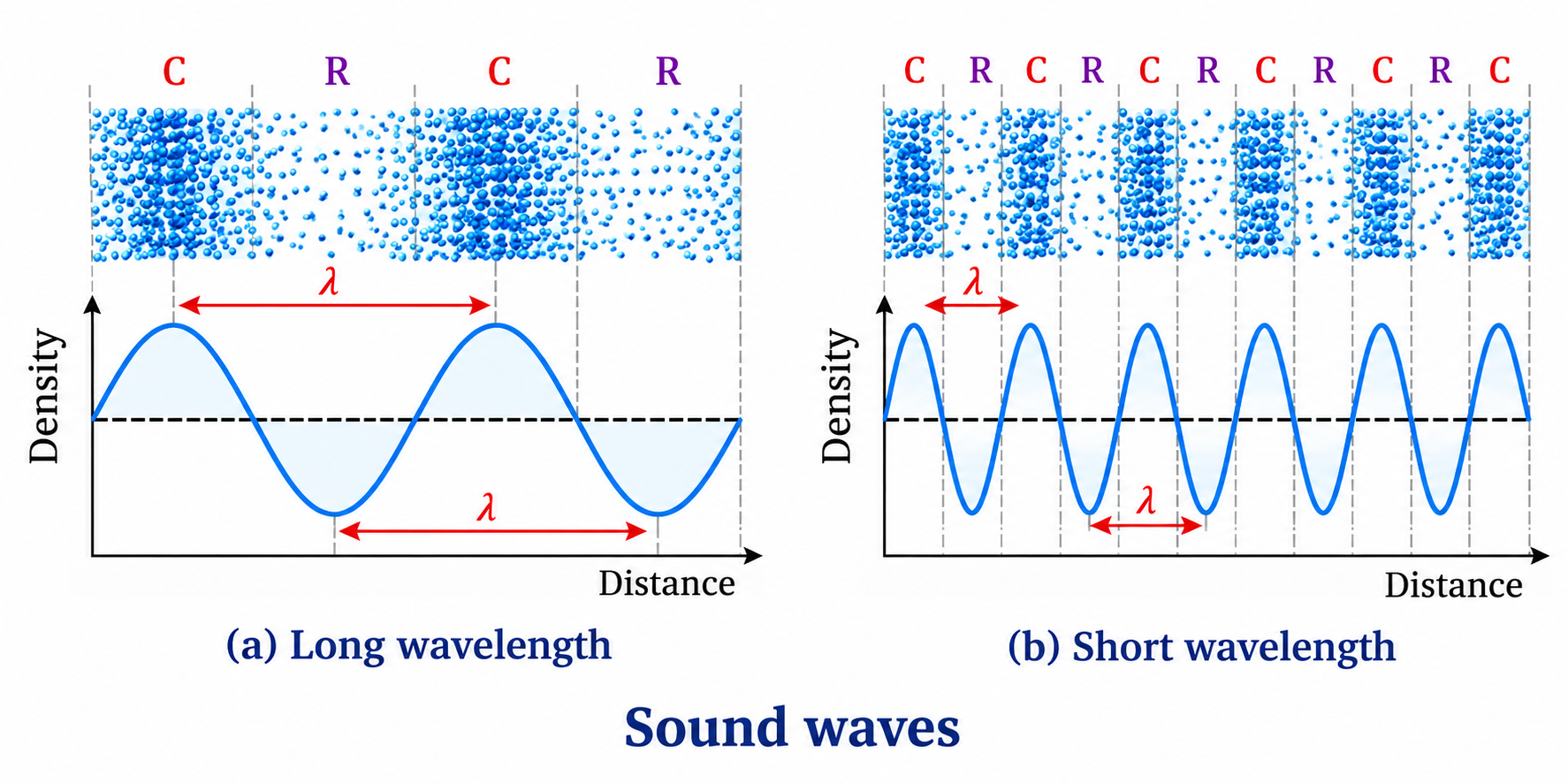
The number of complete density oscillations (C-R-C cycles) per unit time at a fixed location in the medium is called the frequency.
The time required for one complete oscillation in density/pressure at a fixed point (or the time taken for two consecutive compressions to pass a fixed point) is called the time period.
The magnitude of the maximum disturbance or maximum change in density/pressure from its mean value is called the amplitude.
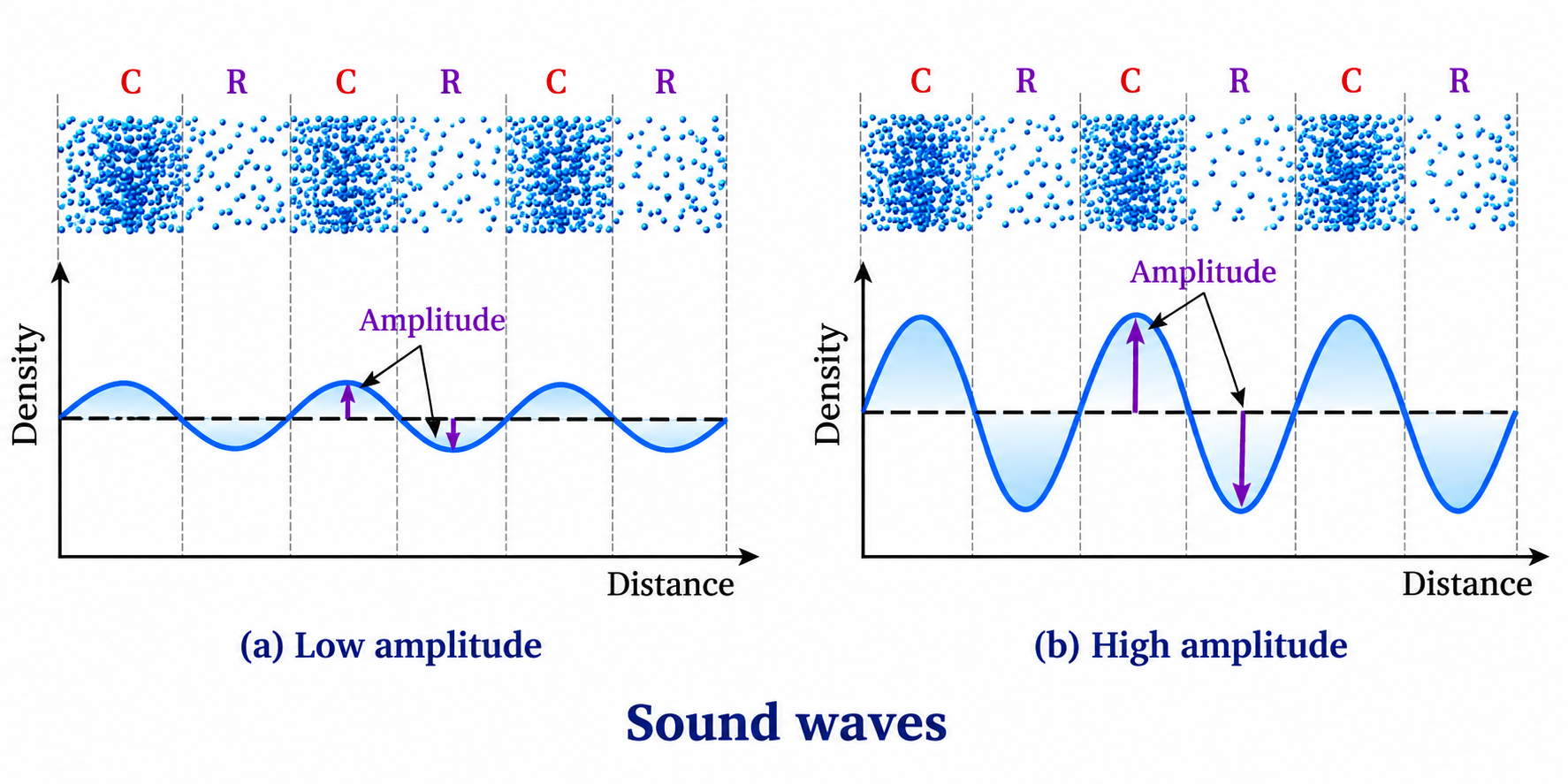
The speed of sound is the distance traveled by a wave point (like a crest or compression) per unit time.
$$ v = \frac{\text{Distance}}{\text{Time}} = \frac{\lambda}{T} = \lambda \times \nu $$Speed = Wavelength × Frequency ($v = \lambda \nu$)
| Parameter | Intensity of Sound | Loudness of Sound |
|---|---|---|
| Definition | Amount of sound energy passing through unit area perpendicular to propagation per unit time. | Subjective auditory perception of the ear to the sound wave. |
| Nature | Objective, measurable physical quantity ($I \propto A^2$). | Subjective; depends on both energy amplitude and ear sensitivity. |
| Unit | $\text{Watts per square metre (W/m}^2\text{)}$. | Decibels (dB). |
| Distance Variation | Decreases with distance ($I \propto 1/r^2$) as wave energy spreads over a larger spherical surface ($4\pi r^2$). | Decreases as listener moves farther from the source. |
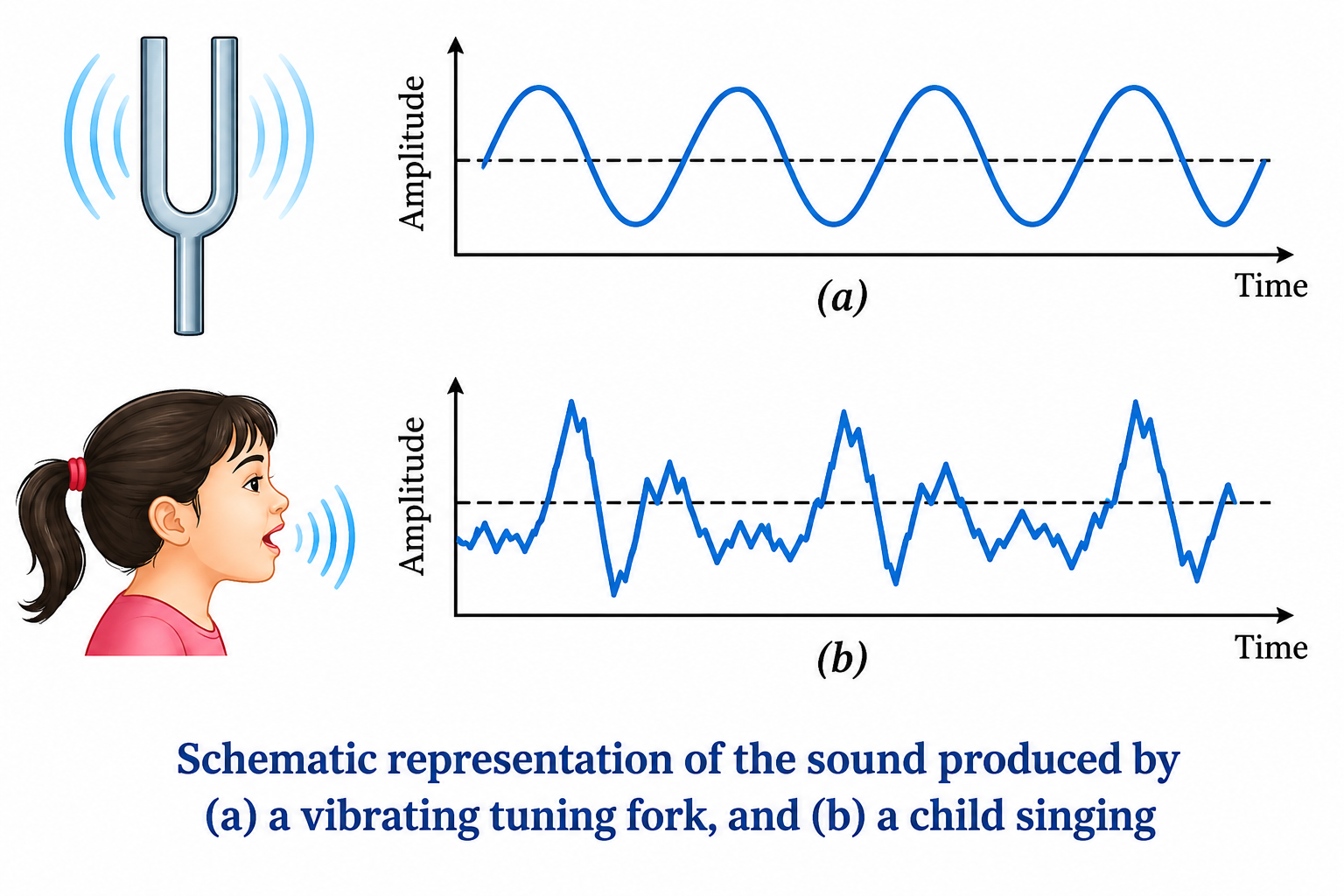
| Property | Determined By | Description & NCERT Examples |
|---|---|---|
| Pitch | Frequency ($\nu$) | Higher frequency = higher pitch (shrill voice, e.g., bird chirping, whistling, woman's voice). Lower frequency = lower pitch (deep voice, e.g., lion's roar, drum beat, man's voice). |
| Loudness | Amplitude ($A$) | Striking a surface harder imparts more kinetic energy $\to$ higher amplitude $\to$ louder sound. Decibel scale (dB): Rustling leaves $\approx 10\text{ dB}$, Normal talk $\approx 60\text{ dB}$, Loud noise $> 100\text{ dB}$. |
| Timbre / Quality | Waveform Shape (Overtones) | Enables us to distinguish two instruments (e.g., flute vs. sitar) playing the same pitch and loudness. A pure single frequency is a Tone; a pleasant mix of fundamental and overtone frequencies is a Note. An Octave is a frequency doubling interval ($200\text{ Hz} \to 400\text{ Hz}$). |
Sir C. V. Raman (Nobel Prize in Physics) conducted pioneering research on acoustics of Indian percussion instruments like the tabla and mridangam. He analyzed how the central black patch (syaahi) on the drum membrane alters acoustic modes to produce rich harmonic overtones.
The speed of sound depends on the state of matter, elasticity, density, temperature, and humidity of the medium.
When an object (fighter jet, bullet) moves faster than the speed of sound in air, it travels at supersonic speed. This source moves faster than its generated sound waves, creating high-energy conical shock waves. The abrupt air pressure jump associated with shock waves produces a sudden, intense explosion sound called a sonic boom, capable of breaking window panes and structural glass.
Sound bounces off solid or liquid obstacles obeying the standard Laws of Reflection:
An echo is the repetition of sound caused by reflection off a distant hard obstacle (cliff, wall, tall building).
In large halls or auditoriums, sound undergoes multiple successive reflections from walls, ceiling, and floor. The persistence of sound due to repeated reflections arriving with time gaps $< 0.05\text{ s}$ is called reverberation.
The Whispering Gallery in the dome of Gol Gumbaz (Bijapur, Karnataka) is designed such that a soft whisper at one side reflects multiple times around the circular dome, enabling a person on the opposite side to hear it clearly.
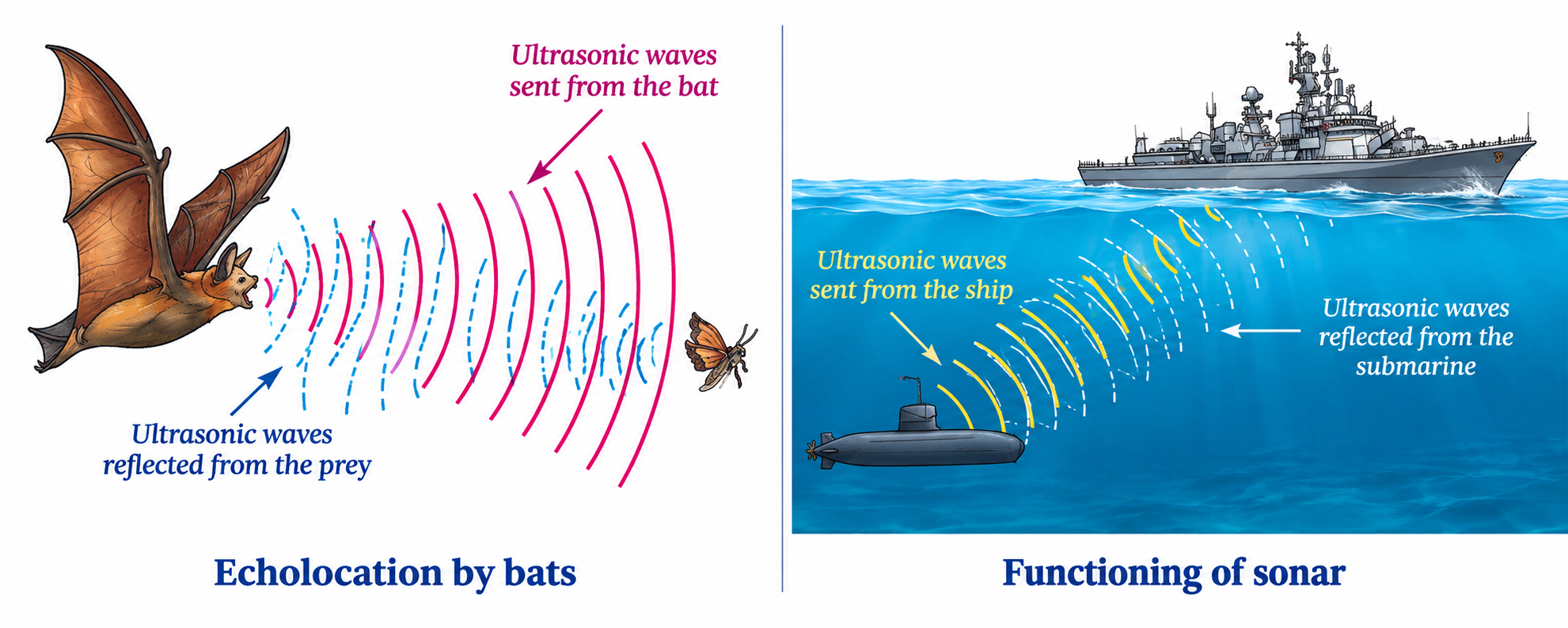
SONAR (Sound Navigation And Ranging): Method using ultrasound to calculate depth, distance, speed, and location of underwater objects (submarines, icebergs, sunken ships).
$$ 2d = v \times t \quad \implies \quad d = \frac{v \times t}{2} $$where $d$ is depth/distance, $v$ is sound speed in seawater ($\approx 1530\text{ m/s}$), and $t$ is total echo round-trip time.
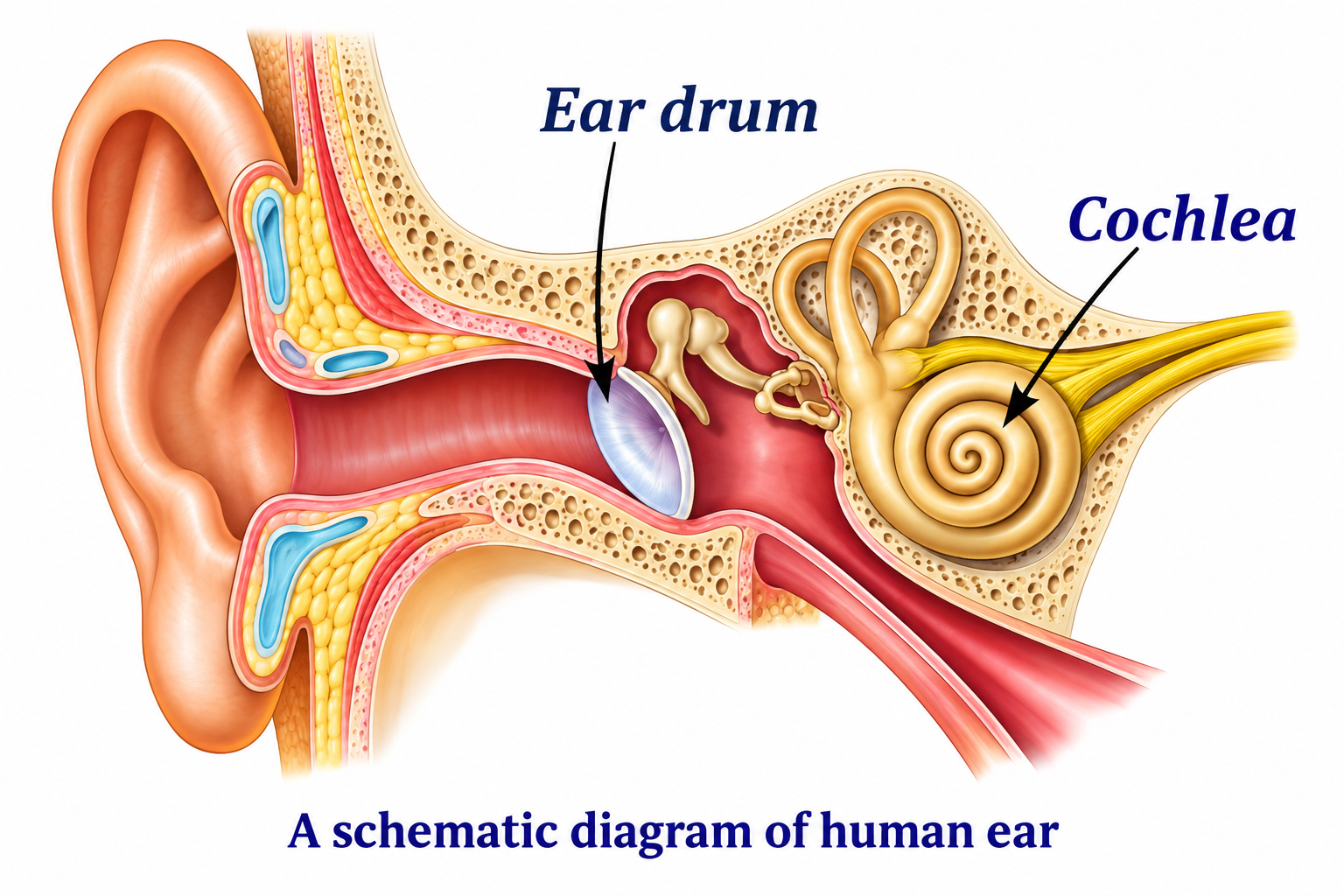
The human ear converts air pressure variations into electrical nerve impulses sent to the brain:
NCERT Example 10.1: If there are 10 density oscillations in 2 seconds at a given position, calculate (i) frequency, and (ii) time period of the sound wave.
Solution:
(i) Frequency $\nu = \frac{\text{Number of oscillations}}{\text{Time taken}} = \frac{10}{2\text{ s}} = \mathbf{5\text{ Hz}}$.
(ii) Time Period $T = \frac{1}{\nu} = \frac{1}{5\text{ Hz}} = \mathbf{0.2\text{ s}}$.
NCERT Example 10.2: Human hearing roughly spans $20\text{ Hz}$ to $20\text{ kHz}$. What are the corresponding wavelengths in air? (Use speed of sound in air $v = 344\text{ m/s}$).
Solution: Using $\lambda = \frac{v}{\nu}$:
(i) For $\nu_1 = 20\text{ Hz}$: $\lambda_1 = \frac{344\text{ m/s}}{20\text{ s}^{-1}} = \mathbf{17.2\text{ m}}$.
(ii) For $\nu_2 = 20,000\text{ Hz}$: $\lambda_2 = \frac{344\text{ m/s}}{20,000\text{ s}^{-1}} = 0.0172\text{ m} = \mathbf{1.72\text{ cm}}$.
NCERT Example 10.3: During a thunderstorm, lightning is seen before thunder is heard. If the time delay between seeing lightning and hearing thunder is $5\text{ s}$, estimate the distance to the lightning strike. (Speed of sound in air $v = 340\text{ m/s}$).
Solution: Distance $d = v \times t = 340\text{ m/s} \times 5\text{ s} = 1700\text{ m} = \mathbf{1.7\text{ km}}$.
NCERT Example 10.4: A sound wave propagating in steel has a wavelength $\lambda = 50\text{ m}$ and speed $v = 5000\text{ m/s}$. Find its frequency and time period.
Solution:
Frequency $\nu = \frac{v}{\lambda} = \frac{5000\text{ m/s}}{50\text{ m}} = \mathbf{100\text{ Hz}}$.
Time Period $T = \frac{1}{\nu} = \frac{1}{100\text{ Hz}} = \mathbf{0.01\text{ s}}$.
NCERT Example 10.5: You clap in an empty corridor and hear an echo after $0.5\text{ s}$. If sound speed in air is $340\text{ m/s}$, calculate your distance from the wall.
Solution: Distance $d = \frac{v \times t}{2} = \frac{340\text{ m/s} \times 0.5\text{ s}}{2} = \mathbf{85\text{ m}}$.
NCERT Example 10.6: A naval SONAR signal sent into seawater returns after $0.90\text{ s}$. The speed of sound in seawater is $1530\text{ m/s}$. How far is the underwater object?
Solution: Distance $d = \frac{v \times t}{2} = \frac{1530\text{ m/s} \times 0.90\text{ s}}{2} = 1530 \times 0.45 = \mathbf{688.5\text{ m}}$.