
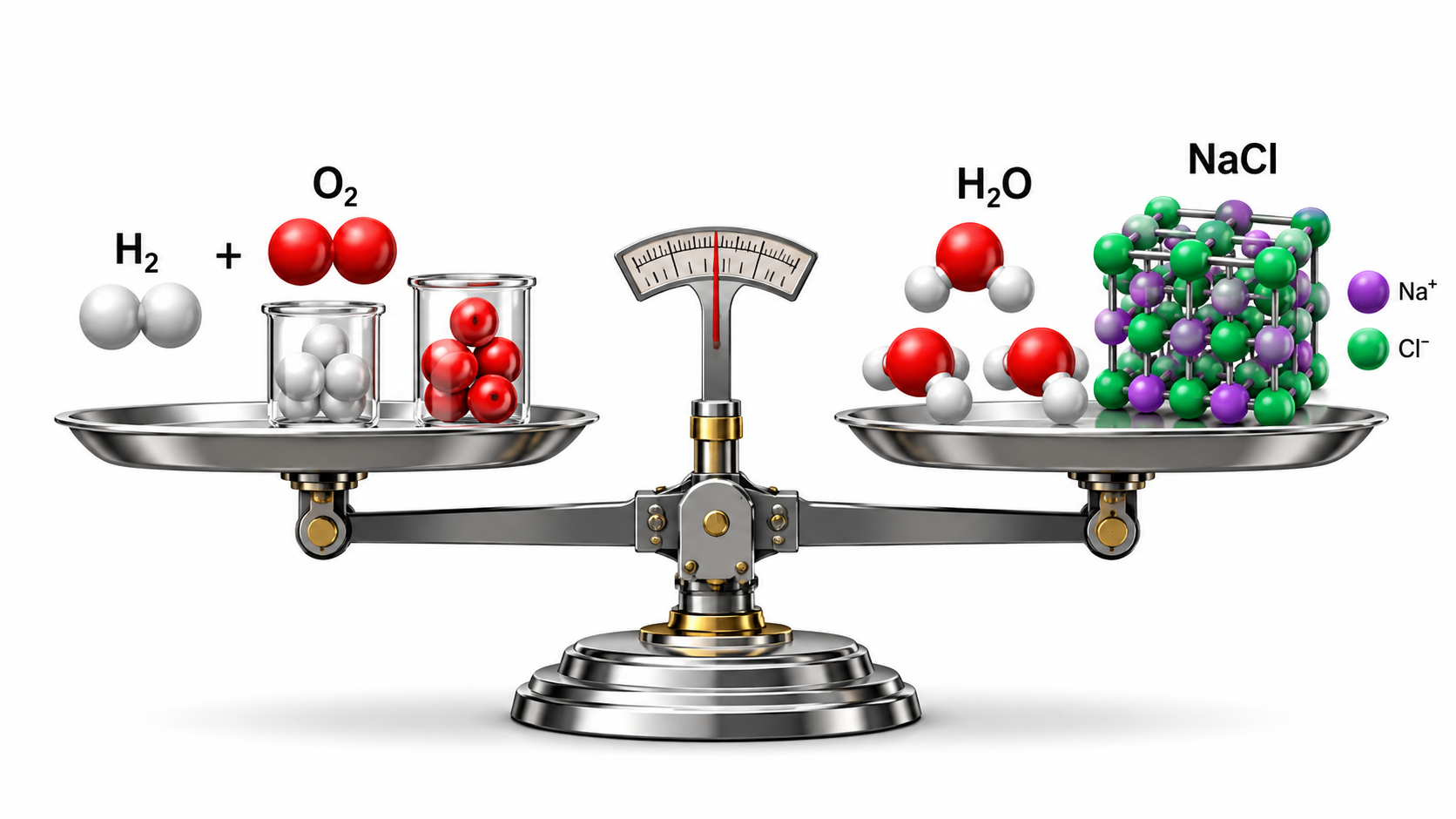
In Chapter 8, we explored the inner architecture of atoms (electrons, protons, and neutrons). When atoms combine, elements lose their original individual properties to form compounds with entirely novel characteristics. For instance, hydrogen gas burns vigorously and oxygen supports burning, yet their compound — water ($H_2O$) — extinguishes fire! The quantitative investigation of such chemical transformations established the fundamental laws of chemical combination.
Formulated in 1789 by French chemist Antoine Lavoisier (celebrated as the Father of Modern Chemistry):
"Matter can neither be created nor destroyed in a chemical reaction."
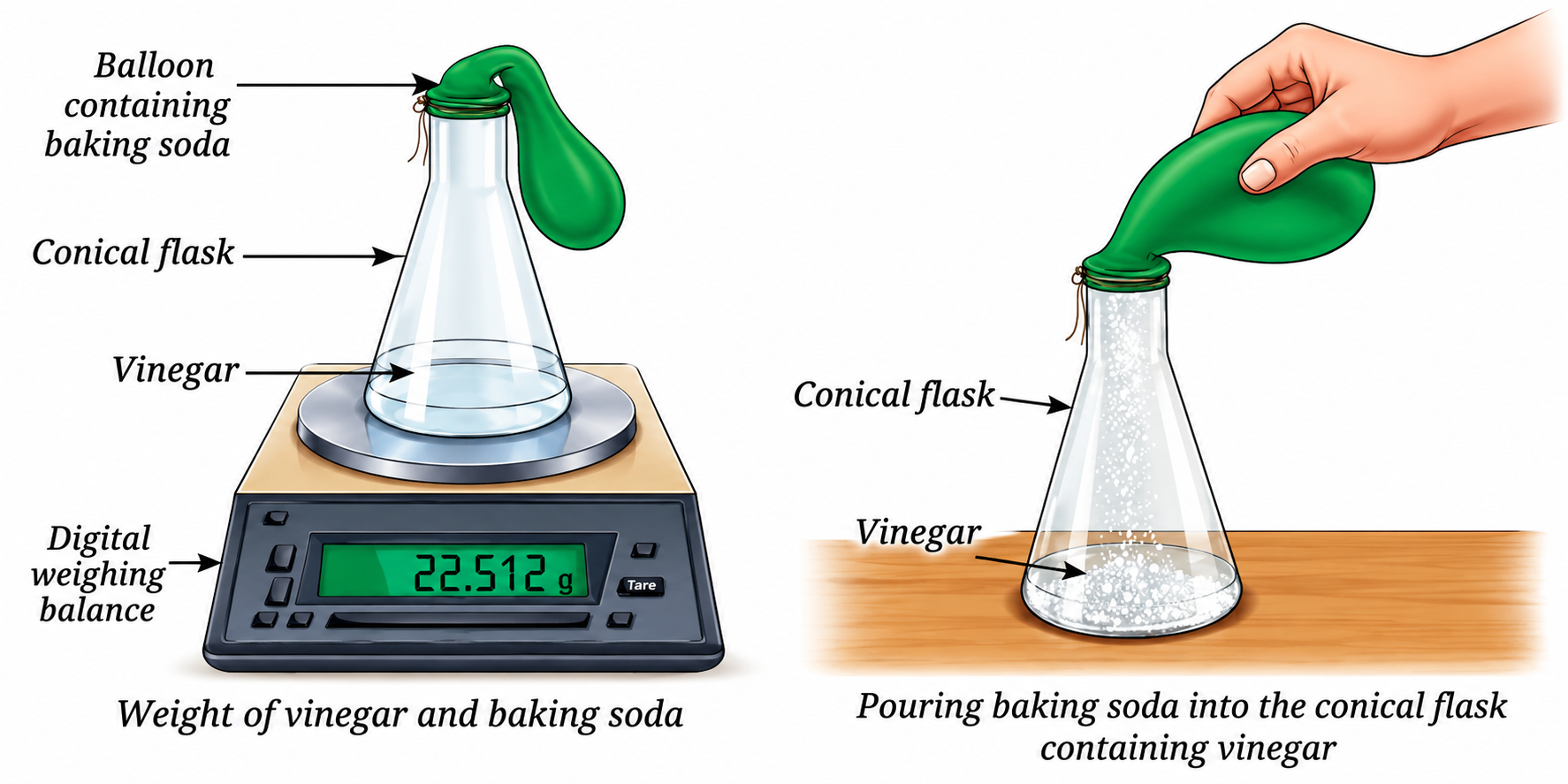
Activity 9.3 (Precipitation Reaction in Open System): When sodium sulfate ($Na_2SO_4$) solution is mixed with barium chloride ($BaCl_2$) solution, an insoluble white precipitate of barium sulfate ($BaSO_4$) forms immediately: $$Na_2SO_4\text{ (aq)} + BaCl_2\text{ (aq)} \longrightarrow BaSO_4\text{ (s)} \downarrow + 2NaCl\text{ (aq)}$$ Because no gaseous product is evolved, this reaction strictly proves the Law of Conservation of Mass even in an open flask!
Problem: Students place $4.0\text{ g}$ of calcium carbonate with $2.92\text{ g}$ of hydrochloric acid in a closed container. After the reaction is over, they measured $1.76\text{ g}$ of carbon dioxide, $0.72\text{ g}$ of water, and $4.44\text{ g}$ of calcium chloride. Verify whether the Law of Conservation of Mass is obeyed or not.
Solution:
Total mass of reactants $= 4.0\text{ g} + 2.92\text{ g} = 6.92\text{ g}$
Total mass of products $= 1.76\text{ g} + 0.72\text{ g} + 4.44\text{ g} = 6.92\text{ g}$
Since $\text{Mass of Reactants} = \text{Mass of Products}$, the Law of Conservation of Mass is strictly obeyed.
Proposed by French chemist Joseph Louis Proust in 1799:
"In a chemical compound, the elements are always present in a definite and fixed proportion by mass, irrespective of its source or method of preparation."
Example 9.2: $12\text{ g}$ of carbon combines with $32\text{ g}$ of oxygen to form $44\text{ g}$ of carbon dioxide. If $2.4\text{ g}$ of carbon reacts completely with oxygen, how much carbon dioxide will be produced?
Solution: $1\text{ g}$ carbon yields $\frac{44}{12}\text{ g } CO_2$. Thus, $2.4\text{ g}$ carbon yields $\frac{44}{12} \times 2.4 = \mathbf{8.8\text{ g of } CO_2}$.
Example 9.3: Sodium chloride ($NaCl$) contains sodium and chlorine in the mass ratio of $23 : 35.5$. If $46\text{ g}$ of sodium reacts completely, how much chlorine is needed to form $NaCl$?
Solution: $\text{Chlorine needed} = \frac{35.5}{23} \times 46 = \mathbf{71\text{ g of chlorine}}$.
In 1808, British scientist John Dalton provided the first modern atomic hypothesis, postulating that matter consists of indivisible atoms that merely rearrange during chemical changes.
Except for inert noble gases ($He, Ne, Ar$), isolated atoms have incomplete valence shells. Atoms combine to:
The attractive electrostatic force holding atoms together in a stable arrangement is called a chemical bond. Chemical bonding occurs primarily through two mechanisms:
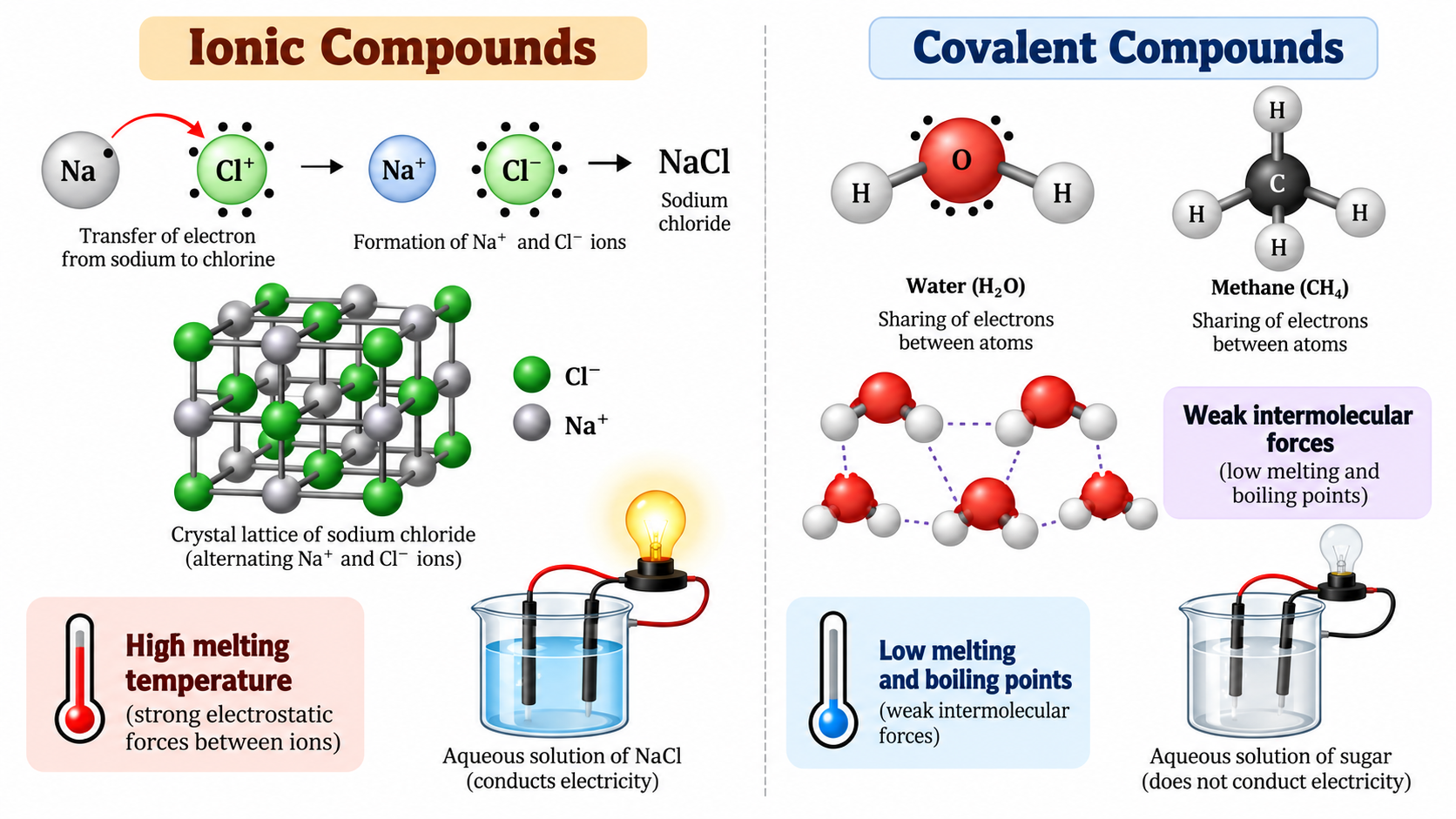
Formed between non-metal atoms. Atoms mutually share one or more pairs of valence electrons so that each atom attains a stable noble gas configuration.
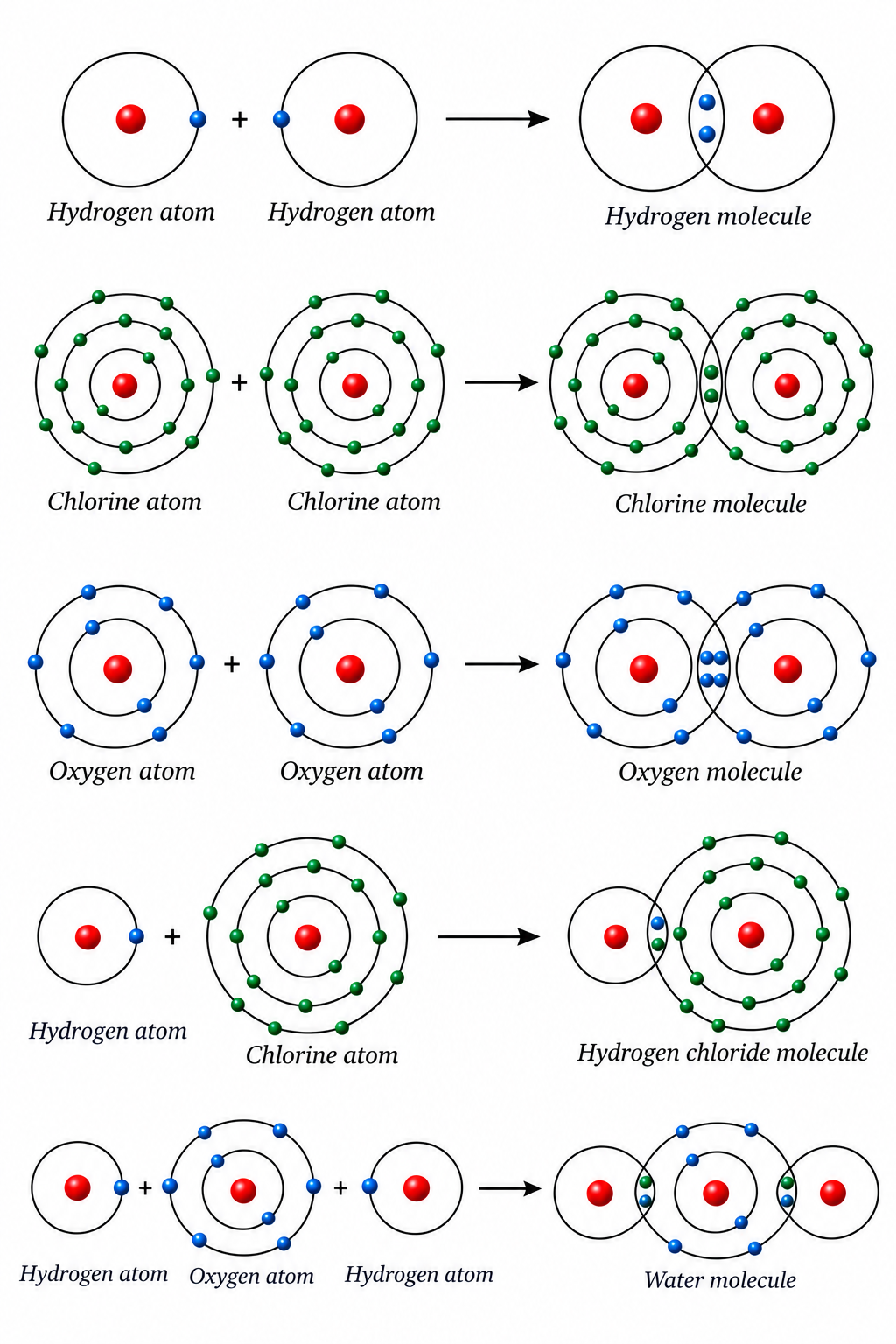
Formed between metals (which readily lose valence electrons to form positive cations) and non-metals (which accept electrons to form negative anions).
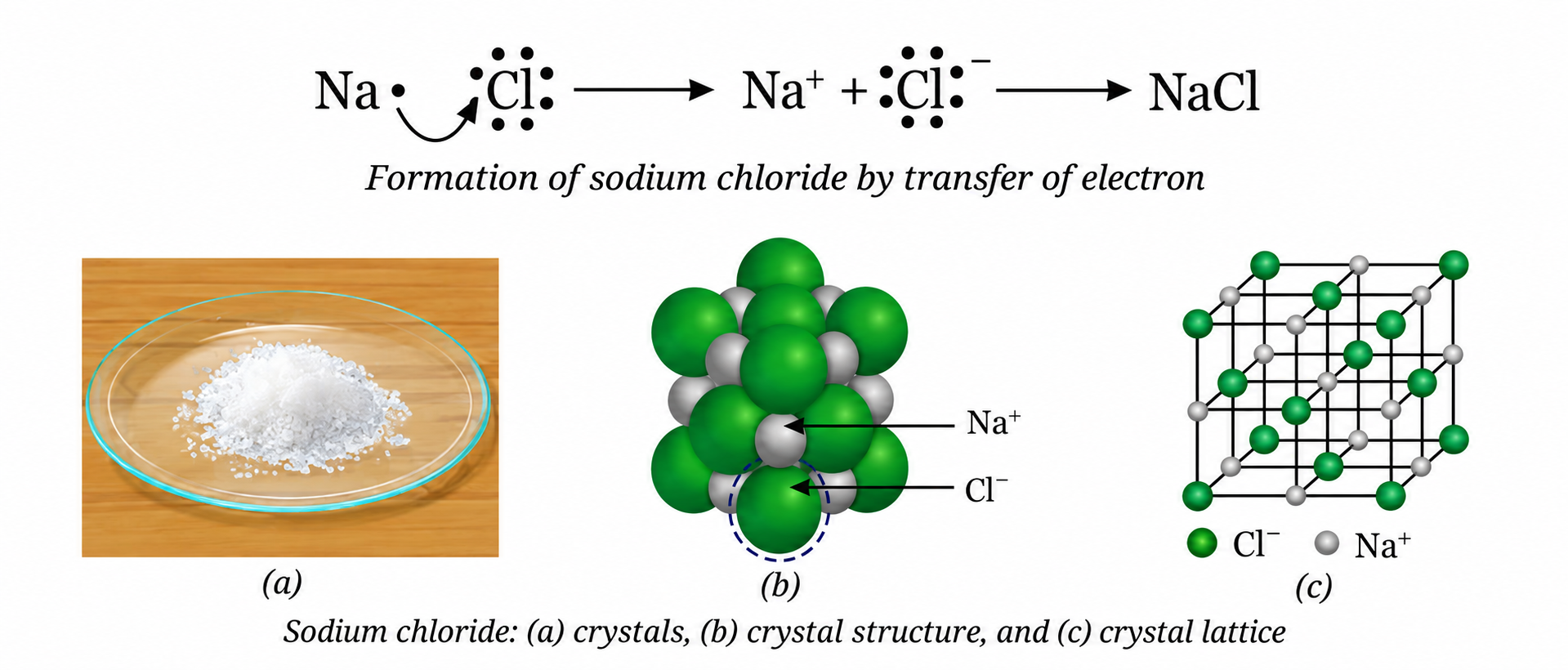
Ionic compounds do not exist as discrete single molecules. Instead, millions of alternating cations and anions arrange into a continuous, highly stable 3-dimensional network called a crystal lattice. In $NaCl$, each $Na^+$ is symmetrically surrounded by 6 $Cl^-$ ions, and each $Cl^-$ is surrounded by 6 $Na^+$ ions.
Table 9.1: Comprehensive Valency Matrix of Common Ions
| Valency | Monoatomic Cations (Metals) | Monoatomic Anions (Non-Metals) | Polyatomic Ions |
|---|---|---|---|
| 1 | Sodium ($Na^+$), Potassium ($K^+$), Lithium ($Li^+$), Silver ($Ag^+$), Cuprous ($Cu^+$) | Chloride ($Cl^-$), Fluoride ($F^-$), Bromide ($Br^-$), Iodide ($I^-$) | Ammonium ($NH_4^+$), Hydroxide ($OH^-$), Nitrate ($NO_3^-$), Hydrogencarbonate ($HCO_3^-$) |
| 2 | Magnesium ($Mg^{2+}$), Calcium ($Ca^{2+}$), Zinc ($Zn^{2+}$), Barium ($Ba^{2+}$), Ferrous ($Fe^{2+}$), Cupric ($Cu^{2+}$) | Oxide ($O^{2-}$), Sulfide ($S^{2-}$) | Carbonate ($CO_3^{2-}$), Sulfate ($SO_4^{2-}$) |
| 3 | Aluminium ($Al^{3+}$), Ferric ($Fe^{3+}$) | Nitride ($N^{3-}$) | Phosphate ($PO_4^{3-}$) |
1. Hydrogen sulfide: $H$ (valency 1), $S$ (valency 2) $\implies \mathbf{H_2S}$
2. Aluminium oxide: $Al$ (valency 3), $O$ (valency 2) $\implies \mathbf{Al_2O_3}$
3. Magnesium hydroxide: $Mg$ (valency 2), $OH$ (valency 1) $\implies \mathbf{Mg(OH)_2}$
4. Aluminium sulfate: $Al$ (valency 3), $SO_4$ (valency 2) $\implies \mathbf{Al_2(SO_4)_3}$
5. Calcium carbonate: $Ca$ (valency 2), $CO_3$ (valency 2) $\implies Ca_2(CO_3)_2 \implies \mathbf{CaCO_3}$
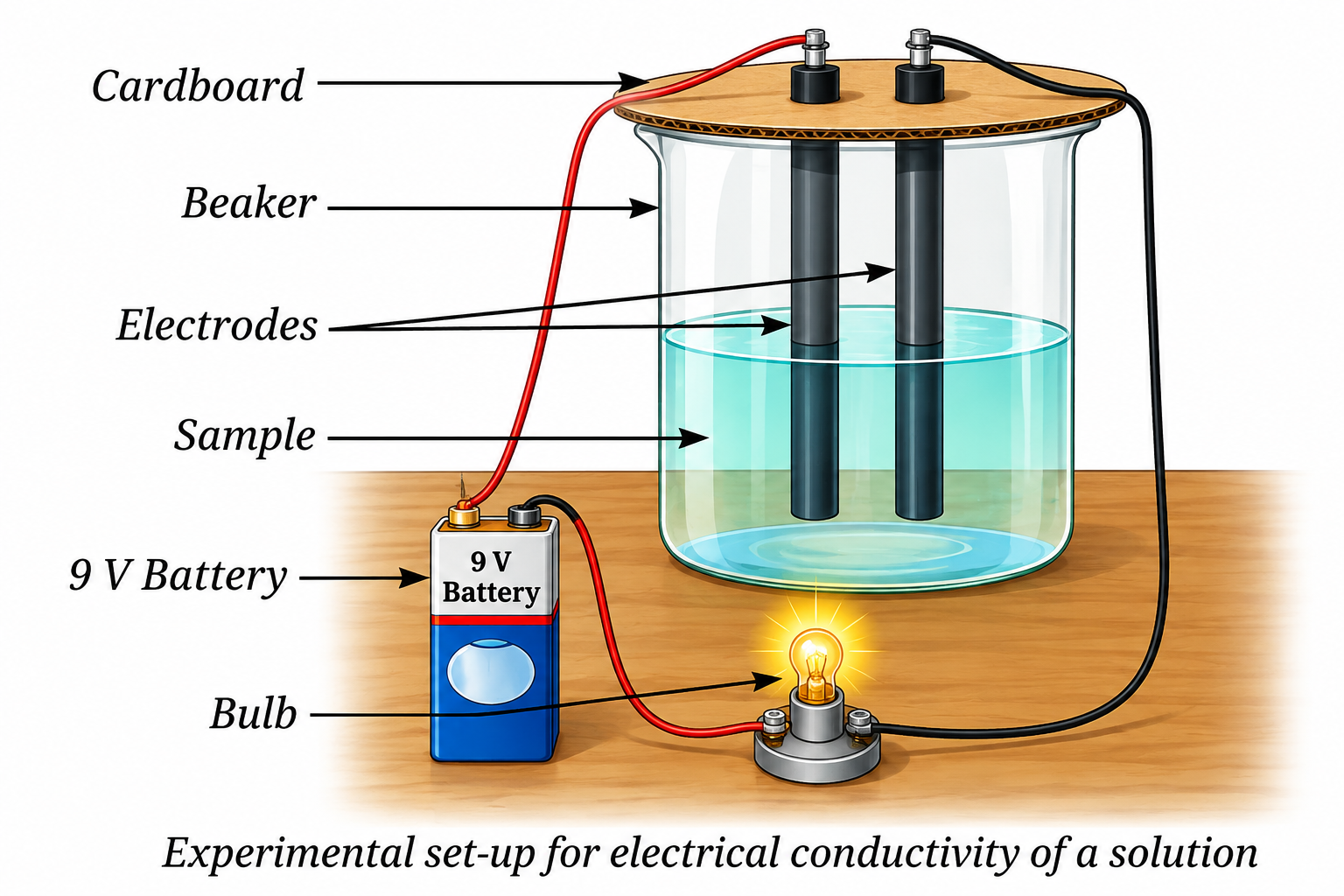
| Property | Ionic Compounds (e.g. $NaCl, CuSO_4$) | Covalent Compounds (e.g. $H_2O, CCl_4$, Camphor) |
|---|---|---|
| Physical Nature | Hard, crystalline solids; brittle under shear force. | Gases, volatile liquids, or soft molecular solids. |
| Melting & Boiling Points | High (strong electrostatic lattice forces require enormous thermal energy to overcome). | Low (weak intermolecular forces between discrete molecules). |
| Solubility | Generally soluble in polar water, but insoluble in organic solvents (kerosene, petrol). | Generally insoluble in water, but dissolve easily in organic solvents like alcohol and petrol. |
| Conductivity in Solid State | Do NOT conduct (ions are locked rigidly in lattice positions; no mobile charge carriers). | Do NOT conduct (composed of neutral molecules; no ions present). |
| Conductivity in Molten / Aqueous State | Excellent conductors (lattice breaks apart; free $Na^+$ and $Cl^-$ ions migrate to electrodes). | Do NOT conduct (even when dissolved, e.g. sugar, they remain neutral molecules). |
1. Molecular Mass of Water ($H_2O$): $(1\text{ u} \times 2) + (16\text{ u} \times 1) = \mathbf{18\text{ u}}$
2. Molecular Mass of Carbon Dioxide ($CO_2$): $(12\text{ u} \times 1) + (16\text{ u} \times 2) = \mathbf{44\text{ u}}$
3. Formula Unit Mass of Sodium Oxide ($Na_2O$): $(23\text{ u} \times 2) + (16\text{ u} \times 1) = \mathbf{62\text{ u}}$
4. Formula Unit Mass of Calcium Nitrate [$Ca(NO_3)_2$]: $$40\text{ u} + [14\text{ u} + (16\text{ u} \times 3)] \times 2 = 40 + [14 + 48] \times 2 = 40 + 124 = \mathbf{164\text{ u}}$$
Q1: A student burns $10\text{ g}$ of ethanol in an open beaker. After the reaction, no residue is left. Does this mean the Law of Conservation of Mass is violated?
Answer: No, it is not violated. Ethanol combustion produces carbon dioxide gas and water vapour: $C_2H_5OH + 3O_2 \to 2CO_2 \uparrow + 3H_2O \uparrow$. In an open beaker, these gaseous products escape into the air. If conducted in a closed vessel, the total mass would remain strictly constant.
Q2: When $20\text{ g}$ of hydrogen reacts completely with $160\text{ g}$ of oxygen, how much water is formed?
Answer: $\text{Mass of water} = 20\text{ g} + 160\text{ g} = \mathbf{180\text{ g}}$.
Q3: A compound consists of $40\%$ sulfur and $60\%$ oxygen by mass. In a sample containing $20\text{ g}$ of sulfur, what mass of oxygen must be present?
Answer: Mass ratio of $S : O = 40 : 60 = 2 : 3$. Thus, $\text{Mass of Oxygen} = \frac{3}{2} \times 20\text{ g} = \mathbf{30\text{ g}}$.
Q4: Carbon monoxide ($CO$) contains carbon and oxygen in mass ratio $3 : 4$. How much oxygen combines with $9\text{ g}$ of carbon?
Answer: $\text{Oxygen needed} = \frac{4}{3} \times 9\text{ g} = \mathbf{12\text{ g}}$.
Q5: Why does the Law of Definite Proportions hold for compounds but not mixtures?
Answer: In compounds, elements combine chemically in fixed whole-number ratios determined by valency. In mixtures, components are physically blended without chemical bonding in any arbitrary ratio.
Q6: Students X and Y prepared copper oxide with $Cu : O$ ratios of $4 : 1$ and $8 : 2$. Do their results justify the law?
Answer: Yes. $8 : 2$ simplifies directly to $4 : 1$. Both are identical.
Q7 (Assertion-Reason): A: $2\text{ g } H_2 + 16\text{ g } O_2 \to 18\text{ g } H_2O$. R: Atoms combine in simple whole number ratios by mass.
Answer: (ii) Both A and R are true, but R is not the correct explanation of A. (A describes mass conservation; R describes definite proportions).
Q8: Structure of $N_2$: Nitrogen ($2,5$) needs 3 electrons. Two N atoms share 3 pairs of electrons to form a triple bond: $:N \equiv N:$.
Q9: Formation of $F_2$: Fluorine ($2,7$) needs 1 electron. Two F atoms share 1 electron each to form a single bond: $F—F$.
Q10: Structures: $CO_2$ ($O=C=O$), $H_2S$ ($H—S—H$), $NH_3$ (Nitrogen single-bonded to three H atoms).
Q11: Why Neon neither transfers nor shares electrons:
Answer: Neon ($Z=10$, configuration $2,8$) already has a completely filled octet in its outermost L-shell, making it energetically stable and chemically inert.
Q12: Oxygen forms an oxide anion ($O^{2-}$) by gaining 2 electrons.
Q13: Blanks: $Cl^-$, one ion of magnesium, two ions of chlorine.
Q14: Cations: $K \to K^+ + e^-$ ($KCl$); $Ca \to Ca^{2+} + 2e^-$ ($CaCl_2$).
Q15: Sodium sulfide: $2Na^+ + S^{2-} \longrightarrow \mathbf{Na_2S}$.
Q16: Names: (i) $CO_2$ = Carbon dioxide, (ii) $NO_2$ = Nitrogen dioxide, (iii) $SF_6$ = Sulfur hexafluoride, (iv) $PCl_3$ = Phosphorus trichloride.
Q17: Formulas: (i) Sodium hydrogencarbonate = $\mathbf{NaHCO_3}$, (ii) Sulfur dioxide = $\mathbf{SO_2}$, (iii) Ferric chloride = $\mathbf{FeCl_3}$, (iv) Cuprous oxide = $\mathbf{Cu_2O}$.
Q18: Formula from ion pairs: $Fe^{3+} + OH^- \implies \mathbf{Fe(OH)_3}$; $K^+ + CO_3^{2-} \implies \mathbf{K_2CO_3}$.
Q19: Solid non-conductor that conducts in water has an ionic bond.
Q20: Metal M ($2,8,2 \implies Mg$): (i) Formula = $\mathbf{MO}$ (or $MgO$), (ii) Bond = Ionic, (iii) Aqueous solution conducts electricity.
Q21: Molecular mass of $HNO_3$: $1 + 14 + (16 \times 3) = \mathbf{63\text{ u}}$.
Q22: Molecular mass of $CH_4$: $12 + (1 \times 4) = \mathbf{16\text{ u}}$.
Q23: Formula unit mass of $KCl$: $39 + 35.5 = \mathbf{74.5\text{ u}}$.
Q24: Formula unit mass of $Mg(OH)_2$: $24 + [16 + 1] \times 2 = 24 + 34 = \mathbf{58\text{ u}}$.
 VARDAAN COMET