
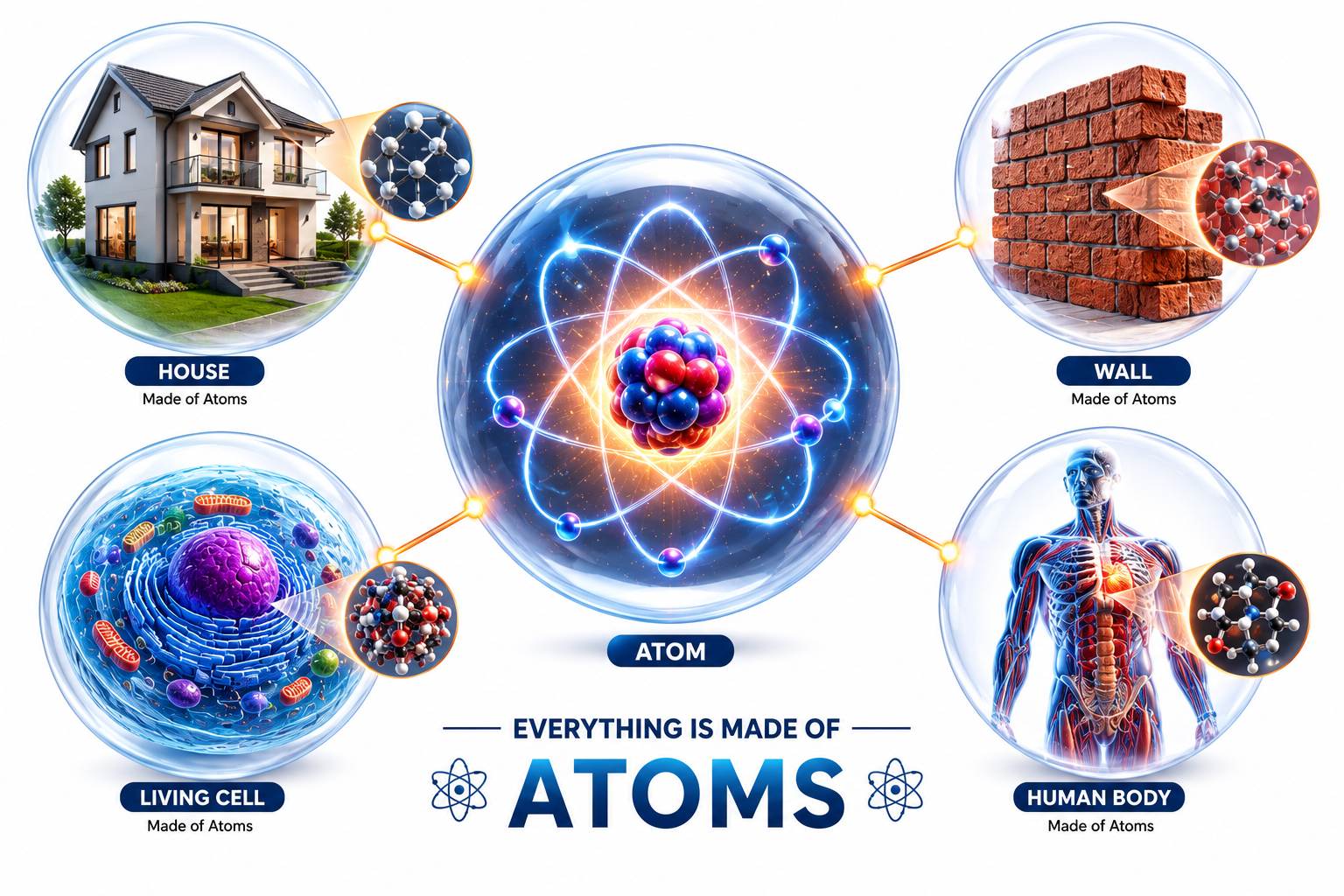
Everything that you see or observe, or feel around is matter. Matter consists of tiny particles called atoms. Since ancient times, philosophers and scientists have pondered the fundamental building blocks of matter.
These early concepts were imaginary ideas rather than being based on experimental observations.
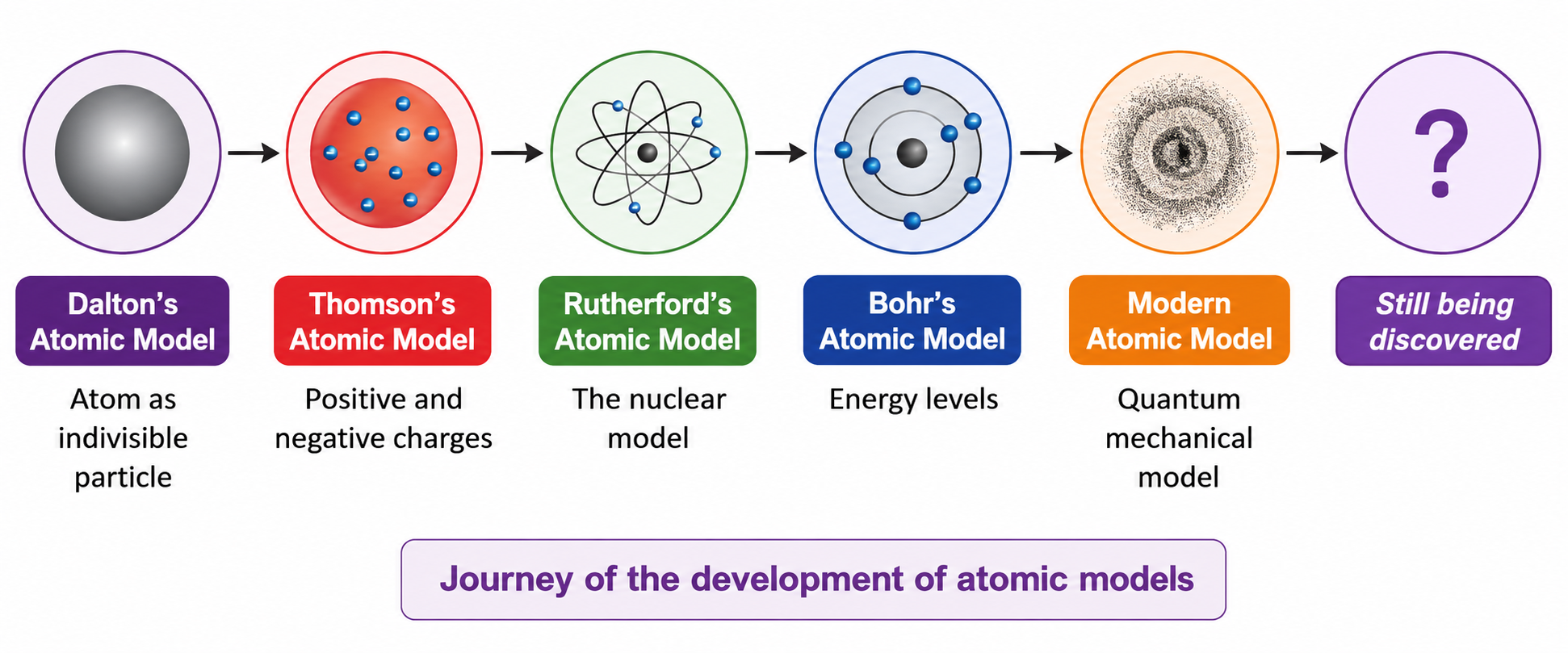
John Dalton proposed the first scientific description of how matter is made. He suggested that all matter is composed of indivisible particles called atoms. Atoms are the fundamental building blocks of matter that cannot be broken down into smaller parts.
Are atoms truly the smallest indivisible particles? Dalton's theory was a starting point, but scientists later discovered that certain elements emit radiation, leading to the realisation that atoms are actually composed of even smaller subatomic particles.
More than a hundred years ago, scientists tried to imagine what atoms might look like by proposing simple models. Driven by curiosity and experimentation, these models were continuously refined.
J.J. Thomson studied the conduction of electric current through gases at very low pressure using a glass tube with two electrodes and a high voltage. He observed rays moving from the cathode (negative electrode) to the anode (positive electrode), called cathode rays.
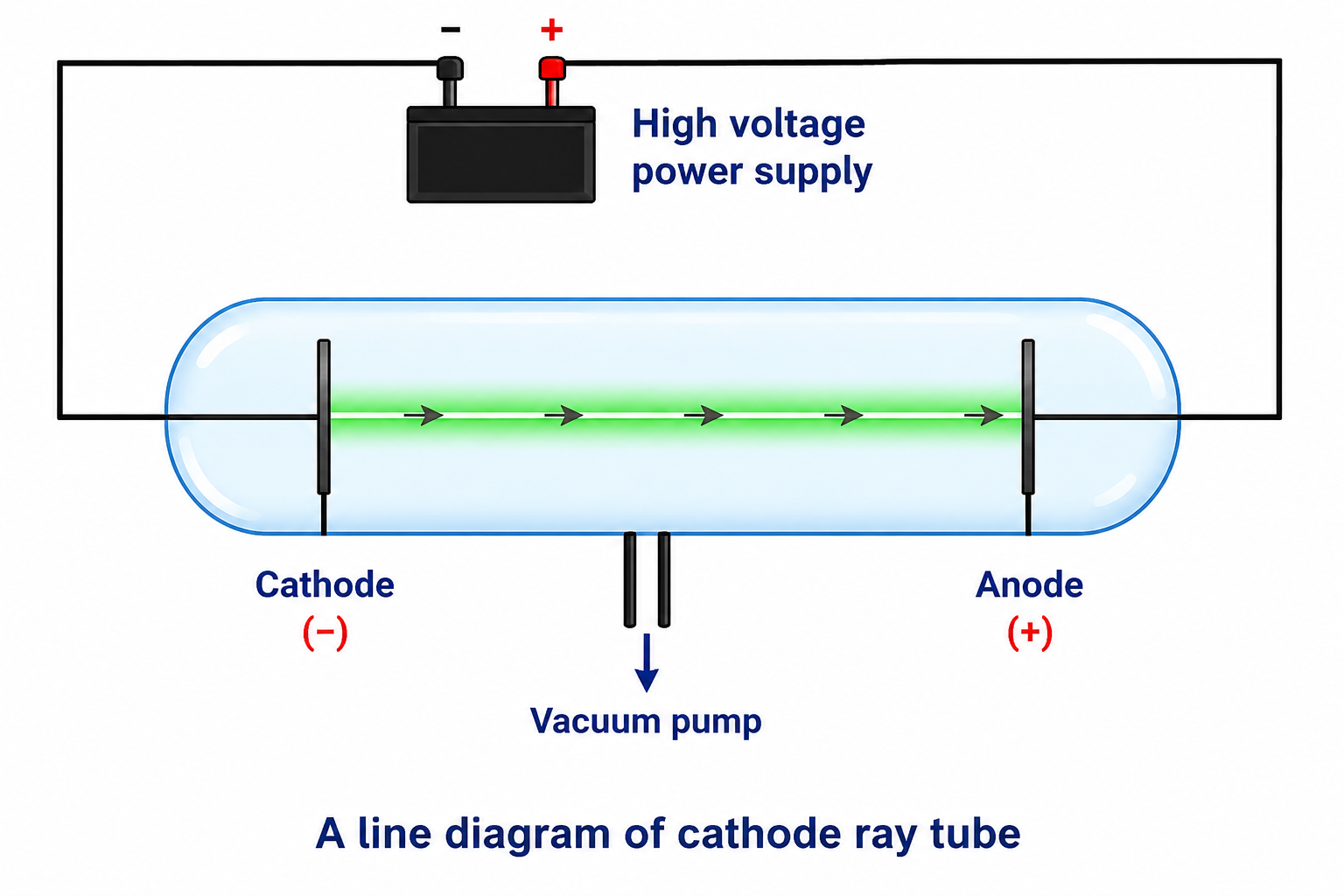
Thomson concluded that cathode rays are streams of negatively charged particles with a much smaller mass than atoms. These particles, later called electrons ($e^-$), are a fundamental component of all atoms. The charge of an electron is approximately $-1.602 \times 10^{-19} \text{ C}$ but is taken as $-1$ by convention.
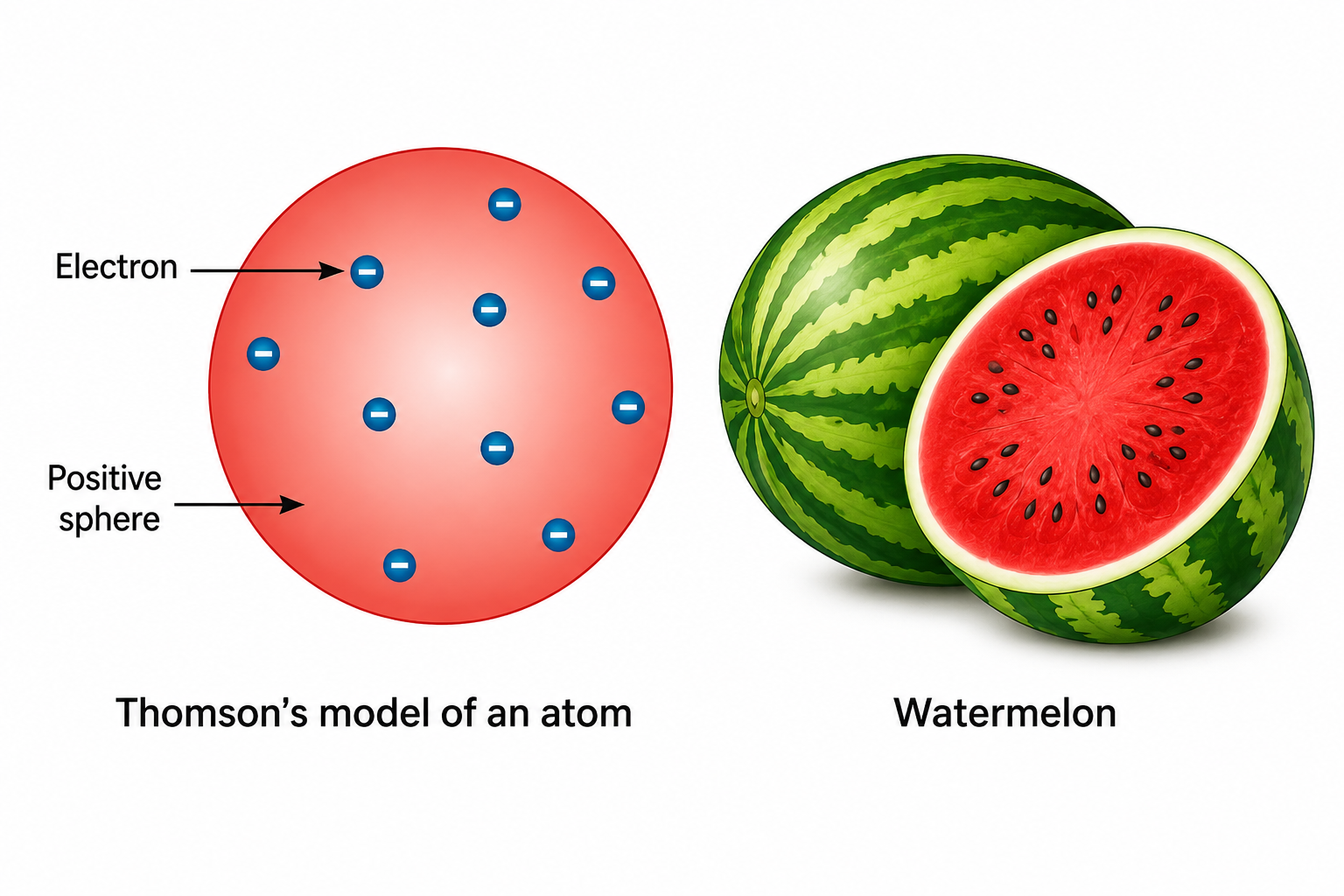
Since atoms are electrically neutral and contain negative electrons, there must be a positive charge to balance them. Thomson proposed that an atom is a sphere of positive charge with electrons distributed throughout it.
Geiger and Marsden, working under Ernest Rutherford, aimed a narrow beam of alpha ($\alpha$) particles at an extremely thin sheet of gold foil. Alpha particles are positively charged particles (helium nuclei, containing two protons and two neutrons).
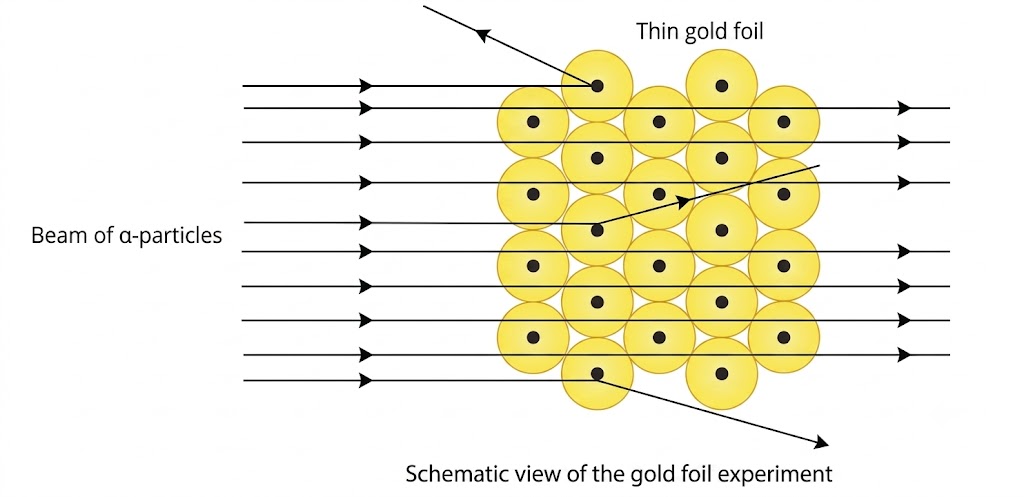
Expectation: If Thomson's model was correct, the positive charge would be spread evenly, so the alpha particles should pass straight through or deflect only slightly.
Observation: While most particles passed straight through, some were sharply deflected, and a few even bounced back (scattering). This proved Thomson's model wrong.
Based on the gold foil experiment, Rutherford concluded that the positive charge is not spread out but concentrated in an extremely small region called the nucleus. His model proposed:
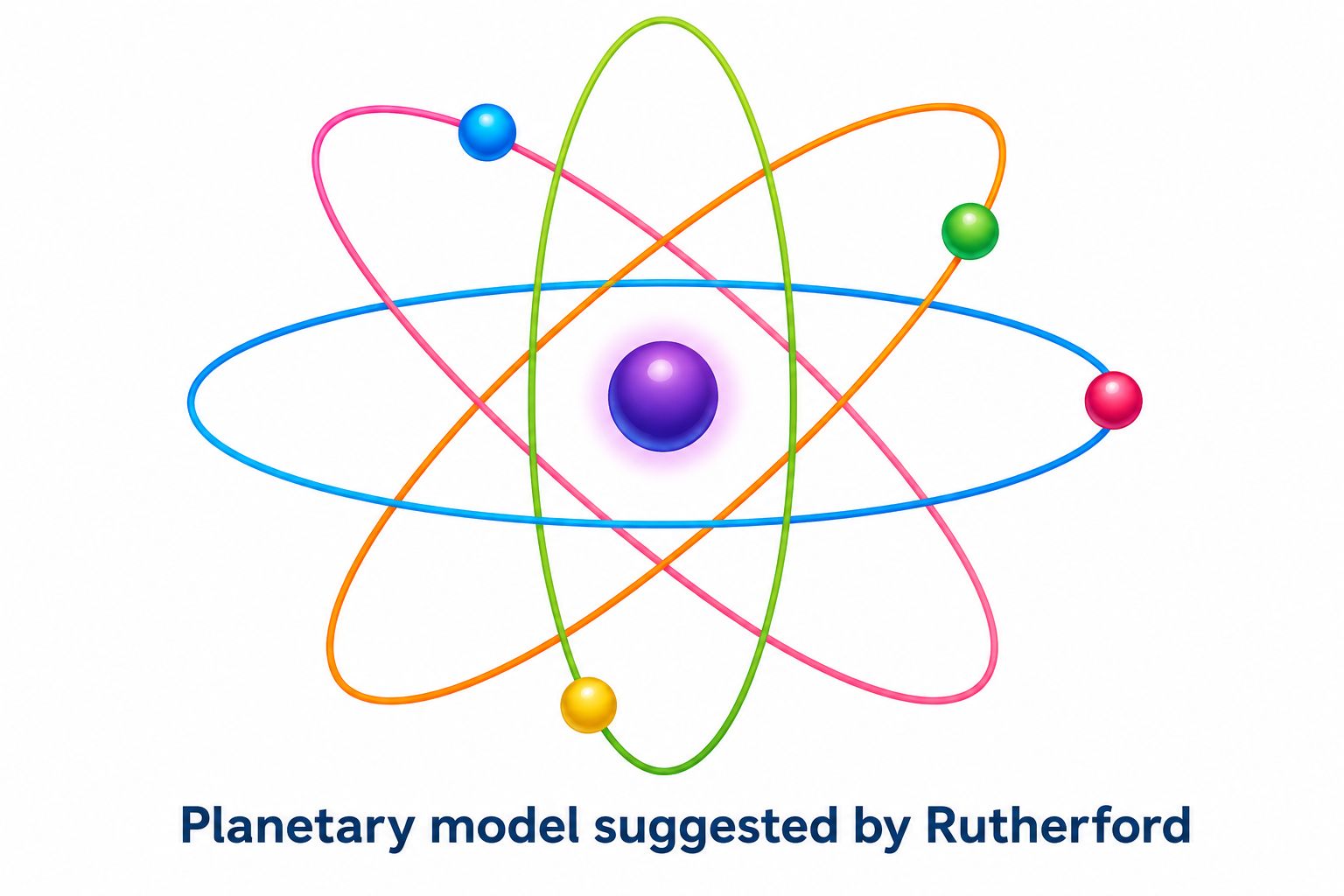
Rutherford found that the nucleus is extremely small — about $10^5$ (one lakh) times smaller than the atom. If an atom were the size of a cricket ground (100 m across), the nucleus would be a tiny black pepper grain (a few mm) at the centre!
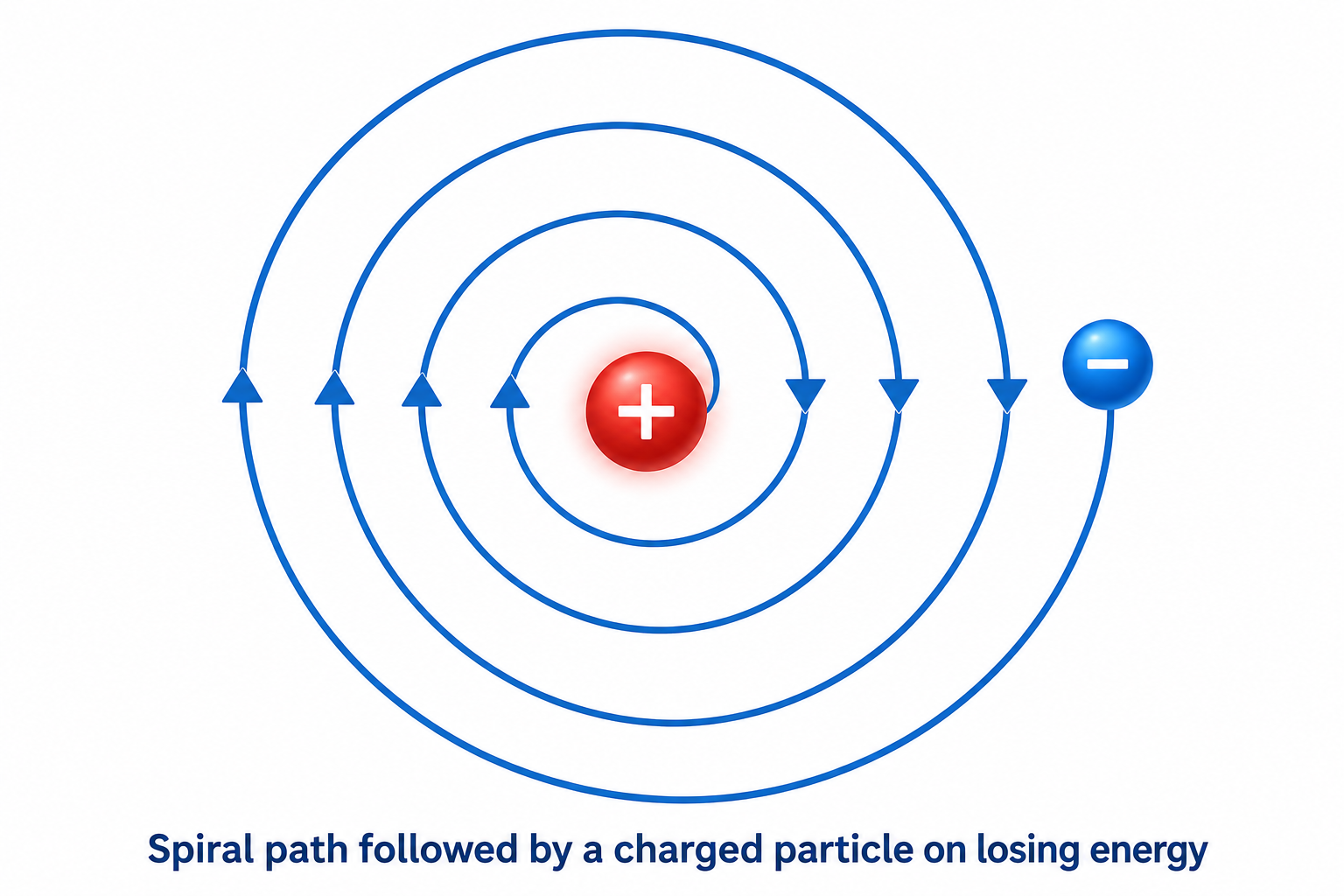
A particle moving in a circular path is constantly accelerating. A negatively charged electron accelerating around a nucleus should continuously lose energy and spiral inward, eventually crashing into the positively charged nucleus. If this happened, atoms would collapse. Since atoms are stable, a new explanation was needed.
Rutherford showed that the nucleus carries positive charge due to particles called protons ($p^+$). Protons are much heavier than electrons and possess a charge equal and opposite to electrons ($+1$). For an atom to be electrically neutral, the number of protons must equal the number of electrons.
To explain why atoms are stable, Niels Bohr proposed a new model with specific rules:
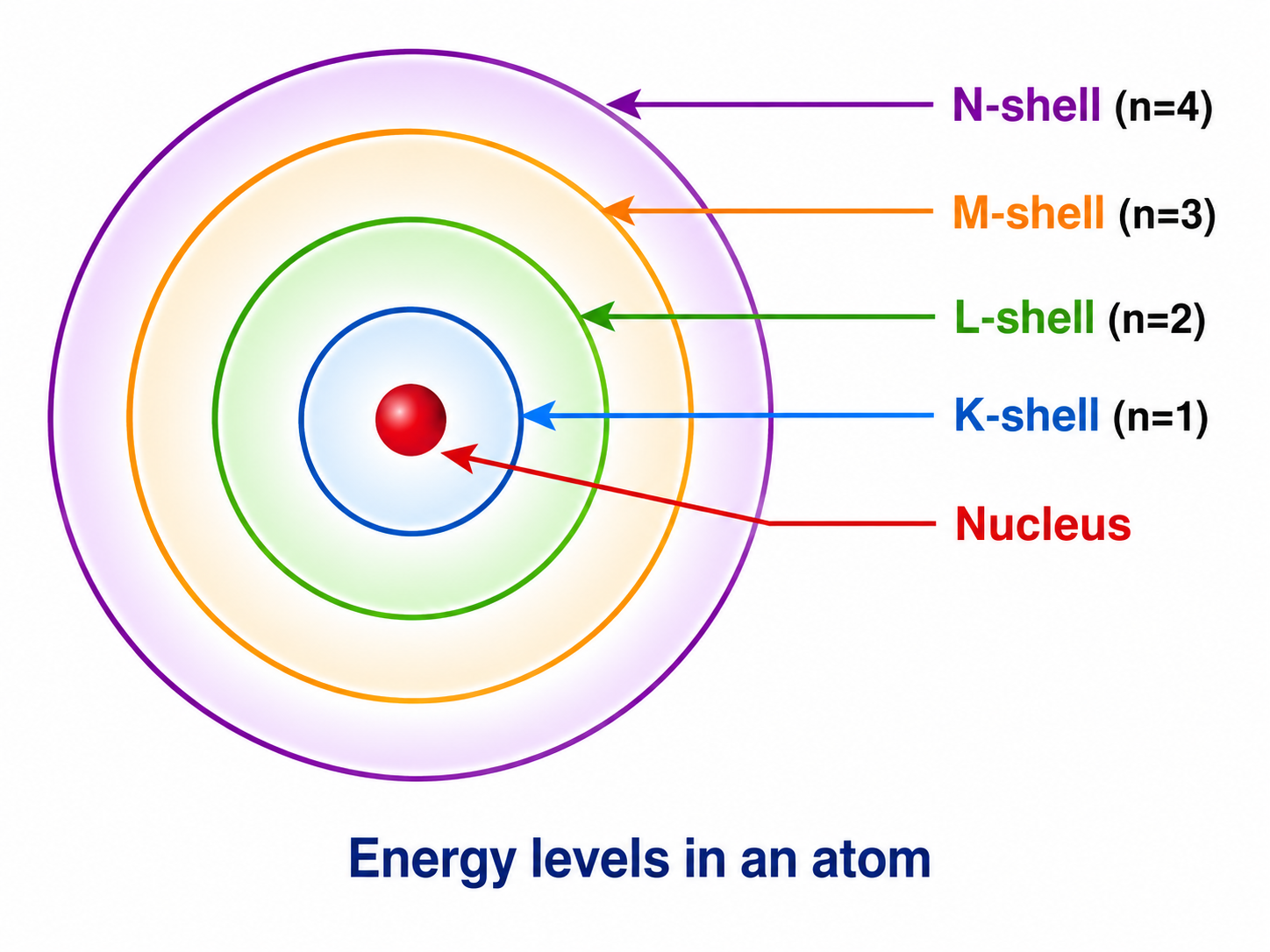
A hydrogen atom has one proton. A helium atom has two protons. However, the mass of a helium atom is about four times that of hydrogen, not double! This puzzle led to the discovery of another particle.
In 1932, James Chadwick discovered a neutral subatomic particle with a mass nearly equal to that of a proton. He named it the neutron ($n^0$). Neutrons are found in the nucleus of all atoms (except hydrogen). The mass of an atom comes mainly from protons and neutrons packed tightly in the nucleus.
Subatomic Particles Summary:
| Subatomic particle | Symbol | Relative charge |
|---|---|---|
| Electron | $e^-$ | $-1$ |
| Proton | $p^+$ | $+1$ |
| Neutron | $n^0$ | $0$ |
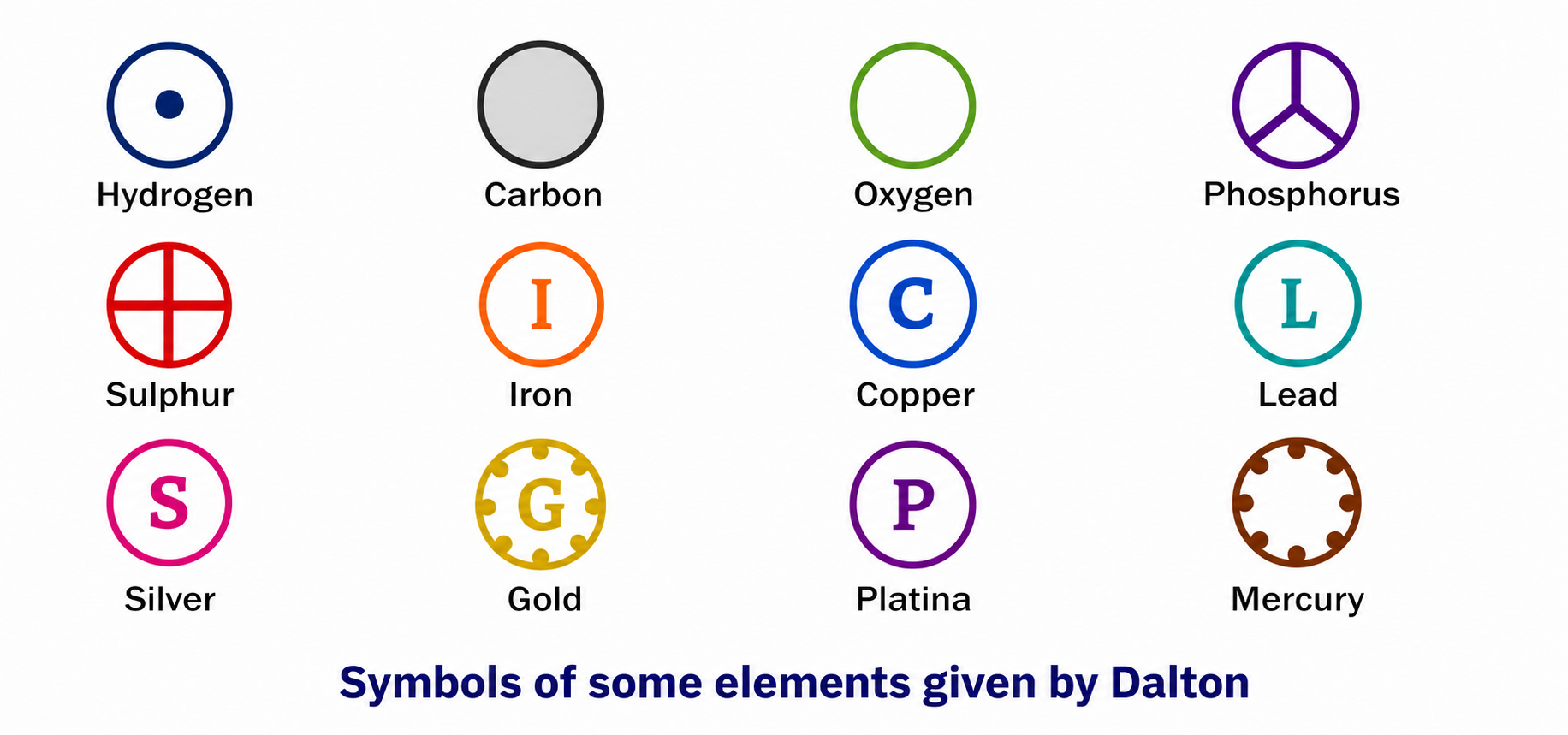
John Dalton was the first to use pictorial symbols. Later, Berzelius suggested using letters from the elements' Latin names. Today, IUPAC approves chemical symbols based on the following rules:
The number of protons in the nucleus of an atom is known as its atomic number. It determines the identity of an element. In a neutral atom, the number of protons equals the number of electrons.
.png)
The total number of protons and neutrons present in the nucleus is called the mass number. Protons and neutrons together are called nucleons.
Standard Notation: An element's symbol, mass number, and atomic number are written as:
Bohr and Bury suggested rules for filling electrons in orbits:
The outermost shell of an atom is known as its valence shell, and the electrons in it are valence electrons.
An outermost shell with 8 electrons is called an octet. Elements with a complete octet (like noble gases) are largely unreactive and stable. Atoms with incomplete valence shells tend to lose, gain, or share electrons to complete their octet.
The number of electrons gained, lost, or shared to complete the octet is the valency (combining capacity) of the element.
Atoms of the same element that have the same atomic number ($Z$) but different mass numbers ($A$) are called isotopes. This means they have the same number of protons but a different number of neutrons.
Examples:
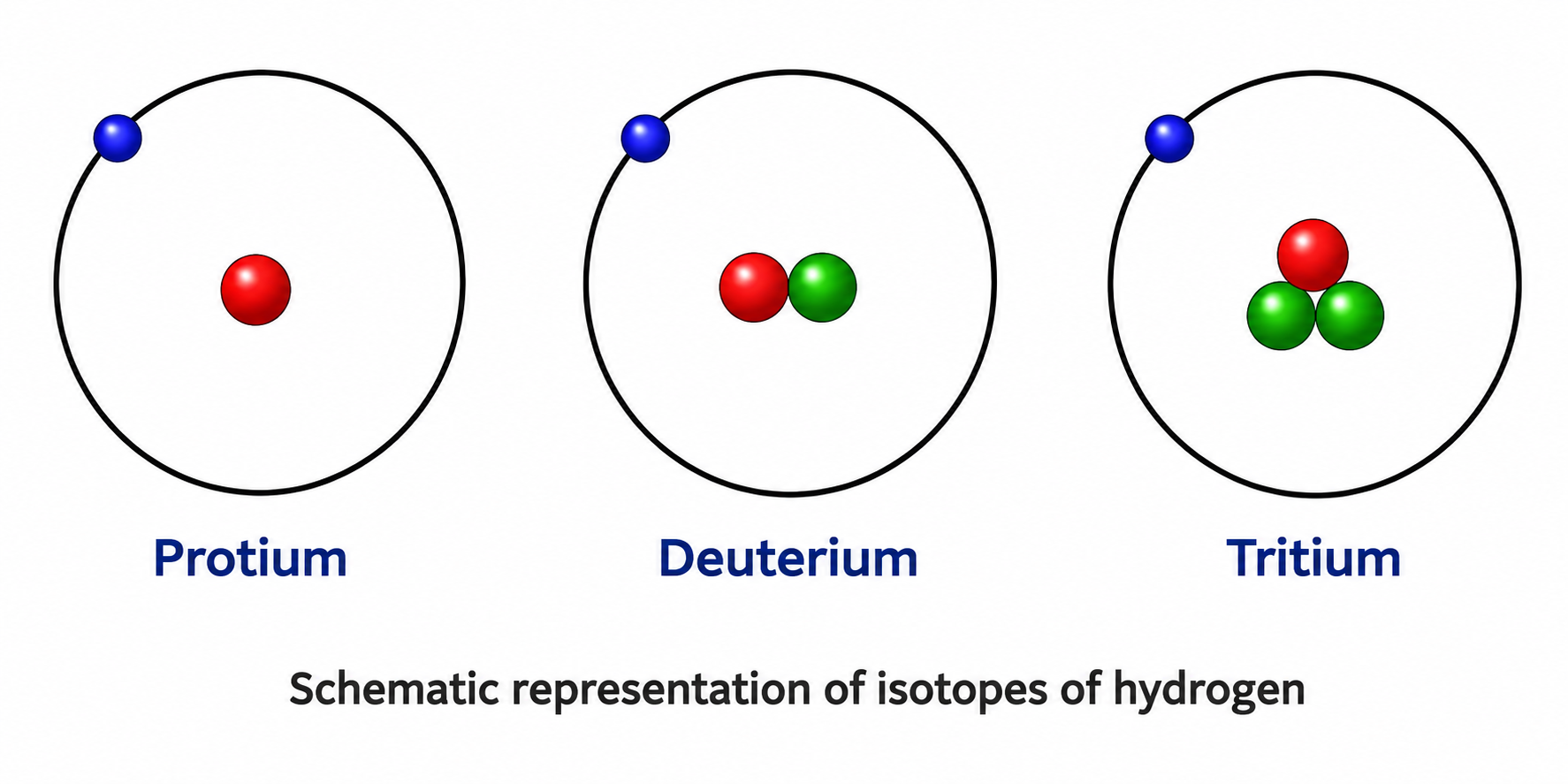
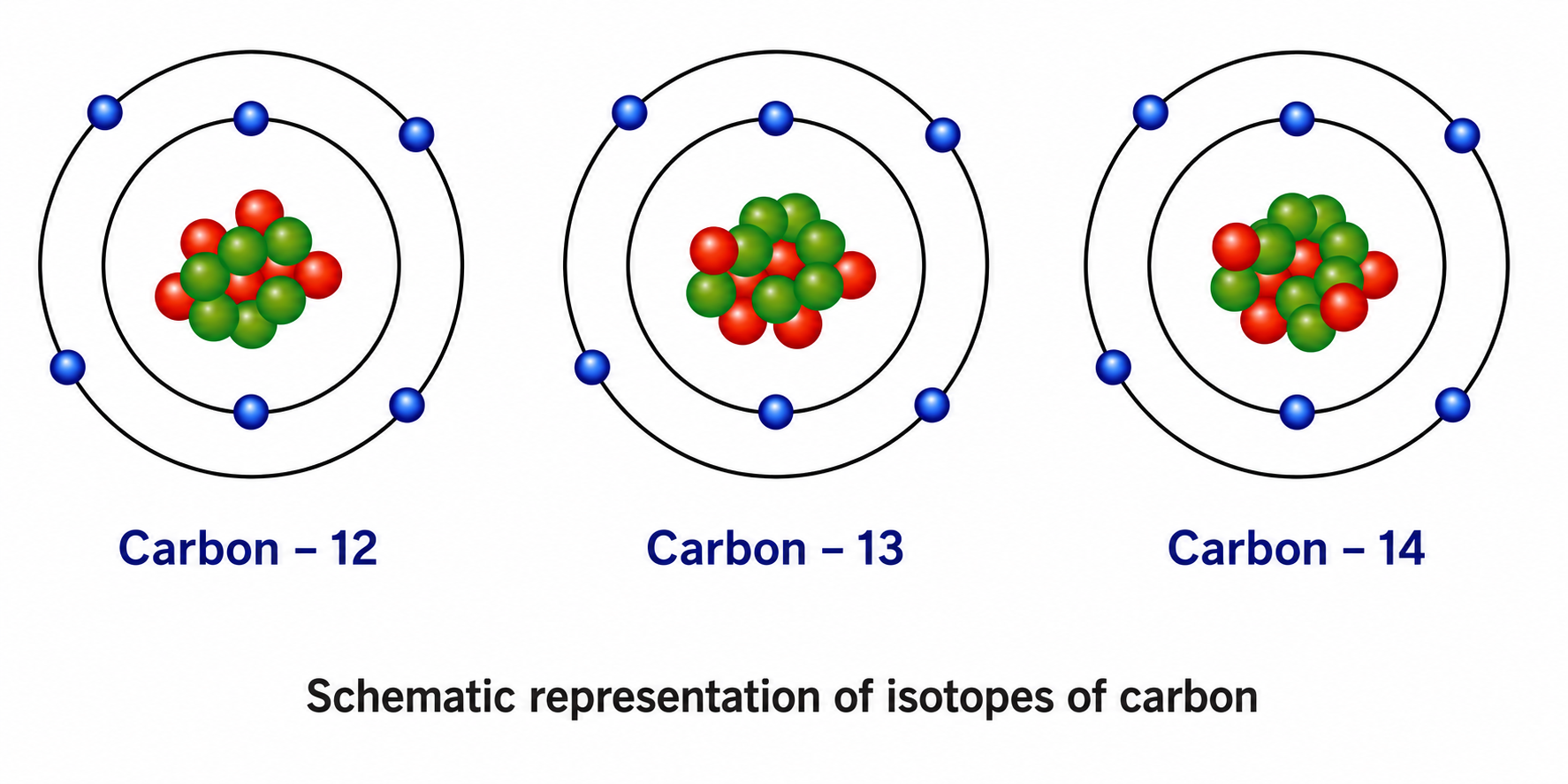
Because chemical properties depend on valence electrons, isotopes of an element exhibit identical chemical properties. However, because their masses differ, their physical properties (like boiling/melting points) can be slightly different.
Applications of Radioactive Isotopes:
Because elements exist in isotopic forms in nature, we use a weighted average atomic mass based on the relative abundance of each isotope.
For example, Chlorine exists as $75\%$ $^{35}\text{Cl}$ and $25\%$ $^{37}\text{Cl}$.
Atoms of different elements that have different atomic numbers but the same mass number are called isobars. This means the total number of nucleons (protons + neutrons) is the same, but the elements themselves are entirely different.
Example: Calcium ($Z=20$), Potassium ($Z=19$), and Argon ($Z=18$) can all have a mass number of $40$.
Question: An atom has 18 neutrons and an atomic number of 17. What is its mass number and identify the element.
Solution:
Atomic Number ($Z$) = Protons = 17.
Neutrons = 18.
The element with atomic number 17 is Chlorine (Cl).
 VARDAAN COMET