In everyday language, "work" refers to any physical or mental effort. However, in science, the definition of work is very specific. Work is said to be done only when a force applied on an object causes a displacement of the object in the direction of the force.
For work to be done in science, two conditions must be satisfied:
Formula: Work done ($W$) by a constant force is defined as the product of the magnitude of the force ($F$) and the distance ($s$) moved in the direction of the force.
The SI unit of work is the Joule (J). One Joule is defined as the amount of work done when a force of $1 \text{ Newton}$ displaces an object by $1 \text{ metre}$ along the line of action of the force.
 Positive Work (a person pu.png)
If a force is applied at an angle $\theta$ to the direction of displacement, the work done is $W = Fs \cos(\theta)$. When $\theta = 90^\circ$, $\cos(90^\circ) = 0$, leading to zero work.
Q: A porter lifts a luggage of 15 kg from the ground and puts it on his head 1.5 m above the ground. Calculate the work done by him on the luggage. (Take $g = 10 \text{ m/s}^2$)
Solution:
Mass of luggage, $m = 15 \text{ kg}$
Displacement, $s = 1.5 \text{ m}$
Force required to lift the luggage is equal to its weight: $F = mg = 15 \text{ kg} \times 10 \text{ m/s}^2 = 150 \text{ N}$
Work done, $W = F \times s = 150 \text{ N} \times 1.5 \text{ m} = 225 \text{ J}$.
Energy is defined as the capacity or ability to do work. The object which does the work loses energy and the object on which the work is done gains energy.
Since energy is the capacity to do work, the SI unit of energy is the same as that of work, which is the Joule (J).
Kinetic energy is the energy possessed by an object due to its motion. The kinetic energy of an object increases with its speed.
Formula: The kinetic energy ($E_k$) of an object of mass $m$ moving with a uniform velocity $v$ is:
Derivation: Let an object of mass $m$ start from rest ($u=0$) and attain a velocity $v$ over a displacement $s$ due to a uniform force $F$. Work done $W = F \times s$. From Newton's second law, $F = ma$. From the third equation of motion, $v^2 - u^2 = 2as \implies s = \frac{v^2}{2a}$.
Substituting $F$ and $s$ into the work equation:
Since the work done is stored as kinetic energy, $E_k = \frac{1}{2}mv^2$.
Q: What is the work to be done to increase the velocity of a car from 30 km/h to 60 km/h if the mass of the car is 1500 kg?
Solution:
Mass $m = 1500 \text{ kg}$
Initial velocity $u = 30 \text{ km/h} = 30 \times \frac{5}{18} = \frac{25}{3} \text{ m/s}$
Final velocity $v = 60 \text{ km/h} = 60 \times \frac{5}{18} = \frac{50}{3} \text{ m/s}$
Initial kinetic energy $E_{k_i} = \frac{1}{2}mu^2 = \frac{1}{2} \times 1500 \times \left(\frac{25}{3}\right)^2 = 750 \times \frac{625}{9} = 52083.33 \text{ J}$
Final kinetic energy $E_{k_f} = \frac{1}{2}mv^2 = \frac{1}{2} \times 1500 \times \left(\frac{50}{3}\right)^2 = 750 \times \frac{2500}{9} = 208333.33 \text{ J}$
Work done = Change in kinetic energy = $E_{k_f} - E_{k_i} = 208333.33 - 52083.33 = 156250 \text{ J}$.
Potential energy is the energy possessed by an object due to its position, shape, or configuration.
Gravitational Potential Energy: The work done in raising an object against gravity from the ground to a certain height.
Formula: Let an object of mass $m$ be raised to a height $h$. The minimum force required to lift it is equal to its weight ($mg$).
Work done, $W = \text{Force} \times \text{Displacement} = mg \times h = mgh$
This work is stored as gravitational potential energy ($E_p$):
The work done by gravity depends only on the vertical height difference between the initial and final positions, not on the path taken. This is a characteristic of conservative forces.
 from a height 'h' to th.png)
Fig 3.1: Free Fall & Energy Conservation
The law of conservation of energy states that energy can neither be created nor destroyed; it can only be transformed from one form to another. The total energy before and after transformation always remains constant.
Example of Free Fall: Consider an object of mass $m$ falling freely from a height $h$.
At any point in its path, the sum of its potential and kinetic energy (Total Mechanical Energy) remains constant: $E_k + E_p = \text{Constant}$.
Power is defined as the rate of doing work or the rate of transfer of energy.
Formula: If an agent does work $W$ in time $t$, then power $P$ is given by:
Unit: The SI unit of power is the Watt (W). $1 \text{ Watt} = 1 \text{ Joule/second}$.
For larger measurements, we use Kilowatt (kW) where $1 \text{ kW} = 1000 \text{ W}$.
The Joule is too small for expressing large quantities of energy. We use a bigger unit called kilowatt-hour (kWh).
1 kWh is the energy consumed when 1 kW of power is used for 1 hour.
The electrical energy used in homes is measured in units. $1 \text{ Unit} = 1 \text{ kWh}$.
Q: An electric bulb of 60 W is used for 6 hours per day. Calculate the 'units' of energy consumed in one day by the bulb.
Solution:
Power of bulb, $P = 60 \text{ W} = \frac{60}{1000} \text{ kW} = 0.06 \text{ kW}$
Time, $t = 6 \text{ h}$
Energy consumed, $E = P \times t = 0.06 \text{ kW} \times 6 \text{ h} = 0.36 \text{ kWh}$
Therefore, the energy consumed is 0.36 'units'.
A simple machine is a mechanical device that changes the direction or magnitude of a force. In general, they can be defined as the simplest mechanisms that use mechanical advantage (also called leverage) to multiply force or to apply force at a convenient point and direction.
Ideal Machine: A hypothetical machine where there is no loss of energy to friction. Efficiency is 100%, and $MA = VR$.
Practical Machine: Energy is always lost due to friction and weight of moving parts. Efficiency is always less than 100%, meaning $MA < VR$.
A rigid straight or bent bar which is capable of turning about a fixed axis called the fulcrum (F).
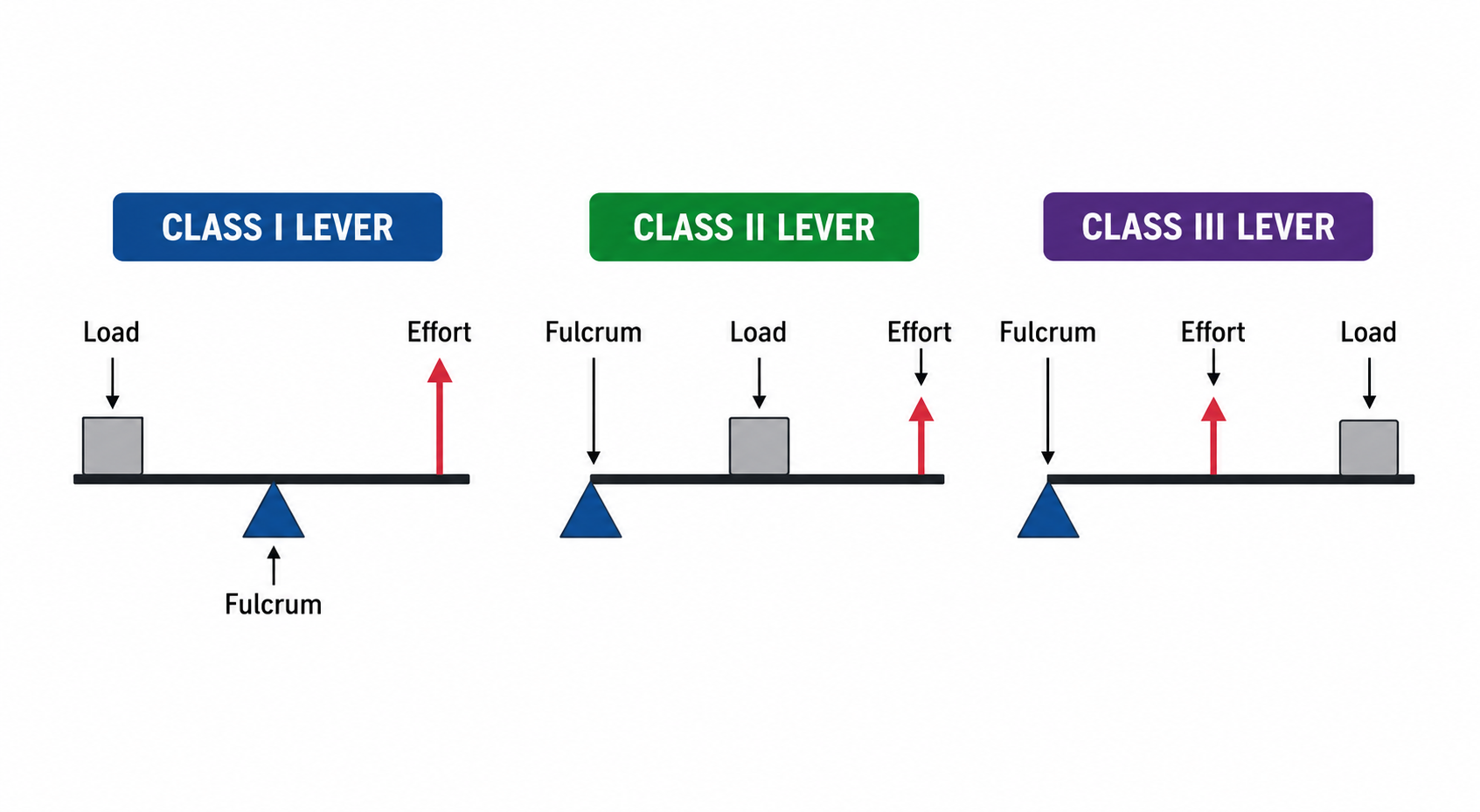
 A single fixed pulley, 2) A single movable pull.png)
A flat surface tilted at an angle ($\theta$) to the horizontal. It acts as a force multiplier to lift heavy loads.
Q: A machine requires an effort of 200 N to lift a load of 800 N. The effort moves through a distance of 10 m while the load moves through 2 m. Calculate the MA, VR, and Efficiency of the machine.
Solution:
Load, $L = 800 \text{ N}$; Effort, $E = 200 \text{ N}$
Displacement of effort, $d_E = 10 \text{ m}$; Displacement of load, $d_L = 2 \text{ m}$
1. Mechanical Advantage (MA): $MA = \frac{L}{E} = \frac{800}{200} = 4$
2. Velocity Ratio (VR): $VR = \frac{d_E}{d_L} = \frac{10}{2} = 5$
3. Efficiency ($\eta$): $\eta = \frac{MA}{VR} \times 100\% = \frac{4}{5} \times 100\% = 80\%$