Created by Team Vardaan with ♥|Powered byVARDAAN COMET
Motion in a Straight Line
References
Compiled from: NCERT Physics Part-1 (Motion in a Straight
Line) • H.C. Verma — Concepts of Physics Vol-1 (Ch. 3: Rest and Motion — Kinematics)
• D.C. Pandey — Understanding Physics: Mechanics Part-1 • Pradeep's Fundamental
Physics XI • S.L. Arora • Cengage (B.M. Sharma) Mechanics-I • Errorless Physics. Target
exams: Boards • JEE Main • JEE Advanced • NEET • NDA.
1. Introduction — Rest, Motion & the Point Object
Mechanics is the oldest and most fundamental branch of physics. It is divided into Statics
(objects at rest under forces), Kinematics (description of motion without asking about its
cause) and Dynamics (motion together with its cause — force). This chapter is pure
kinematics restricted to one dimension — motion along a straight line, also called
rectilinear motion.
1.1 Rest and Motion are Relative (NCERT · HCV Ch-3)
Definition
An object is said to be in motion if its position changes with
time with respect to a chosen observer (frame of reference). It is at rest if
its position does not change with time with respect to that observer.
There is no absolute rest and no absolute motion. A passenger sitting in a moving train
is at rest relative to the train, but in motion relative to the platform.
H.C. Verma opens his kinematics chapter with exactly this idea: motion is always described relative
to a frame. Every answer in kinematics silently assumes a frame — usually the ground.
1.2 Point Object (Particle) Approximation
Definition
An object is treated as a point object when the distance it
travels is very large compared to its own size, so its size is irrelevant to the description of its
motion.
Valid: A train travelling from Delhi to Mumbai (~1400 km vs ~1 km length); Earth
revolving around the Sun; a car on a 100 km journey.
Not valid: A train crossing a bridge or a platform (its own length matters!); a
spinning top; a tumbling gymnast.
⭐ BOARD EXAM ALERT
A very common 1-mark question: "Under what condition can
a train be treated as a point object?" — Answer: when the distance covered is much greater than
the length of the train (e.g., an inter-city journey), but not while it crosses a
bridge/platform.
1.3 One, Two and Three Dimensional Motion
Type
Coordinates changing
Examples
1-D (Rectilinear)
Only one (say $x$)
Train on a straight track, freely falling stone, car on a straight road
To measure position we need: (i) an origin O, (ii) a set of coordinate
axes, and (iii) a clock. Together these form a frame of reference. For
straight-line motion we need only one axis — take it as the x-axis along the line of
motion.
Position $x$ of a particle is its coordinate on this axis. It can be positive (right of
O), negative (left of O) or zero.
Position is a vector, but in 1-D its direction is fully captured by the ± sign — this
is why the entire chapter can be done with signed numbers instead of full vector notation (a key insight
stressed by D.C. Pandey).
Figure 1
The 1-D frame of reference: positions on the x-axis
Position is a signed number in 1-D: P at +3 m, Q at −2 m.
The pulsing dots are the particles; arrows are their position vectors.
3. Distance (Path Length) vs Displacement
Definitions
Distance (path length) = actual length of the path travelled. Scalar, always ≥ 0, never
decreases with time.
Displacement = change in position vector = (final position) − (initial position):
$$\Delta x = x_2 - x_1$$
Vector; can be positive, negative or zero; depends only on end points, not on
the path.
Property
Distance
Displacement
Nature
Scalar
Vector
Sign
Always positive (or zero)
+, − or 0
Depends on path?
Yes
No — only end points
Can decrease with time?
Never
Yes (particle can turn back)
Magnitude relation
Distance ≥ |Displacement| ; equality only for motion in one direction along a
straight line
Round trip value
2 × one-way path
Zero
Key Result
Asked in NEET & Boards repeatedly:
Displacement can be zero while distance is non-zero (round trip). The converse is impossible.
If distance = |displacement|, the particle moved along a straight line without reversing
direction.
Ratio $\dfrac{\text{distance}}{|\text{displacement}|} \geq 1$ always.
✍ SOLVED EXAMPLE 3.1 — NCERT-style · Boards / NEET
Q. A particle moves along the x-axis from x = +2 m to x = +12 m, then turns back and comes
to x = +7 m. Find the total distance travelled and the displacement.
Forward trip: $12 - 2 = 10$ m. Return trip: $12
- 7 = 5$ m.
Geometrically: slope of the tangent to the x–t graph at that instant.
Instantaneous speed = |instantaneous velocity| — always. (They differ only in
"average" versions. Classic NEET trap!)
A speedometer reads instantaneous speed, not velocity (it shows no direction).
4.3 Uniform vs Non-uniform Velocity
Uniform velocity: equal displacements in equal intervals of time, however small. Then
$v_{avg} = v_{inst}$ at every instant, acceleration = 0, x–t graph is a straight line.
Non-uniform (variable) velocity: magnitude or direction (or both) changes. In 1-D
"direction change" means reversal (sign flip).
⭐ MISCONCEPTION BUSTER (HCV / DC PANDEY)
"Average velocity = $\frac{u+v}{2}$" is NOT a general
formula. It is valid only for uniform (constant) acceleration. For any other
motion you must compute displacement ÷ time. Many wrong answers in JEE come from misusing this.
5. Special Average-Speed Results (with Proofs)
5.1 Equal Distances at Two Different Speeds → Harmonic Mean
A particle covers the first half distance at speed $v_1$ and second half at $v_2$.
Distance-wise split → Harmonic mean (D–H:
"Dilli–Haryana"). Time-wise split → Arithmetic mean (T–A: "TA of
time"). Harmonic mean is always the smaller one — going slow for equal distance eats more time!
✍ SOLVED EXAMPLE 5.1 — NEET / Boards classic
Q. A car covers half its journey at 40 km/h and the remaining half distance at 60 km/h.
Find the average speed.
SI unit: m s⁻²; dimension $[M^0LT^{-2}]$. Vector — carries a sign in 1-D.
Geometrically: slope of the tangent to the v–t graph.
A hugely useful alternative form (chain rule, from HCV & DC Pandey):
$$a = \frac{dv}{dt} = \frac{dv}{dx}\cdot\frac{dx}{dt} = v\frac{dv}{dx}$$
Use $a = v\,\dfrac{dv}{dx}$ whenever velocity is given as a function of position.
6.1 The Sign of Acceleration — the Biggest Misconception in this Chapter
⭐ MISCONCEPTION BUSTER
Negative acceleration does NOT automatically mean "slowing
down". Speeding up or slowing down depends on the relative signs of v and a:
$v$ and $a$ same sign (both + or both −) → speeding up.
$v$ and $a$ opposite signs → slowing down (retardation).
Example: a ball falling downward with downward taken negative has $v<0,\ a<0$ — negative
acceleration, yet it speeds up!
Situation
Sign of v
Sign of a
Speed is…
Car accelerating along +x
+
+
Increasing
Car braking while moving along +x
+
−
Decreasing
Car accelerating along −x
−
−
Increasing
Car braking while moving along −x
−
+
Decreasing
Can it happen?
Favourite JEE conceptual list:
Zero velocity with non-zero acceleration? YES — a ball at the top of its vertical
flight (v = 0, a = g downward).
Constant speed with non-zero acceleration? In 1-D NO; in 2-D yes (uniform circular
motion).
Increasing speed with decreasing acceleration? YES — as long as a and v keep the
same sign, speed keeps rising even if |a| shrinks.
7. Equations of Motion (Uniform Acceleration) — All
Derivations
Valid only when acceleration $a$ is constant. Symbols: $u$ = initial velocity, $v$ =
velocity after time $t$, $s$ = displacement in time $t$, $x_0$ = initial position.
The Kinematic Equations
$$\text{(i)}\quad v = u + at$$
$$\text{(ii)}\quad s = ut + \tfrac{1}{2}at^2$$
$$\text{(iii)}\quad v^2 = u^2 + 2as$$
$$\text{(iv)}\quad s = \left(\frac{u+v}{2}\right)t$$
7.1 Derivation by Calculus (NCERT · HCV method)
Equation (i): since $a = \dfrac{dv}{dt}$ is constant,
$$\int_{u}^{v} dv = \int_{0}^{t} a\,dt$$
$$v - u = at \;\Rightarrow\; v = u + at$$
7.2 Derivation by Graphical Method (Boards favourite — 3/5 marks)
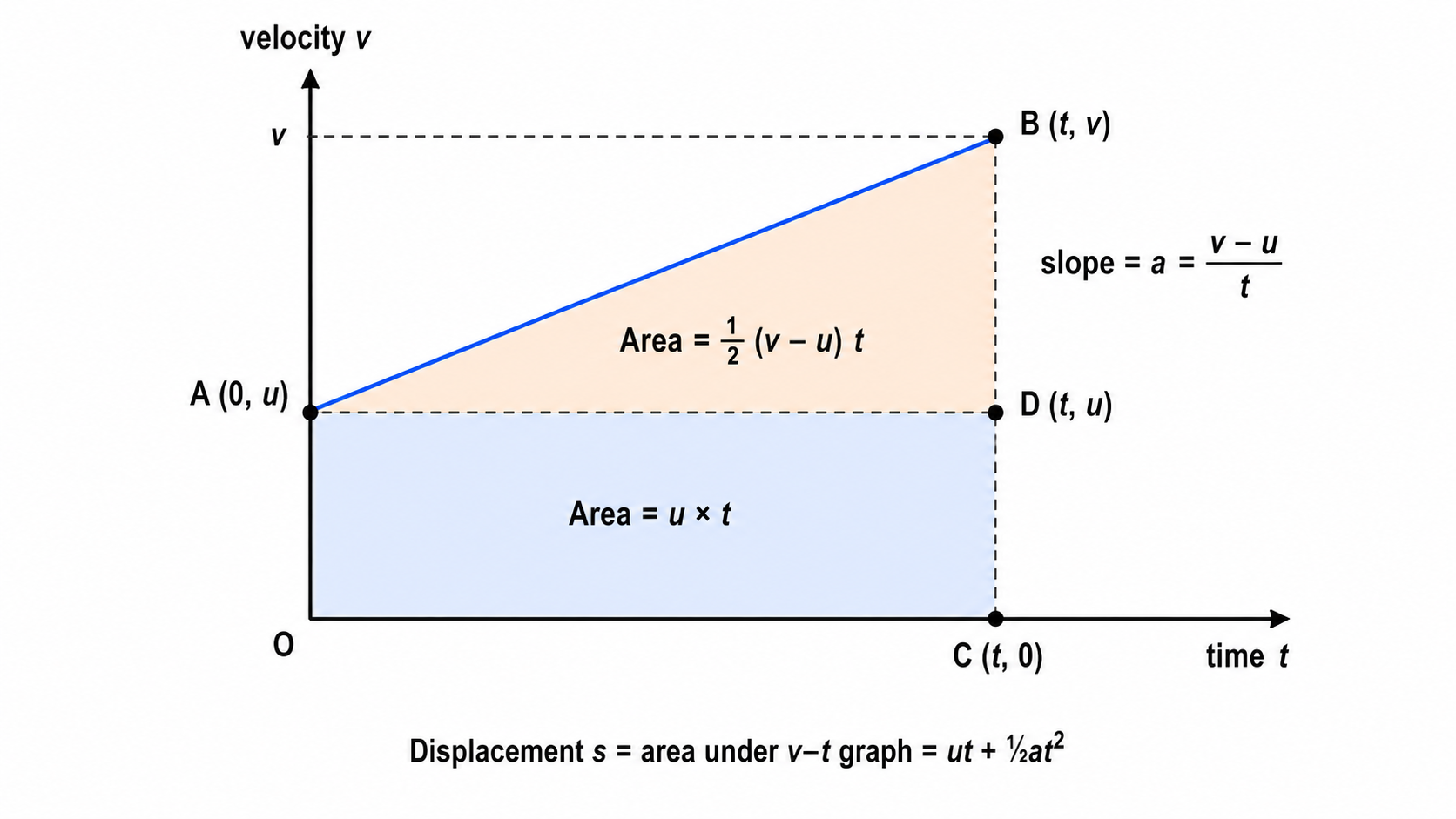
Draw the v–t graph of uniformly accelerated motion: a straight line starting at $v = u$ (point A on the
v-axis) rising to $v$ at time $t$ (point B). Drop perpendicular BC to the time axis and draw AD parallel to
the time axis meeting BC at D.
Slope: $a = \dfrac{BD}{AD} = \dfrac{v-u}{t}\ \Rightarrow\ v = u + at.$
Area under graph = displacement: area of rectangle OADC + area of triangle ABD:
$$s = ut + \tfrac{1}{2}\,t\,(v-u) = ut + \tfrac{1}{2}at^{2}$$
The v–t graph behind the graphical derivation of all three equations
Rectangle OADC (u·t) + triangle ABD (½(v−u)t) reproduce
steps 1–3 of Section 7.2.
7.3 Working with the Equations — Rules of the Game
Choose a positive direction first and give every quantity (u, v, a, s, g) its sign
accordingly. Stick to it for the whole problem.
$s$ in these equations is displacement, not distance. If the particle reverses
direction mid-way (e.g., ball thrown up), distance must be computed in pieces.
Each equation connects 4 of the 5 quantities (u, v, a, s, t). Pick the equation that omits the quantity
you neither know nor need — this is D.C. Pandey's selection trick.
If $a = 0$: all reduce to $s = ut$.
⭐ EXAM PATTERN
Boards: derive (graphical method) — 3 or 5
marks. NEET: direct substitution — 1 question nearly every year. JEE:
equations combined with graphs or two-body chases. NDA: quick numeric plug-ins with
unit conversion traps (km/h → m/s).
8. Displacement in the nth Second
Derivation. Displacement in nth second = (displacement in n s) − (displacement
in (n−1) s):
Result
$$\boxed{\,s_{n^{th}} = u + \frac{a}{2}\,(2n-1)\,}$$
Dimension Doubt — Resolved
(Pradeep / SL Arora) The formula looks dimensionally odd
(velocity on the right, displacement on the left). It is actually displacement per one second
interval; the hidden factor "× 1 s" makes it consistent. Write $s_{n^{th}} = u(1) +
\frac{a}{2}(2n-1)(1)$ if an examiner asks.
Galileo's Odd-Number Rule
For a body starting from rest (u = 0) with constant a, distances in successive seconds are in the ratio
$$s_1 : s_2 : s_3 : \dots = 1 : 3 : 5 : 7 \dots$$
and total distances in 1 s, 2 s, 3 s… are in the ratio $1 : 4 : 9 : \dots$
(i.e., $s \propto t^2$).
✍ SOLVED EXAMPLE 8.1 — NEET / NDA classic
Q. A body starts from rest with uniform acceleration and covers 35 m in the 5th second.
Find its acceleration and the distance covered in 10 s.
Near Earth's surface, ignoring air resistance, every body falls with the same constant acceleration $g
\approx 9.8\ \text{m/s}^2$ (take 10 m/s² when told). Since g is constant, all kinematic equations
apply — just substitute a = ±g with a consistent sign convention.
Take upward as +. Then a = −g always, whether the body moves up or down. This single rule
lets one equation handle the entire flight of a ball thrown upward — the DC Pandey "one-equation" method.
9.2 Case A — Body Dropped from Rest from Height h
u = 0, downward +: $v = gt,\quad h = \tfrac{1}{2}gt^{2},\quad v^{2} = 2gh$
Fall From Height h
$$t_{fall} = \sqrt{\frac{2h}{g}}, \qquad v_{hit} = \sqrt{2gh}$$
Distances in successive seconds follow 1 : 3 : 5 : 7…; positions after 1 s, 2 s, 3 s are $\frac{g}{2}, 2g,
\frac{9g}{2},\dots$
9.3 Case B — Body Thrown Vertically Upward with Speed u
Complete Result Set (Must Memorise)
$$\text{Max height } H = \frac{u^{2}}{2g}$$
$$\text{Time of ascent } = \text{time of descent} = \frac{u}{g}$$
$$\text{Total time of flight } T = \frac{2u}{g}$$
$$\text{Return speed at throw level} = u$$
Symmetry: speed at any height is the same going up and coming down; time up between two
levels = time down between the same two levels.
At the top: v = 0 but a = g (downward) — velocity is momentarily zero, acceleration is not.
Velocity–time graph of the whole flight is a single straight line of slope −g crossing the t-axis at t
= u/g.
Displacement after full flight = 0, distance = 2H = u²/g.
9.4 Case C — Thrown Up (or Down) from the Top of a Tower of Height h
Take up = +, origin at the top. Ball thrown up with speed u lands at the base when displacement = −h:
$$-h = ut - \tfrac{1}{2}gt^{2}$$
Solve the quadratic $\tfrac{1}{2}gt^{2} - ut - h = 0$ for t (take the positive root). Landing speed from
$v^2 = u^2 + 2gh$ — note: the landing speed is the same whether the ball is thrown
up with u or down with u (energy symmetry; only the time differs). This is a favourite JEE/NEET conceptual
point.
Figure 4
Ball thrown vertically upward: flight symmetry (left) and its single-line v–t graph
(right)
The ball animation eases near the top (slow) and speeds up
on descent, while the red dot tracks v falling from +u through 0 (at t = u/g) to −u — both run on the
same 4-second clock.
✍ SOLVED EXAMPLE 9.1 — HC Verma-style · JEE Main level
Q. A ball is thrown upward from the top of a 40 m tower with speed 10 m/s (g = 10 m/s²).
Find (a) time to reach the ground, (b) speed on hitting the ground, (c) total distance travelled.
(c) Up distance $= \frac{u^2}{2g} = 5$ m; down distance $= 5 +
40 = 45$ m; total = 50 m (displacement is only −40 m).
10. Graphs — The Complete Theory
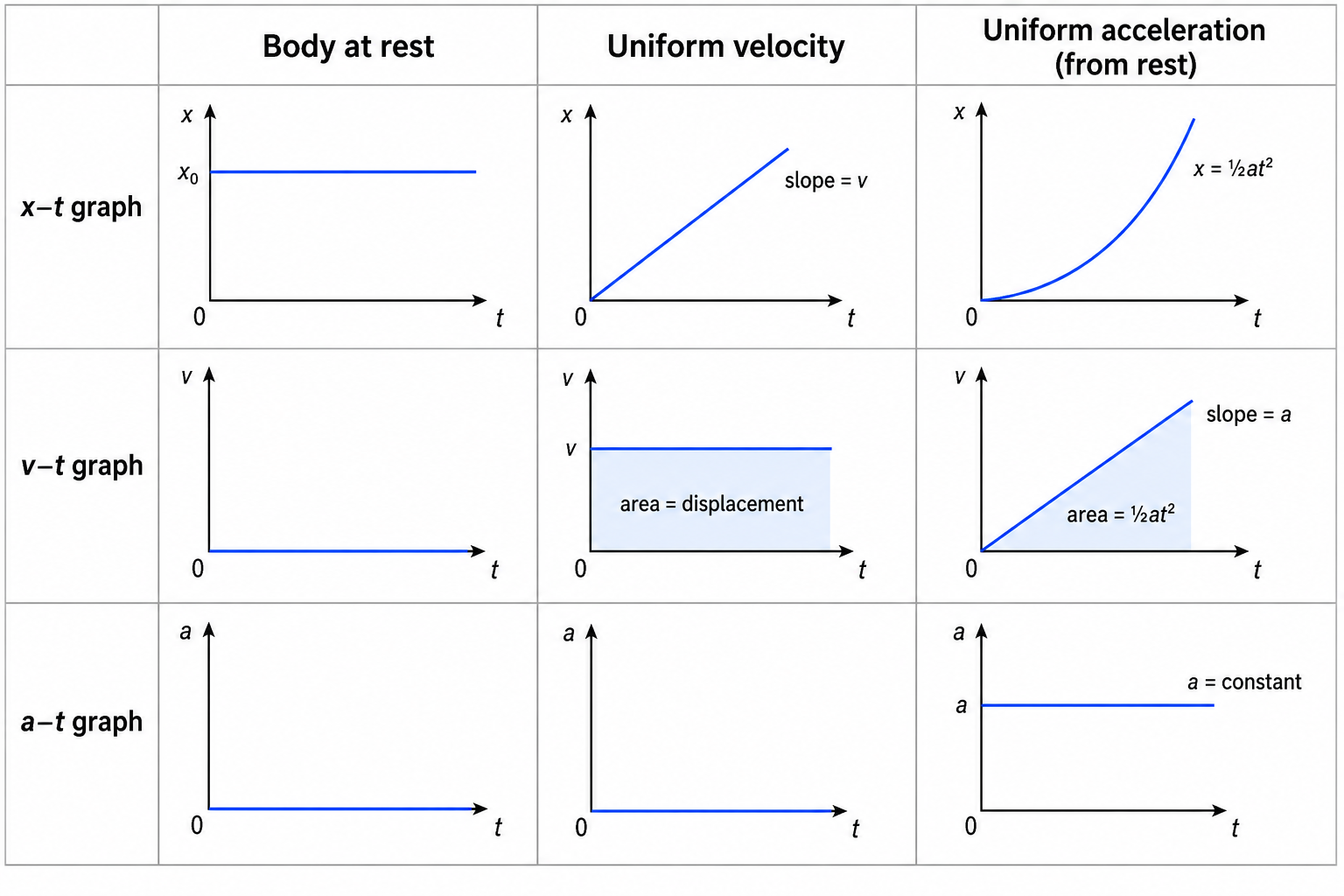
Graphs are the single most-tested topic of this chapter in JEE Main and NEET. Master these three rules and
every graph question falls:
The Three Golden Rules
$$\text{Slope of } x\text{–}t \text{ graph} = \text{velocity}$$
$$\text{Slope of } v\text{–}t \text{ graph} = \text{acceleration}$$
$$\text{Area under } v\text{–}t = \text{displacement};\ \ \text{Area under } a\text{–}t = \Delta v$$
Signed areas: area below the time-axis counts negative for displacement. For
distance, add all areas with positive sign.
Same direction: $|v_{AB}| = |v_A - v_B|$ — a passenger in a fast train sees a slower
parallel train "crawl backward".
Opposite directions: $|v_{AB}| = v_A + v_B$ — oncoming trains close in at the sum of
speeds.
Relative acceleration: $a_{AB} = a_A - a_B$. For two freely falling bodies, $a_{AB} = 0$ → their
relative velocity is constant and their separation changes linearly with time (classic JEE result).
Same relative form of kinematics: $s_{AB} = u_{AB}t + \tfrac{1}{2}a_{AB}t^2$.
11.1 Train Crossing Problems (Length Matters!)
Situation
Relative distance to cover
Time
Train (length L) crosses a pole/man standing
L
$L/v$
Train crosses a platform/bridge (length D)
L + D
$(L+D)/v$
Train L₁ overtakes train L₂ (same direction)
L₁ + L₂
$\dfrac{L_1+L_2}{v_1-v_2}$
Trains cross each other (opposite directions)
L₁ + L₂
$\dfrac{L_1+L_2}{v_1+v_2}$
11.2 Meeting / Catching Problems
Strategy (DC Pandey): sit in the frame of one body. The other body then moves with $u_{rel}$
and $a_{rel}$; "catching" means relative displacement = initial gap; "just catches" means relative velocity
= 0 exactly when the gap closes.
✍ SOLVED EXAMPLE 11.1 — JEE Main pattern (Police & Thief)
Q. A thief's car moves at a constant 10 m/s. A police car starts from rest from the same
point 5 s later with acceleration 2 m/s². When and where does it catch the thief?
Head start of thief: $10 \times 5 = 50$ m. Measure time t from
the police start.
Top: A slowly pulls ahead of B (gap opens at 10 m/s).
Bottom: the trains rush together at 50 m/s.
12. Variable Acceleration — The Calculus Toolkit
When a is not constant, the three kinematic equations are invalid. You must
integrate/differentiate. This is standard JEE Main territory (HCV Ch-3 exercises, DC Pandey "Motion in One
Dimension" objective sets).
Acceleration mixed with time → use $a = \dfrac{dv}{dt}$.
Acceleration mixed with position → use $a = v\dfrac{dv}{dx}$. Never forget the
constant of integration / limits — its omission is the #1 calculus error.
✍ SOLVED EXAMPLE 12.1 — NCERT / Boards (Polynomial motion)
Q. The position of a particle is $x = 8 + 12t - t^{3}$ (x in m, t in s). Find velocity at
t = 0, the time when v = 0, and acceleration at that time.
Velocity: $v = \dfrac{dx}{dt} = 12 - 3t^{2}$; at t = 0, $v =
\mathbf{12 \text{ m/s}}$
v = 0: $12 - 3t^2 = 0 \Rightarrow t = \mathbf{2 \text{ s}}$
Acceleration: $a = \dfrac{dv}{dt} = -6t$; at t = 2 s, $a =
\mathbf{-12 \text{ m/s}^2}$
✍ SOLVED EXAMPLE 12.2 — JEE Main (a as a function of v)
Q. A particle moving at u = 10 m/s decelerates as $a = -0.5v$. Find the time for velocity
to fall to 5 m/s and the distance covered in that time.
Double the speed → four times the stopping distance. A staple 1-mark/MCQ everywhere
(Boards, NDA, NEET).
Stopping time $= u/a \propto u$ (only doubles).
13.2 Reaction Time
During reaction time $t_r$ the vehicle travels at full speed: total stopping distance $= u t_r +
\dfrac{u^2}{2a}$. NCERT's example: measure your own reaction time by catching a falling ruler — $t_r =
\sqrt{2d/g}$ where d is the drop length.
14. Solved Examples — Every Question Type in the Chapter
Below, one worked model of each distinct question type ever asked from this chapter, tagged
by exam. Solve each yourself first, then check.
✍ TYPE 1 — Boards · Definition + Difference Table
Q. Distinguish between distance and displacement / speed and velocity (3 marks); derive v
= u + at graphically (3–5 marks).
Where to answer from: Section 3 table, Section 4 definitions,
Section 7.2 graphical derivation with Fig. 3. Reproduce the table + one example each.
✍ TYPE 2 — NEET / NDA · Direct Kinematics Substitution
Q. A bus moving at 72 km/h is brought to rest in 10 s by applying brakes. Find retardation
and distance covered before stopping.
Convert: u = 72 km/h = 72 × 5/18 = 20 m/s; v = 0; t = 10 s.
Trap defused: the km/h → m/s conversion. NDA loves this.
✍ TYPE 3 — JEE Main · Two-Ball Meeting Under Gravity
Q. Ball A is dropped from the top of a 100 m tower; simultaneously ball B is thrown up
from the base at 25 m/s. When and where do they meet? (g = 10 m/s²)
Relative motion shortcut: Both accelerate at g, so relative
acceleration = 0; relative speed of approach = 25 m/s (constant).
$$t = \frac{100}{25} = \mathbf{4 \text{ s}}$$
Position: A has fallen $\tfrac12(10)(16) = 80$ m below the top →
they meet 20 m above the ground at t = 4 s.
General result: meeting time = separation ÷ initial relative speed, whenever
both bodies are in free fall.
✍ TYPE 4 — NEET · Last-Second-of-Fall Fraction
Q. A stone falls freely from rest and covers half of its total height in the last second.
Find the total height. (g = 10 m/s²)
Setup: Let total time = t. Height in t s: $h = 5t^2$. Height in
(t−1) s: $5(t-1)^2 = h/2$.
Q. A particle starting from rest with uniform acceleration covers distances $s_1, s_2,
s_3$ in the first, next and next equal intervals of time T each. Show $s_1 : s_2 : s_3 = 1 : 3 : 5$,
and average velocities in these intervals are in ratio 1 : 3 : 5 too.
Cumulative distances: $s(nT) = \tfrac12 a n^2T^2$ → cumulative
$1 : 4 : 9$ → intervals $1 : (4-1) : (9-4) = \mathbf{1:3:5}$. Divide by the common T for average
velocities. (Galileo's rule again — Section 8.)
Q. A train accelerates from rest at 1 m/s² for 20 s, runs at constant speed for 60 s, then
brakes uniformly to rest in 40 s. Find total distance. (Best done via v–t graph!)
Top speed: $1 \times 20 = 20$ m/s. Draw the trapezium-shaped v–t
graph; total distance = area:
Contrast: velocity at the mid-point of time is
$\frac{u+v}{2}$. Both formulas are asked; don't mix them.
✍ TYPE 10 — JEE Main · Drops from a Tap (Equal-Time Emission)
Q. Water drops fall at regular intervals from a tap 5 m above the ground; the 3rd drop
leaves just as the 1st hits the ground. Find the heights of the 2nd and 3rd drops at that instant. (g =
10)
Fall time of drop 1: $t = \sqrt{2h/g} = 1$ s → interval = 0.5 s.
Drop 2 has fallen 0.5 s: $d = 5(0.25) = 1.25$ m → height =
3.75 m. Drop 3 has just left → height = 5 m.
Pattern: distances of successive drops from the tap are in ratio 1 : 4 : 9…,
gaps in ratio 1 : 3 : 5.
15. Common Mistakes & Misconceptions — Final Checklist
Night Before Exam
Read this the night before the exam:
s is displacement, not distance, in every kinematic equation. Split the motion at
every direction-reversal to get distance.
Kinematic equations are valid only for constant a. Variable a → calculus (Section
12).
$v_{avg} = \frac{u+v}{2}$ works only for constant a.
Negative a ≠ slowing down; compare signs of v and a (Section 6.1).
At the top of vertical flight v = 0 but a = g ≠ 0.
Slope of x–t gives velocity; slope of v–t gives acceleration — never confuse the two in
graph MCQs.
Area under v–t below the t-axis is negative displacement but
positive distance.
Convert km/h ↔ m/s before substituting (× 5/18 or × 18/5).
An object dropped from a moving platform (balloon, lift, train) starts with the platform's
velocity.
Average speed of equal-distance segments is the harmonic mean — never the plain average.
Time cannot be negative — reject negative roots of the quadratic, but check whether a second
positive root has physical meaning (ball passing a level twice!).