
Compiled from: NCERT Chemistry Part-I, Class XI (Chemical Bonding and Molecular Structure) • J.D. Lee (Concise Inorganic) • O.P. Tandon • V.K. Jaiswal • MS Chouhan practice sets • Previous JEE/NEET papers. Target exams: Boards • JEE Main • JEE Advanced • NEET.
Matter is made up of one or different types of elements. Except noble gases, atoms under normal conditions do not exist independently. A group of atoms held together as a stable species is called a molecule. The attractive force holding various constituents (atoms, ions, etc.) together in different chemical species is defined as a chemical bond. Every system tends to attain stability by lowering its potential energy.
The Octet Rule (Kössel & Lewis, 1916): Atoms combine either by transfer of valence electrons from one atom to another (gaining or losing) or by sharing valence electrons in order to achieve an octet in their valence shell.
The Covalent Bond (Langmuir, 1919 Refinement): Irving Langmuir refined Lewis's model by introducing the concept of a covalent bond formed by the sharing of electron pairs between combining atoms. Each atom contributes at least one electron to the shared pair, and both atoms attain the nearest noble-gas electronic configuration.
(I) Single Covalent Bond Formation: $\mathrm{Cl_2}$, $\mathrm{H_2O}$, and $\mathrm{CCl_4}$
When two combining atoms share one electron pair, they are joined by a single covalent bond. In $\mathrm{Cl_2}$, each chlorine atom ($[\mathrm{Ne}]3s^2 3p^5$) contributes one electron to the shared pair, completing an octet ($8\mathrm{e^-}$) for both atoms. In $\mathrm{H_2O}$, hydrogen attains a stable duplet of $2\mathrm{e^-}$ while oxygen attains an octet of $8\mathrm{e^-}$. In $\mathrm{CCl_4}$, the central carbon shares four electron pairs with four chlorine atoms so that all five atoms achieve stable octets.
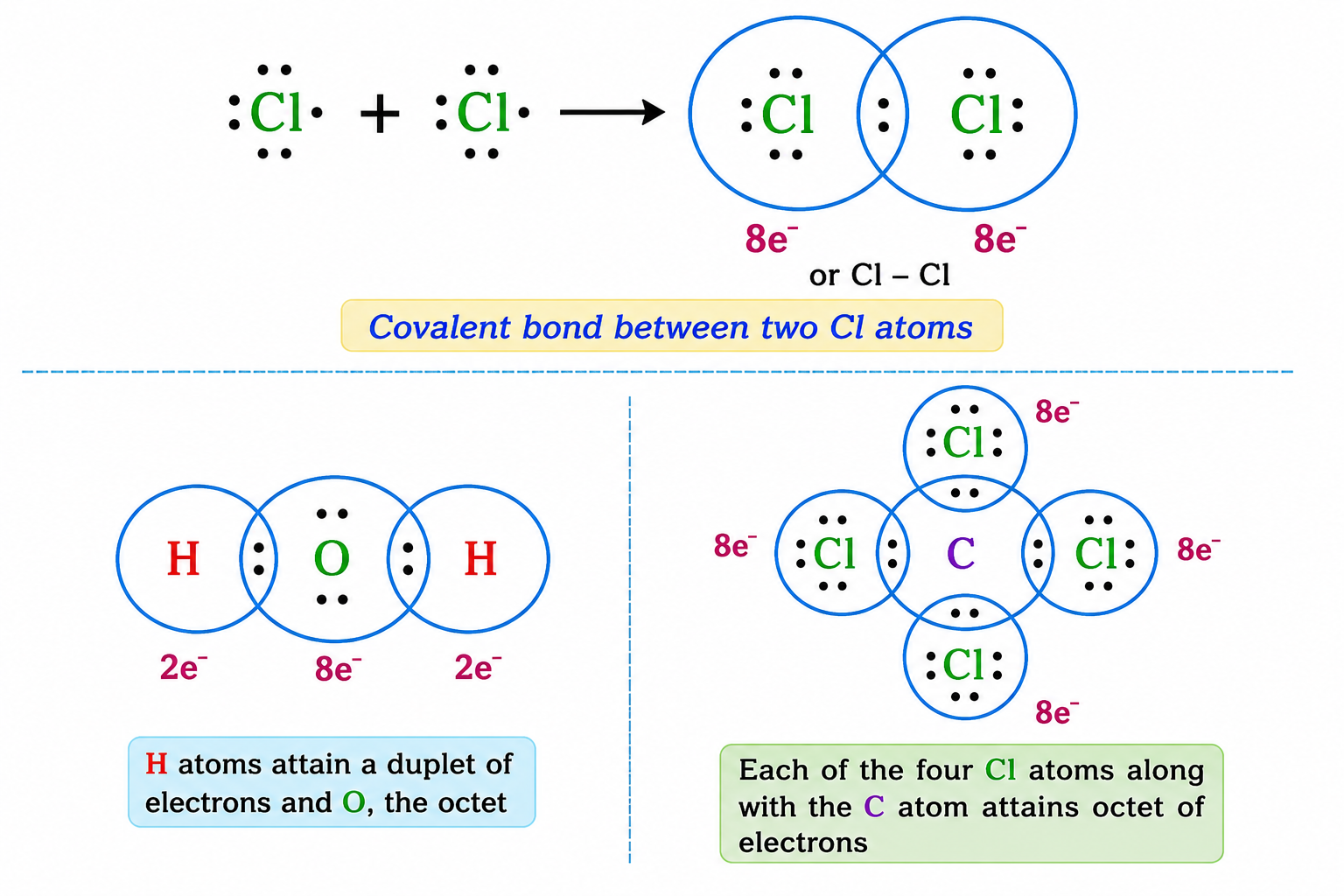
Figure 1.1: Covalent single bond formation in $\mathrm{Cl_2}$ and attainment of duplet/octet in $\mathrm{H_2O}$ and $\mathrm{CCl_4}$.
(II) Double Covalent Bond: $\mathrm{CO_2}$ and $\mathrm{C_2H_4}$ (Ethene)
If two combining atoms share two pairs of electrons, the covalent bond between them is called a double bond. In carbon dioxide ($\mathrm{CO_2}$), the carbon atom shares two electron pairs with each of the two oxygen atoms ($:\!\ddot{\mathrm{O}} = \mathrm{C} = \ddot{\mathrm{O}}\!:$). In ethene ($\mathrm{C_2H_4}$), the two carbon atoms share two pairs of electrons ($\mathrm{C=C}$ double bond) and each carbon shares one pair with two hydrogen atoms ($\mathrm{C-H}$ single bonds).
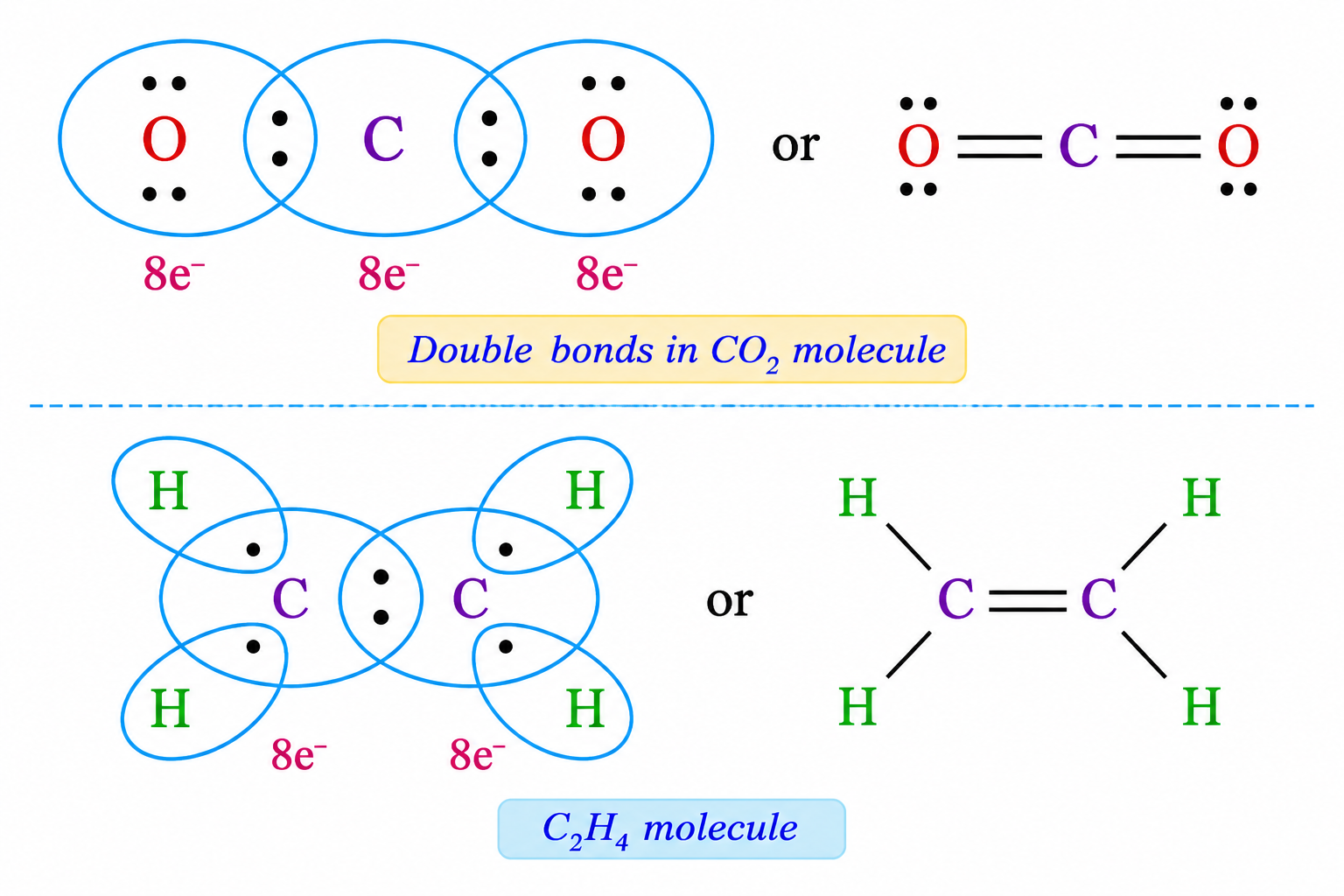
Figure 1.2: Representation of double covalent bonds in carbon dioxide ($\mathrm{CO_2}$) and ethene ($\mathrm{C_2H_4}$).
(III) Triple Covalent Bond: $\mathrm{N_2}$ and $\mathrm{C_2H_2}$ (Ethyne)
When combining atoms share three electron pairs, a triple bond is formed. In the nitrogen molecule ($\mathrm{N_2}$), each nitrogen atom ($2s^2 2p^3$) contributes three electrons, forming three shared pairs ($:\!\mathrm{N} \equiv \mathrm{N}\!:$) and completing an $8\mathrm{e^-}$ octet on both atoms. In ethyne ($\mathrm{C_2H_2}$), a triple bond connects the two carbon atoms ($\mathrm{C \equiv C}$), and single bonds connect each carbon to a hydrogen atom ($\mathrm{H-C \equiv C-H}$).
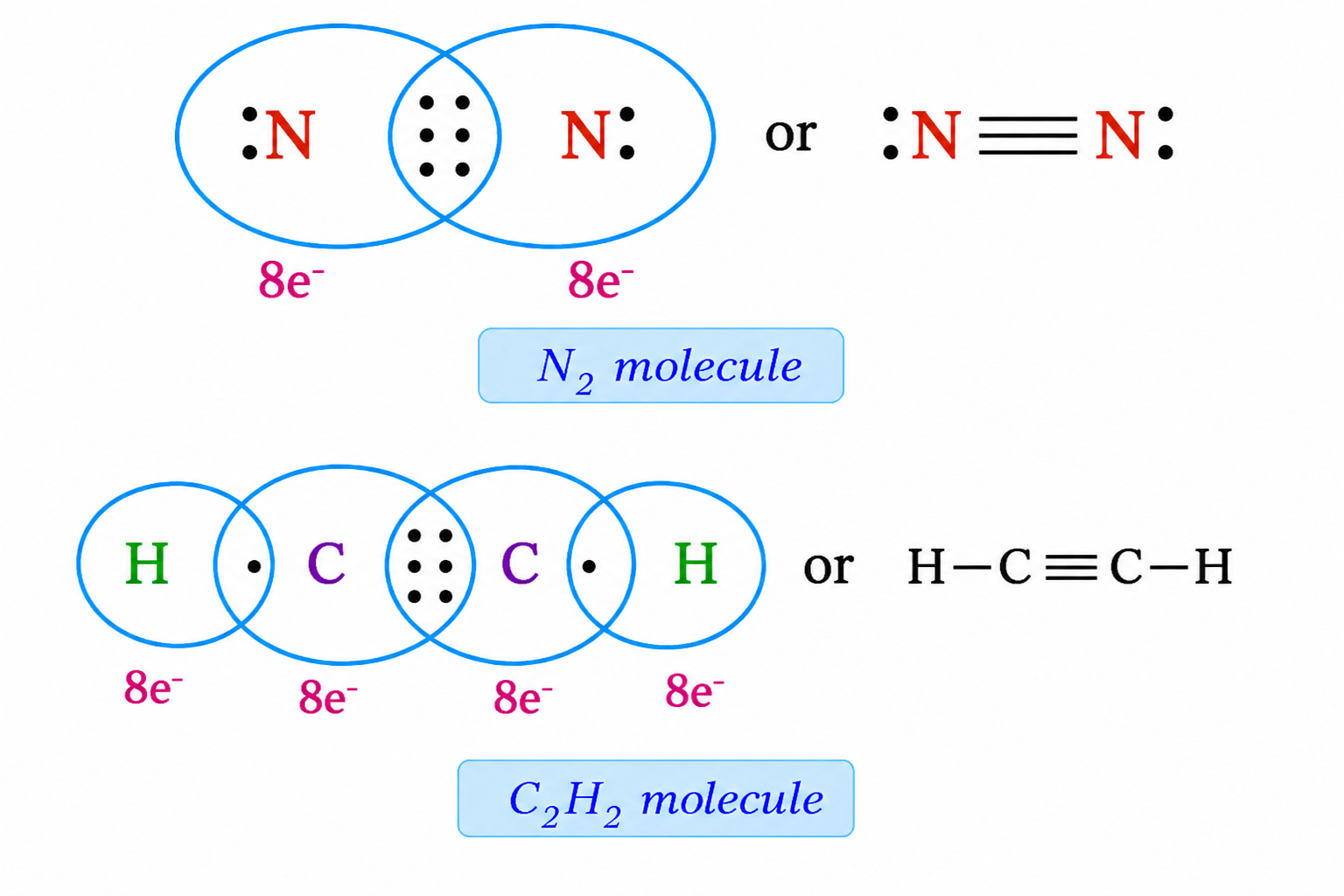
Figure 1.3: Triple bond sharing in nitrogen ($\mathrm{N_2}$) and ethyne ($\mathrm{C_2H_2}$) molecules.
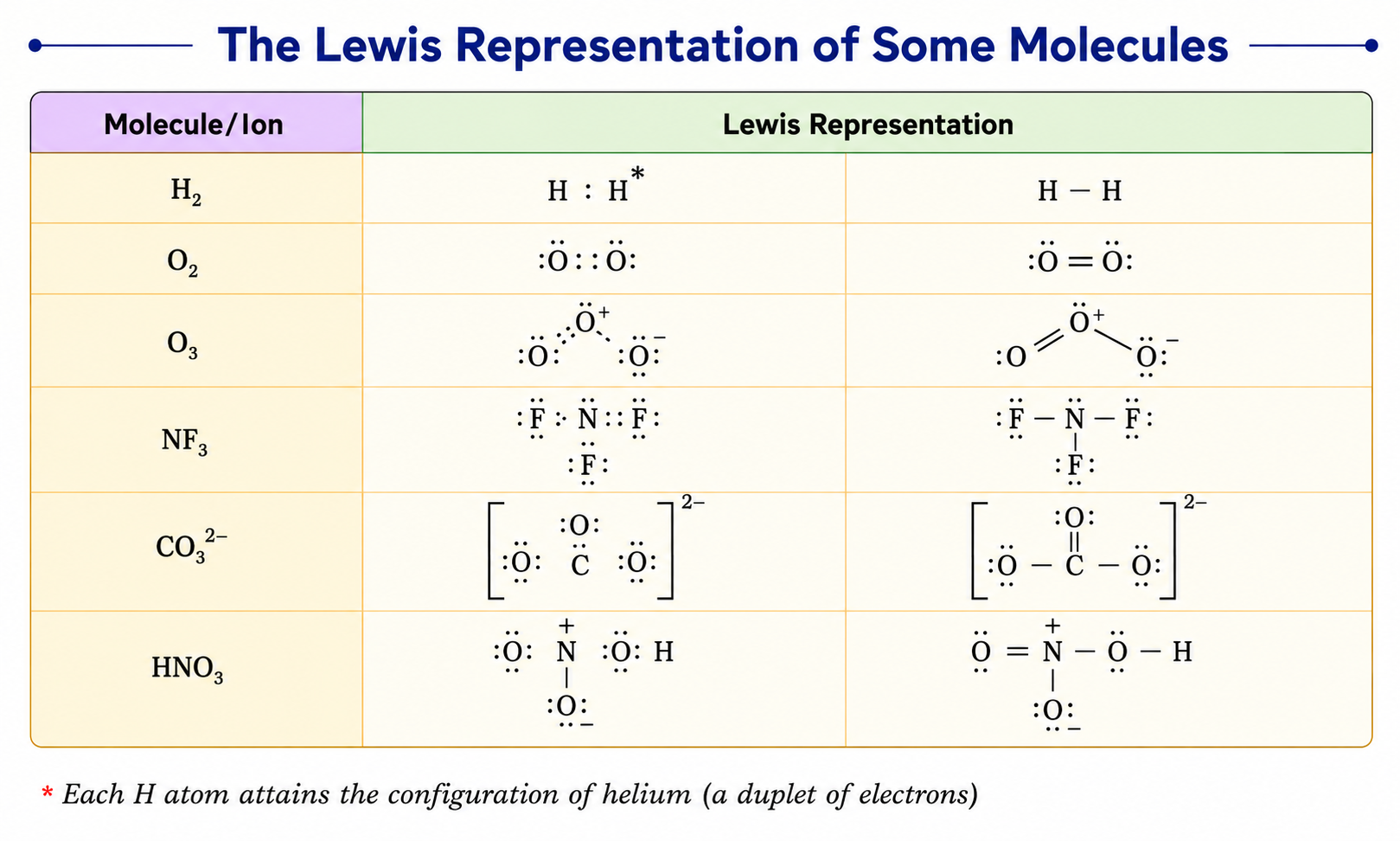
Table 4.1: Lewis dot representations of $\mathrm{H_2}$, $\mathrm{O_2}$, $\mathrm{O_3}$, $\mathrm{NF_3}$, $\mathrm{CO_3^{2-}}$, and $\mathrm{HNO_3}$.
Step 1: Count total valence electrons: $\mathrm{C} (2s^2 2p^2) \implies 4\mathrm{e^-}$; $\mathrm{O} (2s^2 2p^4) \implies 6\mathrm{e^-}$. Total $= 4 + 6 = \mathbf{10\text{ valence electrons}}$.
Step 2: Skeletal structure: $\mathrm{C} \quad \mathrm{O}$.
Step 3: Draw a single shared pair ($\mathrm{C : O}$) and complete the octet on oxygen with 3 lone pairs ($\mathrm{:\!C} - \overset{\bullet\bullet}{\underset{\bullet\bullet}{\mathrm{O}}}\mathrm{:}$). This leaves $2\mathrm{e^-}$ as a lone pair on carbon. Oxygen has 8 electrons, but carbon has only 4 electrons.
Step 4: Shift two lone pairs from oxygen into the interatomic region to form a triple bond:
$$\mathbf{:\!C \equiv O\!: \quad \text{or} \quad :\!C \leftarrow O\!:}$$Both $\mathrm{C}$ and $\mathrm{O}$ now satisfy the octet rule ($8\mathrm{e^-}$ each).
Step 1: Count total valence electrons: $\mathrm{N} (2s^2 2p^3) \implies 5\mathrm{e^-}$; $2 \times \mathrm{O} (2s^2 2p^4) \implies 12\mathrm{e^-}$; negative charge ($-1$) $\implies 1\mathrm{e^-}$. Total $= 5 + 12 + 1 = \mathbf{18\text{ valence electrons}}$.
Step 2: Skeletal structure: $\mathrm{O} - \mathrm{N} - \mathrm{O}$.
Step 3: Distribute single bonds ($\mathrm{O : N : O}$) using $4\mathrm{e^-}$, and complete the octets on terminal oxygen atoms using $12\mathrm{e^-}$. The remaining $2\mathrm{e^-}$ form a lone pair on nitrogen ($\mathrm{N}$). Nitrogen now has only 6 electrons ($3\text{ pairs}$).
Step 4: Shift one lone pair from an oxygen atom to make a $\mathrm{N=O}$ double bond:
$$\left[ \, \overset{\bullet\bullet}{\mathrm{O}} \mathbf{::} \overset{\bullet\bullet}{\mathrm{N}} \mathbf{:} \overset{\bullet\bullet}{\underset{\bullet\bullet}{\mathrm{O}}}\mathbf{:} \, \right]^-$$ $$\text{or}$$ $$\left[ \, \overset{\bullet\bullet}{\underset{\bullet\bullet}{\mathrm{O}}} = \overset{\bullet\bullet}{\mathrm{N}} - \overset{\bullet\bullet}{\underset{\bullet\bullet}{\mathrm{O}}}\mathbf{:} \, \right]^- \quad \text{or} \quad \left[ \, \mathbf{:}\overset{\bullet\bullet}{\underset{\bullet\bullet}{\mathrm{O}}} - \overset{\bullet\bullet}{\mathrm{N}} = \overset{\bullet\bullet}{\underset{\bullet\bullet}{\mathrm{O}}} \, \right]^-$$All atoms now possess complete octets ($8\mathrm{e^-}$ each).
Visual Solution: Lewis Structures of $\mathrm{CO}$ and $\mathrm{NO_2^-}$ (NCERT Problems 4.1 & 4.2)
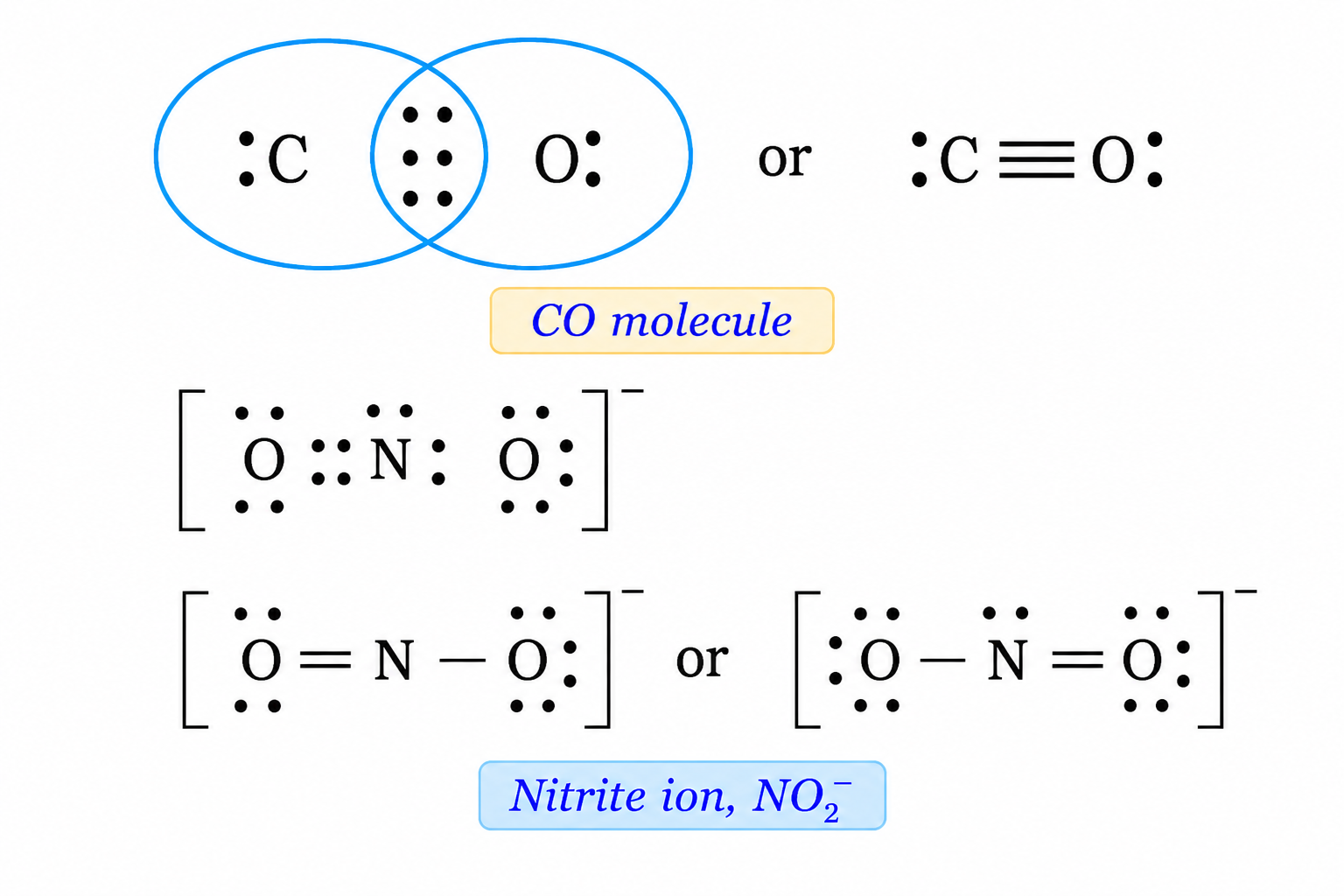
Figure 1.4: Complete shared-electron diagrams for carbon monoxide ($\mathrm{CO}$) and nitrite ion ($\mathrm{NO_2^-}$).
In polyatomic molecules and ions, the overall net charge is possessed by the ion as a whole rather than by a particular atom. However, for keeping track of valence electrons and predicting stability, it is feasible to assign a formal charge (F.C.) to each individual atom in a Lewis structure.
The counting is based on the assumption that the atom in the molecule owns one electron of each shared pair and both the electrons of a lone pair.
Let us consider the ozone molecule ($\mathrm{O_3}$). The Lewis structure of $\mathrm{O_3}$ may be drawn as:
The atoms have been numbered as 1, 2 and 3. The formal charge on:
Hence, we represent $\mathrm{O_3}$ along with the formal charges as follows:
We must understand that formal charges do not indicate real charge separation within the molecule. Indicating the charges on the atoms in the Lewis structure only helps in keeping track of the valence electrons in the molecule. Formal charges help in the selection of the lowest energy structure from a number of possible Lewis structures for a given species. Generally the lowest energy structure is the one with the smallest formal charges on the atoms. The formal charge is a factor based on a pure covalent view of bonding in which electron pairs are shared equally by neighbouring atoms.
The octet rule, though useful, is not universal. It is quite useful for understanding the structures of most of the organic compounds and it applies mainly to the second period elements of the periodic table. There are three types of exceptions to the octet rule.
In some compounds, the number of electrons surrounding the central atom is less than eight. This is especially the case with elements having less than four valence electrons. Examples are $\mathrm{LiCl}$, $\mathrm{BeH_2}$ and $\mathrm{BCl_3}$.
$\mathrm{Li}$, $\mathrm{Be}$ and $\mathrm{B}$ have 1, 2 and 3 valence electrons only. Some other such compounds are $\mathrm{AlCl_3}$ and $\mathrm{BF_3}$.
In molecules with an odd number of electrons like nitric oxide, $\mathrm{NO}$ and nitrogen dioxide, $\mathrm{NO_2}$, the octet rule is not satisfied for all the atoms.
Elements in and beyond the third period of the periodic table have, apart from $3s$ and $3p$ orbitals, $3d$ orbitals also available for bonding. In a number of compounds of these elements there are more than eight valence electrons around the central atom. This is termed as the expanded octet. Obviously the octet rule does not apply in such cases.
Some of the examples of such compounds are: $\mathrm{PF_5}$, $\mathrm{SF_6}$, $\mathrm{H_2SO_4}$ and a number of coordination compounds.
Interestingly, sulphur also forms many compounds in which the octet rule is obeyed. In sulphur dichloride, the $\mathrm{S}$ atom has an octet of electrons around it.
Q. Assign formal charges to all atoms in the carbonate ion ($\mathrm{CO_3^{2-}}$) with one $\mathrm{C=O}$ double bond and two $\mathrm{C-O^-}$ single bonds.
From the Kössel and Lewis treatment of the formation of an ionic bond, it follows that the formation of ionic compounds would primarily depend upon:
The formation of a positive ion involves ionization (removal of electron(s) from the neutral atom), and that of the negative ion involves the addition of electron(s) to the neutral atom:
The electron gain enthalpy ($\Delta_{eg}H$) is the enthalpy change when a gas phase atom in its ground state gains an electron. The electron gain process may be exothermic or endothermic. The ionization, on the other hand, is always endothermic. Electron affinity is the negative of the energy change accompanying electron gain.
Obviously, ionic bonds will be formed more easily between elements with comparatively low ionization enthalpies and elements with comparatively high negative value of electron gain enthalpy.
Most ionic compounds have cations derived from metallic elements and anions from non-metallic elements. The ammonium ion, $\mathrm{NH_4^+}$ (made up of two non-metallic elements), is an exception. It forms the cation of a number of ionic compounds.
Ionic compounds in the crystalline state consist of orderly three-dimensional arrangements of cations and anions held together by coulombic interaction energies. These compounds crystallise in different crystal structures determined by the size of the ions, their packing arrangements and other factors. The crystal structure of sodium chloride, $\mathrm{NaCl}$ (rock salt), is shown below:
 Crystal Lattice Structure.png)
In ionic solids, the sum of the electron gain enthalpy and the ionization enthalpy may be positive, but still the crystal structure gets stabilized due to the energy released in the formation of the crystal lattice:
Therefore, the energy released in the process is more than the energy absorbed. Thus, a qualitative measure of the stability of an ionic compound is provided by its enthalpy of lattice formation and not simply by achieving octet of electrons around the ionic species in gaseous state.
The Lattice Enthalpy of an ionic solid is defined as the energy required to completely separate one mole of a solid ionic compound into gaseous constituent ions.
$$\mathrm{NaCl(s) \longrightarrow Na^+(g) + Cl^-(g)} \quad ; \quad \Delta_{\text{lattice}}H^\ominus = \mathbf{+788\text{ kJ mol}^{-1}}$$This means that $788\text{ kJ}$ of energy is required to separate one mole of solid $\mathrm{NaCl}$ into one mole of $\mathrm{Na^+(g)}$ and one mole of $\mathrm{Cl^-(g)}$ to an infinite distance.
This process involves both the attractive forces between ions of opposite charges and the repulsive forces between ions of like charge. The solid crystal being three-dimensional; it is not possible to calculate lattice enthalpy directly from the interaction of forces of attraction and repulsion only. Factors associated with the crystal geometry have to be included.
.png)
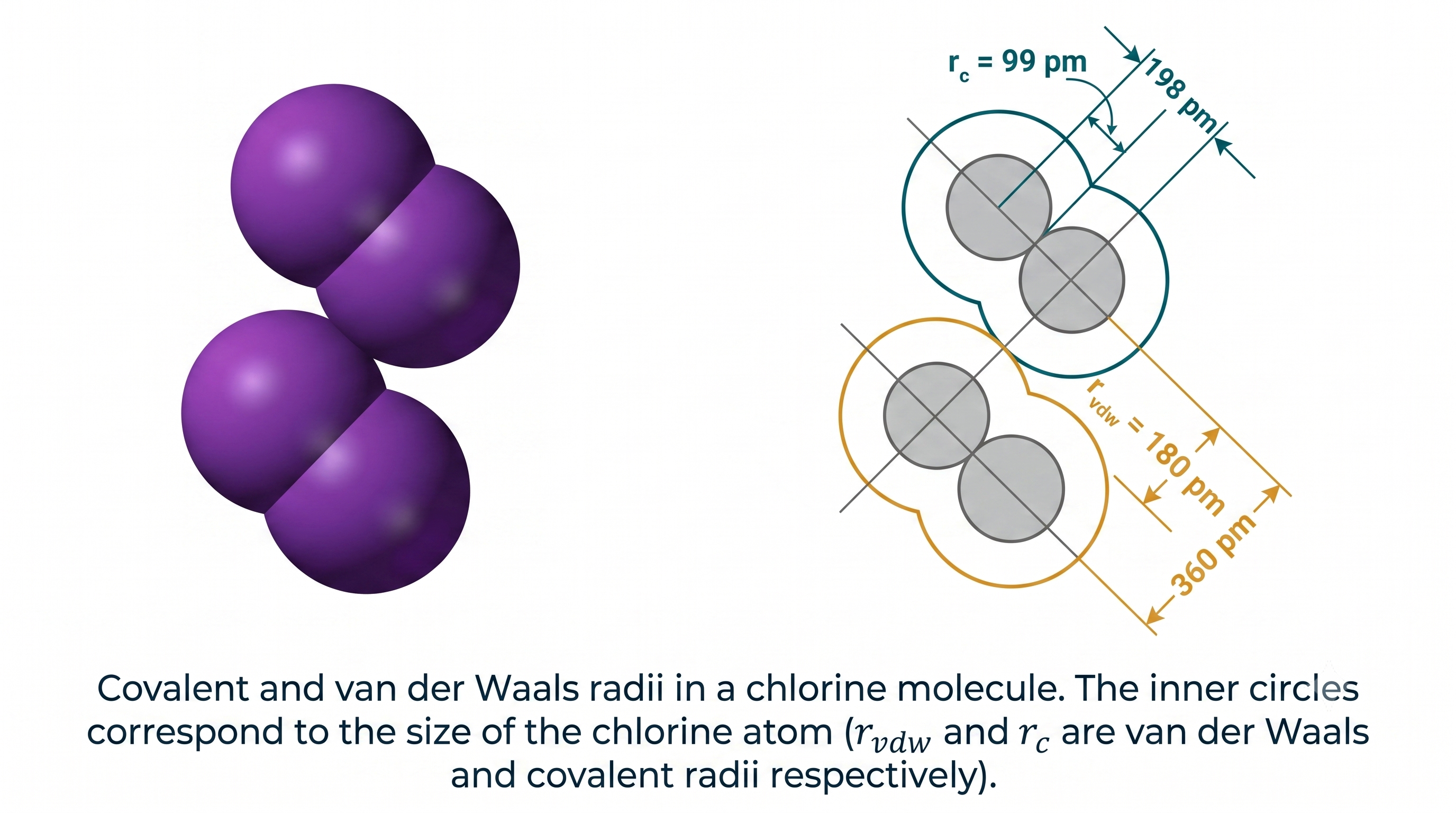
Bond length is defined as the equilibrium distance between the nuclei of two bonded atoms in a molecule. Bond lengths are measured by spectroscopic, X-ray diffraction and electron-diffraction techniques. Each atom of the bonded pair contributes to the bond length (Fig. 4.1). In the case of a covalent bond, the contribution from each atom is called the covalent radius of that atom.
The covalent radius is measured approximately as the radius of an atom's core which is in contact with the core of an adjacent atom in a bonded situation. The covalent radius is half of the distance between two similar atoms joined by a covalent bond in the same molecule:
The van der Waals radius represents the overall size of the atom which includes its valence shell in a nonbonded situation. Further, the van der Waals radius is half of the distance between two similar atoms in separate molecules in a solid. Covalent and van der Waals radii of chlorine are depicted in Fig. 4.2.
It is defined as the angle between the orbitals containing bonding electron pairs around the central atom in a molecule/complex ion. Bond angle is expressed in degree which can be experimentally determined by spectroscopic methods. It gives some idea regarding the distribution of orbitals around the central atom in a molecule/complex ion and hence it helps us in determining its shape. For example $\mathrm{H-O-H}$ bond angle in water can be represented as under:
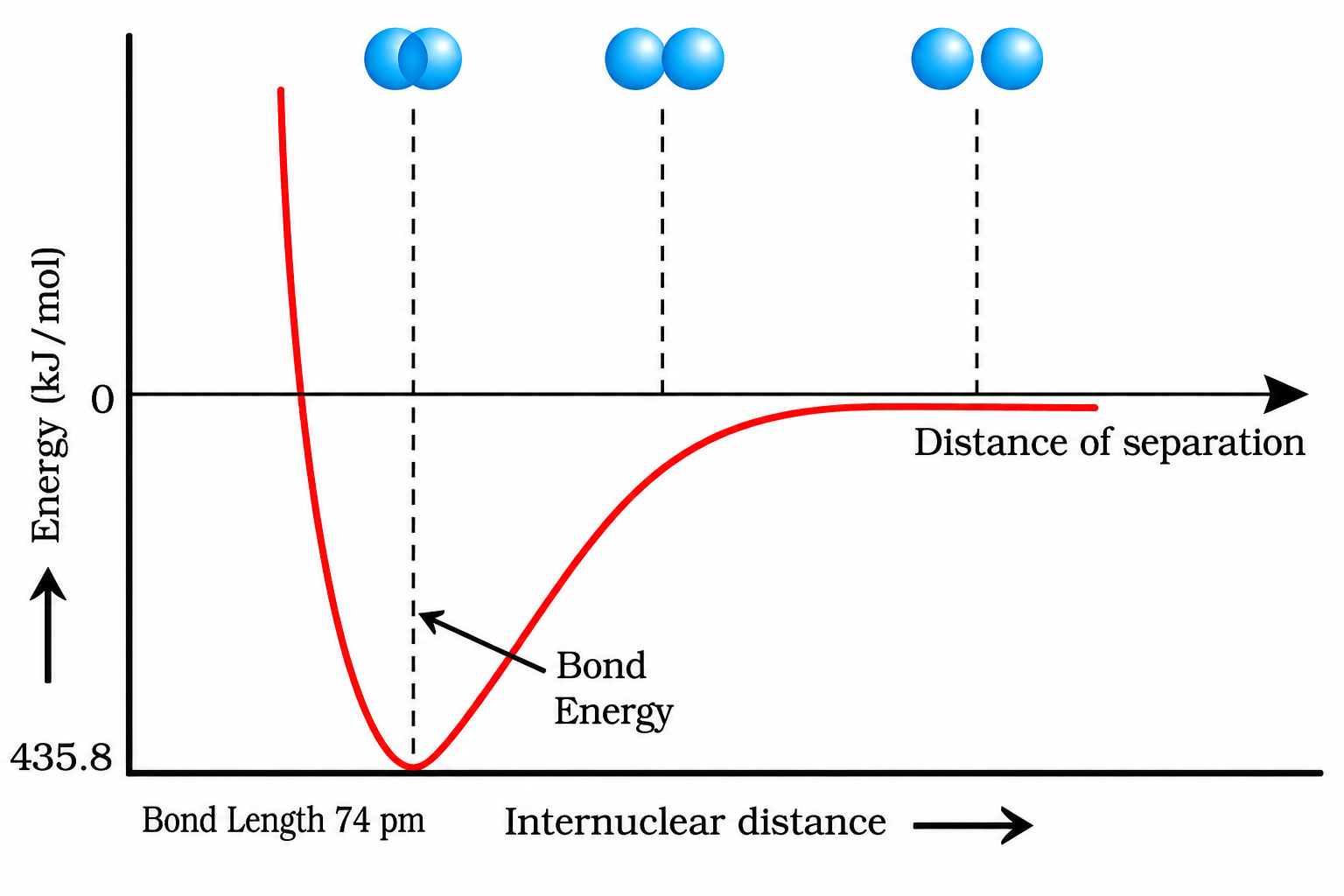
It is defined as the amount of energy required to break one mole of bonds of a particular type between two atoms in a gaseous state. The unit of bond enthalpy is $\mathrm{kJ\ mol^{-1}}$. For example, the $\mathrm{H-H}$ bond enthalpy in hydrogen molecule is $435.8\text{ kJ mol}^{-1}$:
$$\mathrm{H_2(g) \longrightarrow H(g) + H(g)} \quad ; \quad \Delta_a H^\ominus = \mathbf{435.8\text{ kJ mol}^{-1}}$$Similarly, the bond enthalpy for molecules containing multiple bonds, for example $\mathrm{O_2}$ and $\mathrm{N_2}$, will be as under:
$$\begin{aligned} \mathrm{O_2 \ (O = O)(g)} &\longrightarrow \mathrm{O(g) + O(g)} \quad ; \quad \Delta_a H^\ominus = \mathbf{498\text{ kJ mol}^{-1}} \\ \mathrm{N_2 \ (N \equiv N)(g)} &\longrightarrow \mathrm{N(g) + N(g)} \quad ; \quad \Delta_a H^\ominus = \mathbf{946.0\text{ kJ mol}^{-1}} \end{aligned}$$It is important that larger the bond dissociation enthalpy, stronger will be the bond in the molecule. For a heteronuclear diatomic molecule like $\mathrm{HCl}$, we have:
$$\mathrm{HCl(g) \longrightarrow H(g) + Cl(g)} \quad ; \quad \Delta_a H^\ominus = \mathbf{431.0\text{ kJ mol}^{-1}}$$In case of polyatomic molecules, the measurement of bond strength is more complicated. For example, in case of $\mathrm{H_2O}$ molecule, the enthalpy needed to break the two $\mathrm{O-H}$ bonds is not the same:
$$\begin{aligned} \mathrm{H_2O(g)} &\longrightarrow \mathrm{H(g) + OH(g)} \quad ; \quad \Delta_a H_1^\ominus = \mathbf{502\text{ kJ mol}^{-1}} \\ \mathrm{OH(g)} &\longrightarrow \mathrm{H(g) + O(g)} \quad ; \quad \Delta_a H_2^\ominus = \mathbf{427\text{ kJ mol}^{-1}} \end{aligned}$$The difference in the $\Delta_a H^\ominus$ value shows that the second $\mathrm{O-H}$ bond undergoes some change because of changed chemical environment. This is the reason for some difference in energy of the same $\mathrm{O-H}$ bond in different molecules like $\mathrm{C_2H_5OH}$ (ethanol) and water. Therefore, in polyatomic molecules, the term mean or average bond enthalpy is used:
In the Lewis description of covalent bond, the Bond Order is given by the number of bonds between the two atoms in a molecule:
Isoelectronic molecules and ions have identical bond
orders:
• $\mathrm{F_2}$ and $\mathrm{O_2^{2-}}$ have $\mathbf{\text{Bond Order} = 1}$.
• $\mathrm{N_2}$, $\mathrm{CO}$ and $\mathrm{NO^+}$ have $\mathbf{\text{Bond Order} = 3}$.
Key Correlation: With increase in bond order, bond enthalpy
increases and bond length decreases.
It is often observed that a single Lewis structure is inadequate for the representation of a molecule in conformity with its experimentally determined parameters. For example, the ozone, $\mathrm{O_3}$ molecule can be equally represented by the structures $\mathrm{I}$ and $\mathrm{II}$ shown below:
In both structures we have an $\mathrm{O-O}$ single bond and an $\mathrm{O=O}$ double bond. The normal $\mathrm{O-O}$ and $\mathrm{O=O}$ bond lengths are $148\text{ pm}$ and $121\text{ pm}$ respectively. Experimentally determined oxygen-oxygen bond lengths in the $\mathrm{O_3}$ molecule are the same ($128\text{ pm}$). Thus, the oxygen-oxygen bonds in the $\mathrm{O_3}$ molecule are intermediate between a double and a single bond. Obviously, this cannot be represented by either of the two Lewis structures shown above.
According to the concept of resonance, whenever a single Lewis structure cannot describe a molecule accurately, a number of structures with similar energy, positions of nuclei, bonding and non-bonding pairs of electrons are taken as the canonical structures of the hybrid which describes the molecule accurately.
Thus for $\mathrm{O_3}$, the two structures shown above constitute the canonical structures (or resonance structures) and their hybrid (structure $\mathrm{III}$) represents the structure of $\mathrm{O_3}$ more accurately. This is called the resonance hybrid. Resonance is represented by a double-headed arrow ($\longleftrightarrow$).
Solution: The single Lewis structure based on the presence of two single bonds and one double bond between carbon and oxygen atoms is inadequate to represent the molecule accurately as it represents unequal bonds. According to the experimental findings, all carbon to oxygen bonds in $\mathrm{CO_3^{2-}}$ are equivalent. Therefore, the carbonate ion is best described as a resonance hybrid of the canonical forms $\mathrm{I}$, $\mathrm{II}$, and $\mathrm{III}$ shown below:
Solution: The experimentally determined carbon to oxygen bond length in $\mathrm{CO_2}$ is $\mathbf{115\text{ pm}}$. The lengths of a normal carbon to oxygen double bond ($\mathrm{C=O}$) and carbon to oxygen triple bond ($\mathrm{C\equiv O}$) are $121\text{ pm}$ and $110\text{ pm}$ respectively. The carbon-oxygen bond lengths in $\mathrm{CO_2}$ ($115\text{ pm}$) lie between the values for $\mathrm{C=O}$ and $\mathrm{C\equiv O}$. Obviously, a single Lewis structure cannot depict this position and it becomes necessary to write more than one Lewis structures and to consider that the structure of $\mathrm{CO_2}$ is best described as a hybrid of the canonical or resonance forms $\mathrm{I}$, $\mathrm{II}$ and $\mathrm{III}$:
In general, it may be stated that:
Many misconceptions are associated with resonance and the same need to be dispelled. You should remember that:
The existence of a hundred percent ionic or covalent bond represents an ideal situation. In reality no bond or a compound is either completely covalent or ionic. Even in the case of a covalent bond between two hydrogen atoms, there is some ionic character.
When a covalent bond is formed between two similar atoms, for example in $\mathrm{H_2, O_2, Cl_2, N_2}$ or $\mathrm{F_2}$, the shared pair of electrons is equally attracted by the two atoms. As a result, the electron pair is situated exactly in between the two identical nuclei. The bond so formed is called a nonpolar covalent bond.
Contrary to this, in the case of a heteronuclear molecule like $\mathrm{HF}$, the shared electron pair between the two atoms gets displaced more towards fluorine since the electronegativity of fluorine is far greater than that of hydrogen. The resultant covalent bond is a polar covalent bond.
As a result of polarisation, the molecule possesses a dipole moment which can be defined as the product of the magnitude of the charge and the distance between the centres of positive and negative charge. It is usually designated by a Greek letter ‘$\mu$’. Mathematically, it is expressed as follows:
Dipole moment is usually expressed in Debye units (D). The conversion factor is:
$$\mathbf{1\text{ D} = 3.33564 \times 10^{-30}\text{ C m}} \quad (\text{where C is coulomb and m is meter})$$Further, dipole moment is a vector quantity and by convention it is depicted by a small arrow with tail on the negative centre and head pointing towards the positive centre. But in chemistry, the presence of dipole moment is represented by the crossed arrow ($\mapsto$) put on the Lewis structure of the molecule. The cross is on the positive end and the arrow head is on the negative end. For example, the dipole moment of $\mathrm{HF}$ is represented as:
Peter Debye, the Dutch chemist received Nobel prize in 1936 for his pioneering work on X-ray diffraction and dipole moments. The magnitude of the dipole moment is given in Debye units (D) in order to honour him.
In case of polyatomic molecules, the dipole moment not only depends upon the individual dipole moments of bonds known as bond dipoles, but also on the spatial arrangement of various bonds in the molecule. In such cases, the dipole moment of a molecule is the vector sum of the dipole moments of various bonds:
$\mathrm{H_2O}$ has a bent structure with two $\mathrm{O-H}$ bonds oriented at an angle of $104.5^\circ$. Net dipole moment is the resultant of the two $\mathrm{O-H}$ bond dipoles reinforcing each other:
The two equal $\mathrm{Be-F}$ bond dipoles point in opposite directions ($180^\circ$) and cancel each other’s effect completely:
Although the $\mathrm{B-F}$ bonds are polar and oriented at $120^\circ$, the resultant of any two bond dipoles is equal and opposite to the third:
Dipole Moment Comparison: $\mathrm{NH_3}$ vs $\mathrm{NF_3}$ (Pyramidal Geometry)
Both $\mathrm{NH_3}$ and $\mathrm{NF_3}$ have pyramidal shape with a lone pair on nitrogen. Although fluorine is much more electronegative than hydrogen, the resultant dipole moment of $\mathrm{NH_3}$ ($\mathbf{4.90 \times 10^{-30}\text{ C m} = 1.47\text{ D}}$) is much greater than that of $\mathrm{NF_3}$ ($\mathbf{0.80 \times 10^{-30}\text{ C m} = 0.23\text{ D}}$):
Scientific Reason: In $\mathrm{NH_3}$, the orbital dipole due to lone pair is in the same direction as the resultant dipole moment of the three $\mathrm{N-H}$ bonds. In $\mathrm{NF_3}$, the orbital dipole is in the opposite direction to the resultant of the three $\mathrm{N-F}$ bond moments, thereby canceling out a major fraction of the dipole moment.
| Type of Molecule | Example | Dipole Moment, $\mu\text{ (D)}$ | Geometry |
|---|---|---|---|
| Molecule ($\mathrm{AB}$) | $\mathrm{HF}$ | 1.78 | linear |
| $\mathrm{HCl}$ | 1.07 | linear | |
| $\mathrm{HBr}$ | 0.79 | linear | |
| $\mathrm{HI}$ | 0.38 | linear | |
| $\mathrm{H_2}$ | 0 | linear | |
| Molecule ($\mathrm{AB_2}$) | $\mathrm{H_2O}$ | 1.85 | bent |
| $\mathrm{H_2S}$ | 0.95 | bent | |
| $\mathrm{CO_2}$ | 0 | linear | |
| Molecule ($\mathrm{AB_3}$) | $\mathrm{NH_3}$ | 1.47 | trigonal-pyramidal |
| $\mathrm{NF_3}$ | 0.23 | trigonal-pyramidal | |
| $\mathrm{BF_3}$ | 0 | trigonal-planar | |
| Molecule ($\mathrm{AB_4}$) | $\mathrm{CH_4}$ | 0 | tetrahedral |
| $\mathrm{CHCl_3}$ | 1.04 | tetrahedral | |
| $\mathrm{CCl_4}$ | 0 | tetrahedral |
Just as all covalent bonds have some partial ionic character, ionic bonds also have partial covalent character. The partial covalent character of ionic bonds was discussed by Fajans in terms of the following rules:
Mechanism of Polarisation: The cation polarises the anion, pulling the electronic charge toward itself and thereby increasing the electronic charge density between the two. This is precisely what happens in a covalent bond, i.e., buildup of electron charge density between the nuclei. The polarising power of the cation, the polarisability of the anion and the extent of distortion (polarisation) of the anion are the decisive factors determining the percent covalent character of an ionic bond.
As already explained, Lewis concept is unable to explain the shapes of molecules. This theory provides a simple procedure to predict the shapes of covalent molecules. Sidgwick and Powell (1940) proposed a simple theory based on the repulsive interactions of the electron pairs in the valence shell of the atoms. It was further developed and redefined by Nyholm and Gillespie (1957).
For the prediction of geometrical shapes of molecules with the help of VSEPR theory, it is convenient to divide molecules into two categories:
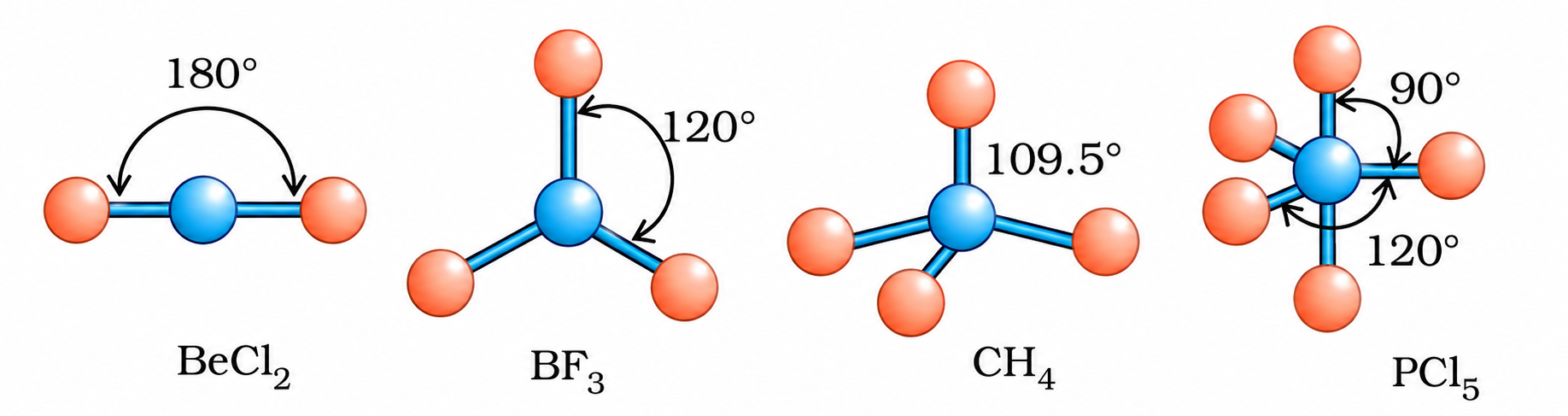
Success & Limitation of VSEPR Theory: The VSEPR Theory is able to predict geometry of a large number of molecules, especially compounds of $p$-block elements, quite accurately even when energy differences between possible structures are very small. However, the exact theoretical basis of electron pair repulsions on molecular shapes is not entirely clear and continues to be a subject of ongoing theoretical discussion.
| Type | bp | lp | Electron geometry | Molecular shape | Angle | Examples |
|---|---|---|---|---|---|---|
| AB₂ | 2 | 0 | Linear | Linear | 180° | BeCl₂, CO₂, HgCl₂ |
| AB₃ | 3 | 0 | Trigonal planar | Trigonal planar | 120° | BF₃, SO₃, NO₃⁻, CO₃²⁻ |
| AB₂E | 2 | 1 | Trigonal planar | Bent | <120° (~119°) | SO₂, O₃, SnCl₂, NO₂⁻ |
| AB₄ | 4 | 0 | Tetrahedral | Tetrahedral | 109.5° | CH₄, CCl₄, SO₄²⁻, NH₄⁺ |
| AB₃E | 3 | 1 | Tetrahedral | Trigonal pyramidal | 107° | NH₃, PCl₃, H₃O⁺ |
| AB₂E₂ | 2 | 2 | Tetrahedral | Bent (V-shape) | 104.5° | H₂O, OF₂, H₂S, SCl₂ |
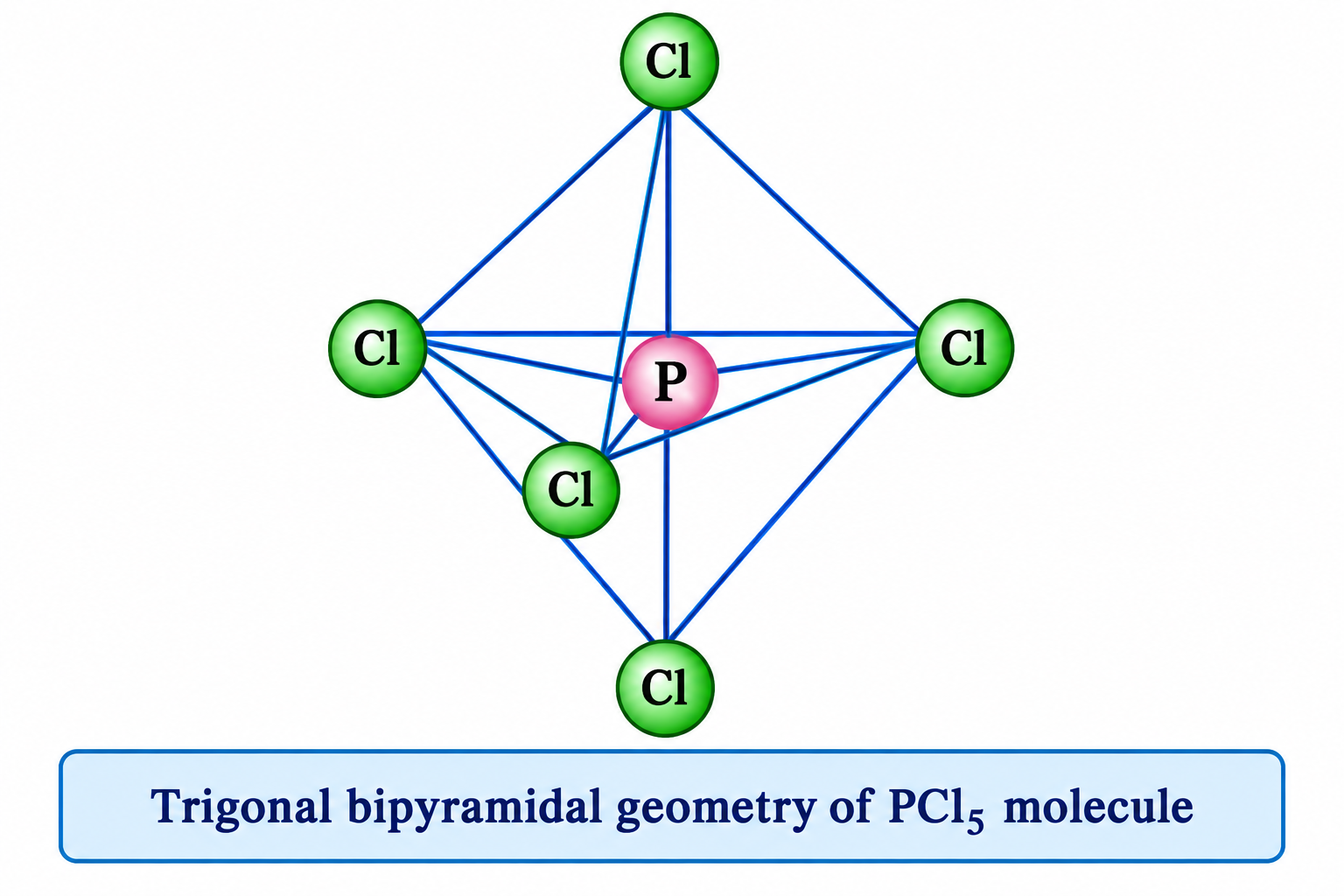
| AB₅ | 5 | 0 | Trigonal bipyramidal | TBP | 120° eq, 90° ax | PCl₅, PF₅ |
| AB₄E | 4 | 1 | TBP | See-saw | <120°, <90° | SF₄ |
| AB₃E₂ | 3 | 2 | TBP | T-shape | <90° | ClF₃, BrF₃ |
| AB₂E₃ | 2 | 3 | TBP | Linear | 180° | XeF₂, I₃⁻ |
| AB₆ | 6 | 0 | Octahedral | Octahedral | 90° | SF₆, PF₆⁻ |
| AB₅E | 5 | 1 | Octahedral | Square pyramidal | <90° | BrF₅, IF₅, XeOF₄ |
| AB₄E₂ | 4 | 2 | Octahedral | Square planar | 90° | XeF₄, ICl₄⁻ |
In trigonal bipyramidal arrangements, lone pairs ALWAYS occupy equatorial positions (only two 90° neighbours instead of three). Angle-squeeze ladder to memorise: CH₄ (109.5°) → NH₃ (107°) → H₂O (104.5°) — each extra lone pair bites ~2.5°. Down a group the angle falls further as the central atom grows: NH₃ > PH₃ > AsH₃; H₂O > H₂S.
VSEPR Molecular Shapes — All 11 Key Shapes with Exact Bond Angles
The presence of lone pairs distorts regular ideal geometries because unshared electron pairs are attracted only by the central nucleus, occupying larger spatial volume and exerting stronger repulsion on neighboring pairs. Below is the systematic NCERT theoretical justification for each distorted shape:
Q. Predict the shapes of (a) XeF₄, (b) ClF₃, (c) I₃⁻ using VSEPR.
.png)
| Feature | σ (sigma) bond | π (pi) bond |
|---|---|---|
| Overlap | Head-on (axial): s–s, s–p, p–p end-to-end | Sideways (lateral): p–p parallel lobes |
| Electron cloud | Symmetric about the bond axis | Above and below the axis (nodal plane contains the axis) |
| Strength | Stronger (larger overlap) | Weaker; exists only alongside a σ bond |
| Rotation | Free rotation possible | Restricts rotation (cis/trans isomerism) |
| Count | First bond of any pair | 2nd and 3rd bonds (double = 1σ+1π; triple = 1σ+2π) |
CO₂: 2σ + 2π. C₂H₄: 5σ + 1π. C₂H₂: 3σ + 2π. Benzene C₆H₆: 12σ + 3π. HCN: 2σ + 2π. Count σ = total bonds drawn as lines; π = extra strokes of double/triple bonds. Asked verbatim in NEET.
σ Bond vs π Bond — Orbital Overlap Comparison
Hybridisation is the process of intermixing atomic orbitals of slightly different energies of the same atom so as to redistribute their energies, resulting in the formation of a new set of orbitals of equivalent energies and shape called hybrid orbitals.
| Hybridisation | Orbitals mixed | Geometry | Angle | Examples |
|---|---|---|---|---|
| sp | 1s + 1p | Linear | 180° | BeCl₂, C₂H₂, CO₂, HgCl₂ |
| sp² | 1s + 2p | Trigonal planar | 120° | BCl₃, C₂H₄, SO₂*, graphite |
| sp³ | 1s + 3p | Tetrahedral | 109.5° | CH₄, NH₃*, H₂O*, diamond, NH₄⁺ |
| sp³d | 1s + 3p + 1d(z²) | Trigonal bipyramidal | 120°, 90° | PCl₅ (2 axial bonds longer than 3 equatorial!) |
| sp³d² | 1s + 3p + 2d | Octahedral | 90° | SF₆ |
| sp³d³ | 1s + 3p + 3d | Pentagonal bipyramidal | 72°, 90° | IF₇ |
*shape ≠ geometry when lone pairs sit in hybrids: NH₃ is sp³ but pyramidal; H₂O is sp³ but bent; SO₂ is sp² but bent.
$\text{SN} = (\text{Number of }\sigma\text{-bonds}) + (\text{Number of lone pairs on central atom})$
• SN = 2: $sp$ (Linear, 180°)
• SN = 3: $sp^2$ (Trigonal Planar, 120°)
• SN = 4: $sp^3$ (Tetrahedral, 109.5°)
• SN = 5: $sp^3d$ (Trigonal Bipyramidal, 120° & 90°)
• SN = 6: $sp^3d^2$ (Octahedral, 90°)
s-Character Rule: More s-character ($sp\text{ [50%]} > sp^2\text{ [33.3%]} > sp^3\text{ [25%]}$) ⟹ shorter, stronger bond & higher electronegativity of that carbon.
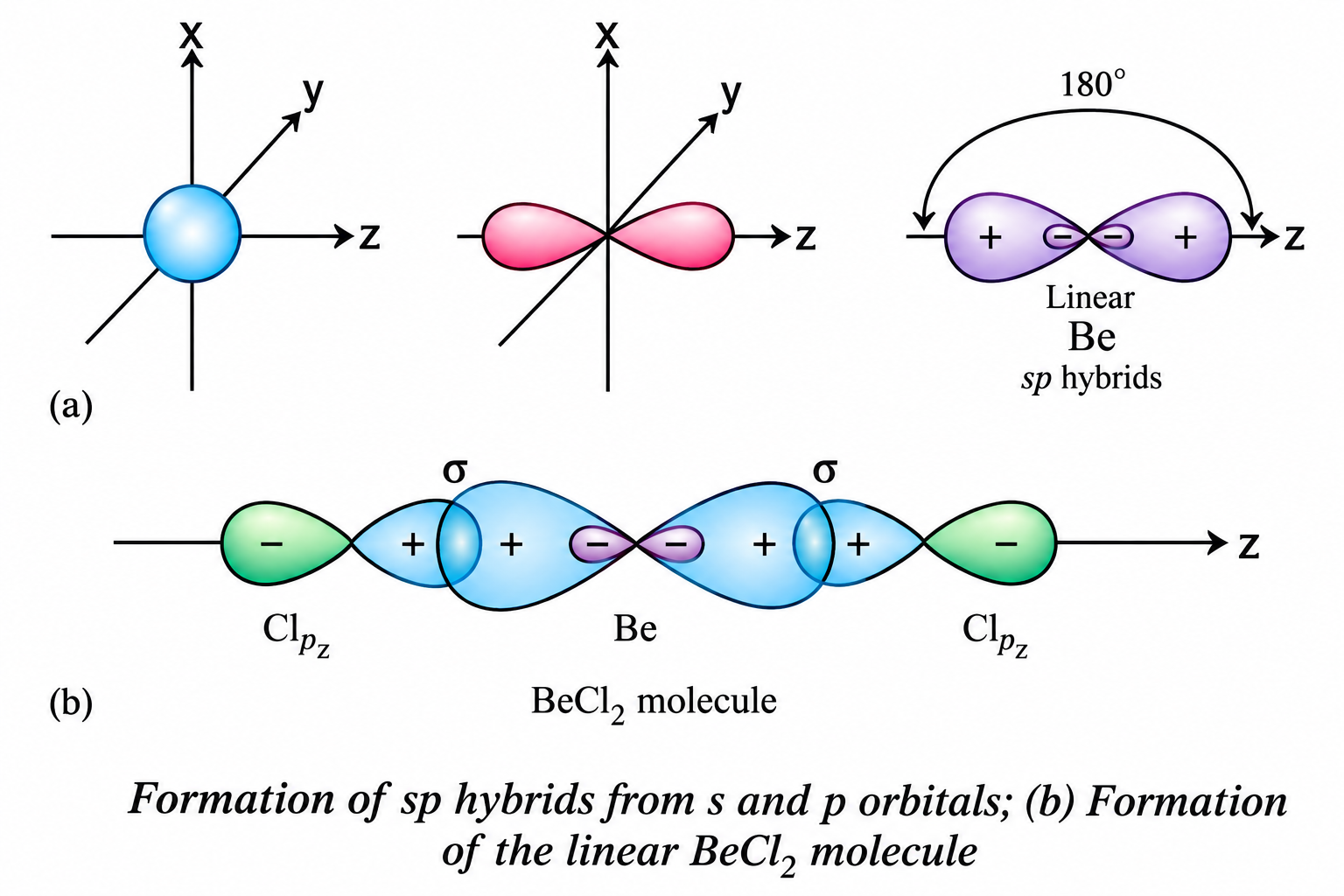
Explanation (Section 4.6.1): Ground state Beryllium ($Z=4$: $1s^2 2s^2$) promotes one $2s$ electron to vacant $2p_x$ ($2s^1 2p_x^1$). One $2s$ and one $2p$ orbital intermix to form two equivalent $sp$ hybrid orbitals oriented in opposite directions at $180^\circ$ along the $z$-axis (50% $s$-character, 50% $p$-character). Each $sp$ hybrid overlaps axially with a singly occupied $3p_z$ orbital of Chlorine to form two linear $\mathrm{Be-Cl}$ $\sigma$ bonds.
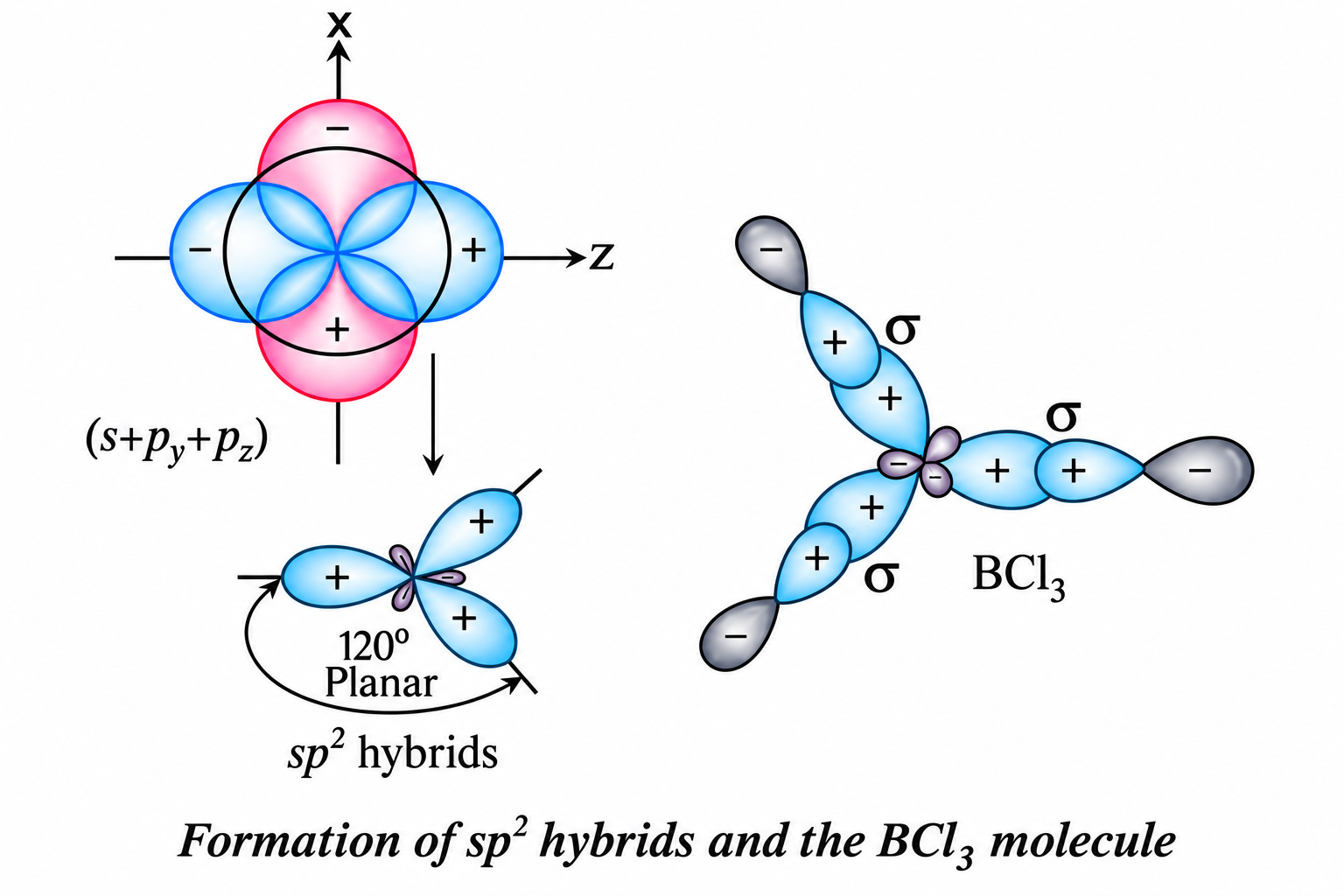
Explanation (Section 4.6.1): Ground state Boron ($Z=5$: $1s^2 2s^2 2p^1$) promotes one $2s$ electron to vacant $2p_y$ ($2s^1 2p_x^1 2p_y^1$). One $2s$ and two $2p$ orbitals intermix to form three equivalent $sp^2$ hybrid orbitals pointing to the corners of an equilateral triangle at $120^\circ$ in a single plane (33.3% $s$, 66.7% $p$). Each $sp^2$ hybrid overlaps axially with a Chlorine $3p$ orbital to form trigonal planar $\mathrm{BCl_3}$.
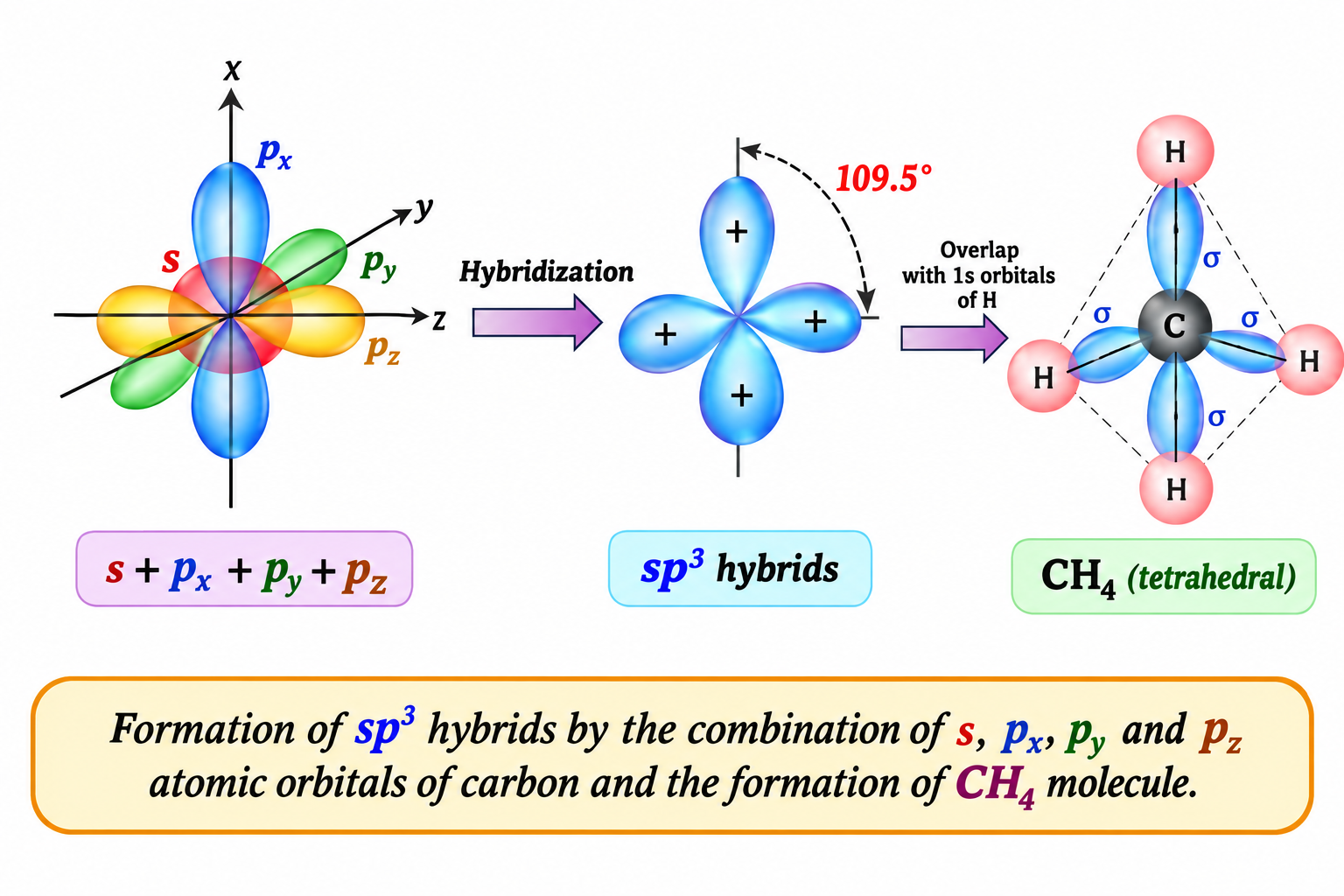
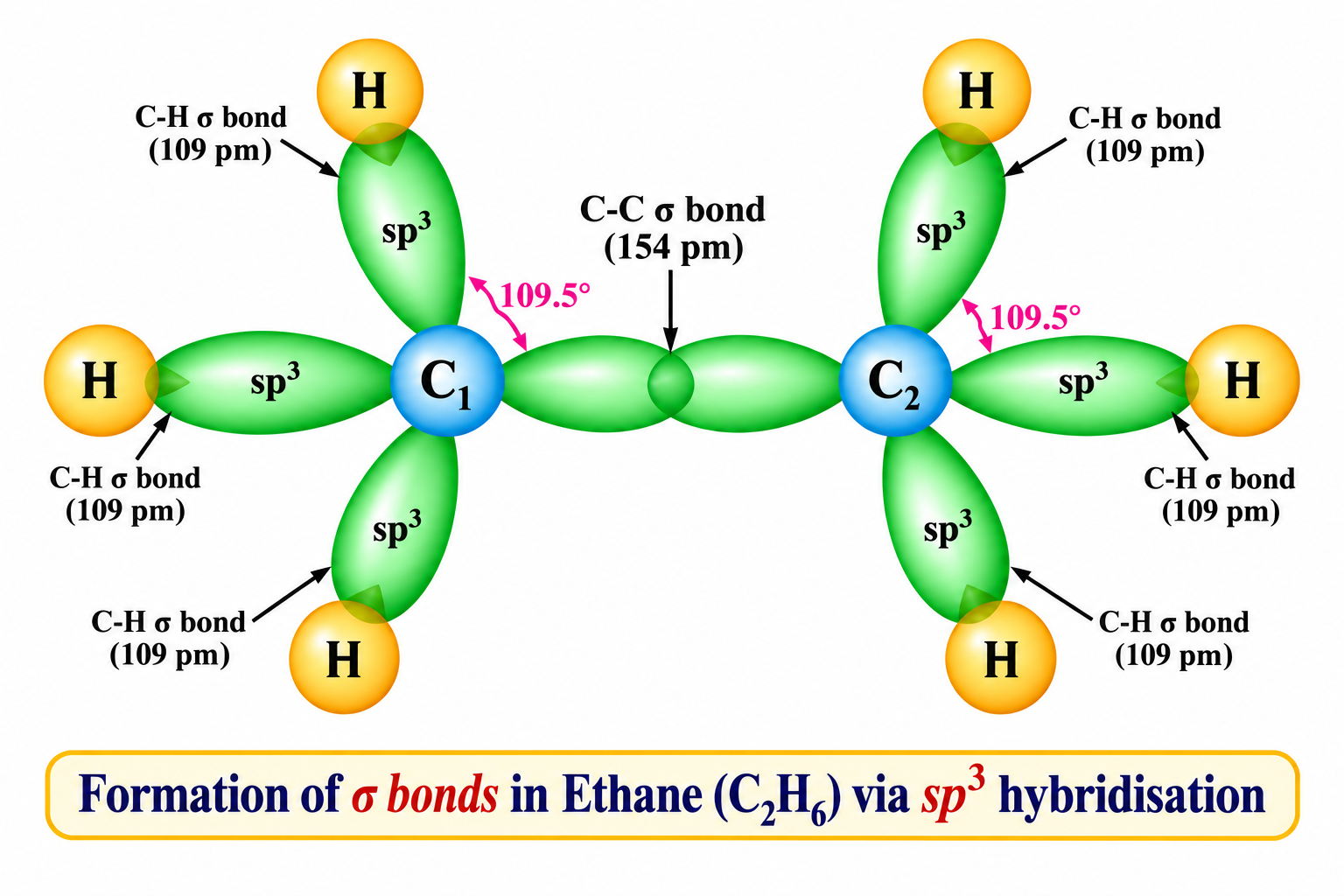
Explanation (Section 4.6.1): Ground state Carbon ($Z=6$: $1s^2 2s^2 2p^2$) promotes one $2s$ electron to $2p_z$ ($2s^1 2p_x^1 2p_y^1 2p_z^1$). One $2s$ and three $2p$ orbitals intermix to form four equivalent $sp^3$ hybrid orbitals directed towards the corners of a regular tetrahedron at $109.5^\circ$ (25% $s$, 75% $p$). Each $sp^3$ hybrid overlaps axially with a Hydrogen $1s$ orbital to form four $\mathrm{C-H}$ $\sigma$ bonds.
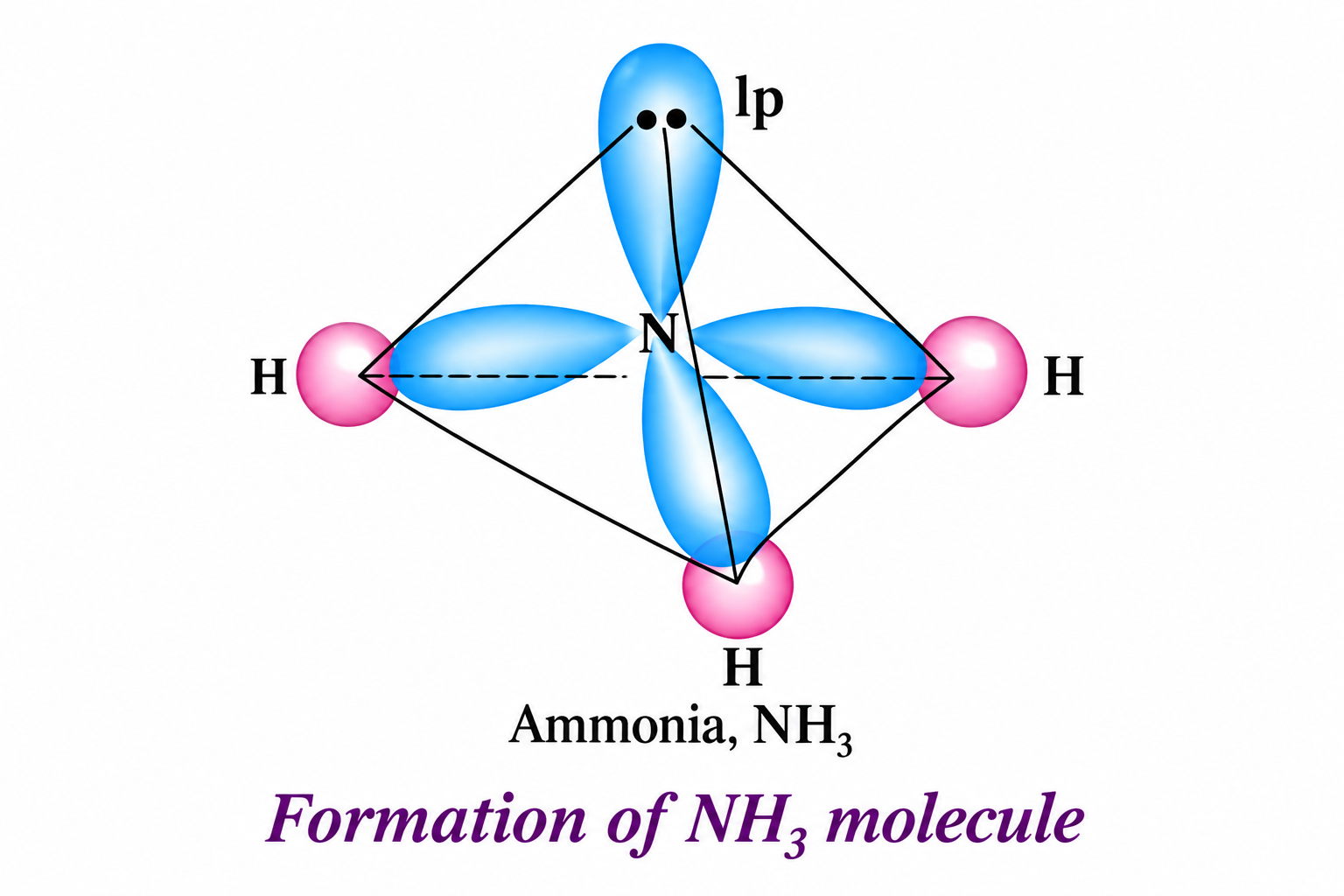
Explanation (Section 4.6.1): Nitrogen ($Z=7$: $1s^2 2s^2 2p^3$) has 5 valence electrons. It undergoes $sp^3$ hybridisation forming four $sp^3$ hybrid orbitals: 3 contain single electrons forming $\mathrm{N-H}$ $\sigma$ bonds with Hydrogen $1s$ orbitals, while the 4th orbital contains a lone pair of electrons. Greater lone pair–bond pair repulsion compresses the $\mathrm{H-N-H}$ bond angle from $109.5^\circ$ to 107°, giving a trigonal pyramidal shape.
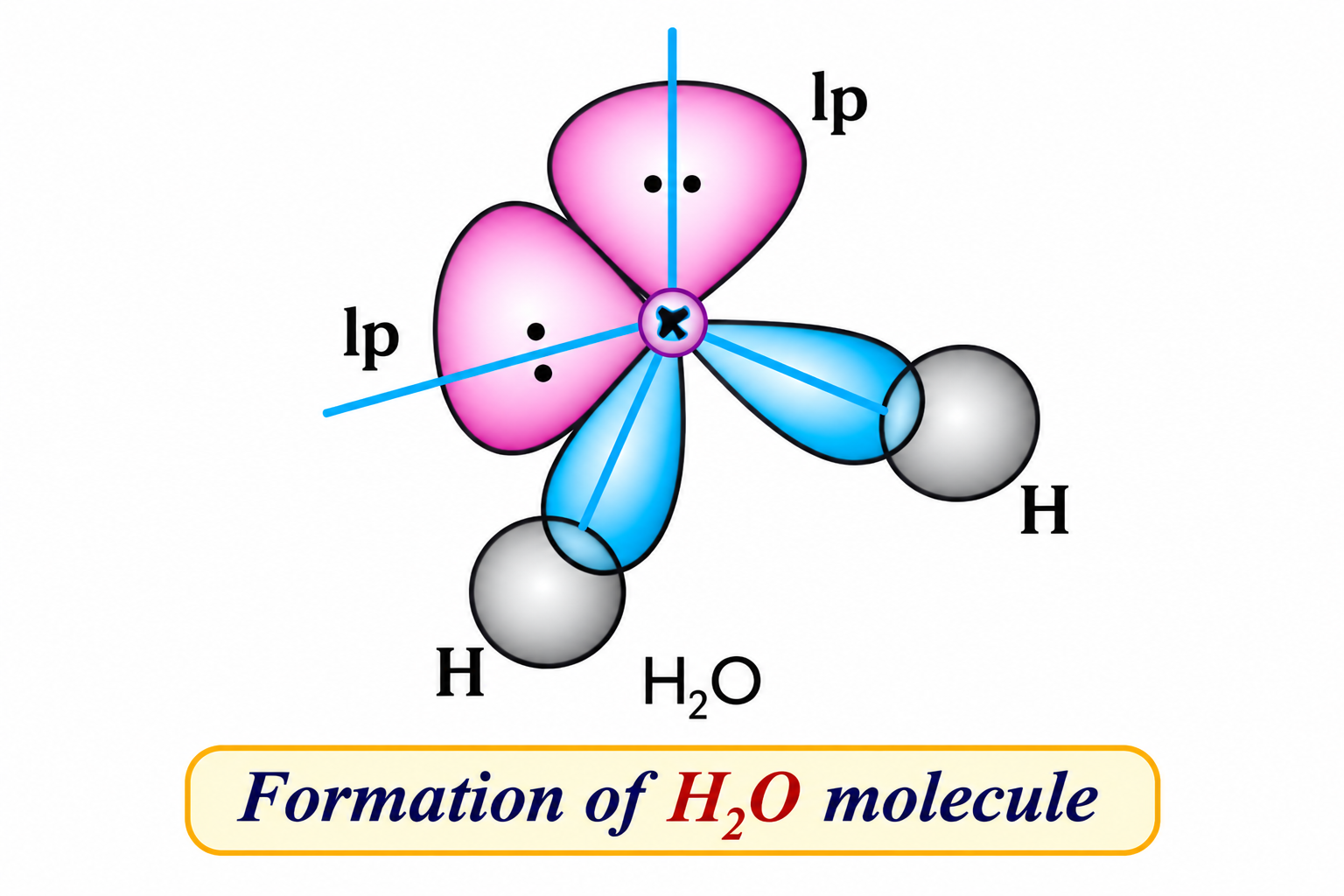
Explanation (Section 4.6.1): Oxygen ($Z=8$: $1s^2 2s^2 2p^4$) has 6 valence electrons. It undergoes $sp^3$ hybridisation forming four $sp^3$ hybrid orbitals: 2 contain lone pairs and 2 contain single electrons forming $\mathrm{O-H}$ $\sigma$ bonds. Strong lone pair–lone pair repulsions contract the $\mathrm{H-O-H}$ bond angle from $109.5^\circ$ to 104.5°, resulting in a V-shaped or bent geometry.
Explanation (Section 4.6.2): In ethane ($\mathrm{C_2H_6}$), both carbon atoms assume $sp^3$ hybrid state. One $sp^3$ hybrid orbital of one carbon overlaps axially with an $sp^3$ hybrid orbital of the other carbon atom to form an $sp^3-sp^3$ $\mathrm{C-C}$ $\sigma$ bond ($\text{C-C}$ bond length = $154\text{ pm}$). The remaining three $sp^3$ hybrid orbitals of each carbon atom form $sp^3-s$ $\mathrm{C-H}$ $\sigma$ bonds with Hydrogen $1s$ orbitals ($\text{C-H}$ bond length = $109\text{ pm}$).
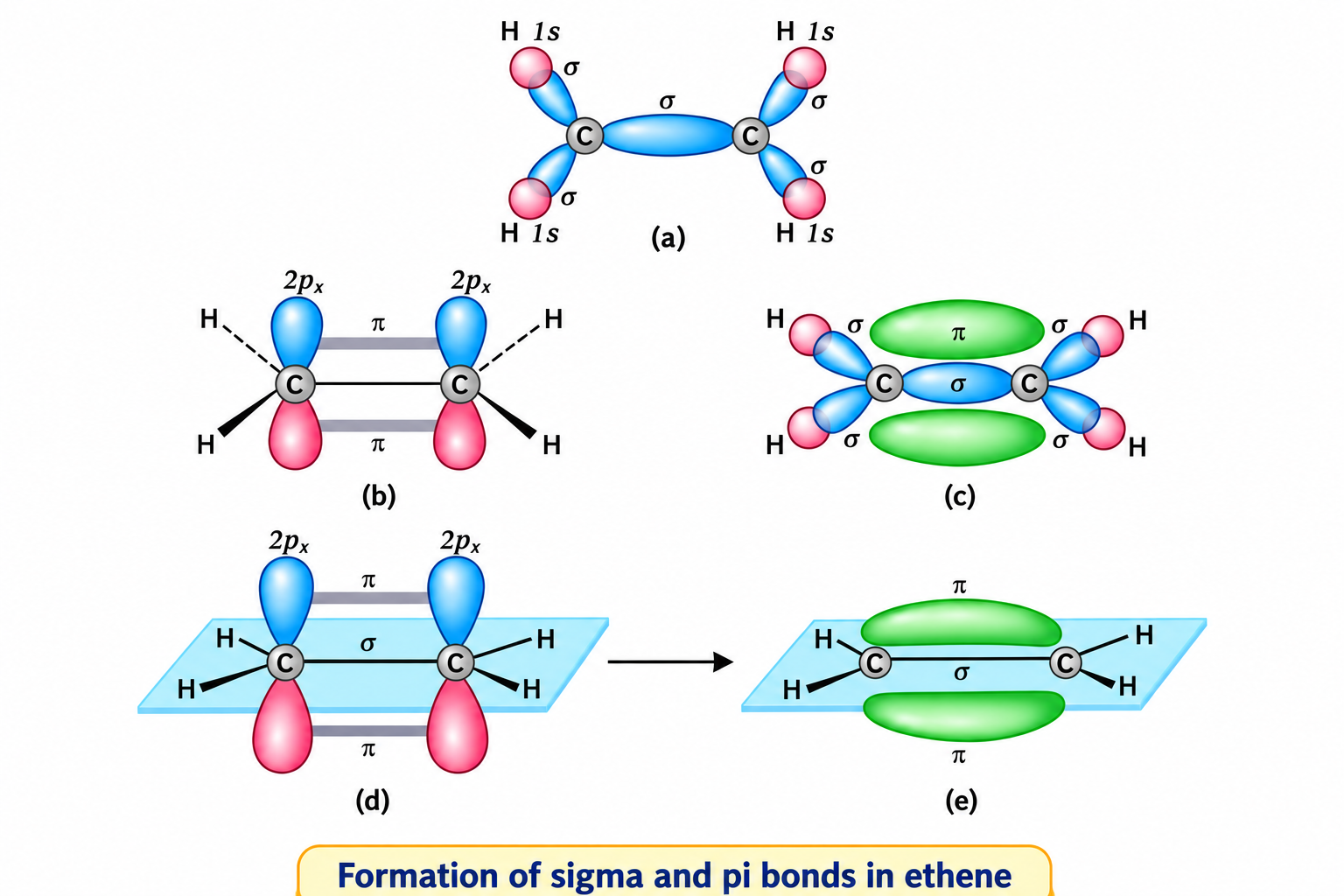
Explanation (Section 4.6.2): In ethene ($\mathrm{C_2H_4}$), each carbon is $sp^2$ hybridized. One $sp^2$ hybrid orbital of each carbon overlaps axially to form an $sp^2-sp^2$ $\mathrm{C-C}$ $\sigma$ bond ($134\text{ pm}$). The remaining two $sp^2$ hybrids on each carbon form $\mathrm{C-H}$ $\sigma$ bonds ($108\text{ pm}$, $\mathrm{H-C-H}$ angle = $117.6^\circ$). The unhybridised $2p_z$ orbital on each carbon atom overlaps sideways perpendicular to the molecular plane to form one $\mathrm{C=C}$ $\pi$ bond (double bond = $1\sigma + 1\pi$).
Explanation (Section 4.6.2): In ethyne ($\mathrm{C_2H_2}$), both carbons undergo $sp$ hybridisation. One $sp$ hybrid of each carbon overlaps axially to form a $\mathrm{C-C}$ $\sigma$ bond, while the second $sp$ hybrid forms a $\mathrm{C-H}$ $\sigma$ bond ($180^\circ$, linear). The two unhybridised orbitals ($2p_y, 2p_z$) on each carbon overlap sideways to form two perpendicular $\pi$ bonds between the carbon atoms ($\mathrm{C\equiv C}$ triple bond = $1\sigma + 2\pi$).

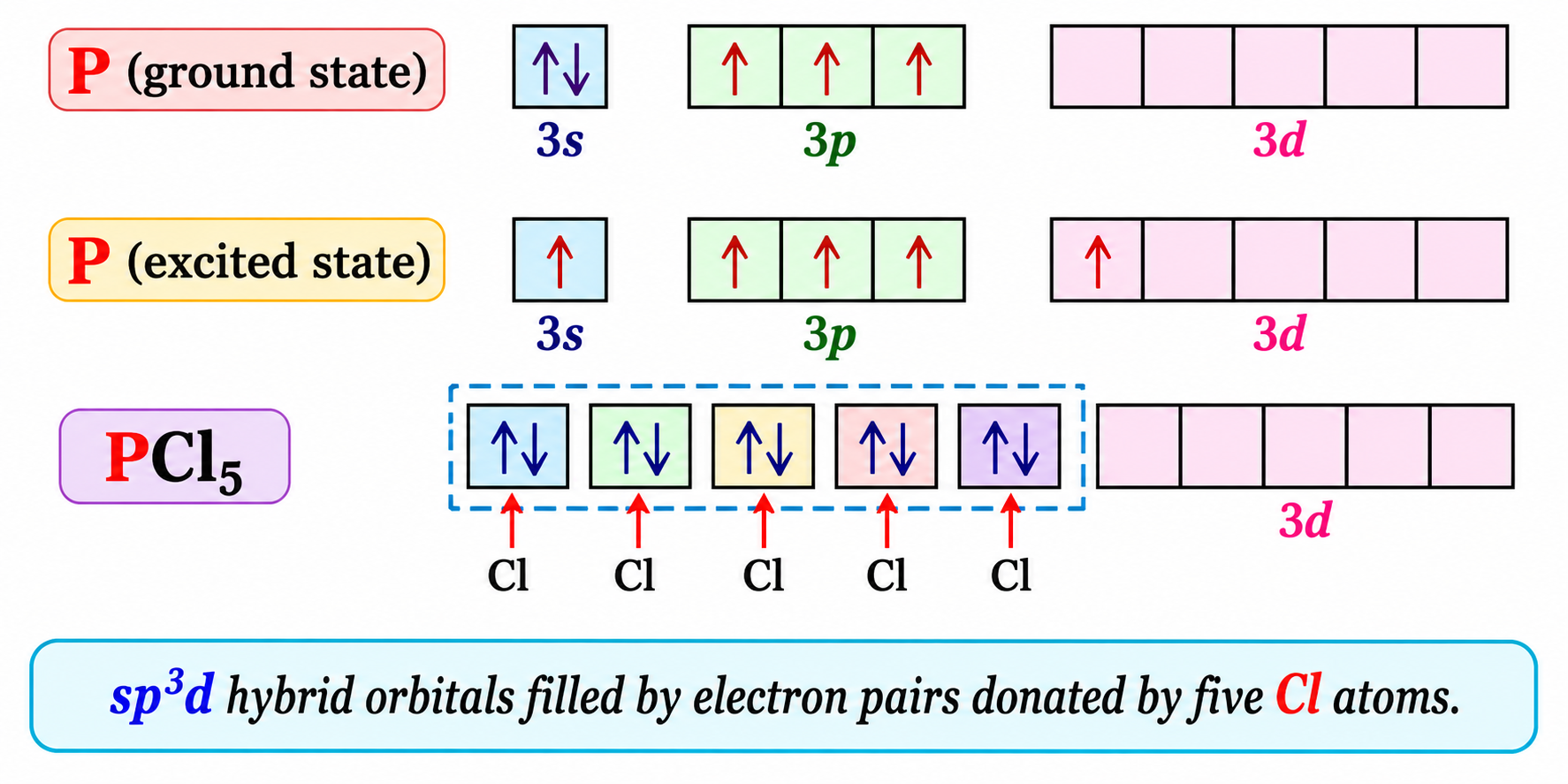
Explanation (Section 4.6.3): Phosphorus ($Z=15$: $[\mathrm{Ne}]\, 3s^2 3p^3 3d^0$) in excited state has configuration $3s^1 3p_x^1 3p_y^1 3p_z^1 3d_{z^2}^1$. These 5 orbitals intermix to yield five $sp^3d$ hybrid orbitals directed towards trigonal bipyramidal vertices. Three equatorial $\mathrm{P-Cl}$ bonds lie in a plane at $120^\circ$ ($202\text{ pm}$), while two axial $\mathrm{P-Cl}$ bonds lie perpendicular above and below at $90^\circ$ ($240\text{ pm}$). Axial bonds suffer 3 strong $90^\circ$ repulsions from equatorial pairs, making them longer, weaker, and highly reactive.
Explanation (NCERT 4.6.3): Sulfur ($Z=16$: $[\mathrm{Ne}]\, 3s^2 3p^4 3d^0$) in excited state promotes two electrons to $3d$ orbitals ($3s^1 3p_x^1 3p_y^1 3p_z^1 3d_{x^2-y^2}^1 3d_{z^2}^1$). These 6 orbitals intermix to yield six equivalent $sp^3d^2$ hybrid orbitals directed towards the six corners of a regular octahedron at $90^\circ$. All 6 $\mathrm{S-F}$ bonds are completely equivalent ($156.4\text{ pm}$) at right angles, making $\mathrm{SF_6}$ exceptionally stable and chemically inert.
Q. State the hybridisation of the central atom in: (a) SO₄²⁻, (b) NH₄⁺, (c) XeF₂, (d) each carbon of CH₃–CH=CH₂.
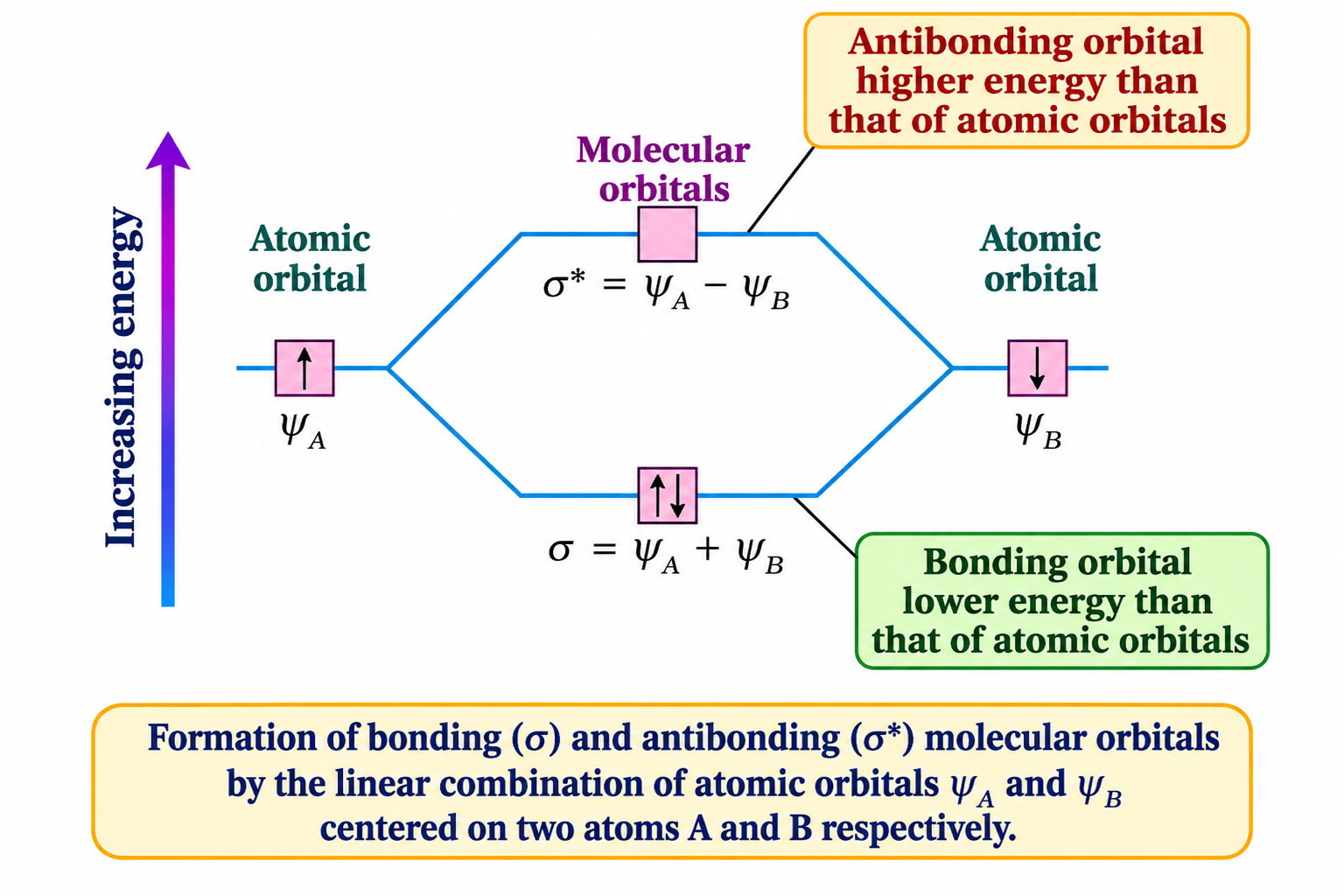
Molecular Orbital Theory (F. Hund & R.S. Mulliken, 1932) considers that atomic orbitals combine to form molecular orbitals (MOs) spread over all nuclei in the molecule. Electrons occupy MOs following the Aufbau principle, Pauli exclusion principle, and Hund's rule.
Atomic wavefunctions $\psi_A$ and $\psi_B$ combine linearly to produce bonding wavefunction $\psi_{\text{MO}} = N(\psi_A + \psi_B)$ and antibonding wavefunction $\psi^*_{\text{MO}} = N^*(\psi_A - \psi_B)$.
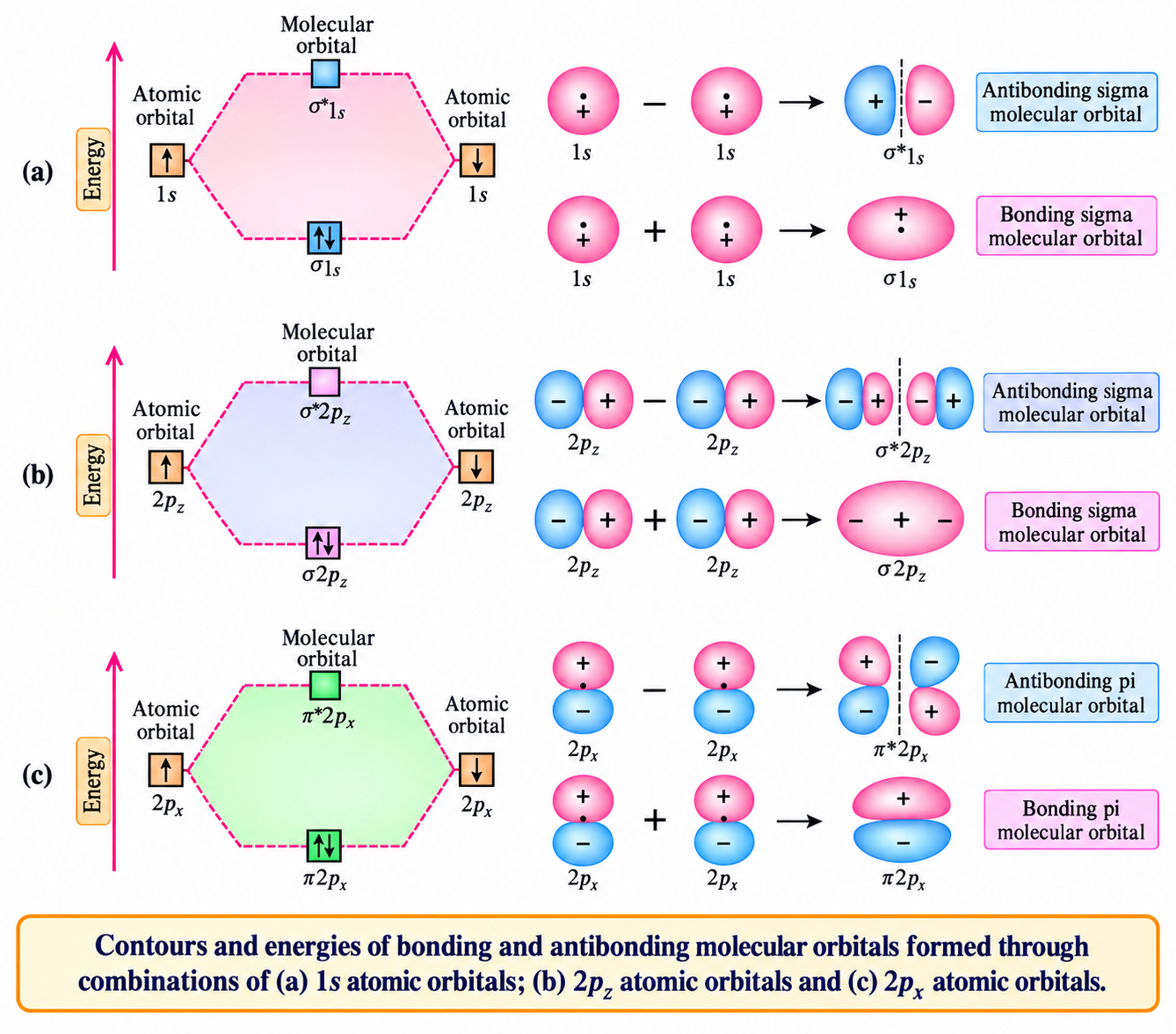
1. For $Z \le 7$ ($14$ or fewer valence/total electrons: $\mathrm{Li_2, Be_2, B_2, C_2, N_2}$): Due to $2s-2p$ mixing, $\sigma 2p_z$ is pushed to a higher energy than the degenerate $\pi 2p_x, \pi 2p_y$ pair:
$$\sigma 1s < \sigma^* 1s < \sigma 2s < \sigma^* 2s < (\pi 2p_x=\pi 2p_y) < \sigma 2p_z < (\pi^* 2p_x=\pi^* 2p_y) < \sigma^* 2p_z$$2. For $Z > 7$ (more than $14$ electrons: $\mathrm{O_2, F_2, Ne_2}$): Negligible $2s-2p$ mixing $\implies \sigma 2p_z$ is lower in energy than $\pi 2p$:
$$\sigma 1s < \sigma^* 1s < \sigma 2s < \sigma^* 2s < \sigma 2p_z < (\pi 2p_x=\pi 2p_y) < (\pi^* 2p_x=\pi^* 2p_y) < \sigma^* 2p_z$$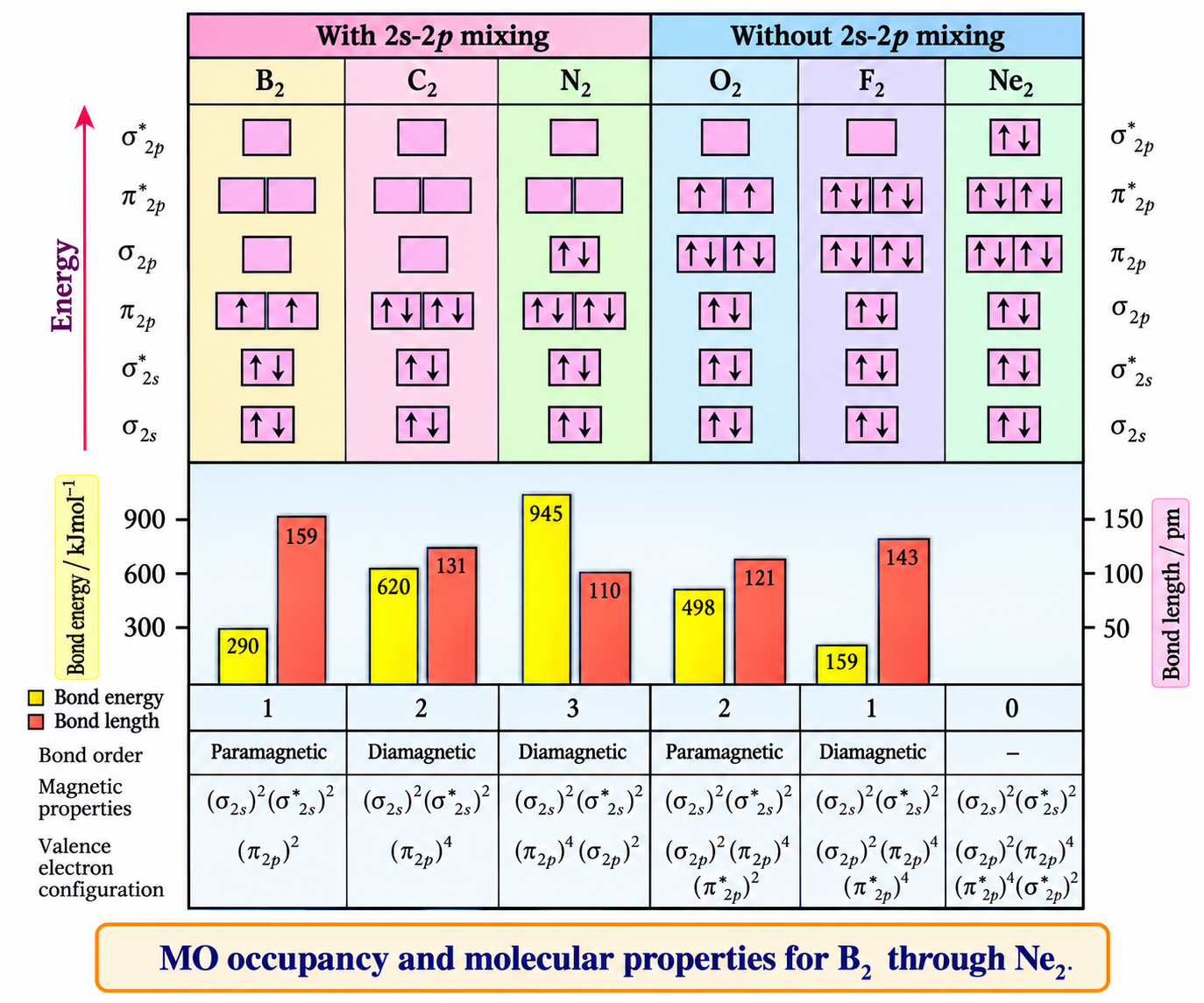
| Species | Total $E^-$ | MO Electronic Configuration | $N_b$ | $N_a$ | Bond Order | Magnetic Character |
|---|---|---|---|---|---|---|
| $\mathrm{H_2}$ | 2 | $\sigma 1s^2$ | 2 | 0 | 1 | Diamagnetic |
| $\mathrm{He_2}$ | 4 | $\sigma 1s^2 \, \sigma^* 1s^2$ | 2 | 2 | 0 | Does not exist |
| $\mathrm{Li_2}$ | 6 | $\mathrm{KK} \, \sigma 2s^2$ | 4 | 2 | 1 | Diamagnetic |
| $\mathrm{Be_2}$ | 8 | $\mathrm{KK} \, \sigma 2s^2 \, \sigma^* 2s^2$ | 4 | 4 | 0 | Does not exist |
| $\mathrm{B_2}$ | 10 | $\mathrm{KK} \, \sigma 2s^2 \, \sigma^* 2s^2$ $(\pi 2p_x^1 = \pi 2p_y^1)$ | 6 | 4 | 1 | Paramagnetic (2 unpaired $e^-$) |
| $\mathrm{C_2}$ | 12 | $\mathrm{KK} \, \sigma 2s^2 \, \sigma^* 2s^2$ $(\pi 2p_x^2 = \pi 2p_y^2)$ | 8 | 4 | 2 | Diamagnetic (Both bonds are $\pi$ bonds!) |
| $\mathrm{N_2}$ | 14 | $\mathrm{KK} \, \sigma 2s^2 \, \sigma^* 2s^2$ $(\pi 2p_x^2 = \pi 2p_y^2) \, \sigma 2p_z^2$ | 10 | 4 | 3 | Diamagnetic (1 $\sigma$ + 2 $\pi$) |
| $\mathrm{O_2}$ | 16 | $\mathrm{KK} \, \sigma 2s^2 \, \sigma^* 2s^2 \, \sigma 2p_z^2$ $(\pi 2p_x^2 = \pi 2p_y^2)$ $(\pi^* 2p_x^1 = \pi^* 2p_y^1)$ | 10 | 6 | 2 | Paramagnetic (2 unpaired $e^-$) |
| $\mathrm{F_2}$ | 18 | $\mathrm{KK} \, \sigma 2s^2 \, \sigma^* 2s^2 \, \sigma 2p_z^2$ $(\pi 2p_x^2 = \pi 2p_y^2)$ $(\pi^* 2p_x^2 = \pi^* 2p_y^2)$ | 10 | 8 | 1 | Diamagnetic |
| $\mathrm{Ne_2}$ | 20 | $\dots \, \sigma^* 2p_z^2$ | 10 | 10 | 0 | Does not exist |
When H is covalently bonded to a small, highly electronegative atom (F, O, N only), the strongly δ+ hydrogen is attracted to a lone pair of another electronegative atom — a hydrogen bond (energy ~10–40 kJ/mol: much weaker than a covalent bond, much stronger than van der Waals).
| Type | Where | Examples | Consequence |
|---|---|---|---|
| Intermolecular | Between different molecules | H₂O, HF (zig-zag chains), NH₃, alcohols, DNA base pairs | Raises b.p./m.p., association: H₂O liquid while H₂S is gas; ice less dense than water (open cage); carboxylic acids dimerise |
| Intramolecular | Within ONE molecule (ring closure) | o-nitrophenol, salicylaldehyde, o-fluorophenol | LOWERS b.p. vs the para isomer (no chains form) — o-nitrophenol is steam-volatile, p-nitrophenol is not |
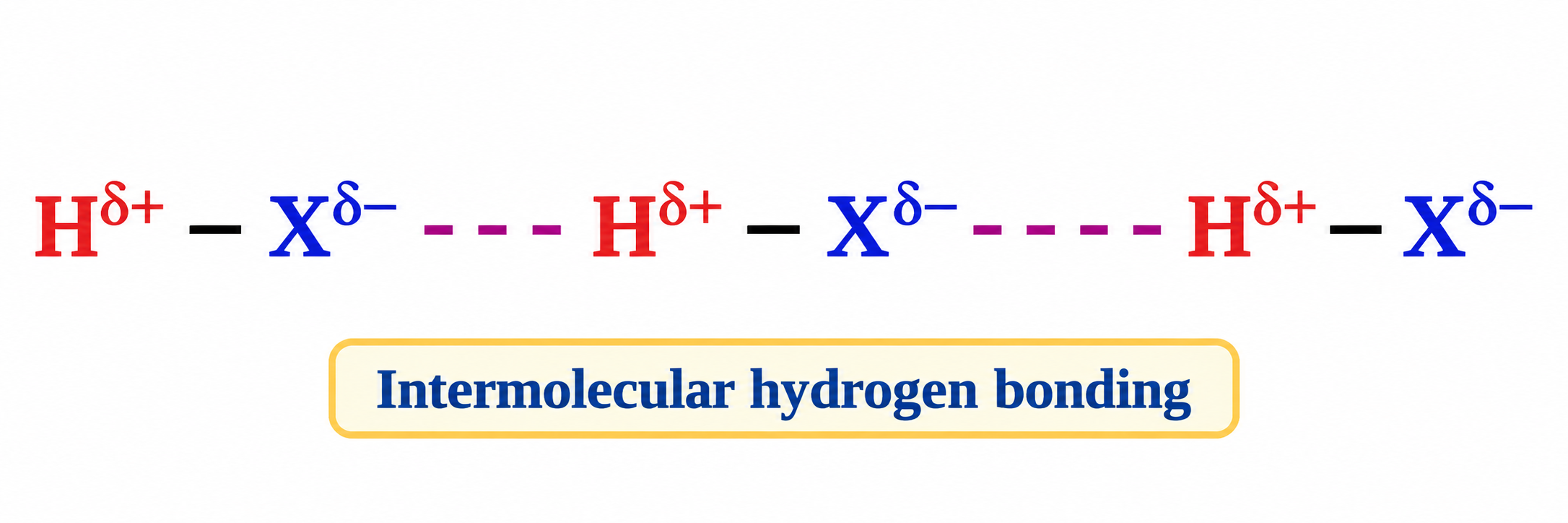
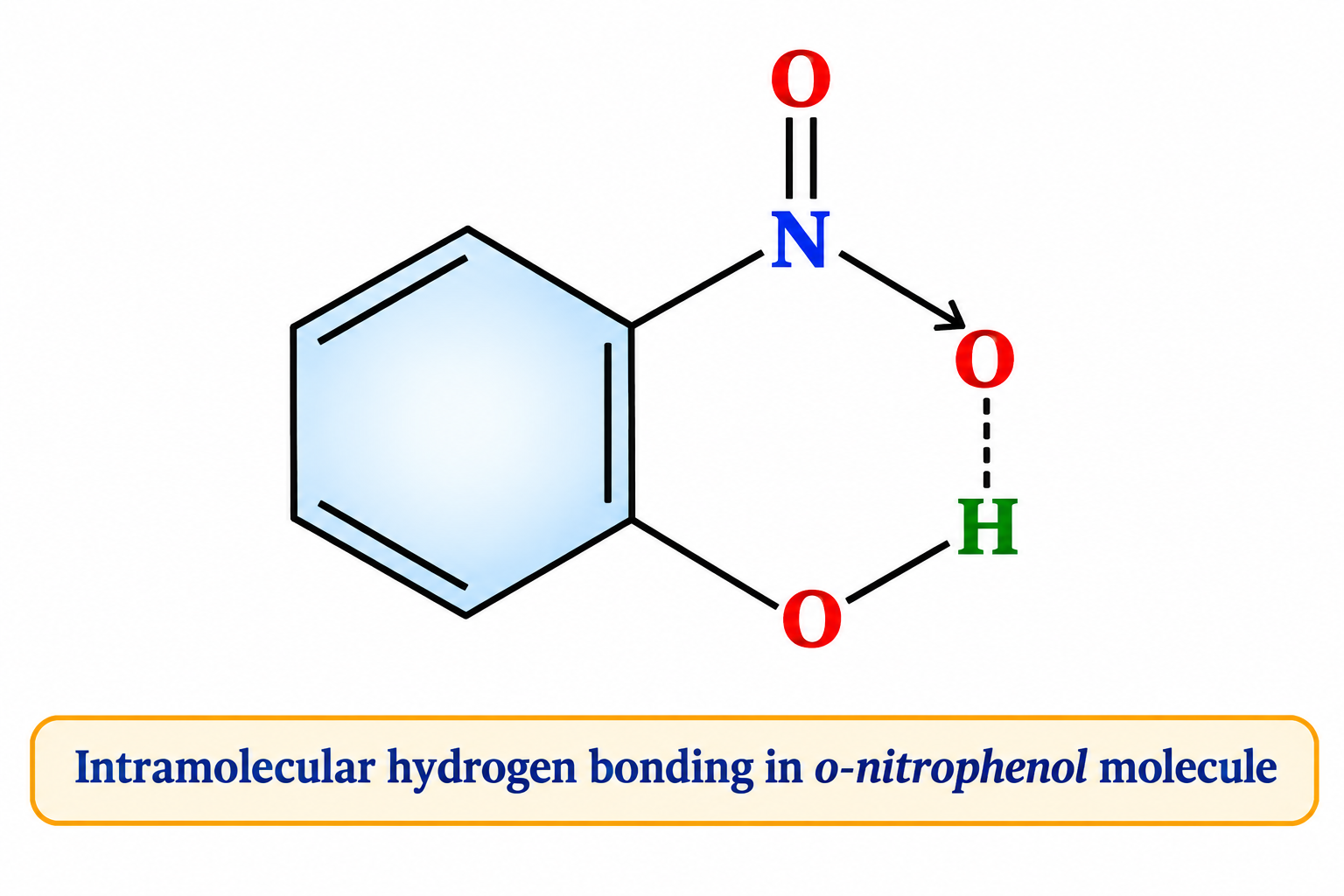
Q. Explain: (a) H₂O is a liquid but H₂S a gas at room temperature; (b) o-nitrophenol has a lower boiling point than p-nitrophenol.
One worked model of each distinct question type asked from this chapter, tagged by exam. Attempt each yourself first, then check.
Q. Define octet rule and list its limitations (3 marks). / Explain resonance with O₃ (3 marks). / State VSEPR postulates and predict the shape of H₂O (3 marks). / Why is O₂ paramagnetic? (2 marks — MOT only!)
Q. Match: SF₄, ClF₃, XeF₄, BrF₅ with their shapes and hybridisations.
Q. Arrange in decreasing bond angle: CH₄, NH₃, H₂O, NH₄⁺, and separately NH₃ vs PH₃.
Q. BF₃ has zero dipole moment while NF₃ has a small one, and NH₃ a large one. Explain all three in two lines each.
Q. Write the MO configuration of N₂ and O₂⁻; give bond order and magnetic behaviour of each.
Q. Using MOT, decide which exist: He₂, He₂⁺, Be₂, H₂⁻.
Q. Count σ and π bonds in CH₂=CH–C≡N, and order the three carbon–carbon/carbon–nitrogen bond lengths.
Q. Arrange in increasing covalent character: NaCl, MgCl₂, AlCl₃; and LiF, LiCl, LiBr, LiI.
Q. Arrange and explain: HF, HCl, HBr, HI by boiling point.
Q. CO, CN⁻, NO⁺ and N₂ are isoelectronic. State their common bond order; then decide the bond order and magnetism of NO.
Solved Example 4.7: Discuss the shape of $\mathrm{PCl_5}$ on the basis of hybridisation.
Solved Example 4.8: Write the molecular orbital electron configuration of $\mathrm{O_2^-}$ ion and calculate its bond order.
Solved Example 4.9: Calculate the bond order of $\mathrm{N_2, N_2^+, N_2^-}$ and compare their relative stabilities.
Solved Example 4.10: Use MOT to explain why $\mathrm{He_2}$ molecule does not exist.
Read this the night before the exam:
| Concept | Key result | Note |
|---|---|---|
| Formal charge | $FC = V - L - \tfrac12S$ | Lowest FC = best structure |
| Octet exceptions | BeH₂/BF₃; NO/NO₂; PF₅/SF₆; XeF₂ | incomplete / odd / expanded / noble |
| Lattice enthalpy | ∝ q₁q₂/r | MgO ≫ NaCl; drives ionic bonding |
| Bond order vs length | BO ↑ ⟹ length ↓, enthalpy ↑ | C–C 154 > C=C 134 > C≡C 120 pm |
| Resonance BO | total bonds / positions | CO₃²⁻: 4/3; O₃: 1.5; C₆H₆: 1.5 |
| Dipole moment | $\mu = q\times d$ (debye) | Vector sum; μ = 0 for CO₂, BF₃, CH₄, CCl₄ |
| % ionic character | $\frac{\mu_{obs}}{\mu_{ionic}}\times100$ | μ_ionic = e·d |
| Fajans | small cation + big anion + high charge ⟹ covalent | LiI most covalent Li-halide |
| VSEPR repulsion | lp–lp > lp–bp > bp–bp | CH₄ 109.5° → NH₃ 107° → H₂O 104.5° |
| Key odd shapes | SF₄ see-saw; ClF₃ T; XeF₂ linear; XeF₄ sq. planar; BrF₅ sq. pyramidal | lp equatorial in TBP |
| Hybridisation ↔ SN | 2 sp, 3 sp², 4 sp³, 5 sp³d, 6 sp³d² | SN = σ + lp |
| s-character | sp 50% > sp² 33% > sp³ 25% | More s ⟹ shorter, stronger, more EN |
| σ vs π | σ axial & strong; π lateral, needs σ first | double = σ+π; triple = σ+2π |
| MOT bond order | $BO = \frac{N_b - N_a}{2}$ | BO 0 ⟹ doesn't exist (He₂, Be₂, Ne₂) |
| Energy-order swap | ≤ N₂: π2p < σ2p_z; O₂/F₂: σ2p_z < π2p | Makes B₂ paramagnetic, C₂'s bonds both π |
| Oxygen ladder | O₂²⁻ 1 < O₂⁻ 1.5 < O₂ 2 < O₂⁺ 2.5 | O₂: paramagnetic, 2 unpaired π* |
| Isoelectronic BO-3 club | N₂, CO, CN⁻, NO⁺ | NO itself: BO 2.5, paramagnetic |
| H-bond | H on F/O/N; 10–40 kJ/mol | b.p.: H₂O > HF > NH₃; intra lowers b.p. |
 VARDAAN COMET