Vardaan Learning Institute
Class 11 Chemistry • Fully Detailed Master Chapter Notes
🌐 vardaanlearning.com
📞 9508841336
CLASSIFICATION OF ELEMENTS AND PERIODICITY IN PROPERTIES
Exam Weightage & Importance
This chapter is a foundational pillar for CBSE Boards, NEET, JEE Main/Advanced, WBJEE, COMEDK, and
VITEEE. Master the periodic laws, electronic configurations, $s, p, d, f$ blocks, and periodic
exceptions (Ionization Enthalpy anomalies, Electron Gain Enthalpy halogen trends, Isoelectronic radii, Oxide
natures) to guarantee top marks!
1. The Journey of Classification: Old Era to Modern Era
Elements are the basic units of all types of matter. In 1800, only 31
elements were known. By 1865, the number of identified elements had more than
doubled to 63 elements. At present, 114 elements (with atomic numbers up
to 118 synthesized/verified) are known. Of these, 94 elements are naturally occurring
(traces of Neptunium and Plutonium, like Actinium and Protactinium, are also found in pitchblende—an ore of
uranium). The rest are man-made synthetic transuranium elements.
The Old Era (Based on Atomic Mass)
All early models relied on Atomic Mass rather than Atomic Number, leading to inherent positional anomalies.
1.1 Dobereiner's Law of Triads (1829)
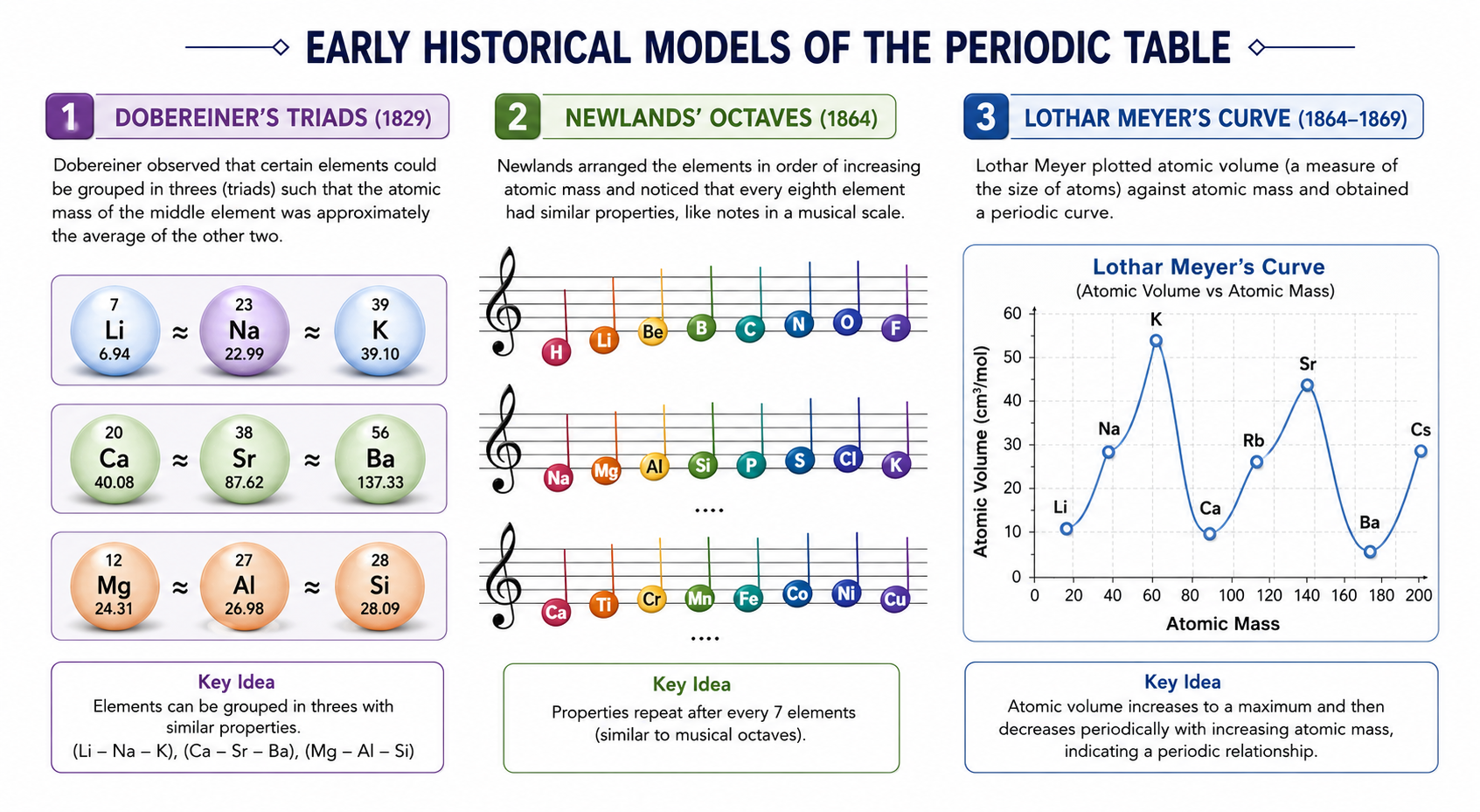
German chemist Johann Dobereiner grouped elements of similar physical and chemical
properties into groups of three called Triads. He observed that the atomic weight of the
middle element was roughly equal to the arithmetic mean of the atomic weights of the first and third
elements.
Examples of Dobereiner's Triads:
- Alkali Metal Triad: $\text{Li} (7), \text{Na} (23), \text{K} (39) \Rightarrow
\text{Mean} = \frac{7 + 39}{2} = \mathbf{23}$
- Alkaline Earth Triad: $\text{Ca} (40), \text{Sr} (88), \text{Ba} (137) \Rightarrow
\text{Mean} = \frac{40 + 137}{2} = \mathbf{88.5}$ (Actual $\text{Sr} = 87.6 \approx 88$)
- Halogen Triad: $\text{Cl} (35.5), \text{Br} (80), \text{I} (127) \Rightarrow
\text{Mean} = \frac{35.5 + 127}{2} = \mathbf{81.25}$ (Actual $\text{Br} = 79.9 \approx 80$)
- Chalcogen Triad: $\text{S} (32), \text{Se} (79), \text{Te} (128) \Rightarrow
\text{Mean} = \frac{32 + 128}{2} = \mathbf{80}$
Limitation: It worked for only a few elements and was dismissed as mere coincidence.
1.2 A.E.B. de Chancourtois' Telluric Helix (1862)
French geologist Alexandre-Émile Béguyer de Chancourtois arranged the known elements in order of increasing
atomic weights on a cylindrical helix (Telluric Helix) to display periodic recurrence of
properties. It was the first geometric periodic classification, but received little attention from chemists.
1.3 Newlands' Law of Octaves (1865)
English chemist John Alexander Newlands arranged elements in increasing order of atomic
weights and noted that every eighth element had properties similar to the first element,
analogous to the eight notes of an octave in music ($\text{sa, re, ga, ma, pa, dha, ni, sa}$).
Table 1.1: Newlands' Octaves Arrangement
| Element |
Li |
Be |
B |
C |
N |
O |
F |
| At. Wt. |
7 |
9 |
11 |
12 |
14 |
16 |
19 |
| Element |
Na |
Mg |
Al |
Si |
P |
S |
Cl |
| At. Wt. |
23 |
24 |
27 |
29 |
31 |
32 |
35.5 |
| Element |
K |
Ca |
|
|
|
|
|
| At. Wt. |
39 |
40 |
|
|
|
|
|
Limitation & Recognition: Newlands' Law of Octaves was valid only up to Calcium
($Z=20$). Beyond Calcium, heavier elements did not fit the octave pattern. Although initially
rejected, Newlands was later awarded the prestigious Davy Medal in 1887 by the Royal
Society, London.
1.4 Lothar Meyer's Curves (1869)
German chemist Lothar Meyer plotted physical properties such as Atomic Volume,
Melting Point, and Boiling Point against Atomic Weight and obtained a
periodically repeating curve pattern:
- Peaks of the Curve: Occupied by strongly electropositive alkali metals ($\text{Li, Na,
K, Rb, Cs}$).
- Ascending Positions: Occupied by electronegative halogens ($\text{F, Cl, Br, I}$).
- Descending Positions: Occupied by alkaline earth metals ($\text{Be, Mg, Ca, Sr, Ba}$).
- Troughs (Bottoms): Occupied by transition metals ($\text{Fe, Co, Ni, Cu, etc.}$).
1.5 Mendeleev's Periodic Table (1869 / 1905)
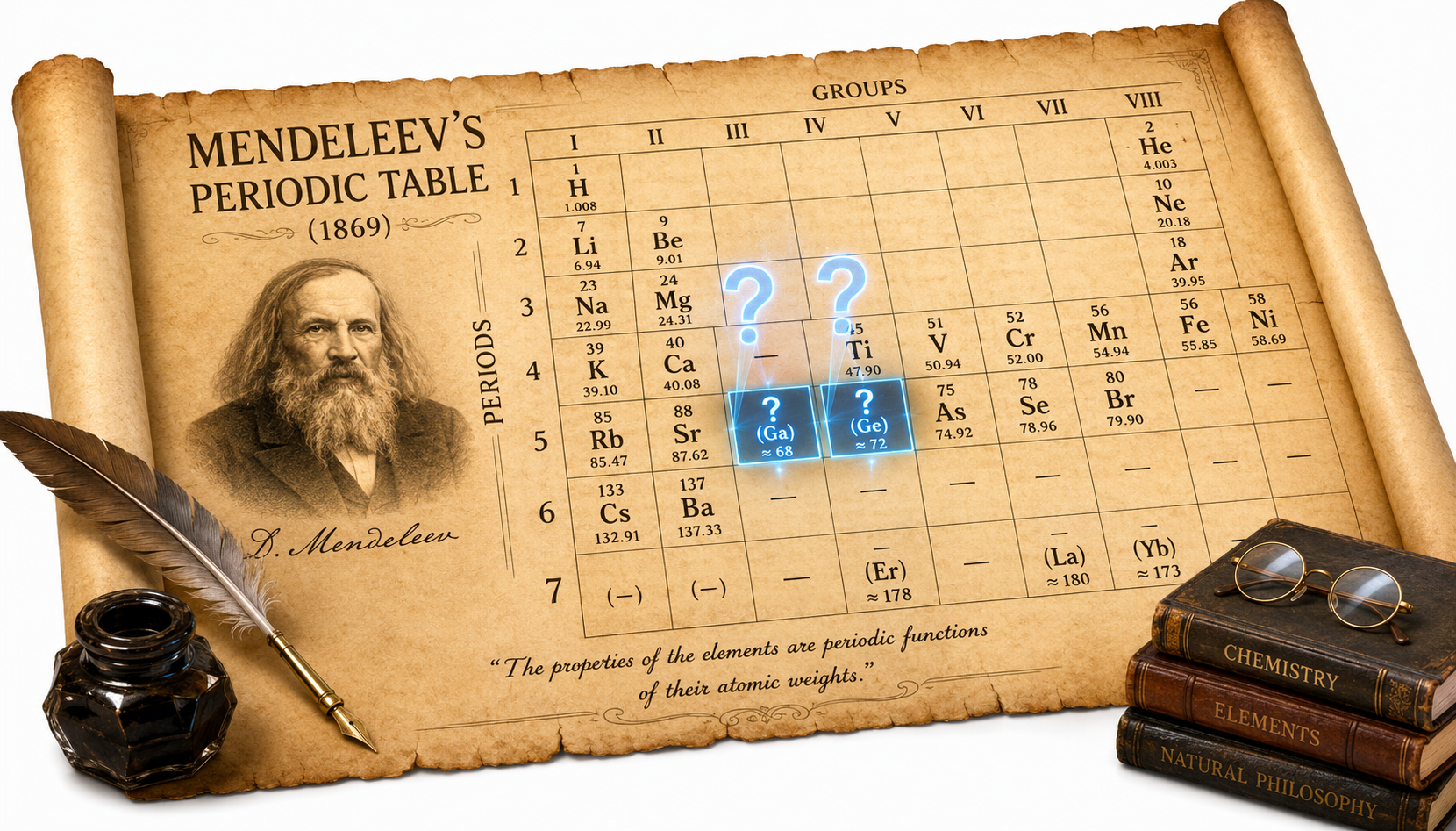
Russian chemist Dmitri Mendeleev published the Periodic Law for the first time:
Mendeleev's Periodic Law
"The physical and chemical properties of the elements are a periodic function of their atomic
weights."
Mendeleev arranged elements in horizontal rows (series) and vertical columns (groups) in order of increasing
atomic weights, relying heavily on similarities in empirical formulas of compounds
(especially oxides $R_2O, RO, R_2O_3, RO_2, R_2O_5, RO_3, R_2O_7, RO_4$ and hydrides $RH_4, RH_3, RH_2,
RH$).
Genius Achievements of Mendeleev:
- Bold Predictions of Undiscovered Elements: Left empty gaps in his table for
undiscovered elements and predicted their exact properties:
- Eka-Aluminium $\rightarrow$ Gallium ($\text{Ga}$)
- Eka-Silicon $\rightarrow$ Germanium ($\text{Ge}$)
- Eka-Boron $\rightarrow$ Scandium ($\text{Sc}$)
- Eka-Manganese $\rightarrow$ Technetium ($\text{Tc}$)
- Correction of Atomic Weights: Corrected atomic weight of Beryllium ($\text{Be}$) from
13.5 to 9 using valency consideration ($Equivalent Weight 4.5 \times Valency 2 = 9$).
Table 1.2: NCERT Table 3.3 — Mendeleev's Predictions vs Experimental Facts
| Property |
Eka-Aluminium (Predicted) |
Gallium (Found) |
Eka-Silicon (Predicted) |
Germanium (Found) |
| Atomic Weight |
68 |
70 |
72 |
72.6 |
| Density ($\text{g/cm}^3$) |
5.9 |
5.94 |
5.5 |
5.36 |
| Melting Point (K) |
Low |
302.93 |
High |
1231 |
| Formula of Oxide |
$\text{E}_2\text{O}_3$ |
$\text{Ga}_2\text{O}_3$ |
$\text{EO}_2$ |
$\text{GeO}_2$ |
| Formula of Chloride |
$\text{ECl}_3$ |
$\text{GaCl}_3$ |
$\text{ECl}_4$ |
$\text{GeCl}_4$ |
Anomalous Pairs in Mendeleev's Table: To maintain property similarities in groups, Mendeleev placed
a few heavier elements before lighter ones, violating strict atomic weight order:
- Tellurium ($\text{Te}, 127.6$) placed before Iodine ($\text{I},
126.9$)
- Cobalt ($\text{Co}, 58.9$) placed before Nickel ($\text{Ni}, 58.7$)
- Argon ($\text{Ar}, 39.9$) placed before Potassium ($\text{K}, 39.1$)
- Thorium ($\text{Th}, 232$) placed before Protactinium ($\text{Pa},
231$)
The Modern Era (Based on Atomic Number)
The revolutionary shift from Atomic Mass to Atomic Number unlocked the true quantum-mechanical nature of
periodicity.
2. Modern Periodic Law and Present Form of the Periodic Table
2.1 Moseley's Experiment (1913)
English physicist Henry Moseley bombarded various metal targets with high-energy electrons
and studied the characteristic X-ray spectra emitted. He plotted the square root of
frequency ($\sqrt{\nu}$) against Atomic Number ($Z$) and Atomic Mass ($A$).
Moseley's Mathematical Law:
$$\sqrt{\nu} = a(Z - b)$$
Where $\nu = \text{frequency of X-rays}$, $Z = \text{Atomic Number}$, and $a, b$ are constants.
Conclusion: The plot of $\sqrt{\nu}$ vs $Z$ yielded a perfectly straight line, whereas
$\sqrt{\nu}$ vs $A$ was non-linear. This proved conclusively that Atomic Number ($Z$) is a
far more fundamental property than atomic mass!
Modern Periodic Law
"The physical and chemical properties of the elements are periodic functions of their atomic numbers
($Z$)."
2.2 Seaborg's Contribution (Noble Prize 1951)
Glenn T. Seaborg synthesized transuranium elements starting with Plutonium ($Z=94$) up to
$Z=102$ in the mid-20th century. He reconfigured the periodic table by placing the Actinoid series
below the Lanthanoid series at the bottom. Element 106 was named Seaborgium
($\text{Sg}$) in his honor.
2.3 Structure of Long Form Periodic Table
- 7 Periods (Horizontal Rows): The period number corresponds to the highest principal
quantum number ($n$) of electrons being filled.
- 1st Period ($n=1$): $1s$ orbital filled $\rightarrow$ 2
elements ($\text{H}, \text{He}$). Shortest period.
- 2nd Period ($n=2$): $2s, 2p$ orbitals filled $\rightarrow$ 8
elements ($\text{Li}$ to $\text{Ne}$). Short period.
- 3rd Period ($n=3$): $3s, 3p$ orbitals filled $\rightarrow$ 8
elements ($\text{Na}$ to $\text{Ar}$). Short period.
- 4th Period ($n=4$): $4s, 3d, 4p$ orbitals filled $\rightarrow$ 18
elements ($\text{K}$ to $\text{Kr}$, includes $3d$ transition series $\text{Sc}$ to
$\text{Zn}$). Long period.
- 5th Period ($n=5$): $5s, 4d, 5p$ orbitals filled $\rightarrow$ 18
elements ($\text{Rb}$ to $\text{Xe}$, includes $4d$ transition series $\text{Y}$ to
$\text{Cd}$). Long period.
- 6th Period ($n=6$): $6s, 4f, 5d, 6p$ orbitals filled $\rightarrow$ 32
elements ($\text{Cs}$ to $\text{Rn}$, includes $4f$ inner-transition Lanthanoids
$\text{Ce}$ to $\text{Lu}$). Longest period.
- 7th Period ($n=7$): $7s, 5f, 6d, 7p$ orbitals filled $\rightarrow$ 32
elements ($\text{Fr}$ to $\text{Og}$, includes $5f$ inner-transition Actinoids
$\text{Th}$ to $\text{Lr}$). Completed up to $Z=118$.
- 18 Groups (Vertical Columns): Numbered 1 to 18 according to IUPAC recommendations
(replacing old IA...VIIA, VIII, IB...VIIB, 0). Elements in a group share identical outer electronic
configuration and similar chemical behavior.
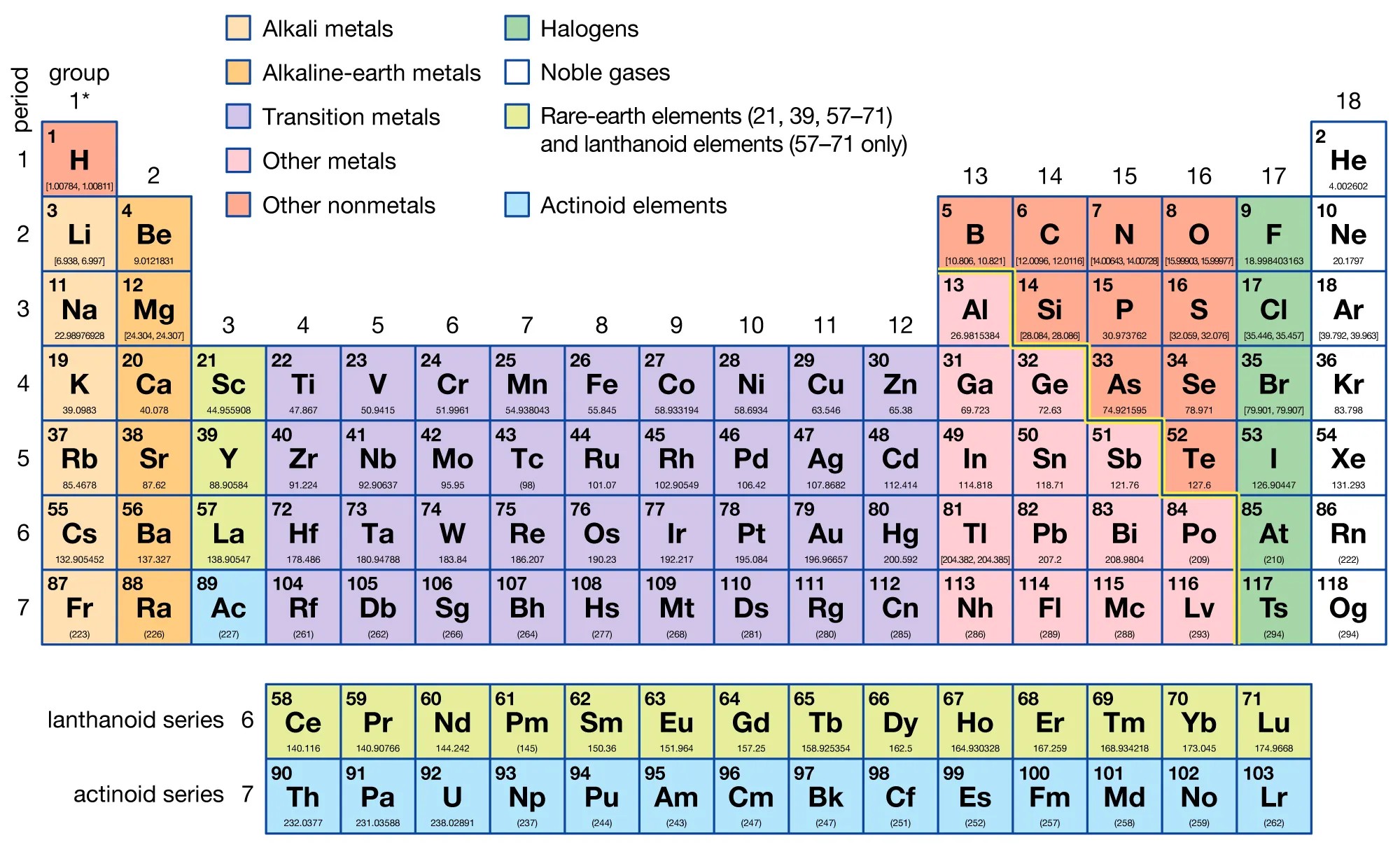
Fig 2.1: Long Form of the Modern Periodic Table of Elements
Practice Set 1 — Historical Laws & Periods
Q1 (NCERT Problem 3.2 / JEE Main): How would you justify the presence of 18 elements in the
5th period of the periodic table?
Solution: For period $n=5$, principal quantum number is 5. The orbitals filled
according to Aufbau principle in order of increasing energy are $5s, 4d,$ and $5p$.
Number of available orbitals: $5s (1) + 4d (5) + 5p (3) = 9 \text{ orbitals}$.
Max electrons accommodated $= 9 \times 2 = \mathbf{18 \text{ electrons}} \Rightarrow \mathbf{18
\text{ elements}}$.
Q2 (NCERT Exercise 3.4 / Board Exam): On the basis of quantum numbers, justify that the 6th
period of the periodic table should have 32 elements.
Solution: For $n=6$, orbitals available for electron filling in increasing energy order
are $6s, 4f, 5d,$ and $6p$.
Total orbitals $= 1 (6s) + 7 (4f) + 5 (5d) + 3 (6p) = 16 \text{ orbitals}$.
Capacity $= 16 \times 2 = \mathbf{32 \text{ electrons}} \Rightarrow \mathbf{32 \text{ elements}}$.
3. IUPAC Nomenclature for Elements with Atomic Number Z > 100
To avoid dispute over discovery claims (e.g. Element 104 was named Rutherfordium by Americans and
Kurchatovium by Soviets), IUPAC established a systematic nomenclature derived directly from the
numerical roots of digits in the atomic number plus suffix 'ium'.
Table 2.1: IUPAC Numerical Digit Roots
| Digit |
0 |
1 |
2 |
3 |
4 |
5 |
6 |
7 |
8 |
9 |
| Root |
nil |
un |
bi |
tri |
quad |
pent |
hex |
sept |
oct |
enn |
| Abbreviation |
n |
u |
b |
t |
q |
p |
h |
s |
o |
e |
Table 2.2: NCERT Table 3.5 — Complete IUPAC Nomenclature & Official Names (Z = 101
to 118)
| $Z$ |
Systematic Name |
Symbol |
Official IUPAC Name |
Official Symbol |
| 101 |
Unnilunium |
Unu |
Mendelevium |
Md |
| 102 |
Unnilbium |
Unb |
Nobelium |
No |
| 103 |
Unniltrium |
Unt |
Lawrencium |
Lr |
| 104 |
Unnilquadium |
Unq |
Rutherfordium |
Rf |
| 105 |
Unnilpentium |
Unp |
Dubnium |
Db |
| 106 |
Unnilhexium |
Unh |
Seaborgium |
Sg |
| 107 |
Unnilseptium |
Uns |
Bohrium |
Bh |
| 108 |
Unniloctium |
Uno |
Hassium |
Hs |
| 109 |
Unnilennium |
Une |
Meitnerium |
Mt |
| 110 |
Ununnillium |
Uun |
Darmstadtium |
Ds |
| 111 |
Unununnium |
Uuu |
Roentgenium |
Rg |
| 112 |
Ununbium |
Uub |
Copernicium |
Cn |
| 113 |
Ununtrium |
Uut |
Nihonium |
Nh |
| 114 |
Ununquadium |
Uuq |
Flerovium |
Fl |
| 115 |
Ununpentium |
Uup |
Moscovium |
Mc |
| 116 |
Ununhexium |
Uuh |
Livermorium |
Lv |
| 117 |
Ununseptium |
Uus |
Tennessine |
Ts |
| 118 |
Ununoctium |
Uuo |
Oganesson |
Og |
Practice Set 2 — IUPAC Nomenclature Problems
Q1 (NCERT Problem 3.1 / Problem 3.3): What is the IUPAC systematic name and symbol for
elements with $Z = 117, 120,$ and $138$?
Solution:
• $Z = 117$: $un + un + sept + ium = \mathbf{Ununseptium}$ (Symbol:
$\mathbf{Uus}$). Group 17 (Halogen).
• $Z = 120$: $un + bi + nil + ium = \mathbf{Unbinilium}$ (Symbol:
$\mathbf{Ubn}$). Group 2 (Alkaline Earth Metal), $[\text{Og}] 8s^2$.
• $Z = 138$: $un + tri + oct + ium = \mathbf{Untrioctium}$ (Symbol:
$\mathbf{Uto}$).
4. Block Classification ($s, p, d, f$) & General Electronic Configurations
The division of elements into four distinct blocks ($s, p, d, f$) is based on the type of atomic
orbital receiving the last entering valence electron (Aufbau principle).
Table 3.1: Complete Block-wise Summary & Characteristics
| Block |
General Outer Configuration |
Groups Included |
Key Features & High-Yield Exceptions |
| s-Block |
$ns^{1-2}$ |
Group 1 (Alkali Metals)
Group 2 (Alkaline Earth) |
Reactive metals, low ionization enthalpy, strong reducing agents, form $+1$ and $+2$ cations.
Compounds are predominantly ionic (except $\text{LiF}, \text{BeCl}_2$). High metallic character.
|
| p-Block |
$ns^2 np^{1-6}$ |
Group 13 to 18 |
Includes metals, non-metals, and metalloids. $s$-block + $p$-block elements are collectively
called Representative Elements or Main Group Elements.
Contains Halogens (G-17), Chalcogens (G-16), and Noble Gases (G-18, $ns^2 np^6$). |
| d-Block |
$(n-1)d^{1-10} ns^{0-2}$ |
Group 3 to 12 |
Transition Elements. Form colored ions, exhibit variable oxidation states,
paramagnetic, act as catalysts. Exceptions: Palladium $\text{Pd} (4d^{10}
5s^0)$, Chromium $\text{Cr} (3d^5 4s^1)$, Copper $\text{Cu} (3d^{10} 4s^1)$. $\mathbf{\text{Zn,
Cd, Hg}}$ ($(n-1)d^{10} ns^2$) are not transition elements (fully filled $d$-orbitals).
|
| f-Block |
$(n-2)f^{1-14} (n-1)d^{0-1} ns^2$ |
Group 3 |
Inner Transition Elements. Located separately at the bottom.
Lanthanoids ($4f, Z=58-71, \text{Ce}$ to $\text{Lu}$) and
Actinoids ($5f, Z=90-103, \text{Th}$ to $\text{Lr}$). All actinoids are
radioactive; transuranium elements ($Z > 92$) are synthetic. |
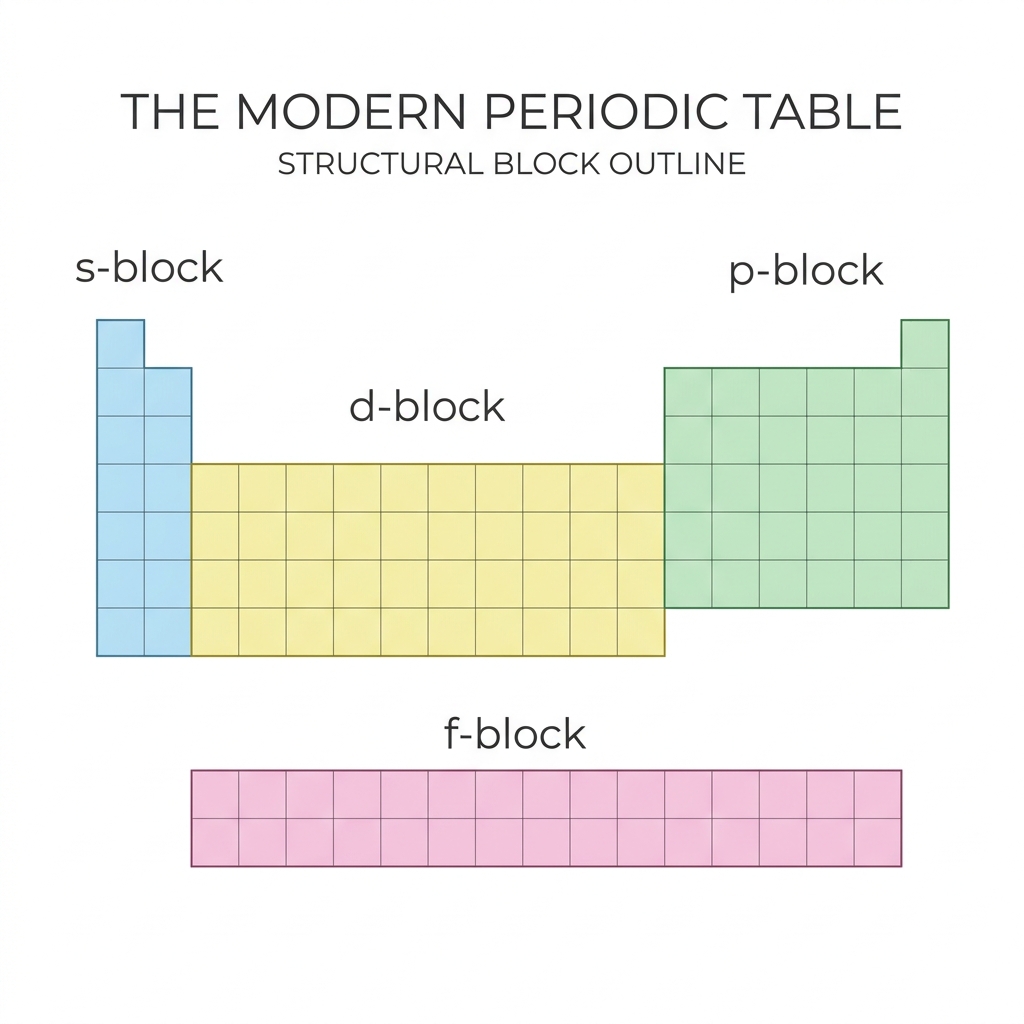
Fig 4.1: Division of the Periodic Table into s, p, d, and f Blocks
Positional Anomalies & Exceptions
Helium ($\text{He}$): Outer electronic configuration is $1s^2$ (belongs to s-block), but is
placed in Group 18 p-block because its completely filled valence shell exhibits noble gas chemical
inertness.
Hydrogen ($\text{H}$): Electronic configuration $1s^1$. Can lose 1 electron to form
$\text{H}^+$ (resembling Group 1 alkali metals) or gain 1 electron to form $\text{H}^-$ (resembling Group 17
halogens). Hence, it is placed separately at the top.
Transition Metal Definition Exception: $\text{Zn, Cd, Hg}$ have general configuration
$(n-1)d^{10} ns^2$. Because their $d$-subshells are completely filled in both ground state and common
oxidation states ($+2$), they are d-block elements but not transition metals.
Practice Set 3 — Configuration & Block Identification
Q1 (NCERT Exercise 3.30 / JEE Main): Assign the position (Period and Group) of elements
having outer electronic configuration:
(i) $ns^2 np^4$ for $n=3$ (ii) $(n-1)d^2 ns^2$ for $n=4$ (iii) $(n-2)f^7
(n-1)d^1 ns^2$ for $n=6$
Solution:
(i) $n=3 \Rightarrow$ 3rd Period. Valence electrons $= 2 + 4 = 6 \Rightarrow$ Group
$= 10 + 6 = \mathbf{16}$ (Sulfur, $\text{S}$).
(ii) $n=4 \Rightarrow$ 4th Period. $d$-block element. Group $= (n-1)d + ns = 2 + 2
= \mathbf{4}$ (Titanium, $\text{Ti}$).
(iii) $n=6 \Rightarrow$ 6th Period. $f$-block element ($4f^7 5d^1 6s^2$)
$\Rightarrow$ Group 3 (Lanthanoid series, Gadolinium $\text{Gd}, Z=64$).
5. Periodic Trends in Physical Properties (High-Yield Core Exam Focus)
5.1 Effective Nuclear Charge ($Z_{eff}$) & Screening Effect
In a multi-electron atom, valence electrons experience attraction toward the nucleus and repulsion from inner
shell core electrons. The inner electrons shield or screen the valence electrons from the full nuclear
charge $Z$.
$$\mathbf{Z_{eff} = Z - \sigma}$$
Where $Z = \text{Actual Nuclear Charge (Atomic Number)}$ and $\sigma = \text{Screening Constant (Slater's
constant)}$.
- Shielding / Screening Power Order: $\mathbf{s > p > d > f}$. Inner $s$-electrons
provide maximum shielding, while $d$ and $f$ electrons provide poor shielding.
- Trend Across Period: $Z_{eff}$ increases steadily because electrons enter the same
valence shell while nuclear charge $Z$ increases by $+1$ per element.
- Trend Down Group: $Z_{eff}$ remains nearly constant because shielding by added inner
principal quantum shells compensates for increasing nuclear charge.
5.2 Atomic Radius ($r_{vdw} > r_{met} > r_{cov}$)
Since an isolated atom's electron cloud lacks a sharp boundary, atomic radius is determined by measuring
internuclear distances between bonded or adjacent atoms in solid state:
- Covalent Radius ($r_{cov}$): Half the distance between nuclei of two identical covalent
single-bonded atoms. E.g., $\text{Cl}_2$ internuclear distance is $198\text{ pm} \Rightarrow r_{cov} =
\frac{198}{2} = \mathbf{99\text{ pm}}$.
- Metallic Radius ($r_{met}$): Half the internuclear distance between two adjacent metal
cations in a metallic crystal lattice. E.g., $\text{Cu}$ distance is $256\text{ pm} \Rightarrow r_{met}
= \mathbf{128\text{ pm}}$.
- Van der Waals Radius ($r_{vdw}$): Half the internuclear distance between two non-bonded
adjacent identical atoms in solid phase. Used for monoatomic Noble Gases.
Radius Magnitude Comparison:
$$\mathbf{r_{vdw} > r_{met} > r_{cov}}$$
Reason: Van der Waals forces are weak non-bonded interactions (large distance), metallic bonding
involves shared crystal cloud, while covalent bonds involve direct orbital overlap (smallest distance).
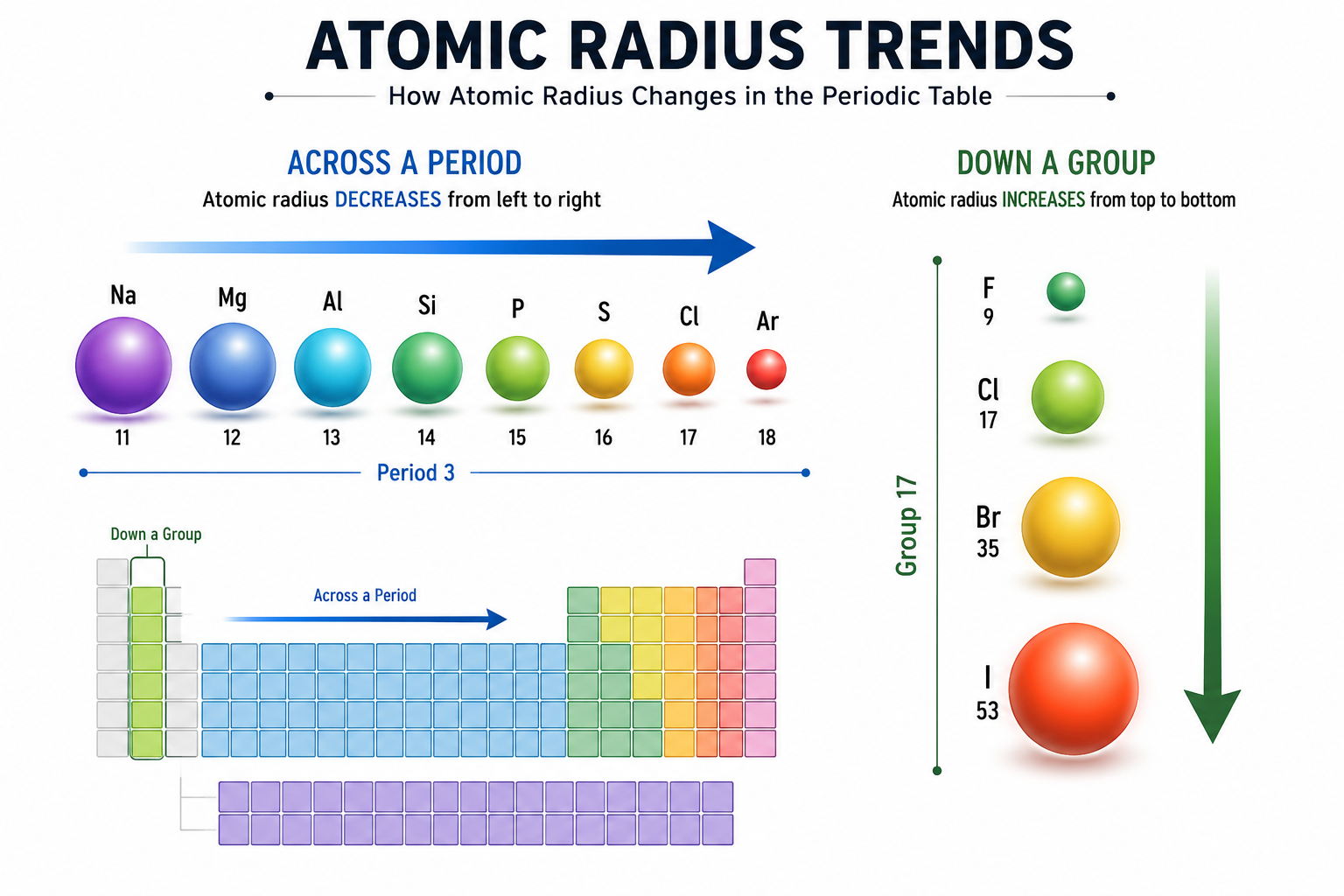
Periodic Trends in Atomic Radius:
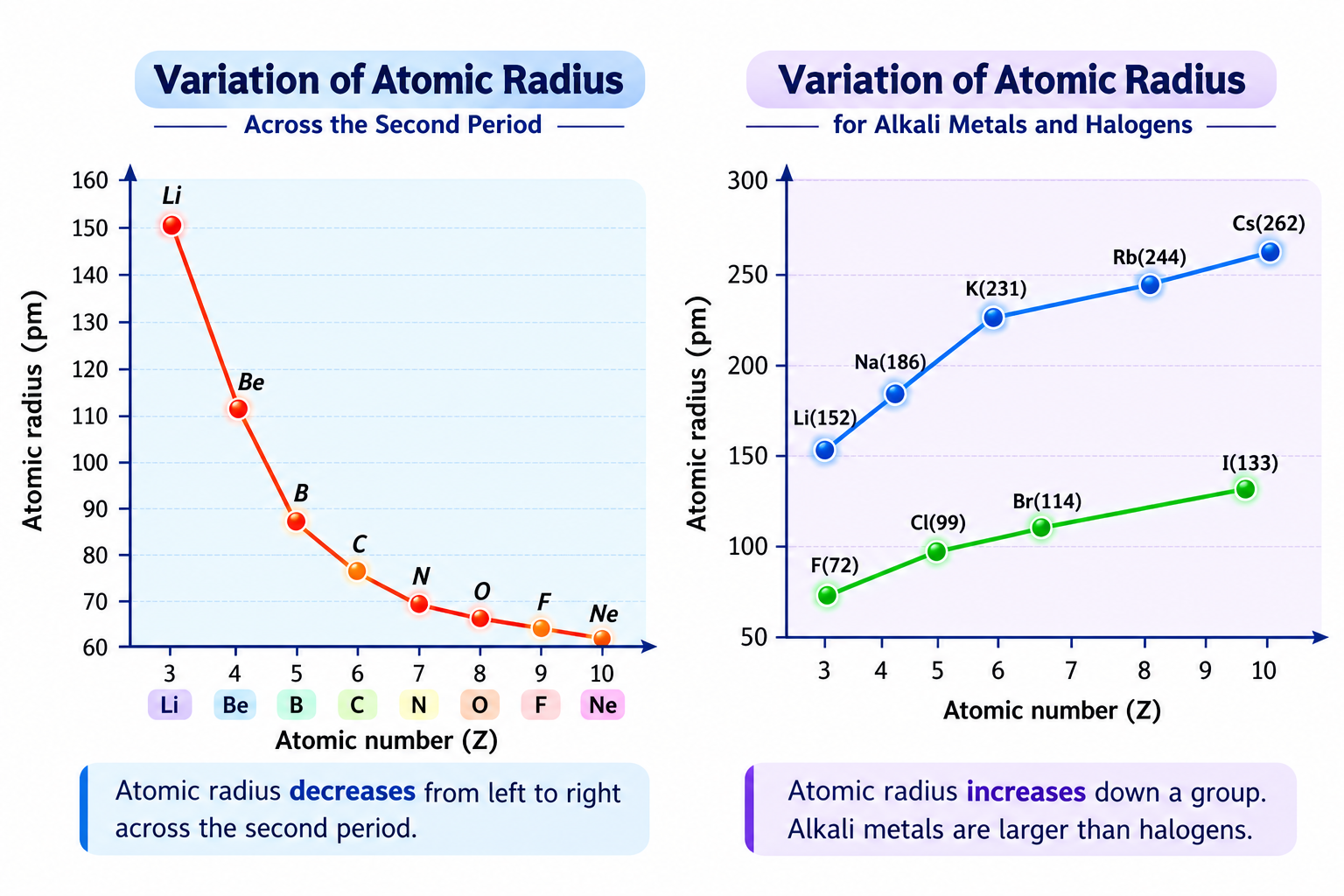
- Across Period (Left to Right): Atomic radius decreases. $Z_{eff}$
increases, pulling valence electrons tighter toward the nucleus.
Period 2 Order: $\text{Li} (152\text{ pm}) > \text{Be} (111) > \text{B} (88) > \text{C}
(77) > \text{N} (74) > \text{O} (66) > \text{F} (64)$.
- Down Group (Top to Bottom): Atomic radius increases. Principal quantum
number $n$ increases, adding new electron shells.
Group 1 Order: $\text{Li} (152) < \text{Na} (186) < \text{K} (231) < \text{Rb} (244) <
\text{Cs} (262\text{ pm})$.
- Noble Gas Anomaly: Noble gases have non-bonded Van der Waals radii, making them appear
abnormally larger than the preceding halogens in their respective periods!
5.3 Ionic Radius & Isoelectronic Series (100% Exam Favorite)
- Cation Radius < Parent Atom: Removal of electron(s) leaves fewer electrons acted upon
by the same nuclear charge. $Z_{eff}$ increases and electron repulsion decreases. E.g.,
$\mathbf{\text{Na}^+ (95\text{ pm}) < \text{Na } (186\text{ pm})}$.
- Anion Radius > Parent Atom: Addition of electron(s) increases electron-electron
repulsion, causing expansion of the electron cloud. E.g., $\mathbf{\text{F}^- (136\text{ pm}) > \text{F
} (64\text{ pm})}$.
Isoelectronic Species Radius Rule
Isoelectronic Species: Atoms and ions containing the same total number of
electrons (e.g., $10\text{e}^-$ series: $\text{N}^{3-}, \text{O}^{2-}, \text{F}^-, \text{Na}^+,
\text{Mg}^{2+}, \text{Al}^{3+}$).
Rule: For isoelectronic species, higher positive nuclear charge ($Z$) $\Rightarrow$
smaller ionic radius.
$$\text{N}^{3-} (171\text{ pm}) > \text{O}^{2-} (140\text{ pm}) > \text{F}^- (136\text{ pm}) >$$
$$\text{Na}^+ (95\text{ pm}) > \text{Mg}^{2+} (72\text{ pm}) > \text{Al}^{3+} (57\text{ pm})$$
JEE / NEET Exception — Lanthanoid Contraction
In $5d$ transition series, filling of $14$ inner $4f$ electrons occurs before $5d$. Due to extremely
poor shielding of $4f$ electrons, nuclear charge pull increases sharply, causing atomic
radii of $5d$ series elements to be virtually identical to $4d$ series elements:
$$\text{Zr } (4d, 160\text{ pm}) \approx \text{Hf } (5d, 159\text{ pm})$$
$$\text{Nb } (4d) \approx \text{Ta } (5d), \quad \text{Mo } (4d) \approx \text{W } (5d)$$
5.4 Ionization Enthalpy ($\Delta_i H$) & Crucial Exam Exceptions
Ionization Enthalpy ($\Delta_i H$): The minimum energy required to remove the most loosely
bound electron from an isolated gaseous atom ($X$) in its ground state:
$$X_{(g)} \longrightarrow X^+_{(g)} + e^- \quad (\Delta_i H_1)$$
Units: $\text{kJ mol}^{-1}$ or $\text{eV/atom}$. Ionization is strictly an endothermic process
($\Delta_i H > 0$).
Successive Ionization Enthalpies: Energy required to remove 2nd and 3rd electrons:
$$X^+_{(g)} \longrightarrow X^{2+}_{(g)} + e^- \quad (\Delta_i H_2)$$
$$X^{2+}_{(g)} \longrightarrow X^{3+}_{(g)} + e^- \quad (\Delta_i H_3)$$
$$\mathbf{\Delta_i H_1 < \Delta_i H_2 < \Delta_i H_3}$$
Reason: Removing an electron from a positively
charged cation requires significantly more energy due to higher $Z_{eff}$ pull.
TOP EXAM EXCEPTIONS — Ionization Enthalpy Anomalies
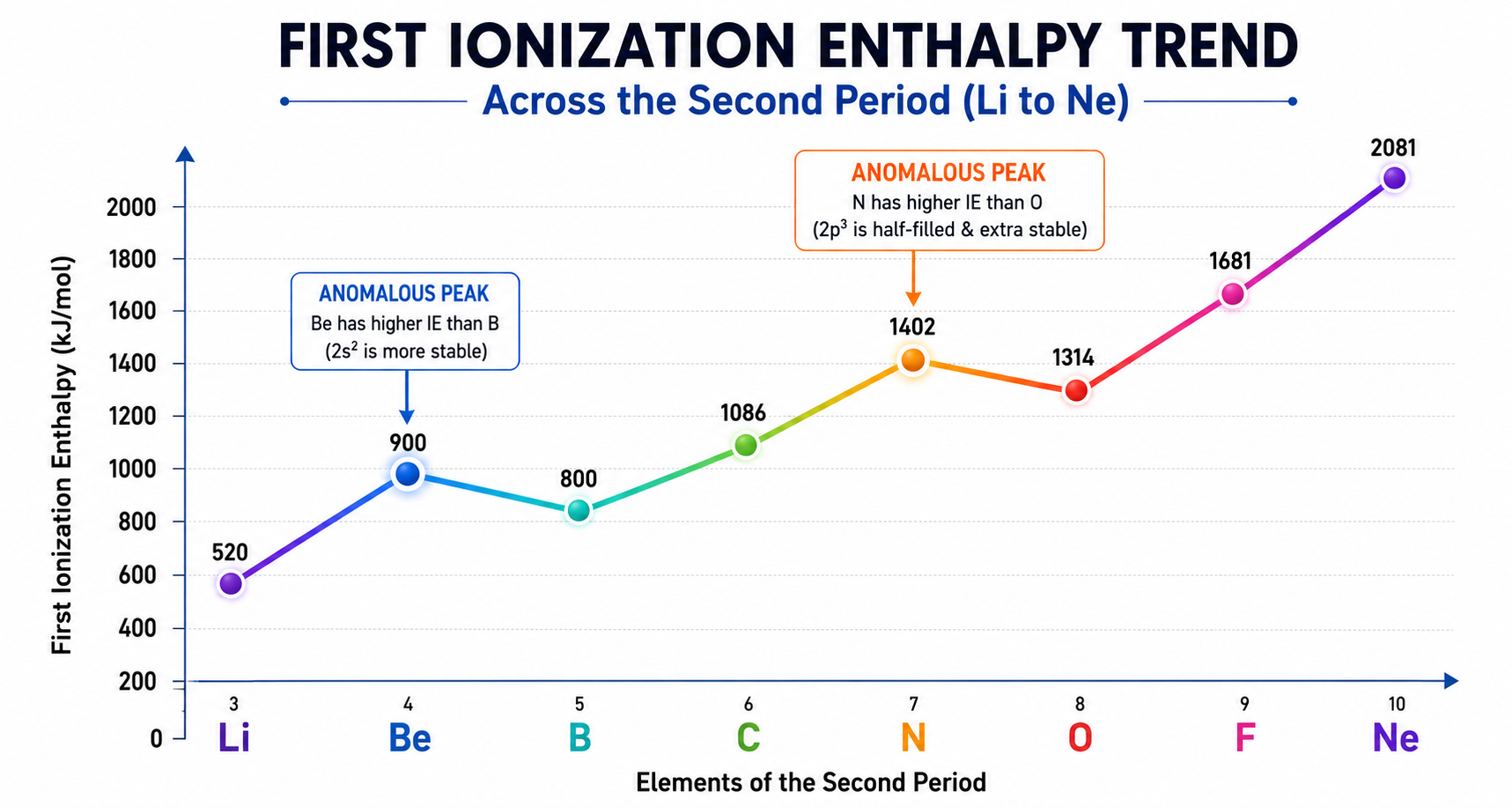
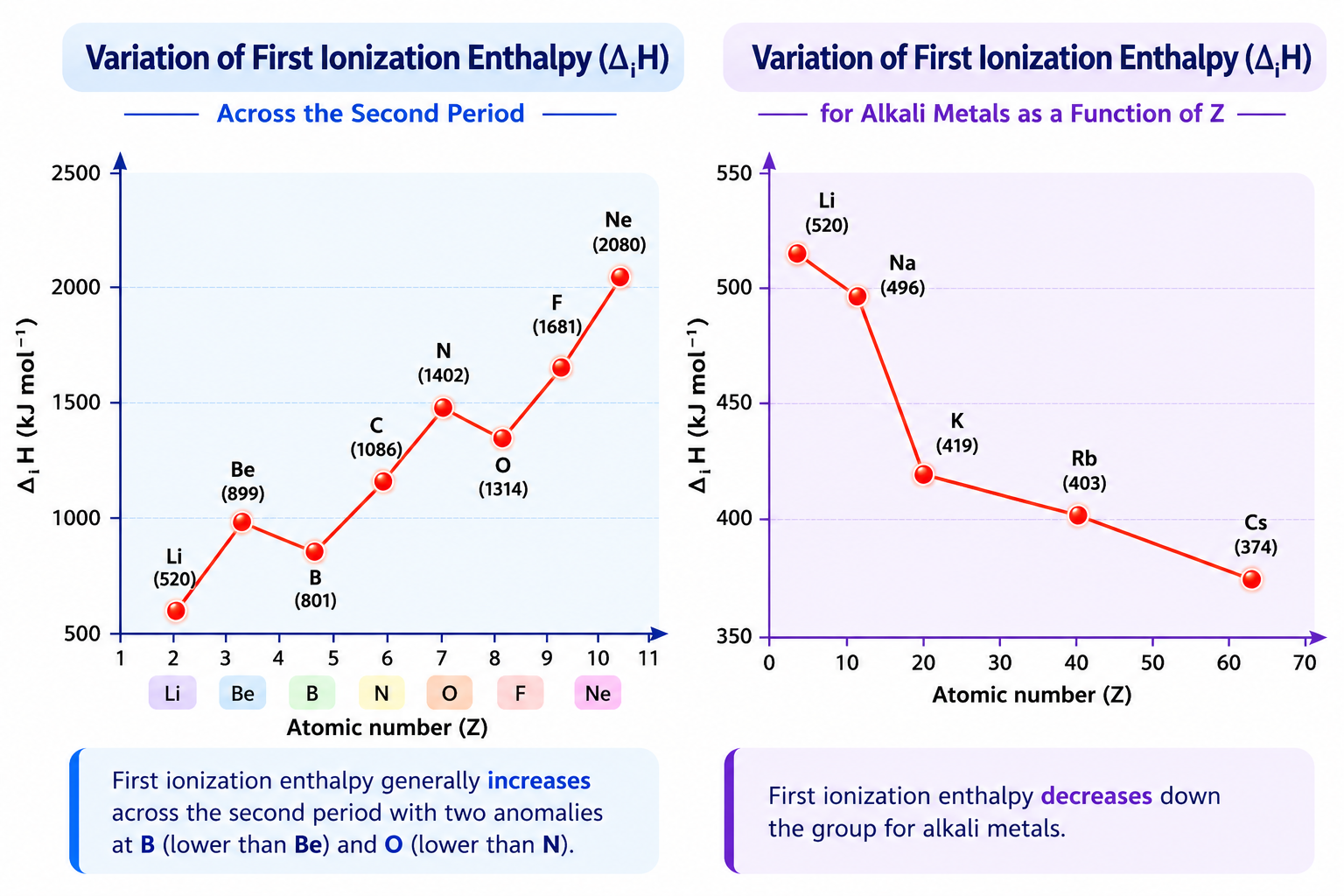
1. $\text{Be} > \text{B}$ ($\Delta_i H_1$ Anomaly): $\text{Be} (1s^2 2s^2, \Delta_i H_1
= 899\text{ kJ/mol})$ has higher first IE than $\text{B} (1s^2 2s^2 2p^1, \Delta_i H_1 = 801\text{
kJ/mol})$. Removing a penetrating $2s$ electron from stable filled subshell requires more energy than
removing $2p^1$. (Same anomaly: $\mathbf{\text{Mg} > \text{Al}}$).
2. $\text{N} > \text{O}$ ($\Delta_i H_1$ Anomaly): $\text{N} (1s^2 2s^2 2p^3, \Delta_i
H_1 = 1402\text{ kJ/mol})$ has higher first IE than $\text{O} (1s^2 2s^2 2p^4, \Delta_i H_1 = 1314\text{
kJ/mol})$. Nitrogen possesses extra stable half-filled $2p^3$ configuration (Hund's rule). In oxygen,
paired $2p^4$ electron suffers inter-electronic repulsion.
3. Complete Period 2 IE Trend Order (High-Yield):
$$\text{Li} < \text{B} < \text{Be} < \text{C} < \text{O} < \text{N} < \text{F} < \text{Ne}$$ 4.
Complete Period 3 IE Trend Order:
$$\text{Na} < \text{Al} < \text{Mg} < \text{Si} < \text{S} < \text{P} < \text{Cl} < \text{Ar}$$ 5.
Group 13 IE Irregularity (JEE Main/Advanced):
$$\text{B} (801) > \text{Tl} (589) > \text{Ga} (579) > \text{Al} (577) > \text{In} (558\text{
kJ/mol})$$
(Caused by transition contraction in $\text{Ga}$ due to $3d^{10}$ and lanthanoid contraction in
$\text{Tl}$ due to $4f^{14}$).
6. Deductive Group Identification from IE Jumps: A sudden massive jump between
$IE_n$ and $IE_{n+1}$ indicates that removing the $(n+1)^{\text{th}}$ electron breaks a noble
gas core $\Rightarrow$ element has $n$ valence electrons.
5.5 Electron Gain Enthalpy ($\Delta_{eg} H$)
Electron Gain Enthalpy ($\Delta_{eg} H$): The enthalpy change when an electron is added
to a neutral isolated gaseous atom to convert it into a negative ion:
$$X_{(g)} + e^- \longrightarrow X^-_{(g)} \quad (\Delta_{eg} H)$$
- If energy is released: $\Delta_{eg} H$ is negative (exothermic). Halogens have
maximum negative values.
- If energy is absorbed: $\Delta_{eg} H$ is positive (endothermic). Noble gases have
large positive values because the electron must enter the higher principal shell.
Table 4.1: NCERT Table 3.7 — Electron Gain Enthalpies ($\text{kJ
mol}^{-1}$)
| Group 1 |
$\Delta_{eg} H$ |
Group 16 |
$\Delta_{eg} H$ |
Group 17 |
$\Delta_{eg} H$ |
Group 18 |
$\Delta_{eg} H$ |
| H |
$-73$ |
O |
$-141$ |
F |
$-328$ |
He |
$+48$ |
| Li |
$-60$ |
S |
$-200$ |
Cl |
$-349$ |
Ne |
$+116$ |
| Na |
$-53$ |
Se |
$-195$ |
Br |
$-325$ |
Ar |
$+96$ |
| K |
$-48$ |
Te |
$-190$ |
I |
$-295$ |
Kr |
$+96$ |
| Rb |
$-47$ |
Po |
$-174$ |
At |
$-270$ |
Xe |
$+77$ |
TOP EXAM EXCEPTIONS — Electron Gain Enthalpy Anomalies
1. Halogen Anomaly ($\mathbf{\text{Cl} > \text{F}}$): Chlorine has the most
negative electron gain enthalpy in the entire periodic table ($-349\text{ kJ/mol}$)!
$$\text{Cl } (-349) > \text{F } (-328) > \text{Br } (-325) > \text{I } (-295\text{ kJ/mol})$$
Reason: Fluorine atom is extremely small; adding an electron into the compact $2p$ subshell
causes strong electron-electron repulsions. In Chlorine, the incoming electron enters the larger $3p$
subshell with less repulsion.
2. Group 16 Anomaly ($\mathbf{\text{S} > \text{O}}$): Sulfur ($-200\text{ kJ/mol}$) has
a more negative $\Delta_{eg} H$ than Oxygen ($-141\text{ kJ/mol}$). Oxygen has the least negative
electron gain enthalpy in Group 16 due to compact $2p$ repulsion!
$$\text{S } (-200) > \text{Se } (-195) > \text{Te } (-190) > \text{Po } (-174) > \text{O } (-141\text{
kJ/mol})$$
3. Second Electron Gain Enthalpy ($\Delta_{eg} H_2$) is ALWAYS Positive:
$$\text{O}_{(g)} + e^- \longrightarrow \text{O}^-_{(g)} \quad \Delta_{eg} H_1 = -141\text{ kJ/mol} \quad
(\text{Exothermic})$$
$$\text{O}^-_{(g)} + e^- \longrightarrow \text{O}^{2-}_{(g)} \quad \Delta_{eg} H_2 = \mathbf{+780\text{
kJ/mol}} \quad (\mathbf{\text{Endothermic}})$$
Reason: Adding a negative electron to an already negatively charged anion ($\text{O}^-$)
encounters strong electrostatic repulsion!
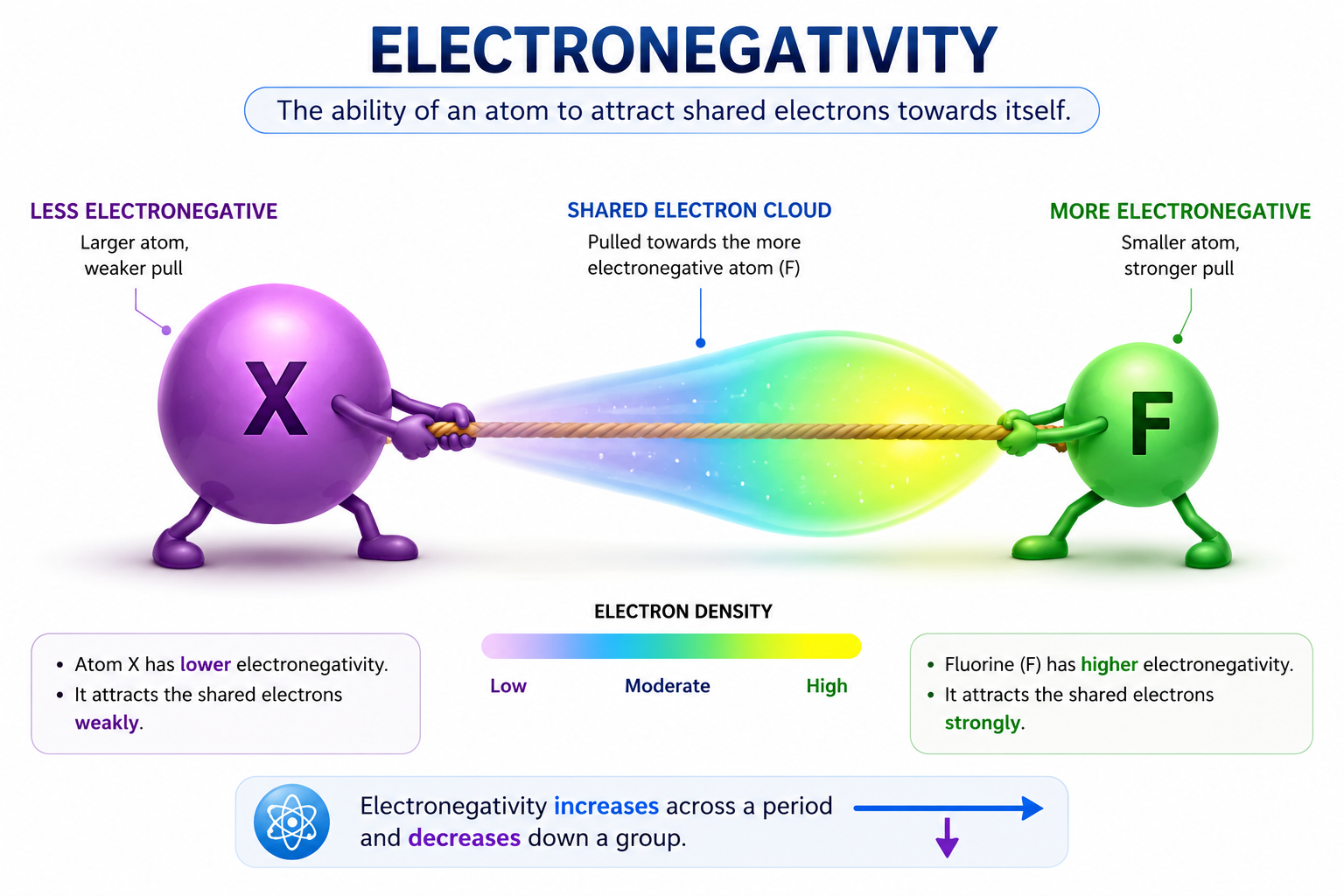
5.6 Electronegativity (EN)
Electronegativity: A qualitative measure of the ability of an atom in a chemical
compound to attract shared pairs of electrons toward itself.
Unlike ionization enthalpy or electron gain enthalpy, electronegativity is not a directly measurable
physical quantity. Various empirical scales exist:
Scales of Electronegativity:
- Pauling Scale (Most Widely Used): Linus Pauling assigned Fluorine max value
$\mathbf{4.0}$.
Key Pauling Values:
$$\text{F}(4.0) > \text{O}(3.5) > \text{N}(3.0) \approx \text{Cl}(3.0) > \text{Br}(2.8) >$$
$$\text{I}(2.5) \approx \text{S}(2.5) \approx \text{C}(2.5) > \text{H}(2.1) > \text{Na}(0.9) >
\text{Cs}(0.7)$$
- Mulliken Scale: $\text{EN}$ is arithmetic mean of Ionization Energy
($\text{IE}$) and Electron Affinity ($\text{EA}$):
$$\text{EN}_{\text{Mulliken}} = \frac{\text{IE} + \text{EA}}{2} \quad (\text{in eV})$$
$$\text{Relation to Pauling Scale:} \quad \mathbf{\text{EN}_{\text{Pauling}} \approx
\frac{\text{EN}_{\text{Mulliken}}}{2.8}}$$
- Allred-Rochow Scale: Based on electrostatic force on valence electron:
$$\text{EN} = 0.359 \frac{Z_{eff}}{r^2} + 0.744 \quad (r \text{ in \AA})$$
- Hybridization Effect: Electronegativity increases with increasing $\%
s$-character of orbitals:
$$\mathbf{sp (50\% s) > sp^2 (33.3\% s) > sp^3 (25\% s)}$$
Practice Set 4 — Trends & Exceptions (JEE / NEET PYQs)
Q1 (JEE Main / NEET): Arrange the following in decreasing order of ionic radius:
$\text{N}^{3-}, \text{O}^{2-}, \text{F}^-, \text{Na}^+, \text{Mg}^{2+}, \text{Al}^{3+}$.
Solution: Isoelectronic 10e series. Higher positive charge = smaller radius.
Order: $\text{N}^{3-} > \text{O}^{2-} > \text{F}^- > \text{Na}^+ > \text{Mg}^{2+} >
\text{Al}^{3+}$.
Q2 (NEET): Which element has the highest first ionization enthalpy among $\text{Li, Be,
B, C, N, O, F, Ne}$?
Solution: Neon ($\text{Ne}$) has highest due to stable noble gas
octet ($2s^2 2p^6$). Among reactive non-metals, Nitrogen ($\text{N}$) ($1402\text{
kJ/mol}$) is higher than Oxygen ($1314\text{ kJ/mol}$) due to half-filled $2p^3$.
Q3 (COMEDK / VITEEE): Which element has the most negative electron gain enthalpy?
Solution: Chlorine ($\text{Cl}$) ($-349\text{ kJ/mol}$).
6. Periodic Trends in Chemical Properties
6.1 Valence & Oxidation States
Valence: Number of outer valence electrons (Group 1, 2, 13, 14) or $(8 - \text{valence
electrons})$ (Group 15 to 18).
Oxidation State: Charge acquired by an atom in a molecule based on relative
electronegativity considerations.
Example ($\text{OF}_2$ vs $\text{Na}_2\text{O}$): Electronegativity order: $\text{F} (4.0) >
\text{O} (3.5) > \text{Na} (0.9)$.
• In $\text{OF}_2$: Fluorine is $-1 \Rightarrow$ Oxygen exhibits $+2$ oxidation
state.
• In $\text{Na}_2\text{O}$: Oxygen is more electronegative $\Rightarrow$ Oxygen exhibits
$-2$ oxidation state and Sodium $+1$.
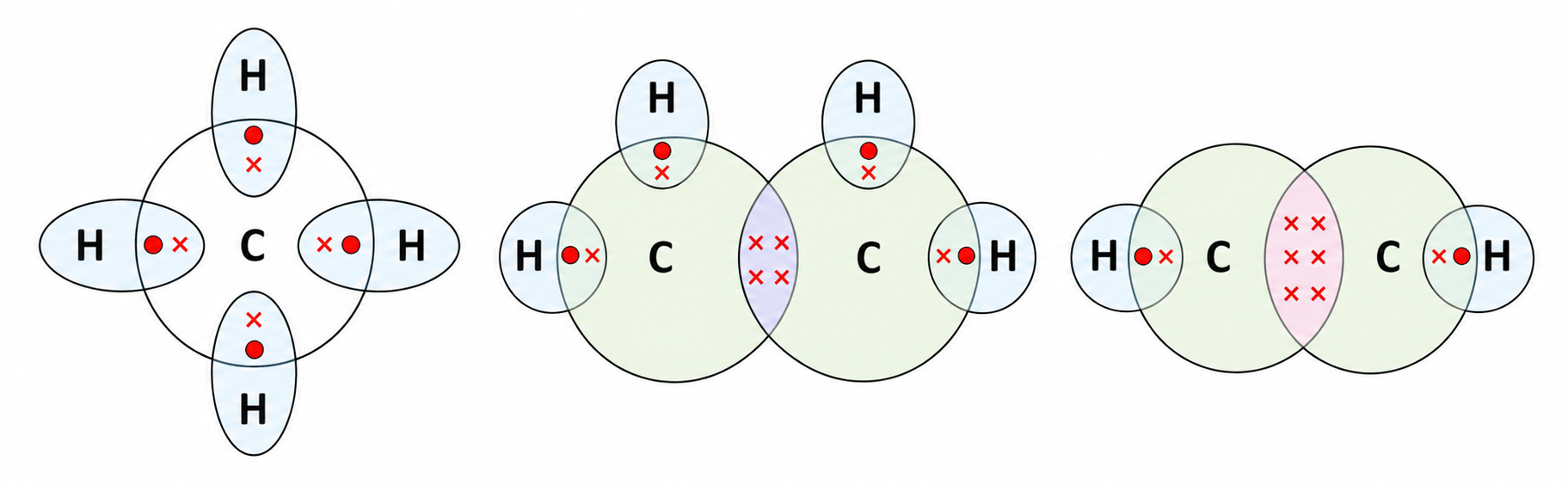
Table 5.1: NCERT Table 3.9 — Periodic Trends in Formulas of Hydrides & Oxides
| Group |
Valence Electrons / Valence |
Formula of Hydride |
Formula of Oxide |
| Group 1 |
1 |
$\text{LiH}, \text{NaH}, \text{KH}$ |
$\text{Li}_2\text{O}, \text{Na}_2\text{O}, \text{K}_2\text{O}$ |
| Group 2 |
2 |
$\text{CaH}_2$ |
$\text{MgO}, \text{CaO}, \text{BaO}$ |
| Group 13 |
3 |
$\text{B}_2\text{H}_6, \text{AlH}_3$ |
$\text{B}_2\text{O}_3, \text{Al}_2\text{O}_3, \text{Ga}_2\text{O}_3$ |
| Group 14 |
4 |
$\text{CH}_4, \text{SiH}_4, \text{GeH}_4, \text{SnH}_4$ |
$\text{CO}_2, \text{SiO}_2, \text{GeO}_2, \text{SnO}_2$ |
| Group 15 |
3, 5 |
$\text{NH}_3, \text{PH}_3, \text{AsH}_3$ |
$\text{N}_2\text{O}_3, \text{N}_2\text{O}_5, \text{P}_4\text{O}_{10}$ |
| Group 16 |
2, 6 |
$\text{H}_2\text{O}, \text{H}_2\text{S}, \text{H}_2\text{Se}$ |
$\text{SO}_3, \text{SeO}_3, \text{TeO}_3$ |
| Group 17 |
1, 7 |
$\text{HF}, \text{HCl}, \text{HBr}, \text{HI}$ |
$\text{Cl}_2\text{O}_7$ |
6.2 Anomalous Behavior of Second Period Elements ($\text{Li, Be, B, C, N, O, F}$)
The first element of each $s$- and $p$-block group differs significantly from subsequent group members
due to:
- Extremely small atomic and ionic size.
- High charge/radius ratio ($\text{polarizing power}$).
- High electronegativity and high ionization enthalpy.
- Absence of vacant $d$-orbitals: Max covalency is strictly limited to
4 ($2s, 2p$). E.g., Boron forms $[\text{BF}_4]^-$, but Aluminium forms
$[\text{AlF}_6]^{3-}$.
- Ability to form $p\pi-p\pi$ multiple bonds: Form multiple bonds with self and other
2nd period elements ($\text{C=C, C}\equiv\text{C, N}\equiv\text{N, C=O, C}\equiv\text{N}$).
6.3 Diagonal Relationship
Elements of 2nd period show close resemblance in chemical properties with diagonally opposite elements of
3rd period ($\text{Li}-\text{Mg}, \text{Be}-\text{Al}, \text{B}-\text{Si}$) due to nearly
identical ionic radii and charge/radius ratios.
Table 5.2: Diagonal Ionic Radii & Polarizing Power Match
| Element Pair |
Ionic Radius $\text{M}^+$ / $\text{M}^{2+}$ |
Diagonal Match |
| $\text{Li}^+$ vs $\text{Mg}^{2+}$ |
$\text{Li}^+ (76\text{ pm})$ vs $\text{Mg}^{2+} (72\text{ pm})$ |
Both form covalent nitrides ($\text{Li}_3\text{N}, \text{Mg}_3\text{N}_2$) and decomposing
carbonates ($\text{Li}_2\text{CO}_3, \text{MgCO}_3$). |
| $\text{Be}^{2+}$ vs $\text{Al}^{3+}$ |
$\text{Be}^{2+} (31\text{ pm})$ vs $\text{Al}^{3+} (53\text{ pm})$ |
Both form amphoteric oxides ($\text{BeO}, \text{Al}_2\text{O}_3$) and passivate in conc.
$\text{HNO}_3$. |
6.4 Oxides Nature Classification (Direct High-Yield MCQs)
- Basic Oxides: Formed by extreme left electropositive metals. React with water to
give bases ($\text{Na}_2\text{O} + \text{H}_2\text{O} \rightarrow 2\text{NaOH}$). E.g.,
$\text{Na}_2\text{O}, \text{K}_2\text{O}, \text{CaO}, \text{BaO}$.
- Acidic Oxides: Formed by right non-metals. React with water to give acids
($\text{Cl}_2\text{O}_7 + \text{H}_2\text{O} \rightarrow 2\text{HClO}_4$). E.g.,
$\text{Cl}_2\text{O}_7, \text{SO}_3, \text{N}_2\text{O}_5, \text{CO}_2, \text{P}_4\text{O}_{10}$.
- Amphoteric Oxides (High-Yield): React with both acids and bases.
Examples: $\mathbf{\text{Al}_2\text{O}_3, \text{Ga}_2\text{O}_3, \text{ZnO}, \text{BeO},
\text{PbO}, \text{SnO}, \text{As}_2\text{O}_3, \text{V}_2\text{O}_5, \text{Cr}_2\text{O}_3}$.
Reactions of $\text{Al}_2\text{O}_3$:
• With acid: $\text{Al}_2\text{O}_3 + 6\text{HCl} \rightarrow 2\text{AlCl}_3 +
3\text{H}_2\text{O}$
• With base: $\text{Al}_2\text{O}_3 + 2\text{NaOH} + 3\text{H}_2\text{O} \rightarrow
2\text{Na}[\text{Al(OH)}_4] \quad (\text{Sodium aluminate})$
- Neutral Oxides (High-Yield): Exhibit neither acidic nor basic properties.
Examples: $\mathbf{\text{CO}, \text{NO}, \text{N}_2\text{O}, \text{H}_2\text{O}}$.
6.5 Chemical Reactivity Trends
- Group 1 Reactivity: Increases down the group ($\text{Li} < \text{Na} < \text{K} <
\text{Rb} < \text{Cs}$) due to decreasing ionization enthalpy and ease of electron loss.
- Group 17 Reactivity: Decreases down the group ($\text{F}_2 > \text{Cl}_2 >
\text{Br}_2 > \text{I}_2$) due to decreasing electron gain enthalpy / electronegativity.
- Oxidizing Power Order (NCERT Exercise 3.40): $\mathbf{\text{F} > \text{O} >
\text{Cl} > \text{N}}$.
7. Complete NCERT Textbook Exercises Solutions (3.1 to 3.40)
NCERT Exercises — Comprehensive Solutions
3.1 What is the basic theme of organisation in the periodic table?
Ans: To classify elements into groups and periods based on similarities in physical
and chemical properties resulting from underlying valence shell electronic configurations.
3.2 Which important property did Mendeleev use to classify the elements in his periodic table
and did he stick to that?
Ans: Atomic weight. He did not stick strictly to it, placing Iodine ($126.9$) after
Tellurium ($127.6$) and Cobalt ($58.9$) before Nickel ($58.7$) to group elements by chemical
similarity.
3.3 What is the basic difference in approach between Mendeleev's Periodic Law and Modern
Periodic Law?
Ans: Mendeleev's Law bases periodicity on Atomic Mass, whereas
Modern Law bases periodicity on Atomic Number ($Z$).
3.5 In terms of period and group where would you locate the element with Z=114?
Ans: Configuration $[\text{Rn}] 5f^{14} 6d^{10} 7s^2 7p^2 \Rightarrow$ 7th
Period, Group 14 (Flerovium, Fl).
3.6 Write the atomic number of the element present in the third period and seventeenth
group.
Ans: $1s^2 2s^2 2p^6 3s^2 3p^5 \Rightarrow \mathbf{Z = 17}$ (Chlorine,
$\text{Cl}$).
3.7 Which element do you think would have been named by (i) Lawrence Berkeley Laboratory (ii)
Seaborg's group?
Ans: (i) Lawrencium ($\text{Lr}, Z=103$) and Berkelium ($\text{Bk}, Z=97$). (ii)
Seaborgium ($\text{Sg}, Z=106$).
3.11 Name a species that will be isoelectronic with: (i) $\text{F}^-$ (ii) $\text{Ar}$ (iii)
$\text{Mg}^{2+}$ (iv) $\text{Rb}^+$
Ans: (i) $\text{Na}^+, \text{Ne}, \text{O}^{2-}$ (ii) $\text{Cl}^-,
\text{K}^+, \text{Ca}^{2+}$ (iii) $\text{Na}^+, \text{Ne}, \text{Al}^{3+}$
(iv) $\text{Kr}, \text{Sr}^{2+}, \text{Br}^-$.
3.15 Energy of an electron in ground state of hydrogen atom is $-2.18 \times 10^{-18}\text{ J}$.
Calculate ionization enthalpy of atomic hydrogen in $\text{J mol}^{-1}$.
Ans: $\Delta_i H = E_{\infty} - E_1 = 0 - (-2.18 \times 10^{-18}\text{ J}) = 2.18
\times 10^{-18}\text{ J/atom}$.
Per mole $= 2.18 \times 10^{-18} \times 6.022 \times 10^{23} = \mathbf{1.31 \times 10^6\text{ J
mol}^{-1}} = \mathbf{1312\text{ kJ mol}^{-1}}$.
3.20 Which of the following pairs of elements would have a more negative electron gain enthalpy?
(i) O or F (ii) F or Cl
Ans: (i) Fluorine ($\text{F}$) ($-328\text{ kJ/mol}$ vs $\text{O }
-141$). (ii) Chlorine ($\text{Cl}$) ($-349\text{ kJ/mol}$ vs $\text{F } -328$).
3.21 Would you expect the second electron gain enthalpy of O as positive, more negative or less
negative than the first? Justify.
Ans: Positive (Endothermic, $+780\text{ kJ/mol}$) because adding
an electron to a negative ion $\text{O}^-$ experiences strong electrostatic repulsion.
3.31 Ionization enthalpies and $\Delta_{eg}H$ data analysis (NCERT Exercise 3.31):
Given: I ($520, 7300, -60$), II ($419, 3051, -48$), III ($1681, 3374, -328$), IV ($1008, 1846,
-295$), V ($2372, 5251, +48$), VI ($738, 1451, -40$).
Ans:
(a) Least reactive element: V (Noble gas, high IE & positive
$\Delta_{eg}H$).
(b) Most reactive metal: II (Lowest 1st IE $= 419$, Alkali metal).
(c) Most reactive non-metal: III (High IE & most negative $\Delta_{eg}H =
-328$, Halogen).
(d) Least reactive non-metal: IV.
(e) Metal forming stable binary halide $\text{MX}_2$: VI (Group 2, moderate 1st
& 2nd IE).
(f) Metal forming covalent halide $\text{MX}$: I (Lithium, high 1st IE jump at
2nd).
8. Master Exam Target Practice Set (Board, JEE, NEET, WBJEE, COMEDK)
Section A: Multiple Choice Questions (PYQs)
Q1 (JEE Advanced): The first ionization enthalpies of $\text{Na, Mg, Al,}$ and
$\text{Si}$ are in the order:
(A) $\text{Na} < \text{Mg} < \text{Al} < \text{Si}$ (B) $\text{Na} < \text{Al} <
\text{Mg} < \text{Si}$
(C) $\text{Al} < \text{Na} < \text{Mg} < \text{Si}$ (D)
$\text{Na} < \text{Al} < \text{Si} < \text{Mg}$
Solution: (B) $\text{Mg} (3s^2)$ has a fully filled stable subshell, so its 1st
IE is greater than $\text{Al} (3s^2 3p^1)$.
Q2 (NEET PYQ): The correct order of atomic radii in group 13 elements is:
(A) $\text{B} < \text{Al} < \text{Ga} < \text{In} < \text{Tl}$ (B) $\text{B} < \text{Ga} <
\text{Al} < \text{In} < \text{Tl}$
Solution: (B) Due to poor screening by $10$ $3d$-electrons in $\text{Ga}$, $Z_{eff}$
increases, making $\text{Ga}$ ($135\text{ pm}$) smaller than $\text{Al}$ ($143\text{ pm}$).
Q3 (WBJEE / COMEDK): Which of the following is an amphoteric oxide?
(A) $\text{V}_2\text{O}_5$ (B) $\text{Cr}_2\text{O}_3$ (C) $\text{BeO}$ (D)
All of the above
Solution: (D) $\text{BeO}, \text{Al}_2\text{O}_3, \text{ZnO}, \text{V}_2\text{O}_5,$ and
$\text{Cr}_2\text{O}_3$ all exhibit amphoteric behavior (reacting with both acids and bases).
Section B: Assertion & Reasoning (NEET / JEE Main Pattern)
Options for A/R questions:
(A) Both A and R are true, and R is correct explanation of A.
(B) Both A and R are true, but R is not the correct explanation of A.
(C) A is true, R is false.
(D) A is false, R is true.
Q4:
Assertion (A): Electron gain enthalpy of chlorine is more negative than that of fluorine.
Reason (R): Fluorine has a very small size and high inter-electronic repulsions in the $2p$
subshell.
Solution: (A) The statement is true and the reason correctly explains the halogen anomaly.
Q5:
Assertion (A): The first ionization enthalpy of Nitrogen is lower than Oxygen.
Reason (R): Across a period, effective nuclear charge increases.
Solution: (D) Assertion is FALSE. Nitrogen has a HIGHER first IE than Oxygen due to its
stable half-filled $2p^3$ configuration. Reason is true.
Section C: Integer / Calculation Type (JEE Main & Board HOTS)
Q6: An element has successive ionization enthalpies (in $\text{kJ/mol}$) of $IE_1=899,
IE_2=1757, IE_3=14850, IE_4=21005$. To which group of the periodic table does it belong?
Solution: Group 2. There is a massive jump between $IE_2$ and $IE_3$,
indicating the atom has 2 valence electrons and breaking into the core requires huge energy.
Q7: What is the atomic number of the element located in the 6th period and 4th group of the
periodic table?
Solution: The noble gas before 6th period is Xenon ($Z=54$).
6th period starts with 6s. $6s^2 \rightarrow 56$ (Ba).
Then 4f fills ($57-71$).
Then 5d series starts. Group 4 means $d^2$. So $54 (\text{Xe}) + 2 (6s) + 14 (4f) + 2 (5d) =
\mathbf{72}$ (Hafnium, Hf).