
Rutherford's Model
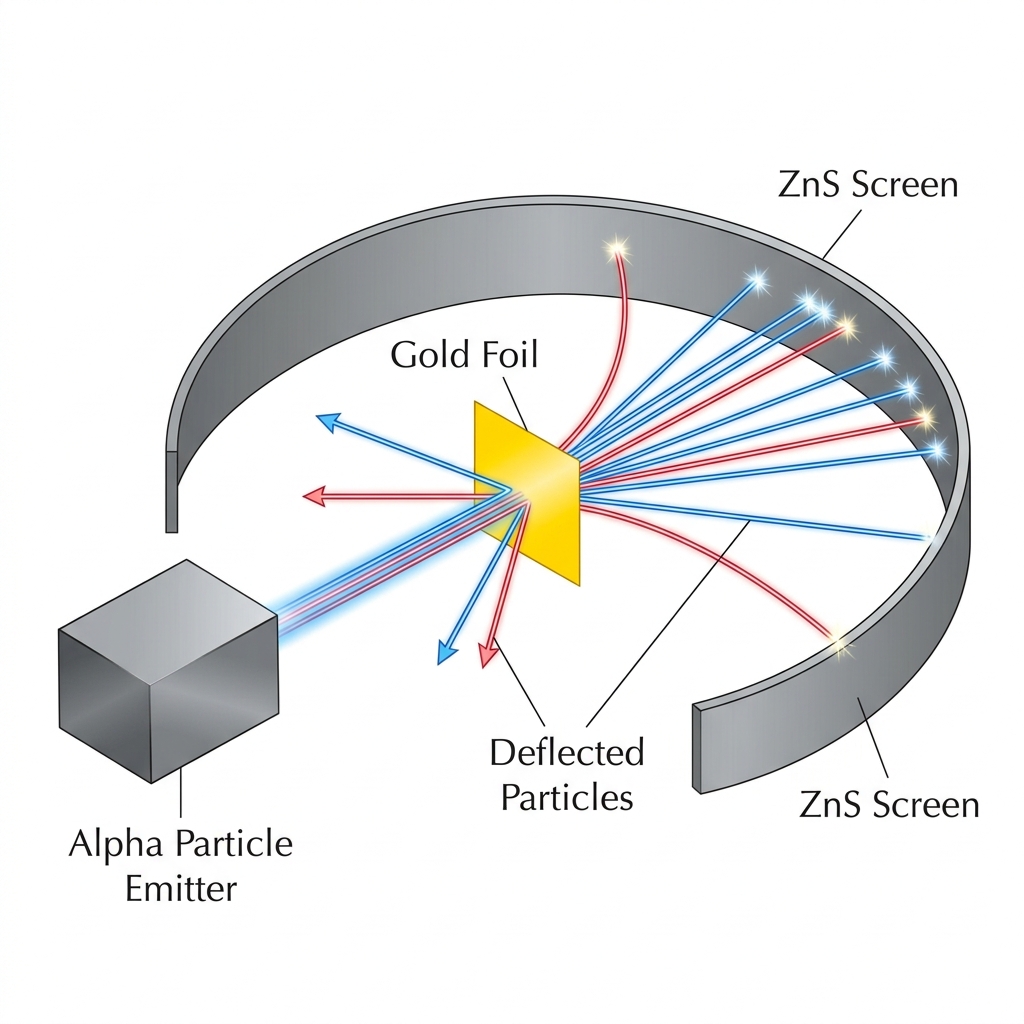
Based on $\alpha$-particle scattering on a gold foil.
Conclusions:
- Most space in an atom is empty.
- Positive charge is concentrated in a tiny volume.
- The nucleus is incredibly dense.
Photoelectric Effect
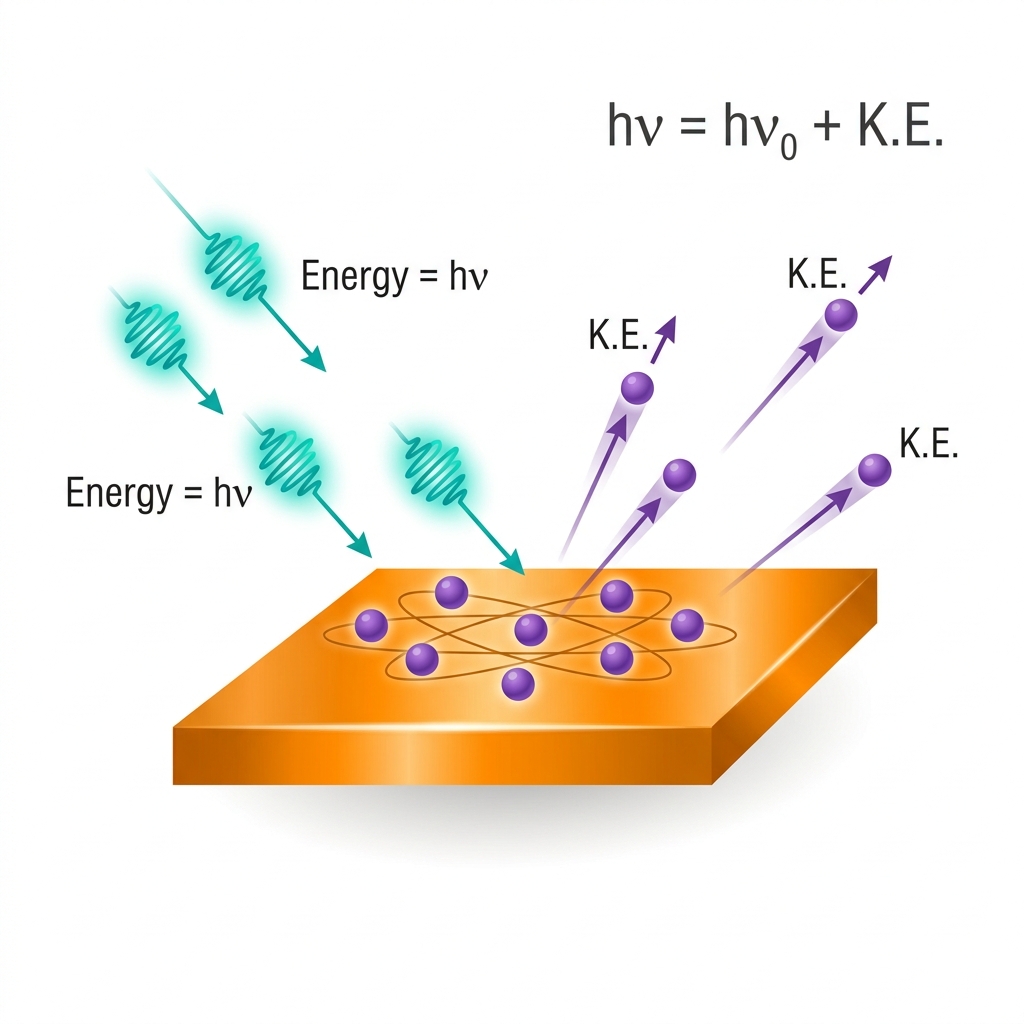
Ejection of $e^-$ when light of suitable frequency hits a metal surface.
Einstein's Equation:
$$ h\nu = h\nu_0 + \frac{1}{2} m_e v^2 $$- $\nu$ = Frequency of incident light
- $\nu_0$ = Threshold frequency
- $K.E.$ = $\frac{1}{2} m_e v^2$
Bohr's Model
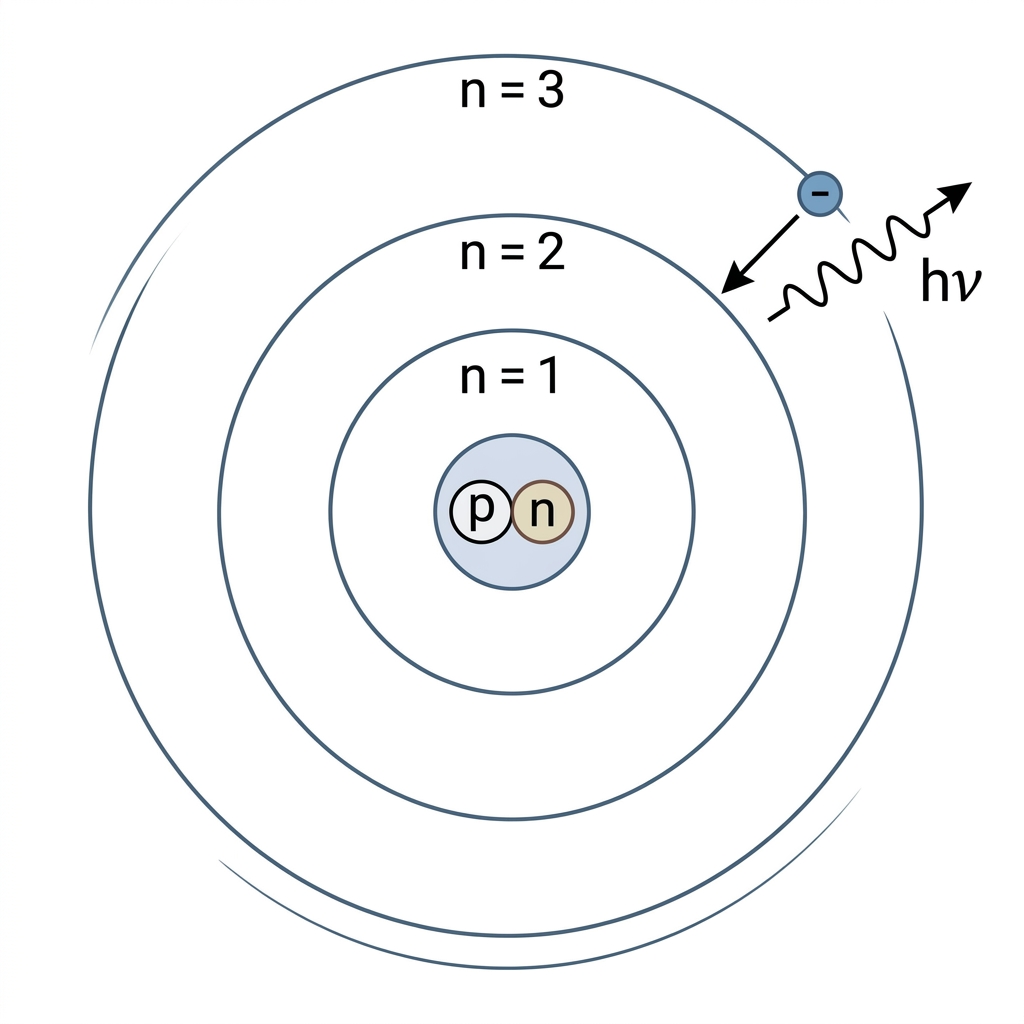
Electrons revolve in well-defined stationary orbits.
Angular Momentum: $$ mvr = \frac{nh}{2\pi} $$ Radius of $n^{\text{th}}$ orbit: $$ r_n = 0.529 \times \frac{n^2}{Z} \text{ \AA} $$ Energy of electron: $$ E_n = -13.6 \times \frac{Z^2}{n^2} \text{ eV} $$Atomic Orbitals
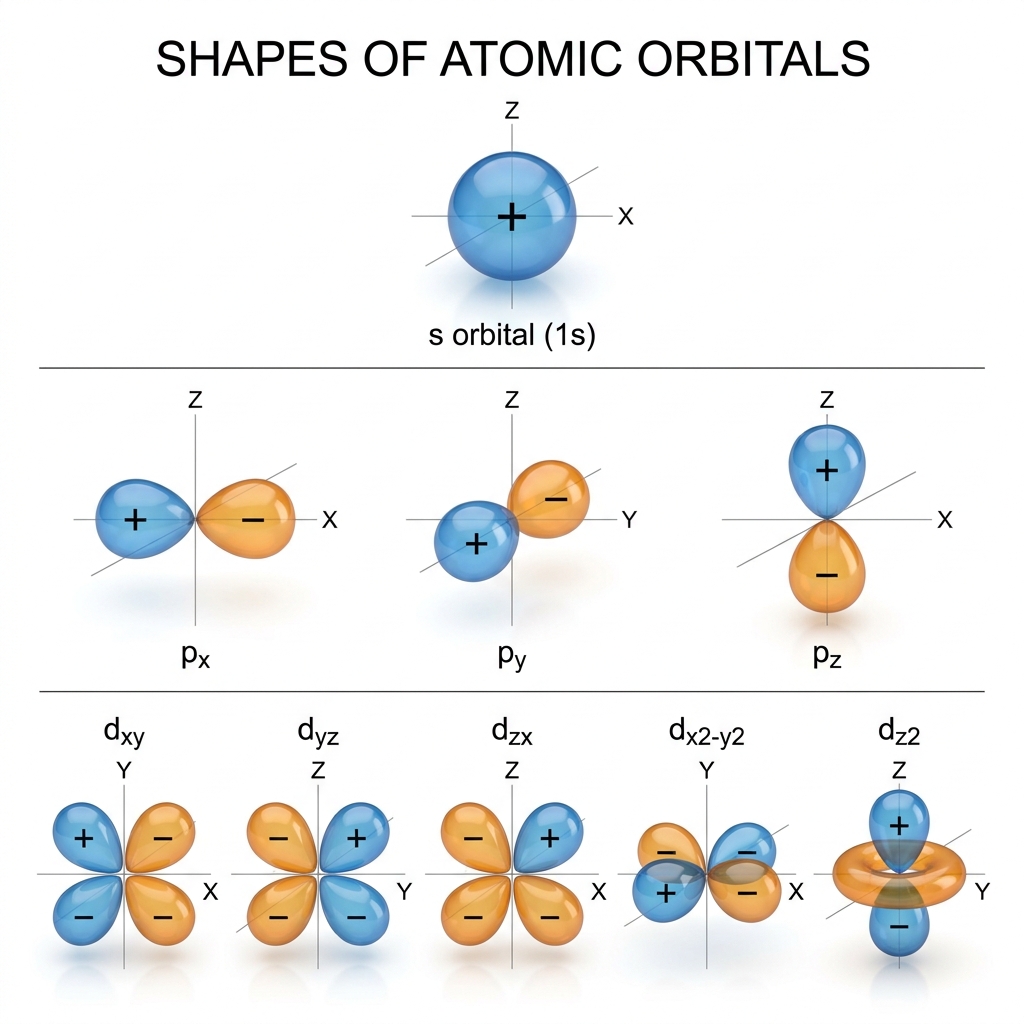
- $s$-orbital: Spherical
- $p$-orbital: Dumbbell
- $d$-orbital: Double dumbbell
Nodes Hack:
Angular nodes = $l$
Radial nodes = $n - l - 1$
Total nodes = $n - 1$
Filling Rules
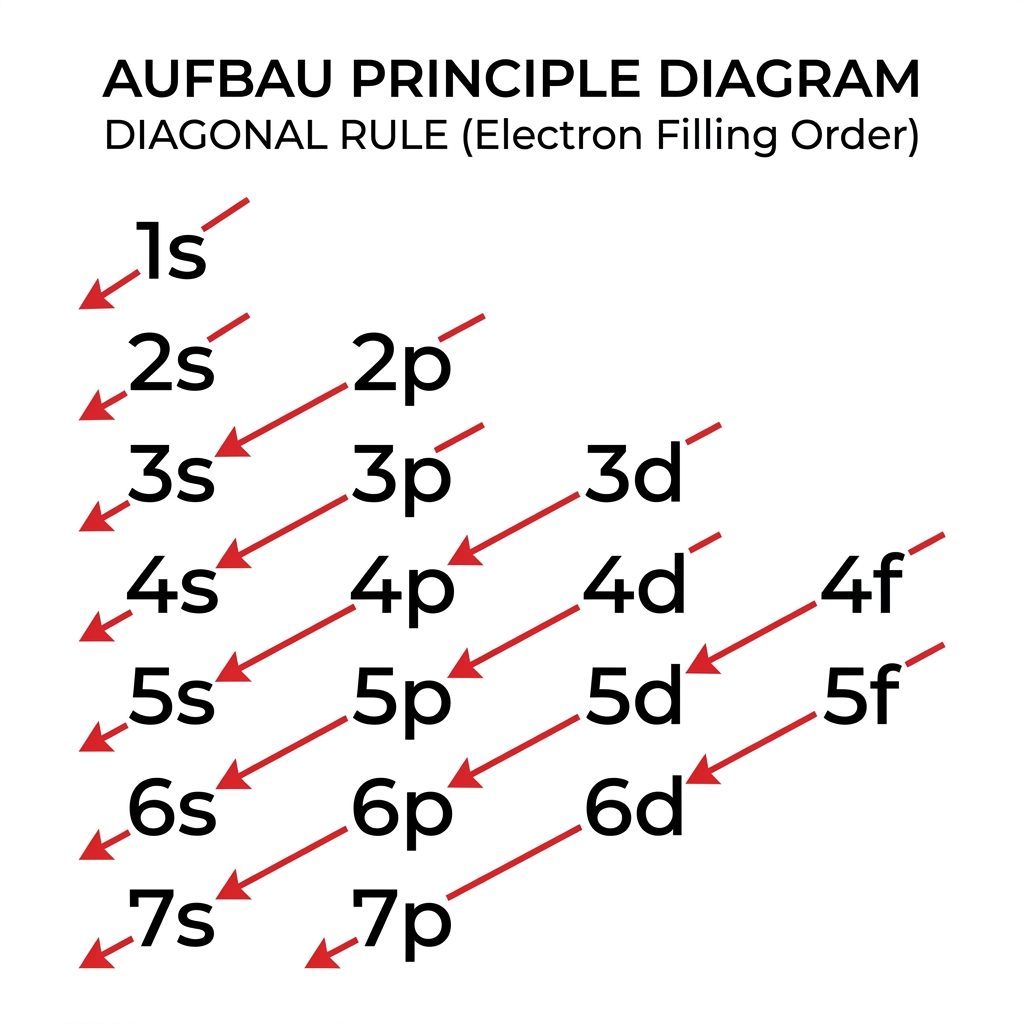
- Aufbau Principle: Fill lowest $(n+l)$ energy orbital first.
- Pauli Exclusion: Max 2 electrons per orbital, opposite spins.
- Hund's Rule: Singly occupy degenerate orbitals before pairing.
Exceptions (High Stability):
Cr (24): $[\text{Ar}] 4s^1 3d^5$ (Half-filled)
Cu (29): $[\text{Ar}] 4s^1 3d^{10}$ (Fully-filled)