Vardaan Learning Institute
Class 11 Chemistry • Chapter Notes
🌐 vardaanlearning.com
📞 9508841336
STRUCTURE OF ATOM
The existence of atoms has been proposed since the time of early Indian and Greek philosophers. However, the
true inner workings of the atom—subatomic particles and quantum mechanics—were unravelled during the 19th
and 20th centuries. This chapter is a cornerstone for both Board Exams and competitive
exams like NEET and JEE.
1. Discovery of Subatomic Particles
Dalton's atomic theory stated that atoms are indivisible. This theory failed when subatomic particles
(electrons, protons, and neutrons) were discovered.
Discovery of Electron
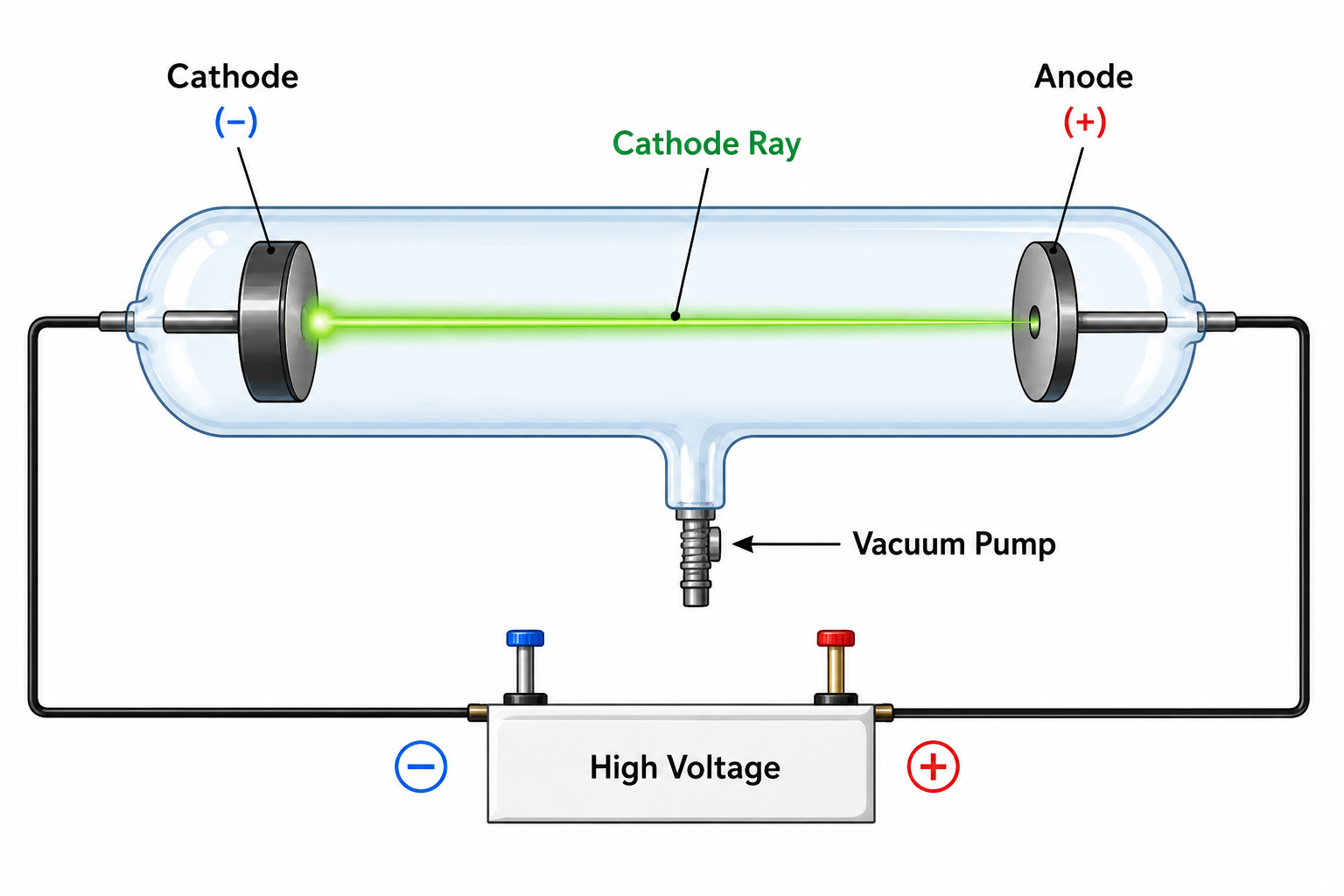
Cathode Rays: Discovered by J.J. Thomson via cathode ray tube experiments. When a high
voltage is applied across electrodes in a partially evacuated tube, rays emerge from the negative electrode
(cathode) and travel towards the positive electrode (anode).
- They travel in straight lines in the absence of electric and magnetic fields.
- They consist of negatively charged particles (electrons) and are deflected towards the positive plate in
an electric field.
- They produce heating effect and can cast shadows of solid objects placed in their path.
- Crucial Point for JEE: The characteristics of cathode rays (electrons) do
not depend on the nature of the electrodes or the gas present in the cathode ray tube.
$e/m$ ratio is constant.
Important Note
Millikan's Oil Drop Experiment: Used to determine the exact charge of an electron ($-1.602
\times 10^{-19}\text{ C}$). By combining this with Thomson's $e/m$ ratio, the mass of an electron was
calculated. Note: While mentioned in NCERT, complex numericals on Millikan's experiment are rarely asked
in JEE.
Discovery of Proton
Anode Rays (Canal Rays): Discovered by Eugen Goldstein. These are streams of positively
charged ions produced in a modified cathode ray tube with a perforated cathode.
- Unlike cathode rays, the positively charged particles depend on the nature of the gas
present in the cathode ray tube.
- Their charge-to-mass ($e/m$) ratio is not constant and varies with the gas used. The highest $e/m$ ratio
is observed for Hydrogen gas (which gives bare protons).
Discovery of Neutron
Discovered by James Chadwick in 1932. He found that electrically neutral particles having a mass slightly
greater than that of protons were emitted when a thin sheet of beryllium was bombarded with alpha ($\alpha$)
particles.
Reaction
$$ ^9_4\text{Be} + ^4_2\text{He} \rightarrow ^{12}_6\text{C} + ^1_0\text{n} $$
The neutron ($^1_0\text{n}$) is a fundamental particle with no charge and a mass of $1.675 \times
10^{-27}\text{ kg}$ ($1.00867\text{ u}$).
| Particle |
Symbol |
Absolute Charge (C) |
Relative Charge |
Mass (kg) |
Mass (u) |
| Electron |
$e$ |
$-1.602 \times 10^{-19}$ |
$-1$ |
$9.1 \times 10^{-31}$ |
$0.00054$ |
| Proton |
$p$ |
$+1.602 \times 10^{-19}$ |
$+1$ |
$1.672 \times 10^{-27}$ |
$1.00727$ |
| Neutron |
$n$ |
$0$ |
$0$ |
$1.675 \times 10^{-27}$ |
$1.00867$ |
Practice Problems 1 — Subatomic Particles
Q1 (School Focus): Calculate the number of protons, neutrons, and electrons in
$^{80}_{35}\text{Br}$.
Solution:
Atomic number ($Z$) = Number of protons = 35.
For a neutral atom, electrons = protons = 35.
Mass number ($A$) = Protons + Neutrons = 80.
Neutrons = $A - Z = 80 - 35 = 45$.
Q2 (NCERT Focus): The number of electrons, protons, and neutrons in a species are equal to
18, 16, and 16 respectively. Assign the proper symbol to the species.
Solution:
Atomic number ($Z$) = protons = 16. The element is Sulphur (S).
Mass number ($A$) = protons + neutrons = $16 + 16 = 32$.
Since electrons (18) > protons (16), the charge is $-2$.
Symbol: $^{32}_{16}\text{S}^{2-}$.
2. Early Atomic Models
Thomson's Model (Plum Pudding Model)
Atom is a positively charged sphere in which electrons are embedded like plums in a pudding or seeds in a
watermelon. Limitation: Although it could explain the overall neutrality of the atom, it
could not explain the results of later experiments like Rutherford's alpha-particle scattering experiment.
Rutherford's Nuclear Model
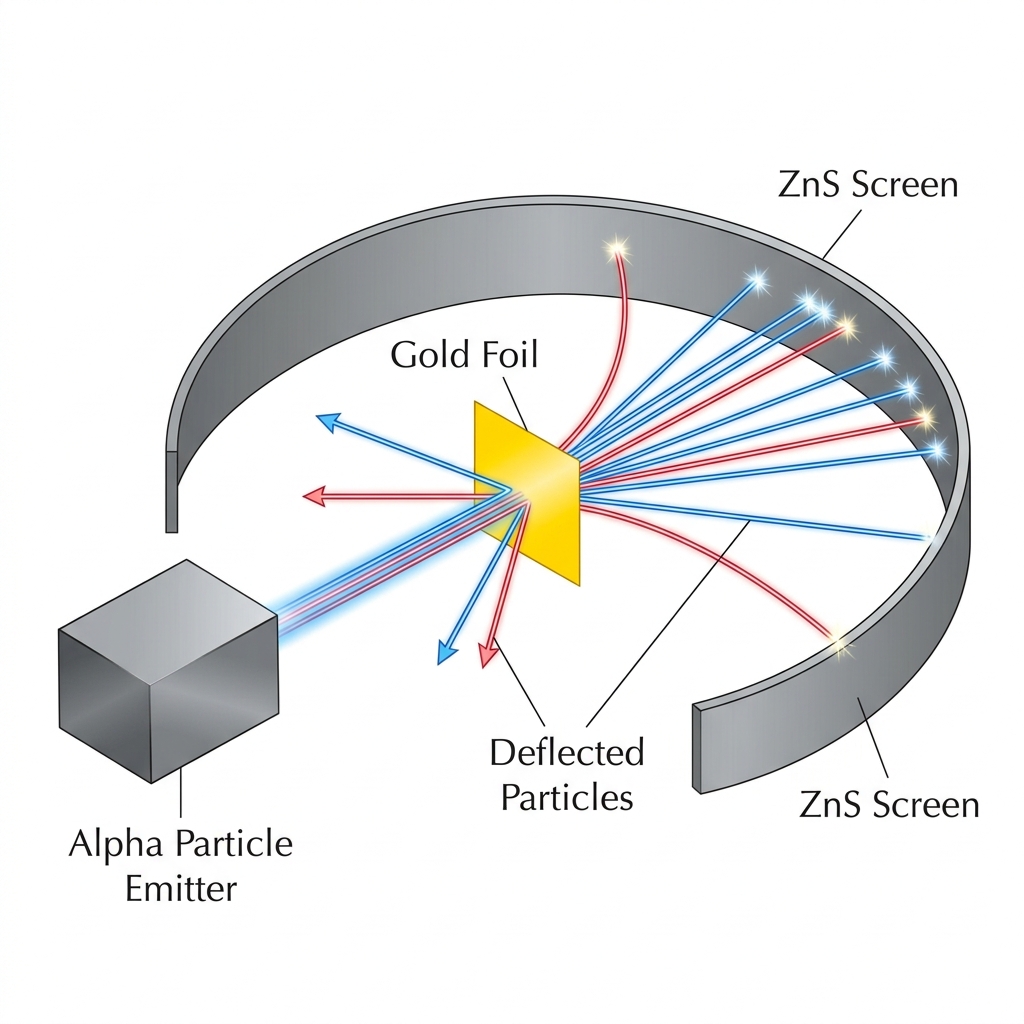
Based on the famous $\alpha$-particle scattering experiment on a thin gold foil.
- Observation 1: Most $\alpha$-particles passed straight through. (Conclusion: Most space
is empty).
- Observation 2: A few were deflected by small angles. (Conclusion: Positive charge is
concentrated in a small volume).
- Observation 3: Very few ($1$ in $20,000$) bounced back $180^\circ$. (Conclusion: The
nucleus is incredibly dense and positively charged).
Drawback
Failure of Rutherford's Model: According to Maxwell's electromagnetic theory, any charged
particle in circular motion (acceleration) must radiate energy. An electron revolving around the nucleus
should continuously lose energy, spiral inwards, and collapse into the nucleus. This model could not explain
the stability of the atom or the line spectrum of hydrogen.
Practice Problems 2 — Early Atomic Models
Q1 (NCERT Focus): Rutherford's alpha particle scattering experiment showed that: (i)
Electrons have negative charge (ii) The mass and positive charge of the atom is concentrated in the nucleus
(iii) Neutron exists in the nucleus (iv) Most of the space in atom is empty. Which of the above statements
are correct?
Solution:
Statements (ii) and (iv) are correct. Rutherford discovered the nucleus and the empty space within the
atom. (Neutrons were discovered later by Chadwick, and electrons by Thomson).
Atomic Number, Mass Number, Isobars and Isotopes
- Atomic Number ($Z$): Number of protons in the nucleus of an atom. In a neutral atom, it
is also equal to the number of electrons.
- Mass Number ($A$): Total number of nucleons (protons + neutrons) in the nucleus. Number
of neutrons ($n$) = $A - Z$.
- Isobars: Atoms of different elements with the same mass number but different atomic
numbers (e.g., $^{14}_6\text{C}$ and $^{14}_7\text{N}$).
- Isotopes: Atoms of the same element with identical atomic numbers but different mass
numbers due to a different number of neutrons (e.g., Protium $^1_1\text{H}$, Deuterium $^2_1\text{H}$,
and Tritium $^3_1\text{H}$). Chemical properties of isotopes are similar because they have the same
number of electrons.
3. Developments Leading to Bohr's Model
Two major developments played a vital role: the dual nature of electromagnetic radiation and the experimental
results regarding atomic spectra.
Wave Nature of Electromagnetic Radiation
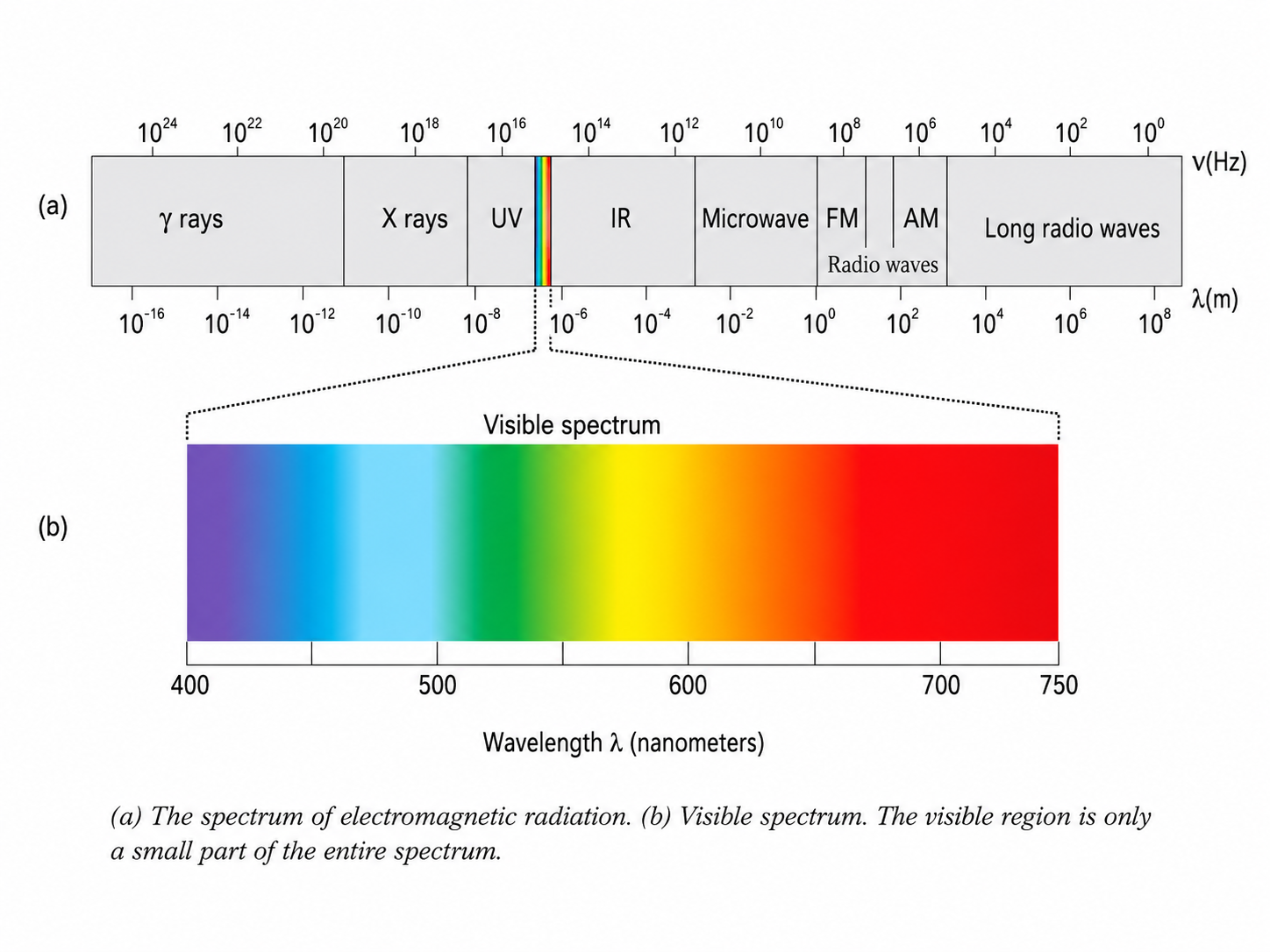
Light behaves as a wave. Key characteristics:
- Wavelength ($\lambda$): Distance between two consecutive crests or troughs. (Units:
$\text{m, \AA, nm}$).
- Frequency ($\nu$): Number of waves passing through a point in one second. (Units:
$\text{Hz}$ or $\text{s}^{-1}$).
- Wave Number ($\bar{\nu}$): Number of wavelengths per unit length. $\bar{\nu} =
\frac{1}{\lambda}$
$$ c = \nu \lambda \quad \text{(where } c = 3 \times 10^8 \text{ m/s)} $$
Particle Nature: Black Body Radiation
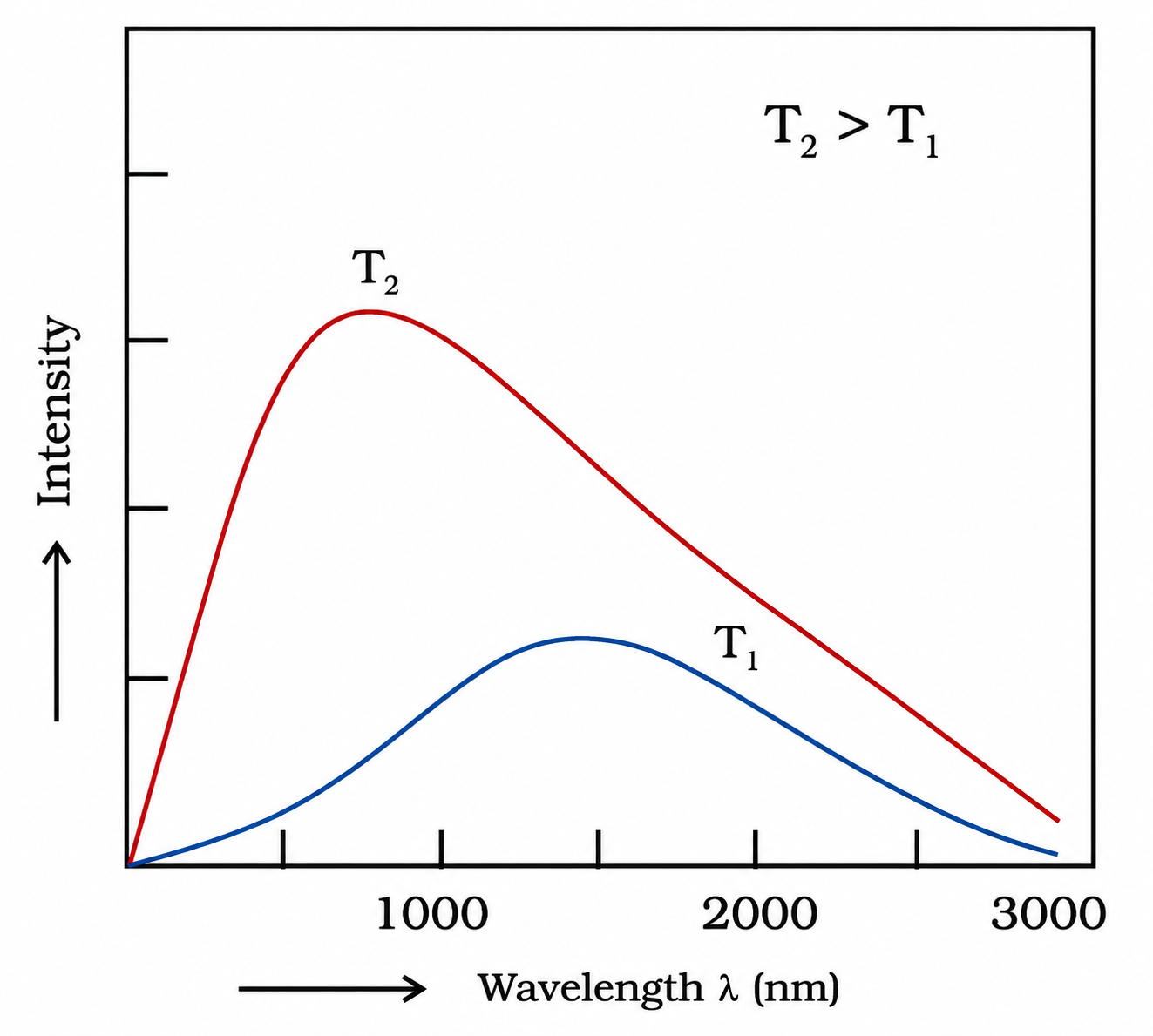
An ideal body that emits and absorbs radiations of all frequencies uniformly is called a black
body. The radiation emitted by such a body is called black body radiation. The intensity and
spectral distribution of black body radiation depend only on its temperature, a phenomenon that could not be
explained by classical wave theory.
Planck's Quantum Theory
To explain black body radiation, Max Planck proposed that energy is emitted or absorbed not continuously, but
discontinuously in the form of small discrete packets called quanta (in case of light,
called photons).
$$ E = h\nu = \frac{hc}{\lambda} $$
Where $h = \text{Planck's constant} = 6.626 \times 10^{-34} \text{ J s}$.
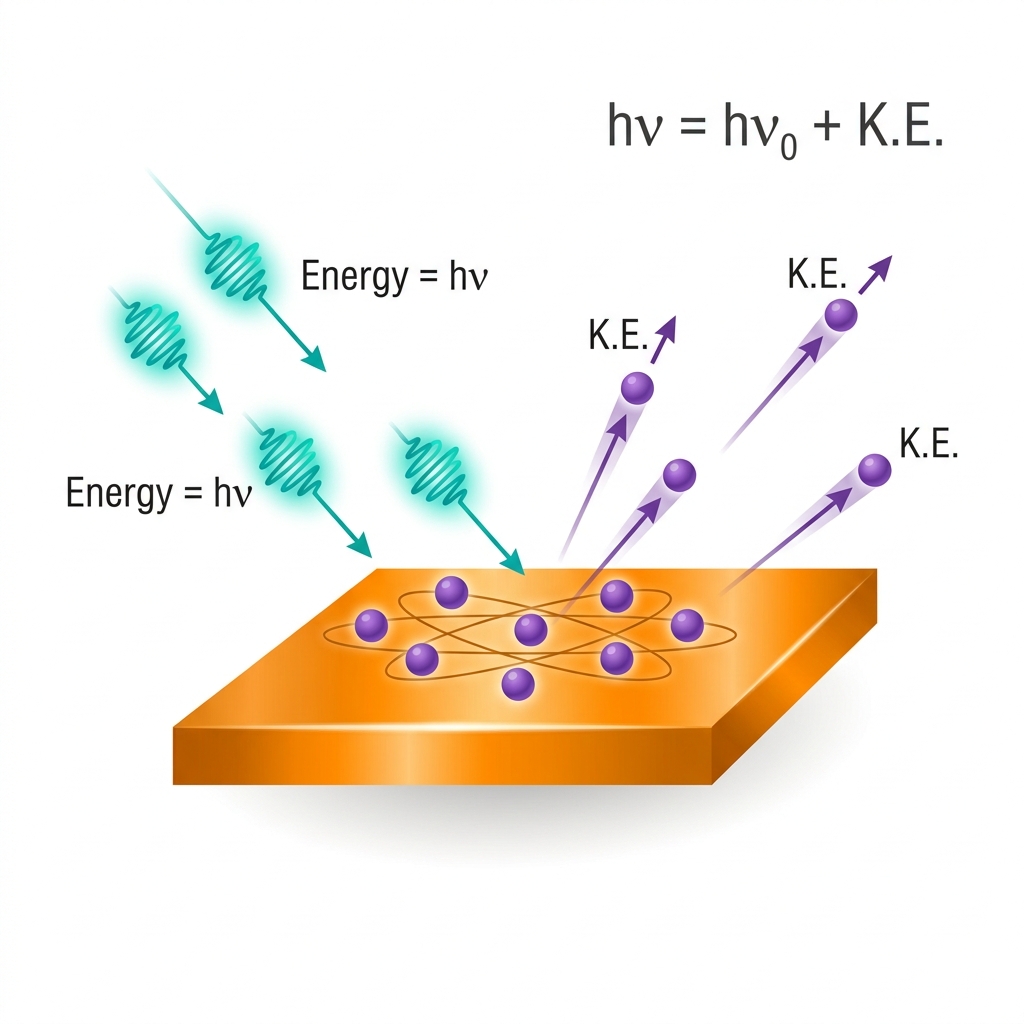
Photoelectric Effect
The phenomenon of ejection of electrons from the surface of a metal when light of suitable frequency strikes
it. Explained perfectly by Einstein using Planck's theory.
Concept Formula
Energy of incident photon = Work Function + Max Kinetic Energy of ejected electron
$$ h\nu = h\nu_0 + \frac{1}{2} m_e v^2 $$
Where $\nu_0$ is the threshold frequency (minimum frequency required to eject an electron).
Emission and Absorption Spectra
- Emission Spectrum: The spectrum of radiation emitted by a substance that has absorbed
energy (excited state). Atoms of different elements emit characteristic specific wavelengths, leaving
dark spaces in between, creating a line spectrum. This acts like a "fingerprint" for
elements.
- Absorption Spectrum: It is like the photographic negative of an emission spectrum. When
continuous white light passes through a sample, certain wavelengths are absorbed, leaving dark lines in
the otherwise bright continuous spectrum.
Practice Problems 3 — Waves & Photoelectric Effect
Q1 (NCERT Exercise 2.5): Yellow light emitted from a sodium lamp has a wavelength
($\lambda$) of $580\text{ nm}$. Calculate the frequency ($\nu$) and wave number ($\bar{\nu}$) of the yellow
light.
Solution:
$\lambda = 580\text{ nm} = 580 \times 10^{-9}\text{ m}$.
Frequency ($\nu$) = $\frac{c}{\lambda} = \frac{3 \times 10^8}{580 \times 10^{-9}} = \mathbf{5.17 \times
10^{14}\text{ s}^{-1}}$.
Wave number ($\bar{\nu}$) = $\frac{1}{\lambda} = \frac{1}{580 \times 10^{-9}} = \mathbf{1.72 \times
10^6\text{ m}^{-1}}$.
Q2 (JEE Main Focus): The threshold frequency $\nu_0$ for a metal is $7.0 \times
10^{14}\text{ s}^{-1}$. Calculate the kinetic energy of an electron emitted when radiation of frequency $\nu
= 1.0 \times 10^{15}\text{ s}^{-1}$ hits the metal.
Solution:
$K.E. = h(\nu - \nu_0)$
$K.E. = 6.626 \times 10^{-34} (1.0 \times 10^{15} - 0.7 \times 10^{15})$
$K.E. = 6.626 \times 10^{-34} \times 0.3 \times 10^{15} = \mathbf{1.988 \times 10^{-19}\text{ J}}$.
4. Bohr's Model for Hydrogen Atom
Niels Bohr combined Rutherford's model with Planck's Quantum theory. This is highly important for NEET/JEE
numericals.
Postulates
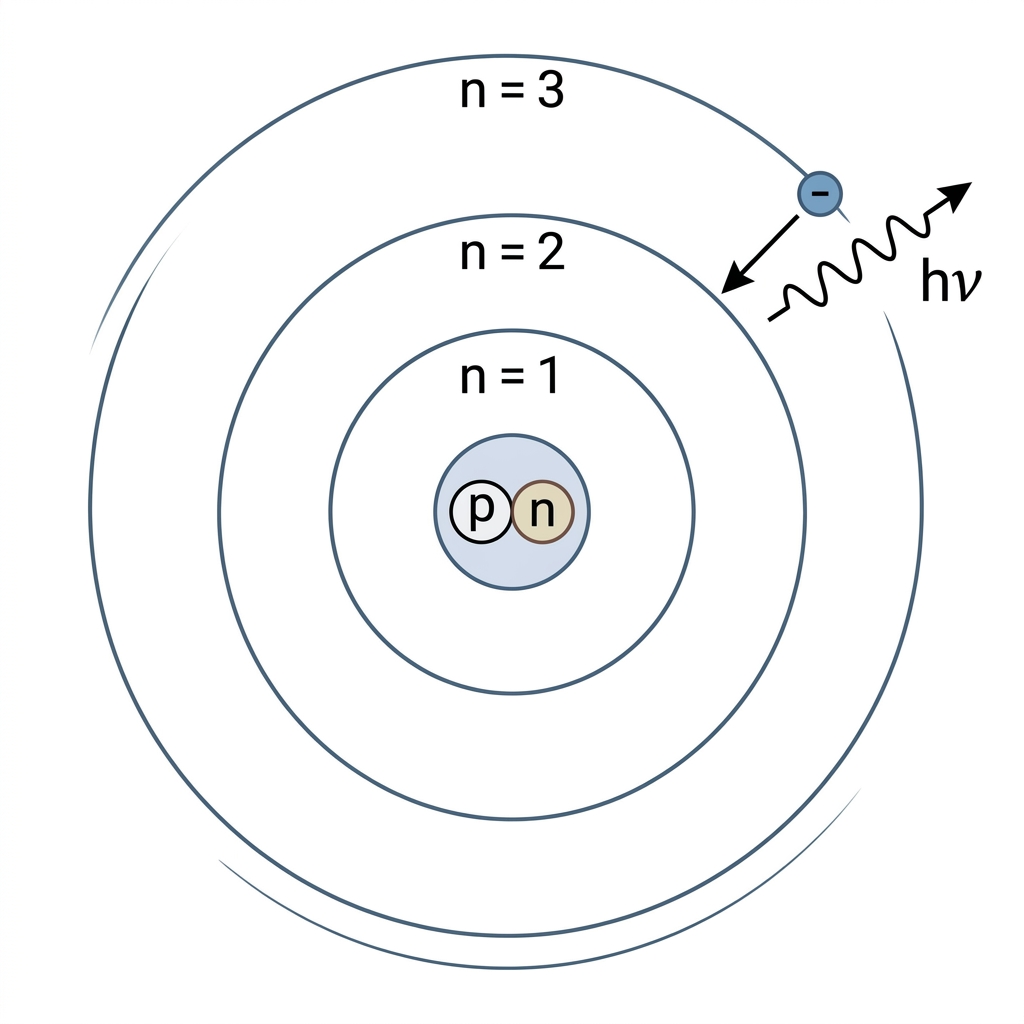
- Electrons revolve in well-defined circular paths called orbits or stationary states
without radiating energy.
- Quantization of Angular Momentum: Electrons can only revolve in those orbits where the
angular momentum ($mvr$) is an integral multiple of $h/2\pi$.
$$ mvr = \frac{nh}{2\pi} \quad \text{where } n = 1, 2, 3... $$
- Energy is emitted or absorbed only when an electron jumps from one orbit to another. $\Delta E =
E_{\text{final}} - E_{\text{initial}} = h\nu$.
Derivations of Bohr's Model (Detailed Step-by-Step)
Let an electron of mass $m$ and charge $e$ revolve in the $n^{\text{th}}$ orbit of radius $r$ with velocity
$v$ around a nucleus of charge $+Ze$ (where $Z$ is the atomic number).
1. Derivation for Radius of $n^{\text{th}}$ Orbit ($r_n$)
For a stable circular orbit, the necessary centripetal force is provided by the electrostatic force of
attraction between the nucleus and the electron.
$$ \frac{mv^2}{r} = \frac{1}{4\pi\varepsilon_0} \frac{(Ze)(e)}{r^2} \quad \text{--- (Eq. 1)} $$
$$ mv^2 = \frac{1}{4\pi\varepsilon_0} \frac{Ze^2}{r} \quad \text{--- (Eq. 2)} $$
From Bohr's quantization postulate of angular momentum:
$$ mvr = \frac{nh}{2\pi} \implies v = \frac{nh}{2\pi mr} \quad \text{--- (Eq. 3)} $$
Substituting the value of $v$ from (Eq. 3) into (Eq. 2):
$$ m \left( \frac{nh}{2\pi mr} \right)^2 = \frac{1}{4\pi\varepsilon_0} \frac{Ze^2}{r} $$
$$ m \frac{n^2 h^2}{4\pi^2 m^2 r^2} = \frac{1}{4\pi\varepsilon_0} \frac{Ze^2}{r} $$
Solving for $r$, we get the radius of the $n^{\text{th}}$ orbit:
$$ r_n = \frac{n^2 h^2 \varepsilon_0}{\pi m Z e^2} $$
Shortcut Formula for Numericals: Substituting the constants ($h, \varepsilon_0, m, e$):
$$ r_n = 0.529 \times \frac{n^2}{Z} \text{ \AA} $$
2. Derivation for Velocity of Electron in $n^{\text{th}}$ Orbit ($v_n$)
Substitute the derived expression of $r_n$ back into Eq. 3:
$$ v = \frac{nh}{2\pi m \left( \frac{n^2 h^2 \varepsilon_0}{\pi m Z e^2} \right)} $$
$$ v_n = \frac{Z e^2}{2 \varepsilon_0 n h} $$
Shortcut Formula for Numericals:
$$ v_n = 2.18 \times 10^6 \times \frac{Z}{n} \text{ m/s} $$
3. Time Period ($T_n$) and Frequency ($f_n$) of Revolution
Time period ($T$) is the time taken to complete one revolution: $T = \frac{2\pi r}{v}$.
Since $r \propto \frac{n^2}{Z}$ and $v \propto \frac{Z}{n}$, we get:
$$ T_n \propto \frac{n^3}{Z^2} $$
Frequency ($f$) is the number of revolutions per second: $f = \frac{1}{T} = \frac{v}{2\pi r}$.
$$ f_n \propto \frac{Z^2}{n^3} $$
Shortcut Formula for Frequency: $f_n = 6.62 \times 10^{15} \times \frac{Z^2}{n^3} \text{
Hz}$
4. Derivation for Total Energy of Electron ($E_n$)
Total Energy ($E$) = Kinetic Energy ($KE$) + Potential Energy ($PE$).
From Eq. 2, $KE = \frac{1}{2} mv^2 = \frac{1}{2} \left( \frac{1}{4\pi\varepsilon_0} \frac{Ze^2}{r} \right) =
\frac{Ze^2}{8\pi\varepsilon_0 r}$
Potential energy of the electron in the electric field of the nucleus:
$$ PE = \frac{1}{4\pi\varepsilon_0} \frac{(Ze)(-e)}{r} = -\frac{Ze^2}{4\pi\varepsilon_0 r} $$
Total Energy $E = KE + PE$:
$$ E = \frac{Ze^2}{8\pi\varepsilon_0 r} - \frac{Ze^2}{4\pi\varepsilon_0 r} = -\frac{Ze^2}{8\pi\varepsilon_0
r} $$
Substituting the value of $r_n$:
$$ E_n = - \frac{m Z^2 e^4}{8 \varepsilon_0^2 n^2 h^2} $$
Shortcut Formulas for Numericals:
$$ E_n = -13.6 \times \frac{Z^2}{n^2} \text{ eV/atom} $$
$$ E_n = -2.18 \times 10^{-18} \times \frac{Z^2}{n^2} \text{ J/atom} $$
(Note: The negative sign indicates that the electron is bound to the nucleus).
Hydrogen Spectrum
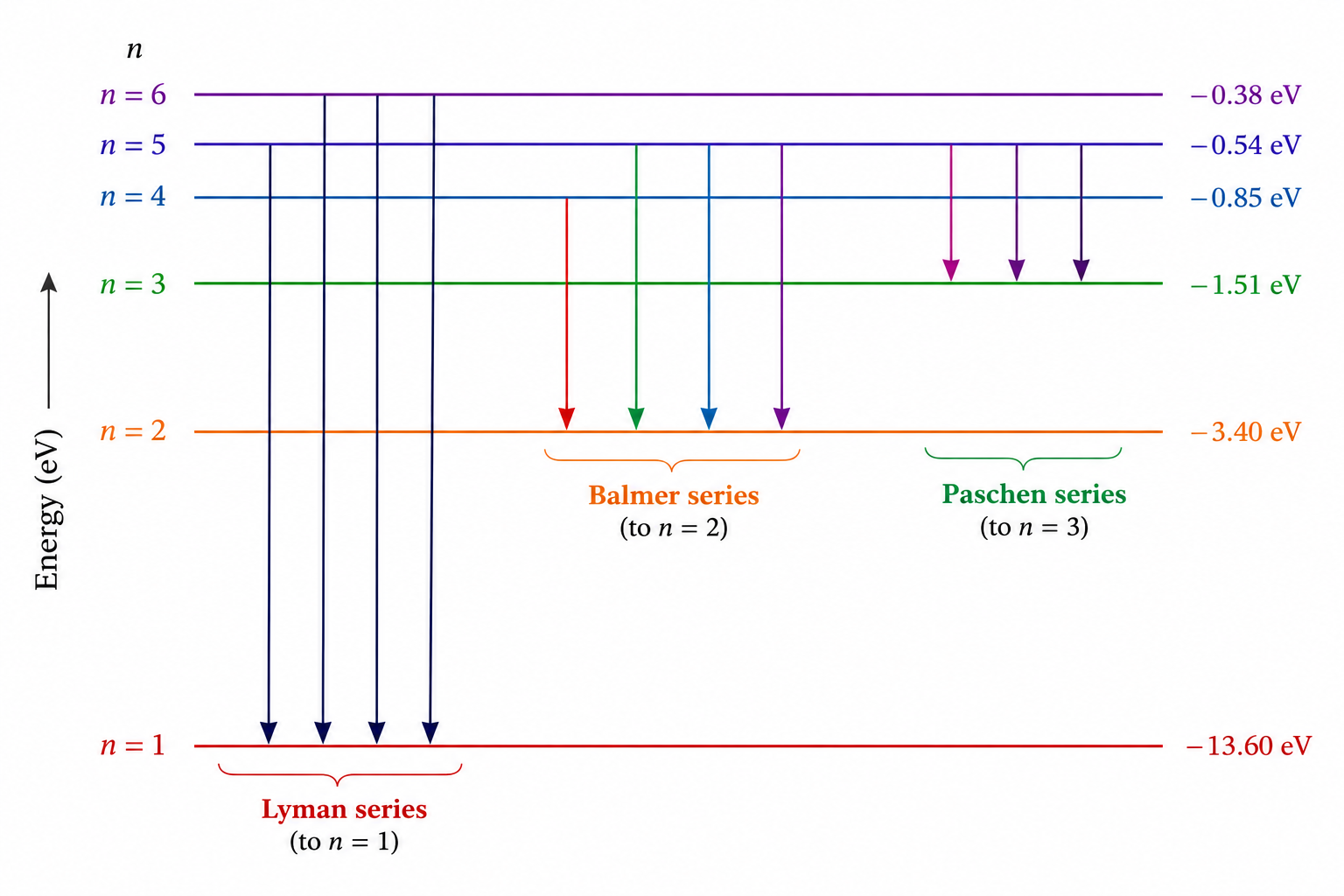
When an electric discharge is passed through hydrogen gas, it emits light. If passed through a prism, a line
spectrum is obtained. The wave number ($\bar{\nu}$) of spectral lines is given by Rydberg's equation:
Formula
$$ \bar{\nu} = \frac{1}{\lambda} = R_H Z^2 \left( \frac{1}{n_1^2} - \frac{1}{n_2^2} \right) $$
Where $R_H$ is Rydberg constant ($109677 \text{ cm}^{-1}$), $n_1$ is the lower energy level, and $n_2$ is
the higher energy level.
| Spectral Series |
$n_1$ |
$n_2$ |
Spectral Region |
| Lyman |
1 |
2, 3, 4... |
Ultraviolet |
| Balmer |
2 |
3, 4, 5... |
Visible |
| Paschen |
3 |
4, 5, 6... |
Infrared |
| Brackett |
4 |
5, 6, 7... |
Infrared |
| Pfund |
5 |
6, 7, 8... |
Infrared |
Practice Problems 4 — Bohr's Model & Spectra
Q1 (NEET Focus): Calculate the energy associated with the first orbit of $\text{He}^+$.
What is the radius of this orbit?
Solution:
For $\text{He}^+$, $Z = 2$. First orbit $n = 1$.
$E_n = -2.18 \times 10^{-18} \times \frac{Z^2}{n^2}\text{ J}$.
$E_1 = -2.18 \times 10^{-18} \times \frac{2^2}{1^2} = \mathbf{-8.72 \times 10^{-18}\text{ J}}$.
$r_n = 0.529 \times \frac{n^2}{Z}\text{ \AA}$.
$r_1 = 0.529 \times \frac{1^2}{2} = \mathbf{0.2645\text{ \AA}}$.
Q2 (NCERT Exercise 2.14): How much energy is required to ionize a hydrogen atom if the
electron occupies $n=5$ orbit? Compare your answer with the ionization enthalpy of H atom (energy required
to remove the electron from $n=1$ orbit).
Solution:
Ionization means exciting the electron from $n=5$ to $n=\infty$.
$\Delta E = E_\infty - E_5 = 0 - \left( -2.18 \times 10^{-18} \times \frac{1^2}{5^2} \right)$
$\Delta E = \frac{2.18 \times 10^{-18}}{25} = \mathbf{8.72 \times 10^{-20}\text{ J}}$.
Ionization from $n=1$: $\Delta E = 2.18 \times 10^{-18}\text{ J}$.
Comparison: The energy required from $n=1$ is 25 times larger than from $n=5$.
5. Towards Quantum Mechanical Model
Limitations of Bohr's Model
- It failed to explain the finer details (doublets) of the hydrogen atom spectrum using sophisticated
spectroscopic techniques.
- It could not explain the spectrum of atoms other than hydrogen (multi-electron atoms like Helium).
- It failed to explain the Zeeman effect (splitting of spectral lines in a magnetic field) and Stark
effect (splitting in an electric field).
- It could not explain the ability of atoms to form molecules by chemical bonds.
- It contradicts Heisenberg's Uncertainty Principle and the dual nature of matter.
These limitations necessitated a new model. Two major principles led to the modern quantum mechanical model.
Dual Behavior of Matter (de Broglie Equation)
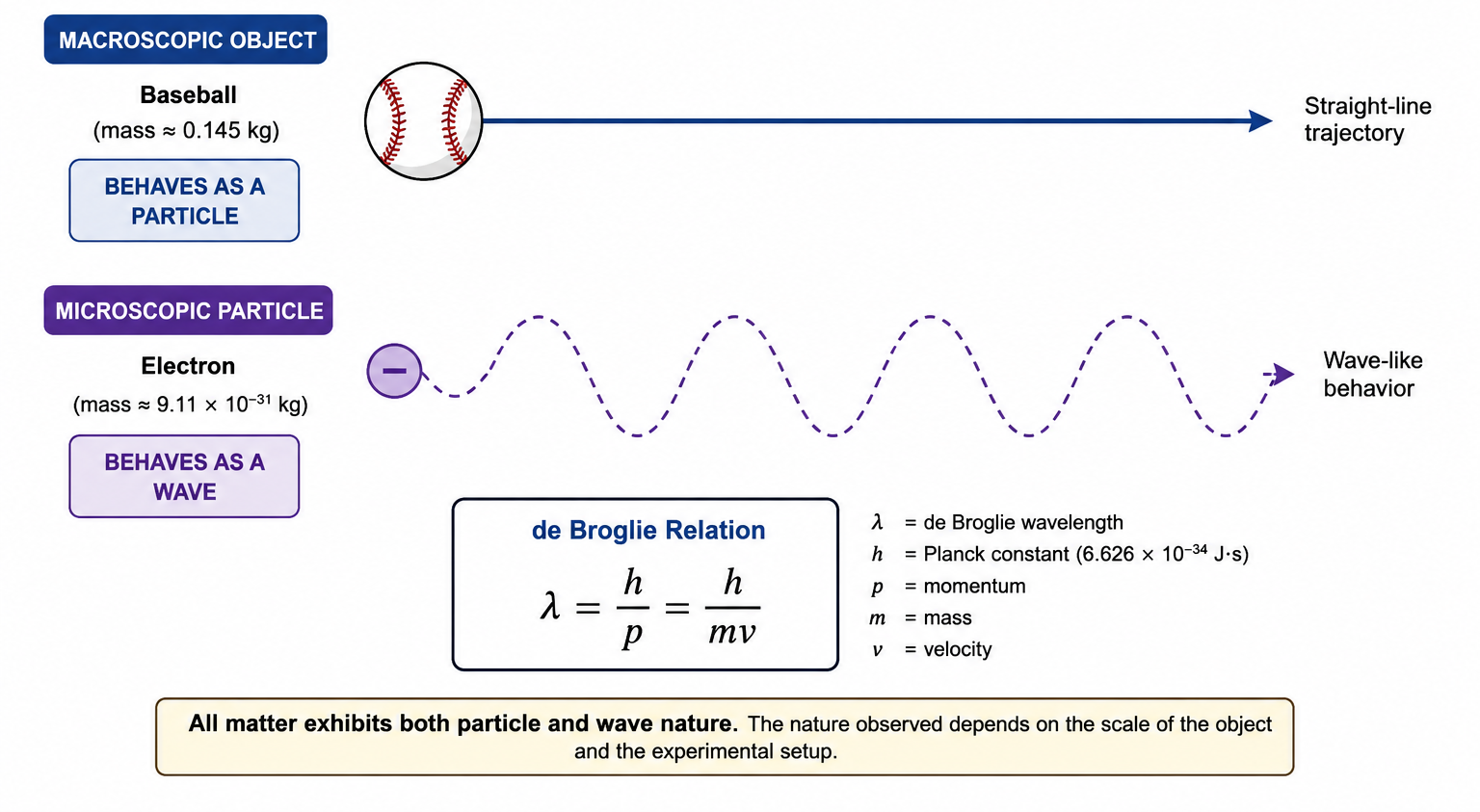
Louis de Broglie proposed that matter, like radiation, should exhibit dual behaviour (both particle and
wave-like properties). For microscopic particles in motion (like electrons):
$$ \lambda = \frac{h}{mv} = \frac{h}{p} $$
Where $p$ is momentum. Note: This effect is negligible for macroscopic objects.
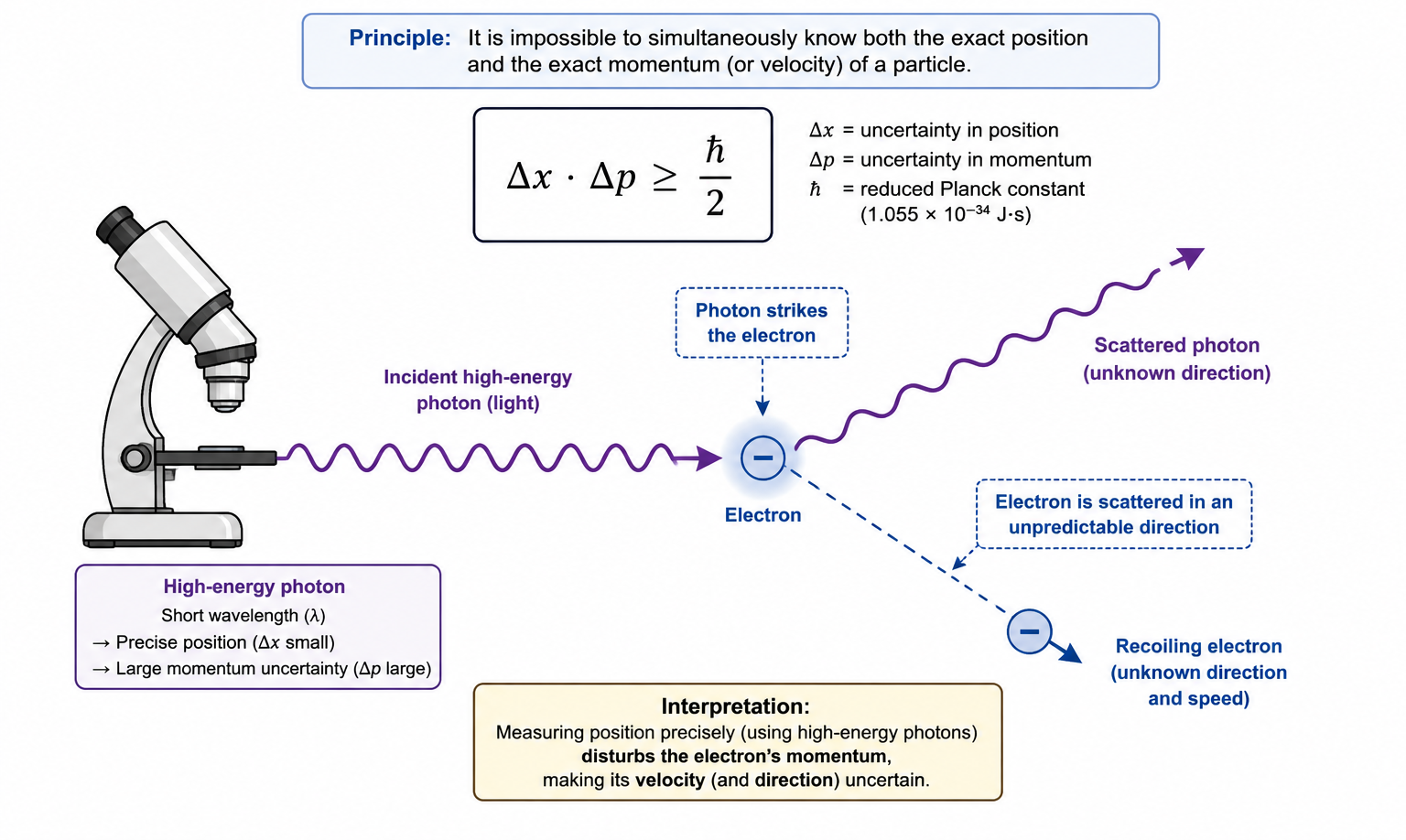
Heisenberg’s Uncertainty Principle
It states that it is impossible to determine exactly both the position and the momentum (or velocity) of a
microscopic particle simultaneously with absolute accuracy.
$$ \Delta x \times \Delta p \ge \frac{h}{4\pi} $$
$$ \Delta x \times (m\Delta v) \ge \frac{h}{4\pi} $$
Conclusion: The concept of well-defined orbits (Bohr's model) is completely ruled out. We can only talk
about the probability of finding an electron.
Practice Problems 5 — Dual Behavior & Uncertainty
Q1 (NCERT Example 2.12): What will be the wavelength of a ball of mass $0.1\text{ kg}$
moving with a velocity of $10\text{ m/s}$?
Solution:
According to de Broglie equation: $\lambda = \frac{h}{mv}$
$\lambda = \frac{6.626 \times 10^{-34}}{0.1 \times 10} = \mathbf{6.626 \times 10^{-34}\text{ m}}$.
This wavelength is so small that it is completely undetectable for macroscopic objects like a
ball.
Q2 (JEE Main Focus): A microscope using suitable photons is employed to locate an electron
in an atom within a distance of $0.1\text{ \AA}$. What is the uncertainty involved in the measurement of its
velocity?
Solution:
$\Delta x = 0.1\text{ \AA} = 0.1 \times 10^{-10}\text{ m} = 10^{-11}\text{ m}$.
From Heisenberg's Uncertainty Principle: $\Delta x \cdot (m\Delta v) = \frac{h}{4\pi}$
$\Delta v = \frac{h}{4\pi m \Delta x} = \frac{6.626 \times 10^{-34}}{4 \times 3.14 \times 9.1 \times
10^{-31} \times 10^{-11}}$
$\Delta v \approx \mathbf{5.79 \times 10^6\text{ m/s}}$.
6. Quantum Mechanical Model of Atom
Erwin Schrödinger developed a mathematical equation that describes the wave-like behavior of electrons. This
forms the basis of quantum mechanics.
Schrödinger Wave Equation
For a system (such as an atom or a molecule) whose energy does not change with time, the Schrödinger equation
is written as:
Equation
$$ \hat{H}\psi = E\psi $$
Where:
- $\hat{H}$ is a mathematical operator called the Hamiltonian operator.
- $E$ is the total energy of the system.
- $\psi$ (psi) is the wave function. It represents the amplitude of the electron
wave. By itself, $\psi$ has no physical meaning.
Physical Significance of $\psi^2$ (Probability Density)
According to Max Born, the square of the wave function ($\psi^2$) at a point gives the probability
density of finding the electron at that point. The region around the nucleus where the
probability of finding the electron is maximum is called an orbital.
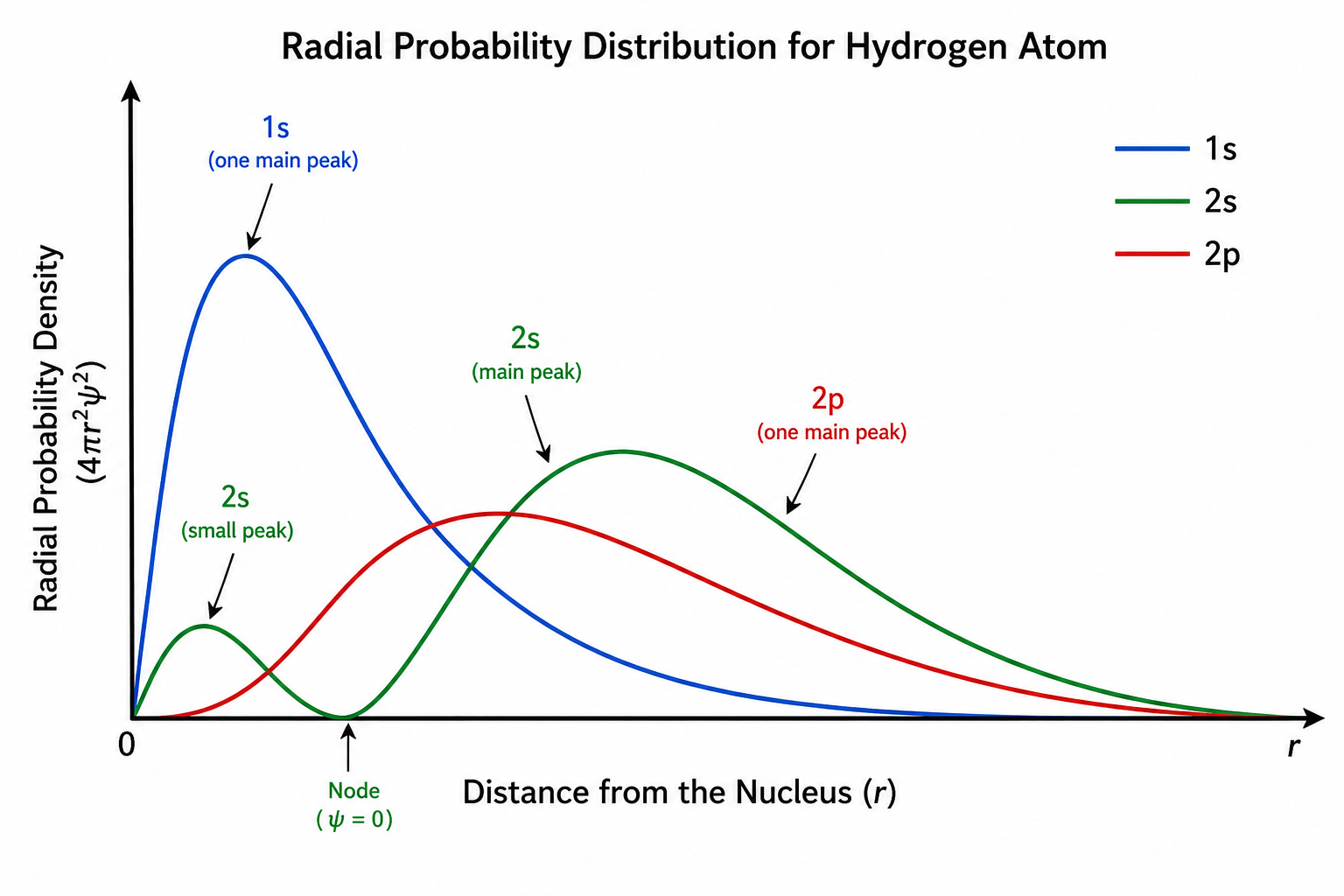
Radial Probability Distribution Curves
The probability of finding an electron in a spherical shell of radius $r$ and thickness $dr$ is given by
$4\pi r^2 \psi^2 dr$. The graph of $4\pi r^2 \psi^2$ against distance $r$ from the nucleus is very important
for JEE.
- For an $s$-orbital, the maximum probability is close to the nucleus but not at the
nucleus (where $r=0$).
- The number of peaks in the curve = $n - l$.
- The number of radial nodes (points where probability is zero) = $n - l - 1$.
- For example, $1s$ has 0 nodes and 1 peak. $2s$ has 1 node and 2 peaks. $2p$ has 0 nodes and 1 peak.
Concept of Shells, Subshells, and Orbitals
The solution to the Schrödinger wave equation gives a set of numbers called Quantum Numbers.
- Shells: Electrons in an atom are arranged in main energy levels called shells (K, L, M,
N...) denoted by principal quantum number $n$.
- Subshells: Each shell consists of one or more subshells (s, p, d, f) depending on the
value of $n$.
- Orbital: Unlike Bohr's well-defined circular paths (orbits), an orbital is a 3D region
in space around the nucleus where the probability of finding an electron is maximum (usually > 90%).
Quantum Numbers
They act as the "postal address" of an electron in an atom.
- Principal Quantum Number ($n$): Determines the main energy shell ($K, L, M, N...$),
size, and energy of the orbital. Values: $1, 2, 3...$
- Azimuthal/Angular Momentum Q.N. ($l$): Determines the sub-shell ($s, p, d, f$), shape
of the orbital, and orbital angular momentum.
Values: $0$ to $(n-1)$.
- $l=0 \implies s$ subshell
- $l=1 \implies p$ subshell
- $l=2 \implies d$ subshell
- $l=3 \implies f$ subshell
- Magnetic Quantum Number ($m_l$): Determines the spatial orientation of the orbital in a
magnetic field.
Values: $-l$ to $+l$ (including zero). Total values = $2l+1$.
- Spin Quantum Number ($m_s$): Refers to the orientation of the spin of the electron.
Values: $+1/2$ (spin up) or $-1/2$ (spin down).
Calculation Hack
Total number of nodes (where probability of finding electron is zero) = $n - 1$
Angular nodes = $l$
Radial nodes = $n - l - 1$
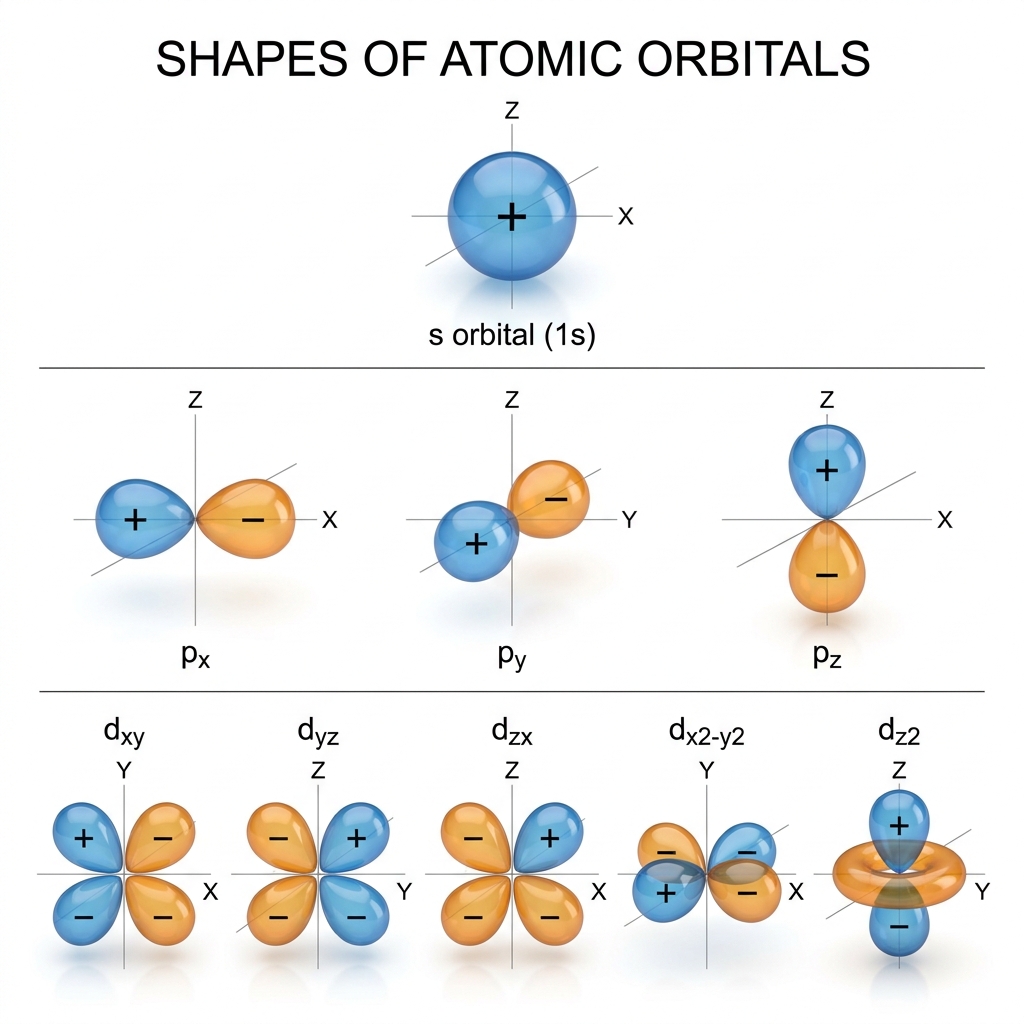
Shapes of Atomic Orbitals
- $s$-orbital ($l=0$): Spherical, non-directional. Size increases with increasing $n$.
- $p$-orbital ($l=1$): Dumbbell-shaped, directional. Exists as $p_x, p_y, p_z$ along
respective axes.
- $d$-orbital ($l=2$): Double dumbbell-shaped (mostly). Exists as $d_{xy}, d_{yz},
d_{zx}, d_{x^2-y^2}$, and a unique donut-shaped $d_{z^2}$.
Practice Problems 6 — Quantum Numbers
Q1 (NCERT Exercise 2.22): Which of the following sets of quantum numbers are not
possible?
(a) $n = 0, l = 0, m_l = 0, m_s = +1/2$
(b) $n = 1, l = 0, m_l = 0, m_s = -1/2$
(c) $n = 1, l = 1, m_l = 0, m_s = +1/2$
(d) $n = 2, l = 1, m_l = 0, m_s = -1/2$
Solution:
(a) Not possible. Principal quantum number $n$ cannot be 0.
(b) Possible (this is the $1s$ orbital).
(c) Not possible. Azimuthal quantum number $l$ can only be up to $n-1$. If $n=1$, $l$ must be 0.
(d) Possible (this is a $2p$ orbital).
Q2 (NEET Focus): How many radial nodes and angular nodes does a $3p$ orbital have?
Solution:
For a $3p$ orbital, $n = 3$, $l = 1$.
Angular nodes = $l = \mathbf{1}$.
Radial nodes = $n - l - 1 = 3 - 1 - 1 = \mathbf{1}$.
Total nodes = $n - 1 = 2$.
7. Rules for Filling Electrons in Orbitals
The distribution of electrons into orbitals is called electronic configuration. It is governed by three
fundamental rules:
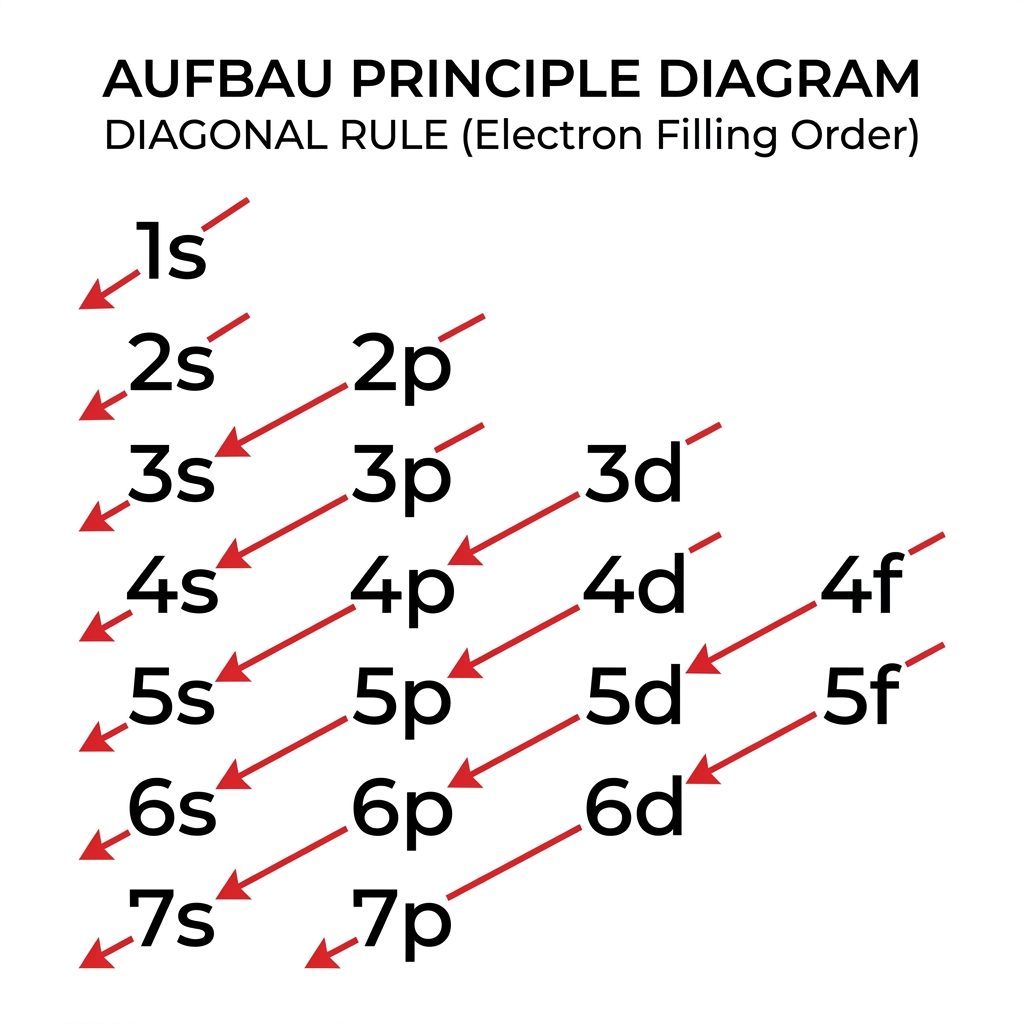
1. Aufbau Principle
In the ground state of the atoms, the orbitals are filled in order of their increasing energies.
$(n+l)$ Rule: Orbitals with a lower value of $(n+l)$ have lower energy. If two orbitals have
the same $(n+l)$ value, the one with the lower $n$ value is filled first.
Order: $1s < 2s < 2p < 3s < 3p < 4s < 3d < 4p < 5s...$
2. Pauli Exclusion Principle
"No two electrons in an atom can have the same set of all four quantum numbers."
Implication: An orbital can hold a maximum of only two electrons, and they must have
opposite spins ($\uparrow \downarrow$).
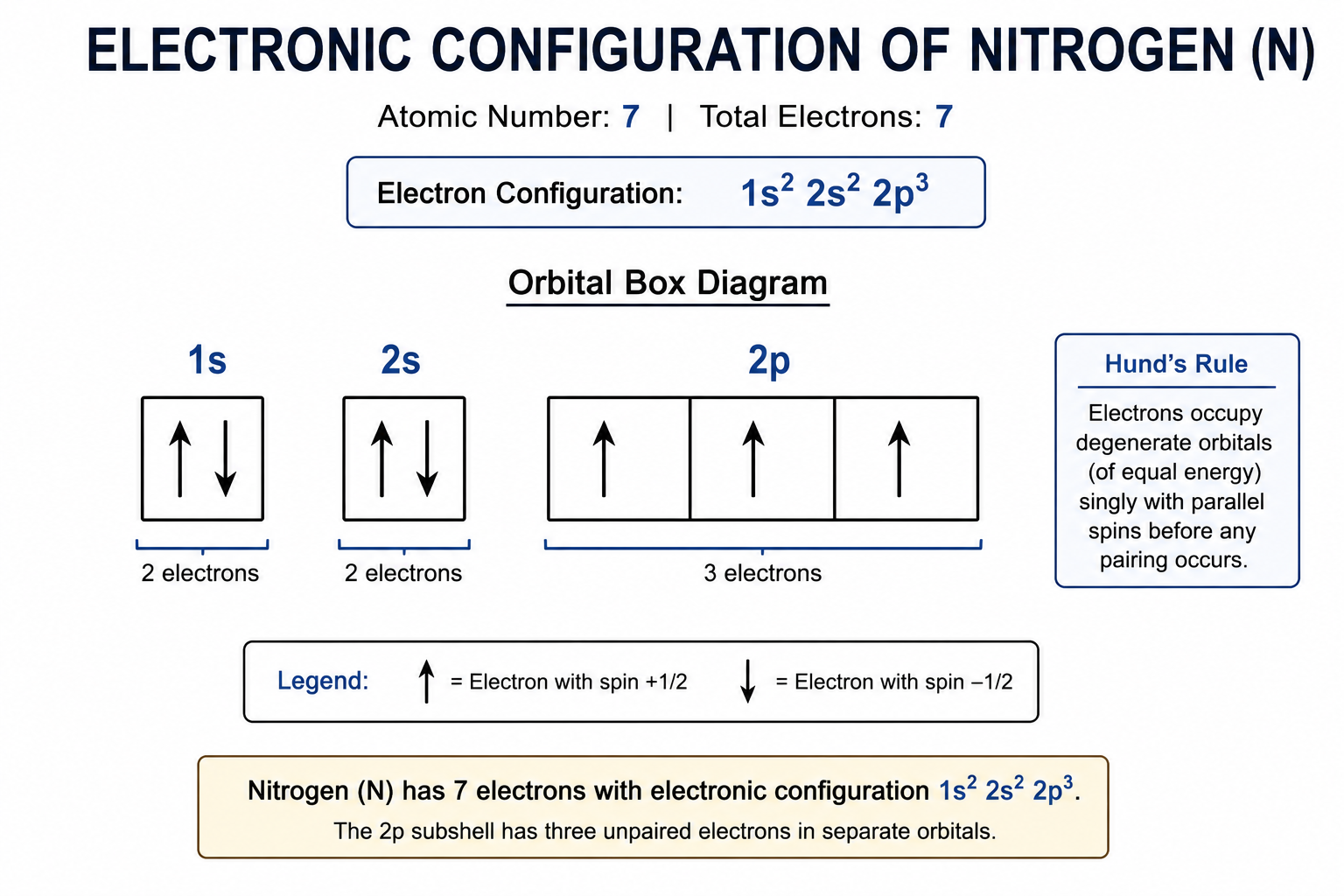
3. Hund's Rule of Maximum Multiplicity
Electron pairing in degenerate orbitals (orbitals of the same subshell, like $p_x, p_y, p_z$) will
not take place until each orbital of a given subshell is singly occupied with parallel spin.
Correct ($Nitrogen$): $\uparrow$ $\uparrow$ $\uparrow$
Incorrect: $\uparrow\downarrow$ $\uparrow$ $\text{empty}$
Practice Problems 7 — Electronic Configuration
Q1 (School Focus): Write the electronic configuration of the following ions: (a)
$\text{H}^-$ (b) $\text{Na}^+$ (c) $\text{O}^{2-}$ (d) $\text{F}^-$.
Solution:
(a) $\text{H}^-$ (2 electrons): $1s^2$
(b) $\text{Na}^+$ (10 electrons): $1s^2 2s^2 2p^6$ (or $[\text{Ne}]$)
(c) $\text{O}^{2-}$ (10 electrons): $1s^2 2s^2 2p^6$
(d) $\text{F}^-$ (10 electrons): $1s^2 2s^2 2p^6$
Q2 (NEET Focus): An atom has $2K, 8L,$ and $5M$ electrons. Write down the
electronic configuration of the atom and identify it.
Solution:
Total electrons = $2 + 8 + 5 = 15$.
Configuration: $1s^2 (K) \mid 2s^2 2p^6 (L) \mid 3s^2 3p^3 (M)$.
The element with atomic number 15 is Phosphorus (P).
8. Exceptional Electronic Configurations
Half-filled and fully-filled degenerate orbitals have extra stability due to symmetry and high
exchange energy. This leads to anomalies in expected configurations.
Board & JEE Favourite
Chromium (Cr, $Z=24$):
Expected: $[\text{Ar}] 4s^2 3d^4$
Actual: $[\text{Ar}] 4s^1 3d^5$ (Stable half-filled 3d subshell)
Copper (Cu, $Z=29$):
Expected: $[\text{Ar}] 4s^2 3d^9$
Actual: $[\text{Ar}] 4s^1 3d^{10}$ (Stable fully-filled 3d subshell)
Practice Problems 8 — Exceptional Configurations
Q1 (NCERT Focus): Write the electronic configuration of $\text{Fe}^{3+}$ ($Z=26$)
and $\text{Mn}^{2+}$ ($Z=25$). Why is $\text{Mn}^{2+}$ more stable than $\text{Fe}^{2+}$?
Solution:
For Iron ($Z=26$): $[\text{Ar}] 4s^2 3d^6$. For $\text{Fe}^{3+}$, remove 3 electrons (first from
$4s$, then $3d$): $[\text{Ar}] 3d^5$.
For Manganese ($Z=25$): $[\text{Ar}] 4s^2 3d^5$. For $\text{Mn}^{2+}$, remove 2 electrons from
$4s$: $[\text{Ar}] 3d^5$.
$\text{Fe}^{2+}$ configuration is $[\text{Ar}] 3d^6$. $\text{Mn}^{2+}$ has a $[\text{Ar}] 3d^5$
configuration, which is exactly half-filled. Since exactly half-filled subshells are extra
stable due to higher exchange energy and symmetrical distribution, $\text{Mn}^{2+}$ is more
stable than $\text{Fe}^{2+}$.