Vardaan Watermark

Some Basic Concepts of Chemistry

Chapter 1 Flashcards
👈
👉

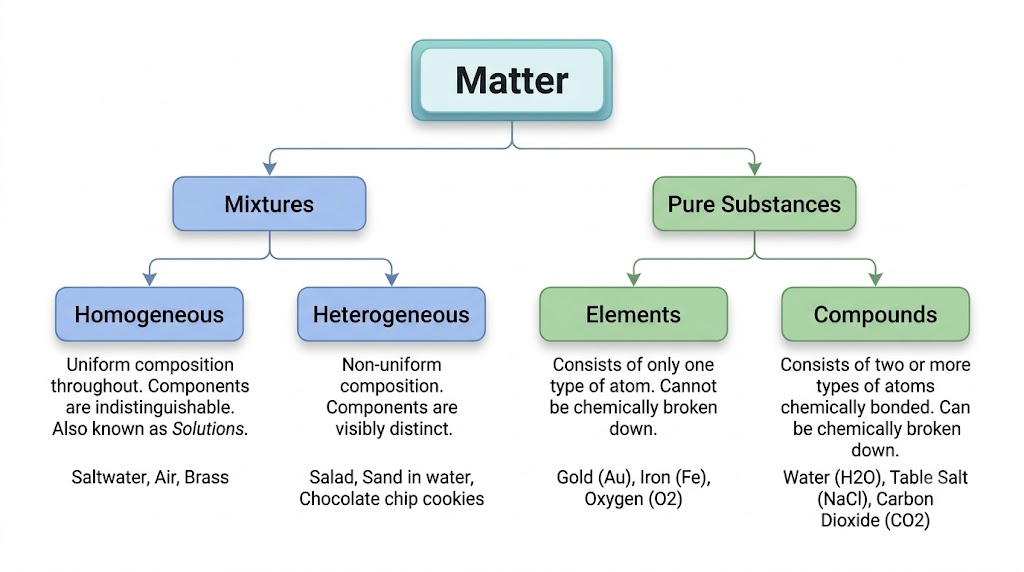
Nature of Matter

1. Mixtures

Contain two or more substances in any ratio.

  • Homogeneous: Uniform (e.g., air, sugar solution)
  • Heterogeneous: Non-uniform (e.g., sand & salt)

2. Pure Substances

Have a fixed composition.

  • Elements: One type of particle (Na, Oâ‚‚)
  • Compounds: Two or more elements in fixed ratio (Hâ‚‚O)
Classification of Matter

Properties & SI Units

Physical: Measured without changing identity (color, melting pt).
Chemical: Require chemical change (acidity, combustibility).

7 Base SI Units

  • Length: metre (m)
  • Mass: kilogram (kg)
  • Time: second (s)
  • Electric current: ampere (A)
  • Temperature: kelvin (K)
  • Amount of substance: mole (mol)
  • Luminous intensity: candela (cd)

Temperature Conversion

$$ \text{K} = ^\circ\text{C} + 273.15 $$ $$ ^\circ\text{F} = \frac{9}{5}(^\circ\text{C}) + 32 $$

Uncertainty & Sig Figs

Significant Figures Rules:

  • All non-zero digits are significant.
  • Leading zeros are not significant (0.003 has 1).
  • Zeros between non-zeros are significant.
  • Trailing zeros are significant if after decimal (0.200 has 3).
  • Exact numbers have infinite sig figs.

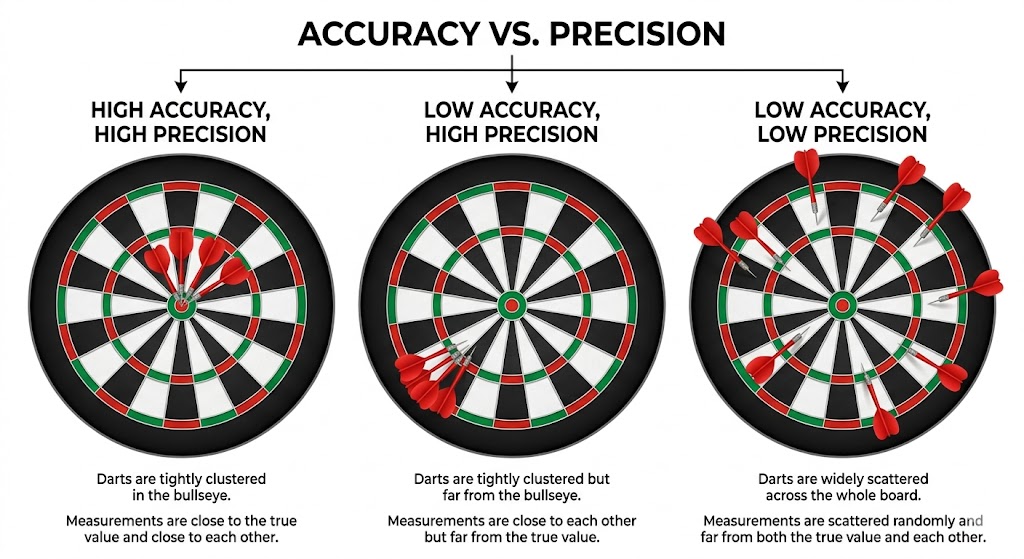
Accuracy vs Precision

Precision: Closeness of various measurements to each other.
Accuracy: Closeness of a measurement to the true value.

Accuracy vs. Precision

Chemical Combinations

  • Law of Conservation of Mass: Matter is neither created nor destroyed. Mass of reactants = Mass of products.
  • Law of Definite Proportions: A compound always contains exactly the same proportion of elements by weight.
  • Law of Multiple Proportions: When two elements form $>1$ compound, the masses of one combining with a fixed mass of the other are in simple whole number ratios.
  • Gay Lussac’s Law: Gases combine/are produced in simple volume ratios at same T & P.
  • Avogadro’s Law: Equal volumes of gases at same T & P contain equal number of molecules.

Dalton's Atomic Theory

  • Matter consists of indivisible atoms.
  • All atoms of a given element have identical properties (including identical mass). Atoms of different elements differ in mass.
  • Compounds are formed when atoms of different elements combine in a fixed ratio.
  • Chemical reactions involve reorganization of atoms. These are neither created nor destroyed.

Atomic & Molecular Masses

Atomic Mass Unit (amu)

Defined as a mass exactly equal to 1/12th the mass of one $^{12}\text{C}$ atom.

$$ 1 \text{ amu} = 1.66056 \times 10^{-24} \text{ g} $$

Average Atomic Mass

Calculated by taking into account fractional abundance of isotopes.

Vapour Density

$$ \text{Molar Mass} = 2 \times \text{Vapour Density} $$

Mole Concept

One Mole is the amount of a substance containing as many particles as there are atoms in exactly $12\text{ g}$ of $^{12}\text{C}$.

$$ N_A = 6.022 \times 10^{23} \text{ particles/mol} $$

Key Formulae

  • Given mass ($w$): $n = \frac{w}{M}$
  • Number of particles ($N$): $n = \frac{N}{N_A}$
  • Gases at STP: $n = \frac{V(\text{in L})}{22.4}$

Percentage Composition

$$ \text{Mass \%} = \frac{\text{Mass of element}}{\text{Molar mass}} \times 100 $$

Empirical & Molecular Formula

  • Empirical: Simplest whole number ratio of atoms.
  • Molecular: Exact number of different types of atoms.
  • Relation: Molecular Formula = $n \times$ (Empirical Formula)
$$ n = \frac{\text{Molar Mass}}{\text{Empirical Formula Mass}} $$

Stoichiometry & LR

Limiting Reagent (LR)

Reactant consumed first. Dictates product amount.
Tip: Divide given moles by stoichiometric coefficient. Lowest value = LR.

POAC

Principle of Atomic Conservation: Moles of atoms of an element remain conserved.

Percentage Yield

$$ \text{\% Yield} = \frac{\text{Actual Yield}}{\text{Theoretical Yield}} \times 100 $$

Reactions in Solutions

  • Molarity ($M$): Moles of solute / Vol of sol in L (Temp dependent)
  • Molality ($m$): Moles of solute / Mass of solvent in kg (Temp independent)
  • Mole Fraction ($x$): $x_A = \frac{n_A}{n_A + n_B}$
  • Normality ($N$): Gram eq. of solute / Vol of sol in L
  • ppm: $\frac{\text{Mass of component}}{\text{Total mass}} \times 10^6$

Master Formula

$$ m = \frac{1000 \times M}{1000 \times d - M \times M_w} $$