Vardaan Learning Institute
Class 11 Chemistry • Chapter Notes
🌐 vardaanlearning.com
📞 9508841336
SOME BASIC CONCEPTS OF CHEMISTRY
Chemistry is the science of molecules and their transformations. It is the science not so much of the one
hundred elements but of the infinite variety of molecules that may be built from them. This chapter lays the
foundation for advanced concepts required for both CBSE Board Exams and JEE
Mains/Advanced.
1. Nature of Matter
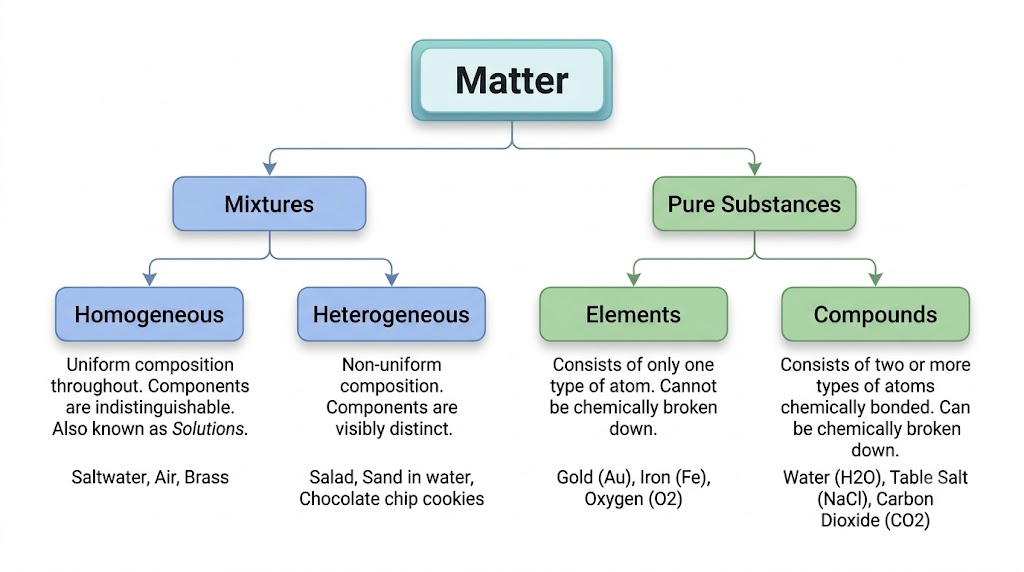
Matter is anything that has mass and occupies space. It can exist in three physical states: solid, liquid,
and gas. Macroscopically, matter is classified into Mixtures and Pure
Substances.
- Mixtures: Contain two or more substances present in any ratio.
- Homogeneous Mixtures: Uniform composition throughout (e.g., sugar solution, air).
- Heterogeneous Mixtures: Non-uniform composition (e.g., sand and salt, water and oil).
- Pure Substances: Have fixed composition.
- Elements: Consist of only one type of particles (atoms or molecules). Example:
$\text{Na}$, $\text{Cu}$, $\text{O}_2$.
- Compounds: Formed when two or more atoms of different elements combine in a fixed
ratio. Example: $\text{H}_2\text{O}$, $\text{CO}_2$.
Practice Problems 1 — Nature of Matter
Q1 (School Exam Focus): Classify the following as a pure substance or a mixture: (a) Air
(b) Copper (c) Sugar solution (d) Distilled water.
Solution:
(a) Air: Homogeneous Mixture (contains N₂, O₂, Ar, etc.)
(b) Copper: Pure Substance (Element)
(c) Sugar solution: Homogeneous Mixture
(d) Distilled water: Pure Substance (Compound, H₂O)
Q2 (NCERT Focus): Identify whether the following represent physical or chemical properties:
(a) Iron rusts (b) Water boils at 100°C (c) Sodium reacts vigorously with water.
Solution:
(a) Iron rusts: Chemical Property (Rusting forms a new compound, Fe₂O₃).
(b) Water boils: Physical Property (Only state changes from liquid to gas; H₂O remains
H₂O).
(c) Sodium reacts: Chemical Property (A chemical reaction occurs producing H₂ gas and
NaOH).
Q3 (NEET Focus): Which of the following is a homogeneous mixture? (a) Brass (b) Muddy water
(c) Smoke (d) Milk
Solution:
(a) Brass. Brass is a solid solution (alloy) of Cu and Zn, making it a homogeneous
mixture. Muddy water, smoke, and milk are heterogeneous.
Q4 (JEE Main Focus): Match the following: (I) Element (II) Compound (III) Homogeneous
mixture (IV) Heterogeneous mixture. (Given: Air, Diamond, Sand & Sugar, Water)
Solution:
Element = Diamond (pure carbon)
Compound = Water (H₂O)
Homogeneous mixture = Air
Heterogeneous mixture = Sand & Sugar
2. Properties of Matter and their Measurement
Every substance has unique or characteristic properties. These are classified into two categories:
- Physical Properties: Measured without changing the identity or composition of the
substance (e.g., color, odor, melting point, density).
- Chemical Properties: Require a chemical change to occur for measurement (e.g., acidity,
basicity, combustibility).
The International System of Units (SI)
There are seven base units in the SI system, heavily tested in objective questions.
| Base Physical Quantity |
Symbol for Quantity |
Name of SI Unit |
Symbol for SI Unit |
| Length |
$l$ |
metre |
$\text{m}$ |
| Mass |
$m$ |
kilogram |
$\text{kg}$ |
| Time |
$t$ |
second |
$\text{s}$ |
| Electric current |
$I$ |
ampere |
$\text{A}$ |
| Thermodynamic temperature |
$T$ |
kelvin |
$\text{K}$ |
| Amount of substance |
$n$ |
mole |
$\text{mol}$ |
| Luminous intensity |
$I_v$ |
candela |
$\text{cd}$ |
Important
Temperature Conversions: In chemistry calculations (especially Gas Laws), temperature MUST
often be converted to Kelvin.
$$ \text{K} = ^\circ\text{C} + 273.15 $$
$$ ^\circ\text{F} = \frac{9}{5}(^\circ\text{C}) + 32 $$
Practice Problems 2 — Properties & Measurement
Q1 (School / NCERT Focus): The normal temperature of a human body is $37^\circ\text{C}$.
Convert this temperature to Fahrenheit ($^\circ\text{F}$) and Kelvin ($\text{K}$).
Solution:
To Fahrenheit:
$^\circ\text{F} = \frac{9}{5}(^\circ\text{C}) + 32$
$^\circ\text{F} = \frac{9}{5}(37) + 32 = 66.6 + 32 = \mathbf{98.6^\circ\text{F}}$
To Kelvin:
$\text{K} = ^\circ\text{C} + 273.15$
$\text{K} = 37 + 273.15 = \mathbf{310.15\text{ K}}$
Q2 (NCERT Focus): What is the SI unit of density? Convert $1\text{ g/cm}^3$ to SI units.
Solution:
The SI unit of density is $\text{kg/m}^3$.
$1\text{ g/cm}^3 = \frac{10^{-3}\text{ kg}}{(10^{-2}\text{ m})^3} = \frac{10^{-3}\text{
kg}}{10^{-6}\text{ m}^3} = \mathbf{1000\text{ kg/m}^3}$.
Q3 (School Exam Focus): Distinguish between mass and weight.
Solution:
Mass is the amount of matter in an object and is constant everywhere.
Weight is the force exerted by gravity on an object ($W = m \times g$) and varies with
location due to changes in gravity.
3. Uncertainty in Measurement
All scientific measurements involve some degree of error. This is managed using scientific notation and
significant figures.
Scientific Notation
Expressed as $N \times 10^n$, where $N$ is a number between $1.000...$ and $9.999...$, and $n$ is an
exponent. Example: $232.508$ can be written as $2.32508 \times 10^2$.
Significant Figures
The meaningful digits in a measured or calculated quantity. Rules to remember for JEE/Board exams:
- All non-zero digits are significant.
- Zeros preceding the first non-zero digit are not significant (e.g., $0.003$ has one
significant figure).
- Zeros between two non-zero digits are significant.
- Zeros at the end or right of a number are significant provided they are on the right side of the decimal
point (e.g., $0.200$ has three significant figures).
- Exact numbers have an infinite number of significant figures (e.g., $2$ apples = $2.0000...$).
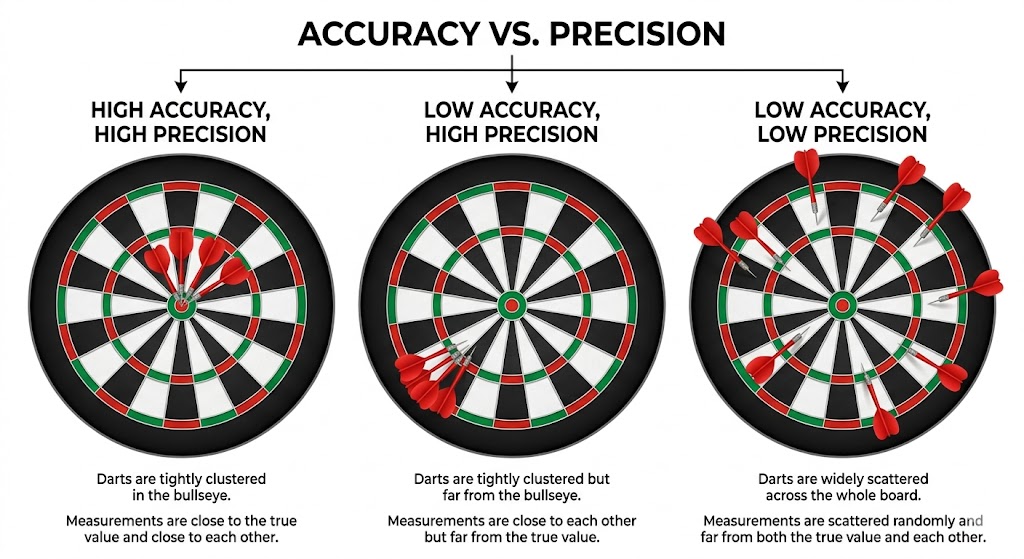
Accuracy and Precision
- Precision: Refers to the closeness of various measurements for the same quantity. If
values are close to each other, they are precise.
- Accuracy: Refers to the agreement of a particular value to the true value of the
result.
Practice Problems 3 — Uncertainty & Significant Figures
Q1 (NEET Focus): The number of significant figures in $0.004560$ and $2.0 \times 10^4$ are
respectively:
Solution:
For $0.004560$: Leading zeros are not significant, but the trailing zero after the decimal is.
Therefore, it has 4 significant figures (4, 5, 6, 0).
For $2.0 \times 10^4$: In scientific notation, we only look at the base number $2.0$, which has
2 significant figures.
Answer: 4 and 2.
Q2 (NCERT Exercise 1.18): Express the following in the scientific notation: (i) $0.0048$
(ii) $234,000$ (iii) $8008$.
Solution:
(i) $0.0048$ = $4.8 \times 10^{-3}$
(ii) $234,000$ = $2.34 \times 10^5$
(iii) $8008$ = $8.008 \times 10^3$
Q3 (NCERT Exercise 1.31): Round up the following up to three significant figures: (i)
$34.216$ (ii) $10.4107$ (iii) $0.04597$ (iv) $2808$.
Solution:
(i) $34.216$ $\rightarrow$ $34.2$
(ii) $10.4107$ $\rightarrow$ $10.4$
(iii) $0.04597$ $\rightarrow$ Since the 4th sig fig is 7 (which is > 5), we round up the 9 to 10,
carrying over to the 5. Result: $0.0460$
(iv) $2808$ $\rightarrow$ To retain 3 sig figs, it becomes $2810$, which is best expressed as
$2.81 \times 10^3$.
Q4 (NEET Focus): The result of the addition $2.51 + 1.2$ should be reported as:
Solution:
In addition, the result must have the same number of decimal places as the term with the fewest decimal
places. $2.51 + 1.2 = 3.71$. Rounding to one decimal place gives $3.7$.
Q5 (JEE Main Focus): Express $0.000459$ and $200.0$ in scientific notation and determine
their significant figures.
Solution:
$0.000459 = \mathbf{4.59 \times 10^{-4}}$ (3 significant figures).
$200.0 = \mathbf{2.000 \times 10^2}$ (4 significant figures).
Dimensional Analysis
Often while calculating, there is a need to convert units from one system to another. The method used is
called the Factor Label Method or Unit Factor Method. It ensures that
units are cancelled out algebraically during conversions.
4. Laws of Chemical Combinations
The combination of elements to form compounds is governed by five basic laws:
- Law of Conservation of Mass (Antoine Lavoisier): Matter can neither be created nor
destroyed. In a chemical reaction, total mass of reactants = total mass of products.
- Law of Definite Proportions (Joseph Proust): A given compound always contains exactly
the same proportion of elements by weight.
- Law of Multiple Proportions (John Dalton): If two elements can combine to form more
than one compound, the masses of one element that combine with a fixed mass of the other element are in
the ratio of small whole numbers.
- Gay Lussac’s Law of Gaseous Volumes: When gases combine or are produced in a chemical
reaction, they do so in a simple ratio by volume, provided all gases are at the same temperature and
pressure.
- Avogadro’s Law: Equal volumes of all gases at the same temperature and pressure should
contain an equal number of molecules.
Practice Problems 4 — Laws of Chemical Combinations
Q1 (JEE Main Focus): Two oxides of a metal contain 27.6% and 30.0% of oxygen respectively.
If the formula of the first oxide is $\text{M}_3\text{O}_4$, find the formula of the second oxide.
Solution:
In the first oxide ($\text{M}_3\text{O}_4$): Metal = $100 - 27.6 = 72.4\%$. Oxygen = $27.6\%$.
Ratio of atoms: $\frac{\text{M}}{\text{O}} = \frac{72.4 / \text{Atomic wt of M}}{27.6 / 16} =
\frac{3}{4} \implies \text{Atomic wt of M} \approx 56$ (Iron, Fe).
In the second oxide: Metal = $100 - 30.0 = 70.0\%$. Oxygen = $30.0\%$.
Ratio of atoms: $\text{M} = \frac{70}{56} = 1.25$, $\text{O} = \frac{30}{16} = 1.875$.
Simplifying the ratio $\frac{1.25}{1.875} = \frac{2}{3}$.
Answer: The formula of the second oxide is $\text{M}_2\text{O}_3$.
Q2 (NCERT Focus): Hydrogen and oxygen combine in the ratio of 1:8 by mass to form water.
What mass of oxygen gas would be required to react completely with $3\text{g}$ of hydrogen gas?
Solution:
According to the Law of Definite Proportions, the mass ratio of H to O in water is
always 1:8.
Mass of oxygen required for $1\text{g}$ of hydrogen = $8\text{g}$.
Mass of oxygen required for $3\text{g}$ of hydrogen = $3 \times 8 = \mathbf{24\text{g}}$.
Q3 (NCERT Focus): When $50\text{mL}$ of nitrogen gas reacts with $150\text{mL}$ of hydrogen
gas at the same temperature and pressure, what volume of ammonia gas is produced?
Solution:
According to Gay Lussac's Law of Gaseous Volumes, gases react in simple whole-number
ratios of their volumes.
Reaction: $\text{N}_2(\text{g}) + 3\text{H}_2(\text{g}) \rightarrow 2\text{NH}_3(\text{g})$
Volume ratio: $1\text{V} : 3\text{V} \rightarrow 2\text{V}$
Since $50\text{mL}$ of $\text{N}_2$ exactly reacts with $3 \times 50 = 150\text{mL}$ of $\text{H}_2$,
the volume of $\text{NH}_3$ produced is $2 \times 50 = \mathbf{100\text{mL}}$.
Q4 (School Focus): State the Law of Conservation of Mass and give an example.
Solution:
"Matter can neither be created nor destroyed." Example: In the combustion of carbon ($\text{C} +
\text{O}_2 \rightarrow \text{CO}_2$), $12\text{g}$ of C reacts with $32\text{g}$ of O₂ to produce
$44\text{g}$ of CO₂. The mass is perfectly conserved.
Q5 (NEET Focus): $45.4\text{ L}$ of dinitrogen reacted with $22.7\text{ L}$ of dioxygen and
$45.4\text{ L}$ of nitrous oxide was formed. The reaction is given below: $2\text{N}_2(\text{g}) +
\text{O}_2(\text{g}) \rightarrow 2\text{N}_2\text{O}(\text{g})$. Which law is being obeyed in this
experiment?
Solution:
The volumes of reacting gases and product gases are $45.4:22.7:45.4$, which simplifies to the ratio
2:1:2 (simple whole numbers). This obeys Gay Lussac's Law of Gaseous Volumes.
Example
Law of Multiple Proportions: Hydrogen and Oxygen combine to form Water
($\text{H}_2\text{O}$) and Hydrogen Peroxide ($\text{H}_2\text{O}_2$).
In Water: $2\text{g}$ of H combines with $16\text{g}$ of O.
In Hydrogen Peroxide: $2\text{g}$ of H combines with $32\text{g}$ of O.
The ratio of oxygen masses combining with fixed hydrogen mass ($2\text{g}$) is $16:32$ or
$1:2$ (a simple whole number ratio).
Dalton's Atomic Theory
In 1808, John Dalton published 'A New System of Chemical Philosophy'. The main postulates are:
- Matter consists of indivisible atoms.
- All atoms of a given element have identical properties, including identical mass. Atoms of different
elements differ in mass.
- Compounds are formed when atoms of different elements combine in a fixed ratio.
- Chemical reactions involve reorganization of atoms. These are neither created nor destroyed in a
chemical reaction.
5. Atomic and Molecular Masses
Atomic Mass Unit (amu or u)
One atomic mass unit is defined as a mass exactly equal to one-twelfth ($1/12$th) the mass of one Carbon-12
($^{12}\text{C}$) atom.
$$ 1 \text{ amu} = 1.66056 \times 10^{-24} \text{ g} $$
Average Atomic Mass
Many naturally occurring elements exist as more than one isotope. The average atomic mass is calculated by
taking into account the fractional abundance of the various isotopes.
$$ \text{Average Atomic Mass} = \sum (\text{Fractional Abundance} \times \text{Isotopic Mass}) $$
Vapour Density (VD)
For gases, vapour density is the ratio of the mass of a certain volume of gas to the mass of the same volume
of hydrogen gas under identical conditions of temperature and pressure.
$$ \text{Molar Mass} = 2 \times \text{Vapour Density} $$
Practice Problems 5 — Atomic & Molecular Masses
Q1 (NEET Focus): Chlorine exists in two isotopic forms, Cl-35 and Cl-37, in the ratio of
3:1. Calculate the average atomic mass of chlorine.
Solution:
Fractional abundance of Cl-35 = $\frac{3}{4}$, and Cl-37 = $\frac{1}{4}$.
Average Atomic Mass = $(\frac{3}{4} \times 35) + (\frac{1}{4} \times 37)$
= $26.25 + 9.25 = \mathbf{35.5 \text{ u}}$.
Q2 (NCERT Exercise 1.1): Calculate the molecular mass of glucose
($\text{C}_6\text{H}_{12}\text{O}_6$).
Solution:
Atomic masses: $\text{C} = 12.011\text{ u}$, $\text{H} = 1.008\text{ u}$, $\text{O} = 16.00\text{
u}$.
Molecular Mass = $(6 \times 12.011) + (12 \times 1.008) + (6 \times 16.00)$
= $72.066 + 12.096 + 96.00 = \mathbf{180.162 \text{ u}}$.
Q3 (JEE Main Focus): An element exists as three isotopes with masses 20, 21, and 22 with
relative abundances of 90%, 2%, and 8% respectively. Calculate the average atomic mass.
Solution:
Average Mass = $(0.90 \times 20) + (0.02 \times 21) + (0.08 \times 22)$
Average Mass = $18.0 + 0.42 + 1.76 = \mathbf{20.18 \text{ u}}$.
Q4 (School Focus): Define Atomic Mass Unit (amu).
Solution:
One atomic mass unit (amu or u) is defined as a mass exactly equal to one-twelfth (1/12th) the mass of
one Carbon-12 atom. $1 \text{ amu} = 1.66056 \times 10^{-24} \text{ g}$.
JEE Shortcut
Dulong and Petit's Law (For Solid Metals):
$$ \text{Approximate Atomic Weight} \times \text{Specific Heat (in cal/g}^\circ\text{C}) \approx 6.4 $$
This is highly useful for predicting the atomic mass of unknown metals in advanced problems.
6. Mole Concept and Molar Masses (Highly Important)
In chemistry, atoms and molecules are extremely small, yet they are present in huge numbers in any
macroscopic sample. The mole concept provides a bridge between the microscopic and macroscopic world.
Concept
One Mole is the amount of a substance that contains as many particles or entities as there
are atoms in exactly $12\text{ g}$ (or $0.012\text{ kg}$) of the $^{12}\text{C}$ isotope.
This number is called Avogadro's Constant ($N_A$):
$$ N_A = 6.022 \times 10^{23} \text{ particles/mol} $$
Molar Mass: The mass of one mole of a substance in grams is called its molar mass. The molar
mass in grams is numerically equal to atomic/molecular/formula mass in $u$.
Key Formulae for Moles ($n$)
- From given mass ($w$): $$ n = \frac{w}{M} $$ (where $M$ is molar mass)
- From given number of particles ($N$): $$ n = \frac{N}{N_A} $$
- For gases at STP (Standard Temperature and Pressure): $$ n = \frac{V(\text{in L})}{22.4} $$
Practice Problems 6 — Mole Concept
Q1 (JEE Main Focus): Calculate the total number of electrons present in $1.6\text{ g}$ of
methane ($\text{CH}_4$).
Solution:
Molar mass of $\text{CH}_4 = 12 + (4 \times 1) = 16\text{ g/mol}$.
Moles of $\text{CH}_4 = \frac{1.6}{16} = 0.1\text{ mol}$.
Number of molecules of $\text{CH}_4 = 0.1 \times N_A$.
One molecule of $\text{CH}_4$ contains $6 (\text{from C}) + 4 (\text{from H}) = 10\text{
electrons}$.
Total electrons = $0.1 \times N_A \times 10 = \mathbf{N_A} \text{ (or } 6.022 \times 10^{23} \text{
electrons)}$.
Q2 (NCERT Exercise 1.28): What will be the mass of one $^{12}\text{C}$ atom in grams?
Solution:
1 mole of $^{12}\text{C}$ atoms $= 6.022 \times 10^{23}$ atoms.
Mass of 1 mole of $^{12}\text{C}$ atoms $= 12\text{ g}$.
Therefore, mass of 1 atom $= \frac{12}{6.022 \times 10^{23}} = \mathbf{1.9926 \times 10^{-23}\text{
g}}$.
Q3 (NCERT Focus): Calculate the number of moles present in $11.2\text{ L}$ of $\text{CO}_2$
gas at STP.
Solution:
For a gas at STP, number of moles $n = \frac{\text{Volume in L}}{22.4}$.
$n = \frac{11.2}{22.4} = \mathbf{0.5\text{ moles}}$.
Q4 (NEET Focus): Which has the maximum number of molecules? (a) $7\text{g N}_2$ (b)
$2\text{g H}_2$ (c) $16\text{g NO}_2$ (d) $16\text{g O}_2$
Solution:
Calculate moles: (a) $7/28 = 0.25\text{ mol}$, (b) $2/2 = 1\text{ mol}$, (c) $16/46 = 0.35\text{ mol}$,
(d) $16/32 = 0.5\text{ mol}$. Maximum moles = maximum molecules. Answer is (b) 2g H₂.
Q5 (JEE Main Focus): Calculate the mass of a single molecule of water in grams.
Solution:
Molar mass of water = $18\text{ g/mol}$. Number of molecules in 1 mole = $6.022 \times 10^{23}$.
Mass of 1 molecule = $\frac{18}{6.022 \times 10^{23}} = \mathbf{2.99 \times 10^{-23}\text{ g}}$.
7. Percentage Composition and Empirical Formula
The mass percentage of an element in a compound is given by:
$$ \text{Mass \% of an element} = \frac{\text{Mass of that element in 1 mole of compound}}{\text{Molar mass of
the compound}} \times 100 $$
- Empirical Formula: Represents the simplest whole number ratio of various atoms present
in a compound.
- Molecular Formula: Shows the exact number of different types of atoms present in a
molecule of a compound.
- Relation: $\text{Molecular Formula} = n \times (\text{Empirical Formula})$, where $n =
\frac{\text{Molar Mass}}{\text{Empirical Formula Mass}}$.
Practice Problems 7 — Percentage Composition
Q1 (School / Board Focus): An inorganic salt contains 29.11% Na, 40.51% S, and 30.38% O.
Find its empirical formula.
Solution:
Moles of Na = $\frac{29.11}{23} = 1.266$
Moles of S = $\frac{40.51}{32} = 1.266$
Moles of O = $\frac{30.38}{16} = 1.898$
Simplest molar ratio (divide by 1.266):
Na = 1, S = 1, O = $\frac{1.898}{1.266} = 1.5$
Multiply by 2 to get whole numbers: Na = 2, S = 2, O = 3.
Empirical Formula: $\mathbf{Na_2S_2O_3}$ (Sodium Thiosulphate).
Q2 (NCERT Exercise 1.2): Calculate the mass per cent of different elements present in
sodium sulphate ($\text{Na}_2\text{SO}_4$).
Solution:
Molar mass of $\text{Na}_2\text{SO}_4 = (2 \times 23) + 32 + (4 \times 16) = 142\text{ g/mol}$.
Mass \% of Na $= \frac{46}{142} \times 100 = \mathbf{32.39\%}$
Mass \% of S $= \frac{32}{142} \times 100 = \mathbf{22.54\%}$
Mass \% of O $= \frac{64}{142} \times 100 = \mathbf{45.07\%}$
Q3 (NCERT Focus): A welding fuel gas contains carbon and hydrogen only. Burning a small
sample of it in oxygen gives $3.38\text{ g}$ carbon dioxide, $0.690\text{ g}$ of water and no other
products. A volume of $10.0\text{ L}$ (measured at STP) of this welding gas is found to weigh $11.6\text{
g}$. Calculate empirical formula, molar mass of the gas, and molecular formula.
Solution:
Mass of C in $3.38\text{g } \text{CO}_2 = \frac{12}{44} \times 3.38 = 0.9218\text{ g}$.
Mass of H in $0.690\text{g } \text{H}_2\text{O} = \frac{2}{18} \times 0.690 = 0.0767\text{ g}$.
Moles of C $= \frac{0.9218}{12} = 0.0768$. Moles of H $= \frac{0.0767}{1} = 0.0767$.
Ratio C:H is $1:1$. Empirical formula = CH.
Molar mass $= \frac{11.6\text{ g}}{10.0\text{ L}} \times 22.4\text{ L/mol} = \mathbf{26\text{
g/mol}}$.
Empirical mass of CH $= 13$. $n = \frac{26}{13} = 2$.
Molecular formula = $\text{C}_2\text{H}_2$ (Ethyne).
Q4 (NEET Focus): A compound contains 4.07% hydrogen, 24.27% carbon and 71.65% chlorine. Its
molar mass is $98.96\text{ g}$. What are its empirical and molecular formulas?
Solution:
Moles: $\text{C}=24.27/12=2.02$, $\text{H}=4.07/1=4.07$, $\text{Cl}=71.65/35.5=2.02$.
Ratio C:H:Cl = 1:2:1. Empirical formula = $\text{CH}_2\text{Cl}$ (mass = 49.5).
$n = 98.96 / 49.5 \approx 2$. Molecular formula = $\text{C}_2\text{H}_4\text{Cl}_2$.
8. Stoichiometry and Limiting Reagent
Stoichiometry deals with the calculation of masses (sometimes volumes) of the reactants and the products
involved in a chemical reaction. A balanced chemical equation is mandatory for stoichiometric calculations.
Crucial for JEE
Limiting Reagent: The reactant which gets consumed first in a chemical reaction is called
the limiting reagent. It dictates the amount of product formed.
Pro Tip to find LR: Divide the given moles of each reactant by their respective stoichiometric
coefficients. The one with the lowest value is the Limiting Reagent.
Principle of Atomic Conservation (POAC)
For complex reactions where balancing is difficult, POAC is a powerful tool for JEE. It
states that the total number of moles of atoms of an element remains conserved throughout the reaction
(based on the Law of Conservation of Mass).
Example: For the reaction forming $\text{KClO}_3$ from $\text{KCl}$ and $\text{O}_2$ (unbalanced), applying
POAC on Oxygen (O):
$$ 2 \times n_{\text{O}_2} = 3 \times n_{\text{KClO}_3} $$
Percentage Yield
In real experiments, the actual amount of product formed is often less than the theoretical amount predicted
by stoichiometry.
$$ \text{\% Yield} = \frac{\text{Actual Yield}}{\text{Theoretical Yield}} \times 100 $$
Practice Problems 8 — Stoichiometry & LR
Q1 (JEE Main Focus): $50.0\text{ kg}$ of $N_2$ (g) and $10.0\text{ kg}$ of $H_2$ (g) are
mixed to produce $NH_3$ (g). Calculate the mass of $NH_3$ (g) formed. Identify the limiting reagent in the
production of $NH_3$ in this situation.
Solution:
Balanced Equation: $\text{N}_2(\text{g}) + 3\text{H}_2(\text{g}) \rightarrow 2\text{NH}_3(\text{g})$
Moles of $\text{N}_2 = \frac{50 \times 10^3\text{ g}}{28\text{ g/mol}} = 1.786 \times 10^3\text{
mol}$
Moles of $\text{H}_2 = \frac{10 \times 10^3\text{ g}}{2\text{ g/mol}} = 5 \times 10^3\text{ mol}$
Divide by stoichiometric coefficients to find LR:
For $\text{N}_2$: $\frac{1.786 \times 10^3}{1} = 1.786 \times 10^3$
For $\text{H}_2$: $\frac{5 \times 10^3}{3} = 1.66 \times 10^3$
Since $1.66 < 1.786$, $\text{H}_2$ is the Limiting Reagent.
$3\text{ moles of H}_2$ produce $2\text{ moles of NH}_3$.
$5 \times 10^3\text{ moles of H}_2$ will produce $\frac{2}{3} \times 5 \times 10^3 = 3.33 \times
10^3\text{ moles of NH}_3$.
Mass of $\text{NH}_3 = 3.33 \times 10^3\text{ mol} \times 17\text{ g/mol} = 56.61 \times 10^3\text{
g} = \mathbf{56.61\text{ kg}}$.
Q2 (NCERT Example 1.3): Calculate the amount of water (g) produced by the combustion of
$16\text{ g}$ of methane.
Solution:
Balanced Equation: $\text{CH}_4(\text{g}) + 2\text{O}_2(\text{g}) \rightarrow \text{CO}_2(\text{g}) +
2\text{H}_2\text{O}(\text{g})$
$16\text{ g of CH}_4 = 1\text{ mole of CH}_4$.
From the equation, $1\text{ mole of CH}_4$ gives $2\text{ moles of H}_2\text{O}$.
Mass of $2\text{ moles of H}_2\text{O} = 2 \times 18\text{ g} = \mathbf{36\text{ g}}$.
Q3 (NCERT Exercise 1.23): In a reaction $\text{A} + \text{B}_2 \rightarrow \text{AB}_2$,
identify the limiting reagent, if any, in the following reaction mixtures: (i) 300 atoms of A + 200
molecules of B₂ (ii) 2 mol A + 3 mol B₂.
Solution:
The reaction shows 1 atom of A reacts with 1 molecule of B₂.
(i) 300 atoms of A require 300 molecules of B₂. Since we only have 200 molecules of B₂, B₂ is
the limiting reagent.
(ii) 2 mol of A require 2 mol of B₂. We have 3 mol of B₂, which is excess. Therefore, A is the
limiting reagent.
Q4 (NEET Focus): $3.0\text{ g}$ of $\text{H}_2$ react with $29.0\text{ g}$ of $\text{O}_2$
to yield water. Which is the limiting reactant? Calculate the maximum amount of water that can be formed.
Solution:
Balanced Eq: $2\text{H}_2 + \text{O}_2 \rightarrow 2\text{H}_2\text{O}$.
Moles of $\text{H}_2 = 3/2 = 1.5$. Moles of $\text{O}_2 = 29/32 = 0.906$.
Check LR: $\text{H}_2 \rightarrow 1.5/2 = 0.75$, $\text{O}_2 \rightarrow 0.906/1 = 0.906$.
Since $0.75 < 0.906$, $\text{H}_2$ is LR.
Moles of water formed = moles of $\text{H}_2 = 1.5$. Mass of water = $1.5 \times 18 =
\mathbf{27\text{ g}}$.
9. Reactions in Solutions
The concentration of a solution or the amount of substance present in its given volume can be expressed in
several ways.
1. Mass Percent ($\text{w/w} \%$)
$$ \text{Mass \% of solute} = \frac{\text{Mass of solute}}{\text{Total mass of solution}} \times 100 $$
2. Mole Fraction ($x$)
The ratio of number of moles of a particular component to the total number of moles of the solution.
$$ x_A = \frac{n_A}{n_A + n_B} \quad \text{and} \quad x_B = \frac{n_B}{n_A + n_B} $$
Note: $x_A + x_B = 1$
3. Molarity ($M$)
Defined as the number of moles of solute in $1\text{ Litre}$ of the solution.
$$ M = \frac{\text{Moles of solute }(n)}{\text{Volume of solution in Litres }(V)} $$
4. Molality ($m$)
Defined as the number of moles of solute present in $1\text{ kg}$ of solvent.
$$ m = \frac{\text{Moles of solute }(n)}{\text{Mass of solvent in kg }(W)} $$
5. Normality ($N$) - [Important for JEE]
Defined as the number of gram equivalents of solute present in $1\text{ Litre}$ of the solution.
$$ N = \frac{\text{Number of gram equivalents of solute}}{\text{Volume of solution in Litres }(V)} $$
Where $\text{Gram Equivalents} = \frac{\text{Given Mass}}{\text{Equivalent Weight}}$
$$ \text{Normality} = \text{Molarity} \times n\text{-factor} $$
6. Parts Per Million (ppm)
Used for expressing the concentration of very dilute solutions (like pollutants in air/water).
$$ \text{ppm} = \frac{\text{Mass of component}}{\text{Total mass of solution}} \times 10^6 $$
Concept
Temperature Dependence:
Molarity and Normality change with temperature because volume depends on temperature.
However, Molality, Mole fraction, Mass percent, and ppm do not change with temperature
because they depend only on mass, which is temperature-independent.
Master Formula
Relationship between Molarity ($M$) and Molality ($m$):
$$ m = \frac{1000 \times M}{1000 \times d - M \times M_w} $$
(Where $d$ is the density of the solution in g/mL and $M_w$ is the molar mass of the solute)
Practice Problems 9 — Reactions in Solutions
Q1 (NEET & JEE Focus): The density of a $3\text{ M}$ solution of $\text{NaCl}$ is
$1.25\text{ g/mL}$. Calculate the molality of the solution.
Solution:
Given: Molarity ($M$) = $3\text{ mol/L}$, Density ($d$) = $1.25\text{ g/mL}$, Molar mass of
$\text{NaCl}$ ($M_w$) = $58.5\text{ g/mol}$.
Let volume of solution be $1\text{ L} (1000\text{ mL})$.
Mass of solution = $1000\text{ mL} \times 1.25\text{ g/mL} = 1250\text{ g}$.
Mass of solute ($\text{NaCl}$) = $3\text{ mol} \times 58.5\text{ g/mol} = 175.5\text{ g}$.
Mass of solvent = Mass of solution - Mass of solute = $1250\text{ g} - 175.5\text{ g} = 1074.5\text{ g}
= 1.0745\text{ kg}$.
Molality ($m$) = $\frac{\text{Moles of solute}}{\text{Mass of solvent (kg)}} = \frac{3}{1.0745} \approx
\mathbf{2.79\text{ m}}$.
Q2 (NCERT Example 1.7): Calculate the molarity of NaOH in the solution prepared by
dissolving its $4\text{ g}$ in enough water to form $250\text{ mL}$ of the solution.
Solution:
Molar mass of NaOH $= 23 + 16 + 1 = 40\text{ g/mol}$.
Moles of NaOH $= \frac{4\text{ g}}{40\text{ g/mol}} = 0.1\text{ mol}$.
Volume of solution $= 250\text{ mL} = 0.25\text{ L}$.
Molarity ($M$) $= \frac{0.1\text{ mol}}{0.25\text{ L}} = \mathbf{0.4\text{ M}}$.
Q3 (NCERT Focus): Calculate the mole fraction of ethylene glycol
($\text{C}_2\text{H}_6\text{O}_2$) in a solution containing 20% of $\text{C}_2\text{H}_6\text{O}_2$ by mass.
Solution:
Assume we have $100\text{ g}$ of solution.
Mass of $\text{C}_2\text{H}_6\text{O}_2 = 20\text{ g}$. Mass of water = $100 - 20 = 80\text{ g}$.
Molar mass of $\text{C}_2\text{H}_6\text{O}_2 = (2\times 12) + (6\times 1) + (2\times 16) = 62\text{
g/mol}$.
Moles of $\text{C}_2\text{H}_6\text{O}_2 = \frac{20}{62} = 0.322\text{ mol}$.
Moles of water = $\frac{80}{18} = 4.444\text{ mol}$.
Total moles = $0.322 + 4.444 = 4.766\text{ mol}$.
Mole fraction of ethylene glycol ($x$) $= \frac{0.322}{4.766} = \mathbf{0.068}$.
Q4 (JEE Main Focus): What is the concentration of sugar
($\text{C}_{12}\text{H}_{22}\text{O}_{11}$) in $\text{mol/L}$ if its $20\text{ g}$ are dissolved in enough
water to make a final volume up to $2\text{ L}$?
Solution:
Molar mass of sugar = $342\text{ g/mol}$.
Moles of sugar = $\frac{20}{342} = 0.0585\text{ mol}$.
Volume = $2\text{ L}$. Molarity = $\frac{0.0585}{2} = \mathbf{0.029\text{ M}}$.
Q5 (School Focus): A solution is prepared by adding $2\text{ g}$ of a substance A to
$18\text{ g}$ of water. Calculate the mass per cent of the solute.
Solution:
Mass percent = $\frac{\text{Mass of A}}{\text{Mass of solution}} \times 100$
Mass percent = $\frac{2}{2 + 18} \times 100 = \frac{2}{20} \times 100 = \mathbf{10\%}$.